Storytelling Class With Freya

One of the joys of parenthood is when your children take an interest in an activity you love. You get the opportunity to teach them what you know and give them all the advice you wish you’d had. My nine-year-old daughter Freya recently lamented that English class was boring because she didn’t get to write stories. She said, “I wish I had a story writing class.” It took a lot of restraint for me to not jump up immediately and start singing “A Whole New World” from Aladdin. Instead, I immediately instituted a story writing class for just the two of us.

My daughter was kind enough to give me permission to post about our classes. Since we’re planning to meet once per week, this will be a new weekly feature until she gets bored or I run out of things to talk about.

Teaching writing to a child is an interesting exercise, and I don’t have a ton of experience teaching. My daughter is a smart cookie, but she doesn’t have a lot of experience writing or reading stories, having not been on this earth all that long. I think the key is to be flexible and adjust to her interests. The most important thing kids need for successful learning is enthusiasm.

For our first “class,” I decided to start with some general principles and try to find out what she was interested in.

Nobody Can Tell You How to Write

I started with an abridged version of my writing advice advice. There are many authors who have found success with wildly different methods that work for them. It’s great to study and find out what works for other people, but you ultimately have to synthesize your own systems from bits and pieces of others’ advice, along with your own discoveries.

I can give advice, but not all of it will work for you. Just take what works and don’t stress too much about what doesn’t.

Making Sense, Feeling Good

It’s important for (most) stories to make sense. They should have events that follow one after another logically. But that isn’t what makes a good story.

If you think about some of your favorite stories, you probably love them because they made you feel something. The “feeling” of a story, the emotions it evokes, is the real measure of its worth. It might be “happily ever after” and make you feel good, but it might also make you feel bad, scared, surprised or satisfied.

I think one of the many reasons humans are storytellers is because stories serve as a sort of experience by proxy. I will never know what it’s like in real life to be an astronaut stranded by myself on Mars. I’ll never know what it’s like to be a little person with hairy feet, sneaking to volcano to throw in a magic ring. But I can still experience these things vicariously through stories.

Doing It on Purpose

The most important things you can do to improve your writing are:

  • Read a lot
  • Write a lot
  • Seek advice and opportunities to learn from others

The human subconscious is a wonderful thing. Your subconscious can absorb ideas and techniques, even without you realizing that you’re absorbing it. Your subconscious instincts can take you a long way. Still, if you want to get better at writing, you can’t rely solely on your subconscious.

You want to be able to make choices and decide how to do things to achieve specific effects. To do that, you need to consciously learn different techniques and the ways to deploy them.

Questions and Homework

To finish, we discussed a few open-ended questions. These may seem a little silly, but I do think that it’s worth it for any writer to ask themselves overly-broad questions

  • What is a story?
  • Why do you read stories, and why do you enjoy them?
  • Why do you want to write stories?

I also asked Freya what she wanted to cover in these classes. She said that one thing she has trouble with is not finishing stories. I’ll admit, this is something I’ve occasionally had issues with as well. So that will be our topic for next time: finishing stories!

State of the Blog – Feb 2022

It’s been six months again, and here we are at another “State of the Blog” post.

I write these partly for myself, and partly for other bloggers who are interested in what someone else is experiencing. Part of creating things for other people is about presenting an experience. Assuming you’re not completely cynical and opportunistic, a blog is going to be at least a little personal, but there’s a temptation to put the best version of yourself forward. Unfortunately, that often means that nobody wants to talk about their statistics or their experiences, unless those statistics and experiences paint them in a very positive light.

This blog is largely built around the idea of openly talking about the process of writing, the ups and downs and the unaltered details. The goal of these “State of the Blog” posts is to openly talk about the blog itself, and how I feel it’s going.

Goals

Six months ago, I gave these overarching goals. These all still apply today.

  • To hold myself accountable to a writing schedule
  • To develop an audience of readers
  • To provide something useful to other writers
  • To make connections with other writers

Blogging is the best tool I’ve found so far to keep myself writing on a regular basis. If I don’t write anything else, I am still writing 2-3 blog posts per week. In years past, I have often gone weeks or even months without writing, so this is very positive for me. That said, I still want to be writing more fiction than I am, and I need to figure out more strategies to motivate myself to do that.

Developing an audience is slow going. I think that’s partly because I’m not putting out fiction quickly or consistently, and partly just because it takes time and effort to catch eyeballs, and only a certain percentage of people are going to be interested. I’m continuing to see steady growth, so I’m not too worried about that, but certainly getting more good work out there wouldn’t hurt.

Providing something useful for other writers and making connections with them go hand in hand. Again, based on the statistics, it seems like more and more people are appreciating what I’m posting. I’ve also been working on making connections with other writers who blog regularly and have work that interests me. That’s a slow and tedious process of internet search-an-find, but it is rewarding to discover someone who posts great content, and even better if they like what I’m doing as well.

I have a couple short-term goals for the next six months:

  • Post Razor Mountain chapters more consistently and more frequently
  • Find more great writing blogs to follow

Metrics

  • Years blogging: 1.5
  • Total Posts: ~165
  • Total Followers: 62 (and 9 on Twitter)
  • Monthly Views: ~175 (average over last 3 months)

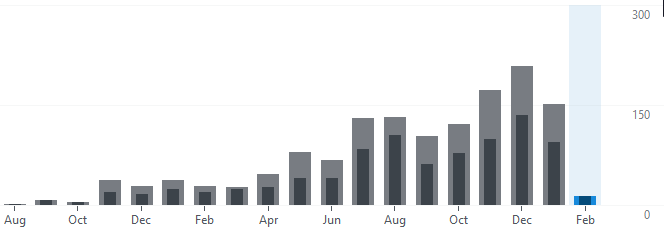
I try not to put too much stock in statistics, but if I’m honest, it’s hard to not pay a little bit of attention. So I take my data points during these six month intervals. Since this is the third of those intervals, I can start to make some comparisons between those three samples.

The short takeaway is that everything is just about double what it was six months ago. In terms of raw growth, that’s still closer to exponential than linear. It’s slower than it was between the six month mark and the one year mark, but I don’t think that’s terribly relevant when dealing with small numbers. In general, if the lines continue to go up, that translates to more people finding and liking the site.

I crossed the 1,000 view mark in December ’21, after about 15 months of blogging. At the current rate, I’d expect to hit the next thousand by May ’22, five months later. Not huge numbers, but steady improvement.

“Engagement” feels like a gross web business buzzword, but what’s probably more important is that I’ve seen more engagement in likes and comments. Comments are still hard to come by, but that’s to be expected. From what I’ve seen, it’s not uncommon to see anywhere from 25:1 – 100:1 ratios of views to comments. It’s just a lot easier to get people to read what you’ve written than it is to get them to comment on it.

In the next six months, I’d obviously like to see numbers continue to grow, but my biggest indicator of success will be more comments and likes. Feedback is great. Dialogue is even better.

Reblogs

In the past six months, I’ve started doing Wednesday reblogs more frequently. Basically, any week where I don’t post Razor Mountain chapters, I’ll post a Wednesday reblog. I’ll be honest, part of this is that it’s low-effort. I love the blog, but I also limit the time I spend each week on the blog. Hopefully this is a good way to highlight something that I found interesting or useful for other writers, without taking too much time away from other projects.

So…yeah, let me know if you like the reblogs, or if they just clog your feed. I can adjust accordingly.

Razor Mountain

Six months ago, I was still outlining and doing pre-production work on Razor Mountain. Since then, I’ve finished outlining and done all of the book-adjacent tasks like writing the back cover and designing the front cover. I’ve posted five chapters. That’s progress.

I made quick progress initially, then slowed down around the holiday season. Thanks to some real-life factors, I ended up feeling overwhelmed by the schedule I was trying to maintain. I’m now in a more relaxed place, and thinking about trying to push chapters out with a little more frequency.

I do enjoy the cadence of putting out a chapter in 2-3 parts throughout a week, and following it up with a Friday Razor Mountain Development post to talk about the process of writing the chapter. I think it will be interesting to look back on those development journals when the book is done, to see how it has evolved since I first started outlining.

I’m continuing to post chapters to Wattpad and Tapas alongside the blog, but my audience on those platforms is just about nonexistent. It’s understandable since I haven’t put much effort into networking with other writers on those platforms, and I’m not in the more popular genres and styles that I see on their front pages. For now, I’ll keep posting. There’s no point worrying too much about promotion until you have something you really want to promote. At some point when I have more chapters posted (or maybe even the entire book) I’ll dig into those platforms and make a little more effort to draw some attention.

Next Stop: Two Years

I continue to have lots of ideas for stand-alone blog posts and series. I used to worry that I might run out of ideas for a blog, but having written for this long, I’m now confident that I won’t run out any time soon. I have one specific series in the works that I’m excited about—more on that in a week or two.

That’s all I have for now. See you again in six months, for the two-year anniversary of Words Deferred.

Reblog: The Memex Method — Cory Doctorow

Cory Doctorow is an opinionated activist, technologist, futurist, and insanely prolific writer of novels and short stories, essays, speeches and Twitter threads. He’s also been blogging for more than two decades. To say that he gets a lot done would be a gross understatement.

Interestingly, Doctorow suggests that blogging hasn’t taken away time from his other projects. He believes that the blog is just a commonplace book (or better yet, a memex) that’s made available to the public, giving the writer a natural incentive to be a little more organized. It’s a tool for kicking around thoughts and opinions, assembling and tending to them until they’re ready to become a story, an essay, a book. It’s an idea generator.

Like those family trip-logs, a web-log serves as more than an aide-memoire, a record that can be consulted at a later date. The very act of recording your actions and impressions is itself powerfully mnemonic, fixing the moment more durably in your memory so that it’s easier to recall in future, even if you never consult your notes.

The genius of the blog was not in the note-taking, it was in the publishing. The act of making your log-file public requires a rigor that keeping personal notes does not. Writing for a notional audience — particularly an audience of strangers — demands a comprehensive account that I rarely muster when I’m taking notes for myself. I am much better at kidding myself my ability to interpret my notes at a later date than I am at convincing myself that anyone else will be able to make heads or tails of them.

Writing for an audience keeps me honest.

Read the rest over at Cory Doctorow’s Medium page…