
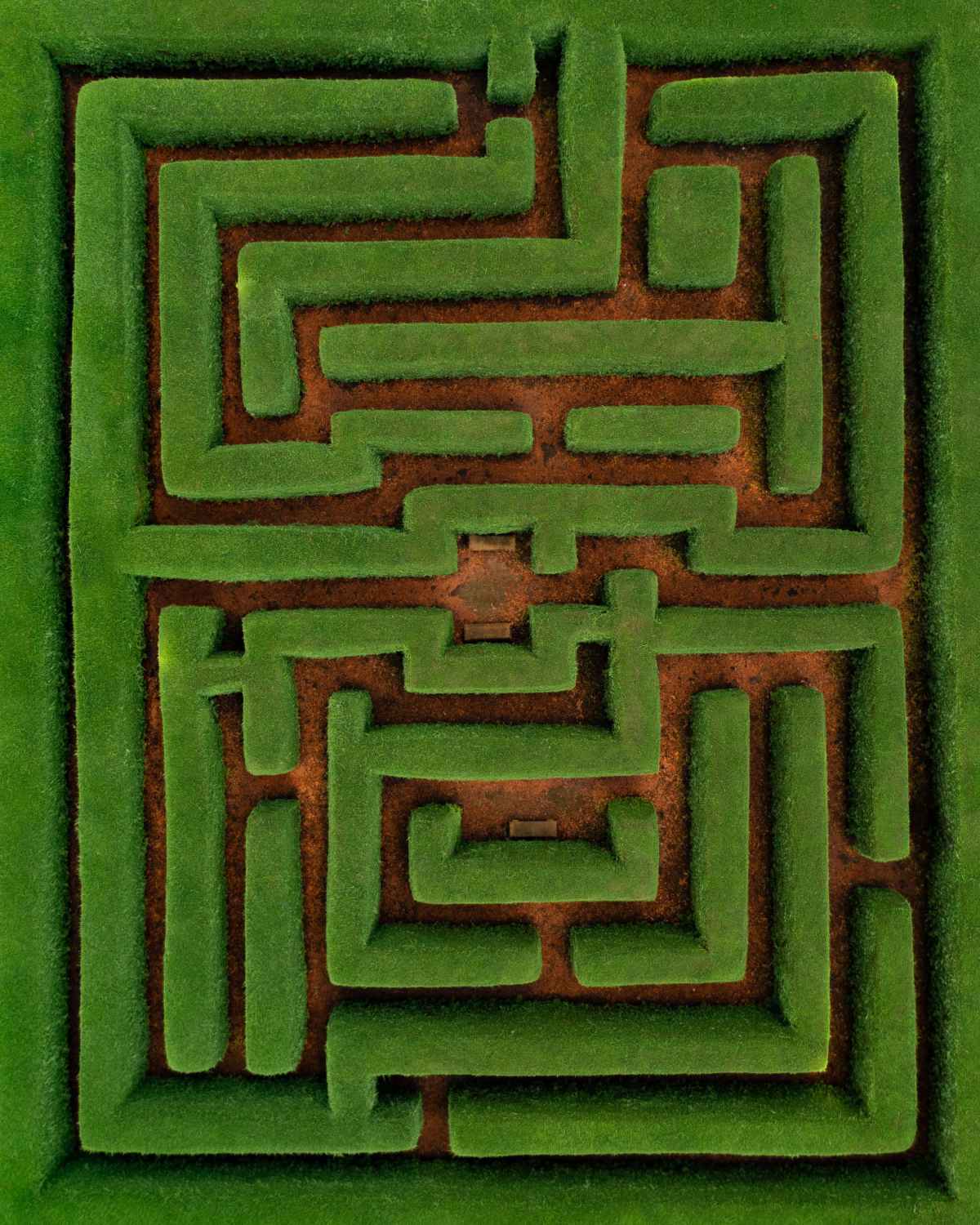
House of Leaves is a 2000 novel by Mark Z. Danielewski. I don’t have a very precise memory of when I first read it, but it must have been about fifteen years ago. It is a formative book for me, and parts of it took up permanent residence in my head. Yet when I reread it this past October, I had to admit that I had no memory of large swaths of the book. That seems somehow appropriate for a sprawling, layered story with unreliable narrators and intentional inconsistencies.
Despite being a best-seller that continues to be reprinted, House of Leaves feels like a cult classic. It has ardent fans, but it seems too esoteric and weird to be truly mainstream. The people who love it will be the first to admit that it is not an easy read, and the people who hate it will declaim it barely readable at all. It generates the same sort of divisive conversations as Ulysses (or Homestuck).
After my recent reading, I dove down the rabbit hole of online information, arguments and discussions about the book. I learned about some of the many things I had missed. I was amazed and a little appalled by the number of secrets hidden in the text, the number of subtle allusions and not-so-subtle codes. I have to admit that I may now be a member of the strange cult obsessed with this book. So, while I touched on it briefly in my October Read Report, I feel obligated to write something more about House of Leaves.
I don’t have much interest in writing traditional reviews, but this is a review of sorts. If nothing else, I hope it gives you an idea of what the book is like, and whether you’re likely to love it or hate it.
Zampanò
The title page of the book says, “Mark Z. Danielewski’s House of Leaves, by Zampanò, with Introduction and Notes by Johnny Truant.” The origins and provenance are purposely muddled. The intermingling of stories and frames, reality and fiction, starts before the first word.1
The book starts with Johnny, but we’ll start with Zampanò.
Zampanò is a blind old man who lives by himself in a run-down apartment. He has done his best to seal up the windows and the crack under the door. Among his few possessions is a battered trunk filled with notes and a half-finished manuscript for a scholarly analysis of a film called The Navidson Record.
We can infer a little about Zampanò from his work. It is riddled with footnotes, and certainly makes a variety of assertions about The Navidson Record, but these are all suspect. He often discusses the visuals, despite being blind. Johnny’s notes point out that there is no evidence that a film called The Navidson Record ever existed (even within the story) and the many works of criticism for the film that Zampanò cites are fabricated as well.
Johnny never meets Zampanò. He only hears things about him second-hand.2 He talks to the various people who came to read to the old man. He hears about Zampanò’s ritualistic daily walks around the perimeter of the apartment complex’s overgrown courtyard.
Ultimately, the only real interaction between Zampanò and Johnny is that the old man dies, and Johnny’s friend Lude gets him into the apartment to look for interesting stuff left behind. Johnny takes the trunk full of Zampanò’s half-finished book, and begins to read and edit it.
That’s where his troubles really start.
The Navidson Record
The Navidson Record doesn’t exist. Johnny tells us that pretty early on. But the portions of the book that belong to Zampanò are so persistent in their certainty that they make it feel real.
Zampanò describes The Five and a Half Minute Hallway and Exploration #4, viral videos that spread via bootleg VHS and the early internet. They both turn out to be excerpts from The Navidson Record. The first shows a door in an exterior wall that opens onto a hallway that cannot possibly exist. The second shows the endless maze of dark rooms at the other end of that hallway.
Zampanò describes the film itself. Famous photojournalist Will Navidson moves, with his partner, Karen Green and their two children, to an old house in rural Virginia. Giving up more dangerous projects like war photography, Navidson plans to document this new stage in their lives with video journals that he and Karen keep, as well as motion-activated cameras set up around the house. The pair’s internal traumas and external relationship struggles are present, but suppressed. For a time, the house seems idyllic.
Then, it begins to change shape. At first this is subtle, a matter of a mere 1/4 inch across its entire length. Then individual rooms begin to change size. Navidson becomes obsessed with measuring these tiny changes, but they soon become so obvious that measurement is not necessary. A new hallway appears between two rooms. A door appears in an exterior wall, but it doesn’t open onto the yard. It leads to an apparently endless maze of hallways, rooms, and stairs, unlit and frigid.
The tensions between Will and Karen quickly reach a breaking point. She wanted to escape the fear that accompanied Will going out into danger to capture his photos. But the mysterious extra-dimensional portion of the house is too alluring. He is desperate to explore it.
Instead, he brings in outsiders: a scientist, and a trio of expert mountaineers. While he remains in the house, manning the radio at “base camp,” the three explorers set out on a series of expeditions, surveying the ever-changing architecture beyond the impossible hallway and even taking samples from the walls. They carry his video cameras with them.
These videos document the rare moments when the dimensions of the house visibly change around them. They document the strange way things break down within the bowels of the house; markers and supply caches shredded or vanished, buttons and zippers disappearing from their clothing. They document the eerie growl that sometimes passes over them like a wave, or follows at a distance.
And though they aren’t collected until much later, they document exactly how everything goes horribly wrong.
Exhibits and Appendices
The last section of the book contains six “exhibits” and three appendices. However, to say that these are the conclusion of the book is only technically true. Just as Johnny’s narrative inserted into footnotes encourages the reader to jump back and forth between layers of story, other footnotes point to the appendixes and encourage the reader to dig into them in the first few chapters.
The exhibits are unfinished. They are things that Zampanò hoped to include: scientific analysis of the samples Navidson and others took from the house, reproductions of interviews, a section on architecture, an excerpt from an Air Force manual, and some of Karen’s medical records, along with related excerpts from psychiatric literature.
The first appendix is filled with the writings of Zampanò. Johnny’s note tells us that these are included to shed more light on the man. Notably, among Zampanò’s poems is an untitled fragment that contains the only reference to the book’s title within the text:
Little solace comes
to those who grieve
when thoughts keep drifting
as walls keep shifting
and this great blue world of ours
seems a house of leaves
moments before the wind.
The second appendix contains Johnny’s items: sketches and polaroids, poems and collages, his father’s obituary, and “The Three Attic Whalestoe Institute Letters,” correspondence between Johnny and his erudite and apparently schizophrenic mother, long institutionalized.
These letters are arguably the most important thing in the appendices, and act almost as a third narrative alongside Zampanò’s and Johnny’s, revealing and clarifying many details from Johnny’s account, and raising new questions.
Formatting
Some footnotes are referenced in multiple places. Some are missing. Most use numbers, but some use a variety of strange symbols that may or may not relate to the text. There are footnotes to footnotes, occasionally several levels deep.
But beyond the unusual use of footnotes, there are many other formatting oddities in House of Leaves.
There is the use of color: house always appears in blue, several struck sections in red, and one particular phrase in purple.
A single bar of music is printed sideways, running vertically down the page.
In two different sections of The Navidson Record, the shape of the text reflects the shape of the narrative or the shape of the house.
It is contained within
sidebars or blue-bordered
squares, running forward
and backward along the
pages, turned sideways and
upside down.


It     is     spread     out,

only     a     few     words     per     page,

as     the     characters     run,

frantic,

through     the     labyrinth.


It is  drawn   out   slowly,    as     the      text       explores        the         meaning          in           a            few              slowed               frames                of                 film.


It is cramped and tight,
as the halls of the
house narrow,
sloped in
diagonals
as
 the
  explorers
   move downhill,
    separated by a vast
     gulf of


white space


when they encounter a chasm.
Although the story itself is sometimes unclear or frustratingly abstract, it is this shaping of the text on the page that presents the first barrier a reader must overcome to form any connection with House of Leaves. But it is also an invitation to the reader. The text practically demands interpretation. Why these colors? Why this formatting? Why must I follow a footnote to a footnote to a letter in Appendix B?
Your instinctive reaction to this—excitement or irritation—is a good indicator of whether you will enjoy the book.
Secrets
. . . . . . Related Things. . . . . .

. . . . MyHouse.WAD . . . . . . . . .
. . . . . . .Labyrinth. . . . . . . .
House of Leaves Reddit. . . . . . . .
. . . . . . . . . . . . . . . . . . .
. . . . . . . . . You Should Have Left
.House of Leaves Forum. . . . . . . .
. . . . . . . . .Cumaean Sibyl. . . .
. . . . . . . . . . . . . . . . . . .
. . . . . . . The Whalestoe Letters .
. . . Jacob and Esau. . . . . . . . .
. . . . . . . .Haunted. . . . . . . .
House of Leaves - TV Pilot. . . . . .
. . . . . . . . . . . . . . . . . . .
. . . . . . . . . Minotaur. . . . . .
. . . . . Only Revolutions. . . . . .
. . . . . The Backrooms . . . . . . .
.Ergodic Literature . . . . . . . . .
. . . . . . . . . ? . . . . . . . . .
A few of the fooTnotes contain Huge lIstS of places, names of archItectS, etc., etc. At first glaNce, these appear tO be poinTless. AsTute readers, after discovering tHe sEcret cOdes spelled out iN PeLafina’s “Whalestoe Letters” through misplaced capital letters and acrostics, have applied the same codes to these lists, and discovered that theY also contain hidden Messages. One codE, embedded in the Navidson Record, SeemS relAted to those letters. Another spells Danielewski’s full name.
In my hardcover edition, there are also hundreds of 4-diGit hExadecimal codes imprinted on the inside of the cover. Some enterprising individual determined that these describe part of a music file: a snippet from the companion album to the book, Haunted, by Poe (the stage name of Danielewski’s sister).
Do these secrets add anything meaningful to the story? Hard to say, but they certainly evoke a feeling that there are hidden meanings everywhere in House of Leaves, if only the reader is willing to dig deep enough.
.3
- How many levels of frame story are there? Well, there’s the Navidson Record, and all the collected ephemera around it: interviews and articles, books and art, arguments, analysis and critique. There’s Zampanò’s written analysis of the film. There are Johnny’s notes on Zampanò’s work. And there are the fictional editors, who chime in occasionally to clarify a point or cite a source that Johnny never got around to. There is Danielewski, the real author, almost invisible. But there’s also Johnny’s institutionalized mother, Pelafina, who sends him letters (or does she) of varied lucidity. The really obsessive fans have their own theories about her, but I won’t spoil them.3 ↩︎
- Johnny’s story is told in notes and footnotes, denoted only by a different font. Sometimes these notes comment on Zampanò’s work, but they often wander away from the subject at hand, into long and meandering anecdotes from Johnny’s life. As the book progresses, they become less and less decipherable, entire pages of run-on sentence. ↩︎
- Even more perplexing, these frames are fuzzy; the stories leak out of their original context. Late in the story, Johnny encounters a group of strangers who are obsessed with a story that has been passed around the early internet, and it turns out to be a version of the account we’re reading. In Zampanò’s summary of The Navidson Record, Will Navidson, lost within the labyrinth of the house, burns his final matches to read a book, and the book is House of Leaves. These examples of impossible recursion are never explained. ↩︎

 Words Deferred