
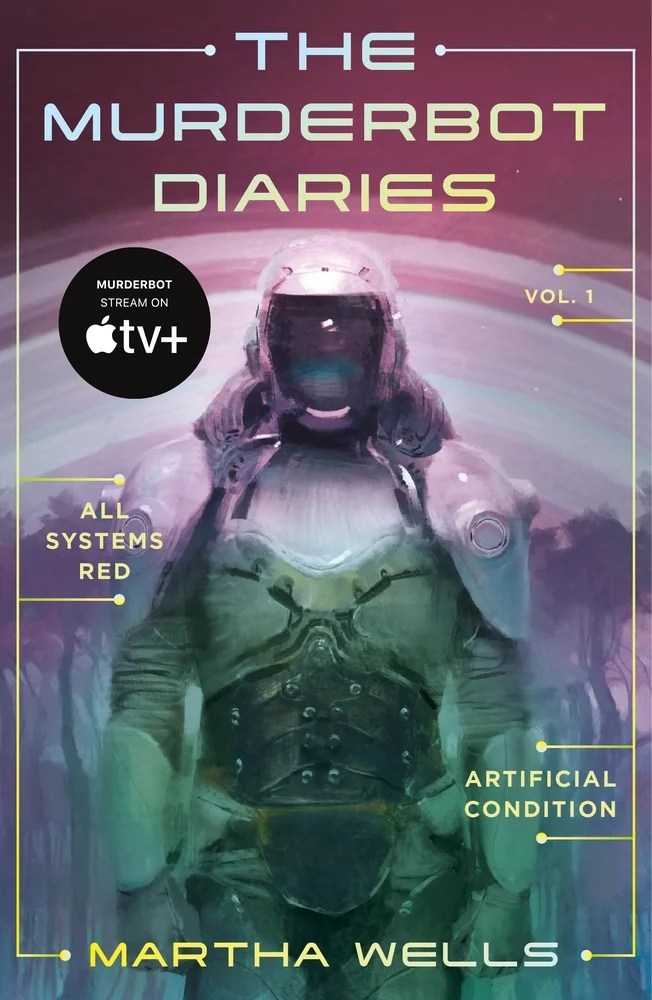

Book | E-book | Audiobook (affiliate links)
I suspect, in a vacuum, I would not pick up a book labeled Murderbot Diaries. It sounds like a combination of military SF parody and introspective John Green-esque YA fiction. Having read the first installment, the title comes off as tongue-in-cheek and less abrasively cheesy.
This is one of those cases where “word of mouth” unequivocally led to a sale. The book has been recommended to me by friends, acquaintances, podcasts, and blogs which would usually all have very different tastes. My interest was piqued by broad support across normally unaligned quadrants.
Who is this Killer Robot?
I can see why so many people like Murderbot. He is a protagonist for our times.
In another universe, he might have the makings of a charismatic action hero: a humanoid, partly organic robot with armor; built-in weapons; the ability to repair from near death; and extensive experience in private security.
In the universe of All Systems Red, he just wants to slack off, avoid talking to anyone, and watch his favorite shows.
Many robot narratives are either as emotionless as possible or essentially indistinguishable from a human narrative. Murderbot finds a middle-ground. He has emotions and can certainly get caught up in the moment, but he is also aware that he is more affected by the storylines of his shows than by the actual interactions between himself and the crew who has purchased his company contract for security services.
He needs his space, both physically and emotionally. He’s more comfortable talking to the crew with his opaque helmet on; more comfortable seeing them through the security cameras; and happy to spend his time alone in the tiny security room, or even tinier repair bay.
The company that owns Murderbot and sells his services to the highest bidder is an amoral edifice of shitty space capitalism. They worry about the welfare of the people Murderbot is hired to protect because they will suffer financial penalties for injuries and deaths. They care about Murderbot because he would be expensive to replace.
Murderbot himself has more theoretical autonomy than he should. He has hacked his own modules and only feigns following orders enough to not get caught. He also has actual morals, even if they often butt up against his limited emotional range and social anxiety.
Many readers identify with Murderbot because he reflects marginalized identities. He is aromantic, asexual, and exhibits behaviors and feelings familiar to many neurodivergent people. He is also a small character in a big world. He uses his very limited freedom to seek little comforts that help block out an indifferent and cruel universe, at least for a little while. He cannot possibly imagine leading a rebellion or overthrowing evil, but he appreciates when someone does it on TV.
I suspect many of us feel the same way when we flip on our favorite show these days.
Quick Hits and Remixes
I am a big fan of the return of novellas. When I was young I read huge fantasy tomes and played 100-hour JRPGs. Now that I’m older and cherish my precious free time, I quite like a book or game that I can finish comfortably in a day or two.
Novellas also lend themselves wonderfully to series like this. Much like a weekly TV show, each entry can provide a concise arc while building characterization and setting on top of the previous entries.
I’m also appreciative of the fresh familiarity of Murderbot. It’s hard to point to any particular element of the story that is a purely original take. The action-adventure, the robot learning how to be more human, and the mildly dystopic libertarian space future have all been explored elsewhere. However, Martha Wells puts those puzzle pieces together in a way that feels fun and strangely parallel to our current moment in time.

 Words Deferred