
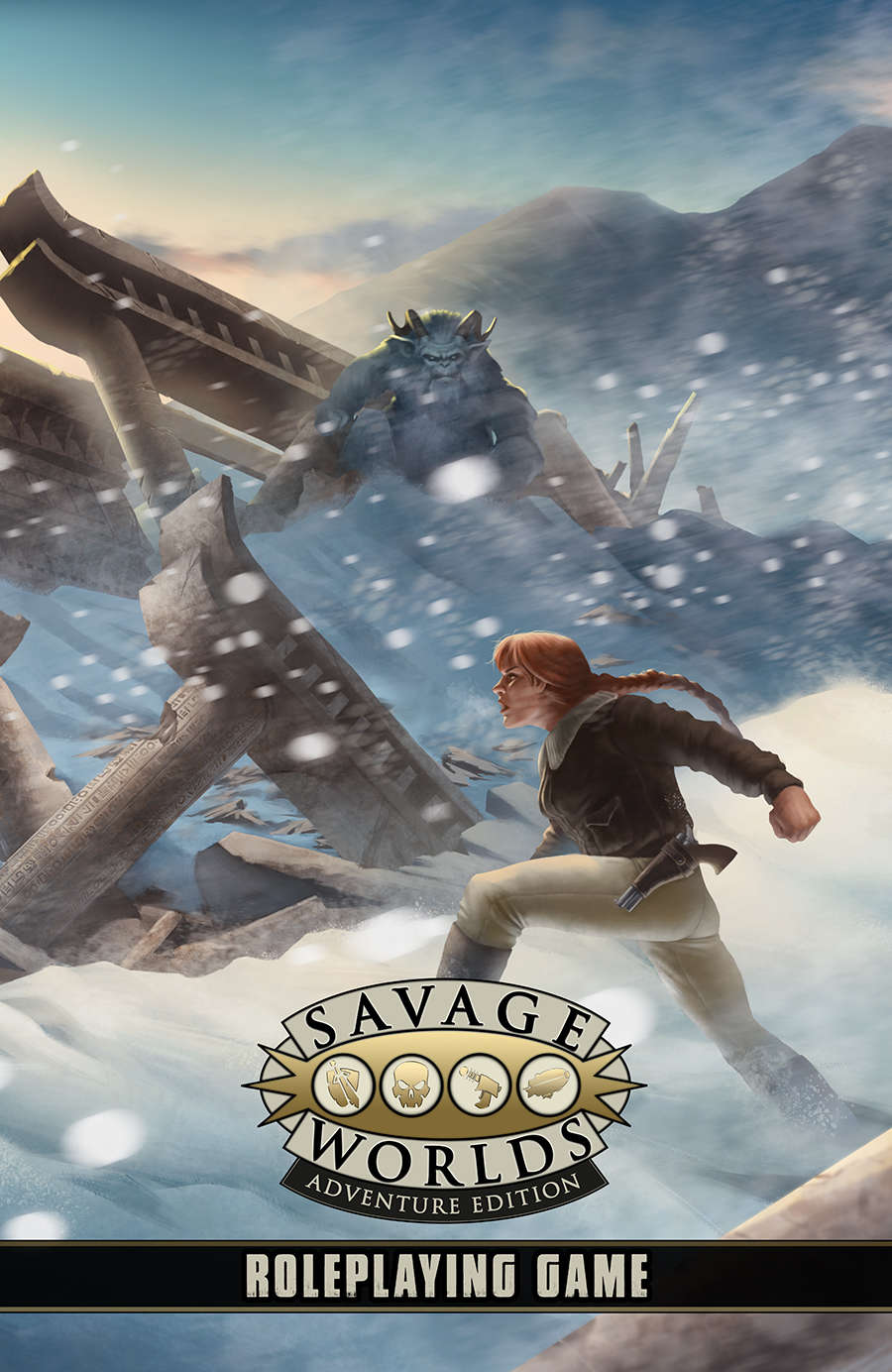
I picked up the Savage Worlds Adventure Edition in anticipation of the the physical book release of the (somewhat confusingly-named) Secret World Special Edition for Savage Worlds. I have the D&D/d20 rules book, but I was not very satisfied with the way the Secret World mechanics came across in that—they seemed about as clunky as they could possibly be.
The main issue I had with the 5e rules is all the bookkeeping around archetypes, a system that Secret World introduces to give characters bundles of spells, proficiencies, features and special abilities. Characters trade out and gain access to more archetypes as they level up, and can swap their active archetype any time they rest.
D&D, as the default TTRPG system, has been used to run just about every kind of game, and the 5e SWL (perhaps grudgingly) is designed to allow that flexibility. But TTRPGs have trended toward lighter and less combat focused mechanics over the years. 5e is lighter than some earlier versions of D&D, but still a rules-heavy, “crunchy” system. I haven’t yet read through D&D Next/5.5e, but the impression I get is that it’s incremental adjustments to 5e, not a sea change.
My hope for Savage Worlds was a system with more adaptability than 5e—after all, it’s specifically designed to be a multi-setting, “generic” system.
I’ll note up front that I haven’t played a Savage Worlds session yet. These are just my first impressions from reading through the core book and doing a little online research.
Being Everything to Everyone
From what I’ve seen, there are a few styles of generic TTRPG system. Some “genericized” systems are based on a more specific system stripped of its setting and perhaps some setting-specific details. “Extensible” systems are usually much simpler and tend to be copied and modified/extended for new styles of play or settings. And “base layer” systems try to be truly generic for any setting, sometimes even to the point of including tables of weapons and skills that range from Stone Age to far-future.
D&D has accidentally become a genericized system that at least aspires to supporting all types of play, even though its native settings of Faerun and Greyhawk are both fantasy. The Cypher system has similar aspirations, but is really just Numenara and The Strange (and I’ve never personally encountered a group that played The Strange.)
Apocalypse World and Blades in the Dark are the two games I think of when it comes to extensible systems. They’ve spawned countless other games by virtue of the flexibility and simplicity of the Powered by the Apocalypse and Forged in the Dark scaffolding.
Then there are the truly generic “base layer” systems. I often find that on first blush these are some of the least compelling core books on game store shelves. They have terrible names, like GURPS, and they lack strong settings, which tend to be what draws me into TTRPGs. These games are designed to change settings like changing clothes.
Savage Worlds is definitely a “base layer” system. From their catalogue, Deadlands is clearly their best-seller, but it does seem to just be a western-horror setting on top of Savage Worlds, not the expected default.
Assumptions vs. Reality
Going into the core rule book, I assumed that Savage Worlds would be less rules-heavy than D&D, unburden the GM, support grid combat and theater-of-the-mind equally, and make its rules modular for easy swapping. I found that some of these assumptions were accurate, and some were definitely not.
It is quickly apparent that the system is very crunchy, and combat rules are designed first and foremost for grid-based miniatures-based combat. A full set of TTRPG dice are used, although it seems that d20s are rarely used.
There are tables full of equipment and vehicles, past, present, and future. Armor and injuries are body-part specific.
The system does try to limit the headaches for GMs. The most complicated bit seems to be resolving actions and attacks, with rolls for hit, rolls for damage, calculations for armor, exploding dice, and extra “wild dice” for player characters and important villains. But ordinary henchmen and bad guys are simplified, and there is no HP to track. Characters are either up, shaken, wounded or incapacitated.
This simplified damage system seems like it will have a lot of knock-on effects. Damage will be swingy, with attacks either doing effectively nothing, or rapidly removing the character from combat.
Bennies
The other very important system that’s somewhat unique to Savage Worlds is Bennies. Short for “benefits,” these are tokens that can be used for soaking damage, recovering from shaken status, re-rolling dice, and various other things.
My initial impression of Bennies was that they are a bigger, better version of D&D Inspiration. However, where Inspiration has an occasional impact on the game, it sounds like Bennies are a constant, central mechanic of Savage Worlds. Because combat can be so swingy, Bennies give players and GM a direct way to push back and change outcomes. Unlike the singleton Inspiration, Bennies are a pool of tokens, and managing them is key to success.
Flexibility
The system does a decent job of making the rules modular. There are five pages of core combat rules, and thirteen pages of separate, more situational rules. Specialized systems are presented for chases, dramatic tasks like bomb diffusing or safe cracking, horror/fear, mass battles, info-seeking/investigation, and more. Any of these could be easily swapped out.
“Powers” provide a scaffolding for magic in settings that have it, but can also be used for super powers, cybernetics, psionics, or anything similar.
The Usual Complaints
As is typical with TTRPG core books, I find the layout frustrating. Why does the Gear chapter come before the two Rules chapters? Is it because equipment is needed for character creation? But powers will also be needed, and that chapter comes later…
The book also fails to properly highlight the importance of certain mechanics. I only began to understand the importance of Bennies and the flow of combat when I ventured online to try to resolve some of the confusion the book had left me with.
These things would also be more obvious with the inclusion of some examples. I have long maintained that any core book should include at least a brief example adventure and some accounts of what the flow of actual play looks like. Sadly, many games outsource the actual play to randos on YouTube, where it can be difficult to tell if you’ve found a good example or not. Pinnacle at least offers some free “test drives” in multiple genres on their website.
Conclusions
While there are things I like and dislike so far about Savage Worlds, I’m withholding any judgement until I get a chance to GM it. Since I’m mainly interested in the system for Secret World, the quality of those additions will be a factor. I do think there are some interesting ideas here, and I may try the test drive adventures to get a feel for what carries over between settings, and what differs.
If you’ve played this latest edition of Savage Worlds, leave a comment and let me know what the experience was like. I’ll post an update when I get my paws on the Secret World Special Edition book and have a chance to try it out.

 Words Deferred