

This is the monthly post where I talk about what I’ve been reading. As usual, if you’re interested in any of these books, please use the included Bookshop.org links instead of Amazon. It helps independent bookstores, and I get a small affiliate commission.
Sandman: Worlds’ End (Vol. 8)
By Neil Gaiman

This volume is a collection of stories within a Canterbury Tales-esque frame. A group of strangers from across the Sandman universe get caught in a storm and find shelter at The Worlds’ End, an inn that exists beyond ordinary space and time, and a play on words in a few different ways.
This is, in many respects, the beginning of the end: the final arc of The Sandman series. While this volume is similar to several others, with seemingly disconnected stories set in the same expansive world, it’s laying groundwork for the two volumes to follow.
The end of the book makes this apparent, as the storm quiets, and all the strange guests at the Worlds’ End see a huge procession in the sky. This is a funeral on a cosmic scale, and the dead man is Dream of the Endless.
Sandman: The Kindly Ones (vol. 9)
By Neil Gaiman

Finally paying off the foreshadowing in Volume 7 and 8, The Kindly Ones is the largest volume in the series, and the climax of Dream’s story. The dangling plot threads come together, and it’s incredibly appropriate as Dream’s antagonists in this volume are none other than the Fates, who measure and cut the thread of each person’s life.
In the Sandman mythos, the Fates have many aspects, each represented by three women: young, middle-aged, and ancient. They are also called the Furies, embodiment of revenge against those who dare to spill the blood of family.
The Furies are called to action against Dream by Hypolyta Hall, the former super-hero from earlier volumes, who conceived her son within dreams and holds a grudge against Morpheus for “killing” her husband. She’s convinced that Dream has stolen her child. However, the real kidnappers are mere mythological tricksters. It’s Dream’s murder of his own son, Orpheus, that allows the Furies to work against him.
The surface conflict between Dream and the Furies becomes progressively more violent, and we see a number of fan-favorite characters caught in the cross-fire. The bigger question, however, is why this is allowed to happen. Within their specific sphere of influence, the furies have power to equal the Endless, but it seems that Dream is holding back.
Gaiman has shown that he knows how to wrap up a story, so I can only assume that this final ambiguity is on purpose. It’s up to the reader to decide why Dream doesn’t have his heart in the fight. Is he overwhelmed with the shame and guilt of what he did to his son? Is he an exhausted immortal who knows that there will always be another fight, another petty enemy knocking at his doorstep? Does he know himself too well; his obsession with responsibility forcing him into the fight when he could just as easily run away like his brother, Destruction?
In the end, Dream dies. This isn’t a spoiler so much as an inevitability. However, he doesn’t lose. He is prepared for even this eventuality, and a new aspect of Dream appears to take his place.
For my money, this is still probably the single finest volume in comics. Not only does it provide a satisfying conclusion to a great series, but it represents an inflection point in comics that opened the doors to so many great stories in subsequent years.
Sandman: The Wake (Vol. 10)
By Neil Gaiman

The Wake is a classic epilogue. The story of Dream (at least the Dream that we’ve followed for 9 volumes) is ended. This last volume sweeps the floors, pus the chairs on the tables, and turns off the lights.
It starts with the funeral that was hinted at in Worlds’ End, a once-in-a-billion-years send-off for one of the Endless. As is appropriate, this somber affair happens in dreams, and many of the side characters from throughout the series are in attendance, even if they don’t all entirely understand what’s happening.
The final few issues are a melancholy mix. We spend a day with Hob, the immortal (but otherwise ordinary) man who met with Dream once each century. His life goes on.
We meet a man exiled from ancient China, who finds himself in one of the “soft places” between waking and dream. He meets the old Dream and the aspect who replaced him. The man doesn’t run from his fate: he meets his exile with dignity.
Finally, we see Shakespeare, near the end of his life. He finishes the second and final play commissioned by the Lord of Dreams. This was the price he paid for the chance to tell stories that would live beyond his own lifetime.
The play is The Tempest, and Dream commissioned it because it is a play about endings. Though he didn’t realize it at the time, we see the possibility that the Lord of Stories wanted just one story about himself. He wanted an ending.
We’re left with the words of a Roman soldier, lost in the place between dreams and waking:
Omnia mutantur nihil interit.
Everything changes, but nothing is truly lost.
500 Ways to Write Harder
By Chuck Wendig
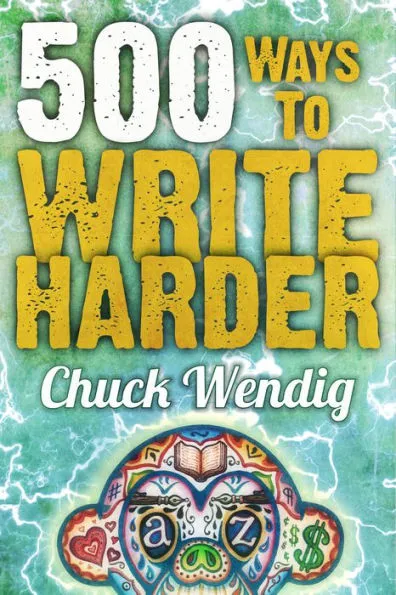
I snagged this book after reading Wendig’s Damn Fine Story. This is an older book, and only barely available as an e-book from one or two retailers.
There was probably a reason for that. On the upside, it only cost a couple bucks.
The book consists of a series of listicles, each on a particular writing topic: antagonists, novel prep, self-publishing, etc. Each has 25 items. It’s apparent that these lists were originally Twitter or blog fodder and were compiled unaltered—a few of them say as much.
I don’t begrudge Wendig for turning these posts into a saleable product, especially since this was published a decade ago, when Wendig was early in his career as a professional writer. The origins of the material show in the lack of cohesive through-line, something that made Damn Fine Story much more satisfying.
Considering the low price, this book isn’t a bad one to pick up, but I wouldn’t suggest reading it cover to cover. Instead, skim through the list of topics and use it as reference. If you’re revising a book (as I am), you might find the section on revision useful. Consult the topics when they’re relevant to you.
Harry Potter and the Chamber of Secrets
By J.K. Rowling

I’m still reading Harry Potter with my kids.
This second book establishes a lot of the elements that will repeat through most of the series. Harry spends his summer with his caricature-villain evil aunt, uncle and cousin, before being whisked back to wizard school where he can live happily (apart from wizard Hitler occasionally trying to kill him).
I realized as I was reading this installment that these early Harry Potter books follow a very straightforward formula. A mystery is established early on, and Harry and his friends latch on to a red herring. Clues appear at intervals, and they all seem to support the red herring thesis. In the finale, the truth is revealed, including an explanation for each clue and how it actually pointed toward the real answer.
The first book is all about the kids’ distrust of Snape and the mystery of the package hidden in the guarded corridor. But Snape turns out to merely be a jerk and not the jerk. The second book is all about finding the person opening the chamber of secrets, and the children are fooled into thinking it’s the only adult they actually like and trust. Nope, it’s the ghost of Wizard Hitler!
The moral of the books so far seems to be that adults are untrustworthy. Some are bumbling, some are outright malicious, and a few are well-meaning, but ineffective. Even Dumbledore, often invoked as the most powerful wizard in the world, doesn’t really…do anything useful, at least so far.
As an adult myself, this lesson is a little concerning, but I also know first-hand that adults really are often bumbling, malicious and ineffective. As a starting point for a middle-grade series, it makes a lot of sense. Kids aren’t going to get into interesting adventures if they go whining to the grown-ups whenever they have a life-threatening problem.
What I’m Reading in October
I finished The Sandman series…or did I? There are two more more spin-off volumes: Endless Nights and Dream Hunters. As long as I’m rereading, I might as well include those, right?
I’m also overdue on getting back to The Witcher, and I aim to remedy that with at least one book in October. I’ll be continuing through Harry Potter with my kids, so I expect to get through one or two more of those.
Finally, I’ve started ordering some of the trade paperbacks for comics on my huge list of “acclaimed non-superhero comics of the past 30 years I haven’t read yet.” I’ve been enjoying comics a lot lately, partly because a typical trade paperback is novella-length, and I can feel like I’m reading a lot more books.
See you next time!
 Words Deferred