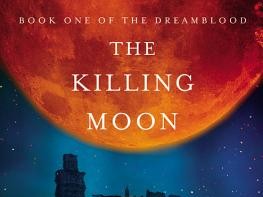
The Killing Moon — Read Report

Book | E-book | Audiobook — Bookshop/Libro affiliate links

The New York Times calls Jemisin “The most celebrated science fiction and fantasy writer of her generation.” She has repeatedly won every major sci-fi/fantasy award, and when she’s not winning, she’s usually nominated. In short, I’ve heard great things about Jemisin for a while now, but I’ve never read her work. The Killing Moon was published in 2012, so I’m a couple decades late to the party.

I’ve been listening to a lot of audio books lately, and I’ve taken it as an opportunity to fill in some of these major gaps in my genre knowledge. I knew nothing about this book going in, I just saw it on Libro.fm while searching for something new to listen to on my commute.

The Killing Moon takes place in an Egyptian-inspired secondary world, a desert land with a loose pantheon of gods shared across nations. The technology is in the neighborhood of bronze or iron age, with the swords, spears, and armor a fantasy reader would expect.

There is magic in this world, specifically dream magic—narcomancy—attributed to the power of the goddess Hananja. But this is not a world where the gods are close. If they do exist, they are distant and do not meddle.

The story follows master Ehiru and apprentice Nijiri, gatherers who use narcomancy to collect magical energy from souls and guide them to the afterlife. This magical killing, sanctioned by the state of Gujaareh, is usually a gift reserved for the willing but sometimes used as a form of capital punishment for those deemed corrupt.

The pair are assigned to chase down Sunandi, a foreign ambassador accused of corruption. But they soon discover themselves embroiled in a conspiracy that goes to the highest levels of their order, and to the prince of Gujaareh himself. It threatens to reveal long-buried secrets about the near-mythological founding of their country, the religious order surrounding Hananja, and the true nature of narcomancy.

Settings and Sentiment

About a third of the way into The Killing Moon, I found myself struggling. I wasn’t feeling that compulsion to continue that usually accompanies a fantastic book. With all of the hype around Jemisin, I was expecting to be blown away, and I found myself a little disappointed.

I have a hard time pointing to any particular issue. The writing is solid. The world is well-constructed. The plot is perhaps a little slow to get going. However, I was consuming this as an audiobook, and I’m coming to realize that is not a mode of reading that makes it easy to analyze a story in detail.

One thing I can point to is the setting. I am thoroughly burnt out on the “elves and dwarves in medieval Europe” school of fantasy, so I was hoping that the Egyptian-inspired world would prove interesting. However, aside from the names and the desert, I don’t think it made much of an impact. It’s still swords and sorcery. It’s still mighty kings and high priests and big battles and political machinations.

Jade City makes for an interesting comparison. It is also a fantasy book inspired by an underused geographical region, and another one that I read as an audiobook. Jade City imagines a world that is recently industrialized and recovering from war, akin to post-WWII Asia. It eschews the kings and kingdoms so common in fantasy, and imagines a complicated web of politics, religion, and family ties that feels more modern. It limits its scope to roughly two generations of recent history and the capital city of a small island nation. The result is a setting that feels fresh and richly detailed, and I believe that’s in large part because it’s not trying to cover a thousand years and an entire world, as so many fantasy stories do.

Another frustration I noticed is that practically every character in The Killing Moon is miserable all the time. Moments of levity or happiness are brief and far between. Everything is bad, and it’s getting worse. This is certainly an engine to drive the plot, but I found that it ground me down and made it tiring to be with these characters for an extended length of time.

There are a few twists near the end that piqued my interest and substantially improved my opinion of the book overall. I was also relieved to discover that the plot wraps up nicely, because I was expecting it to end with a cliffhanger. The Killing Moon is billed as the first book in the Dreamblood duology, but they apparently only share a setting and can be read as independent books.

(A side note, as I’m reading so much fantasy lately. I sometimes find it exhausting that the norm for this genre is huge tomes and multi-book series. If I’m trying an author to see if I like their work, I don’t want to commit to a 1500 page odyssey. Just one more way it feels like we’re still slavishly copying Tolkien. Where are all the high-quality standalone fantasy books?)

It’s Not You, It’s Me

I don’t like giving negative reviews. If I don’t like a book, I’ll often just not talk about it. I’d much rather discuss what makes good things work. I can’t help but feel that I’m heaping unnecessary negativity on The Killing Moon. I don’t think it’s a bad book. To the contrary, all of the components are here for a great book. It’s well written; it just didn’t resonate for me and I don’t entirely understand why. Maybe part of that was having my expectations calibrated by all the acclaim and awards I know Jemisin has accrued.

Oddly, this only makes me want to read another book by Jemisin. Is it this particular book that doesn’t work for me? Only one way to find out.

After some searching, I see that the Broken Earth trilogy seems to be the most recommended. It made history by winning the Hugo three years in a row, for all three books in the series. Plus, it apparently uses second person POV extensively, and that’s certainly an ambitious choice. I’ll try that next.

Speaker for the Dead — Read Report

Book | E-book | Audiobook — Bookshop/Libro affiliate links

Speaker for the Dead is the second book in the Ender’s Game series. The last time I read this, I was probably still a teen.

For Ender and Valentine, it has been two decades since the events of Ender’s Game. But much of that time has been spent on starships traveling at relativistic speeds. A thousand years have passed outside those starship hulls. Humanity has spread across the hundred worlds. Ender’s pseudonymous books, The Hive Queen and The Hegemon have convinced most humans that Ender, “the Xenocide,” was a genocidal monster, and have inspired a secular religion of “speakers for the dead,” who try to eulogize those who have passed with complete honesty.

Ender and Valentine find themselves on the icy, Scandinavian-colonized world of Trondheim, teaching and speaking for the dead, when they hear the news that the only other known sentient alien species, the Pequeninos, have brutally killed a scientist on the tiny colony of Lusitania. A call goes out for a Speaker, and Ender follows it. His sister, however, is married and expecting her first child. For the first time in twenty-two years, they part ways, fully knowing that after the lightspeed journey she will be nearly double his age.

Ender arrives at the Portugese-Catholic colony with two secrets: the egg of the last bugger hive queen, ready to revive the species he destroyed a thousand years previous, and a jewel in his ear that lets him communicate with Jane, the only sentient AI in the universe.

Ender intrudes upon a decades-long family drama. Novinha Ivanova is the colony’s xenobiologist, the orphaned daughter of the original xenobiologists, who died in the process of saving the colony from the deadly alien Descolada plague. In her youth, she was mentored by the colony’s xenologer and fell in love with his son (and apprentice). These two important men in her life, the only people allowed to interact with the Pequeninos, are the ones the aliens choose for strange, ritual murders. And Novinha is determined to keep secret any and all information that might lead others to the same fate.

Speaker for the Dead is a very different book from Ender’s Game. That book was all about Ender’s struggles to overcome adversity at the battle school. Ender is a genius with a variety of remarkable skills, but it works in that context because the challenges stacked against him are so brutal.

In Speaker for the Dead, Ender is even more of a Gary Stu. He is the legendary Xenocide. He is the accidental father of a religion. Not content to have committed genocide, he plans to revive the bugger species. Jane, the AI, chooses him as the only human she will reveal herself to. Even the Pequeninos can only be fully understood by Ender, solving mysteries in days that the xenologers couldn’t penetrate over decades. He immediately gains the trust of almost everyone he interacts with on Lusitania, with apparently little effort.

It’s a testament to the setting and the mystery-driven plot that the book is still good in spite of Ender’s nearly inhuman ability to do whatever he sets his mind to. The alien ecology of Lusitania is interesting and well-conceived, and there are fun twists along the way. The resolution of the mysteries makes perfect sense thanks to the clues peppered throughout the book.

This feels a bit like two books that only come together in the final act. Ender has his own life (and years of post-Ender’s Game history that is only alluded to) before the journey to Lusitania. And many of the important events on planet happen before he leaves or during his long lightspeed transit. Much of the remainder of the book involves teasing out this history and connecting the disparate threads, in the same way the detective pieces together clues in the drawing room at the end of a cozy murder mystery.

The main plot points of Speaker for the Dead came back to me pretty quickly as I was reading. However, I remember very little of the next book, Xenocide, and I’ll be rereading that soon. I’m curious to see if it has more in common with the first or second book in the series.

Exhalation — Read Report

Buy on Bookshop.org (affiliate link)

Buy audio book at Libro.fm (affiliate link)

(As I mentioned in my May Read Report, I’m going to try breaking out these posts per-book instead of the monthly summary that I have been writing. That’ll mean more of these posts, but each one shorter and more focused.)

Chiang first appeared on my radar via the 2016 movie Arrival, which is based on his short story “Story of Your Life.” The film made an impression on me by the many things it was able to juggle simultaneously. It is a great first contact sci-fi story and an emotionally fraught personal story that are intimately connected. It’s a great example of Chuck Wendig’s principle from Damn Fine Story—the inner emotional story drives the external action. On top of that, it is told in a cleverly non-linear way that not only enhances the tension, but fits with the key themes of the plot. It remains one of my favorite sci-fi movies.

Exhalation is a collection of nine stories. Two of the longest, The Lifecycle of Software Objects and Anxiety is the Dizziness of Freedom account for about half of the total length, and the other seven are much shorter in comparison.

The Lifecycle of Software Objects begins with the invention of a rudimentary AI system that is designed to learn and grow. The main character is a former zookeeper turned software developer who is brought in to train and develop these AI companions for the company that hopes to sell them as an advanced Tomagatchi.

The AI companions are a success at first, enough that robot bodies are even produced to allow them to movie around in the real world, albeit a bit clumsily. However, the fad soon loses its momentum as consumers begin to realize that raising these AI is just as much work as raising a human child. They learn slowly, ask difficult questions, and show none of the super-human capabilities that sci-fi has long imagined from AI. The company goes under, but the protagonist and a dwindling group of die-hard believers in the project continue to raise their AI children with the understanding that it will be just as difficult as parenting a human child.

There are no shortage of stories out there about superintelligent AI taking over the world, but far fewer that suggest non-human lifeforms might need just as much raising and growing up as their human counterparts.

In Anxiety is the Dizziness of Freedom, a device called a “prism” can create a quantum event at the moment of initialization, with two possible outcomes. The result is two parallel realities that diverge at that exact moment, a clunky briefcase laptop linking them with text chat and video calls to its parallel-universe counterpart. Each briefcase has a limited amount of memory it can use to communicate between the two worlds before it is used up, making older or less-used machines more valuable and rare.

The story explores various ways people are affected by this tech. Some obsessively compare their own lives to those of their alternate-universe selves or use alternate realities to justify their decisions. Some use it as an opportunity to “work together” with their alternate selves, or talk with alternates of people who have died in their own world.

While the prism device is the conceit on which the story hinges, it’s really about the choices we make. Alternate realities may make some question the value of a given choice, when the exact opposite is chosen in other worlds. But each choice still has consequences in this one, and an associated moral weight. Is a person defined by the accumulation of their choices across one life, or across infinite parallel lives?

There is little “hard” sci-fi or far-future technology in Chiang’s stories. Stories like The Merchant and the Alchemist’s Gate, Dacey’s Patent Automatic Nanny, and Exhalation dip their toes in steampunk sensibilities, while The Lifecycle of Software Objects, What’s Expected of Us, and Anxiety is the Dizziness of Freedom posit worlds that could essentially be the one we live in today, but for one or two technological additions.

It’s also apparent from these stories that there are a few themes that Chiang keeps returning to, the bigger planets in his solar system, whose gravity is obvious across his work. Time travel and alternate universes are a recurring theme, but this may be because he is so intent on explorations of choice, free will, and whether our decisions have meaning.

As with any sci-fi, technology is at the heart of these stories, but they are not cold and robotic as sci-fi can sometimes be. Writers like Asimov are often critiqued for clockwork plots with flat characters who are merely parts in the machine. That’s certainly not a problem for Chiang. Most of his stories are character-forward, and are about human behavior and belief in the face of the changes wrought by technology. It’s easy to relate to these characters, because they face decidedly human problems in worlds much like ours, where technology drives change and sometimes creates new joys and new pains.

I often want to roll my eyes when speculative fiction authors escape the genre fiction ghetto and get themselves shelved under that haughty label of “literature.” It seems like a flimsy excuse by the gatekeepers to allow themselves to enjoy what they would otherwise be required to look down upon, due to the presence of spaceships or elves. For Chiang, I’ll make an exception. I think he deserves to be widely read, and I’d rather not see people put off by the time machines and intelligent robots.