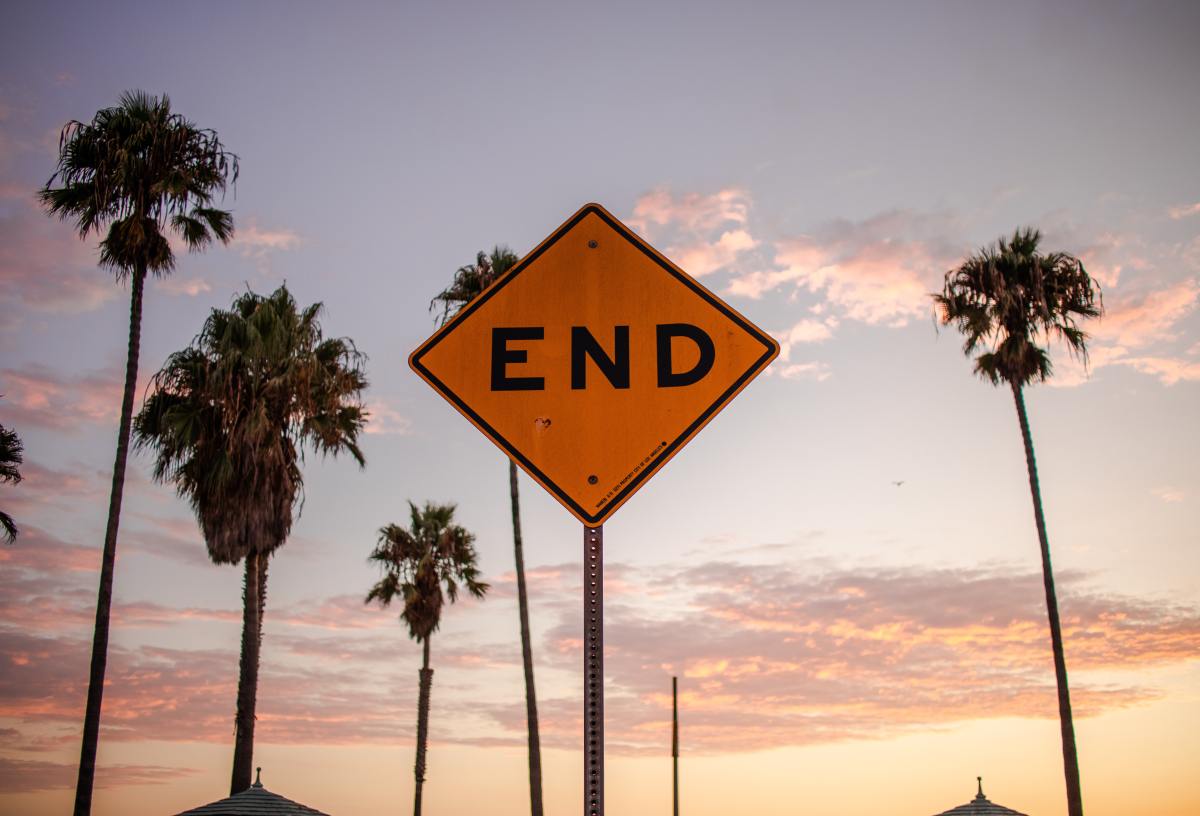
In Defense of Endings

I have a co-worker who loves anime and manga. Once, several years ago, he was in the bookstore, perusing the manga, and a boy sidled up to him. The kid was practically vibrating, he was so excited to tell him about the best manga ever: Naruto. My co-worker was all-too-familiar with Naruto and explained that he was not interested. But the boy insisted. Repeatedly rebuffed, he refused to give up. He was certain that this series was great, if only the dumb adult would listen. He pointed to one of the spines, some ten or twenty books into the series.

“Here,” he said. “See where the covers change color? That’s where it gets good.”

My co-worker, exasperated, threw up his hands and said, “I’m not going to read twenty books just to get to the good part!

The War on Endings

In the traditional story breakdown, the ending is one of the three parts of the story. It comes after the beginning and the middle. Or does it?

Today more than ever, media is business as well as art. And it is competitive. All the big gatekeepers are in competition not just with each other, but with all the little indie artists out there, from self-published e-books to rappers on SoundCloud to short films on YouTube.

Big media companies love a sure thing, or as close to one as they can get. Conveniently, after decades of mergers and acquisitions they also have warehouses full of old IPs and characters from all their previous successes. They are happy to use and re-use it, playing on nostalgia or even just vague familiarity. And even with brand new IP, they love to milk their stories and characters until they’re dry, desiccated husks.

More Star Wars, more Marvel, more Game of Thrones and Stranger Things and Lord of the Rings!

These modern mega-media empires are incentivized to make everything as episodic and ongoing as possible. Endings are bad for business. They want to sell more tickets, more monthly subscriptions, more merch. They want a multi-generational fan base. In short, they want the story to go on forever.

But stories aren’t meant to go on forever. They’re meant to end.

Engines Need Fuel

What drives a good story forward? What gets us excited and makes us eager to find out what will happen next? Well, Lincoln Michael would say that there are many different engines that can power a story.

Often the engine is about characters and their goals. They’re seeking something. Sometimes it’s mystery and discovery: something we want to find out. Machael suggests other options, like form, language and theme. However, all of these engines have some similarities. As we dig into them and begin to understand them, they get used up. The patience of the audience is a finite resource. Familiarity breeds contempt.

A character with a goal drives the story forward. They run into obstacles, they have successes and setbacks, and we root for them. But eventually, they have to make progress, whether that be success or failure. Eventually, they need to achieve their goal or have it slip out of their reach, or we get bored. Likewise, a mystery can only remain mysterious for so long. The clues have to lead somewhere. The red herrings have to be revealed eventually, or we’re left in a stew of uncertainty and frustration. The detective has to find the killer.

There are ways, of course, of stretching out that resolution. Perhaps the character fulfils their goal, only to discover a newer, bigger goal. Perhaps the original villain turns out to be just another henchman of the real villain.

These kind of tricks can only take you so far. The engine of the story eventually runs out of gas. You might be able to refill it once or twice by escalating into some exciting new territory, but if you go too long without a satisfying resolution, it all starts to fall apart.

What About Episodes?

Episodic stories might seem like the escape hatch. After all, the police procedural catches the killer at the end of the episode, and next time there will be a new case, right? But it doesn’t really solve the problem at all.

Episodic stories have two options: they can carry baggage from episode to episode, or they can wipe the slate clean every time. If they carry things forward, building larger arcs beyond episodes, then they wind up with the same problems of escalation as any other story. They need arcs, and they have to build toward endings. But if they wipe the slate clean, they run into an even bigger problem.

Episodic stories with no larger arc are cartoons. Often literally, but sometimes only figuratively. The world and the characters become static cardboard cut-outs. They can be played for laughs or drama for a while, but there are only so many times we can laugh at the same jokes or wonder “how will they get out of this one?” These are the zombie remains of real stories, still going through the motions, but utterly devoid of life.

Are Endings Really Necessary?

No. For all my complaining, I’ve watched some of those shows. I’m actively reading several stories with no ending in sight. That’s fine. We can still get joy out of those things. Hell, Hollywood is banking on it.

It’s really just a missed opportunity. A good ending elevates the beginning and middle. A bad ending can ruin a good beginning and middle (which is why we collectively get so incredibly mad when the ending is bad). A story with no ending at all? We’ll never know if it could be great. It’ll just fade away slowly.

All of my favorite stories have endings. So really, this is just a plea for you to cater to my tastes.

Give your stories endings. Give them the opportunity for greatness.

What I Learned From The Unwritten (Part III)

Having gone through the first four volumes in Part I, and the next four volumes in Part II, I finally arrive at the end. Just when the heroes seem to be at their strongest, rescuing a whole host of characters from Hades, Tom gets whisked off to another world entirely, leaving the others behind on an Earth that’s rapidly falling into a chaotic maelstrom of stories and reality.

Sometimes a Crossover is Less Than The Sum of Its Parts

The ninth volume of The Unwritten is a crossover with another (and arguably bigger) Vertigo series: Fables. I have only read a couple of the Fables books, so I know the basics. The Fables are castaways from fairy tale worlds, with the main series focused (at least initially) on a group living in modern day New York. Having not read the whole series, I had to make some assumptions about what’s going on in this crossover.

From what I can tell, Tom finds himself in an alternate version of the Fables universe where pretty much everything has gone to shit. One of the protagonists has become an antagonist here, and another is imprisoned. All the Fables are on the run from an evil that has nearly succeeded in taking over all of their worlds, with his seat of power in the hollowed-out shell of New York city.

Of course, this could also just be much further down the O.G. Fables timeline than I have read. I don’t know.

This illustrates an inherent problem with crossovers. Your target audience is people who enjoy both of these stories, but many people will only be fans of one. They will have little or no background in the other story. You can’t make assumptions—you have to explain everything that matters to the crossover story, and ideally try to avoid boring your core audience who already understands.

However, an even bigger problem than not knowing is not caring. I haven’t read all the Fables books because the ones I did read didn’t make me excited enough to go buy more. I was excited about The Unwritten. All I really wanted out of this story was to see what happens to Tom. However, Tom spends a good chunk of the crossover storyline stuck in his wizard alter-ego, Tommy Taylor, which was always intended to be a Harry Potter pastiche. The story is mostly a Fables story, where the “real” Tom gets one big confrontation and one big revelation at the very end.

As a result of all this, I found Volume 9 to be the least interesting to me, personally. Everything Tom got out of this storyline could be summarized in a few paragraphs in the next book. In fact, it is. I have no doubt that die-hard Fables fans find much more to enjoy, but for me it was one big aside to the main story.

Don’t Give Characters a Breather

As authors and as readers, we sympathize with well-written characters and often want them to be happy. But they can’t be happy. They always have to be in a tug-of-war; they always have to be struggling. Whenever they succeed, there has to be a new challenge waiting in the wings—preferably a bigger challenge, or the momentum of the story begins to peter out.

As Wilson Taylor says, “Nobody ever lives happily ever after, Tom. If that were to happen, the story would have to stop. Because it’s sustained on the endless agonies and exertions of the hero. The twists and turns of the plot resemble a maze. But they’re the very opposite of a maze. There are no wrong turnings. Just one way through, and one end point. At the close of each book, we promise…a respite. A moment’s peace, and a moment’s all it is. But believe me, lad—that’s as close as you’re ever going to get to a happy ending.”

The End is Never Really The End

And on that note, the very last page of The Unwritten is a title page. It has the credits listed, like the start of any other issue. And then you turn the page, and it’s done. Armageddon has more-or-less happened, and nearly all of the mainstay characters have disappeared. Only one is left. But rather than end on this note of “victory, but at what cost?” we get a title page. The tantalizing expectation of something more. Our last character is heading off in search of the others. It’s the beginning of a new adventure that we don’t get to see.

It’s a bold move, and one that clearly annoyed some people, going by the reviews. It worked for me, because I don’t mind ambiguous endings. In stories and in real life, the beginnings and endings are all a matter of where you choose to start and end the story. The characters were around before the first words, and at least some of the characters, the world…something…will continue on after the last words.

As authors, we tend to think a lot more about the backstory, the bits that happen before the first words. Those inform everything that happens in the story itself. But it’s also worth thinking about the post-story, the epilogue, even when it doesn’t get written. The trajectory of the characters and world after the events of the story inform the story as well. The real world didn’t magically appear the moment you were born, and it won’t disappear into the void when you die. A good story will feel the same way, like things are going to keep happening, whether the reader is there to see them or not.

A Tiny Bit of Review

As I’ve said before, I’m not very interested in writing traditional reviews. Instead, I prefer to look at a story and see what useful ideas I can pull from it. But I’ll indulge a little bit here.

I really liked The Unwritten. I read through the entire series, and then I went back and skimmed through a lot of it as I was writing these three posts. Even on cursory examination, I picked up on things I had missed the first time. I look forward to letting the story rest for a while and giving it a thorough rereading in a year or two.

It’s not without its weak points. It dragged for me in the Fables issue, and there were definitely a few plot points that worked on an emotional level and made a nicely-shaped story, but didn’t make logical sense for me when I stopped to think about them. Overall, they don’t detract much from the work. This is my second-favorite Vertigo series, after the incomparable Sandman, and in my top five favorite comics series of all time.

I guess I’m just a sucker for a “Power of Stories” narrative. I already think that stories have the power to shape the way we see the world, and in The Unwritten, stories have that power literally as well as figuratively. The universe bends to the story and the ways we interpret it. It’s a sort of mass hallucination. One that I’m happy to partake in.