

It’s Spring. Here in Minnesota it may be 40 or 80 degrees on any given day. The animals have that springtime energy. The kids can sense that summer is almost in spitting distance. But there are also those notorious April showers, and some cooler days, and plenty of reasons to curl up inside with a good book. Let’s talk about some of them.
Where possible, I include Bookshop affiliate links instead of Amazon. If any of these books pique your interest, please use those links. I’ll get a tiny commission, and you’ll support real book stores instead of scalp polish for Jeff Bezos.
Audio Books and Libro.fm
I recently decided to try audio books as a way to “read” more while I’m driving, folding laundry, or performing other mundane tasks. I was excited to discover Libro.fm, an audio book alternative to Amazon’s Audible, much like Bookshop.org has become my default option for buying paper books.
While Bookshop is a B Corp and Libro is a Social Purpose Corporation, both share profits with local bookstores and seem to have a moral framework beyond simple money-making. While the moral aspects of my purchases have become increasingly important to me, I’ll also note that both of these websites (and in Libro’s case, their mobile app) are well-constructed and easy to use, and the buying experience is very good. So I don’t feel like I’m missing out or working harder for the same product.
The first audio book I purchased through Libro was Jade City, by Fonda Lee.
Jade City

By Fonda Lee
I could tell immediately that Jade City fits my fantasy sensibilities perfectly. There are no elves or dragons to be seen, no medieval castles. Yes, the story takes place in a secondary world, and yes, there is magic in that world, but it feels grounded and real. High fantasy this is not.
The story takes place in the small, Asian-inspired island nation of Kekon, and almost entirely in the capital city of Janloon. The country is in a transitional period in the decades following the Many Nations War, a world war which distracted colonial overlords long enough for native, magic-imbued freedom fighters to drive them out.
As is often the case, without a shared enemy to fight the guerrilla army fractures into feuding clans. While there is an official, somewhat clan-neutral government over Kekon, these clans have an effective monopoly on magic and exercise significant power. They operate like mafia houses with spiritual, commercial, and governmental components, controlling and battling over territory. The fight to free the country from outsiders is still within living memory, but that memory is fading.
Although the world of Jade City is in the early stages of industrial revolution, with cars being commonplace and guns only slightly less so, the magic is decidedly wuxia, focusing on close-range martial arts fighting with knives and swords. Even then, the magic serves to move the plot as a political and social element, and only occasionally comes to the fore in tense life-or-death battles.
Magic is derived from bio-reactive jade, and this jade is only to be found in Kekon. Moreover, not everyone can use jade. It requires a genetic component, luck, and training.
However, there is a loophole. A drug has recently been invented—SN1 or “shine”—that allows those without aptitude and genetics to use jade. It threatens both the political order of Kekon and the Kekonese control of jade. Larger powers out in the world are eager to get their hands on both jade and the means to use it, and most of them are indifferent towards Kekon.
Within this complex historical and geopolitical backdrop, the story follows a single family: the Kauls, leaders of the No Peak clan. They are one of the largest clans, second only to the Mountain clan. But the longstanding equilibrium is broken as the Mountain makes moves to consolidate power inside and outside the island, no longer following the codes of honor that have long bound the actions of jaded “greenbones.”
Jade City is a family drama, as well as a political and crime drama. It’s Wuxia Godfather. It’s a fantastic first entry for a fantasy trilogy, and I’ll definitely pick up the sequels.
Hellblazer Vol. 12 – How to Play With Fire
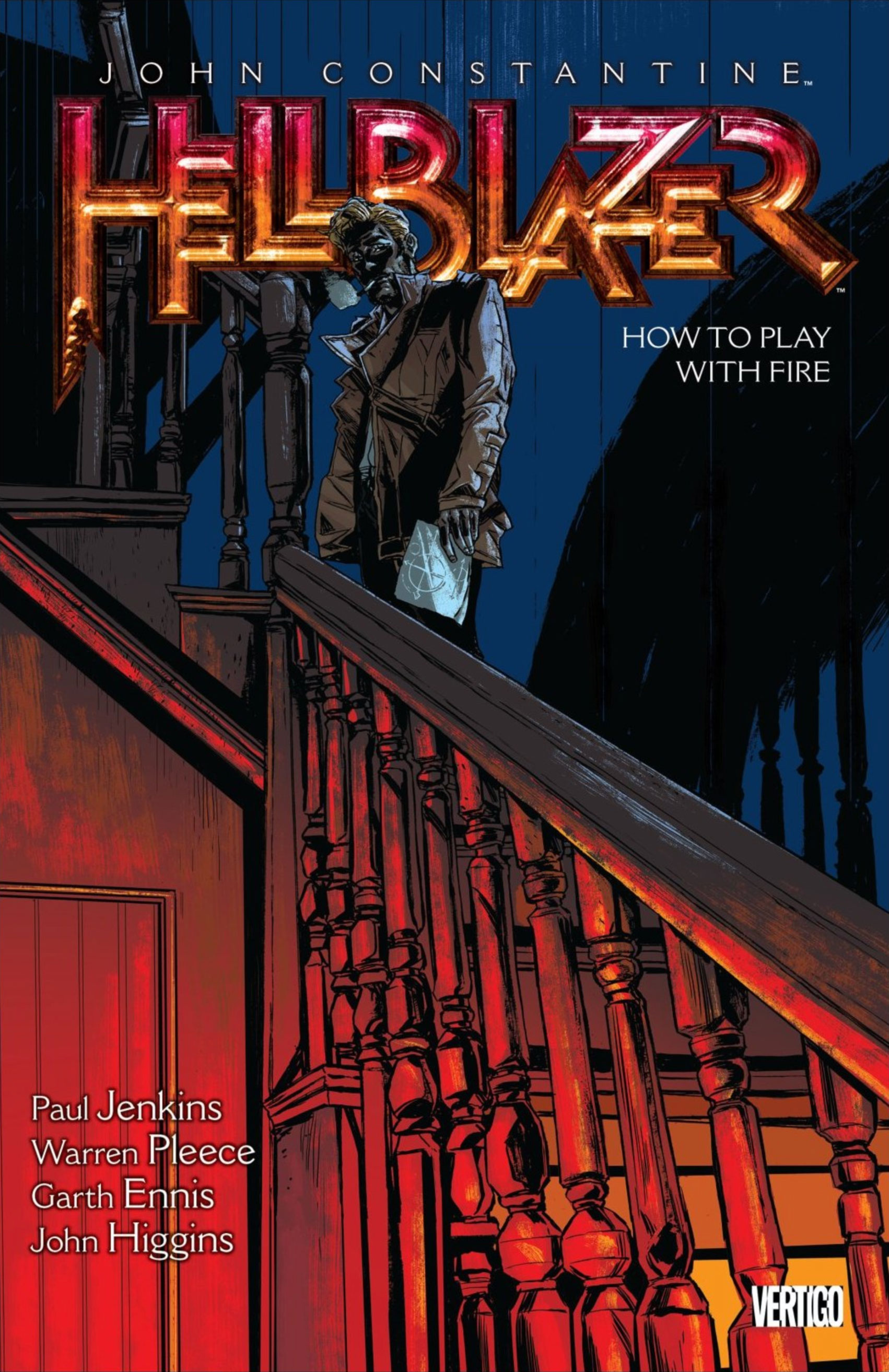
By Paul Jenkins, Warren Pleece, Garth Ennis, John Higgins
There are questions you ask at the start of any Constantine story arc. Which old enemy is going to show up? Which estranged friends? What terrible thing is going to happen to this girlfriend? Does the big bad evil plan to wreck up the entire planet, or only London?
This trade paperback collects three story arcs, four issues each. In the first, Constantine is in New York to meet the latest girlfriend’s family. And for some reason, he’s up against that classic villain, Satan. But the devil isn’t raining down fire and brimstone, he’s unleashing some kind of overly-vague psychic malaise on New York, the girlfriend’s family included. Of course, John manages to save the day with the help of the girlfriend’s grandpa and a psychic he happens to know. Or at least he clears off the bad mojo from her family. Everyone else is on their own.
This arc really felt like filler to me. The actual danger is described in such vague terms, and the solution is just as unclear. I don’t need every story to conclude with a beatdown of the villain, but I do need to actually understand what’s going on, and as far as I can tell the plot of these issues seems to be that America is psychically sick, and the only cure is to share memories with boomers who know what it means to really live.
The second storyline is classic Hellblazer, with old friends turned to enemies and demonic forces desperate to get even with Constantine. As usual, everything in John’s life begins to fall apart. His buddies are estranged and his girlfriend leaves him. But all it takes to fix it is making a deal with the devil.
The final arc is the best of the bunch. John’s friend Chas gets accidentally mixed up in some gangster business and hopes that Constantine can get him out of it. Unfortunately, John has history with these gangsters too—he once did them a dangerous favor that ended in a little bit of demonic possession. This one does end in a proper showdown with a big nasty demon. So maybe that is something I need in a Hellblazer story to really enjoy it.
American Gods

By Neil Gaiman
I last read American Gods about two decades ago. It holds up pretty well, all things considered.
It is a love letter to America and especially the Midwest, a novel whose story runs across rural highways and through chintzy roadside attractions. It looks on America kindly, but also observes our weaknesses and foibles as only an outsider can.
In American Gods, there is a spiritual void in modern America, and the gods are dying. They are being forgotten, their worshipers dwindling. In their place, new concepts ascend: media, the internet, and mysterious three-letter government organizations. And yet, for some, the transition can’t happen soon enough. Among the new gods, there are those who aren’t content to let the old gods fade. They want blood.
Meanwhile, Shadow is getting out of prison. He’s served his time and he’s going home to his wife. He has a job lined up. Then, right before release, he finds out that his wife is dead, and everything falls apart. That’s when he meets an old man who calls himself Mr. Wednesday, and Shadow is pulled into the war among the gods.
The end hinges on several surprise twists, which are nicely telegraphed, but not obvious. The final chapters are satisfying without being glib or wrapping things up too cleanly.
Acknowledging Monsters
I would be remiss to write up this book without acknowledging the recent accusations against Gaiman. His stories never shied away from dark topics like sexual assault—which once seemed like a clear-eyed view of an often terrible world. Now, it comes across as something more personal and disturbing.
I won’t argue for or against the death of the author. I can understand appreciating a piece of work, even while disagreeing with or hating the author. I’ve certainly enjoyed stories by authors like Card or Heinlein while vehemently disagreeing with their politics and social views. I also can’t blame anyone who can’t (or doesn’t want to) separate the author and the story.
There are things I love in many of Gaiman’s works. I would have called myself a fan of his not so long ago. It’s unfortunate that those stories will now be tainted. They will always have that dark coda attached.
What I’m Reading in April
Hey, it turns out audiobooks are pretty cool. I can turn a lot more of my mundane task time into listening time. And what I’m listening to next is the Area X trilogy by one of my favorite literary SFF authors: Jeff VanderMeer. I’ve also got short fiction by Ted Chiang, and maybe a couple other things from the TBR pile. See you next month.
 Words Deferred