The Read Report — May 2025

Another month has passed, and I’m here to talk about books.

There are a lot of them. Really, a shocking number of books. They keep coming out!

Despite my best efforts, I haven’t read them all. But I promise, I’m working on it. Let’s talk about the ones I finished in May.

Where possible, I include Bookshop and Libro affiliate links instead of Amazon. If any of these books pique your interest, please use those links. I’ll get a small commission, and you’ll support real book stores instead of luxury ice for billionaires’ cocktails.

Annihilation (Southern Reach – Book 1)

By Jeff VanderMeer

(Audiobook on Libro.fm)

As I mentioned last time, I’ve been getting into audio books as a way to read more. The three-books-in-one Area X collection was my second audio book purchase, and it was a fantastic choice. I’ve loved Jeff VanderMeer’s work for years, but between the Borne books and the Southern Reach series, he might just be my favorite author.

Annihilation begins with a simple premise: there is a place somewhere in the coastal US where something supernatural or alien has taken root. (The exact location never entirely clear, but it’s in the South, and VanderMeer himself lives near Tallahassee.) This place, dubbed Area X, is surrounded by an invisible barrier that vanishes any living creature that crosses it. The only entrance or exit is a gate of scintillating light.

The government has surrounded Area X with a military blockade, created a cover story of “ecological catastrophe,” and created a clandestine organization called The Southern Reach to study it, because that’s the sort of thing governments do.

We enter into this situation with The Biologist, one of four members of the 12th expedition sent into Area X. Her fellows are The Anthropologist, The Surveyor, and The Psychologist, who also serves as the expedition’s leader. They are discouraged from knowing anything about each other, even their real names.

Within Area X they encounter mysteries and monsters, and The Biologist soon has reason to believe that the Southern Reach knows more about Area X than it has told the members of the expedition.

Annihilation was shorter than I was expecting, only six hours as an audio book, but it’s packed full. Each chapter provides new revelations about the situation or unfurls new backstory about the characters in a way that kept me constantly revising my understanding of what was going on. And even so, the central mystery of “what is Area X” kept the story moving forward.

It’s interesting to see themes from VanderMeer’s other books present here. His stories are off the map. Deep in the unknown. Places that feel alien, and characters that often feel alien despite being human.

The man is obsessed with fungus as a vector for our fear of parasites, a foreign body that brings death—or transformation. Mushrooms and mushroom-people figured heavily in the Ambergris stories. He also clearly has a deep love for ecology and nature, especially coasts and tidal pools. The Biologist, with her aquatic obsessions, mirrors the protagonists of Dead Astronauts, another book by VanderMeer.

This feels like cosmic horror, but subtle. It says the world is unknown, and unknowable. Inscrutable. It reminded me of House of Leaves. You can’t trust the laws of physics, the constancy of space and time. There is a feeling of Area X holding forbidden knowledge that will destroy anyone who comes across it.

Authority (Southern Reach – Book 2)

By Jeff VanderMeer

(Audiobook on Libro.fm)

As soon as I finished Annihilation, I jumped into Authority. I was hooked.

It starts with a twist that immediately grabbed me. One of the characters in the first book wasn’t who they pretended to be. Everything I knew from the 12th expedition was turned on its head.

This time, we follow the brand new director of the Southern Reach, a man who insists on being called Control— though it quickly becomes apparent that very little is actually in his control.

He has been brought in to replace the old director and “fix” the Southern Reach. Central, a shady government agency that may or may not be the CIA, is concerned that the organization is rotten—somehow infected or sympathetic toward Area X despite the directive to contain and control. They have become too close to the problem.

Control arrives just in time for the debriefing of the survivors of the 12th expedition, despite at least some of them appearing to be dead at the end of the first book. One of these survivors is The Biologist.

Beyond the weirdness of Area X and secret government organizations vying for power, Control has to contend with all the difficulties of being the outsider brought into a dysfunctional organization he doesn’t understand, to be in charge of people who don’t trust him and quietly resist any significant change.

As is often the case with clandestine organizations, Control soon realizes that he really doesn’t know everything going on at the Southern Reach or at Central. He is being manipulated from all sides while becoming more and more obsessed with the mysteries of Area X.

Even worse, the past has been purposely muddied. There have been far more than twelve expeditions, but the numbers are reused, the members lied to. The facts are hidden from all but the highest-ranking officials. The previous director’s notes indicate that Area X is expanding, though there seems to be no outward sign of it.

Control cannot even trust himself. The Southern Reach uses hypnosis to condition and control the members of the expeditions, and it seems increasingly likely that Central uses the same conditioning on its own people. Can he be sure of what he knows? Can he be sure of who he is?

The first book ended in personal catastrophe: death and failure for the 12th expedition. The second book ends in what appears to be a global catastrophe as Area X suddenly and rapidly expands, not only extending its border, but surpassing it, spreading its seeds out into the wider world. Control flees, but like everyone who spends time at the Southern Reach, he can’t really get away, and he finds himself returning to Area X.

If Authority has a hypothesis, it’s that nobody is truly in control. You can take a name or a title, you can construct borders to protect yourself, you can perform as much rigorous, scientific categorization and classification as you’d like. It won’t stand up in the face of the unknown.

Acceptance (Southern Reach – Book 3)

By Jeff VanderMeer

(Audiobook on Libro.fm)

Annihilation and Authority mostly follow linear narratives, even if information about the past is revealed in bits and pieces throughout. Acceptance is decidedly non-linear. It intermingles three stories.

The time before the border fell over the Forgotten Coast is told by Saul Evans, lighthouse keeper and former preacher. He encounters the Séance and Science (S&S) Brigade, a weird collection of locals who investigate strange phenomena from scientific and paranormal angles, and somehow seem to be intimately involved in the eventual advent of Area X.

The time after Area X appeared is told by the director of the Southern Reach who preceded Control. She reveals the origin of the organization, some of its ties to Central, and what really happened across the many expeditions and years of investigation.

The present, then, is told by Control and The Biologist—or at least something that looks like The Biologist, but calls herself Ghost Bird. Control is drawn to Area X, repulsed by it, obsessed with it and terrified of it. Ghost Bird has a connection to Area X that she does not completely understand. They both suspect she is the only one who can stop it.

In the aftermath of the border’s expansion, the pair trek through the pristine wilderness of Area X, to the island off the coast. They meet an old friend and formulate a desperate plan to return to the buried tower that forms the heart of Area X, to stop the threat it poses to all of humanity.

The trilogy is built as something of a mystery box, with the ultimate question for readers being the cause and purpose of Area X. Is it supernatural? Alien?

I’d argue that VanderMeer is better than most at constructing this kind of mysterious narrative while still giving up big, exciting revelations along the way, but there are plenty of questions left to answer going into book three. To his credit, most of the questions are answered by the last page.

There are revelations about the origin and purpose of Area X, but they are oblique. Some readers will be satisfied with that, either constructing their own head-canon from the pieces, or accepting that there will always be a little uncertainty. On the other hand, I’ve seen plenty of folks online still looking for more clarity.

Personally, I came well-prepared, having read another VanderMeer series first — the not-quite trilogy of Borne, The Strange Bird, and Dead Astronauts. Those books are delightful explorations of language in a post-apocalyptic future, but they’re challenging and they leave a lot of questions unresolved. In comparison, the Southern Reach trilogy is practically overflowing with answers.

And luckily, there may be more. After ten years away, VanderMeer recently released a fourth Southern Reach book: Absolution. (Of course it has to start with A.)

What I’m Reading in June

When do you know you’re reading too many books at the same time? Right now, I’m halfway through an audio book that I listen to in the car. I’m also halfway through an e-book that I can read in spare minutes on my phone. And I’m halfway through a physical book that I keep next to my bed.

Next month, expect to hear about some sci-fi short stories, one of the most award-winning fantasy authors of recent times, and yet more from Jeff VanderMeer.

I’m also considering a change in format. I originally started these Read Reports as a way to combine my thoughts on a few books into a single post, but now I’m finding that it ends up being an awfully long post when I write about a month’s-worth of books.

So let me know in the comments — do you like these consolidated Read Reports, or would you rather have bite-sized posts on one book at a time?

Monetizing Myself

Being a writer is strange. You have to be full of yourself to believe that others will want to read these things you’ve written, but you also need to be insecure enough to spend endless hours obsessively revising and improving those same things.

Gone are the days when a moderately successful writer could live out of a Parisian hotel. Now, you’re lucky if you don’t have to be your own marketing department and shell out thousands up front for an editor, while still holding down a day job.

Money and writing often feel like a Venn diagram that’s just two separate circles. The writerly split self-image is necessary here too. You’ve got to simultaneously think that someone might actually want to pay you, and continue working hard even when nobody does.

This is all a very roundabout way of explaining that I’ve added a new page to the menu where you can support me by buying things on Bookshop.org, signing up for Libro.fm, or directly sending me a dollar. I don’t expect that anyone is clamoring to give me their money just because I run this little blog, but now the option is there, just in case.

Monetization Options

That begs the question, what would I need to do to be “worthy” of a random dollar here or there from passing internet pedestrians?

In the modern futuristic gig economy, the cool thing to do would be to set up some kind of crowd-funding or techno-patronage system like a Kickstarter or a Patreon. I’d be interested in doing something like that some day, but it would require having a plan, a good sales pitch, and an exciting product or service provided on a deadline.

In the writing and fiction space, there are a few successful examples of this in print magazines and web zines. It varies from just another magazine subscription system to added bonus content or physical editions, to just regularly begging for donations. I also occasionally see individual authors monetizing, which usually involves either a Substack/Medium blog subscription, or a little storefront for selling self-published work.

The paid blog route really requires a time and effort investment in blogging or newsletters. That’s something I know I could do, because I’ve written fairly consistently and frequently for this blog in the past. However, it would make this feel more like a job—without any guaranteed paycheck. I enjoy blogging and the meta aspect of discussing everything writing-related, but I see it as a fun side project to my fiction. Monetizing the side project would force it to be the main project, and I don’t want fiction to be a side gig to the blog.

For the Patreon route, I’d want to send out fiction as a reward. I’d be hesitant to commit to something like a new story each month, but building up a set of 12 stories in advance sounds feasible. Heck, it could be a good way to give new life to stories that have already been published, without the hassle of trying to sell reprints to magazines or anthologies.

I could also see doing something with Razor Mountain, if I ever get around to properly revising it. A novel might be more appealing for some readers than a collection of short stories, and I could add in some of the material I documented about the process of writing a novel, which was the main appeal (at least to me) of that whole project.

Finding an Audience

Crowd funding doesn’t do any good without a crowd. The real challenge is getting any project like this in front of people who might be legitimately interested in it.

I’ve blogged long enough to know that it’s not easy to build an audience. Having work published and blogging with focus and consistency are probably the two best ways to build that, but there’s also a strong element of luck. Even with all three, it can take years or decades to find people, and it’s easy to lose them by shifting focus or just taking time off.

I have been hesitant to put any monetization on the blog because my audience just isn’t very big. On the other hand, it’s not clear when the right time is to start monetizing. My current thinking is that as long as it’s unobtrusive, it’s unlikely to turn people off, and I can start small and figure things out as I go.

What’s Next?

As usual, I’ll treat this as an experiment and try to be open about it in case the information is useful to others. I don’t have any specific plans and I don’t expect to add more monetization soon.

I’m interested to hear from any other bloggers/authors who are doing any kind monetization. What have you tried? What works or doesn’t work for you? Let me know in the comments.

The Read Report — April

It’s Spring. Here in Minnesota it may be 40 or 80 degrees on any given day. The animals have that springtime energy. The kids can sense that summer is almost in spitting distance. But there are also those notorious April showers, and some cooler days, and plenty of reasons to curl up inside with a good book. Let’s talk about some of them.

Where possible, I include Bookshop affiliate links instead of Amazon. If any of these books pique your interest, please use those links. I’ll get a tiny commission, and you’ll support real book stores instead of scalp polish for Jeff Bezos.

Audio Books and Libro.fm

I recently decided to try audio books as a way to “read” more while I’m driving, folding laundry, or performing other mundane tasks. I was excited to discover Libro.fm, an audio book alternative to Amazon’s Audible, much like Bookshop.org has become my default option for buying paper books.

While Bookshop is a B Corp and Libro is a Social Purpose Corporation, both share profits with local bookstores and seem to have a moral framework beyond simple money-making. While the moral aspects of my purchases have become increasingly important to me, I’ll also note that both of these websites (and in Libro’s case, their mobile app) are well-constructed and easy to use, and the buying experience is very good. So I don’t feel like I’m missing out or working harder for the same product.

The first audio book I purchased through Libro was Jade City, by Fonda Lee.

Jade City

By Fonda Lee

I could tell immediately that Jade City fits my fantasy sensibilities perfectly. There are no elves or dragons to be seen, no medieval castles. Yes, the story takes place in a secondary world, and yes, there is magic in that world, but it feels grounded and real. High fantasy this is not.

The story takes place in the small, Asian-inspired island nation of Kekon, and almost entirely in the capital city of Janloon. The country is in a transitional period in the decades following the Many Nations War, a world war which distracted colonial overlords long enough for native, magic-imbued freedom fighters to drive them out.

As is often the case, without a shared enemy to fight the guerrilla army fractures into feuding clans. While there is an official, somewhat clan-neutral government over Kekon, these clans have an effective monopoly on magic and exercise significant power. They operate like mafia houses with spiritual, commercial, and governmental components,  controlling and battling over territory. The fight to free the country from outsiders is still within living memory, but that memory is fading.

Although the world of Jade City is in the early stages of industrial revolution, with cars being commonplace and guns only slightly less so, the magic is decidedly wuxia, focusing on close-range martial arts fighting with knives and swords. Even then, the magic serves to move the plot as a political and social element, and only occasionally comes to the fore in tense life-or-death battles.

Magic is derived from bio-reactive jade, and this jade is only to be found in Kekon. Moreover, not everyone can use jade. It requires a genetic component, luck, and training.

However, there is a loophole. A drug has recently been invented—SN1 or “shine”—that allows those without aptitude and genetics to use jade. It threatens both the political order of Kekon and the Kekonese control of jade. Larger powers out in the world are eager to get their hands on both jade and the means to use it, and most of them are indifferent towards Kekon.

Within this complex historical and geopolitical backdrop, the story follows a single family: the Kauls, leaders of the No Peak clan. They are one of the largest clans, second only to the Mountain clan. But the longstanding equilibrium is broken as the Mountain makes moves to consolidate power inside and outside the island, no longer following the codes of honor that have long bound the actions of jaded “greenbones.”

Jade City is a family drama, as well as a political and crime drama. It’s Wuxia Godfather. It’s a fantastic first entry for a fantasy trilogy, and I’ll definitely pick up the sequels.

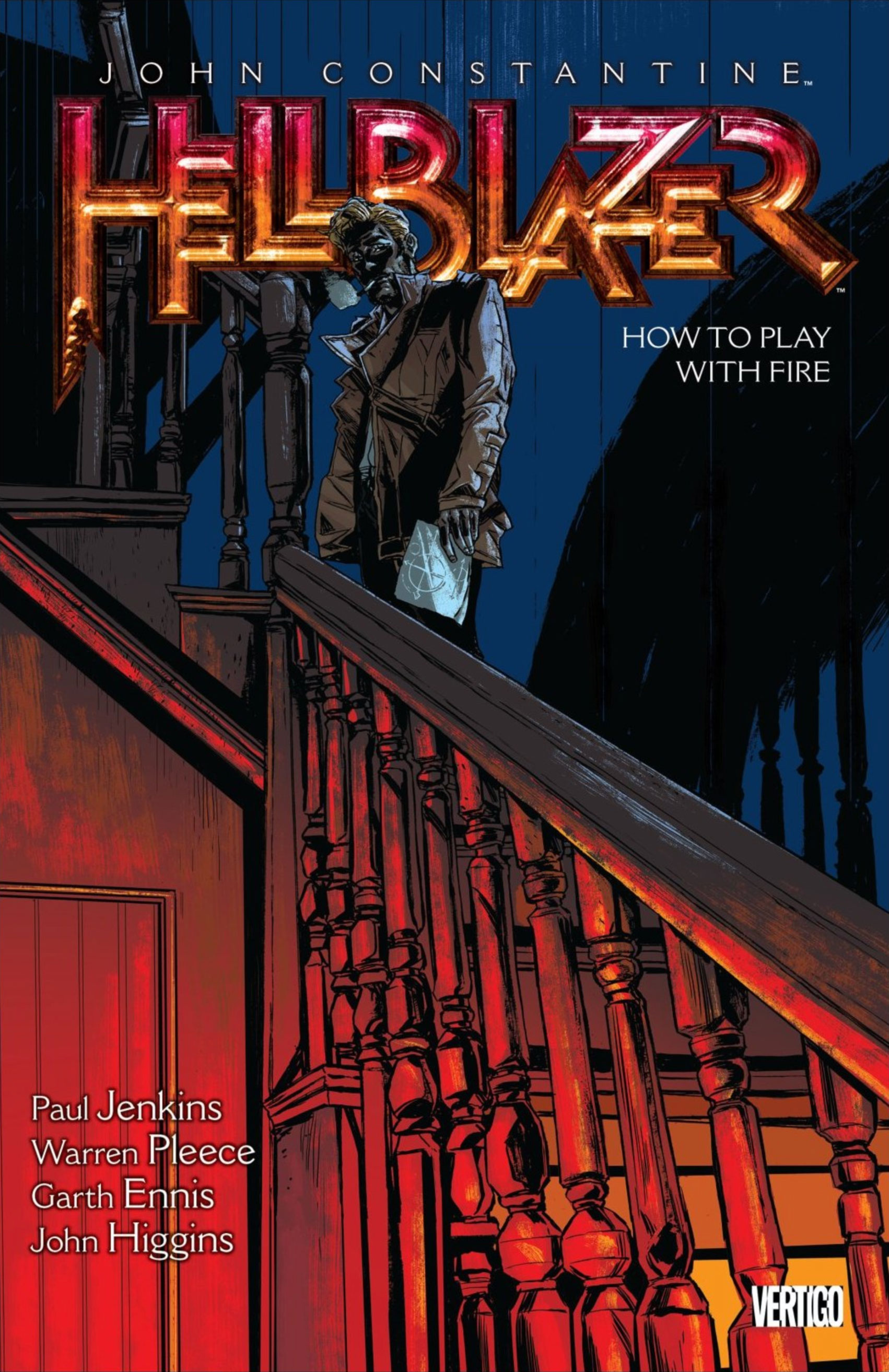
Hellblazer Vol. 12 – How to Play With Fire

By Paul Jenkins, Warren Pleece, Garth Ennis, John Higgins

There are questions you ask at the start of any Constantine story arc. Which old enemy is going to show up? Which estranged friends? What terrible thing is going to happen to this girlfriend? Does the big bad evil plan to wreck up the entire planet, or only London?

This trade paperback collects three story arcs, four issues each. In the first, Constantine is in New York to meet the latest girlfriend’s family. And for some reason, he’s up against that classic villain, Satan. But the devil isn’t raining down fire and brimstone, he’s unleashing some kind of overly-vague psychic malaise on New York, the girlfriend’s family included. Of course, John manages to save the day with the help of the girlfriend’s grandpa and a psychic he happens to know. Or at least he clears off the bad mojo from her family. Everyone else is on their own.

This arc really felt like filler to me. The actual danger is described in such vague terms, and the solution is just as unclear. I don’t need every story to conclude with a beatdown of the villain, but I do need to actually understand what’s going on, and as far as I can tell the plot of these issues seems to be that America is psychically sick, and the only cure is to share memories with boomers who know what it means to really live.

The second storyline is classic Hellblazer, with old friends turned to enemies and demonic forces desperate to get even with Constantine. As usual, everything in John’s life begins to fall apart. His buddies are estranged and his girlfriend leaves him. But all it takes to fix it is making a deal with the devil.

The final arc is the best of the bunch. John’s friend Chas gets accidentally mixed up in some gangster business and hopes that Constantine can get him out of it. Unfortunately, John has history with these gangsters too—he once did them a dangerous favor that ended in a little bit of demonic possession. This one does end in a proper showdown with a big nasty demon. So maybe that is something I need in a Hellblazer story to really enjoy it.

American Gods

By Neil Gaiman

I last read American Gods about two decades ago. It holds up pretty well, all things considered.

It is a love letter to America and especially the Midwest, a novel whose story runs across rural highways and through chintzy roadside attractions. It looks on America kindly, but also observes our weaknesses and foibles as only an outsider can.

In American Gods, there is a spiritual void in modern America, and the gods are dying. They are being forgotten, their worshipers dwindling. In their place, new concepts ascend: media, the internet, and mysterious three-letter government organizations. And yet, for some, the transition can’t happen soon enough. Among the new gods, there are those who aren’t content to let the old gods fade. They want blood.

Meanwhile, Shadow is getting out of prison. He’s served his time and he’s going home to his wife. He has a job lined up. Then, right before release, he finds out that his wife is dead, and everything falls apart. That’s when he meets an old man who calls himself Mr. Wednesday, and Shadow is pulled into the war among the gods.

The end hinges on several surprise twists, which are nicely telegraphed, but not obvious. The final chapters are satisfying without being glib or wrapping things up too cleanly.

Acknowledging Monsters

I would be remiss to write up this book without acknowledging the recent accusations against Gaiman. His stories never shied away from dark topics like sexual assault—which once seemed like a clear-eyed view of an often terrible world. Now, it comes across as something more personal and disturbing.

I won’t argue for or against the death of the author. I can understand appreciating a piece of work, even while disagreeing with or hating the author. I’ve certainly enjoyed stories by authors like Card or Heinlein while vehemently disagreeing with their politics and social views. I also can’t blame anyone who can’t (or doesn’t want to) separate the author and the story.

There are things I love in many of Gaiman’s works. I would have called myself a fan of his not so long ago. It’s unfortunate that those stories will now be tainted. They will always have that dark coda attached.

What I’m Reading in April

Hey, it turns out audiobooks are pretty cool. I can turn a lot more of my mundane task time into listening time. And what I’m listening to next is the Area X trilogy by one of my favorite literary SFF authors: Jeff VanderMeer. I’ve also got short fiction by Ted Chiang, and maybe a couple other things from the TBR pile. See you next month.