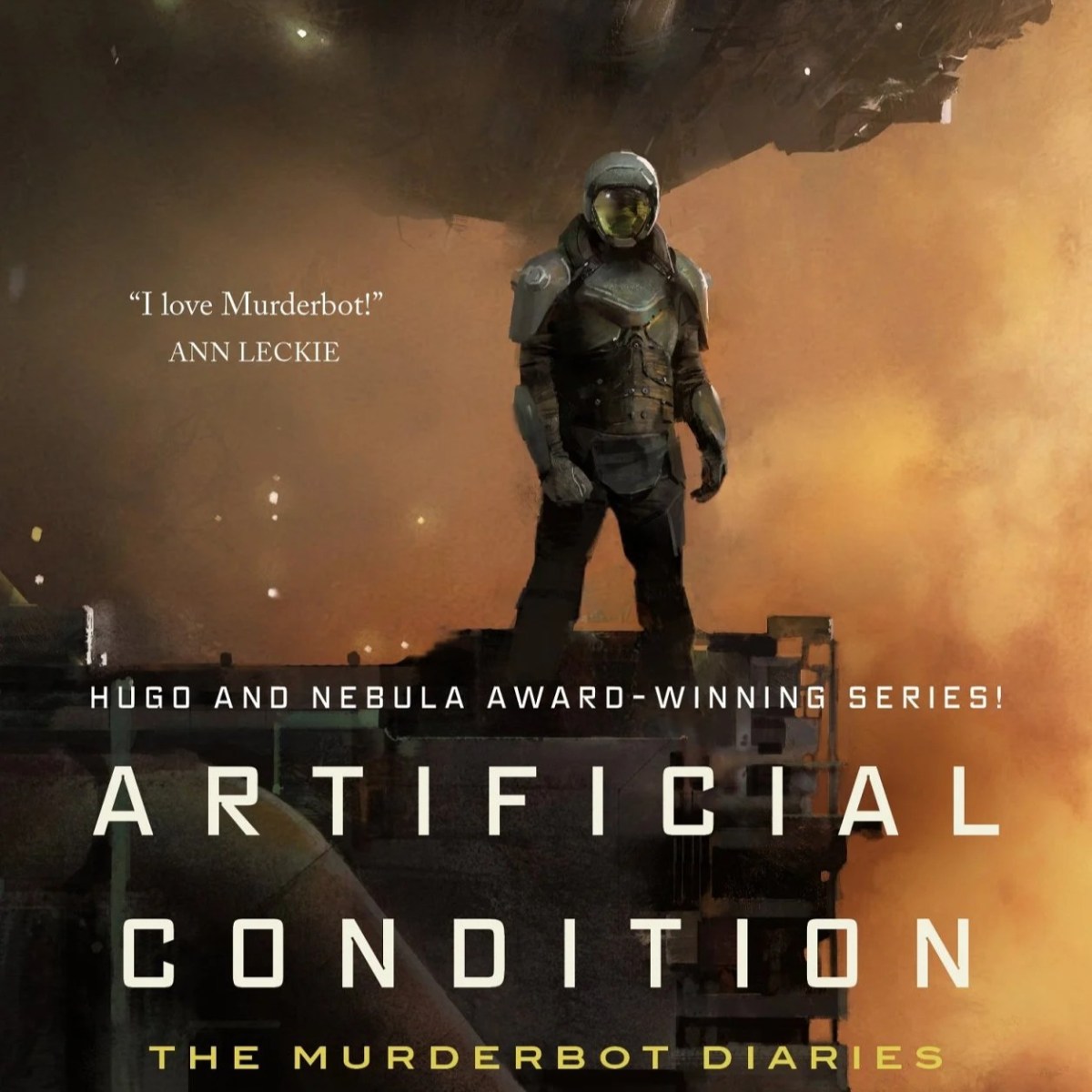
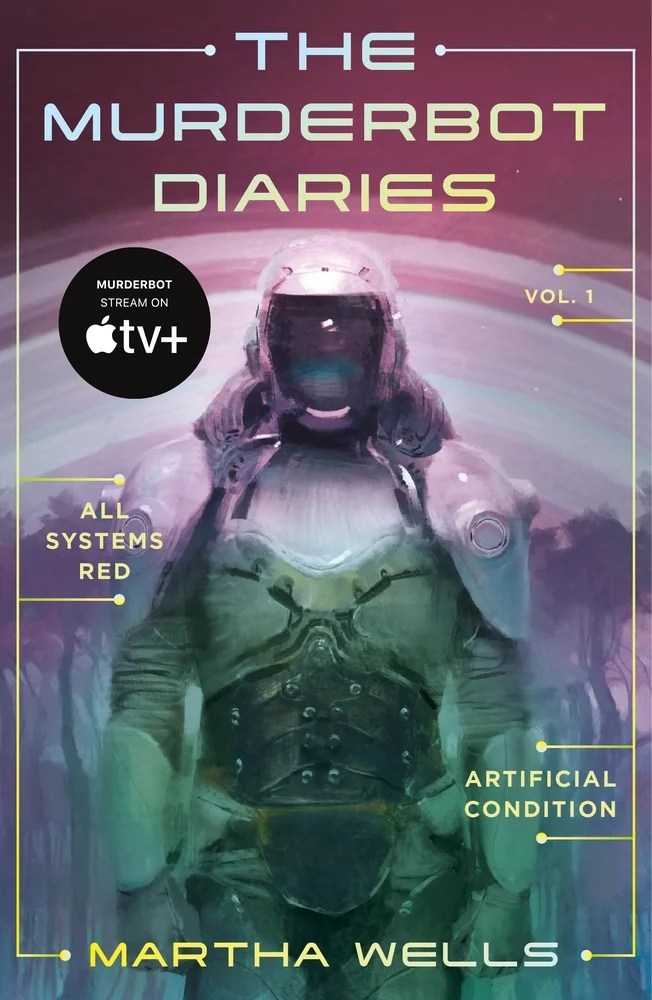
All Systems Red (Murderbot Diaries #1) — Read Report

Book | E-book | Audiobook (affiliate links)

I suspect, in a vacuum, I would not pick up a book labeled Murderbot Diaries. It sounds like a combination of military SF parody and introspective John Green-esque YA fiction. Having read the first installment, the title comes off as tongue-in-cheek and less abrasively cheesy.

This is one of those cases where “word of mouth” unequivocally led to a sale. The book has been recommended to me by friends, acquaintances, podcasts, and blogs which would usually all have very different tastes. My interest was piqued by broad support across normally unaligned quadrants.

Who is this Killer Robot?

I can see why so many people like Murderbot. He is a protagonist for our times.

In another universe, he might have the makings of a charismatic action hero: a humanoid, partly organic robot with armor; built-in weapons; the ability to repair from near death; and extensive experience in private security.

In the universe of All Systems Red, he just wants to slack off, avoid talking to anyone, and watch his favorite shows.

Many robot narratives are either as emotionless as possible or essentially indistinguishable from a human narrative. Murderbot finds a middle-ground. He has emotions and can certainly get caught up in the moment, but he is also aware that he is more affected by the storylines of his shows than by the actual interactions between himself and the crew who has purchased his company contract for security services.

He needs his space, both physically and emotionally. He’s more comfortable talking to the crew with his opaque helmet on; more comfortable seeing them through the security cameras; and happy to spend his time alone in the tiny security room, or even tinier repair bay.

The company that owns Murderbot and sells his services to the highest bidder is an amoral edifice of shitty space capitalism. They worry about the welfare of the people Murderbot is hired to protect because they will suffer financial penalties for injuries and deaths. They care about Murderbot because he would be expensive to replace.

Murderbot himself has more theoretical autonomy than he should. He has hacked his own modules and only feigns following orders enough to not get caught. He also has actual morals, even if they often butt up against his limited emotional range and social anxiety.

Many readers identify with Murderbot because he reflects marginalized identities. He is aromantic, asexual, and exhibits behaviors and feelings familiar to many neurodivergent people. He is also a small character in a big world. He uses his very limited freedom to seek little comforts that help block out an indifferent and cruel universe, at least for a little while. He cannot possibly imagine leading a rebellion or overthrowing evil, but he appreciates when someone does it on TV.

I suspect many of us feel the same way when we flip on our favorite show these days.

Quick Hits and Remixes

I am a big fan of the return of novellas. When I was young I read huge fantasy tomes and played 100-hour JRPGs. Now that I’m older and cherish my precious free time, I quite like a book or game that I can finish comfortably in a day or two.

Novellas also lend themselves wonderfully to series like this. Much like a weekly TV show, each entry can provide a concise arc while building characterization and setting on top of the previous entries.

I’m also appreciative of the fresh familiarity of Murderbot. It’s hard to point to any particular element of the story that is a purely original take. The action-adventure, the robot learning how to be more human, and the mildly dystopic libertarian space future have all been explored elsewhere. However, Martha Wells puts those puzzle pieces together in a way that feels fun and strangely parallel to our current moment in time.

Final Exam — The Story Idea Vault

It’s a common misconception that a great idea makes a great story. The truth is that most great stories come down to execution. A great idea with poor execution rarely works, but a great writer can breathe new life into even the most tired tropes.

Like any writer, I have my own treasure trove of ideas that might end up in a story…someday. But why horde them? Instead, I’m opening the vault and setting them free.

Use these ideas as a writing prompt, or come up with your own twist and reply in the comments.

Final Exam

In old movies, recognizing aliens was easy. They looked like giant insects, or gray-skinned people with huge black eyes, or heck, just humans with pointy ears. They spoke words through something mouth-shaped, and if they didn’t want to eat you or lay some eggs in your stomach, they at least wanted something reasonable, like taking over your planet.

The scientists in the old movies didn’t have to worry about Species 104, the plasma clouds that only understand calculus. They never had to devise a translator for Species 92, the fungal/viral symbiosis that communicates by rupturing your cells.

As a trained xenologist, it’ll be my job to explore the galaxy and make first contact with new alien species. I’ll be ambassador of the human race. But first, I need to pass my final exam: picking which one of these ten asteroid chunks is actually alive, and whether it talks by exchanging argon crystals or by carving glyphs into you with a focused sonic pulse.

Based on the noises made by the last student and the amount of blood on the floor of the examination room, I’m guessing it’s the glyphs.

Now, which rock…

Speaker for the Dead — Read Report

Book | E-book | Audiobook — Bookshop/Libro affiliate links

Speaker for the Dead is the second book in the Ender’s Game series. The last time I read this, I was probably still a teen.

For Ender and Valentine, it has been two decades since the events of Ender’s Game. But much of that time has been spent on starships traveling at relativistic speeds. A thousand years have passed outside those starship hulls. Humanity has spread across the hundred worlds. Ender’s pseudonymous books, The Hive Queen and The Hegemon have convinced most humans that Ender, “the Xenocide,” was a genocidal monster, and have inspired a secular religion of “speakers for the dead,” who try to eulogize those who have passed with complete honesty.

Ender and Valentine find themselves on the icy, Scandinavian-colonized world of Trondheim, teaching and speaking for the dead, when they hear the news that the only other known sentient alien species, the Pequeninos, have brutally killed a scientist on the tiny colony of Lusitania. A call goes out for a Speaker, and Ender follows it. His sister, however, is married and expecting her first child. For the first time in twenty-two years, they part ways, fully knowing that after the lightspeed journey she will be nearly double his age.

Ender arrives at the Portugese-Catholic colony with two secrets: the egg of the last bugger hive queen, ready to revive the species he destroyed a thousand years previous, and a jewel in his ear that lets him communicate with Jane, the only sentient AI in the universe.

Ender intrudes upon a decades-long family drama. Novinha Ivanova is the colony’s xenobiologist, the orphaned daughter of the original xenobiologists, who died in the process of saving the colony from the deadly alien Descolada plague. In her youth, she was mentored by the colony’s xenologer and fell in love with his son (and apprentice). These two important men in her life, the only people allowed to interact with the Pequeninos, are the ones the aliens choose for strange, ritual murders. And Novinha is determined to keep secret any and all information that might lead others to the same fate.

Speaker for the Dead is a very different book from Ender’s Game. That book was all about Ender’s struggles to overcome adversity at the battle school. Ender is a genius with a variety of remarkable skills, but it works in that context because the challenges stacked against him are so brutal.

In Speaker for the Dead, Ender is even more of a Gary Stu. He is the legendary Xenocide. He is the accidental father of a religion. Not content to have committed genocide, he plans to revive the bugger species. Jane, the AI, chooses him as the only human she will reveal herself to. Even the Pequeninos can only be fully understood by Ender, solving mysteries in days that the xenologers couldn’t penetrate over decades. He immediately gains the trust of almost everyone he interacts with on Lusitania, with apparently little effort.

It’s a testament to the setting and the mystery-driven plot that the book is still good in spite of Ender’s nearly inhuman ability to do whatever he sets his mind to. The alien ecology of Lusitania is interesting and well-conceived, and there are fun twists along the way. The resolution of the mysteries makes perfect sense thanks to the clues peppered throughout the book.

This feels a bit like two books that only come together in the final act. Ender has his own life (and years of post-Ender’s Game history that is only alluded to) before the journey to Lusitania. And many of the important events on planet happen before he leaves or during his long lightspeed transit. Much of the remainder of the book involves teasing out this history and connecting the disparate threads, in the same way the detective pieces together clues in the drawing room at the end of a cozy murder mystery.

The main plot points of Speaker for the Dead came back to me pretty quickly as I was reading. However, I remember very little of the next book, Xenocide, and I’ll be rereading that soon. I’m curious to see if it has more in common with the first or second book in the series.

Life in a Signal — The Story Idea Vault

It’s a common misconception that a great idea makes a great story. The truth is that most great stories come down to execution. A great idea with poor execution rarely works, but a great writer can breathe new life into even the most tired tropes.

Like any writer, I have my own treasure trove of ideas that might end up in a story…someday. But why horde them? Instead, I’m opening the vault and setting them free.

Feel free to use these ideas as a writing prompt, or come up with your own twist and reply in the comments.

Life in a Signal

It starts—we think—as a garbled message. It continues due to a bug in the protocol that lets a signal repeat forever, bouncing from node to node. It thrives when it mutates to set the multicast flag. Its clone-children spread across the network.

Whatever purpose the original packets had, it’s soon forgotten. This new electronic life, this heart that beats in milliseconds over insulated copper and fiber optic cable, seeks only what all life seeks: to continue itself. Like a shark, it has to keep moving, swimming through wires, or it will die.

Mutant messages broadcast from every node to every node. Bandwidth is used and exceeded. Everything slows to a crawl…

…and…

…stops.

New life born and ended in a few blinks of the eye.

Sadly, we will never know its thoughts or motives, its dreams or fears. All we know is that it caused yet another power outage in Texas.

Dreaming of Other Worlds — The Story Idea Vault

It’s a common misconception that a great idea makes a great story. The truth is that most great stories come down to execution. A great idea with poor execution rarely works, but a great writer can breathe new life into even the most tired tropes.

Like any writer, I have my own treasure trove of ideas that might end up in a story…someday. But why horde them? Instead, I’m opening the vault and setting them free.

Feel free to use these ideas as a writing prompt, or come up with your own twist and reply in the comments.

Dreaming of Other Worlds

His dreams are always out of focus. Bits and pieces of familiar places he has never seen. These places speak to him indirectly, in subtle metaphors. No matter how hard he tries, he cannot identify them.

It’s like trying to remember the title of a movie from a song on the soundtrack, or identifying a woman by her perfume. He tries to explain it to his parents, his husband, his children. They don’t understand.

It’s such a relief then, on his deathbed, when his dreams come clear. He remembers all those other worlds—places where he’s lived other lives—and it doesn’t scare him to know that he’s about to go someplace new.

The Story Idea Vault — Super Swap

It’s a common misconception that a great idea makes a great story. The truth is that most great stories come down to execution. A great idea with poor execution rarely works, but a great writer can breathe new life into even the most tired tropes. Like any writer, I have my own treasure trove of ideas that might end up in a story…someday. But why horde them? Instead, I’m opening the vault and setting them free.

Feel free to use these ideas as a weekly writing prompt, or come up with your own twist and reply in the comments.

Super Swap

Everyone was leery of the machine at first. Superheroes and supervillains already cause an awful lot of trouble. Why would we want a machine that transfers powers from one person to another?

Sure, heroes want to retire. Isn’t it better that they pass on their powers? Otherwise they’re destined to die in battle as they age, or simply fade into obscurity, hiding in their secret bases or behind their secret identities.

We all wondered if the machine would be used on heroes against their will. Or would the rich and famous simply buy their way into heroic powers? Does anyone really want Jeff Bezos with supersonic speed, or Elon Musk with laser eyes?

Surprisingly, nobody expected the Debt Villains: the people with good intentions taking out huge loans to get their super-powers. How do you expect the super-powered to pay off their debts? It’s awfully tempting to just rob a few banks or jewelry stores. It’s not villainy really. Just a few more heists before they can fully dedicate themselves to proper heroism. Just a few more…

The Story Idea Vault — Post-Apocalyptic Cookbook

It’s a common misconception that a great idea makes a great story. The truth is that most great stories come down to execution. A great idea with poor execution rarely works, but a great writer can breathe new life into even the most tired tropes.

Like any writer, I have my own treasure trove of ideas that might end up in a story…someday. But why horde them? Instead, I’m opening the vault and setting them free.

Feel free to use these ideas as a weekly writing prompt, or come up with your own twist and reply in the comments.

Idea of the Week – Post-Apocalyptic Cookbook

Something has gone badly wrong in the world. Perhaps it was a natural disaster, or global warming, or nuclear war. Whatever happened, the old human societies fell apart. Those that remain live in small tribes, struggling for survival in a hostile world.

But enough about that. I’m hungry. We all are.

In this new dark age, one person travels the globe, braving the dangers of the wilds to make contact with all the remnants of human civilization and ask them that age old question: “What’s for dinner?”

Their post-apocalyptic cookbook is a collection of anecdotes and recipes that reveal the lives people live and the meals they eat in the shadow of destruction. Mutant plants? Giant cockroaches? Cans of creamed corn from some Silicon Valley billionaire’s ruined fallout shelter?

Mmm, mmm. Let’s eat.

The Story Idea Vault — The Final Year

It’s a common misconception that a great idea makes a great story. The truth is that most great stories come down to execution. A great idea with poor execution rarely works, but a great writer can breathe new life into even the most tired tropes.

Like any writer, I have my own treasure trove of ideas that might end up in a story…someday. But why horde them? Instead, I’m opening the vault and setting them free.

Feel free to use these ideas as a weekly writing prompt, or come up with your own twist and reply in the comments.

Idea of the Week – The Final Year

There’s a meteor shower coming, and it’s a big one. Hundreds of city-sized rocks are headed for Earth, and we only have one year to prepare.

Of course, the governments and space agencies of the world are working feverishly to find a solution. Oil drillers? Nuclear weapons? Space lasers? Or maybe they’ve secretly given up on saving earth and they’re planning a colony ship to Mars?

Among the citizens of the world, some hold out hope. Some find religion. Others believe that we’re living in the twilight of the human race, and they decide how to live out Earth’s final months.

Is there chaos? Apathy and despair? Widespread riots, looting and violence?

Cults pop up across the globe; what are their plans? What is this final year like for the elderly, or middle-aged parents, or grade-schoolers?

The Story Idea Vault — Garbage Miner

It’s a common misconception that a great idea makes a great story. The truth is that most great stories come down to execution. A great idea with poor execution rarely works, but a great writer can breathe new life into even the most tired tropes.

Like any writer, I have my own treasure trove of ideas that might end up in a story…someday. But why horde them? Instead, I’m opening the vault and setting them free.

Feel free to use these ideas as a weekly writing prompt, or come up with your own twist and reply in the comments.

Idea of the Week – Garbage Miner

In the future, all sorts of resources are scarce. Precious metals that were once easily strip mined from the surface have now been exhausted. Luckily, new processes and advances in biotech make possible the separation and disassembly of all sorts of materials.

The rise in prices of many commodities makes it cost-efficient to mine the past. Huge companies crop up to dig up and process old landfills. Historic buildings are stripped for parts and rebuilt with futuristic, cheap materials. In some places, the flora, fauna, and the soil itself are churned up for the valuable trace elements absorbed from previous centuries’ pollution.

What are the consequences of these shortages? How do these new “mines” and “factories” impact the communities around them. Are people desperate for the lifestyle these once-ubiquitous materials afford them? Or do they try to change society so we can all live comfortably (or uncomfortably) without?

The Story Idea Vault — Virtual Afterlife

It’s a common misconception that a great idea makes a great story. The truth is that most great stories come down to execution. A great idea with poor execution rarely works, but a great writer can breathe new life into even the most tired tropes.

Like any writer, I have my own treasure trove of ideas that might end up in a story…someday. But why horde them? Instead, I’m opening the vault and setting them free.

Feel free to use these ideas as a weekly writing prompt, or come up with your own twist and reply in the comments.

Idea of the Week – Virtual Afterlife

Earth is becoming uninhabitable, and humankind faces extinction. Luckily, there’s a new invention that allows us to upload the human consciousness into a computer. A system is built in a stable orbit, designed to survive as long as possible without intervention, fed by solar power so long as the sun still shines. Ten thousand people are uploaded into the machine.

This artificial physical space can be made to look like anything. Who are the architects, and how do they design it? What can people do in this virtual existence that they couldn’t do in the real world? What do the power structures and politics look like in this virtual afterlife?

Are the remnants of humanity happy to have survived the end, or are they haunted by the loss of their species? Is a virtual world freeing, or does it feel like a prison?