The Story Idea Vault — The Final Year

It’s a common misconception that a great idea makes a great story. The truth is that most great stories come down to execution. A great idea with poor execution rarely works, but a great writer can breathe new life into even the most tired tropes.

Like any writer, I have my own treasure trove of ideas that might end up in a story…someday. But why horde them? Instead, I’m opening the vault and setting them free.

Feel free to use these ideas as a weekly writing prompt, or come up with your own twist and reply in the comments.

Idea of the Week – The Final Year

There’s a meteor shower coming, and it’s a big one. Hundreds of city-sized rocks are headed for Earth, and we only have one year to prepare.

Of course, the governments and space agencies of the world are working feverishly to find a solution. Oil drillers? Nuclear weapons? Space lasers? Or maybe they’ve secretly given up on saving earth and they’re planning a colony ship to Mars?

Among the citizens of the world, some hold out hope. Some find religion. Others believe that we’re living in the twilight of the human race, and they decide how to live out Earth’s final months.

Is there chaos? Apathy and despair? Widespread riots, looting and violence? Cults pop up across the globe; what are their plans? What is this final year like for the elderly, or middle-aged parents, or grade-schoolers?

Year of Short Stories — Weeks #50 and #51

2024 is my year of short stories. In this weekly series, I talk about the stories I’m working on, from idea and draft to submission.

  • Stories in Progress – 2
  • Submissions This Week – 2
  • Submissions Currently Out – 5
  • Acceptances This Year – 1
  • Rejections This Year – 29 (11 higher tier)

Submissions

I missed last week, so this is a double update. I’m also pretty sure that I started this series a few weeks into the year, and yet I’m approaching week fifty-two…which makes me suspect my count got messed up somewhere. In any case, we’re approaching the end of the year!

One of my drabbles came back two weeks ago, and I had another that had been sitting idle, so I spent some time digging through Duotrope for good places to submit them. I still struggle to find good potential homes for these, as they’re technically “reprints” that have been on the blog previously. I’m currently looking at non-paying markets to expand my options.

Payment in cents per word are generally paltry for 100-word stories anyway, so pursuing the paid options is really just for the ego boost of getting into a bigger, more difficult-to-crack publication.

The Bluefinch and the Chipmunk also came back to me in the past week with a form rejection, which is always disappointing after a longish wait. So it goes. I sent it back out alongside one of the drabbles.

Revisions

I haven’t been doing much on the Red Eyes revisions, and whenever I’m not getting things done, I have that feeling that I ought to work harder. However, I did have several new ideas for the story in the past week, and this is something that happens fairly often when I’m not actively working much on a story, but I have it on my mind. It makes me wonder if the extra time is necessary, or if I’d get to a similar place by spending more time at the keyboard (or at least staring at the screen).

This sort of thing also makes me wonder whether it’s better to let stories sit like this, and work on other things in the meantime, or whether it’s better to stick to one thing to completion. Switching between stories means thinking less about that story in waiting, which means those new ideas and changes in perspective may not come.

I tend to vacillate back and forth on this, sometimes focusing more on a single thing, and sometimes switching between several. Maybe that’s the way to do it.

Goals for Next Week

None. I’m going to enjoy the holidays with my family. If I write, I write. If I don’t, that’s fine too.

Cover Letters for Short Fiction

Anyone paying attention to this blog in the past year will be well aware of my Year of Short Stories experiment. If you write short stories and submit them for publication, you’ll quickly learn a few things about formatting.

Firstly, there is a specific format—Standard Manuscript Format—that everyone uses, and the canonical explanation of that format can be found on William Shunn’s website. For many years, this was something that you just had to piece together from reading lots of submission requirements, but Shunn made a fantastic and thorough explanation, so now, many publications just link directly to it on their submission pages.

All your stories should be formatted this way by default. Of course, some publications have their own little foibles, and these are typically called out in their submission requirements. You should make sure you pay attention to these notes and adjust your story’s formatting accordingly. Usually it’s something simple, like Standard Format with a courier-family font, or Standard Formatting with no personally identifiable information (to ensure unbiased readers). Standard Manuscript Format is still the best starting point for your story if you want to quickly and easily make those small changes.

Secondly, many publications want a cover letter along with your manuscript. Sometimes this is a separate field in an online form, sometimes it is the body of the email you send with your story attached. Rarely, it’s a separate document. Some don’t want one at all.

Unfortunately, there’s no Shunn-style standard for cover letters. Many publications are much less specific about what they’re looking for in a cover letter for short fiction. For a new writer, “cover letter” sounds awfully formal, and the lack of specifications make it seem worryingly mysterious.

So, what goes into a cover letter? Does anyone actually read it? And can it really help or hinder your chances of having your story selected for publication?

Why Should I Care?

The strange truth of submitting short stories (and submitting to “traditional” publishers in general) is that most of the formalities really do nothing to increase your chances of being published. The quality of the story and the taste of the people in charge is really what matters. However, being clearly unprofessional or very bad at following instructions might hurt your chances of successfully selling an otherwise pretty good story.

The story is the most important thing, but the people who work in publishing are human, and at least some of them will take note of signs that you might be a pain to work with. That probably won’t make them reject a story they absolutely love, but it might lend a slight negative weight to something they were on the edge about.

A cover letter should be short, polite, and business-formal. Doing something unusual will make you stand out, but probably not in a good way.

Addressing, Thanking, Signing

First, address the editors. This can be as simple as “Dear Editors.” If you want to, you can try to figure out who is actually going to read your manuscript and address them personally. That might be the head editor, other editors, or a mysterious cadre of readers.

In my experience, many publications do not make it clear who will read the story, and there are often several layers of readers, culminating in editors and editors in chief. Some editors explicitly suggest that you not try to address your cover letter to anyone in particular.

The biggest faux pas is to address your cover letter to a particular editor, and then reuse that cover letter for a subsequent submission without remembering to update the greeting. That might cause someone some mild irritation, and is a good reason to stick to the generic “Editor.”

Part of being polite is thanking your reader. They are likely reading a huge number of often mediocre story submissions for little to no money, and they honestly deserve a little thanks. This is unlikely to sway anyone’s opinion. It’s just nice to do.

Finally, put your name on the thing. For clarity, this should generally be your real name, not your pen name.

So, the bookends of the cover letter ought to look something like this:

Dear Editors,


Thank you for your consideration.

John Doe

Story Info

Cover letters commonly include some basic info about the story. This helps associate the cover letter to the story, which might occasionally matter in disorganized editing environments (and doubly if the submission requirements tell you to remove personally identifiable info from your manuscript itself).

This info is very simple: story title, genre, and length.

You might think your story is “genreless” and you might be bending genres, but chances are that you decided to send this story to this publisher because they tend to publish things like your story. And most publications advertise themselves as a particular genre or set of genres. Try to fit your story in that neat little labeled box, even if you know in your heart that it’s not so easily categorized. Stick to the “big” genres. Think science fiction, not solarpunk; fantasy, not grimdark. If the publication lists subgenres they like, you might decide to use one of those labels. Generally, it’s best to just use a label you’d see on a shelf at the big box bookstore, or in the Amazon books menu.

Word count doesn’t have to be exact. Round to the nearest hundred words unless the publication says otherwise.

All of this can easily fit in a single sentence:

Dear Editors,

Attached is "The Really Cool Sword" (fantasy, 1200 words).


Thank you for your consideration.

John Doe

Credits

It is common for cover letters to include some previous publishing credits: a.k.a. other stories you’ve had published. These should generally not be self-published or “indie” credits like a personal blog, print-on-demand services, or Amazon e-pub. It’s only relevant if another person chose your story from a selection of submissions to publish. Winning or placing in a contest is also fair game.

You might think that publishing credits could go some ways toward making you stand out, but that generally isn’t the case. There may be some cachet in listing high-profile professional magazines, but again, this isn’t going to make an editor suddenly love a piece they previously hated. It might get you a second read if they’re on the edge about your work.

This section should be brief, listing no more than two or three credits. If you have a long list to choose from, it’s better that they be relevant. A credit in Analog looks good to the editor of a science fiction magazine, but might not mean much if you’re submitting to Atlantic or Esquire. More recent publications are also generally better than older ones.

It’s perfectly acceptable to state that you don’t have any credits and are unpublished. This might feel like admitting to being an amateur, but it’s really not a big concern. Most editors want a great story more than a high-profile name. Many editors love to publish first stories from unpublished authors. It’s a nice credit for them to have “discovered” you when you go on to become a beloved and famous author.

If a publisher doesn’t explicitly say that they want credits in the cover letter, you can choose to leave them out.

Finally, if you have some life experience or professional “day job” experience that directly relates to your story, you might choose to mention that in this section as well. For example, if you are writing about growing up Native American on a reservation, or if you’re a retired CIA agent writing a spy story, that may be pertinent.

Dear Editors,

Attached is "The Hacker" (fantasy, 1200 words).

I have worked in network security for fifteen years, and that perspective really informed this story.

My work was recently published in Clarkesworld and is forthcoming in Analog's October issue.

Thank you for your consideration.

John Doe

…or alternately, if you have less to say…

Dear Editors,

Attached is "The Really Cool Sword" (fantasy, 1200 words).

I am relatively new to submissions and I have not yet been professionally published.

Thank you for your consideration.

John Doe

Variations

That’s really all there is to a basic cover letter, but there are a few variations. These are bits that you should leave out unless you’re in a particular situation and are explicitly asked for them.

First: the submission type. Some publications accept reprints, which are typically defined as any story that has been published in print, or online somewhere public (not password protected). They might offer different payment for those stories, or limit the number of reprints they accept in an issue. They may also want credit the original publisher.


Attached is "The Really Cool Sword" (fantasy, 1200 words). This is a reprint submission, originally published in The Best Flash Fiction Anthology, 2021.

Some publications also allow simultaneous submissions, which simply means sending the same story to more than one place for consideration at the same time. Whenever a story is under simultaneous submission, it’s good form to let all those publishers know immediately if the story is accepted somewhere, so they’re not wasting their time. But some publishers want to know up-front, in the cover letter.


Attached is "The Really Cool Sword" (fantasy, 1200 words).  I will be submitting simultaneously to other publications.

Finally, some publishers may request a brief biography to include at the end of the piece. This saves them the effort of asking for it after they accept your story. These usually have a pretty strict word limit. Don’t go over it. They may suggest a format, too.

There is a whole art to little biography blurbs, but the basics are all you really need: your name, location, and maybe something interesting about you, your job, or your family. This is the place in the cover letter where it’s perfectly fine to show a little bit of your personality. If it’s permitted, you might also advertise a personal website or social media handle.

This is what I’ve used in my own submissions:

Sam Johnston is a software developer by day and a writer of fiction by night. He lives in Minnesota with his wife, three children, and a small grumpy dog. More of his work can be found on his website at wordsdeferred.com.

Cover Letters…Covered

While cover letters may sound intimidating, they really aren’t that bad. As these examples show, there are really only a couple things that go into a cover letter, and your main concern should be following the submission directions for each publication.

The contents of your cover letter aren’t critical. It’s the quality of the story that matters at the end of the day. The paperwork around submissions is really just an opportunity to show that you are a pleasant, professional writer who is able to follow simple directions.

Here are some additional resources if you want to read more about cover letters.

The Story Idea Vault — Small Gods

It’s a common misconception that a great idea makes a great story. The truth is that most great stories come down to execution. A great idea with poor execution rarely works, but a great writer can breathe new life into even the most tired tropes.

Like any writer, I have my own treasure trove of ideas that might end up in a story…someday. But why horde them? Instead, I’m opening the vault and setting them free.

Feel free to use these ideas as a weekly writing prompt, or come up with your own twist and reply in the comments.

Idea of the Week – Small Gods

The big, fancy gods of war, money, love, and lightning bolts are the ones that get all the attention. But good animists know that there are gods for just about everything: places, objects, and ideas. As the world and its human societies change, old gods fade and new gods are born.

There are gods of bullying, gods of slacking off at work, gods of avoiding eye contact on the subway, and gods of doomscrolling on your phone while watching TV. While many of them might be considered weak compared to the classical gods of old, some of these lesser gods still have real power in their own special domain.

How do these gods manifest themselves in our modern world? Do they seek more power by influencing people? Do they fight one another at the borders of their ideological kingdoms? What happens to them when the concepts that birthed them no longer exist?

The Read Report — November 2024

Where did November go? I got distracted for a minute, and the whole month was over.

Despite my best intentions, the month was light on both writing and reading. Still, I managed to sneak a few things in. I’m still working on the final volume of the main Witcher series, and still working through the last of the Dark Materials books with my kids. With some vacation time on the horizon, I have high hopes that those will be in the December report.

But, back to November…

Where possible, I’ve included Bookshop affiliate links instead of Amazon. If any of these books pique your interest, please use those links. I’ll get a small commission, and you’ll support real book stores instead of cocktails of longevity drugs for billionaires.

The Umbrella Academy — Vol. 1, 2, and 3

By Gerard Way, Illustrated by Gabriel Bá

My first experience of the Umbrella Academy was being in the room while my wife watched the Netflix show. While I have arguably “seen” most of that series, my attention was not necessarily focused.

The impression I got from the show was that it was a near miss for me: lots of individual elements that I loved, but it somehow didn’t quite gel together to make something that really excited me.

So, either in spite of, or because of that, I had fairly high hopes for the comics. After all, most comic adaptations either crash and burn (cough, cough…League of Extraordinary Gentlemen, cough) or have trouble capturing the magic of their source material. However, as a power-nerd, I tend to come to those adaptations already familiar with the comics. In this case, I was starting with the show and going backward. As much as I try to remain unbiased, there’s a common tendency to appreciate the format where you first discovered the story.

My first impressions, in volume one, is that this is a setting that’s a bit whacky, without leaning especially hard into comedy. I mean, it practically starts with a cybernetic Gustav Eiffel attempting to launch the Eiffel Tower as a rocket into space.

This is very much a superhero comics world. Superhero comics are the background radiation, even if it’s not obsessed with muscle-bound men and women in incredibly resilient spandex. It’s a world where insane happenings are just a normal part of life.

These books follow the titular Umbrella Academy, seven super-powered children adopted by a cold and uncaring father and trained to save the world. Much like Disney channel actors, this thoroughly messes them up. Unlike Disney channel actors, only one in seven becomes a drug addict.

Volume one felt like a rushed introduction. Not only does it need to establish this world, but the seven super-powered children, their adoptive father, their robot mother, the chimp butler, and a handful of other miscellaneous characters. It’s a lot for six issues.

There’s a story here about the one estranged sibling turning villain against the others, but it’s so lost in the tumult. I never felt like the story had time to understand why she was angry, or so quick to “go bad.” Each character is touched on, but there’s not enough time to dig into any of them in depth. Ironically, the TV series gave me extra context that helped me understand the books. I suspect I would have had a tougher time without that.

Volume two feels like the real, proper beginning. The characters have been introduced, and we’re at least familiar with the surface-level. While this second series focuses on one particular member of the squad, we get more interaction and more background on pretty much all of the characters. We also get two completely deranged villains. I have to appreciate this, since absolute crazy people with incomprehensible motives are difficult characters to make work, and they work pretty well in this particular setting. And there are time travel shenanigans, which always makes me happy.

I think the second volume is the strongest story arc of the three. There’s a clear instigation, as the time-travel police come after a member of the Umbrella Academy, there’s a clear resolution by the end, and the story is neatly structured to build up the characters along the way.

The third volume is the longest of the three, boasting seven issues instead of six. It’s also the most ambitious in expanding the world and characters of the Umbrella Academy universe. Unfortunately, I can’t help but feel that it’s an interstitial story, setting up a Volume Four that has yet to release five years later. (Supposedly it’s in development.)

I have pretty mixed feelings about the series overall. It’s definitely unique among the series I’ve read, and I like to think I’ve covered a decent breadth of indie comics. But it has that same “not quite hitting it” feeling that I got from the TV show. Still, if Volume Four ever comes out, I’ll definitely buy it, so that says something.

Interestingly, and somewhat surprisingly in the era of Marvel ascendent, the Netflix show excised almost all of the superhero background radiation, and still made it work pretty well. For a show where the leader of the time-travel police is a robot body with a goldfish bowl for a head, it’s surprisingly grounded. If nothing else, it’s a great case study in making a comics-based show appeal to a non-comics audience. As much as such a thing even exists these days.

EVE Online “Chronicles”

I’m not generally interested in tie-in fiction. I’ve been burned too many times before.

When I was young, I read some of the early Star Wars tie-ins. I remember the novelizations of the original trilogy being pretty good. And then there was the Heir to the Empire trilogy, which was so successful as to spawn the entire Star Wars Expanded Universe. Of course, it was written by Timothy Zahn, who turned out to be decent apart from Star Wars. (I really enjoyed his Conqueror’s trilogy as a teen. Having not read it since, I assume it must still hold up…)

The Myst games were among the first games I played that felt like they had a real story (as little as you could glean from them) and I devoured the trilogy of books that expanded that universe. For my money, the first two Myst games and those three books are still probably the best example of games and books that tell a great story together.

My first real disappointment with tie-in fiction came several years later. I had discovered the relatively young and expanding world of ARGs, and found an archive of a Halo ARG now commonly known as ilovebees. It was a strange and seemingly futuristic way to deliver a story, and came in the form of a sort of radio-play pieced together from 30-second clips by a group of people discovering it as it went along.

I decided to delve into the Halo books, and quickly discovered that they were pretty much unreadable, even for a teen with possibly questionable taste.

Since then, I have steered clear of tie-in fiction. I may have dabbled here and there with some D&D-adjacent stories, but I’ve mostly turned up my nose at those shelves in the bookstore packed with D&D, Star Wars, Star Trek and myriad examples of trying to make a novel out of a hundred lines of in-game dialogue.

And now we come to the present day, where I am an old man having just turned forty, and I have begun dabbling in EVE Online.

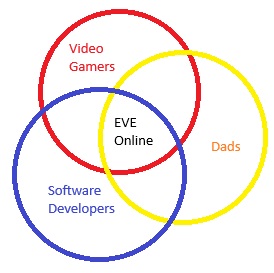
How could this have happened? Well, there honestly aren’t that many games with spaceships. I’ve bounced off this one twice before, and for some reason, this time it stuck. I just couldn’t escape the gravity of a game that seems to be populated mostly by middle-aged dads with a high propensity for programming.

EVE is one of those incredibly rare MMOs that isn’t World of Warcraft, and yet keeps puttering along, staying alive for over twenty years. Throughout all that time, they’ve been releasing fiction in this world.

Don’t get me wrong, I haven’t read any of their books yet. There are a few of them, but I’m not that far gone. Instead, I’ve been perusing the “Chronicles,” which encompass a bunch of dry descriptive reads about particular factions or technologies, and a slightly shocking number of short stories.

It’s now been a couple of years since I’ve participated in a long-running TTRPG group, and I find that this really scratches that itch. It’s the same satisfying combination of playing in a world, and then really digging into the setting. The only difference is that this one is online. (Well, okay, I guess my last D&D group met online too, thanks to the pandemic.)

What I’m Reading in December

Yes, I’m still reading the last Witcher book. Yes, I’m a little worried that the whole story is going to fall apart in the final volume. I’ll also be trying to wrap up the Dark Materials series, and I’ve still got a few more comics trade paperbacks waiting in the wings.

See you next month!

Year of Short Stories — Week #49

2024 is my year of short stories. In this weekly series, I talk about the stories I’m working on, from idea and draft to submission.

  • Stories in Progress – 2
  • Submissions This Week – 0
  • Submissions Currently Out – 4
  • Acceptances This Year – 1
  • Rejections This Year – 29 (11 higher tier)

A Quick Update

I don’t have a lot to report this week. A single rejection came back for No More Kings, which was something of a long-shot to begin with, being a drabble and a reprint. I’ve got a couple of these drabbles just hanging around taking up space, and I should probably spend some time finding places to submit them again in the next week or two.

I’m still working on Red Eyes revisions, although I admittedly didn’t get a lot done this week. Still, any progress is good progress, and a long winter vacation is on the horizon.

Approaching the End of the Year

I’m beginning to feel the end of 2024 closing in. For my first year really dedicated to short stories, I’m fairly pleased with the results. I’m sure I’ll do a final retrospective, but I’ve already managed to make 30 submissions. Not too shabby.

Goals for Next Week

  • Look for places to send drabbles
  • Continue Red Eyes revisions

Year of Short Stories — Week #48

2024 is my year of short stories. In this weekly series, I talk about the stories I’m working on, from idea and draft to submission.

  • Stories in Progress – 1
  • Submissions This Week – 0
  • Submissions Currently Out – 5
  • Acceptances This Year – 1
  • Rejections This Year – 28 (11 higher tier)

Submissions

No rejections or new submissions this past week (or rather, this past 4-5 days, since I was late in posting last week’s update). My lone submission the previous week was Dr. Clipboard’s Miracle Wonder Drug, which had just come back to me with a contest honorable mention.

Since I do a lot of my writing work on the weekends, I often resend stories and write blog posts in the same day. Before I do that, I look at the Duotrope Theme and Deadline Calendar, and the Publishing News. The calendar gives me a convenient list of themed issues and anthologies with deadlines in the next month, and the news page gives me a list of new publishers and those that have recently opened to submissions. These two lists are incredibly valuable when you’re sending out short stories.

Most weeks, I don’t find anything particularly exciting in the theme calendar, but it’s still worth checking because I occasionally find an upcoming issue or anthology whose theme fits one of the stories that I’m resubmitting that week.

Last week was one of those weeks, and I found an anthology that sounds perfect for Dr. Clipboard. Sure enough, I got a response within a few hours, holding the story for further consideration.

Further Consideration

This is the first time I’ve gotten this style of response for a story submission. As is typical for anything related to short story submissions, Aeryn Rudel has an article. He puts holds, further consideration, and short listing all in the same bucket—a story that someone at the publisher read and liked enough to consider publishing it.

Since most markets are inundated with submissions and will only end up publishing a fraction of the stories they like, it makes sense for them to keep their options open until the end of their submission window.

Not every publisher notifies the writer that their story is being held. They’ll just hold it and either send an acceptance or rejection when they’ve made a final decision. As a writer, you can appreciate a publisher that communicates the hold, or you can be frustrated to have yet another reason to get your hopes up, and possibly disappointed if that hold results in a rejection.

Personally, I’d rather have the additional information. Even if the story ends up being rejected, a positive, personalized response still tells me that the story is probably solid, and I just need to find the right publication for it.

Stories in Progress

I still have some projects lingering from my truncated November “PerShoStoWriMo.” I haven’t gotten a lot of words down for those stories, but they’re still taking up brain space, and I may spend more time with them in the coming weeks.

I’m still in the process of condensing the critiques I received for Red Eyes into actionable changes. In some cases this is a straightforward rewording or cut, but in other cases it requires a fair amount of thought to figure out how I want to address a concern (or if I want to address it at all). I may write a post in the future about this process.

The most interesting piece of feedback I received was that the length of the story is good. It clocks in around 6,500 words, which is long for me, and I explicitly asked readers if they saw any good places to trim that word count. A few readers ignored the question, but most of them said there were no good places to make a significant cut. A couple even said that they’d like to see a longer version of the story. One suggested a novelette, the other suggested a full-blown novel.

While I don’t plan to follow that advice, the unified response does alleviate my fears that the story is too long. I suppose I’m just stuck with a longer story, and I’ll have to deal with that when I’m finished editing and have to look for markets to submit to.

Goals for Next Week

  • Continue revising Red Eyes
  • Spend some time on one of those other story ideas