
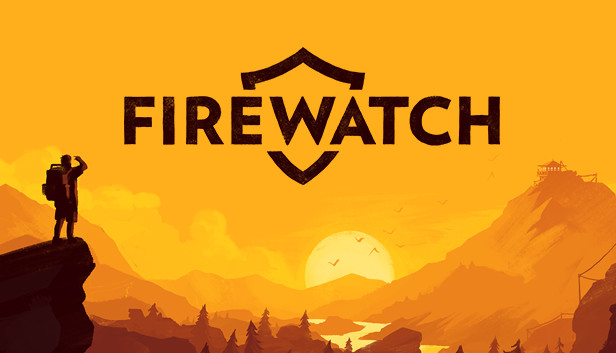
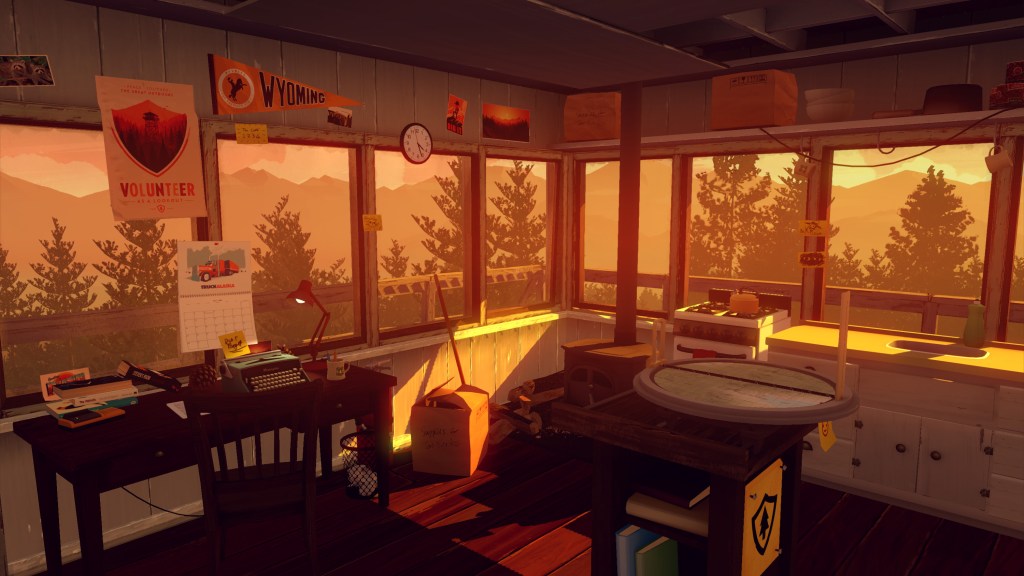
The job of a firewatch involves living in a single-room tower deep in the wilderness, monitoring the forest for fires. It’s a job that attracts those seeking solitude—the strange or socially awkward, and people trying to run away from their problems.
An Unorthodox Beginning
Firewatch begins with a blurred background and the audioscape of a bar. You play as Henry, a drunk college student, and you’re meeting your wife, Julia, for the first time.
A few paragraphs of text and a couple of life choices allow you to choose-your-own-adventure through several years of Henry and Julia’s relationship and marriage: their joys, arguments, and struggles. The choices start out easy, then problems arise, and the game presents more harrowing decisions where neither option is good.
Interspersed between these text vignettes are little snippets of 3D gameplay. As Henry, you load your truck in your apartment’s underground parking. You arrive at a trailhead in the forested wilderness. You hike, you camp. Eventually, you arrive at a huge, wooden firewatch tower.
On paper, I would never expect the opening of Firewatch to work. A rushed prologue in plain text? Front-loading a ton of emotional weight and exposition? When the game started, I was skeptical.
It’s a testament to the writing and design of the Campo Santo team that it does work. As a player, you become a participant by making tough choices with Henry in his back-story. You get a glimpse of life being good, then bad, and finally almost unbearable. It’s just enough time and detail to begin to sympathize with him and understand why he took the firewatch job.
Interleaving this backstory with the journey to the firewatch tower is oddly cinematic, a bit like voiceover, and creates the sense that all of this is weighing on him as he travels to the tower.
Exploration
Beyond this initial prologue, Firewatch sets aside the text and becomes a full 3D game. Your tower is your home base, but most of your time is spent in the forest. As Henry, you can walk and run, vault over obstacles and climb, but not jump. This is not a “walking simulator,” but the mechanics are simple and straightforward.
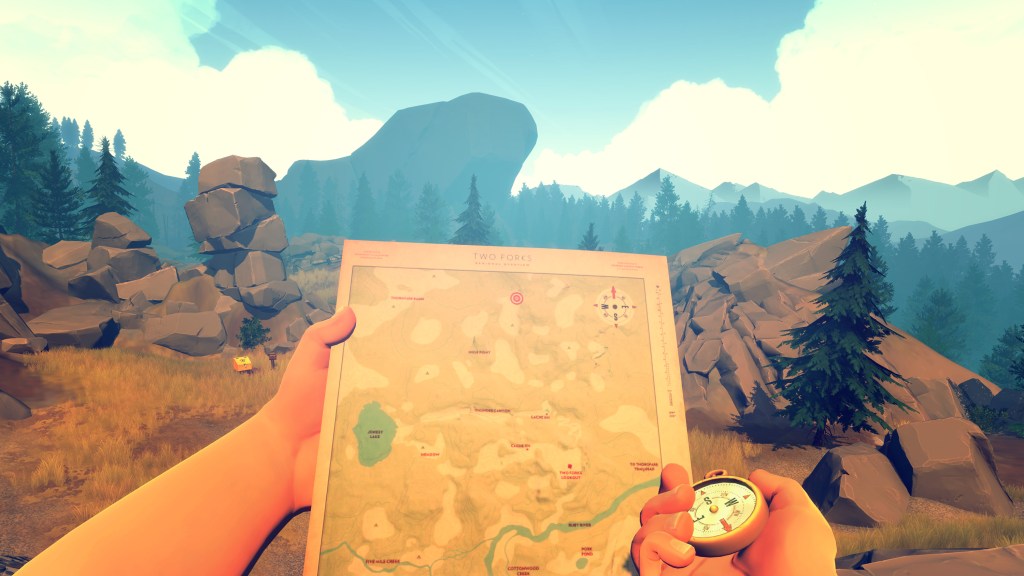
From the beginning, a surprisingly large area of wilderness is open to your exploration. More areas open up as you get further into the game and acquire new tools, the first of which is a backpack of ropes that allow you to rappel up and down shale slides and steep slopes.
You are given a compass and map, and the game doesn’t clutter the screen with big arrows, icons, and indicators. It’s easy to get turned around or take the wrong path, but this makes it feel more like real exploring and less like the game is holding your hand.
In reality, the game carefully contains the player, but it goes to great pains to make it feel like the world is wide open. For the most part, it succeeds.
Ten-Four, Boss
You are alone in the wilderness, and your only link to the rest of the world is your high-powered walkie-talkie radio. With it, you can talk to your boss, Delilah, in the next tower over, which is barely visible on the top of a mountain several miles away.
As your boss, she helps get you acclimated to the job and provides you with tasks to keep you busy. She’s been out here for years and knows her way around.
The radio becomes your primary means of interacting with the world. When you see something interesting in the world, an icon pops up and you have the opportunity to talk to Delilah about it. You soon strike up a snarky rapport, and she becomes your constant companion throughout the game. The two of you discuss your past, shoot the shit, and become close. Then everything starts to go wrong.
What’s Out There?
From your first day on the job, there is mystery lurking in the forest. Delilah tasks you with finding and telling off some camping teens who are launching fireworks in peak fire season. On your way back, you encounter a shadowy figure who blinds you with a flashlight and disappears into the night. Then you find that someone has broken into your tower.
At first, the strange happenings seem innocuous, but things get weirder and weirder. More and more clues point toward something nefarious (and perhaps science-fictiony) going on.
To make matters worse, a fire breaks out just a few miles away. Fire crews do their best to contain it, but it grows day by day, a looming danger that adds tension. If it spreads, you and Delilah will be forced to evacuate, and you’ll never know the truth about what’s really going on.
Storytelling
Firewatch is full of moral quandaries posed to flawed characters. Everyone here has made bad choices, and everyone can be blamed for something. The game doesn’t tell you how to feel, and doesn’t paint the world in black and white. It doesn’t provide a pat conclusion either.
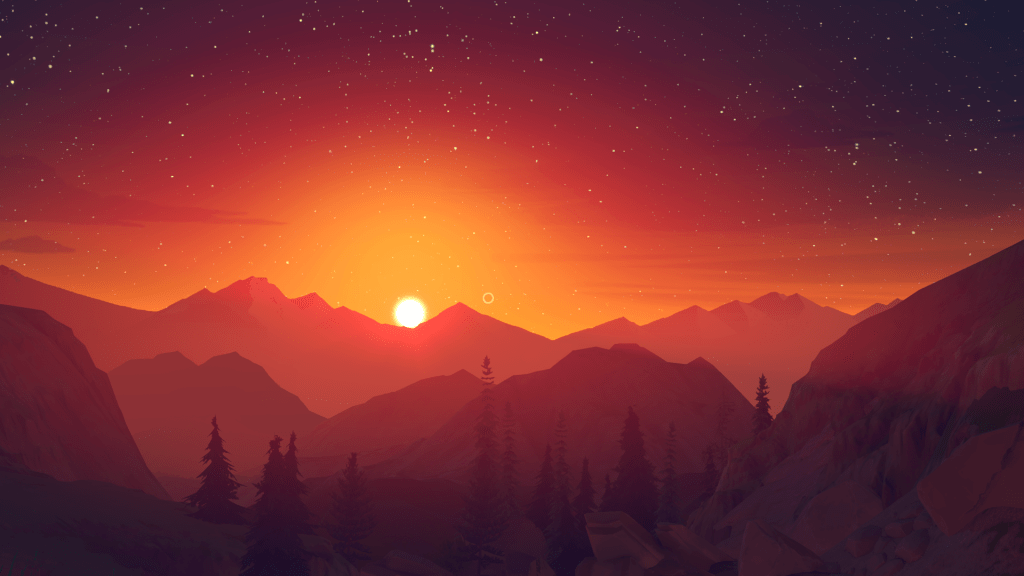
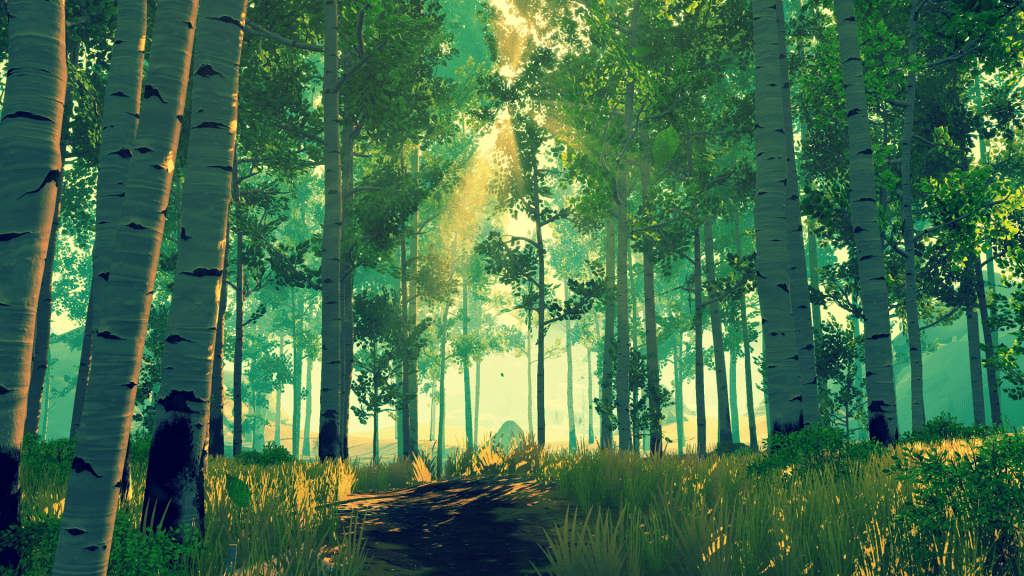
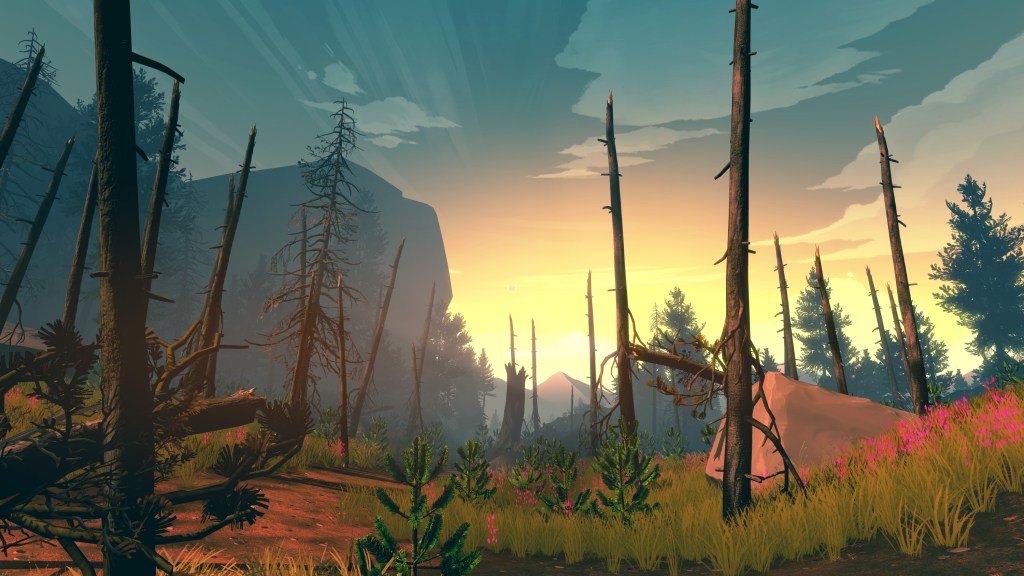
Firewatch isn’t perfect—it was made by a small team, and they had to cut corners in some places to be able to finish it. But they did so very smartly. The graphics are not state of the art (even for a decade ago, when the game was released), but they have a painterly aesthetic that is often beautiful. There are few characters, but the voice-acting is impeccable, and makes the whole game work.
The story can be completed in 3-5 hours, but it’s full of twists and turns, and contains a few laughs and a fair bit of heartbreak. Games, even story-centric games, often struggle with endings. Firewatch sticks the landing. It’s not necessarily a happy ending, but the mysteries are all resolved.
Henry, having run away from his problems, is confronted with an example of how badly that can go. It’s up to you whether he takes that lesson to heart.
As a wonderful bonus, the game includes a documentary mode. It turns the game into a sort of interactive museum with stations scattered throughout the wilderness. Each station has voice notes from the developers, and sometimes concept art or other notes pinned to bulletin boards. I wish more games would do something like this, although I can understand forgoing it when it’s such a challenge just to ship a game.
Where to Get It
Firewatch is a game by Campo Santo, published by indie powerhouse Panic, Inc. It’s available on just about every modern console and PC platform.

 Words Deferred