Reblog: Writing Set-Up For the Big Reveal — Beem Weeks

Today I wanted to point you to a quick read about setting up a story with a big reveal at the end. I appreciate that this advice is just as applicable for writers like me, who like to outline, as to those who prefer exploratory writing.

Some writers swear by the outline. Other writers, those seat-of-the-pants types, have little time for such nonsense. The desire to get that story from head to page is much too urgent. I’m not going to rehash that old outline-versus-pantser argument. Writers will choose the one that works best for the individual and run with it.

What I’d like to share today is the set-up. This is where an outline really comes in handy, though it certainly isn’t necessary. Most writers know what the set-up entails. It’s those breadcrumbs sprinkled throughout the story that leads to the big reveal at the end.

Read the rest over at Story Empire…

Storytelling Class — Finishing Stories

Every week, my daughter Freya and I have a “storytelling class.” Really, it’s just a fun opportunity to chat about writing stories. In our first class, I asked her if she had any topics she wanted to cover. She said, she sometimes has trouble finishing stories, something that I think many of us can relate to. So this week, our topic was how to finish stories.

The Two Questions

Each class, I start with two questions: what did we read, and what did we write? Then we talk about how we felt about those things, and if we learned anything.

What Did We Read?

Freya has been reading a lot. She’s re-reading the Bone graphic novels and Harry Potter (currently on The Order of the Phoenix). At school, they’re reading The One and Only Ivan.

I had just finished The Martian. I’ve also been reading the ongoing bloggy adventures of Ela the Expert and Grace. I’m also in the midst of reading The Lord of the Rings to the kids. We just finished the Battle of Pelennor Fields.

I explained that I really appreciated the Martian as a great example of the try/fail cycle in action. Freya had a hard time thinking of specific things that she liked about the stories she had read. I suggested that when she reads, she occasionally try to think about what she likes or dislikes about what she’s reading. As a writer, this is a great way to learn from what you’re reading, and pick up new ideas and techniques.

What Did We Write?

Freya wrote about The One and Only Ivan in her writing journal at school. I wrote a chapter of Razor Mountain. In keeping with the theme of this week’s class, I’d been procrastinating getting that chapter done.

I also wrote four or five blog posts, including a reblog of Cory Doctorow’s “The Memex Method.” We talked about his idea that a blog can serve as an idea incubator, growing those ideas until they’re ready to be stories.

Freya said she often has fun ideas, but isn’t sure how to make them into a story. We talked briefly about saving those ideas in a file or journal, and how sometimes the key is to combine a couple different interesting ideas into a story. Turning ideas into stories is a big thing, so we decided this would be a good topic for a future class.

Finishing Stories

On to the main topic: what are some ways to finish stories when we’re having a hard time?

1. Write Shorter Things

As a general rule of thumb, the shorter the story, the less time and effort it takes to write. It’s harder to finish a novel than it is to finish a short story. That doesn’t mean that writing a short story is easy. It just means that if you want to try to finish more things, a good strategy is to write shorter stories.

2. Have a Plan

We talked a little about outlining vs. exploratory writing, and G.R.R.M.’s categorization of writers as gardeners and architects. I’m more of an architect, and Freya is more of a gardener. Either way, we all sometimes get stuck in the middle of a story because we don’t know what happens next. It can help to have some sort of plan. It doesn’t have to be a full outline. It may just be knowing the beginning and ending of the story, or knowing a handful of stepping-stones we want to land on.

3. Make a Schedule

A lot of writers are procrastinators. As the famous phrase goes, “I hate writing, but I love having written.” Sometimes what you really need is a reason to put butt in chair and pen in hand. Personally, I often find that the biggest effort of a writing session is to get myself to write the first sentence. As soon as I start, I remember what I love about the story, and the words flow.

One of the reasons I love having a blog is that it makes me write on a regular basis. If I want to post something every Monday and Friday, then I have to sit down and write something at least a couple times per week. That doesn’t necessarily mean I’m working on other projects, but at least I’m writing.

4. Switch Back and Forth

Sometimes we just need variety in our lives. While there are a few authors who are content to write book after book in the same world, with the same characters, most authors I know have so many varied ideas that they’d like to explore that they’ll never have enough time to work on them all.

It can be incredibly refreshing to take a break from a project that you’re struggling on to work on something fresh and new. One of the oddities of human brains is that they’ll often solve problems in the background, when the conscious mind is focused on something else.

This is another great thing about having a blog. If I’m having a rough time working on a novel or story, I can always take a break to write something for the blog. I can switch from fiction to non-fiction, or from one story to another.

Of course, if you’re switching between things, you need to make sure you’re coming back to them. It’s not a helpful technique if you start ten things and finish none of them. Then you’re just telling yourself you’re taking a break, when you’re really serially abandoning writing projects.

5. Be Accountable to Someone

I’ll be honest. My ambitions are usually far bigger than my work ethic. I’d love to finish that novel, but dang it, there’s another Steam sale and I’ve gone and bought five new video games for $3 each. For a lot of us, our own internal motivations don’t always get the job done. Being accountable to something or someone beyond just ourselves can give us that motivating boost we need.

This is yet another place where having a blog helps me. If I know I have readers, it makes me want to keep writing for them. Even if, realistically, nobody is going to be terribly disappointed if I miss a week of posts, I still feel a little bit like I’m letting someone down.

A writing partner, writing group or class can also be a great motivator. Schedule a regular time with a helpful reader to go over new work, and you’ll suddenly be far more reluctant to show up with no new words in hand.

6. Set it Aside

This may not sound like a great way to finish things, but it can be, occasionally. Sometimes you start writing a story and it’s just…missing something. No amount of brainstorming or reworking seems to fix it. In that case, it may just be that you’re not ready to write that story. Maybe it’s missing some crucial idea that will pull everything together, and you haven’t thought of it yet.

If a story just isn’t working, you may need to set it aside. Again, your subconscious can keep struggling with that problem while your conscious does something else. The key is to keep coming back periodically. Re-read it every once in a while. Look through your idea journal and see if there’s something there that breathes new life into that old story. Eventually, inspiration may strike. If not, you’ve hopefully been more productive writing something else.

7. Check for Something Missing

Many stories don’t work because they’re missing something structurally. Make sure you have at least a main character who has a problem or wants something. A character without a goal is rarely interesting, and a goal without complications or road-blocks usually doesn’t make a very good story either.  There has to be a source of conflict or tension.

I told Freya a little bit about chapter five of Razor Mountain, and how it wasn’t very interesting until I added some conflict between God-Speaker and other members of the tribe. We also talked about the characters in the Harry Potter series, and how each of them has their own goals and challenges, even though Harry vs. Voldemort is the central conflict of the series.

Homework

First, we have the standard weekly homework: we need to be ready to answer the two questions, what did we read, and what did we write? How did we feel about it and what did we learn?

Second, we’re going to finish a story! Each of us will write a story two pages or less. This will help us practice some of the techniques we talked about: writing shorter things, making a schedule, and being accountable.

Next week, following Freya’s suggestion, we’ll look at ways of turning ideas into stories.

Razor Mountain Development Journal — Chapter 6

his is part of an ongoing series where I’m documenting the development of my serial novel, Razor Mountain.

You can find my spoiler-free journals for each chapter, my spoiler-heavy pre-production journals, and the book itself over at the Razor Mountain landing page.

A Little Rewrite

I knew what I wanted to do in this chapter and I didn’t deviate too much from my outline. I initially wrote the first couple pages of this chapter as a summary of what Christopher had been doing for the past week or so, but that was too dull. I rewrote that section from the perspective of a single day, while layering in little details of what he has been doing along the way.

This is something I catch myself doing occasionally. It almost always turns out better to have a scene where a character is actively doing something, instead of paragraphs of exposition describing what they already did. While I think “show, don’t tell” is one of those rules that people worry about far too much, this is a fairly classic example of “show, don’t tell.”

I caught myself (much more quickly) doing the same thing in the second part of the chapter, as I summarized Christopher’s thought process leading up to his test excursion. Once again, I adjusted it to start with him taking action, and interspersed his thoughts and details of his preparations.

Winter Camping and

For this chapter I had to research a topic that I knew was coming: cold weather camping. Some things are fairly obvious: you need to wear multiple layers and warm outerwear. You need a fancier sleeping bag and tent. Other things were less obvious to me, like watching out for sunburn or dehydration from sweating.

Here’s a selection of links, if you want a taste:

Tents for cold-weather camping come in a few different types, ranging from under 3 lbs. to over 20 lbs. Single-person tents designed for mountain climbers can be impressively light and sturdy. The larger ones are more for basecamp or for recreational camping, because they’re a hassle to carry.

Some are double-walled, but not all. They’re typically a waterproof fabric with additional coatings, and require stronger poles (e.g. carbon fiber). Even with waterproofing, water in the tent can be a concern – a person’s breath can create condensation on the inside.

I made a rough list of the things Christopher might want to bring with him. Estimating the weight of all of this, it could come to 50 lbs. or more, so the sled really becomes necessary to carry a good chunk of that weight.

  • Food
  • Fresh water (need 1 liter / 2 hours of hiking. 3.78L = 1 gallon. Snow can also be melted.)
  • Sleeping bag + pad
  • Hatchet
  • Flint and steel, dry kindling
  • Snow shoes
  • Small snow shovel
  • Spare clothes
  • First aid kit
  • Rifle
  • Camp stove & fuel
  • Utensils, Knife, misc.
  • Lantern

Everything is Harder Than It Looks

Things are still not easy for Christopher. He has supplies, but he has no expertise. He’s not in particularly good shape and was recently injured.

I think pop culture has trained a lot of us to accept that protagonists can just step up and do whatever needs doing and end up being just fine. The supposedly average character effectively gains super-powers when the plot calls for them to do hard things. I really don’t want Christopher to be one of these action heroes. Even something that might sound fairly straightforward, like hiking and camping in cold weather, can actually be fraught, especially when completely cut off from civilization.

Christopher’s just taking baby steps, but soon he’s going to have to get riskier. Things are going to get harder for him. We’ll see how it goes in Chapter 7.

Razor Mountain — Chapter 6.2

Razor Mountain is a serial novel, with new parts published every week or two. For more info, visit the Razor Mountain landing page.

Two days later, excited and nervous, Christopher stepped out of the bunker with a full pack on his back and another tied onto his makeshift sled. It would be more than he needed for a day trip, but he needed all of it to validate his experiment.

Christopher knew, intellectually, about the Dunning-Kruger effect, but he now realized that he had never really believed that it applied to him. Of course he knew his own strengths and limitations, fully and completely. As a suburban office worker who hadn’t gone camping since childhood, he had known he was no expert outdoorsman. On the other hand, how hard could it be, if you had the right equipment?

A week and a half in his current predicament had cured him of those notions. Even with the safe, warm, well-stocked bunker as his base camp, he could tell how out of his depth he was. Making it to the next square on the map would require a multi-day trip. He would need to navigate. He would need food and water and shelter. Even then, he had no idea what he would find when he got there.

He checked his compass and veered off at a diagonal to both the line of the cliff on his left and the shore of the pond on his right. The lightly wooded land ahead sloped slowly upward toward a pair of hills. His first landmark. He stopped after a few minutes and looked back.

The entrance hatch to his bunker was fairly well-protected under the overhang of the cliff. While it wasn’t exactly hidden, it could only really be seen from a small area of shoreline within twenty or thirty feet of the hatch. From his current position, it was invisible. If each of the locations marked on the map were a similar structure, Christopher might navigate perfectly and still never find what he was looking for. He could stand on top of it and never know.

He would have to prepare for the trip to the next square, and the trip back if he didn’t find anything. Then he’d be faced with an even tougher decision. Try again? Dare an even longer journey to the next dot in the chain? Or sit in the bunker and wait until the supplies eventually ran out, with less hope of rescue every day?

He forced himself to not think so far ahead. First, he would get to that next dot. That was enough for now.

But before he could do that, he had to convince himself that he had a reasonable chance of making it there and back.

He had decided on a one-day trip for his first major excursion. He could scout in the direction he would be headed. He could practice camping and cooking, and he would be much less likely to become catastrophically lost. He would pack everything he was going to take on the final trip. As it turned out, that was a lot.

The day ended up being perfect for hiking. The sky was clear blue. The sun shone brightly, providing what little warmth it could. Visibility was perfect, and the mountainous landscape and trees were the only thing preventing Christopher from seeing from horizon to horizon.

He was surprised how energized he felt. He was finally doing something. He was taking control. He had to admit, it felt a little out of character for him, but in a good way.

“All it took for you to be proactive was a terrible, mysterious plane crash in the wilderness,” he said to himself as he trudged up a low hill. “They should make that some kind of corporate leadership training exercise. Get your MBA in Alaskan Wilderness Survival and Self-Esteem today, at Fly-By-Night University.”

His makeshift sled worked unreasonably well, considering it was just a broken shelf. He had debated whether it would be too much of a hindrance in rough terrain, but it didn’t seem possible to carry both the tent and all his supplies on his back. So he was hauling it, at least on this test excursion, to see how practical it was.

He did his best to keep a steady pace, knowing that once he was more than a day out from the bunker, the speed of his progress would be a very real factor in his survival. He paused on a hill with three aspens crowning it and ate one of the strange jerky-and-fruit bars. He measured his progress by the movement of the sun. As it approached noon, he found a flat place with only a little snow, nestled between two low hills. A crescent-shaped grove of aspen, still clinging to a few of their yellow leaves, half-surrounded the hills, providing some protection from wind.

He unstrapped the little shovel from his backpack, he did his best to clear a space in the snow. Then he set everything down on the sled and unfurled the tent. He had set it up twice, once in the comfort of the bunker, and once on the bare, flat ground between the hatch and the pond, with the full inconvenience of heavy gloves and winter gear. Now, he did it once again, setting up the inner tent, then the outer rainfly. He used the hammer end of his hatchet to pound the stakes into the frozen earth.

By the time the tent was set up to his satisfaction he was sweating beneath the layers of winter clothes, and he realized he was intensely thirsty. He paused to drink from a jug of water, and ended up finishing half of it. It seemed strange to be so thirsty hiking in the cold, but he would have to be careful to not become dehydrated.

He hauled his gear into the tent, doing his best to avoid tracking snow inside. He set up the sleeping pad and sleeping bag. He already felt the allure of taking a warm nap, but with no alarm to wake him he didn’t want to risk accidentally camping overnight. This was only supposed to be a day trip. He took off his jacket and snow pants, and sat cross-legged, sipping water and taking inventory once more.

His backpack was filled with things he most wanted to have on hand, or keep dry. The sleeping gear, extra clothes, fire starter and the food that could be eaten on the trail. The backpack was also equipped with a pocket specifically for a first-aid kit, and straps for snow shoes, collapsible shovel, and hatchet. In the pack on the sled, he kept more food and water, a gas camp stove and fuel tank, a lantern and cooking utensils. He had also brought a rifle and a box of ammunition, even though he had never fired a gun before and doubted he would be likely to use it for hunting or self-defense.

Once he had rested and cooled down a bit, he suited up once more and went outside. He cleared a space near the tent to set up the little camp stove. First he melted enough fresh snow to refill his water bottle. Then he opened a can of chicken noodle soup. He knew that there should be nothing stopping canned goods from staying fresh for decades, but he still sniffed it tentatively. It smelled more or less like  soup. The little burner of the stove was unimpressive, but it heated the small saucepan well enough. Christopher worried that he had no good way to check the amount of fuel left in the small tank. It wasn’t a concern on this trip, but it might be a concern on a multi-day journey.

By the time he was done with his lunch and felt somewhat rested, it was well past midday. He felt a little foolish disassembling the tent after having it up for an hour, but he packed it back into its bag, and all the rest of his gear into his backpack. He had thought he was becoming acclimated to tromping around in the snow and spending hours out in the cold, but hiking with dozens of pounds of gear was sapping his energy more than he had expected. It drained him just knowing that he couldn’t step back into the warmth of the bunker whenever he wanted. As he followed his own tracks back the way he had come, he could tell that his knee was starting to get irritated again as well.

The motivation of the morning had left him. A sharp wind came blowing out of the southwest, and it brought scudding clouds that dimmed the sun as it drew closer to the horizon. Christopher pulled his ski mask down over his face against the cold.

As the sun sank lower, it became clear that he was taking much longer going back than he had on the way out. He came to the hill with three distinctive pines where he had taken his mid-morning snack as the sun approached the mountain peaks, casting them in red light. All he could think was how lucky he was that he had decided to take a test outing before attempting the real thing.

He climbed to the top of the hill and squatted among the three trees for another snack, watching the sun come down to touch the tallest peaks. He remembered to drink his water and found once again that he was incredibly thirsty. He rose and picked up the sled rope, but before he could start down the hill, a crack rang out, echoing among the trees and hills.

It could have been a large branch breaking somewhere in the distance, but something about the timbre of it gave Christopher the unshakable feeling that it was the sound of a gun, far in the distance. He waited and listened, holding his breath without realizing it. The silence was cut only by the gusting wind. He knew there were probably a dozen natural explanations for such a noise in the wilderness, but it left him feeling uneasy.

After a minute or two, he continued. The sun sank past the distant mountains and the now-cloudy sky lit up like a purple and red bruise, then faded slowly to black. It felt like a defeat when Christopher was forced to get out the gas lantern and light it. It was well after sunset when he reached the long, gentle slope that led down between the cliff face and the pond, back toward the hatch and the bunker. Navigation had been easy. He just had to follow his own trail.

The moon was obscured, but the cloud cover wasn’t complete. There were patches of sky where bright stars still shone through. Christopher paused to take a deep breath of cold air and stare up at them. Even after a frustrating day out in the wilderness, he couldn’t deny that it was beautiful out here.

In the small patch of open sky, framed by gray clouds, a streak of light appeared, followed by another.

“Damn.”

He couldn’t remember if he had ever actually seen shooting stars before. People always seemed to make such a big deal about them in TV and movies, but it was just a tiny streak of light, so quick and faint that he wondered if he had imagined it. Still, he decided to take it as a sign of good luck, finishing out an otherwise unsatisfying day.

“I wish to not die alone in the wilderness,” he said, under his breath. Then, recalling that he had seen two, he added, “And I’d like to go home, please.”

The sigh of warm air as he opened the hatch was a relief. He dragged the sled inside and left a trail of slightly damp clothes across the floor on the way to the bunk room. He had just enough energy to replace them with warm, dry clothes. Then he fell into bed, where he was immediately asleep.

<< PREVIOUS ] [HOME] [ NEXT >>

Razor Mountain — Chapter 6.1

Razor Mountain is a serial novel, with new parts published every week or two. For more info, visit the Razor Mountain landing page.

Christopher woke before the piped-in sunlight illuminated the bunker. The days were getting shorter. He wondered if he was far enough north to see days of near-total darkness in the depths of winter. He opened the footlocker in front of the bed and dressed. He had packed it with the few sets of clothes he had found in the bunker that fit him relatively well. Most were slightly baggy, although he had made some crude adjustments to waistbands with a small sewing kit.

He ate a dull breakfast of oatmeal, flavored with a packet of freeze-dried berries. He put on his jacket and snow-pants, grabbed his backpack of supplies, and exited the hatch, dragging a makeshift sled behind him. It was fashioned out of a sheet-metal shelf from the pantry, with a length of rope passed through the bolt-holes.

It had snowed again, several inches of fluffy powder, so he got out his snow shoes to travel easier. He trekked down the shoreline to an area thick with large pines. He had been working his way through this section of trees, chopping off the most easily accessible branches and collecting the dead wood. He made three trips today, loading the sled thigh-high with wood each time.

He didn’t drag it all the way back to the bunker. Instead, he brought it to a shallow pit he had dug and surrounded with a ring of rocks. It was nestled next to a tangle of low shrubs that protected the fire from the wind, making it easier to light. The line of trees further off gave the smoke a chance to rise before the wind caught it. The smoke still dissipated as it rose above the tree line, but he could only hope that the faint haze would be enough to tip off any observers.

He sat on a flat rock near the pit, periodically feeding more wood into the fire and writing in his notebook. He marked the days so that he wouldn’t lose track of time. He wasn’t quite sure how much time he had lost after the initial crash, but he figured he had been at the bunker for eight or nine days. Enough time that anyone looking for him would probably be looking for a body, rather than a survivor.

Once he had put the last of the wood on the fire, he packed his things. He had been exploring the area around the lake, and had discovered that there was a place about a few hundred feet east of the hatch where the sheer cliff was broken by a gap. It looked as though a whole section of the wall had sloughed off, leaving behind gravel and fist-sized rocks. A shallow slope rose through the gap, leading to a shelf some twenty feet up. From there, several navigable paths branched off.

Christopher had spent a good part of two days exploring up on the cliff, making a crude map in his journal as he went. He wanted to find a vantage point to get a better view of his surroundings. Today, he followed a rough path that went further up, finding that it eventually turned back in the direction of the bunker entrance, rising steadily the whole way. It led to a narrow ledge that tapered to nothing, but he found a few hand-holds up to another, wider ledge. After a couple hours of hiking, it led him to a flat spot that he guessed must be nearly straight above the hatchway. From here, he could survey his tiny corner of the world.

From above, the shape of the lake was quite different from what he had imagined as he walked the perimeter. He had envisioned it as a bean shape, with the lobe closest to the bunker a little bigger than the one further away. He had found a dozen or more lakes like that on the map he had found in the bunker. From his higher vantage point, he could see that it was more like a “3,” with a third protrusion in the middle that jutted out beyond the other two.

Christopher had studied the map for days. He knew that shape. It was the shape of a specific pond on the map, one of a handful directly adjacent to the unlabeled squares. He had no way to take a picture from this high vantage point. His phone was either in the burnt remains of plane, scattered across a mountainside, or at the bottom of the pond. He took off his gloves for a few minutes to sketch in the notebook. It wasn’t perfect, but it was good enough considering his half-numb hands.

He made his way back, purposely taking his time. His leg was still sore, but he no longer felt a knifing pain when he put weight on it. Now that it was healing, he didn’t want to re-injure it with an accidental slip or fall. Going down the final slope turned out to be the most taxing part. It felt significantly steeper descending than it had ascending, but he found a piece of dead wood for a walking stick and sidled his way down without incident.

He made it back to the hatch before the sun had reached its zenith, but he felt as though he had already spent a full day outside. He made an early lunch of rice and beans to regain his energy. When he had finished, he set the map and his sketch on the table.

After all the hours he had spent studying the map, it was gratifying to see that the shape of the pond from above clearly identified his location on the map. It was also irritating that he had wasted so much time scrutinizing all the little bean-shaped ponds simply because he couldn’t get a good sense of the shape from walking the perimeter. He circled his location on the map with the pencil. It was a little square in the bottom left corner.

The squares were scattered across the map, but there was clearly a pattern, with several lines of them radiating out in five directions from the middle, like an octopus. Pentapus? There was nothing marked in that central area, but from the contour lines it appeared to be the tallest peak in the area. The square above the little “3”-shaped lake was at the very end of one of these spokes. Only one other dot was anywhere near it.

There was no indication of scale on the map. The only easy measure that Christopher could think of was the lake itself. He didn’t particularly trust his own eyes, but he guessed the lake was about a mile long. He carved little notches in the pencil with his fingernail, using it as a rough ruler. The distance between most of the squares was anywhere from ten to twenty miles, if his guess was accurate. The distance from his square to the next one was about fifteen miles.

He had been hiking up and down the relatively flat and open shoreline of the lake for several days. Fifteen miles of that type of terrain might be hard to manage in a single day, especially if he were carrying supplies. But the terrain would almost certainly be rougher. In every direction, the landscape was mountainous and rocky, and often dense with trees or brush.

An even bigger issue would be keeping track of where he was. There were compasses among the gear in the bunker, but the rough, hilly terrain would force Christopher to go around obstacles. The map had little detail apart from the contours of the land, and bodies of water. Those would need to be the landmarks he navigated by.

A faint crackle of static issued from the radio over in the corner. Christopher left it on day and night now. He never caught anything, apart from a few seconds of the numbers station here and there. The radio and the smoke signals held no hope for him at this point. There was no rescue coming. If he wanted to get home, he was going to have to do it himself.

He circled the square closest to his own on the map, and drew a line for his route. He flipped the journal to a fresh page and began a list of the things he would need for an expedition.

<< PREVIOUS ] [HOME] [ NEXT >>
Storytelling Class With Freya

One of the joys of parenthood is when your children take an interest in an activity you love. You get the opportunity to teach them what you know and give them all the advice you wish you’d had. My nine-year-old daughter Freya recently lamented that English class was boring because she didn’t get to write stories. She said, “I wish I had a story writing class.” It took a lot of restraint for me to not jump up immediately and start singing “A Whole New World” from Aladdin. Instead, I immediately instituted a story writing class for just the two of us.

My daughter was kind enough to give me permission to post about our classes. Since we’re planning to meet once per week, this will be a new weekly feature until she gets bored or I run out of things to talk about.

Teaching writing to a child is an interesting exercise, and I don’t have a ton of experience teaching. My daughter is a smart cookie, but she doesn’t have a lot of experience writing or reading stories, having not been on this earth all that long. I think the key is to be flexible and adjust to her interests. The most important thing kids need for successful learning is enthusiasm.

For our first “class,” I decided to start with some general principles and try to find out what she was interested in.

Nobody Can Tell You How to Write

I started with an abridged version of my writing advice advice. There are many authors who have found success with wildly different methods that work for them. It’s great to study and find out what works for other people, but you ultimately have to synthesize your own systems from bits and pieces of others’ advice, along with your own discoveries.

I can give advice, but not all of it will work for you. Just take what works and don’t stress too much about what doesn’t.

Making Sense, Feeling Good

It’s important for (most) stories to make sense. They should have events that follow one after another logically. But that isn’t what makes a good story.

If you think about some of your favorite stories, you probably love them because they made you feel something. The “feeling” of a story, the emotions it evokes, is the real measure of its worth. It might be “happily ever after” and make you feel good, but it might also make you feel bad, scared, surprised or satisfied.

I think one of the many reasons humans are storytellers is because stories serve as a sort of experience by proxy. I will never know what it’s like in real life to be an astronaut stranded by myself on Mars. I’ll never know what it’s like to be a little person with hairy feet, sneaking to volcano to throw in a magic ring. But I can still experience these things vicariously through stories.

Doing It on Purpose

The most important things you can do to improve your writing are:

  • Read a lot
  • Write a lot
  • Seek advice and opportunities to learn from others

The human subconscious is a wonderful thing. Your subconscious can absorb ideas and techniques, even without you realizing that you’re absorbing it. Your subconscious instincts can take you a long way. Still, if you want to get better at writing, you can’t rely solely on your subconscious.

You want to be able to make choices and decide how to do things to achieve specific effects. To do that, you need to consciously learn different techniques and the ways to deploy them.

Questions and Homework

To finish, we discussed a few open-ended questions. These may seem a little silly, but I do think that it’s worth it for any writer to ask themselves overly-broad questions

  • What is a story?
  • Why do you read stories, and why do you enjoy them?
  • Why do you want to write stories?

I also asked Freya what she wanted to cover in these classes. She said that one thing she has trouble with is not finishing stories. I’ll admit, this is something I’ve occasionally had issues with as well. So that will be our topic for next time: finishing stories!

State of the Blog – Feb 2022

It’s been six months again, and here we are at another “State of the Blog” post.

I write these partly for myself, and partly for other bloggers who are interested in what someone else is experiencing. Part of creating things for other people is about presenting an experience. Assuming you’re not completely cynical and opportunistic, a blog is going to be at least a little personal, but there’s a temptation to put the best version of yourself forward. Unfortunately, that often means that nobody wants to talk about their statistics or their experiences, unless those statistics and experiences paint them in a very positive light.

This blog is largely built around the idea of openly talking about the process of writing, the ups and downs and the unaltered details. The goal of these “State of the Blog” posts is to openly talk about the blog itself, and how I feel it’s going.

Goals

Six months ago, I gave these overarching goals. These all still apply today.

  • To hold myself accountable to a writing schedule
  • To develop an audience of readers
  • To provide something useful to other writers
  • To make connections with other writers

Blogging is the best tool I’ve found so far to keep myself writing on a regular basis. If I don’t write anything else, I am still writing 2-3 blog posts per week. In years past, I have often gone weeks or even months without writing, so this is very positive for me. That said, I still want to be writing more fiction than I am, and I need to figure out more strategies to motivate myself to do that.

Developing an audience is slow going. I think that’s partly because I’m not putting out fiction quickly or consistently, and partly just because it takes time and effort to catch eyeballs, and only a certain percentage of people are going to be interested. I’m continuing to see steady growth, so I’m not too worried about that, but certainly getting more good work out there wouldn’t hurt.

Providing something useful for other writers and making connections with them go hand in hand. Again, based on the statistics, it seems like more and more people are appreciating what I’m posting. I’ve also been working on making connections with other writers who blog regularly and have work that interests me. That’s a slow and tedious process of internet search-an-find, but it is rewarding to discover someone who posts great content, and even better if they like what I’m doing as well.

I have a couple short-term goals for the next six months:

  • Post Razor Mountain chapters more consistently and more frequently
  • Find more great writing blogs to follow

Metrics

  • Years blogging: 1.5
  • Total Posts: ~165
  • Total Followers: 62 (and 9 on Twitter)
  • Monthly Views: ~175 (average over last 3 months)

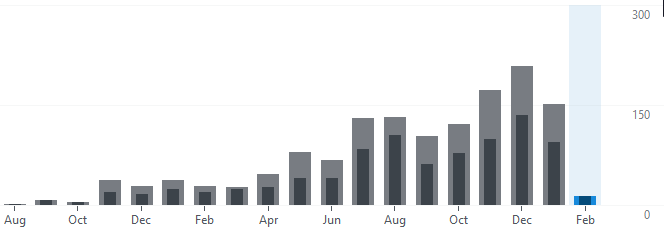
I try not to put too much stock in statistics, but if I’m honest, it’s hard to not pay a little bit of attention. So I take my data points during these six month intervals. Since this is the third of those intervals, I can start to make some comparisons between those three samples.

The short takeaway is that everything is just about double what it was six months ago. In terms of raw growth, that’s still closer to exponential than linear. It’s slower than it was between the six month mark and the one year mark, but I don’t think that’s terribly relevant when dealing with small numbers. In general, if the lines continue to go up, that translates to more people finding and liking the site.

I crossed the 1,000 view mark in December ’21, after about 15 months of blogging. At the current rate, I’d expect to hit the next thousand by May ’22, five months later. Not huge numbers, but steady improvement.

“Engagement” feels like a gross web business buzzword, but what’s probably more important is that I’ve seen more engagement in likes and comments. Comments are still hard to come by, but that’s to be expected. From what I’ve seen, it’s not uncommon to see anywhere from 25:1 – 100:1 ratios of views to comments. It’s just a lot easier to get people to read what you’ve written than it is to get them to comment on it.

In the next six months, I’d obviously like to see numbers continue to grow, but my biggest indicator of success will be more comments and likes. Feedback is great. Dialogue is even better.

Reblogs

In the past six months, I’ve started doing Wednesday reblogs more frequently. Basically, any week where I don’t post Razor Mountain chapters, I’ll post a Wednesday reblog. I’ll be honest, part of this is that it’s low-effort. I love the blog, but I also limit the time I spend each week on the blog. Hopefully this is a good way to highlight something that I found interesting or useful for other writers, without taking too much time away from other projects.

So…yeah, let me know if you like the reblogs, or if they just clog your feed. I can adjust accordingly.

Razor Mountain

Six months ago, I was still outlining and doing pre-production work on Razor Mountain. Since then, I’ve finished outlining and done all of the book-adjacent tasks like writing the back cover and designing the front cover. I’ve posted five chapters. That’s progress.

I made quick progress initially, then slowed down around the holiday season. Thanks to some real-life factors, I ended up feeling overwhelmed by the schedule I was trying to maintain. I’m now in a more relaxed place, and thinking about trying to push chapters out with a little more frequency.

I do enjoy the cadence of putting out a chapter in 2-3 parts throughout a week, and following it up with a Friday Razor Mountain Development post to talk about the process of writing the chapter. I think it will be interesting to look back on those development journals when the book is done, to see how it has evolved since I first started outlining.

I’m continuing to post chapters to Wattpad and Tapas alongside the blog, but my audience on those platforms is just about nonexistent. It’s understandable since I haven’t put much effort into networking with other writers on those platforms, and I’m not in the more popular genres and styles that I see on their front pages. For now, I’ll keep posting. There’s no point worrying too much about promotion until you have something you really want to promote. At some point when I have more chapters posted (or maybe even the entire book) I’ll dig into those platforms and make a little more effort to draw some attention.

Next Stop: Two Years

I continue to have lots of ideas for stand-alone blog posts and series. I used to worry that I might run out of ideas for a blog, but having written for this long, I’m now confident that I won’t run out any time soon. I have one specific series in the works that I’m excited about—more on that in a week or two.

That’s all I have for now. See you again in six months, for the two-year anniversary of Words Deferred.

Reblog: The Memex Method — Cory Doctorow

Cory Doctorow is an opinionated activist, technologist, futurist, and insanely prolific writer of novels and short stories, essays, speeches and Twitter threads. He’s also been blogging for more than two decades. To say that he gets a lot done would be a gross understatement.

Interestingly, Doctorow suggests that blogging hasn’t taken away time from his other projects. He believes that the blog is just a commonplace book (or better yet, a memex) that’s made available to the public, giving the writer a natural incentive to be a little more organized. It’s a tool for kicking around thoughts and opinions, assembling and tending to them until they’re ready to become a story, an essay, a book. It’s an idea generator.

Like those family trip-logs, a web-log serves as more than an aide-memoire, a record that can be consulted at a later date. The very act of recording your actions and impressions is itself powerfully mnemonic, fixing the moment more durably in your memory so that it’s easier to recall in future, even if you never consult your notes.

The genius of the blog was not in the note-taking, it was in the publishing. The act of making your log-file public requires a rigor that keeping personal notes does not. Writing for a notional audience — particularly an audience of strangers — demands a comprehensive account that I rarely muster when I’m taking notes for myself. I am much better at kidding myself my ability to interpret my notes at a later date than I am at convincing myself that anyone else will be able to make heads or tails of them.

Writing for an audience keeps me honest.

Read the rest over at Cory Doctorow’s Medium page…

Six Things I Learned From “The Martian”

The Martian is a 2011 sci-fi suspense novel about astronaut Mark Watney, who finds himself stranded on Mars after a huge dust storm ends his crew’s mission and nearly kills him. It’s a book that combines near-future hard science-fiction with a classic survival story. Author Andy Weir keeps the story rooted in realistic science and extrapolates what the first few manned missions to Mars might look like. But it’s Watney’s struggle to survive and overcome one impossible challenge after another that gives the book its heart.

Rather than review a decade-old book, I decided to look at what the story does well, and what lessons I can learn from it to improve my own writing.

1 – A Good Opening Is a Juggling Act

There’s a lot going on at the start of the book. The astronauts of the Mars mission leave their habitation module in the midst of a severe dust storm, fleeing to their launch vehicle so they can escape before it tips over in the high winds. They’re unable to see each other in the dust. When Watney is skewered by a high-speed flying antenna, disabling him and his suit’s comms, his teammates have no choice but to leave him for dead.

Weir could have started the book with this high-octane action scene, but he doesn’t. Instead, he starts with this:

Chapter 1

LOG ENTRY: SOL 6

I’m pretty much fucked.

That’s my considered opinion.

Fucked.

Six days into what should be the greatest month of my life, and it’s turned into a nightmare.

I don’t even know who’ll read this. I guess someone will find it eventually. Maybe a hundred years from now.

For the record…I didn’t die on Sol 6. Certainly the rest of the crew thought I did, and I can’t blame them. Maybe there’ll be a day of national mourning for me, and my Wikipedia page will say, “Mark Watney is the only human being to have died on Mars.”

And it’ll be right, probably. ‘Cause I’ll surely die here. Just not on Sol 6 when everyone thinks I did.

There’s no doubt that the action scene would start the book on an exciting note, and it would set up the plot nicely, but wouldn’t do much more than that. Instead, Weir starts with a log entry and Watney’s assessment of his situation, before he describes what happened.

This has a few advantages. It immediately gives us hints of Watney’s personality. The way he describes the situation is important. These few sentences set up Watney as the main character and the challenge he will have to overcome: surviving Mars, alone. This primes us to ask “what the heck happened?” And now we’re hooked, and we keep reading to find out more.

2 – Adjust the Narrative Style to Fit Your Needs

I can’t remember the last time I read a book that splits up the scenes of the story in so many different ways.

The first five chapters (about fifty pages) are told entirely through Watney’s computer logs. We get to know him and his situation, and see him go into problem-solving mode as he tries to solve the immediate challenges of staying alive. Interestingly, the logs are relatively short, with several logs per chapter.

Next, the book goes into a third-person narrative style to go back to Earth and the folks back at NASA. There is a larger cast of characters to follow at NASA, so this shift makes it a lot easier to follow what’s happening, while sacrificing some of the closeness to a single character that the “logs” style give us with Watney.

The next major shift is at chapter 12, about halfway through the book, where we finally get a flashback to the action-packed scene of the astronauts fleeing earth. This comes at a time where things are going well for Watney, so it injects a bit of needed tension. More importantly, this flashback serves to introduce us to the rest of the crew of the Ares III mission, just in time for them to come into the story. After the flashback, we immediately roll into a scene with these same people in the present.

Finally, throughout the book, little mini-scenes and dialogues play out as back-and-forth messages between those in space and those back on earth. These serve a few different purposes, but mostly convey necessary info quickly so the story can move on to something more interesting.

What was most surprising to me about all of this is that it’s really not distracting. As long as these different techniques are written well and serve the needs of the story, they enhance the experience, rather than detracting.

3 – Go to Great Lengths to Cut the Boring Bits

The style of Watney’s logs give Weir a great way to skip the boring parts, and opportunities to create micro-tension as Watney describes his plans in one log, then describes the results of those plans in the next log, often within the same chapter.

The story doesn’t even touch on the people back at NASA or Watney’s crewmates until it’s time for them to enter the story. All along the way, the important information is provided, the characters introduced, exactly when they are needed. Information that isn’t worth an entire scene is conveyed through quick exposition or text messages.

The book doesn’t slow down, because as soon as there’s any risk of that happening we skip ahead to the next exciting bit.

4 – The Try/Fail Cycle is an Engine That Drives the Story

Watney is faced with a big challenge: survive and somehow get off Mars. That one overarching goal is actually composed of dozens of smaller challenges: having enough food, water and air; making contact with earth; and traveling hundreds of kilometers to another mission’s launch vehicle. Back on Earth, they have their own challenges. As the characters try to solve each problem, they sometimes succeed, sometimes fail, sometimes have to change strategies and try again, or deal with the fallout of a bad decision or unexpected event.

The book exemplifies how the try/fail cycle can drive a plot. The characters have clear goals and sub-goals, and clear stakes for success or failure. Plus, Weir uses these cycles to ramp the tension up or down. I could sense when a few things had gone well for Watney that it was just about time for some new catastrophe to blow up all his well-laid plans.

The tension only abates occasionally, to give the reader a reprieve. Once we’ve taken a collective breath, a new problem is introduced, and once again the characters have their work cut out for them. They have to inch forward, fighting every step of the way.

One example even interleaves Watney’s happy logs, where everything is going smoothly for a change, with italics description of the manufacturing process for a particular piece of equipment. What would otherwise be relatively mundane description of things going well becomes ominous as it becomes clear that the description is foreshadowing the imminent failure of that equipment, and the ensuing disaster.

5 – Asymmetric Information Can Create Tension

For most of the book, Watney is completely cut off from NASA, or can only communicate one-way through simple morse code messages, spelled out in rocks and read through satellite photos. This creates a dynamic where Watney knows things that the people at NASA do not, and vice versa. In each of these cases, Weir uses this asymmetric knowledge to create tension.

The reader, being able to look out through multiple viewpoints, can see the incoming problem while some of the characters remain ignorant until it’s too late. The characters would have too easy a time overcoming some of these challenges if they could work together with no hindrance, so Weir creates believable problems that prevent them from working together.

6 – Sometimes You Don’t Need a Villain

A lot of readers love a great villain, but this book really doesn’t have one, and it still works. If anything, Mars is the antagonist, but none of the characters really bear any ill will toward the big red rock. Despite effectively being a prisoner on the planet, alone for months, Watney has mixed feelings whenever he thinks he might actually escape.

If the book has any overarching message, it’s one of optimism. It says that almost anything can be overcome with human ingenuity, and our greatest strength is our ability to work together. Near the end of the book, Watney ponders how he could have never come as far as he had without the help of hundreds of people working tirelessly at NASA, along with the rest of his Ares III crewmates, and even some surprise help from the Chinese space agency.

A story like this can be hopeful without being saccharine. Not every story is zero-sum. Sometimes nobody has to lose and everyone can win. And I think that’s the kind of story that a lot of readers are finding appealing right now.

Should We All Be Selling Fiction NFTs?

If you haven’t been living under a rock for the last few months, you’ve probably heard a bit about NFTs. The news outlets and crypto bros are all incredibly eager to tell us about just how much money this or that JPEG was recently sold for. The only thing more popular than gawking at these huge sales is writing blog posts trying to explain in layman’s terms what the heck an NFT is, or why the heck anyone would want to buy one.

As authors, it feels like we’ve been living in a technological revolution for a while now. We’ve seen a huge transformation of the publishing industry in the past decade or so. Traditional publishing and distribution channels shrank while self-publishing and online distribution became viable options. Could the recent rise of NFTs represent yet another way for authors to sell their work?

For as much talk as there has been around NFT visual art and the (ugh) “metaverse,” there is comparatively little discussion of monetizing the written word. Although the latest NFT craze has been around visual digital art, there’s no technical limitation stopping other types of art from being “NFT-ified.” An NFT itself is able to hold only a tiny amount of data, but the way NFTs are typically used is more as a glorified digital certificate of authenticity, and it can point to almost anything. So let’s take a look at what fiction NFTs might look like, and whether they seem likely to be a viable way for authors to sell their work.

Downsides

Publishing fiction and building an audience is already a challenge. Most of us aren’t looking to make it even harder, so it’s important to look at the downsides of using NFTs.

Minting Ain’t Free

NFTs use cryptocurrencies and blockchains as their bedrock (usually the Ethereum chain and its native currency, Ether). You’ll need a cryptocurrency wallet, and you’ll need some cryptocurrency in it. That means you’ll need to buy crypto with real money. You’ll need to pay gas fees. You’ll probably also need a browser extension or a wallet with built-in browser to interface with the exchange and set up your listing.

If that last paragraph sounded like technobabble to you, then you see the other cost: complexity. If you haven’t been involved with cryptocurrency and/or you’re not very computer savvy, getting all of this set up can feel like a pretty big undertaking. Plus, the world of crypto is full of hacks and scams (try looking up “rug pull” or “stolen NFT”), so jumping into it without a good understanding of what’s going on can be risky.

No Silver Bullet

Huge sales of NFTs have drawn big headlines because they make for exciting news, but anecdotes should not be confused with statistics. Like cryptocurrency, the NFT marketplace seems to be pretty volatile. It’s fueled by speculation, sentiment and hype.

A few people have tried to fight the hype with research, and what they’ve found is that most NFTs don’t sell for more than a hundred dollars (and that’s before fees). Most artists who jump in aren’t getting rich. It’s not even clear if the average artist breaks even. There are a few people selling for hundreds of thousands or even millions of dollars, but is that really any different from Stephen King or E. L. James in the traditional publishing world?

Simply minting an NFT is no guarantee you’ll make money, and it’s certainly possible to lose some.

An Ideological Minefield

Cryptocurrency and NFTs aren’t exactly mainstream yet, but they’re getting more attention and press. And there are plenty of institutions and investors hyping them (often with holdings that stand to benefit from that hype). But there are plenty of others who are just as loudly pointing out the dangers: energy consumption, unstable and insecure technology, lack of regulation or oversight, and more.

In a world that is increasingly polarized, this is a natural ideological battleground—a tangled web of political beliefs, complicated technology, and economics. Having money at stake rarely makes people more objective.

It’s fair to say that announcing a venture into this arena will be met with excitement by the true believers, and scorn by the skeptics. Be ready to deal with that, and hope that the audience who gets excited is big enough to make it worthwhile.

Upsides

So far, NFTs don’t seem like a great deal. They’re certainly fraught with challenges. But there are some possible advantages too.

Novelty

NFTs have name recognition. They’re relatively new technology that’s attracting a lot of attention. And for those who are interested, they feel a bit like being involved in a sci-fi future.

If you’re the sort of person who likes experimenting with new, technology-infused forms of storytelling (like interactive fiction), then NFTs may be an exciting new playground. And the readers who are interested in new forms of storytelling may be more likely to jump the technical hurdles and be willing to support an NFT project.

This article from Lit Hub suggests that at least a few authors are making money by using NFTs to experiment with form and function, or at least provide a novel (heh heh) marketing twist for their writing projects.

Another Potential Income Stream

One of the oddities of NFTs, at least where digital art is concerned, is that they don’t actually provide legal or physical ownership of the thing they represent. They’re a digital note that can’t be easily forged, and point to the digital item of your choosing.

An NFT could be used as a way to sell the rights to a story or a novel, but it doesn’t have to be. It could be used more like autographed promotional materials or Patreon rewards: a bonus or collectable for invested fans. Minting an NFT of a story doesn’t mean the buyer owns any legal rights to that story, and you could still go on to publish it yourself.

Be aware, however, that blockchain information is inherently public. A typical NFT points to the item it represents at a URL that anyone can access. Since many publishers want “first” rights, minting an NFT of a piece of fiction may severely limit the rights that you can subsequently sell.

Conclusions

I’m personally pretty skeptical of NFTs and their cryptocurrency underpinnings, but it is a fact that it is now possible to mint NFTs for our art (or at least tangentially related to it). If nothing else, I think it’s always good to know what options are out there.

What do you think? Would you ever consider making NFTs of your fiction? Do you think there’s a market for it today? What about in five or ten years?