Blog

Razor Mountain — Chapter 6.1

Razor Mountain is a serial novel, with new parts published every week or two. For more info, visit the Razor Mountain landing page.

Christopher woke before the piped-in sunlight illuminated the bunker. The days were getting shorter. He wondered if he was far enough north to see days of near-total darkness in the depths of winter. He opened the footlocker in front of the bed and dressed. He had packed it with the few sets of clothes he had found in the bunker that fit him relatively well. Most were slightly baggy, although he had made some crude adjustments to waistbands with a small sewing kit.

He ate a dull breakfast of oatmeal, flavored with a packet of freeze-dried berries. He put on his jacket and snow-pants, grabbed his backpack of supplies, and exited the hatch, dragging a makeshift sled behind him. It was fashioned out of a sheet-metal shelf from the pantry, with a length of rope passed through the bolt-holes.

It had snowed again, several inches of fluffy powder, so he got out his snow shoes to travel easier. He trekked down the shoreline to an area thick with large pines. He had been working his way through this section of trees, chopping off the most easily accessible branches and collecting the dead wood. He made three trips today, loading the sled thigh-high with wood each time.

He didn’t drag it all the way back to the bunker. Instead, he brought it to a shallow pit he had dug and surrounded with a ring of rocks. It was nestled next to a tangle of low shrubs that protected the fire from the wind, making it easier to light. The line of trees further off gave the smoke a chance to rise before the wind caught it. The smoke still dissipated as it rose above the tree line, but he could only hope that the faint haze would be enough to tip off any observers.

He sat on a flat rock near the pit, periodically feeding more wood into the fire and writing in his notebook. He marked the days so that he wouldn’t lose track of time. He wasn’t quite sure how much time he had lost after the initial crash, but he figured he had been at the bunker for eight or nine days. Enough time that anyone looking for him would probably be looking for a body, rather than a survivor.

Once he had put the last of the wood on the fire, he packed his things. He had been exploring the area around the lake, and had discovered that there was a place about a few hundred feet east of the hatch where the sheer cliff was broken by a gap. It looked as though a whole section of the wall had sloughed off, leaving behind gravel and fist-sized rocks. A shallow slope rose through the gap, leading to a shelf some twenty feet up. From there, several navigable paths branched off.

Christopher had spent a good part of two days exploring up on the cliff, making a crude map in his journal as he went. He wanted to find a vantage point to get a better view of his surroundings. Today, he followed a rough path that went further up, finding that it eventually turned back in the direction of the bunker entrance, rising steadily the whole way. It led to a narrow ledge that tapered to nothing, but he found a few hand-holds up to another, wider ledge. After a couple hours of hiking, it led him to a flat spot that he guessed must be nearly straight above the hatchway. From here, he could survey his tiny corner of the world.

From above, the shape of the lake was quite different from what he had imagined as he walked the perimeter. He had envisioned it as a bean shape, with the lobe closest to the bunker a little bigger than the one further away. He had found a dozen or more lakes like that on the map he had found in the bunker. From his higher vantage point, he could see that it was more like a “3,” with a third protrusion in the middle that jutted out beyond the other two.

Christopher had studied the map for days. He knew that shape. It was the shape of a specific pond on the map, one of a handful directly adjacent to the unlabeled squares. He had no way to take a picture from this high vantage point. His phone was either in the burnt remains of plane, scattered across a mountainside, or at the bottom of the pond. He took off his gloves for a few minutes to sketch in the notebook. It wasn’t perfect, but it was good enough considering his half-numb hands.

He made his way back, purposely taking his time. His leg was still sore, but he no longer felt a knifing pain when he put weight on it. Now that it was healing, he didn’t want to re-injure it with an accidental slip or fall. Going down the final slope turned out to be the most taxing part. It felt significantly steeper descending than it had ascending, but he found a piece of dead wood for a walking stick and sidled his way down without incident.

He made it back to the hatch before the sun had reached its zenith, but he felt as though he had already spent a full day outside. He made an early lunch of rice and beans to regain his energy. When he had finished, he set the map and his sketch on the table.

After all the hours he had spent studying the map, it was gratifying to see that the shape of the pond from above clearly identified his location on the map. It was also irritating that he had wasted so much time scrutinizing all the little bean-shaped ponds simply because he couldn’t get a good sense of the shape from walking the perimeter. He circled his location on the map with the pencil. It was a little square in the bottom left corner.

The squares were scattered across the map, but there was clearly a pattern, with several lines of them radiating out in five directions from the middle, like an octopus. Pentapus? There was nothing marked in that central area, but from the contour lines it appeared to be the tallest peak in the area. The square above the little “3”-shaped lake was at the very end of one of these spokes. Only one other dot was anywhere near it.

There was no indication of scale on the map. The only easy measure that Christopher could think of was the lake itself. He didn’t particularly trust his own eyes, but he guessed the lake was about a mile long. He carved little notches in the pencil with his fingernail, using it as a rough ruler. The distance between most of the squares was anywhere from ten to twenty miles, if his guess was accurate. The distance from his square to the next one was about fifteen miles.

He had been hiking up and down the relatively flat and open shoreline of the lake for several days. Fifteen miles of that type of terrain might be hard to manage in a single day, especially if he were carrying supplies. But the terrain would almost certainly be rougher. In every direction, the landscape was mountainous and rocky, and often dense with trees or brush.

An even bigger issue would be keeping track of where he was. There were compasses among the gear in the bunker, but the rough, hilly terrain would force Christopher to go around obstacles. The map had little detail apart from the contours of the land, and bodies of water. Those would need to be the landmarks he navigated by.

A faint crackle of static issued from the radio over in the corner. Christopher left it on day and night now. He never caught anything, apart from a few seconds of the numbers station here and there. The radio and the smoke signals held no hope for him at this point. There was no rescue coming. If he wanted to get home, he was going to have to do it himself.

He circled the square closest to his own on the map, and drew a line for his route. He flipped the journal to a fresh page and began a list of the things he would need for an expedition.

<< PREVIOUS ] [HOME] [ NEXT >>

Storytelling Class With Freya

One of the joys of parenthood is when your children take an interest in an activity you love. You get the opportunity to teach them what you know and give them all the advice you wish you’d had. My nine-year-old daughter Freya recently lamented that English class was boring because she didn’t get to write stories. She said, “I wish I had a story writing class.” It took a lot of restraint for me to not jump up immediately and start singing “A Whole New World” from Aladdin. Instead, I immediately instituted a story writing class for just the two of us.

My daughter was kind enough to give me permission to post about our classes. Since we’re planning to meet once per week, this will be a new weekly feature until she gets bored or I run out of things to talk about.

Teaching writing to a child is an interesting exercise, and I don’t have a ton of experience teaching. My daughter is a smart cookie, but she doesn’t have a lot of experience writing or reading stories, having not been on this earth all that long. I think the key is to be flexible and adjust to her interests. The most important thing kids need for successful learning is enthusiasm.

For our first “class,” I decided to start with some general principles and try to find out what she was interested in.

Nobody Can Tell You How to Write

I started with an abridged version of my writing advice advice. There are many authors who have found success with wildly different methods that work for them. It’s great to study and find out what works for other people, but you ultimately have to synthesize your own systems from bits and pieces of others’ advice, along with your own discoveries.

I can give advice, but not all of it will work for you. Just take what works and don’t stress too much about what doesn’t.

Making Sense, Feeling Good

It’s important for (most) stories to make sense. They should have events that follow one after another logically. But that isn’t what makes a good story.

If you think about some of your favorite stories, you probably love them because they made you feel something. The “feeling” of a story, the emotions it evokes, is the real measure of its worth. It might be “happily ever after” and make you feel good, but it might also make you feel bad, scared, surprised or satisfied.

I think one of the many reasons humans are storytellers is because stories serve as a sort of experience by proxy. I will never know what it’s like in real life to be an astronaut stranded by myself on Mars. I’ll never know what it’s like to be a little person with hairy feet, sneaking to volcano to throw in a magic ring. But I can still experience these things vicariously through stories.

Doing It on Purpose

The most important things you can do to improve your writing are:

  • Read a lot
  • Write a lot
  • Seek advice and opportunities to learn from others

The human subconscious is a wonderful thing. Your subconscious can absorb ideas and techniques, even without you realizing that you’re absorbing it. Your subconscious instincts can take you a long way. Still, if you want to get better at writing, you can’t rely solely on your subconscious.

You want to be able to make choices and decide how to do things to achieve specific effects. To do that, you need to consciously learn different techniques and the ways to deploy them.

Questions and Homework

To finish, we discussed a few open-ended questions. These may seem a little silly, but I do think that it’s worth it for any writer to ask themselves overly-broad questions

  • What is a story?
  • Why do you read stories, and why do you enjoy them?
  • Why do you want to write stories?

I also asked Freya what she wanted to cover in these classes. She said that one thing she has trouble with is not finishing stories. I’ll admit, this is something I’ve occasionally had issues with as well. So that will be our topic for next time: finishing stories!

State of the Blog – Feb 2022

It’s been six months again, and here we are at another “State of the Blog” post.

I write these partly for myself, and partly for other bloggers who are interested in what someone else is experiencing. Part of creating things for other people is about presenting an experience. Assuming you’re not completely cynical and opportunistic, a blog is going to be at least a little personal, but there’s a temptation to put the best version of yourself forward. Unfortunately, that often means that nobody wants to talk about their statistics or their experiences, unless those statistics and experiences paint them in a very positive light.

This blog is largely built around the idea of openly talking about the process of writing, the ups and downs and the unaltered details. The goal of these “State of the Blog” posts is to openly talk about the blog itself, and how I feel it’s going.

Goals

Six months ago, I gave these overarching goals. These all still apply today.

  • To hold myself accountable to a writing schedule
  • To develop an audience of readers
  • To provide something useful to other writers
  • To make connections with other writers

Blogging is the best tool I’ve found so far to keep myself writing on a regular basis. If I don’t write anything else, I am still writing 2-3 blog posts per week. In years past, I have often gone weeks or even months without writing, so this is very positive for me. That said, I still want to be writing more fiction than I am, and I need to figure out more strategies to motivate myself to do that.

Developing an audience is slow going. I think that’s partly because I’m not putting out fiction quickly or consistently, and partly just because it takes time and effort to catch eyeballs, and only a certain percentage of people are going to be interested. I’m continuing to see steady growth, so I’m not too worried about that, but certainly getting more good work out there wouldn’t hurt.

Providing something useful for other writers and making connections with them go hand in hand. Again, based on the statistics, it seems like more and more people are appreciating what I’m posting. I’ve also been working on making connections with other writers who blog regularly and have work that interests me. That’s a slow and tedious process of internet search-an-find, but it is rewarding to discover someone who posts great content, and even better if they like what I’m doing as well.

I have a couple short-term goals for the next six months:

  • Post Razor Mountain chapters more consistently and more frequently
  • Find more great writing blogs to follow

Metrics

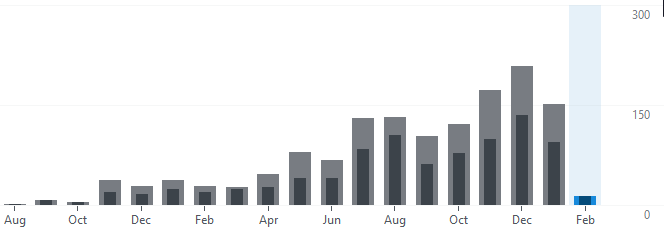
  • Years blogging: 1.5
  • Total Posts: ~165
  • Total Followers: 62 (and 9 on Twitter)
  • Monthly Views: ~175 (average over last 3 months)

I try not to put too much stock in statistics, but if I’m honest, it’s hard to not pay a little bit of attention. So I take my data points during these six month intervals. Since this is the third of those intervals, I can start to make some comparisons between those three samples.

The short takeaway is that everything is just about double what it was six months ago. In terms of raw growth, that’s still closer to exponential than linear. It’s slower than it was between the six month mark and the one year mark, but I don’t think that’s terribly relevant when dealing with small numbers. In general, if the lines continue to go up, that translates to more people finding and liking the site.

I crossed the 1,000 view mark in December ’21, after about 15 months of blogging. At the current rate, I’d expect to hit the next thousand by May ’22, five months later. Not huge numbers, but steady improvement.

“Engagement” feels like a gross web business buzzword, but what’s probably more important is that I’ve seen more engagement in likes and comments. Comments are still hard to come by, but that’s to be expected. From what I’ve seen, it’s not uncommon to see anywhere from 25:1 – 100:1 ratios of views to comments. It’s just a lot easier to get people to read what you’ve written than it is to get them to comment on it.

In the next six months, I’d obviously like to see numbers continue to grow, but my biggest indicator of success will be more comments and likes. Feedback is great. Dialogue is even better.

Reblogs

In the past six months, I’ve started doing Wednesday reblogs more frequently. Basically, any week where I don’t post Razor Mountain chapters, I’ll post a Wednesday reblog. I’ll be honest, part of this is that it’s low-effort. I love the blog, but I also limit the time I spend each week on the blog. Hopefully this is a good way to highlight something that I found interesting or useful for other writers, without taking too much time away from other projects.

So…yeah, let me know if you like the reblogs, or if they just clog your feed. I can adjust accordingly.

Razor Mountain

Six months ago, I was still outlining and doing pre-production work on Razor Mountain. Since then, I’ve finished outlining and done all of the book-adjacent tasks like writing the back cover and designing the front cover. I’ve posted five chapters. That’s progress.

I made quick progress initially, then slowed down around the holiday season. Thanks to some real-life factors, I ended up feeling overwhelmed by the schedule I was trying to maintain. I’m now in a more relaxed place, and thinking about trying to push chapters out with a little more frequency.

I do enjoy the cadence of putting out a chapter in 2-3 parts throughout a week, and following it up with a Friday Razor Mountain Development post to talk about the process of writing the chapter. I think it will be interesting to look back on those development journals when the book is done, to see how it has evolved since I first started outlining.

I’m continuing to post chapters to Wattpad and Tapas alongside the blog, but my audience on those platforms is just about nonexistent. It’s understandable since I haven’t put much effort into networking with other writers on those platforms, and I’m not in the more popular genres and styles that I see on their front pages. For now, I’ll keep posting. There’s no point worrying too much about promotion until you have something you really want to promote. At some point when I have more chapters posted (or maybe even the entire book) I’ll dig into those platforms and make a little more effort to draw some attention.

Next Stop: Two Years

I continue to have lots of ideas for stand-alone blog posts and series. I used to worry that I might run out of ideas for a blog, but having written for this long, I’m now confident that I won’t run out any time soon. I have one specific series in the works that I’m excited about—more on that in a week or two.

That’s all I have for now. See you again in six months, for the two-year anniversary of Words Deferred.

Reblog: The Memex Method — Cory Doctorow

Cory Doctorow is an opinionated activist, technologist, futurist, and insanely prolific writer of novels and short stories, essays, speeches and Twitter threads. He’s also been blogging for more than two decades. To say that he gets a lot done would be a gross understatement.

Interestingly, Doctorow suggests that blogging hasn’t taken away time from his other projects. He believes that the blog is just a commonplace book (or better yet, a memex) that’s made available to the public, giving the writer a natural incentive to be a little more organized. It’s a tool for kicking around thoughts and opinions, assembling and tending to them until they’re ready to become a story, an essay, a book. It’s an idea generator.

Like those family trip-logs, a web-log serves as more than an aide-memoire, a record that can be consulted at a later date. The very act of recording your actions and impressions is itself powerfully mnemonic, fixing the moment more durably in your memory so that it’s easier to recall in future, even if you never consult your notes.

The genius of the blog was not in the note-taking, it was in the publishing. The act of making your log-file public requires a rigor that keeping personal notes does not. Writing for a notional audience — particularly an audience of strangers — demands a comprehensive account that I rarely muster when I’m taking notes for myself. I am much better at kidding myself my ability to interpret my notes at a later date than I am at convincing myself that anyone else will be able to make heads or tails of them.

Writing for an audience keeps me honest.

Read the rest over at Cory Doctorow’s Medium page…

Six Things I Learned From “The Martian”

The Martian is a 2011 sci-fi suspense novel about astronaut Mark Watney, who finds himself stranded on Mars after a huge dust storm ends his crew’s mission and nearly kills him. It’s a book that combines near-future hard science-fiction with a classic survival story. Author Andy Weir keeps the story rooted in realistic science and extrapolates what the first few manned missions to Mars might look like. But it’s Watney’s struggle to survive and overcome one impossible challenge after another that gives the book its heart.

Rather than review a decade-old book, I decided to look at what the story does well, and what lessons I can learn from it to improve my own writing.

1 – A Good Opening Is a Juggling Act

There’s a lot going on at the start of the book. The astronauts of the Mars mission leave their habitation module in the midst of a severe dust storm, fleeing to their launch vehicle so they can escape before it tips over in the high winds. They’re unable to see each other in the dust. When Watney is skewered by a high-speed flying antenna, disabling him and his suit’s comms, his teammates have no choice but to leave him for dead.

Weir could have started the book with this high-octane action scene, but he doesn’t. Instead, he starts with this:

Chapter 1

LOG ENTRY: SOL 6

I’m pretty much fucked.

That’s my considered opinion.

Fucked.

Six days into what should be the greatest month of my life, and it’s turned into a nightmare.

I don’t even know who’ll read this. I guess someone will find it eventually. Maybe a hundred years from now.

For the record…I didn’t die on Sol 6. Certainly the rest of the crew thought I did, and I can’t blame them. Maybe there’ll be a day of national mourning for me, and my Wikipedia page will say, “Mark Watney is the only human being to have died on Mars.”

And it’ll be right, probably. ‘Cause I’ll surely die here. Just not on Sol 6 when everyone thinks I did.

There’s no doubt that the action scene would start the book on an exciting note, and it would set up the plot nicely, but wouldn’t do much more than that. Instead, Weir starts with a log entry and Watney’s assessment of his situation, before he describes what happened.

This has a few advantages. It immediately gives us hints of Watney’s personality. The way he describes the situation is important. These few sentences set up Watney as the main character and the challenge he will have to overcome: surviving Mars, alone. This primes us to ask “what the heck happened?” And now we’re hooked, and we keep reading to find out more.

2 – Adjust the Narrative Style to Fit Your Needs

I can’t remember the last time I read a book that splits up the scenes of the story in so many different ways.

The first five chapters (about fifty pages) are told entirely through Watney’s computer logs. We get to know him and his situation, and see him go into problem-solving mode as he tries to solve the immediate challenges of staying alive. Interestingly, the logs are relatively short, with several logs per chapter.

Next, the book goes into a third-person narrative style to go back to Earth and the folks back at NASA. There is a larger cast of characters to follow at NASA, so this shift makes it a lot easier to follow what’s happening, while sacrificing some of the closeness to a single character that the “logs” style give us with Watney.

The next major shift is at chapter 12, about halfway through the book, where we finally get a flashback to the action-packed scene of the astronauts fleeing earth. This comes at a time where things are going well for Watney, so it injects a bit of needed tension. More importantly, this flashback serves to introduce us to the rest of the crew of the Ares III mission, just in time for them to come into the story. After the flashback, we immediately roll into a scene with these same people in the present.

Finally, throughout the book, little mini-scenes and dialogues play out as back-and-forth messages between those in space and those back on earth. These serve a few different purposes, but mostly convey necessary info quickly so the story can move on to something more interesting.

What was most surprising to me about all of this is that it’s really not distracting. As long as these different techniques are written well and serve the needs of the story, they enhance the experience, rather than detracting.

3 – Go to Great Lengths to Cut the Boring Bits

The style of Watney’s logs give Weir a great way to skip the boring parts, and opportunities to create micro-tension as Watney describes his plans in one log, then describes the results of those plans in the next log, often within the same chapter.

The story doesn’t even touch on the people back at NASA or Watney’s crewmates until it’s time for them to enter the story. All along the way, the important information is provided, the characters introduced, exactly when they are needed. Information that isn’t worth an entire scene is conveyed through quick exposition or text messages.

The book doesn’t slow down, because as soon as there’s any risk of that happening we skip ahead to the next exciting bit.

4 – The Try/Fail Cycle is an Engine That Drives the Story

Watney is faced with a big challenge: survive and somehow get off Mars. That one overarching goal is actually composed of dozens of smaller challenges: having enough food, water and air; making contact with earth; and traveling hundreds of kilometers to another mission’s launch vehicle. Back on Earth, they have their own challenges. As the characters try to solve each problem, they sometimes succeed, sometimes fail, sometimes have to change strategies and try again, or deal with the fallout of a bad decision or unexpected event.

The book exemplifies how the try/fail cycle can drive a plot. The characters have clear goals and sub-goals, and clear stakes for success or failure. Plus, Weir uses these cycles to ramp the tension up or down. I could sense when a few things had gone well for Watney that it was just about time for some new catastrophe to blow up all his well-laid plans.

The tension only abates occasionally, to give the reader a reprieve. Once we’ve taken a collective breath, a new problem is introduced, and once again the characters have their work cut out for them. They have to inch forward, fighting every step of the way.

One example even interleaves Watney’s happy logs, where everything is going smoothly for a change, with italics description of the manufacturing process for a particular piece of equipment. What would otherwise be relatively mundane description of things going well becomes ominous as it becomes clear that the description is foreshadowing the imminent failure of that equipment, and the ensuing disaster.

5 – Asymmetric Information Can Create Tension

For most of the book, Watney is completely cut off from NASA, or can only communicate one-way through simple morse code messages, spelled out in rocks and read through satellite photos. This creates a dynamic where Watney knows things that the people at NASA do not, and vice versa. In each of these cases, Weir uses this asymmetric knowledge to create tension.

The reader, being able to look out through multiple viewpoints, can see the incoming problem while some of the characters remain ignorant until it’s too late. The characters would have too easy a time overcoming some of these challenges if they could work together with no hindrance, so Weir creates believable problems that prevent them from working together.

6 – Sometimes You Don’t Need a Villain

A lot of readers love a great villain, but this book really doesn’t have one, and it still works. If anything, Mars is the antagonist, but none of the characters really bear any ill will toward the big red rock. Despite effectively being a prisoner on the planet, alone for months, Watney has mixed feelings whenever he thinks he might actually escape.

If the book has any overarching message, it’s one of optimism. It says that almost anything can be overcome with human ingenuity, and our greatest strength is our ability to work together. Near the end of the book, Watney ponders how he could have never come as far as he had without the help of hundreds of people working tirelessly at NASA, along with the rest of his Ares III crewmates, and even some surprise help from the Chinese space agency.

A story like this can be hopeful without being saccharine. Not every story is zero-sum. Sometimes nobody has to lose and everyone can win. And I think that’s the kind of story that a lot of readers are finding appealing right now.

Should We All Be Selling Fiction NFTs?

If you haven’t been living under a rock for the last few months, you’ve probably heard a bit about NFTs. The news outlets and crypto bros are all incredibly eager to tell us about just how much money this or that JPEG was recently sold for. The only thing more popular than gawking at these huge sales is writing blog posts trying to explain in layman’s terms what the heck an NFT is, or why the heck anyone would want to buy one.

As authors, it feels like we’ve been living in a technological revolution for a while now. We’ve seen a huge transformation of the publishing industry in the past decade or so. Traditional publishing and distribution channels shrank while self-publishing and online distribution became viable options. Could the recent rise of NFTs represent yet another way for authors to sell their work?

For as much talk as there has been around NFT visual art and the (ugh) “metaverse,” there is comparatively little discussion of monetizing the written word. Although the latest NFT craze has been around visual digital art, there’s no technical limitation stopping other types of art from being “NFT-ified.” An NFT itself is able to hold only a tiny amount of data, but the way NFTs are typically used is more as a glorified digital certificate of authenticity, and it can point to almost anything. So let’s take a look at what fiction NFTs might look like, and whether they seem likely to be a viable way for authors to sell their work.

Downsides

Publishing fiction and building an audience is already a challenge. Most of us aren’t looking to make it even harder, so it’s important to look at the downsides of using NFTs.

Minting Ain’t Free

NFTs use cryptocurrencies and blockchains as their bedrock (usually the Ethereum chain and its native currency, Ether). You’ll need a cryptocurrency wallet, and you’ll need some cryptocurrency in it. That means you’ll need to buy crypto with real money. You’ll need to pay gas fees. You’ll probably also need a browser extension or a wallet with built-in browser to interface with the exchange and set up your listing.

If that last paragraph sounded like technobabble to you, then you see the other cost: complexity. If you haven’t been involved with cryptocurrency and/or you’re not very computer savvy, getting all of this set up can feel like a pretty big undertaking. Plus, the world of crypto is full of hacks and scams (try looking up “rug pull” or “stolen NFT”), so jumping into it without a good understanding of what’s going on can be risky.

No Silver Bullet

Huge sales of NFTs have drawn big headlines because they make for exciting news, but anecdotes should not be confused with statistics. Like cryptocurrency, the NFT marketplace seems to be pretty volatile. It’s fueled by speculation, sentiment and hype.

A few people have tried to fight the hype with research, and what they’ve found is that most NFTs don’t sell for more than a hundred dollars (and that’s before fees). Most artists who jump in aren’t getting rich. It’s not even clear if the average artist breaks even. There are a few people selling for hundreds of thousands or even millions of dollars, but is that really any different from Stephen King or E. L. James in the traditional publishing world?

Simply minting an NFT is no guarantee you’ll make money, and it’s certainly possible to lose some.

An Ideological Minefield

Cryptocurrency and NFTs aren’t exactly mainstream yet, but they’re getting more attention and press. And there are plenty of institutions and investors hyping them (often with holdings that stand to benefit from that hype). But there are plenty of others who are just as loudly pointing out the dangers: energy consumption, unstable and insecure technology, lack of regulation or oversight, and more.

In a world that is increasingly polarized, this is a natural ideological battleground—a tangled web of political beliefs, complicated technology, and economics. Having money at stake rarely makes people more objective.

It’s fair to say that announcing a venture into this arena will be met with excitement by the true believers, and scorn by the skeptics. Be ready to deal with that, and hope that the audience who gets excited is big enough to make it worthwhile.

Upsides

So far, NFTs don’t seem like a great deal. They’re certainly fraught with challenges. But there are some possible advantages too.

Novelty

NFTs have name recognition. They’re relatively new technology that’s attracting a lot of attention. And for those who are interested, they feel a bit like being involved in a sci-fi future.

If you’re the sort of person who likes experimenting with new, technology-infused forms of storytelling (like interactive fiction), then NFTs may be an exciting new playground. And the readers who are interested in new forms of storytelling may be more likely to jump the technical hurdles and be willing to support an NFT project.

This article from Lit Hub suggests that at least a few authors are making money by using NFTs to experiment with form and function, or at least provide a novel (heh heh) marketing twist for their writing projects.

Another Potential Income Stream

One of the oddities of NFTs, at least where digital art is concerned, is that they don’t actually provide legal or physical ownership of the thing they represent. They’re a digital note that can’t be easily forged, and point to the digital item of your choosing.

An NFT could be used as a way to sell the rights to a story or a novel, but it doesn’t have to be. It could be used more like autographed promotional materials or Patreon rewards: a bonus or collectable for invested fans. Minting an NFT of a story doesn’t mean the buyer owns any legal rights to that story, and you could still go on to publish it yourself.

Be aware, however, that blockchain information is inherently public. A typical NFT points to the item it represents at a URL that anyone can access. Since many publishers want “first” rights, minting an NFT of a piece of fiction may severely limit the rights that you can subsequently sell.

Conclusions

I’m personally pretty skeptical of NFTs and their cryptocurrency underpinnings, but it is a fact that it is now possible to mint NFTs for our art (or at least tangentially related to it). If nothing else, I think it’s always good to know what options are out there.

What do you think? Would you ever consider making NFTs of your fiction? Do you think there’s a market for it today? What about in five or ten years?

Reblog: 13 Things That Might Be Holding You Back as a Writer — Edie Melson

(I found this post thanks to Chris, the Story-Reading Ape, who re-posts a ton of interesting writing-related things from around the web.)

If you’re still looking for a New Year’s resolution, this might give you some ideas. Writers aren’t all the same, but it’s worth taking a look at this list. Chances are pretty good you’ll find something you should work on. For example, I don’t read as much as I should, and I’ve been meaning to join a writing group for about five years now.

Check out the list over at The Write Conversation, With Edie Melson…

Razor Mountain Development Journal — Chapter 5

This is part of an ongoing series where I’m documenting the development of my serial novel, Razor Mountain.

You can find my spoiler-free journals for each chapter, my spoiler-heavy pre-production journals, and the book itself over at the Razor Mountain landing page.

God-Speaker’s Goals

After two chapters starring Christopher and a holiday hiatus, it feels like it has been a long time since we got to hang out with God-Speaker. His tribe is on the road now, and we get to see a glimpse of what life is like for him in the wake of his mentor’s death.

It took a long time and quite a few drafts to write this chapter. Much longer than the previous chapters. Part of that was real life, but a lot of it was the story itself. It’s an important lesson that’s easy to forget: if writing something seems especially hard, you may not be writing the right thing.

My initial outline for this chapter mostly just had the tribe moving from point A to point B. My primary beta reader (the wife) confirmed that the chapter felt like filler, or “waiting for something important to happen.” I was thinking and writing about story threads and character goals at that time, it became pretty obvious that God-Speaker needed better-defined goals and clearer challenges to overcome.

This chapter is still about the tribe going from point A to point B, but that is now the backdrop for God-Speaker’s own struggles. It turns out he’s not good at the things that are important to a pre-historic tribe, like hunting, so his status has never been very high among the tribe. When he was taken in by Makes-Medicine to train as a shaman, and when he found and bonded with the stone god, his social status became murkier.

Now, Makes-Medicine is gone, which removes some of his social “armor.” The people of the tribe still aren’t too sure about this stone god thing, and some of the hunters still clearly have a low opinion of God-Speaker. The expectation for a shaman is to prove himself wise and capable, and become an important leader for the tribe. This is one goal.

Another goal becomes clear in this chapter. Makes-Medicine couldn’t bring the tribe out of the mountains to someplace warmer and more hospitable, but God-Speaker might. God-Speaker has no idea how to find snowless lands, but again, this gives him some direction.

Secondary Characters

I really didn’t have secondary characters fleshed out for God-Speaker’s part of the story, which probably should have been a red flag in the outlining process. However, this chapter forced me to build some of these characters. They’re directly tied to God-Speaker’s goals and obstacles.

I had to come up with more names for members of the tribe (both in this chapter and for later use). The interesting thing about this style of descriptive naming is that it automatically gives the character a bit of back-story. I need to come up with something that they’ve done or that they’re known for, to figure out what they should be named.

Far-Seeing and Finds-the-Trail are two of the best hunters of the tribe, representing everything that God-Speaker aspired to, and largely failed at. They see him as beneath them, and would be happy to see him fail, maintaining the current social order.

Braves-the-Storm is a more ambiguous figure. He is a rival for leadership. He has status as someone wise, brother of the former shaman, and a great hunter in his youth. However, he also reveals Makes-Medicine’s prophecy to God-Speaker, suggesting that he could bring the tribe to a better place. He quietly stands up for God-Speaker and begins to act as a possible replacement mentor figure in this chapter.

Research

I did a bit more research on the kinds of game animals that the tribe might find. There are a lot of good resources that talk about animals in the modern day, their habitats and ranges. But it’s much harder to find information on what was around thousands of years ago.

For example: pages about Alaskan hares.

Serial Writing

As writing this chapter dragged on, I had to admit that I just can’t consistently hit a schedule of one chapter per week with any consistency. Writing and publishing chapters as I go is honestly more of a challenge than I expected.

I could have put out this chapter a couple of weeks sooner, but the extra time has improved it quite a bit, and will also improve the rest of the story going forward. Rather than being beholden to a tight schedule, I decided that I’d rather try to put out good fiction and adjust the schedule as needed.

Of course, I’m still never completely happy, so I’m still planning to do another pass of revisions and improvements once all the chapters have been released. (If you have any thoughts or suggestions, feel free to leave comments!) But I’d like the story to be as good as possible for the readers that are reading it now.

Thanks for reading. See you next chapter!

Razor Mountain — Chapter 5.3

Razor Mountain is a serial novel, with new parts published every week or two. For more info, visit the Razor Mountain landing page.

When God-Speaker and Braves-the-Storm returned to the rest of the people, it was nearly dark. Soon after, the hunters returned, not with deer, but with two more hares.

“You said there were deer in the trees,” Far-Seeing said, setting the rabbits on the ground and sauntering up to God-Speaker.

“I only heard something like deer,” God-Speaker said.

Far-Seeing raised a finger and opened his mouth to reply, but he was cut off by Braves-the-Storm.

“There were tracks. You followed them, didn’t you?”

Far-Seeing gave the old man a surly look. “We followed them until it was dark. We found no deer.”

“You found meat,” God-Speaker said, trying to sound encouraging. “If the deer have moved on, then there is nothing else you could do.”

Far-Seeing turned and walked away, scowling. “If you think we can’t track deer, you’re welcome to come on the next hunt. Maybe the spirits can tell us where to find meat.”

It was less of a feast than everyone had hoped for, but once they had been skinned and cooked, there was enough for each person to have a few bites, and the mood around the fires improved. The pelts would be fine and soft as well, caught between winter white and summer brown.

Braves-the-Storm told the people about the small tribe of strangers that he and God-Speaker had seen across the river. They had never had reason to fear other tribes before, but with the death of Makes-Medicine still fresh in their minds nobody was happy to have another tribe somewhere nearby. Wood was plentiful near the trees, so they fed the fires until they burned high and bright. A few of the hunters took turns staying awake, watching the path back toward the river crossing.

God-Speaker stayed awake for much of the night too, but not out of fear of the strangers. The other tribe did not feel like a threat to him. One of the strangers had set down his spear in what seemed like a gesture of peace.

The faint sound of the nearby river made him think of a time when he was a child, and the people had journeyed along the sea. It was so much water; sheet ice and shimmering waves stretching into the distance. That was before the years journeying through the mountains. And what had been before that? All the people knew was the journey, never ending. There were stories of a time long ago when they had lived in snowless lands. Then the ice came, covering everything. Evil spirits bringing cold to destroy the people. What would it be like to find another snowless land? What would it be like for God-Speaker to lead the people to that place?

God-Speaker rolled in close to the stone god and murmured to it.

“Will you bring us somewhere without snow and ice?”

The god was silent and still.

God-Speaker rolled onto his back again. What would they encounter tomorrow, away from the river?

He thought about Makes-Medicine. He tried to remember what she had told him—about the spirits, about the rituals and the herbs and plants that could heal sickness. He could no longer ask her questions. He was afraid that he would forget something important. What secrets had she not passed on to him? What had he missed or forgotten? Those things would be lost to the people forever now.

He lay on the hard ground, staring up into the clear sky. Among the bright stars, there were two streaks of light, one after another. He waited, frozen in place, and watched. Another streak. Another.

These, at least, he remembered. Makes-Medicine said that many signs could be good or evil, to be interpreted by the events surrounding them. But shooting stars were almost always a bad omen.

God-Speaker sat up. The god remained silent; a hunched mass in its pouch. Far-Seeing squatted near one of the fires, half-dark, half illuminated, watching the darkness between the river and the trees. Everyone else was asleep.

God-Speaker lay back down. He closed his eyes and tried to remember everything Makes-Medicine had ever taught him.

<< PREVIOUS ] [HOME] [ NEXT >>

Razor Mountain — Chapter 5.2

Razor Mountain is a serial novel, with new parts published every week or two. For more info, visit the Razor Mountain landing page.

It did not take long to come to the narrow part of the river. They found it was an even better crossing than it had appeared from above. Many of the rocks and boulders that had washed down the river collected here in a place where the water cut back and forth through a crack in a huge shelf of solid stone. The water was very deep and fast, but the crossing was narrow enough that everyone could jump it, even mothers carrying their children. The only child too big to carry was Black-Eyes-Staring, and he was nearly a man and able to make the jump by himself, under the worried eyes of his mother. They crossed one by one, with people waiting on the far side to catch them, until all were across.

The land was rocky and barren around the crossing, but they soon came to the trees that God-Speaker had seen from the ridge. They covered a broad area of rolling hills. Birch and pines grew far apart, surrounded by tangled bushes and undergrowth. All the plants and trees were eager for spring and had sprouted new growth and new leaves.

The people followed the edge of the forest, still within sight of the river, and soon came upon hoof-prints in a half-frozen patch of mud. The sun was still well above the horizon, but they immediately stopped and made camp. Several of the hunters took their spears and slings and went off into the trees while the rest of the people made quiet, excited conversation.

God-Speaker saw Braves-the-Storm at the edge of the group, and the man motioned for God-Speaker to join him. God-Speaker looked down to the pack that he had only just removed from his aching shoulders. He left the god sleeping there, in the middle of the camp, and followed Braves-the-Storm.

“If we do not hunt, we can at least look ahead,” he said as God-Speaker caught up.

They walked a little ways in the space between the trees and the river. The shadows grew long in the fading light. The water was quieter here. The furrow carved by the river cut deeper and deeper into the earth. They approached the edge and saw that the water was far below now. The walls of the little canyon were slick with ice. Even here, the gap between the walls was not wide. Braves-the-Storm picked up a rock and threw it to the other side. It barely cleared the gap and skittered into a line of gray boulders.

Suddenly, the shape of a person holding a spear came walking from behind those boulders, followed by several more. They were not quite shadows, but were hard to see clearly with the sun setting behind them. They stood in a line, looking across the gap at God-Speaker and Braves-the-Storm. It was a small group, much smaller than their own people. God-Speaker thought of the strange man who had invaded their valley days before. Did these people look the same? It was hard to tell. He tensed, watching for any sign of danger.

The man with the spear crouched and set his weapon on the ground. Then he stood and made a broad, sweeping gesture with his arms. One of the others spoke or made some sound, but it meant nothing to God-Speaker. He looked to Braves-the-Storm, but his face showed uncertainty too. After a few silent moments, the others walked back to the line of boulders, turned, and went out of sight up-river.

When God-Speaker and Braves-the-Storm returned to the rest of the people, it was nearly dark. The hunters had returned, not with deer, but with two more hares. It was less of a feast than everyone had hoped for, but once they had been skinned and cooked, there was enough for each person to have a small portion, and the mood around the fires improved. The pelts, caught between winter white and summer brown, would be fine and soft as well.

Braves-the-Storm told the people about the small group of others that he and God-Speaker had seen across the river. They had never had reason to fear other tribes before, but with the death of Makes-Medicine still fresh in their minds, nobody was excited to have another tribe somewhere nearby. Wood was plentiful near the trees, so they fed the fires until they burned high and bright. A few of the hunters took turns staying awake, watching the path back toward the river crossing.

God-Speaker stayed awake for much of the night too. The other tribe did not feel like a threat to him. The man had set down his spear in what seemed like a gesture of peace. Still, he worried about what they might encounter tomorrow, away from the river. He thought about Makes-Medicine. He tried to remember everything she had ever told him, about the spirits, about the rituals and the herbs and plants that could heal sickness. He could no longer ask her questions. He was afraid that he would forget something important. What secrets had she not passed on to him? What had he missed or forgotten? Those things would be lost to the people forever now.

He lay on his back, staring up into the clear sky. Among the bright stars, there were two streaks of light, one after another. He waited, frozen in place, and watched. Another streak. Another.

These, at least, he remembered. Makes-Medicine said that many signs could be good or evil, to be interpreted by the events surrounding them. But shooting stars were almost always a bad omen.

God-Speaker sat up. The god remained silent; a hunched black mass in its pouch. Far-Seeing squatted near one of the fires, half-dark, half illuminated, watching the void between the river and the trees. Everyone else was asleep.

God-Speaker lay back down. He closed his eyes and tried to remember everything Makes-Medicine had ever taught him.

<< PREVIOUS ] [HOME] [ NEXT >>