This August was the three-year anniversary of Words Deferred. Around that same time I also hit 10,000 views.
Is that a good amount? Who knows. It’s certainly ramped up since that first year, when I was more-or-less shouting into the void.
It’s hard to believe it has already been that long. But then, the flow of time broke sometime in 2020, so now everything gets lost in the temporal vortex.
Anyway, thanks for hanging out and talking about writing with me!
Since I started this blog, I’ve done a “State of the Blog” post every six months. This is the sixth such post.
One of the key tenets of this blog is an open writing process. I’ve brought that to my serial novel Razor Mountain with development journals, and I bring it to the blogging process with these posts.
For quite some time, I’ve seen visitors to the blog increase steadily. There might be a month or two where numbers would drop, but they inevitably kept creeping up. In December of 2022, I saw the biggest peak up to that point, as presumably more people who like to read blogs do so when they have some extra vacation time over the holidays.
After that, the graph got weird. Up and down constantly, and not much growth on average. Why? I don’t really know. Maybe I’ve been posting a little less consistently. Not much, but a little.
I have a few regular readers, but more than half of my usual traffic comes from search, and search traffic seems to be more variable these days. I can see why people who obsess over traffic or try to make money at this would get into all the little intricacies of SEO, keywords, etc. It’s strange to see a change in the pattern and not really understand why.
The End of Razor Mountain
Six months ago, I could just barely see the end of Razor Mountain in the distance. This July, I posted the final chapter.
This felt like a turning point for the blog. I’ve been working on Razor Mountain almost since the beginning. Between the actual episodes and the development journals, it accounts for 171 posts, about 45% of the entire blog.
I was so eager to finish the book, I didn’t think that much about what effect it would have on Words Deferred. Sure, I still have to do revisions, but the reality is that it’s going to be a very different blog, now that I’m not posting so much Razor Mountain.
For now, I plan to continue some of my other regular posts—monthly read reports and general writing topics.
Updated Posting Schedule
One of the great things about writing Razor Mountain was that blogging and writing fiction were intermingled. I could do both at the same time. However, as much as I enjoyed the experiment, I plan to write my next novel in private.
As a result, I can’t continue to dedicate so much time to the blog if I want to keep up with my actual writing. As a result, I plan on cutting back. The fact that I’ve been posting 2-3 times per week for so long is shocking to me, considering how challenging it seemed when I first started.
I’m still committed to posting at least once per week, so it’s not like I’ll be disappearing. I have quite a backlog of topics I’d like to write about.
Next Time
Speaking of cutting back—now that I’ve done six of these on a bi-annual basis, I’ll be switching to once-per-year assessments. I still like having this chance to look back at what I’ve done and think about what’s next, but the blog isn’t young and new anymore, and I don’t feel the need to do it quite so frequently.
The next few months will be a change, but hopefully a good one.
During the month of May I performed an experiment. I decided to limit myself: I would watch no video (TV, movies, streaming, or internet), play no video games, and stay off social media. It was an enlightening experience.
Soma
In Brave New World, Aldous Huxley introduces a fictional drug called soma, which is used to make the people in the story’s future civilization happy and docile. A variety of people have excitedly pointed toward media, and especially television and social media as a kind of modern soma.
I think those arguments are overblown in some ways. In the past hundred years, various pundits have claimed that newspapers, paperback books, comics, radio, and every form of television would also turn us into mindless zombies. Somehow society hasn’t collapsed. However, there’s also clearly some truth in the idea: media can be an escape from the real world, and it’s certainly possible to use it as a mind-numbing drug.
There’s plenty of “junk food” media that passes time, but nobody would claim is great art. Or even mediocre art. A great movie can feel elevating and change your whole outlook on life. But also, Jersey Shore exists. The junk can be fun, but too much of it is obviously problematic.
I’ve certainly done things like doom-scroll Twitter while watching a movie I don’t care about with half an eye. I would frequently watch whatever the YouTube algorithm threw at me while playing a low-effort video game. That’s the sort of behavior that really crams so much stuff into the eyeballs that the brain short-circuits. I like the word used by the YouTube video game theory channel Extra Credits: abnegation, literally entering an ego-negating mental state via the consumption of media.
Finding My Keys
Over the month, I shifted from a lifestyle where I was frequently performing this kind of media-fueled abnegation to one where I consumed almost no screen-based media at all. I did continue to listen to podcasts (although most of these are writing-related) and I read books.
I’m reminded of a comedy act I saw years ago (and unfortunately can no longer find to give credit). They talked about giving up smoking weed.
I could remember things again. I thought I was psychic. I was like, where are my keys?
They’re over on the counter!
How did I know?
I don’t smoke, but I did find that my time used to disappear mysteriously. Where did my evening go? My weekend? That time would just vanish. During May, I really didn’t have that feeling at all. I was experiencing all that time instead of letting it just slip away.
I also noticed some of the environmental factors that contributed to my problem. On day 2, I realized I had the Twitter app open on my phone, with no recollection of opening it. I ended up turning off notifications, because the bird app would ping me first thing in the morning, inviting me to turn off my brain before I even got out of bed.
I also began to notice just how many pings I got from services like Steam and Oculus. When I wasn’t paying attention, all these things together created a steady stream of invitations to distraction every single day. But being aware of them also takes away a lot of their power. It turns out almost none of those notifications were for anything that was more than a 5/10 on my excitement scale, so why would I bother opening them, except out of habit?
What I Did Instead
I read eleven books in a month. (Granted, there were a few short ones in there, but I still find that hard to believe.) I have a bad tendency of buying books faster than I read them, and I have quite a backlog on the book shelf. If I keep reading like this, I could get through it in a couple months.
In addition to all that reading, I got a lot more of my to-do list done. And when bedtime rolled around, I was much more inclined to actually go to bed. I got the appropriate amount of sleep most nights, which is another strange feeling when I’ve spent years depriving myself of sleep to various degrees.
I wrote more, but not a lot more. I found that even when I had more time, my ability to write (as well as do other things) was still limited by my energy. As much as I love it, writing is not low-effort or relaxing to me.
During the week, I only have time at the end of the day, and I’m already drained. Unfortunately, I didn’t find my secret to writing productivity, but I did come to a better understanding of what’s limiting me.
What Changed?
It’s now June. My experiment is over, but it really changed my outlook. While I had the periodic itch to watch something, or pick up Twitter or a video game, I wouldn’t say I’ve been missing it.
At the start, I was worried that May would be a miserable month for me. In actuality, it felt really good—so good that I want to keep that feeling going. That doesn’t mean I’m going to give up most media forever, but I am going to be much more discriminating when I spend my time watching or playing something.
Taking a month off really clarified which media I’m genuinely excited about. I found that I had no desire to go back to most of the “junk” I was watching before, but I wrote a small list of movies I’ve been meaning to watch and never got around to because it was just slightly more effort than firing up the first thing that caught my eye on YouTube or Netflix. I can still watch less, but feel like I’m getting more out of it.
I’m honestly not sure if I’ll go back to Twitter. It was a slow-burning dumpster fire in April, when they broke all the integrations, and I sincerely doubt it has gotten any better in the past month. It is, unfortunately, still the social media hangout for writers though. I’ve found a lot of great books, blogs, substacks, etc. through it. Time will tell.
Try It, You’ll Like It
I’ll close with this. If you’re someone who consumes a lot of media, I’d encourage you to try this experiment: one month, no TV, movies, games or social media. If it turns out to be miserable, well, it’s only a month. But I don’t think it will. It changed my perspective and my priorities, and somewhat to my surprise, it made me a happier person.
If you decide to try it, let me know. I’d love to know how it goes for you.
At the end of April, WordPress announced that due to the changes in Twitter’s API policies and prices, they can no longer automatically tweet out links to our blog posts. Admittedly, I think the majority sentiment these days is that Twitter is a slow-motion train wreck, but it somehow still seems to be the biggest social media platform for readers and writers.
My first thought was that I would have to start manually tweeting my posts, but honestly, I don’t know if I’m going to bother. With my limited following (and limited effort) I really don’t get much engagement from Twitter. It was just the ease of use that allowed me to keep the @DeferredWords account active.
If you have a Twitter integration that’s no longer integrating for your blog, I think the best bet is probably to get one of the many browser plugins that let you click to tweet links. That way you can still tweet out your posts with relative ease. Unfortunately, it’s a manual process now, which means it doesn’t work with scheduled posts. I already have a lot of rigamarole around posting Razor Mountain chapters to multiple services, so I don’t really want to add yet more steps.
At this point, I’m ready for Twitter to die. I hear that maybe BlueSky is the app that will actually get everyone to jump ship, but I’ll believe it when I see it. They said that about Mastodon and three or four other Twitter clones. Mastodon is still around and still sort-of, kind-of, not really active. All the other services are at least twice as dead.
Mostly I’m just trying to spend less time on Twitter, which I suppose is a good thing.
It’s that time again. Since I started this blog, I’ve done a “State of the Blog” post every six months. This is the fifth such post.
One of the key tenets of this blog is an open writing process. I’ve brought that to my serial novel, Razor Mountain, with my development journals, and I bring it to the blogging process with these posts. While the Razor Mountain development journals focus mostly on fiction writing, these posts are about blogging in general.
The split between search traffic and direct traffic has stayed roughly the same in the past few months. Something like 75% of the traffic I get is from search, with one hero post and a handful of other mid-ranked posts capturing most of those views. The remaining 25% looks like it’s mostly from regular readers, and they’re mostly reading my new posts each week. As you’d expect, comments and likes come mostly from the regulars, while views are mostly the drive-by-searchers.
That search engine traffic varies quite a bit from week to week and month to month, so I’m in the odd position where my stats often aren’t driven much by what I posted recently, and instead come down to how many people wandered in from Google.
Slower Growth?
As I looked back at previous six-month windows, I saw fairly consistent growth in numbers. Usually, my views would just about double over the course of six months. The past six months were the first time where that wasn’t really the case. On average, those stats still went up, but not at that exponential rate.
Complicating the issue is that the numbers didn’t show a consistent trend. As you can see from the graph, there were a couple of fairly low months and a very high month. Turns out a lot of people have extra time to catch up on their blogs in the last two weeks of December.
It will be interesting to see what the next six months look like. This just isn’t a ton of data points to infer much from. I’m not really looking to change what I do based on these numbers—I won’t be doing a bunch of SEO stuff or using more clickbait-y titles. I’d love to see the blog keep growing, but if it does it will be because I keep posting what I enjoy posting, and people find it and like it too.
Approaching the End of Razor Mountain
There are ten chapters left in Razor Mountain. That number may change a little as I work through Act III, but that’s still well over 2/3 done. Plus, as an experiment, I already wrote a first draft of the last chapter at the start of the book. So as long as I can keep up my current pace, I should have all my chapters done before my next State of the Blog post.
I’ve been thinking about what happens next. First, I know I’m going to take a break from the book to get a little distance. Then I’ll be rereading and digging into whole-book edits and polish. I worked extra hard on the front-end to make these episodes as good as they could be when they are released, but I know that there will be a lot of opportunities to go back and further improve and tighten the story.
The bigger long-term question is what I want Razor Mountain to be. Right now, it lives on the blog, and on Wattpad and Tapas. I wanted this to be an open experiment, and I’m very happy with how it has gone. But with a rare few exceptions, traditional publishers are not interested in publishing a book that is already out in the world. I may decide to explore self-publishing, just in case there are folks out there who would be willing to throw a few bucks my way for a copy of the final book.
What Lies Beyond
Razor Mountain has been an integral part of my blog almost since its inception. My posting schedule changed when I went from pre-production to actually posting chapters, and it will probably change again when I get into editing. Then, at some point, I’m going to be done with the book, and there will be a big gap to fill in the posting schedule.
I have a few ideas of what I would like to work on next. I would love to spend at least a few months writing nothing but short stories and really grinding submissions to publishers. I also have dreams of writing a TTRPG campaign setting—I know there is a decent chunk of my regulars who are into that sort of thing, and I think it would bring in some new readership as well. I’ve been kicking around ideas for a setting for years, so it would be great to get it out of my head and onto paper.
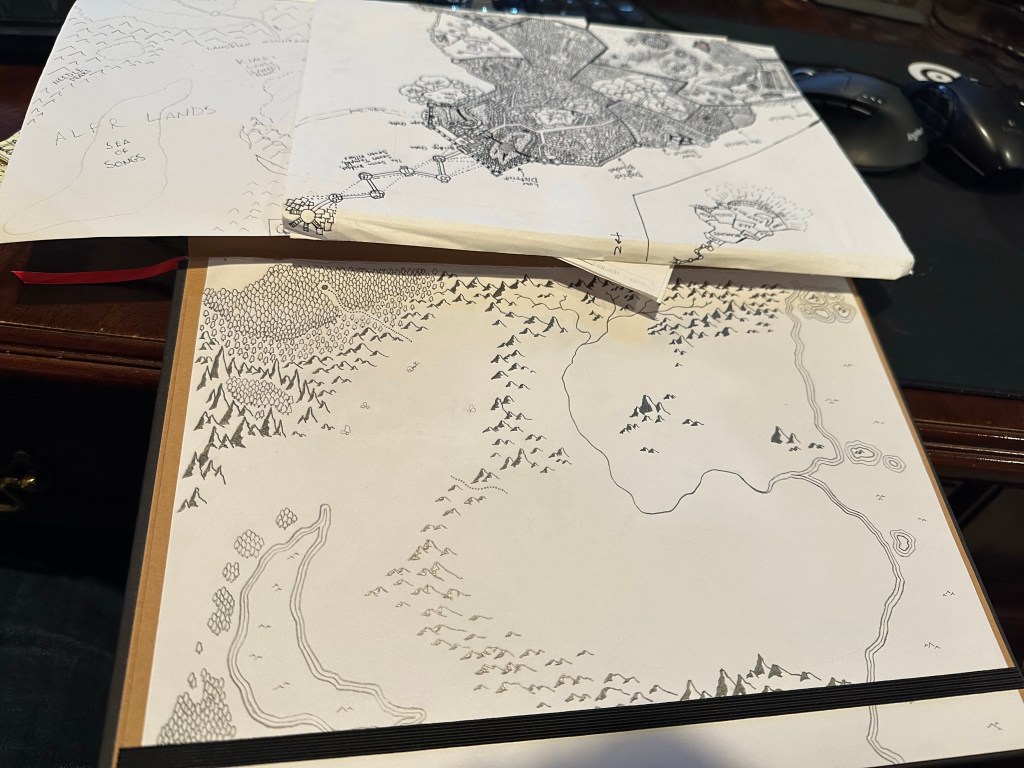
I hear that people love maps…
Whichever project I choose to do next, it’s very likely that I will end up posting less frequently. I love the blog, and it has been very satisfying to get to a point where I put out at least three posts most weeks, but I also want to produce more fiction and other work that I won’t end up posting to the blog. Since there are only so many words I can produce in a given week, that necessarily means I will end up stealing time from the blog for other projects.
That’s okay. In some ways, I feel like the blog has grown up. It’s no longer a baby blog where I post my thoughts into the void. I have regular readers that I recognize, and writing and blogging friends that I occasionally trade comments with. I don’t want to stop blogging, but I feel like the blog can continue to grow and thrive with a little less care and feeding than I’ve been putting into it so far.
See You Next Time
That’s it for this time. I’ll see you in another six months for the three-year blogoversary!
One of the goals of Words Deferred has always been to open up my writing process for everyone to see. I don’t claim to have the perfect process, and I think the best way to write will ultimately be different for each writer. However, there’s surprisingly little talk among writers about the day-to-day details of what writing is like, and I want to do my small part to change that.
As the end of the year approaches, I thought it would be interesting to look at the writing I’m doing and the tools I’m using in 2022. Then I can look back on this next year and see how things have changed, or if they’ve stayed the same.
Ideation
Writers are known for carrying little notebooks and jotting down ideas whenever and wherever they appear. In the past, I’ve carried pocket-sized notebooks, but I went entirely digital several years ago.
My digital notebook of choice is Microsoft OneNote. I have separate tabs for general brainstorms and ideas, short stories, novels, blog posts, lists of books I might eventually read, and more. When I need to take notes on the go, I just jot them down on my phone. OneNote synchronizes automatically between phone and laptop, with only occasional weird formatting issues.
My OneNote. There are a lot of pages hidden under those headings…
Novel Writing
For novels, when I’m ready to go beyond the idea-gathering stage, I move all my notes from OneNote into Scrivener.
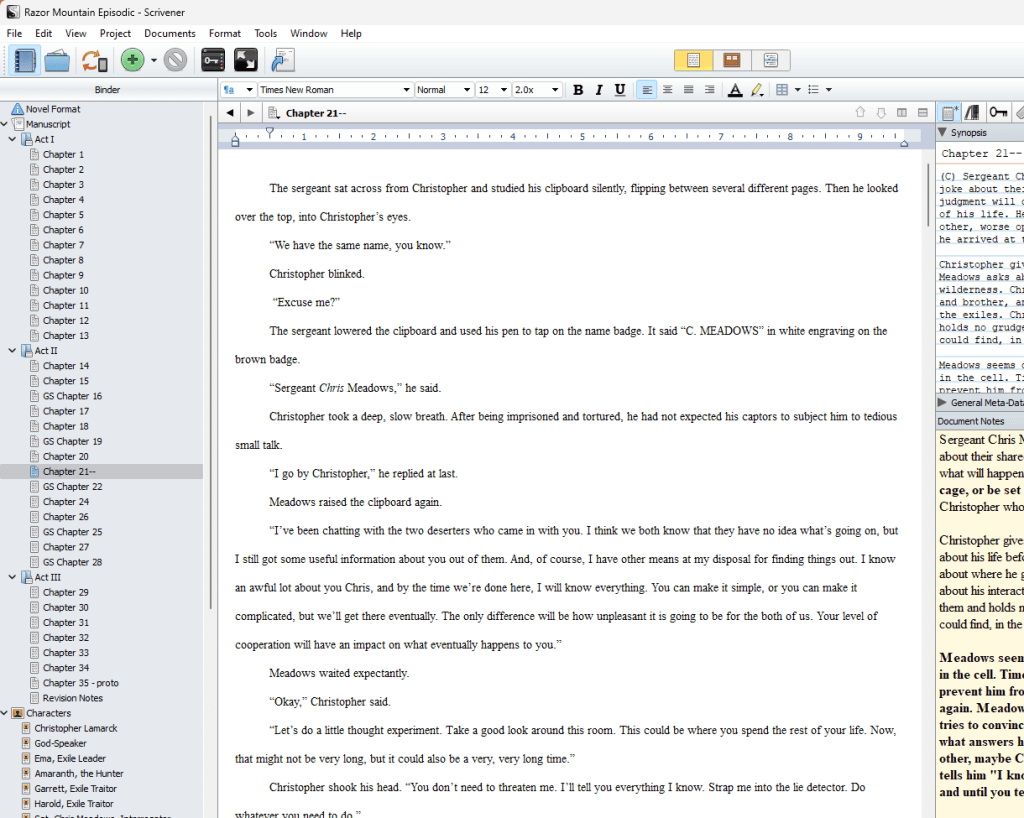
As far as I am concerned, Scrivener is the best novel-writing application out there. Where it really shines is in the way it lets me split a big project into nested parts. I split Razor Mountain into folders for each act, then split out each chapter into its own document under those folders. I have separate sections for major characters, locations and other research notes.
With a click of a button, I can look at the chapter summaries on a cork-board view, and I can drag-and-drop chapters in the document tree to rearrange them, something that has been really convenient as I’ve merged and moved chapters in Act II. Scrivener also has built-in support for “snapshots,” which I use to save each revision of each chapter. I typically save at least a rough draft, a second draft after some editing, and a third draft once I’ve gotten reader feedback.
To ensure that my work is fully backed up, I save my Scrivener files to Dropbox, which copies them across my computers and my phone for safe-keeping. I do have the mobile version of Scrivener, but I almost never use it. I love taking notes on my phone, but I do not enjoy long-form writing on that tiny keyboard.
Scrivener’s editing and cork board views.
Serial Publishing
I’m publishing Razor Mountain as a serial in three places: here on the blog, on Wattpad, and on Tapas. I chose to do this so that I could get a feel for the different platforms, and to try to increase the visibility. However, I haven’t done much to promote the Tapas or Wattpad versions, so pretty much all of my regular readership is on WordPress. I keep telling myself that I’ll eventually put some love into Tapas and Wattpad, and that may actually happen at some point. Either way, I’ll continue on all three until Razor Mountain is finished.
Because I’m posting to three platforms, my process for this is a little bit insane. It goes something like:
Write the first draft and first round of edits in Scrivener.
Copy it to Google Docs for easy beta reader feedback. Fix the formatting that doesn’t transfer nicely.
Make changes based on feedback in Scrivener, and decide how to split the chapter into multiple posts.
Copy it to a OneNote template with the brief description at the top and links to previous/home/next at the bottom.
Copy from OneNote to WordPress. Schedule the posts.
Copy from OneNote to Wattpad. Fix all the formatting that doesn’t transfer nicely. (Wattpad has no way to schedule posts.)
Copy from OneNote to Tapas. Fix the formatting that doesn’t transfer nicely. Schedule the posts.
On the scheduled day, chapter parts automatically post to WordPress and Tapas.
I have to manually post the saved draft to Wattpad. I also have to update the previous/next links in the WordPress post, and I need to add links to the Razor Mountain home page. Depending on how busy I am, I sometimes forget to do these things, and I typically don’t catch it until I start posting the next chapter.
Some of this complexity comes from posting in three places, each with their own idiosyncrasies. It’s obnoxious how often copy/pasting between tools and websites causes the formatting to be lost. It’s doubly obnoxious that Wattpad doesn’t let me schedule posts.
I suspect there is probably a way to add WordPress links (previous/next and home page) that point to a scheduled post and only work once the post is “live.” I haven’t spent the time to figure it out though.
Short Stories
The majority of my writing time this year went toward Razor Mountain and the blog, but I have managed to sneak in a few short stories.
For microfiction, drabbles, and flash fiction, I often just work in OneNote. Unlike novel writing, I sometimes do work on short short stories on my phone, and I typically do not need organizing features or formatting more complex than italics and bold.
For longer stories, I usually use Microsoft Word on the laptop. Oddly, I copy to Google Docs for easy beta reader feedback, but I never really write in it. I’ve been using Word for years and I’m comfortable with it.
For all of my stories, I save everything to Dropbox to make sure it’s backed up. When it comes time to find places to submit stories, I use Duotrope.
Blogging
My blogging schedule has fluctuated over time, but these days I try to post Razor Mountain chapters every other week.
Unless a chapter is around a thousand words or less, I will break it into 2-3 parts of about a thousand words each. I’ve read that 500-1000 words is the sweet spot for keeping readers’ attention for blogs, and a slim majority of my WordPress readers are on mobile, where a post of that size feels bigger on the page than it does on a full-size monitor or tablet. Tapas and Wattpad don’t have that kind of detailed dashboard for writers, but they do say that most of their readers are also on mobile.
Along with the chapters themselves, I write a development journal for each Razor Mountain chapter. Sometimes I post the chapter parts earlier in a week (e.g. Wednesday and Thursday), and the development journal on Friday. If I have three parts in a chapter or get a little behind, I will sometimes post the development journal the following Monday. I used to worry about maintaining an exact schedule, but nowadays I just aim for a schedule and adjust as needed.
I write blog posts unrelated to Razor Mountain on the “off” weeks, and sometimes for the Monday of Razor Mountain weeks as well. I’ve been blogging long enough now that I have a few ongoing series of posts, so I will often mix one of those posts with something stand-alone in a given week.
I’ve gotten in the habit of posting reblogs every other Wednesday. Writing three blog posts in a week is too much for me, and reblogs are low-effort (while hopefully still interesting content). They occasionally result in some cross-pollination with the other blog’s readership. Their main purpose is to serve as a good motivation for me to regularly read other writing blogs. I maintain a list of interesting articles and blog posts in my OneNote, and trawl through them for these reblogs.
For the header images on my posts, I use Pexels. I don’t usually do any picture editing apart from cropping. If I have a really difficult time finding an image that I’m happy with, I will occasionally check Unsplash. Both of these sites offer pictures that are free to use and do not require specific license language to be displayed.
(If you’re blogging, please do yourself a favor and always check the licensing and make sure you’re attributing correctly. There are trolls out there who will sue you for hundreds of dollars, even for such non-crimes as using the incorrect version of Creative Commons. And if the image isn’t licensed for your use, don’t use it!)
I make it easy on myself and always use the same cover image for Razor Mountain chapters, and pictures of mountains for development journals. For all other posts, I just search for terms vaguely related to the content.
I always write my blog posts in OneNote, do an editing pass, and then copy/paste them into WordPress. I almost never publish a post immediately. Instead, I schedule them for 7:00am CST on a subsequent day—usually Monday, Wednesday or Friday.
Tracking
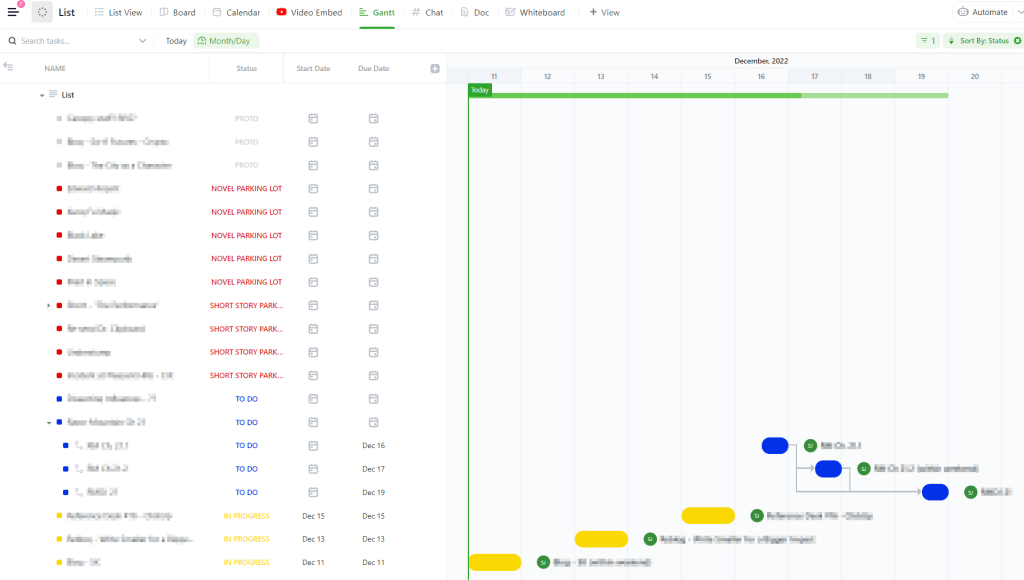
My latest endeavor is to try to get a better understanding of how I’m using my writing time. Lately, I’ve been using ClickUp. I like it for charting “deadlines,” even if they’re entirely self-imposed, and laying out a schedule of things I intend to write.
And even though I’ve explicitly said in the past that I don’t want to end up tracking things in Microsoft Excel, I’ve been doing a little bit of tracking in Excel. I haven’t found a great way to roll up the time spent on different projects in ClickUp in a way I like. Excel makes it dead simple to make a few columns and track days, projects and half-hour increments. It’s all compact and easy to eyeball, and there’s always an easily searched website that will tell you how to translate a few columns into an interesting graph, even if Excel formulas make me feel a little dirty.
This tracking stuff is still in flux, and I expect it to change. In every other respect I am an old man, set in my ways. It’ll be interesting to check back in next year, and see if anything is different.
This post is already much longer than I planned, so I’ll end it here. Hopefully it was interesting to see how another writer works. If you’re an author who writes about your own process, I’d love to read about how you’re working. Leave a comment or a link to a post of your own.
Welcome to the new, slightly more spiffy Words Deferred!
Since I have a little end-of-year vacation time, it seemed like a perfect opportunity to update the site design. The old layout felt a little too “Geocities” for modern times, and I’ve been thinking about changing it for a while.
If you’re reading this in a subscription email or the WordPress Reader view where the content is stripped from the layout, you may not have noticed anything different. If you actually still visit the site, I hope you find it to be a much cleaner experience.
If anyone is curious, the old theme was Syntax, very slightly customized. The new theme, somewhat confusingly, is named Twenty Sixteen.
The Syntax theme didn’t have a sidebar, so I ended up throwing a jumbled mess of stuff onto the Words Deferred home page in somewhat random sequence. I suspect it didn’t provide the greatest first impression to new visitors. Of course, you hope that people won’t judge a book by its cover, but you also know that at least some amount of cover-book-judging is inevitable. Now, I’ve moved all the navigational content to the sidebar, freeing up the home page to be much more focused.
The one other big thing that annoyed me about the Syntax theme was the menu. It was weirdly hidden by default. I liked that it stayed out of the way of the main content, and was always accessible, but I missed having a static menu. The Twenty Sixteen theme has a static menu up-top, where it’s still out of the way of the content. It’s no longer accessible when you’re scrolled down the page, but I can live with that.
If you’re a reader who actually visits the site, please leave me a comment and let me know what you think about the changes. If you only read via email, WordPress Reader, RSS, etc., and this makes no difference to you, I’d be interested to hear about that too.
Thanks to everyone for reading, especially my regulars.
One of the goals of this blog is an open writing process, and I include the inner workings of the blog itself in that. I’m not exactly an internet celebrity or SEO expert, but hopefully there’s some value to other bloggers in seeing what my numbers look like.
The progression of these view milestones is interesting to look at:
Sept. 2020 – Blog created
Nov. 2021 – 1000 views
Apr. 2022 – 2000 views
Dec. 2022 – 5000 views
As you can see, while starting from small numbers, the progression is more exponential than linear. It took 14 months to get enough readership to get a thousand views. The next thousand took only 6 months, and five thousand came 8 months after that.
A Little Traffic Analysis
Based on the traffic stats, I attribute most of my traffic to a fairly consistent posting schedule and the long tail of search results. Almost none of my traffic in the first year came from external search engines. It was driven almost entirely by regular readers and people who found the blog through the internal WordPress.com search and recommendations.
Once Google picked up some of my posts to rank on the first page of certain niche search terms, the bulk of my traffic started to come in from that. On a typical day, I see hits on my most recent 1-2 posts, hits on my top few posts in Google search, and one or two hits on random old posts. I assume these old posts come up in WordPress search and recommendations or in the “other posts like this” end-cap.
This shows why people chase that sweet, sweet SEO. Having posts that rank high in the Google results gives you a steady stream of traffic, and that traffic can be converted into regulars and get more visitors clicking on your other articles in the end-cap. I haven’t put much effort into SEO, so it typically comes as a surprise to me which articles end up ranking high enough in a niche search to drive traffic.
Smoothing Over Time
It’s worth noting that statistics like this “smooth out” as you look at longer time scales. If you’re a new blogger, please don’t drive yourself crazy looking at daily view counts and other statistics. Especially when your blog is small, there will be a lot of variation from day to day and week to week. Even on a monthly scale, my graphs jump up and down significantly.
This is why I have been doing my own State of the Blog posts every six months. I don’t find the statistics to be all that useful on time scales much smaller than that.
I don’t typically talk much about my personal life on this blog. The blog is about writing, and I want to keep it that way, and not digress into the kind of parasocial voyeurism that pervades so much internet and television these days. However, I did want to drop a quick personal note today.
I’ve been absent from the blog and my other usual online haunts over the past week or so. Mere days into the busy start of the school year with three school-aged children, we had COVID make its way through the family. We’re all vaccinated, but I was still pretty effectively sidelined for a couple days, and the kids had to stay home from school.
I’m now on the other side of it, feeling fairly functional—only occasionally short of energy and a bit more easily winded. Everyone else is recovered or mostly-recovered. I’m thankful that we all had relatively mild and short-lived symptoms. I probably had the worst of it, and I really have nothing to complain about when considering what some people have gone through with this illness.
After what felt like an interminably hot and humid August, this weekend I got to enjoy air that feels cool enough to qualify as autumn weather. I went for a walk in the woods with the kids. I sat in the back yard with the monumental 865-page Ambergris omnibus hardcover. The cicadas are in high form, buzzing their raucous farewells to summer.
The parkway near our house was populated by only the most determined joggers and bikers in the mid-day swelter of a week ago, but in the cooler weather it now seems to have spontaneously germinated clusters of people like mushrooms: adults with their dogs and their children in strollers.
This week I feel like I’ve been given the opportunity to slow down; to watch and listen and “be present” (as trite as that phrase sometimes feels these days); to experience a series of peaceful moments, like little Norman Rockwell paintings. Maybe it’s a touch of altered consciousness, thanks to cold medications and COVID brain fog. Whatever it is, it feels like a nice break.
I’ll be back to the usual blogging soon. Back to Razor Mountain and the writing stuff. I’m already itching for it. I guess I’ve become a bit of an addict over these past couple years.
Dang y’all! Somehow it has been two years since I started this blog. It’s honestly hard to believe.
One of the key tenets of this blog is an open writing process. I’ve brought that to my serial novel, Razor Mountain, with my development journals, and I bring it to the blogging process with these “state of the blog” posts every six months or so.
Metrics
Years blogging: 2
Total Posts: ~250
Total Followers: 87
Monthly Views: ~375 (average over last 3 months)
I do my best to not worry too much about visitors, views, and all the other bloggy statistics, but I do keep an eye on them. In the past six months, I really have nothing to complain about as far as the graphs and numbers. I don’t pay much attention to the totals. I’m small by most standards. All I really look for is growth, and the blog has been growing steadily. It took until this May to hit 2,000 total views, and a couple weeks ago I hit 3,000 total views.
One Post to Rule Them All?
One interesting statistic that has become apparent over the last few months is that I have a single post that has out-performed all the others, by a considerable margin.
Great Writing — Can You Say Hero? is a post from about a year ago. I had intended to start a series of posts talking about some of my favorite pieces, but I’m distractable, and I’ve never written another of these posts. Views for this post have steadily increased over the past few months, to the point where now they account for about 50% of the views I get every single day!
It’s important to note that I did not intend or expect this. I just wrote a post, and hoped (as I always do) that it would be interesting for others. This particular post hit a search algorithm sweet spot.
You see, there is a steady flow of people looking for Junod’s story about Mr. Rogers, and not very many search results on Google. Because of this, my post shows up near the top of results for several similar searches. This traffic is almost entirely driven by Google.
This is a potent illustration of the power of search engines to drive traffic. This is why people spend so much effort chasing SEO. However, the million dollar question is whether this traffic is actually good for me. I just happen to be capturing views in search of something else. On the other hand, the more people who read the blog, the more likely that some of them will be interested and come back.
The next six months will be interesting, because I’m also seeing search engine-driven traffic on a couple other posts on a much smaller scale. We’ll see if these other posts start to grow in a similar way.
The Long Tail
Even setting aside the search engine traffic, I’ve now reached a point where the post of the day is usually not the primary driver of traffic. On days when I post something new, it is almost always out-performed by a random assortment of my past articles.
This is why so much advice for “content creators” boils down to “keep making a steady stream of new stuff.” On rare occasions, you’ll make an outlier that performs better than most of your other stuff, but you’ll also create a large body of work that collectively draws in a bunch of people over time.
Looking Back and Setting Goals
These six-month reviews are partly about looking back, and partly about re-evaluating what I’m trying to achieve.
Looking back, I feel like I’ve really hit my stride. I have a steady rhythm of alternating weeks: Razor Mountain episodes and a development journal one week, then two writing-related posts and a reblog the following week. Every once in a while I skip a post. I’m not a robot. And I no longer worry about maintaining a perfect schedule.
I usually have a backlog of ideas for posts. Sometimes I do a series on a topic, sometimes I do one-offs. I’ve become a lot more comfortable with off-the-cuff posts and less editing. I’ve also become a lot less stressed about throwing my work onto the internet where everyone can see it. (There will probably always be a little pang of stress about that, but I think that’s probably healthy.)
My goals right now are:
Finish Razor Mountain
Write a couple of short stories alongside the novel
Write more, and especially write more fiction
Think about what’s next for the blog after Razor Mountain
See You Next Time
That’s all I’ve got for this two-year blogoversary. Thanks for reading, and we’ll check back in six months.
















 Words Deferred