The Read Report — Sept and October 2024

We’re doubling up two months again! Why? Because I didn’t read much in September, and by golly, I’m all about providing maximum quality to my readership.

Where possible, I’ve included Bookshop affiliate links instead of Amazon. If any of these books pique your interest, please use those links. I’ll get a small commission, and you’ll support real book stores instead of private islands for billionaires.

Dune, the Graphic Novel — Vol. 1, 2, 3

Adapted by Brian Herbert and Kevin J. Anderson

Illustrated by Raul Allen and Patricia Martin

Dune is one of those perpetually evergreen sci-fi books that has somehow managed to maintain relevancy for more than half a century. This graphic novel adaptation of the book comes on the heels of the big budget Denis Villeneuve movies (despite the fact that those movies also have graphic novel adaptations).

I’ll admit that I had uncertain expectations for these books. Dune is fairly dense, as evidenced by its longevity and the very different adaptations that have been made over the years. These three volumes cover the plot of the original book, but there was no way to make it work in comic form without significant trimming. Even beyond that, Dune is a book that is often dialogue-sparse and heavy on characters’ internal thoughts, and this is a challenge that any visual adaptation needs to overcome.

The framing in the first book mostly stays out of the way. It’s nice and clear, but avoids any interesting or dangerous choices. There are a few multi-panel zooms and pans; a variety of big and small, wide and narrow panels; but almost no verticality in a medium where pages are taller than they are wide, and not a single curved line. It’s all rectangles, all the time.

However, the second and third books expand into a much wider variety of framing techniques. There are several pages with interesting nested circular frames, and a little bit of blending with nebulous or absent frames. It’s not quite the insane level of frame shenanigans you’ll see in something like Sandman: Overture, but it’s still praise-worthy.

The art is a little inconsistent, but never bad. There are a few faces and figures that come across as stilted or flat. It improves steadily in the second and third volumes. If I was disappointed, it was only because the whole package didn’t quite live up to the potential shown in some of the best, gorgeous full-page spreads. Hoo-boy, that full page sandworm reveal shot is fantastic. Color is used to great effect, with the characters and elements of House Atreides shaded blue, in contrast to the reds and pinks of House Harkonnen and the planet of Arrakis.

It tells the story competently, but I would have really loved to see more of that classic sci-fi strangeness. For all of the aspects of Dune that feel tropey in modern sci-fi (cough-cough-desert-planet-cough), it is a book where the people, places and cultures feel genuinely foreign and weird. The best aspect of the much-lampooned 1984 David Lynch movie adaptation was that it leaned into that weirdness. Even the Hollywood-friendly Villeneuve movies capture some of that magic with the Sardaukar throat-singing, insectoid spaceships, and psychopathic man-baby Harkonnen aesthetic. Here, the clothes, the technology, the landscapes all look a little too normal.

The story did, as I expected, suffer in some ways due to the inherent trimming that had to happen to fit into the graphic novel form factor. There is no room for expanded dialogue or exposition. The writers do take advantage of the ability to make characters thoughts visible to the reader. Ultimately, this is a slightly abridged version of the story, but there are only a couple of places where the development feels rushed as a result. The story isn’t broken, but it’s occasionally bent and loses some nuance.

My daughter (who didn’t really pay attention when I was reading the original book with my son) decided to read these books as soon as I was done with them. While I thought they might serve as a lighter, easier introduction to Dune, especially for a younger reader, her opinion was that it was still pretty confusing.

The Subtle Knife

By Philip Pullman

This is the second book in the Dark Materials trilogy, which I’m working through for bedtime reading with my children.

The Subtle Knife is a very different book from The Golden Compass. The first book takes place entirely in a secondary world, and feels like a traditional fantasy novel. It follows Lyra Belacqua, who is the classic precocious child/chosen one archetype. This second book takes Lyra into our world and another fantasy world, and introduces a second viewpoint character named Will Parry.

Will’s story is darker and hits a little closer to home, since he hails from the “real” world, and his problems, while extreme, are more relatable. I was curious to see how his story connects to Lyra’s. It’s clear that there are parallels between the two worlds, so I assumed the two characters are entangled in ways they don’t understand.

Pullman doesn’t lock us into a strict POV—the book jumps between Will and Lyra—but it does feel like Will is heavily favored, and certainly seems to make more meaningful choices. Lyra often seems to be pulled along as a sidekick, and this is a significant demotion of her character after the first book. I wonder if this pairing would have felt more natural if Pullman had included parts of Will’s story in the first book, even if Will and Lyra didn’t cross paths until the second.

The book ends with a strange series of events. An important character dies for a reason that was only lightly hinted at once. Another major character dies because he forgot that he had a “get out of jail free” card until it was too late. The villains, after being completely stymied for the entire book, are suddenly pretty effective. And it looks like book three is going to be even moreso Will’s story, at least to begin with.

The feeling I had when reading The Golden Compass was that this is a serious kids’ fantasy series that doesn’t quite succeed at achieving the plot, deep characterization, and world-building that other YA fantasy has achieved in the last couple decades. That feeling is not going away here.

I do still believe that Pullman has some genuine weirdness in his setting and plot that deviates unusually far from the classic Tolkien fantasy formulas, and I really hope that it will blow up in book three.

The New Age of Apocalypse

By Larry Hama, Akira Yoshida, Tony Bedard
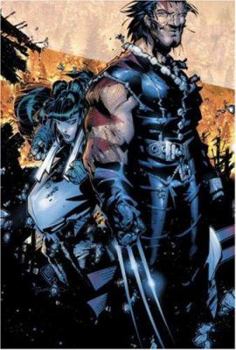
As I mentioned in my August recap, I discovered a lost box of superhero comics when I moved to my new house. This month, I re-read the “new” Age of Apocalypse.

The original Age of Apocalypse was a big cross-book event that ran for four or five months across all of the X-Men books in the mid ’90s. It’s my favorite thing in superhero comics, although that is probably a function of my age when it hit, the state of Marvel at that time, and a good dose of classic nostalgia. I also don’t really read superhero comics anymore, so there’s really no opportunity for anything to usurp it.

The New Age of Apocalypse is the trade paperback collection of a limited-run series that released for the 10-year anniversary of the original event and picks up the story in the same alternate universe where the originals left off.

The book is drawn in the same heavy-lined, anime-inspired style of the Ultimate X-Men books I reviewed in the August read report. This style is clean and easy to read, and the artists are certainly skilled and make it work, but something about it just rubs me the wrong way. It’s a little too cartoony.

The story follow’s Magnetos X-Men as they try to pick up the pieces in the wake of Apocalypse’s collapsed North American empire. There is a mystery element, with Mr. Sinister playing the villain, but the resolution of that mystery ends up being…kind of dumb. There is a soap opera quality of over-the-top character motivations and emotions, and some of the characters change their minds seemingly at the drop of a hat. If I’m being charitable, I’d say that the writers tried to cram too much plot into relatively few issues, and this explains the abruptness of the action and mood swings of the characters.

Much like Ultimate X-Men, the New AoA feels like a classic comic book story with classic comic book failings. It’s a little more disappointing to me, but that’s only because I have such a fondness for the original AoA.

On that note, my box of old comics does include almost the entire run of the original Age of Apocalypse. I’m a little afraid to read those issues again, lest I discover that it’s not quite as good as my faded and nostalgic memory would claim. But I might do it anyway.

The Witcher: The Tower of Swallows

By Andrzej Sapkowski

Dear God, I did it! After several months of promising that I would get back to it, I finally finished this book.

The Tower of Swallows is the penultimate volume in the main five-book Witcher series, and it suffers a bit of the classic long fantasy series syndrome. All of the characters are wandering across the land, spending a long time trying to get somewhere for something to happen.

Our three main characters, Ciri, Geralt, and Yennefer, are all split up for this entire book, and I suspect this is a lot of what slows it down. They each have their own cast of secondary characters in orbit, and while a lot is happening, it still ends up feeling like all the pieces are being lined up just right for everything exciting to happen in the final volume.

That said, it’s still a good book in a great series. The setting, heavily inspired by Polish mythology, continues to shine. The world feels alive with complexity and depth, and even the characters with supernatural powers are often at the mercy of bigger cultural and political forces.

I’m beginning to feel that Sapkowski’s literary calling card is his ability to build a narrative through a dozen little frame stories. The book is a mix of flashbacks and retellings of events from different perspectives: a bard’s memoirs, a late night story next to the hearth, or the testimony of a soldier on trial for treason. It’s to the author’s credit that all of these blend together into a cohesive quilt of smaller stories.

With any luck, I’ll finish the final volume before the end of the year. I’ve really enjoyed my time with the Witcher and his cohorts, and I’m hopeful that Sapkowski will answer the remaining questions, finish off the biggest villains, and bring it all to a satisfying conclusion.

The Read Report — August 2023

This is the monthly post where I talk about what I’ve been reading. As usual, if you’re interested in any of these books, please use the included Bookshop.org links instead of Amazon. It helps independent bookstores, and I get a small affiliate commission.

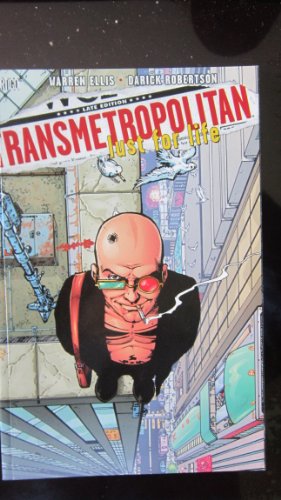
Transmetropolitan (Vol. 1)

Written By Warren Ellis, Illustrated by Derick Robertson

Transmetropolitan has been on my radar for some time, even though I knew almost nothing about it. It was lodged in my brain alongside a bunch of other 90s-2000s non-superhero comics. I’ve recently discovered just how cheaply you can snag slightly beat-up trade paperbacks of old series at places like ThriftBooks, so I went ahead and purchased the first two volumes of the series just to see if I had any interest.

My feeling coming away from the first volume is that Transmetropolitan is weird for the sake of weird, and that particular brand of “edgy” that was popular in this era, but a little silly in retrospect. It is a depiction of the kind of cultural and technological singularity where almost everything is possible and is probably happening just down the street, but the absolutely schizophrenic nature of that kind of chaos doesn’t really jive with telling a deep or particularly coherent story.

The book begins with former journalist Spider Jerusalem living like a wild-man in a mountain-top cabin surrounded by booby-traps. He is naked, heavily tattooed, and clearly hasn’t gotten a shave or a haircut in a few years. We learn that he was the most famous journalist in a nearby city (simply known as The City), and he gave it all up to move out here. Unfortunately, he signed a contract for a book deal, overdue by five years, and now his publisher is threatening to take the money back. So off he goes, back to The City.

Spider breaks into the offices of his old newsfeed, secures a job and an apartment, removes all his hair with a chemical shower, and gets his trademark glasses out of the totally-not-a-Star-Trek-replicator in his kitchen. Then he turns on the news. There are cryogenic defrostees, people uploaded into nanite clouds, and humans surgically turning themselves into aliens and trying to succeed from The City and create their own colony. As it turns out, these will all be plots for subsequent issues.

The first volume didn’t wow me as an introduction. The chaos of The City struck me as an excuse to just throw any sort of futuristic spaghetti at the wall and see what sticks. The characters all range from unpleasant to outright awful, and I have a hard time taking it seriously when the city is called The City and the protagonist has a name like Spider Jerusalem. But hey, it’s the first volume, and a lot of series don’t find their feet right away, so I started in on the next one…

Transmetropolitan (vol. 2)

Written By Warren Ellis, Illustrated by Derick Robertson

I realized partway through this volume that the post-facts world of Transmetropolitan probably seemed more science-fictiony around the year 2000. Nowadays, it’s hardly any different than world outside my window. This certainly isn’t the first piece of sci-fi to satirize politics and religion, only to find that the future went and outdid them. Being subversive and edgy is not a good way to last—yesterday’s shocks are boring to tomorrow’s audience.

I also came to the conclusion that a lot of what rubs me the wrong way about the series is that it’s packed with big, obnoxious allegory. It’s constantly winking and nudging you.

Transmetropolitan doesn’t have an ongoing arc in these first couple volumes. It’s just a series of unrelated stories. This time, we get one about Spider’s assistant’s boyfriend, who decides to download himself into a cloud of nanites. After that, it’s a cryogenically frozen woman who wakes up and discovers that the future is impossible to acclimate to, and that nobody much cares to try and help her. Then there’s Spider’s tour of the “reservations,” hermetically sealed places throughout The City that are built to preserve different cultures and ways of life. Each of these works pretty well as a stand-alone short story, but it didn’t feel like it was building to anything bigger.

Ultimately, I found that Spider Jerusalem was one of the least interesting characters in his own book. It’s possible that some of these disparate threads will eventually weave back together into a larger story, but I wasn’t feeling it after two volumes. I don’t think I’ll be continuing this series.

The Witcher: Sword of Destiny

By Andrzej Sapkowski

This is the second Witcher book that’s billed as a short story collection. And it is, but they end up feeling like more than the sum of their parts. There are bigger arcs happening across these stories, continuing the events from the first book.

In addition to the titular Witcher, Dandelion the bard and the sorceress Yennifer are the other main characters. If there is an overall theme across the book, it’s the angst between Geralt and Yennefer, who are both outcasts and troublemakers in their own ways. They each think they can’t make the other person happy, while also being unable to permanently break things off.

There is also a great deal more world-building happening here, including the first mentions of the Wild Hunt, a mysterious recurring event where ghostly warriors cross the sky and portend disaster and war. These stories are still “low to the ground,” but they incorporate a bit more about the nations and politics of the northern kingdoms.

Of course, it wouldn’t be the Witcher without stories about the interactions between humans and magical creatures, whether that be a shapeshifter stealing friends’ identities or a pompous town mayor in love with a mermaid. It also sets up the series of books to follow, as Geralt meets Ciri, the kid princess whose destiny he inadvertently entwined with his own.

The Sandman: Fables and Reflections (Vol. 6)

Written By Neil Gaiman, Illustrated by P. Craig Russell

Much like Volume 3, Dream Country, this is a set of mostly stand-alone tales where Dream takes on a minor role. There’s a story about Emperor Norton, the real person who declared himself Emperor of the United States of America, a fable about a clan of eastern European werewolves, a tale of young Marco Polo getting lost (and eventually found) in the desert, and story of a spectacular Baghdad, greater than we ever knew it because it was traded into dreams so it might stay perfect forever.

Unlike Dream Country, there are a few things of note that tie back into the broader ongoing plot. For the first time in the series, we actually see “the prodigal,” Destruction, the one member of the Endless who has abdicated his position. We witness a retelling of the ancient Greek tragedy of Orpheus, who is an oracle, and Dream’s son. We see why Orpheus lives eternally as a severed head, and the cause of the rift between him and his father.

These events lead directly into Volume 7, and it really feels like the meandering main story is picking up steam.

The Sandman: Brief Lives (Vol. 7)

Written by Neil Gaiman, Illustrated by Jill Thompson

The issues of this arc are labeled as “chapters,” and this is probably the most linear and focused volume since the first. The beginning pulls together several threads from earlier stories, and the end implies a whole lot of bad things are in store for Dream.

Each chapter begins with a sequence of cryptic phrases, like this for chapter one:

Blossom for a lady

Want/not want

The view from the backs of mirrors

Not her sister

Rain in the doorway

The number you have dialed…

They turn out to be little landmarks in the story, a game where the reader can try to guess what might happen from these tidbits, and then check items off the list as they come to pass. It got me thinking how excellent the whole series is at these little things. From the surreal Dave McKean covers and interstitial art to the introductory quotes to the entertainingly themed credits, the Sandman books feel like absolutely every single element was labored over more than was really reasonable. All the little things add up.

The story of this volume centers around the duo of Dream and his youngest sister, Delirium (who used to be Delight). Delirium’s personality is somewhere between a young child and a lunatic, and you get the feeling that the rest of the oh-so-serious Endless family is perpetually humoring her. She decides to go looking for Destruction, the brother that abandoned the rest of the Endless and made it clear that he doesn’t want to be found. Delirium asks her siblings to help her, but one by one they brush her off. When she comes to Dream, the most serious of them all, it’s a surprise that he agrees to go with her. So the pair set off to find Destruction.

Eventually, we learn that Dream had ulterior motives, and never really expected to find Destruction. But he takes his responsibilities seriously, and since he promised to help Delirium, he turns to the one person who has the power to find the Endless, even when they do not want to be found: his own son, Orpheus. For this favor, Orpheus (a severed head who cannot die) asks his father to end his suffering.

The book ends with foreboding. They find Destruction, only to have him leave again. Morpheus returns to his realm, everything neatly wrapped up, and then reveals his chalk-white hands stained with his son’s blood. It’s made clear that there are consequences for the Endless when they spill family blood. The only question is what those consequences will be…

Small Gods

By Terry Pratchett

Sometimes I look at the Hitchhikers’ Guide omnibus on my shelf and I think sadly about how I’ll never be able to read another Douglas Adams story for the first time. But if there’s anyone who can compare to Adams, it has to be Terry Pratchett. I’m grateful that unlike Adams, he wrote so prolifically.

There are 41 books in the Discworld series, and I’ve been slowly going through them, picking up new ones at Half Price Books whenever I see them. I’m savoring them, because I know eventually I’ll run out.

Small Gods is about an accidental prophet named Brutha, in the desert land of Omnia, where the people worship the god Om. Omnia is a strict theocracy where the church is the central pillar of life, and it’s not uncommon for supposed sinners to have the badness tortured out of them. Faith is of the utmost importance in Omnia, so it’s especially awkward when Brutha discovers that Om is trapped in the form of a turtle with hardly any godlike powers at all, and this is because nobody besides Brutha actually believes in him anymore.

Brutha goes on a hero’s journey, and despite his best efforts he manages to overthrow the Omnian order, restore (real) belief in Om, and generally start making the country a place where people can live their lives without worrying about being randomly tortured.

Small Gods isn’t my favorite Discworld book, but it’s a parody with plenty of laughs and a few sideways glances toward our world. As usual, an average book by Terry Pratchett is quite good by anyone else’s standards.

Harry Potter and the Sorcerer’s Stone

By J. K. Rowling

One of the joys of being a parent is getting to share things you enjoy with your kids. One of the strange things about being a parent of several children (with a few years in-between) is that I’ve shared a bunch of those things with my eldest kids, and my youngest knows nothing about them. So, although I read the Harry Potter books to my eldest son—and my daughter was sometimes in the general vicinity of the reading—I was told that we should read them again. And now we are.

I’ll say here that I don’t agree with Rowling and the garbage she is now known for spewing on social media. I also think it’s fashionable to criticize books by authors who are deemed terrible people. Despite Rowling acting out, I think the Harry Potter books are perfectly enjoyable.

A lot of the complaints about this series are about all the unbelievable aspects of the world-building. There are a lot of problems with the Wizarding World and its interactions with the regular world that just aren’t addressed. And that’s completely true. But I also think it doesn’t really matter.

The odd thing about this series is that it grew up along with its readership. The first book is very much a children’s story, in its form and in the language it uses. It’s not worried about perfectly consistent world-building, any more than Little Red Riding Hood or Goldilocks is, because the shape of the story still works. Part of that is because it borrows from fairy tales, starting with the classic evil step parents (or in this case, aunt and uncle), and the orphan boy who is destined to save the world.

So shockingly, my takeaway is that a super-bestselling book that started a huge pop-culture craze and made more money than some small countries does, in fact, do a lot of things well.

What I’m Reading in September

I’ll continue working my way through the Sandman and Witcher series. I might go for a couple brand-new books about writing that I just got. I also recently compiled a list of highly-rated comics from the last 20 years, and I might start working through some of those.

See you at the end of September.

The Read Report — June 2023

This is the monthly post where I talk about what I’ve been reading. This month, I continued my reread of the Sandman series, and delved into the Witcher books. I also took a look at a new TTRPG.

As usual, if you’re interested in any of these books, please use the included Bookshop.org links instead of Amazon. It helps independent bookstores, and I get a small affiliate commission.

The Sandman, Vol. 2: The Doll’s House

Written by Neil Gaiman, Illustrated by Mike Dringenberg

The first Sandman trade paperback followed Morpheus (a.k.a. Dream) through his embarrassing imprisonment by a petty modern sorcerer, his escape, and the subsequent retrieval of his magical tools. It also introduced some of his siblings, the immortal personifications known as the Endless.

However, things aren’t yet back to normal. In this second trade paperback, Dream must clean up his kingdom, which fell into disarray in his absence. Several of his minions are missing, including The Corinthian, a murderous nightmare with mouths for eyes. To make matters worse, a Vortex has appeared: a mortal with the ability to tear down the walls between dreams (which turns out to cause a lot of problems). Mixed up in all of it are Dream’s siblings, Desire and Despair, who plan a potentially deadly trap for their older brother.

Through flashbacks, we see stories from Dream’s past, interspersed with his present-day hunt for the escaped dreams and the Vortex. While he is obsessed with his responsibilities, there are some indications that his imprisonment has taught him to have more compassion in his dealings with mortals.

This volume confirms that the series is not afraid to wade into dark topics, with storylines involving an abused child and a convention of serial killers doing the sorts of things you’d expect them to do.

The Sandman, Vol. 3: Dream Country

Written by Neil Gaiman, Illustrated by Kelley Jones

This volume contains four stand-alone stories set in the Sandman universe. Some involve Dream heavily, some barely, or not at all. They’re all enjoyable in their own way, but not strictly necessary to read if you’re only interested in the “main” storyline.

They include a story about a feline prophet from the perspective of cats, a captive muse used (and abused) by artists for fame and fortune, Shakespeare’s theatre company putting on a play for faeries, and the second story to feature Death, about an un-killable super-hero who wants to die after her powers alienate her from society.

The book ends with some notes, revealing the origins of these stories (namely that Gaiman was itching to do different things after struggling to complete the Doll’s House arc). It includes the original script for Episode 17: Calliope. If you’re interested in writing for comics, it’s a nice side-by-side comparison of script and finished product, from a widely acknowledged master of the craft.

Die: The RPG

By Kieron Gillen and Stephanie Hans

This was a Kickstarter that I backed somewhat on a whim.

It starts with a group of people attending a school reunion. They played table-top RPGs together when they were younger. Now they’re all grown up, and they’re getting together to do one final adventure. Only this game is different. It’s magical, and it transports them, literally, to another world.

It’s basically TTRPG Jumanji.

Die began its life as a comic series. You can read the first issue for free. Now, it’s also a real TTRPG by the same authors. It’s a nice, 400-page hard-bound all-in-one rulebook.

The main innovation the system offers is a doubly-layered story. Players first create a cast of “real life” characters, a group with history and emotional baggage. Then those characters become the paragons (the classes) in the fantasy world of Die.

Die eschews the usual fantasy archetypes. The default rules require each player to play a different class, and each is associated with one of the classic TTRPG dice. Characters can play as…

  • The Dictator (D4), with the power to alter others’ emotional states
  • The Fool (D6), who gains incredible luck so long as they’re being dangerously daring or cavalier
  • The Emotion Knight (D8), who harnesses a specific emotion for martial power and wields a sentient weapon
  • The Neo (D10), a cyberpunk thief whose powers are fueled by money
  • The Godbinder (D12), a spiritual mercenary who gains magical powers by going into debt with the divine
  • The Master (D20), is played by the GM, and can break the rules and cheat at the risk of destroying themselves.

The game is relatively rules-light. It’s a D6 dice-pool game, with the class dice adding a little variety for special skills. The book includes a single chapter bestiary, and very little incidental description of items.

It is also story-light. It doesn’t have a setting so much as a meta-setting, a world with 20 regions that can take the form of whatever settings you want to pull into your game. The Master plays the ultimate villain who forces the players into this alternate world, and all the players must collectively decide whether to stay in the fantasy or leave together. At least, all the players who are alive at the end…

There are some interesting rules for death, where players come back as zombie versions of themselves, capable of regaining life only by taking it from one of the other players. And there are The Fair, the hidden denizens of the world of Die, with their own secret agenda and godlike powers.

I don’t have an active RPG group at the moment, and I haven’t had the chance to play this yet, but it feels like a game designed for veteran players. The two-layered characterization requires players to deeply understand and heavily role-play their characters. It’s unlikely to make for a fun hack-and-slash dungeon crawl. The lack of detailed systems or predefined settings and adventures mean the GM is going to have to either prep a lot or do some excellent improv (and probably both).

Overall, an interesting game book to read, and one I’m happy to have on my shelf, but probably not one I’ll be playing any time soon. For experienced groups who are looking for a new game, it might be a system worth trying.

The Witcher: The Last Wish

By Adrzej Sapkowski

The Witcher series contains eight entries: a five novel series and three stand-alone books. This is the first: a short story collection. They were originally written in Polish by Andrzej Sapkowski and later translated into a variety of languages, several successful video games, and an ongoing Netflix series that just happens to have released a new season.

These sword-and-sorcery tales take place in an Eastern-European-feeling secondary world and follow the titular Witcher, Geralt, one of a dying group of magic-infused monster hunters. Geralt is often feared and treated poorly because of his mutant nature, and an ongoing theme of the books is that the humans are often more evil than the monsters.

In addition to monsters and humans, there are several non-human races like dwarves, elves, and gnomes. There are hints that these races once ruled the continent, but were long ago ousted by humans and their kingdoms in a series of brutal and attritive wars. Now, they are forced to choose between hopeless rebellions or integration into a society that treats them as dangerous and lesser beings.

Geralt, by virtue of being an outsider among humans, moves between all these different factions and groups, managing to make friends and enemies in equal measure just about everywhere. The stories often hinge on questions of ethics, with Geralt being thrust into situations with no good choices.

This is a great intro to the character and the world. Many of the elements are fantasy staples and little homages to fairy tales, but they’re infused with little twists that make them all feel fresh again.

The Witcher: Blood of Elves

By Andrzej Sapkowski

In the release chronology, this is technically the third book, however it is the first book of the five-part series of novels, and the place to start if you’re less interested in the short stories.

I have to admit, the beginning of the book is a little hard to swallow. The famous troubadour Dandelion sings to a crowd, crooning a thinly veiled ballad about the Witcher, Geralt, and his young princess ward Ciri. For the remainder of the chapter, the crowd of listeners dump exposition about these characters, their past, the world, and the current political situation. Somehow, half a dozen of the people gathered have had run-ins with these people. After that, however, it livens up quickly.

The story mostly follows Geralt and Ciri, and the sorceresses Yennifer and Triss. Ciri is the princess of a kingdom annexed by invaders. While the invasion was halted by an alliance of other kingdoms, war seems to be looming on a variety of fronts, and at least a few dangerous people are looking for Ciri and her Witcher protector.

This book really expands the world with some tantalizing hints of a long and complex history. It’s revealed that monsters came into the world through an event known as the Conjunction of the Spheres, an overlaying of dimensions more than a thousand years previous where things could cross between worlds. Monsters are invasive species, and while many are dangerous, they are not necessarily well-adapted to this world and are generally in decline, leaving Witchers with less work. It is also implied that humans may have entered the world during the Conjunction, explaining how they suddenly started to take over ancient non-human lands.

Sapkowski introduces some interesting anachronisms to his largely medieval setting. Sorcerers and Witchers apparently understand quite a bit about biology, physiology, and the origins of disease, and use a mix of magic and modern(-ish) medicine.

This is a great first book for a series, introducing important characters, building the world, and hinting at bigger mysteries and a villain lurking in the shadows. While Geralt is at home among the common folk (rarely interacting with anyone more important than a mayor in The Last Wish), this book promises an epic fantasy series with plenty of royal politics, assassins, magic, and world-shattering consequences. The characters drive the action, and are largely pulled into these broader political situations against their wills. Geralt is the perfect gruff-but-lovable protagonist, and I look forward to learning more about the cosmology of Sapkowski’s world.

What I’m Reading in July

I’ll continue the Sandman and Witcher series, I’m going to get back to Discworld with my kids, and I’ve got a Neal Stephenson novel I’ve been slowly picking at in e-book that I’m determined to finish.