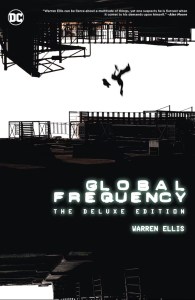
The version from my local library is the Deluxe Edition, containing all 12 original issues from the 2002-2004 run. As an early 2000s title, I’d say this is on the tail end of non-superhero books working their way into mainstream culture. So there is no spandex and no superpowers (at least by that parlance), but Global Frequency does dabble in super-villain sci-fi and supernatural stuff on roughly the believability level of The X-Files.
The Global Frequency is a semi-secret, global and unaffiliated spy organization, 1001 specialized experts recruited by a woman who calls herself Miranda Zero. They live in a heightened version of the real world at the turn of the millennium, and they find solutions for crises big and small.
Each issue is a self-contained story, “monster of the week” style. There is no broader arc or big bad pulling all the strings, and no significant final wrap-up for the series. Miranda Zero and her central radio operator Aleph are the only recurring characters. Everyone else is a day player, and therefore sometimes expendable.
Each issue sets up a high stakes problem with many lives on the line, then places Global Frequency members with interesting skills nearby to solve that problem. Sometimes “interesting skills” means hacking into anything and everything. Sometimes it just means a lot of punching and shooting. Sometimes it’s being a super-detective or having a bionic arm or being a magician or building your own civilian space agency.
Some of the impending catastrophes are varied, like a memetic alien mind virus or an apparent angelic visitation that drives a whole town insane. Unfortunately, about half of them boil down to a big bomb. And by big, I mean at least three separate instances of nuclear weapons, and one orbital railgun that would only be similar in effect to an atomic bomb.
2000s Edgy
The series is very of-its-time, on the bleeding edge of what was cool in 2002: parkour and UAVs and satellite imagery. The Matrix was only a couple years earlier, and the Internet still felt new. I don’t begrudge the high tech that seems mundane from a 2020s perspective, or the hackers that get into any computer in five seconds flat. Some of the early web slang, spoken aloud by serious characters, is a little harder to forgive.
The biggest problem, however, is classic Warren Ellis: the series seems to want to play with the literary big boys, but it comes off as adolescent a little too often. It’s William Gibson by way of Hot Topic.
Oh, there are cultists with a bomb and hostages? And the bomb is connected to their heart rate monitors? And they took a slow-acting poison? It’s a delicate situation. Better send in a pair of action heroes to shoot them all, and shoot the remote before the leader can push the button. Good thing the heart monitor bit was a bluff.
Then, of course, the action heroes who have been at each others’ throats the whole time can immediately go offscreen to get it on. Its violent and sexy and there are naughty words, and that makes it adult.
I don’t mind these kinds of shenanigans. They’re why people still love over-the-top 90s action flicks. Heck, Netflix is still making a few of those movies per year, with big actors and eye-watering budgets. It works when the story doesn’t take itself too seriously. But Global Frequency sometimes feels like it’s trying a little too hard to be cool.
Missed Opportunities
That said, the series could have really benefitted from another 12 issues, and I would have been happy to read them. The run is short and it sticks to the anthology- style disconnected stories a little too much for my tastes. There are two things that more issues could have given breathing room for: a multi-issue arc, and an opportunity for failure.
The Global Frequency is a sort of an organizational Mary Sue. Their funding and equipment is never really explained. All their members are experts in their field, and everyone is fully aligned with the mission, whatever that might be. There are no moles and no traitors, despite their many enemies. In a spy series!
I would love to have gotten a little more background, and that could have very easily played into some kind of SPECTRE counter-spy organization or villain with a bone to pick. It would also have allowed for the Global Frequency to fail. Because they never really do. Individual members may die in the line of duty, but they always save the day.
Art and Extras
The art is solid and varied. Each issue has a different artist, so there’s always something new to look at. The angles, panels, and framing are occasionally unexpected, but there’s nothing especially crazy or unusual going on for this era of DC. There were a few places where the action was muddied, mostly in a specific issue that is almost entirely taken up by a big one-on-one brawl.
The book ends with two Deluxe Edition extra features: the original proposal for the series as submitted to DC, and a script for one issue. These are interesting for those who want to work in comics, and those who just like to see how the sausage gets made.
This is the monthly post where I talk about what I’ve been reading. As usual, if you’re interested in any of these books, please use the included Bookshop.org links instead of Amazon. It helps independent bookstores, and I get a small affiliate commission.
Written By Warren Ellis, Illustrated by Derick Robertson
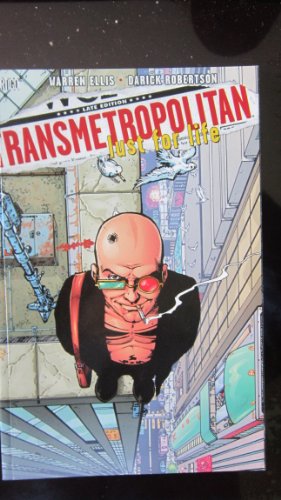
Transmetropolitan has been on my radar for some time, even though I knew almost nothing about it. It was lodged in my brain alongside a bunch of other 90s-2000s non-superhero comics. I’ve recently discovered just how cheaply you can snag slightly beat-up trade paperbacks of old series at places like ThriftBooks, so I went ahead and purchased the first two volumes of the series just to see if I had any interest.
My feeling coming away from the first volume is that Transmetropolitan is weird for the sake of weird, and that particular brand of “edgy” that was popular in this era, but a little silly in retrospect. It is a depiction of the kind of cultural and technological singularity where almost everything is possible and is probably happening just down the street, but the absolutely schizophrenic nature of that kind of chaos doesn’t really jive with telling a deep or particularly coherent story.
The book begins with former journalist Spider Jerusalem living like a wild-man in a mountain-top cabin surrounded by booby-traps. He is naked, heavily tattooed, and clearly hasn’t gotten a shave or a haircut in a few years. We learn that he was the most famous journalist in a nearby city (simply known as The City), and he gave it all up to move out here. Unfortunately, he signed a contract for a book deal, overdue by five years, and now his publisher is threatening to take the money back. So off he goes, back to The City.
Spider breaks into the offices of his old newsfeed, secures a job and an apartment, removes all his hair with a chemical shower, and gets his trademark glasses out of the totally-not-a-Star-Trek-replicator in his kitchen. Then he turns on the news. There are cryogenic defrostees, people uploaded into nanite clouds, and humans surgically turning themselves into aliens and trying to succeed from The City and create their own colony. As it turns out, these will all be plots for subsequent issues.
The first volume didn’t wow me as an introduction. The chaos of The City struck me as an excuse to just throw any sort of futuristic spaghetti at the wall and see what sticks. The characters all range from unpleasant to outright awful, and I have a hard time taking it seriously when the city is called The City and the protagonist has a name like Spider Jerusalem. But hey, it’s the first volume, and a lot of series don’t find their feet right away, so I started in on the next one…
Transmetropolitan (vol. 2)
Written By Warren Ellis, Illustrated by Derick Robertson
I realized partway through this volume that the post-facts world of Transmetropolitan probably seemed more science-fictiony around the year 2000. Nowadays, it’s hardly any different than world outside my window. This certainly isn’t the first piece of sci-fi to satirize politics and religion, only to find that the future went and outdid them. Being subversive and edgy is not a good way to last—yesterday’s shocks are boring to tomorrow’s audience.
I also came to the conclusion that a lot of what rubs me the wrong way about the series is that it’s packed with big, obnoxious allegory. It’s constantly winking and nudging you.
Transmetropolitan doesn’t have an ongoing arc in these first couple volumes. It’s just a series of unrelated stories. This time, we get one about Spider’s assistant’s boyfriend, who decides to download himself into a cloud of nanites. After that, it’s a cryogenically frozen woman who wakes up and discovers that the future is impossible to acclimate to, and that nobody much cares to try and help her. Then there’s Spider’s tour of the “reservations,” hermetically sealed places throughout The City that are built to preserve different cultures and ways of life. Each of these works pretty well as a stand-alone short story, but it didn’t feel like it was building to anything bigger.
Ultimately, I found that Spider Jerusalem was one of the least interesting characters in his own book. It’s possible that some of these disparate threads will eventually weave back together into a larger story, but I wasn’t feeling it after two volumes. I don’t think I’ll be continuing this series.
This is the second Witcher book that’s billed as a short story collection. And it is, but they end up feeling like more than the sum of their parts. There are bigger arcs happening across these stories, continuing the events from the first book.
In addition to the titular Witcher, Dandelion the bard and the sorceress Yennifer are the other main characters. If there is an overall theme across the book, it’s the angst between Geralt and Yennefer, who are both outcasts and troublemakers in their own ways. They each think they can’t make the other person happy, while also being unable to permanently break things off.
There is also a great deal more world-building happening here, including the first mentions of the Wild Hunt, a mysterious recurring event where ghostly warriors cross the sky and portend disaster and war. These stories are still “low to the ground,” but they incorporate a bit more about the nations and politics of the northern kingdoms.
Of course, it wouldn’t be the Witcher without stories about the interactions between humans and magical creatures, whether that be a shapeshifter stealing friends’ identities or a pompous town mayor in love with a mermaid. It also sets up the series of books to follow, as Geralt meets Ciri, the kid princess whose destiny he inadvertently entwined with his own.
Written By Neil Gaiman, Illustrated by P. Craig Russell
Much like Volume 3, Dream Country, this is a set of mostly stand-alone tales where Dream takes on a minor role. There’s a story about Emperor Norton, the real person who declared himself Emperor of the United States of America, a fable about a clan of eastern European werewolves, a tale of young Marco Polo getting lost (and eventually found) in the desert, and story of a spectacular Baghdad, greater than we ever knew it because it was traded into dreams so it might stay perfect forever.
Unlike Dream Country, there are a few things of note that tie back into the broader ongoing plot. For the first time in the series, we actually see “the prodigal,” Destruction, the one member of the Endless who has abdicated his position. We witness a retelling of the ancient Greek tragedy of Orpheus, who is an oracle, and Dream’s son. We see why Orpheus lives eternally as a severed head, and the cause of the rift between him and his father.
These events lead directly into Volume 7, and it really feels like the meandering main story is picking up steam.
The Sandman: Brief Lives (Vol. 7)
Written by Neil Gaiman, Illustrated by Jill Thompson
The issues of this arc are labeled as “chapters,” and this is probably the most linear and focused volume since the first. The beginning pulls together several threads from earlier stories, and the end implies a whole lot of bad things are in store for Dream.
Each chapter begins with a sequence of cryptic phrases, like this for chapter one:
Blossom for a lady
Want/not want
The view from the backs of mirrors
Not her sister
Rain in the doorway
The number you have dialed…
They turn out to be little landmarks in the story, a game where the reader can try to guess what might happen from these tidbits, and then check items off the list as they come to pass. It got me thinking how excellent the whole series is at these little things. From the surreal Dave McKean covers and interstitial art to the introductory quotes to the entertainingly themed credits, the Sandman books feel like absolutely every single element was labored over more than was really reasonable. All the little things add up.
The story of this volume centers around the duo of Dream and his youngest sister, Delirium (who used to be Delight). Delirium’s personality is somewhere between a young child and a lunatic, and you get the feeling that the rest of the oh-so-serious Endless family is perpetually humoring her. She decides to go looking for Destruction, the brother that abandoned the rest of the Endless and made it clear that he doesn’t want to be found. Delirium asks her siblings to help her, but one by one they brush her off. When she comes to Dream, the most serious of them all, it’s a surprise that he agrees to go with her. So the pair set off to find Destruction.
Eventually, we learn that Dream had ulterior motives, and never really expected to find Destruction. But he takes his responsibilities seriously, and since he promised to help Delirium, he turns to the one person who has the power to find the Endless, even when they do not want to be found: his own son, Orpheus. For this favor, Orpheus (a severed head who cannot die) asks his father to end his suffering.
The book ends with foreboding. They find Destruction, only to have him leave again. Morpheus returns to his realm, everything neatly wrapped up, and then reveals his chalk-white hands stained with his son’s blood. It’s made clear that there are consequences for the Endless when they spill family blood. The only question is what those consequences will be…
Sometimes I look at the Hitchhikers’ Guide omnibus on my shelf and I think sadly about how I’ll never be able to read another Douglas Adams story for the first time. But if there’s anyone who can compare to Adams, it has to be Terry Pratchett. I’m grateful that unlike Adams, he wrote so prolifically.
There are 41 books in the Discworld series, and I’ve been slowly going through them, picking up new ones at Half Price Books whenever I see them. I’m savoring them, because I know eventually I’ll run out.
Small Gods is about an accidental prophet named Brutha, in the desert land of Omnia, where the people worship the god Om. Omnia is a strict theocracy where the church is the central pillar of life, and it’s not uncommon for supposed sinners to have the badness tortured out of them. Faith is of the utmost importance in Omnia, so it’s especially awkward when Brutha discovers that Om is trapped in the form of a turtle with hardly any godlike powers at all, and this is because nobody besides Brutha actually believes in him anymore.
Brutha goes on a hero’s journey, and despite his best efforts he manages to overthrow the Omnian order, restore (real) belief in Om, and generally start making the country a place where people can live their lives without worrying about being randomly tortured.
Small Gods isn’t my favorite Discworld book, but it’s a parody with plenty of laughs and a few sideways glances toward our world. As usual, an average book by Terry Pratchett is quite good by anyone else’s standards.
One of the joys of being a parent is getting to share things you enjoy with your kids. One of the strange things about being a parent of several children (with a few years in-between) is that I’ve shared a bunch of those things with my eldest kids, and my youngest knows nothing about them. So, although I read the Harry Potter books to my eldest son—and my daughter was sometimes in the general vicinity of the reading—I was told that we should read them again. And now we are.
I’ll say here that I don’t agree with Rowling and the garbage she is now known for spewing on social media. I also think it’s fashionable to criticize books by authors who are deemed terrible people. Despite Rowling acting out, I think the Harry Potter books are perfectly enjoyable.
A lot of the complaints about this series are about all the unbelievable aspects of the world-building. There are a lot of problems with the Wizarding World and its interactions with the regular world that just aren’t addressed. And that’s completely true. But I also think it doesn’t really matter.
The odd thing about this series is that it grew up along with its readership. The first book is very much a children’s story, in its form and in the language it uses. It’s not worried about perfectly consistent world-building, any more than Little Red Riding Hood or Goldilocks is, because the shape of the story still works. Part of that is because it borrows from fairy tales, starting with the classic evil step parents (or in this case, aunt and uncle), and the orphan boy who is destined to save the world.
So shockingly, my takeaway is that a super-bestselling book that started a huge pop-culture craze and made more money than some small countries does, in fact, do a lot of things well.
What I’m Reading in September
I’ll continue working my way through the Sandman and Witcher series. I might go for a couple brand-new books about writing that I just got. I also recently compiled a list of highly-rated comics from the last 20 years, and I might start working through some of those.