
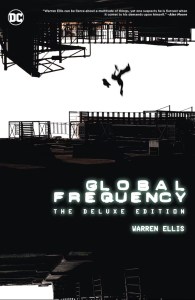
(Global Frequency Deluxe Edition at DC.com)
The version from my local library is the Deluxe Edition, containing all 12 original issues from the 2002-2004 run. As an early 2000s title, I’d say this is on the tail end of non-superhero books working their way into mainstream culture. So there is no spandex and no superpowers (at least by that parlance), but Global Frequency does dabble in super-villain sci-fi and supernatural stuff on roughly the believability level of The X-Files.
The Global Frequency is a semi-secret, global and unaffiliated spy organization, 1001 specialized experts recruited by a woman who calls herself Miranda Zero. They live in a heightened version of the real world at the turn of the millennium, and they find solutions for crises big and small.
Each issue is a self-contained story, “monster of the week” style. There is no broader arc or big bad pulling all the strings, and no significant final wrap-up for the series. Miranda Zero and her central radio operator Aleph are the only recurring characters. Everyone else is a day player, and therefore sometimes expendable.
Each issue sets up a high stakes problem with many lives on the line, then places Global Frequency members with interesting skills nearby to solve that problem. Sometimes “interesting skills” means hacking into anything and everything. Sometimes it just means a lot of punching and shooting. Sometimes it’s being a super-detective or having a bionic arm or being a magician or building your own civilian space agency.
Some of the impending catastrophes are varied, like a memetic alien mind virus or an apparent angelic visitation that drives a whole town insane. Unfortunately, about half of them boil down to a big bomb. And by big, I mean at least three separate instances of nuclear weapons, and one orbital railgun that would only be similar in effect to an atomic bomb.
2000s Edgy
The series is very of-its-time, on the bleeding edge of what was cool in 2002: parkour and UAVs and satellite imagery. The Matrix was only a couple years earlier, and the Internet still felt new. I don’t begrudge the high tech that seems mundane from a 2020s perspective, or the hackers that get into any computer in five seconds flat. Some of the early web slang, spoken aloud by serious characters, is a little harder to forgive.
The biggest problem, however, is classic Warren Ellis: the series seems to want to play with the literary big boys, but it comes off as adolescent a little too often. It’s William Gibson by way of Hot Topic.
Oh, there are cultists with a bomb and hostages? And the bomb is connected to their heart rate monitors? And they took a slow-acting poison? It’s a delicate situation. Better send in a pair of action heroes to shoot them all, and shoot the remote before the leader can push the button. Good thing the heart monitor bit was a bluff.
Then, of course, the action heroes who have been at each others’ throats the whole time can immediately go offscreen to get it on. Its violent and sexy and there are naughty words, and that makes it adult.
I don’t mind these kinds of shenanigans. They’re why people still love over-the-top 90s action flicks. Heck, Netflix is still making a few of those movies per year, with big actors and eye-watering budgets. It works when the story doesn’t take itself too seriously. But Global Frequency sometimes feels like it’s trying a little too hard to be cool.
Missed Opportunities
That said, the series could have really benefitted from another 12 issues, and I would have been happy to read them. The run is short and it sticks to the anthology- style disconnected stories a little too much for my tastes. There are two things that more issues could have given breathing room for: a multi-issue arc, and an opportunity for failure.
The Global Frequency is a sort of an organizational Mary Sue. Their funding and equipment is never really explained. All their members are experts in their field, and everyone is fully aligned with the mission, whatever that might be. There are no moles and no traitors, despite their many enemies. In a spy series!
I would love to have gotten a little more background, and that could have very easily played into some kind of SPECTRE counter-spy organization or villain with a bone to pick. It would also have allowed for the Global Frequency to fail. Because they never really do. Individual members may die in the line of duty, but they always save the day.
Art and Extras
The art is solid and varied. Each issue has a different artist, so there’s always something new to look at. The angles, panels, and framing are occasionally unexpected, but there’s nothing especially crazy or unusual going on for this era of DC. There were a few places where the action was muddied, mostly in a specific issue that is almost entirely taken up by a big one-on-one brawl.
The book ends with two Deluxe Edition extra features: the original proposal for the series as submitted to DC, and a script for one issue. These are interesting for those who want to work in comics, and those who just like to see how the sausage gets made.


