2026 is another year of short stories. In this weekly series, I track my short story writing, from idea and draft to submission.
This is the week of Jul 20 – 26.
Stats
Stories Finished: 3
Submissions Currently Out: 8
Submissions Total: 26
Rejections: 22
Acceptances: 0
Submissions and Responses
I was fighting a cold this week, so I wasn’t able to log much writing time. However, it did turn out to be a fairly productive week for submissions.
I received one form rejection for The Incident at Pleasant Hills. Since my active submissions list has been dwindling, I sent out six new submissions, including three for my freshly completed horror story, Beneath the House at Caen. That bumps my submissions number back up to roughly where it should be for my goal of 50 submissions by the end of the year.
Most of these were to publications that accept simultaneous submissions, so I will likely spend more time combing through Duotrope to send out more in the upcoming week.
Writer Beware has long been a great resource for writers, calling out outright scams, questionable services, and bad publishers. Lately, they’ve been following the ongoing saga of the class-action lawsuit against Anthropic, and the proposed settlement.
For those who aren’t aware, the settlement revolves around Anthropic’s use of illegally downloaded works of fiction in training it’s LLM models. So while AI and copyright are involved, this is strictly about the means of acquisition and not around the training itself.
The number of books involved is staggering. Only holders of registered copyrights were allowed to participate in the settlement, but this still amounts to roughly 400,000 books. The maximum possible penalties would be $150,000 per case of infringement. In actuality, the settlement will be closer to $3,000 each, which might seem pretty weak in comparison, but still amounts to 1.5 billion dollars, by far the largest copyright-related settlement in history.
As of this week, the settlement has been approved by the judge, which means it’s very likely to go forward and the numbers are unlikely to change in a significant way.
There are also still a handful of authors who opted out of the settlement and have already filed lawsuits separately, presumably in hopes of getting an amount closer to that $150k maximum. So the finalization of the settlement doesn’t mean Anthropic’s woes are over for this particular case. And beyond that, there are dozens of other lawsuits against the big LLM companies still pending.
Check out these recent posts at Writer Beware for more details:
2026 is another year of short stories. In this weekly series, I track my short story writing, from idea and draft to submission.
This is the weeks of Jul 6 – Jul 19.
Stats
Stories Finished: 3
Submissions Currently Out: 3
Submissions Total: 20
Rejections: 19
Acceptances: 0
Submissions and Responses
I had two form rejections come back this week: a magazine submission for Dr. Clipboard’s Miracle Wonder Drug, and an anthology submission for Taco Cat.
Not much to say for these. The anthology was a rather specific theme that fit the story, which is a theoretical leg up, but by no means a guarantee that it’ll be read in a positive light.
My open submissions list in Duotrope is getting thin, so I will be scouring the listings and sending out stories again this week.
Goals and Results
Last time, my goals were:
Revise Beneath the House in Caen to completion, or close to it.
Clean up and trim T.I.M., consider whether it needs another round of Critters.
Happily, I have now worked through all the critique revisions on Caen, so that will be included in my next round of submissions. It’s a horror/dark fantasy story, which will be a nice addition to my stable, since there are a decent number of markets for horror that I wasn’t able to submit to before.
Now I ought to get back to T.I.M., but I’m still feeling burned out on that story, so I may work on one of my other drafts. Estate Sale another horror story, so I may work on that as long as I am in a horror headspace.
I also have some critiques to catch up on, so I’ll be ready when it’s time to send those out for feedback.
It’s a common misconception that a great idea makes a great story. The truth is that most great stories come down to execution. A great idea with poor execution rarely works, but a great writer can breathe new life into even the most tired tropes.
Like any writer, I have my own treasure trove of ideas that might end up in a story…someday. But why horde them? Instead, I’m opening the vault and setting them free.
Use these ideas as a writing prompt, or come up with your own twist and reply in the comments.
Cordyceps Cosmicum
Grigory Romanslov has space mushrooms growing in his head. He knows this ought to worry him, but it doesn’t.
He knows there are mushrooms in there because his sinuses and ears feel plugged, and everything smells like portobello, and a delicate, thin-stemmed white cap unfurled just above his earlobe while he was shaving last week. Maybe he shouldn’t have breathed in the glowing green dust surrounding the crater he found in the south forty.
A Google search leads him to Ophiocordyceps unilateralis, which sounds much nicer than “zombie ant fungus.” It tells him the fungus controls the ants’ behavior. He doesn’t feel like the space mushrooms are controlling him, although he has been drinking salt water lately, and sucking on pennies.
He feels healthy, despite the fine white fuzz growing on his skin. He did puke up his breakfast on the front lawn yesterday, but he felt fine after.
When he wakes up and sees a dozen tree-sized mushrooms in the yard, it makes him happy. They look nice there. Decorative. And the spores twinkle a million shades of green as they catch the morning breeze.
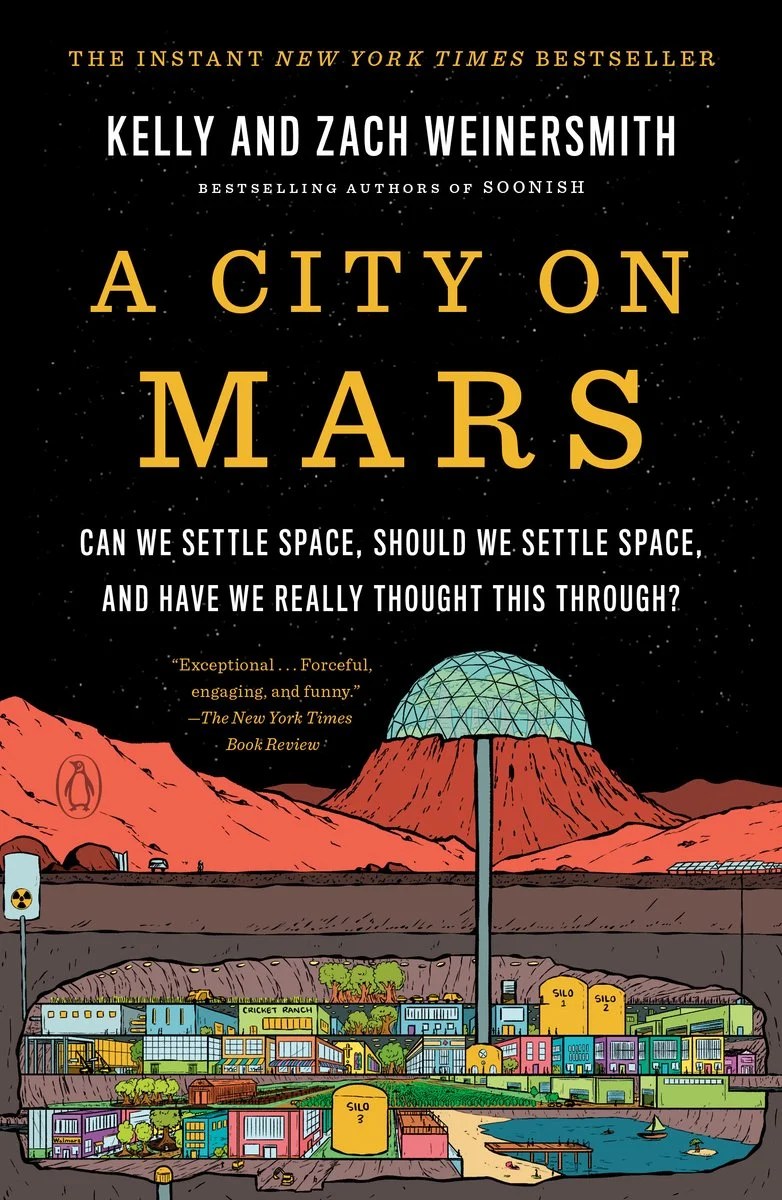
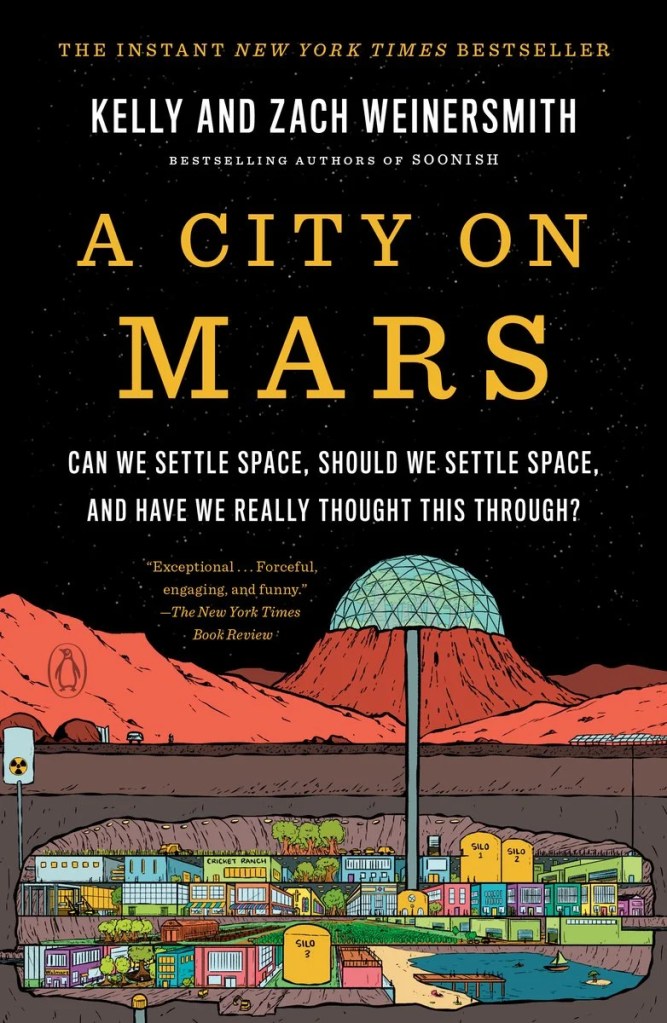
A City on Mars is the perfect kind of pop-science non-fiction for science fiction writers. It’s no surprise they got blurbs from the likes of Mary Robbinette Kowal and Andy Weir. It’s easy reading, comedic without being too jokey, and well-illustrated (Zach is author of Saturday Morning Breakfast Cereal). It delves into a subject that’s core to science fiction, one we’re all familiar with, and makes it feel new and interesting.
This is a book about space colonization, but with a few unexpected twists. “Can we settle space, should we settle space, and have we really thought this through?” asks the subtitle. Those might seem like silly questions when so much engineering and money have gone into space exploration over the last 75 years. And yet, the authors make a fairly convincing case that in some really important ways, we’ve only scratched the surface.
The Weinersmiths note that we seem to be at the beginning of a new age of space exploration. Unlike the Apollo era, there are more countries in the space game. There are private companies managing flights. And there is an awful lot of supposedly serious talk about space colonization, or at least space capitalism.
A City on Mars explores space colonization on multiple axes: not only engineering and tech, but biology, law, economics, and politics.
The Technology of Colonization
We have rockets. We have space stations. Space suits and space toilets. All sorts of advanced space technology. Hundreds of people have been to space, including Katy Perry. How hard could it be?
Of course, simply going into space is fraught with danger and wildly expensive, and this is easy to forget after watching a blockbuster movie or two. Living in space (or on other planets) is more expensive, harder, and more dangerous than living at the bottom of the sea or Antarctica. Orders of magnitude worse. And yet, those harshest of terrestrial environments often seem more fraught in our imaginations than the cold, airless, heavily irradiated void of space.
We have surprisingly little understanding of living in space—really living for years, or lifetimes—not just visiting and doing a little science. Practically everyone in space has been a well-trained, psychologically stable adult, in the prime of life and in incredible physical shape. The longest contiguous period ever spent in space is 437 days. Nobody has built anything approaching a self-sustaining environment in space. Nobody (that we know of) has ever conceived, been pregnant, or given birth in space. No children have grown up, way up there.
Despite all these unknowns, all these open questions and possible things that could go wrong, there are plenty of high-profile calls for “space colonization.” We could solve Earth’s population crisis. We could make trillions of dollars mining asteroids. We could make humanity a multi-planetary species, robust against catastrophe.
Don’t get me wrong, there have long been space nerds with dreams like this. I’m one of them, and so are the Weinersmiths. But now, space nerdery has been infected by the same Silicon Valley ethos that captured tech, finance, a lot of government, and seems to be rapidly becoming the villain of modern life. Its core tenet says that if we understand computer programming we can understand and solve any problems, probably very easily. It’s good to remember that is often not the case.
A City on Mars is in many ways a litany of all the problems that need to be solved to make space colonization a reality. It’s a long list, but also an interesting one.
More than Tech
The intersection of tech and law is rarely something that catches the zeitgeist. Where Silicon Valley interacts with the law, it often seems to be working under the famous adage of “move fast and break things.” And by pretty much any measure, it turns out that space colonization would be breaking our current space laws.
International space law is unsurprisingly limited. A handful of documents from 50+ years ago comprise all of it. That hasn’t been much of an issue while you can count all the space-faring governments on one accident-prone sawmill worker’s hand. It might become more of a problem when a dozen space programs and an equal number of private corporations are racing into space. Especially if they’re led by libertarian billionaires with certain ideas about manifest destiny.
The Weinersmiths look at the existing laws, where they are likely to be inadequate, and some international frameworks that might make good templates for new laws, including those that govern the deep sea and Antarctica.
They also look at the economic drivers for space exploration and colonization, or the lack thereof. Even with drastic improvements to the tech, the likelihood of making money in space seems slim. It’s so hard and expensive and slow to do anything in space that the payoffs would have to be outright astronomical to develop any kind of self-sustaining industry.
Space Livin’ Ain’t Easy
If there’s a broad takeaway from A City on Mars, it’s that space colonization is still a lot harder than it’s often assumed to be, and that it would be a good idea to take it slow and act thoughtfully rather than jumping in with half a plan and dealing with the consequences. It’s not a sexy position for a book aimed at space nerds to take, and the Weinersmiths are keenly aware of this.
They make their case well, and it’s hard to argue against it. This doesn’t mean space colonization is doomed, but it does probably mean that it’s a very long-term project, and one whose parameters may not jive with a lot of the current discourse. It means there are a lot of problems still to solve, and that throwing money at them won’t be enough.
Science has proven pretty good at solving some of these problems, given enough public support. That’s half the battle. The other half is purely social: can we work together and get along, as individuals and nations? The technology may be the easier lift.
Pessimism for Writers?
So why would a book that catalogues all the barriers to space colonization be good for science fiction writers? Simple: we need tension and conflict in our stories.
Practically every page of A City on Mars is a story waiting to happen. Every challenge, every difficulty or unsolved problem is just another seed for an interesting new plot.
Sci-fi can get bogged down in the land of technobabble solutions to technobabble problems. It’s not always satisfying when your dilithium crystals break and you solve it by reversing the polarity on the tractor beam to push your ship out of the neutral zone. A City on Mars offers a wealth of potentially fun challenges for characters to overcome: problems of technology and biology, but also of politics, law, and economics. If you want to write about near-future space colonization, it’s a fantastic place to start.
2026 is another year of short stories. In this weekly series, I track my short story writing, from idea and draft to submission.
This is the weeks of Jun 29 – Jul 5.
Stats
Stories Finished: 2
Submissions Currently Out: 5
Submissions Total: 20
Rejections: 17
Acceptances: 0
Submissions and Responses
All quiet this week. No new submissions or responses.
Goals and Results
Last time, my goals were:
Revise Beneath the House in Caen to completion, or close to it.
Clean up and trim T.I.M., consider whether it needs another round of Critters.
As usual, this was optimistic, but I did want to leave the week open to work on either of these stories, depending on what I felt like doing. In the end, it was Beneath the House at Caen that I ended up working on. This was productive revision, trimming about 200 words and cleaning up quite a few small things.
My process for dealing with workshop feedback has evolved into roughly three steps. First, I do the initial read-through of all of it, and copy it over into a single unwieldy OneNote document. Then I take a second pass through all of it, decide what I’m going to discount or ignore, and begin taking bullet-point notes. The result is a stack of bullet points and a few pages of little feedback snippets at the top of the doc, and everything else relegated to the wasteland at the bottom of the doc. The final refinement is to go through the snippets and either immediately change something in the story to address them, or convert them into a bullet point.
Similar feedback gets combined. If I’m clever, I come up with a fix that addresses several things at once. Eventually, what I’m left with is a long list of bullet points (about 50 in the case of Caen). Some are still easy fixes, some require more thought. Then I work through them.
The Halfway Mark
Week 26 means we are halfway through the year. I figured this would be a good time to review my goals and see where I stand.
Finish and submit twelve short stories — Current: 2 / Goal: 6
Send 50 submissions — Current: 20 / Goal: 25
Post 100 times on Words Deferred — Current: 43 / Goal: 50
I’m a little behind on all of these metrics. The biggest issue is actually getting those stories across the finish line so they can be sent out. However, even if I get the two in progress finished soon, I’ll still be behind there. I always knew that a story per month was going to be difficult for me, but I’d still like to get this number higher.
My submission count, on the other hand, is solid. I’ve been doing more simultaneous submissions this year, which helps a lot. If I can get a few more stories in rotation, that will make this goal easy to hit.
The state of the third goal can be clearly seen on my WordPress stats. All I have to do to meet that goal is two posts per week, and one of them is this weekly update. I absolutely hit that standard the first three months of the year, but I trailed off in the second quarter. Part of that comes down to finding something interesting to talk about. I have no interest in writing something that bores me and you. If I had to pick one goal to not achieve, it would be this one. After all, it’s the “Year of Short Stories,” not the “Year of Blogging.” That was somewhere around 2006.
Next Week
I’m a broken record:
Revise Beneath the House in Caen to completion, or close to it.
Clean up and trim T.I.M., consider whether it needs another round of Critters.