
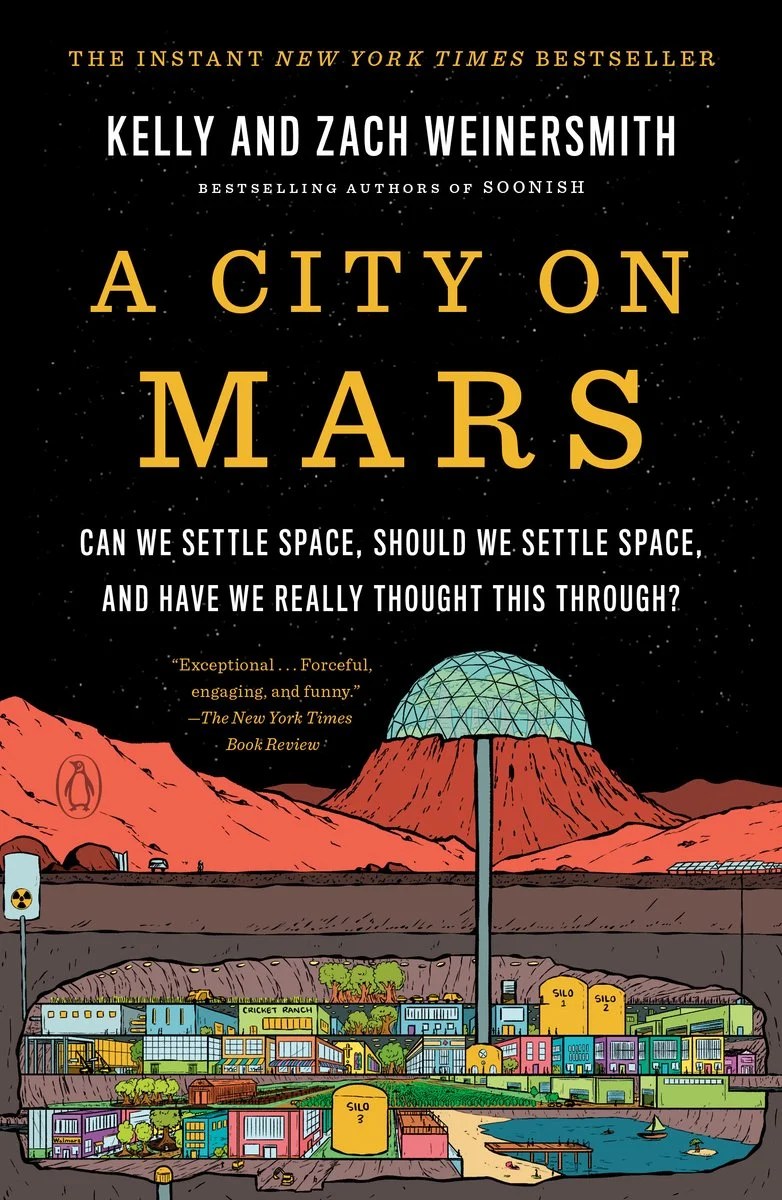
Book | E-book | Audiobook (affiliate links)
A City on Mars is the perfect kind of pop-science non-fiction for science fiction writers. It’s no surprise they got blurbs from the likes of Mary Robbinette Kowal and Andy Weir. It’s easy reading, comedic without being too jokey, and well-illustrated (Zach is author of Saturday Morning Breakfast Cereal). It delves into a subject that’s core to science fiction, one we’re all familiar with, and makes it feel new and interesting.
This is a book about space colonization, but with a few unexpected twists. “Can we settle space, should we settle space, and have we really thought this through?” asks the subtitle. Those might seem like silly questions when so much engineering and money have gone into space exploration over the last 75 years. And yet, the authors make a fairly convincing case that in some really important ways, we’ve only scratched the surface.
The Weinersmiths note that we seem to be at the beginning of a new age of space exploration. Unlike the Apollo era, there are more countries in the space game. There are private companies managing flights. And there is an awful lot of supposedly serious talk about space colonization, or at least space capitalism.
A City on Mars explores space colonization on multiple axes: not only engineering and tech, but biology, law, economics, and politics.
The Technology of Colonization
We have rockets. We have space stations. Space suits and space toilets. All sorts of advanced space technology. Hundreds of people have been to space, including Katy Perry. How hard could it be?
Of course, simply going into space is fraught with danger and wildly expensive, and this is easy to forget after watching a blockbuster movie or two. Living in space (or on other planets) is more expensive, harder, and more dangerous than living at the bottom of the sea or Antarctica. Orders of magnitude worse. And yet, those harshest of terrestrial environments often seem more fraught in our imaginations than the cold, airless, heavily irradiated void of space.
We have surprisingly little understanding of living in space—really living for years, or lifetimes—not just visiting and doing a little science. Practically everyone in space has been a well-trained, psychologically stable adult, in the prime of life and in incredible physical shape. The longest contiguous period ever spent in space is 437 days. Nobody has built anything approaching a self-sustaining environment in space. Nobody (that we know of) has ever conceived, been pregnant, or given birth in space. No children have grown up, way up there.
Despite all these unknowns, all these open questions and possible things that could go wrong, there are plenty of high-profile calls for “space colonization.” We could solve Earth’s population crisis. We could make trillions of dollars mining asteroids. We could make humanity a multi-planetary species, robust against catastrophe.
Don’t get me wrong, there have long been space nerds with dreams like this. I’m one of them, and so are the Weinersmiths. But now, space nerdery has been infected by the same Silicon Valley ethos that captured tech, finance, a lot of government, and seems to be rapidly becoming the villain of modern life. Its core tenet says that if we understand computer programming we can understand and solve any problems, probably very easily. It’s good to remember that is often not the case.
A City on Mars is in many ways a litany of all the problems that need to be solved to make space colonization a reality. It’s a long list, but also an interesting one.
More than Tech
The intersection of tech and law is rarely something that catches the zeitgeist. Where Silicon Valley interacts with the law, it often seems to be working under the famous adage of “move fast and break things.” And by pretty much any measure, it turns out that space colonization would be breaking our current space laws.
International space law is unsurprisingly limited. A handful of documents from 50+ years ago comprise all of it. That hasn’t been much of an issue while you can count all the space-faring governments on one accident-prone sawmill worker’s hand. It might become more of a problem when a dozen space programs and an equal number of private corporations are racing into space. Especially if they’re led by libertarian billionaires with certain ideas about manifest destiny.
The Weinersmiths look at the existing laws, where they are likely to be inadequate, and some international frameworks that might make good templates for new laws, including those that govern the deep sea and Antarctica.
They also look at the economic drivers for space exploration and colonization, or the lack thereof. Even with drastic improvements to the tech, the likelihood of making money in space seems slim. It’s so hard and expensive and slow to do anything in space that the payoffs would have to be outright astronomical to develop any kind of self-sustaining industry.
Space Livin’ Ain’t Easy
If there’s a broad takeaway from A City on Mars, it’s that space colonization is still a lot harder than it’s often assumed to be, and that it would be a good idea to take it slow and act thoughtfully rather than jumping in with half a plan and dealing with the consequences. It’s not a sexy position for a book aimed at space nerds to take, and the Weinersmiths are keenly aware of this.
They make their case well, and it’s hard to argue against it. This doesn’t mean space colonization is doomed, but it does probably mean that it’s a very long-term project, and one whose parameters may not jive with a lot of the current discourse. It means there are a lot of problems still to solve, and that throwing money at them won’t be enough.
Science has proven pretty good at solving some of these problems, given enough public support. That’s half the battle. The other half is purely social: can we work together and get along, as individuals and nations? The technology may be the easier lift.
Pessimism for Writers?
So why would a book that catalogues all the barriers to space colonization be good for science fiction writers? Simple: we need tension and conflict in our stories.
Practically every page of A City on Mars is a story waiting to happen. Every challenge, every difficulty or unsolved problem is just another seed for an interesting new plot.
Sci-fi can get bogged down in the land of technobabble solutions to technobabble problems. It’s not always satisfying when your dilithium crystals break and you solve it by reversing the polarity on the tractor beam to push your ship out of the neutral zone. A City on Mars offers a wealth of potentially fun challenges for characters to overcome: problems of technology and biology, but also of politics, law, and economics. If you want to write about near-future space colonization, it’s a fantastic place to start.

