Year Walk — Games for People Who Prefer to Read

In the old days, man tried to catch a glimpse of the future in the strangest of ways.

they locked themselves in dark rooms

not partaking of food and drink

At the stroke of midnight

they ventured out into the night

through the dark woods

when strange creatures roamed

To see if they would be healthy

To see if they would be happy

To see if they would live

To see if they would be loved

After playing and thoroughly enjoying Device 6, I went into the back catalog for the game’s developer, Simogo. It’s a strange history, including a simple puzzle game (SPL-T), a rhythm game (Beat Sneak Bandit), a physics game (Kosmo Spin), and a strange side-scrolling driving game where you move the ground instead of the car (Bumpy Road). It’s clear that Simogo was innovating in a variety of ways, and not willing to stick to one genre.

However, Device 6 hit my brain just right because of the combination of interesting mobile-tailored interactions and interwoven story, and the old Simogo games fitting that mold seem to be Year Walk—released before—and The Sailor’s Dream—released after. I decided to try Year Walk first.
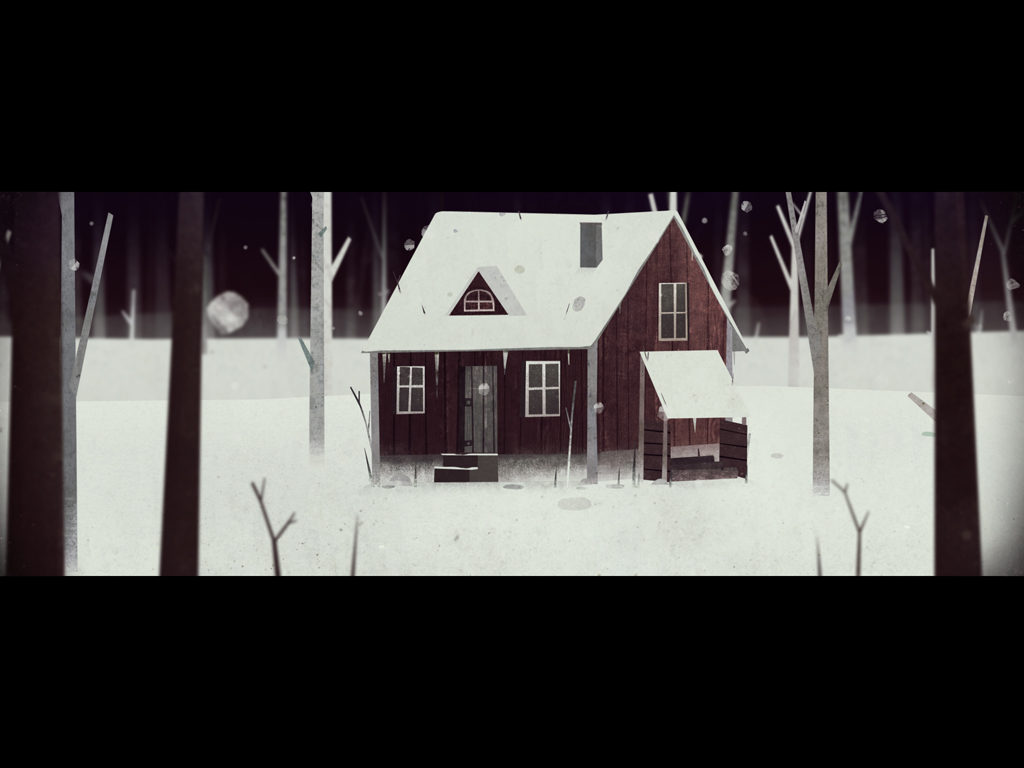
Cabin in the Woods

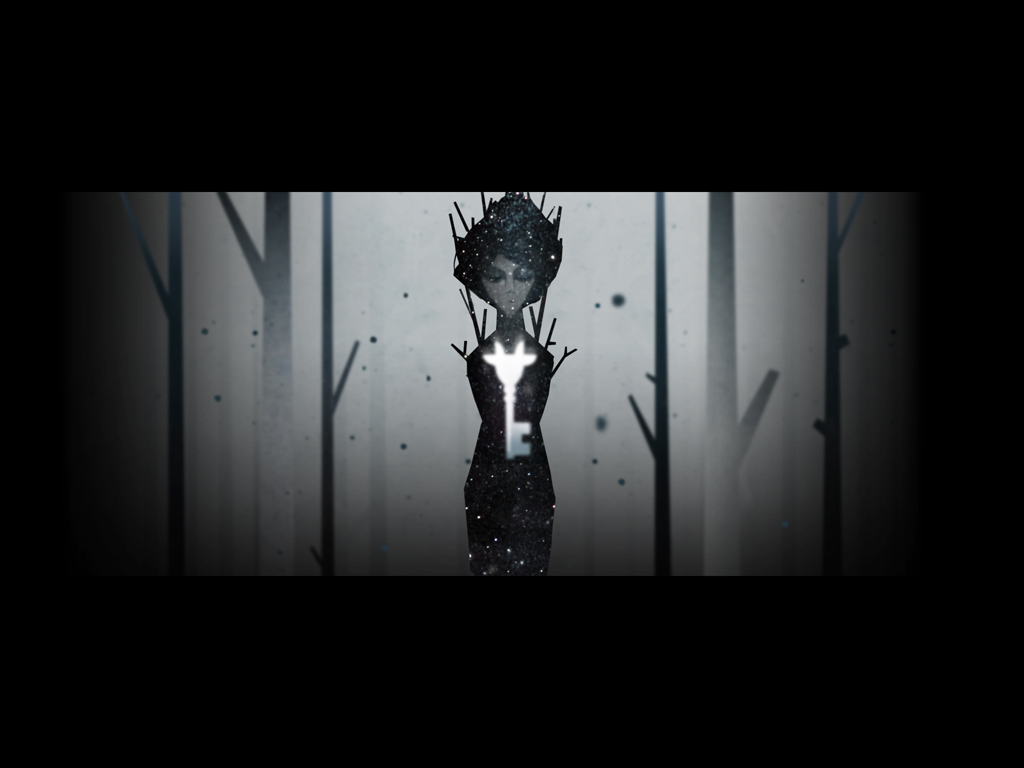
The game opens with the strange and cryptic description of Year Walking (an actual form of ancient Swedish divination: årsgång). However, you start by walking the woods during daylight, in deep winter.

Navigation is confusing at first. Scroll left and right with a finger. Swipe up or down where arrows appear at the edges of the screen to zoom into or out of the landscape. The world is a multi-layered paper cutout, and zooming takes you from one layer to another, while walking left and right show off the depth as the layers parallax.

Faint film grain adds a cinematic quality. The music is quiet, sometimes almost non-existent. As you move, boots crunch in the snow.

Eventually, by learning the controls and exploring, you find your way to a windmill. The miller’s daughter is there. You clearly love her, but does she love you? Either way, she’s betrothed to another. So you leave, returning to your cabin, vowing to year walk to see whether you will be with her in the future.
Moderate Dread, Mild Irritation

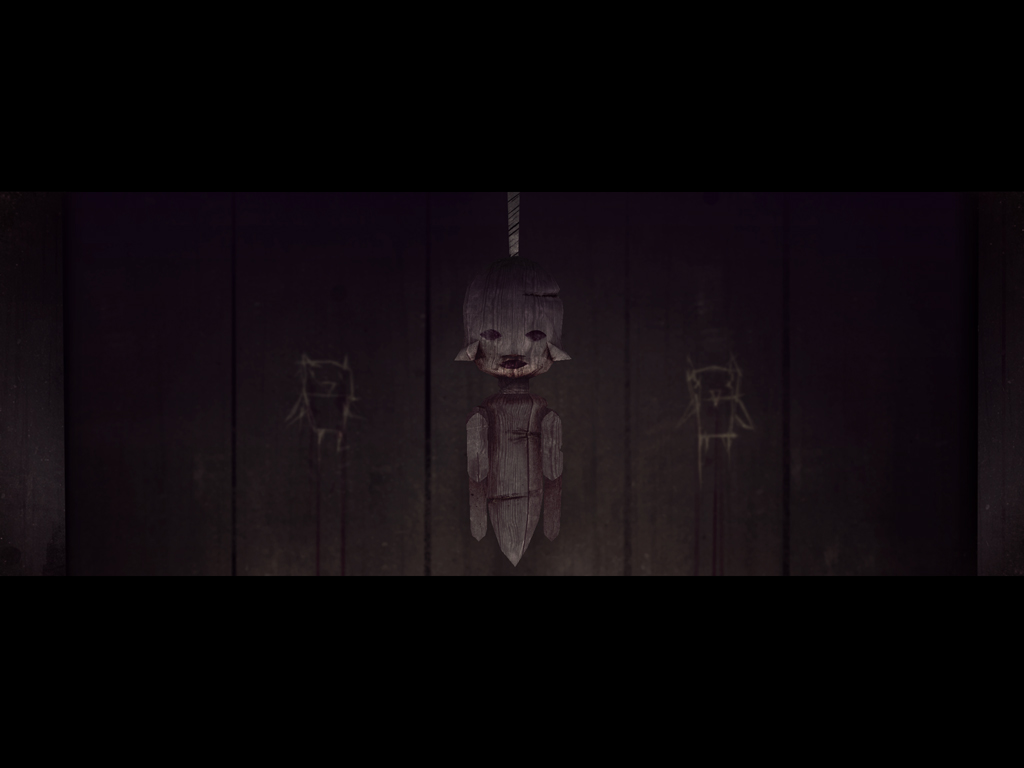
Year Walk is an atmospheric horror game with almost no dialogue. You walk the woods at night, coming across phantasmagorical visions and obscure creatures from Swedish myth. There is a little blood and a few jump scares.

For the bulk of the game, the story must be inferred from vague hints. This is a puzzle game, and the puzzles are challenging and obtuse. No real hints are given in the iOS version, although apparently the Steam version and Simogo’s game collection for console has a hint system. However,  there are a couple puzzles here that rely on mobile functionality which had to be reworked for other platforms.

I wouldn’t consider myself a puzzle master, but I do alright. For Year Walk, I had to use a guide to finish. The puzzles require some significant leaps of logic and aren’t nearly as clearly demarcated as in Device 6. One puzzle I missed completely because the interface made it unclear that the scene could be interacted with.

The Companion

The game points you subtly to the Year Walk “companion app,” and gives you a number. This is a completely separate, free app in the store, which describes some of the mythology that the game was based on. It’s written from the perspective of a researcher, and using the code grants you access to his secret personal journal.

This was where the game became more interesting to me—after it was ostensibly over. The journal, hidden inside this separate app, has the same ARG feel that Device 6 dipped its toes into.

Journal entries and blurry photographs document the life of a scholar researching the practice of year walking, trying to find old records or elderly people who may be familiar with the nearly forgotten folk ritual. His research leads him to a small town where the last recorded year walk may have occurred. It is somehow intertwined with a strange murder, for which the walker was convicted and executed.

The scholar’s own writing becomes more erratic and unhinged as he continues to unravel new threads. He finds a wooden box in the woods, locked by a mechanism with strange symbols. And here is likely where most players suddenly remember that this box appeared near the start of Year Walk, a puzzle that was never solved over the course of the game.

The scholar decides he can stop the murder that occurred decades previous. He can use the box to send a message through time. If only he can open it.

If you can decipher the code from his journal, you can restart the game, find the box, and open it to discover the message the scholar sent. This reveals a different, but no less bloody ending to the story.
A Sign of Things to Come

I found Year Walk to be slightly less polished and more frustrating than Device 6, but this final sequence went a long way toward improving my opinion of it. I can see the creative impulses and connective tissue between these two games. Year Walk…walked…so Device 6 could run.

I can’t say I would recommend Year Walk unequivocally. If you enjoy strange horror, challenging puzzles with no hand-holding, obscure Swedish folklore, or experimental games, it might be worth a few bucks and a look in.

How to Play

Year Walk is $6 on iOS and Android. It’s also available in a modified format on Steam for PC, and oddly enough, in yet another differently modified form for the Wii U. It is included along with many other games in the recently released Simogo Legacy Collection.

Device 6 — Games for People Who Prefer to Read

Device 6 is a 2013 iOS release from Simogo, ostensibly a puzzle game, although “game” is a bit of a misnomer here. It could be called a visual novel or piece of interactive fiction. It is mainly text, enhanced by sound, music, images and formatting.

Mobile Game (Derogatory)

If you own a smart phone in 2026, there’s a good chance you’ve been exposed to the horrors of modern mobile games. The most popular games are boldly billed as “free to play,” but are typically riddled with ads or paid loot boxes, with micro-transaction systems and dark patterns designed with scientific precision to promote addiction and spending.

Companies like Zynga, King and Tencent spent more than a decade systematically enshittifying these ecosystems, and Apple and Google have largely turned a blind eye to it while taking a 30% cut of the revenues enabled by these practices.

Device 6 hails from a simpler time. Five years after the release of the original iPhone, ubiquitous touchscreens were still exciting technology. Most of us remembered the pain of texting on a 10-digit keypad. Mobile games were slowly expanding beyond Snake and Breakout clones.

The Nintendo Wii had introduced motion controls to the public at large, and Microsoft’s Kinect brought computer vision. Now we all had multi-functional supercomputers in our pockets, and touch interfaces that could morph to any shape. In certain circles, there was a feeling that mobile was the new frontier for experimental game design.

Device 6 feels a little like an artifact from an alternate universe, one where mobile games didn’t drown in an ocean of slop; one where the user is made to feel something more than the desire to play one more indistinguishable level or tap their credit card.

If I sound bitter, it’s only because I think we were cheated out of a more interesting, vibrant future. Device 6 is a game that manages to feel fresh and innovative despite being 13 years old.

Text as Physical Space

Device 6 starts with a face scan. (Fake, of course. phones didn’t have face recognition back then.) A scan line buzzes across the screen once, twice, and then you’re in, given a generic-sounding user name.

The intro credits sequence that follows provides cinematic weight. It’s James Bond by way of Archer, stylized 2D animation of a delivery truck moving toward its destination backed by a light bebop soundtrack.

Then:

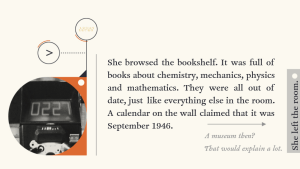
The black-and-white picture of a radio within the arrow is layered with film grain and parallaxed as you scroll, giving it a sense of depth, like a a storybook with cutout windows that peer into the another world. The sound of the radio accompanies the picture, but it becomes muffled as you scroll, because the text takes you out of the room, into a hallway.

The text gives you only a phone-sized page or two of description, bristling with side-thoughts in italics and more windows into the world before bringing you to a stairway where the text itself

steps

  down,

    taking you

      through

        the house, the shape and formatting of the text bringing you into a physical space.

Then it tips onto its side, inviting you to rotate your device to read the long, narrow lines that take you down a hallway, expanding to fill the screen again only when you reach another room.

Device 6 presents as a multimedia House of Leaves: a trapped, semi-amnesiac character moving through a mysterious, empty island mansion as the text and pictures move across and around the page.

Reaching Through the Window

Device 6 is split into six chapters, each with a handful of puzzles that need to be solved to progress. These puzzles use text, audio, and visual components scattered across the chapter. Some of those storybook windows are interactive: locks, computer terminals, keypads and other machinery that can be pushed, poked, or manipulated.

Early chapters have fewer, more self-contained interactions and puzzles. Later ones tend to build on each other, requiring a cascade of solving one puzzle to solve another to solve another. Backtracking is at first helpful, and eventually mandatory, to find the necessary clues. This is where the format shines, because the layout of the story makes scouring the text feel like searching a physical space.

I found paper and pencil to be helpful in the last two chapters, but veteran puzzlers with good memory could probably make do without.

A Layered Labyrinth

There is layer of meta-narrative in Device 6 that is easy to ignore at first. The story and the puzzles are designed to immerse you in the viewpoint of Anna, the protagonist. You quickly forget about the face scan at the beginning.

In between chapters, the game asks a few survey questions, then awards points to the player. Never mind the strangeness of some of those questions. Never mind that nice round 100 points you seem to get no matter what answers you choose.

Each chapter features a diagram somewhere alongside the text; schematics for a series of numbered devices that work in tandem and directly affect the human brain.

Even the seemingly random elements that flash across the screen during the credits sequence have meaning, much more apparent upon finishing the story and going back for a second viewing.

These extra layers aren’t required to follow Anna’s story or solve the puzzles, but they provide connective tissue and help to interpret the otherwise ambiguous ending. They add a pinch of ARG flavor by making the reader feel like a character in the story.

Where to Play

Device 6 is $3.99 and should take about 1-3 hours depending on how quickly you solve the puzzles.

It is available on iOS, Nintendo Switch and Switch 2, and Windows. Do yourself a favor and play it on a device you can rotate and manipulate with your hands to get the full experience.

Killing Time at Lightspeed — Games for People Who Prefer to Read

Killing Time at Lightspeed is a text-based, narrative game by Gritfish about browsing social media while voyaging between the stars.

You are a traveler who has left their life and your planet behind. Your lightspeed voyage will feel like less than an hour to you, but to your friends on Earth it will be twenty years. The only connection you have to those people is a news and social media feed: FriendPage.

This is a small indie game, clearly developed with limited resources. There are a few static illustrations in the introduction. After that, the entire game is contained within a simple, monochromatic yellow and black text console.

The game plays out in a series of turns, each one taking only a minute or two. During a turn, you can read your friends’ updates on FriendPage, and a handful of news headlines. You’re given the option to reply to one or two posts, and you can give them thumbs up or thumbs down. When you’ve read and responded as much as you like, you can click a button to “refresh” the page. When you do, a year passes back on earth and the news and social feeds update.

With that click of a button, you may see the results of an action a friend was considering. Relationship statuses are updated as the people you know get together and break up. They get married and have children. New technology appears, like cybernetic implants and humanoid androids. Your friends have time to adjust to societal and personal changes, but for you it all comes and goes in minutes instead of years.

There are many sci-fi ideas at play here. The arguments about cybernetic enhancement cover similar ground to the Deus Ex games. Discussions of android rights echo Detroit: Become Human. However, with this short runtime and limited budget, the game can’t delve as deeply into these particular issues. In a way, that’s the point.

In Killing Time at Lightspeed, everything that happens in your social media feed is ephemeral—even more than in our day-to-day lives. It excels in delivering a feeling of being cut off and left behind. You’re reading about what everyone else is doing and experiencing, but you are alone.

How much can you really communicate with your friends when months or years pass between messages? Momentous changes in your friends’ lives are summarized in one or two sentences. How many other important things are you missing altogether? You can ask them about what’s happening, but how can they explain all the things that have happened to them since last year and your last message?

The point is really driven home in the final years of the game, when a new social media site becomes popular and friends start to drift away from FriendPage. You don’t have the option of making a new account or checking the new feed. You only have what your spaceship gives you. Soon, your feed is almost entirely filled with spam, bots, and pointless Buzzfeed-esque listicles. You’re stuck on MySpace, in space. Your one tenuous tether to Earth is nearly severed. But you keep refreshing in the hopes that someone will come back and post something.

Then you arrive at your destination. The terminal shuts down. The game is over. Your friends are far away, living their lives without you. Presumably you’ll go off and live a new life without them.

Killing Time at Lightspeed is shorter than a movie, and can be comfortably completed in a sitting. It’s a narrative snack, not a full meal. I didn’t walk away from it with a lot of new thoughts, as I sometimes do with games like this. Instead, it left me with a feeling. A melancholy vignette.

Killing Time at Lightspeed is available for PC on Steam and Humble Bundle.