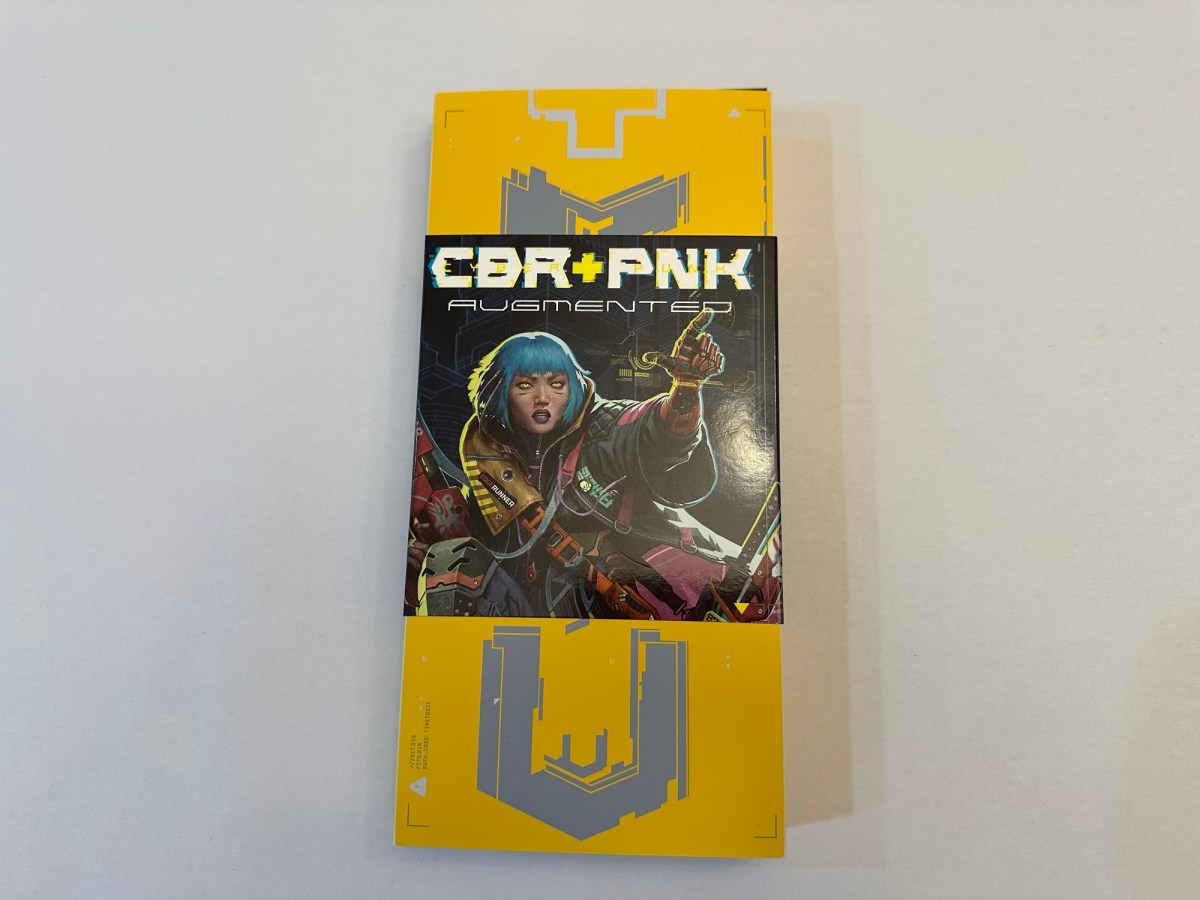
CBR+PNK: Augmented — First Impressions

I received CBR+PNK (“cyber plus punk”) as a holiday gift, and while I haven’t had a chance to play it yet, half the fun of TTRPGs is in leafing through the materials, enjoying the art, and trying to figure out how the rules fit together and how it will actually play.

CBR+PNK  bills itself as “Cyberpunk one-shots forged in the dark.” It gets its story DNA from its namesake, Cyberpunk, the gritty dystopic future setting that has recently found fresh life in the popular Cyberpunk 2077 video game and Cyberpunk RED core rules update. However, its rules are based on a stripped-down version of Blades in the Dark, a fiction-first, fast and simple ruleset with a core mechanic of rolling d6 pools.

The Package

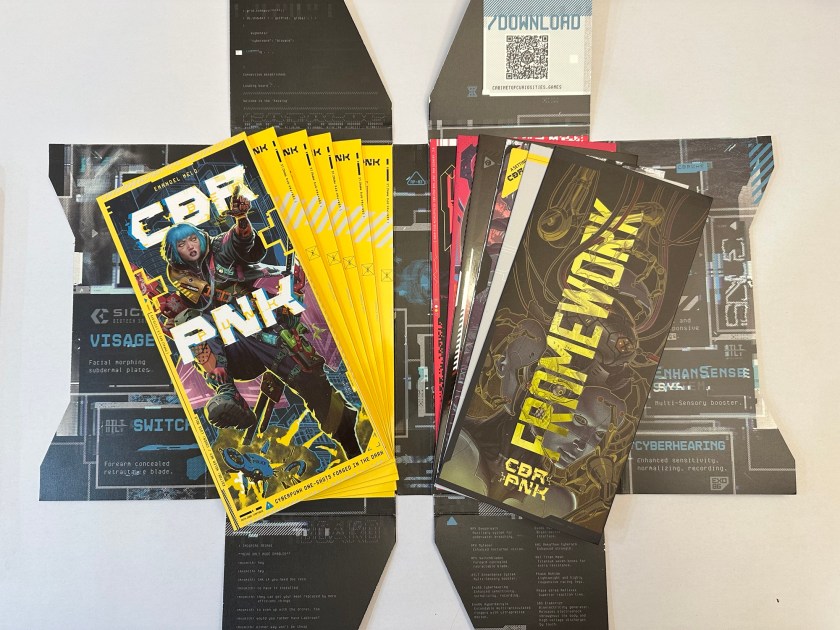
CBR+PNK is clearly broadcasting its goal of being a light, low-prep, pick-up-and-go game. The form factor is less than half the bulk of a typical core rule book; a slick little fold-out box filled with laminated pamphlets, all held together by a sturdy sleeve.

The lamination means these should stand up well to the typical abuses of game nights, including spilled drinks. It also allows players and GM to mark up their pamphlets with whiteboard markers and reuse them across sessions.

The left fold of the packet contains includes a “GM protocols” pamphlet and 5x player “runner files”—a combination character sheet and mini instruction manual. The right half contains a variety of odds and ends: optional mechanics, settings and runs.

The Framework

The players play as criminal or semi-criminal agents, mercenaries with specialized skill sets who might come together for assassinations, heists, sabotage, or other high-stakes operations at the behest of shadowy contacts promising huge payouts.

Unlike games that cater more to long campaigns where player characters can grow over months or years, the characters in CBR+PNK are veterans on their last mission, hoping to finish the run and get out of the game alive.

There are some optional rules for running CBR+PNK campaigns over multiple sessions (and supplements to that effect on Itch.io), but it’s tailored for one-shots, and I suspect the rules might feel thin in places for a long story across many missions.

As part of initial setup, each character has an “angle.” Are they out for revenge? Trying to buy a luxury flat to get their family out of the slums? Paying off a bookie? Searching for a missing friend?

At the end of the run, each player decides how they will leverage the results of the mission to try to satisfy this broader character goal, then rolls a special skill check with various bonuses. This is the final payoff or disaster.

Setup

The game is designed to be low-stress for the GM. That’s achieved in three ways—few rules, spreading some load to players, and minimizing prep.

It’s suggested that the GM figure out the mission objective, a couple locations and assets (people, data, vehicles, etc.), and 3-6 obstacles that players may have to overcome.

Players come up with their character’s name, look and “angle,” then assign points to the four “approaches” (broad attributes like Aggressive and Smart) and the 11 “skills” (narrow attributes like Close Combat and Coding). All of these attributes max out at 2, keeping bookkeeping simple.

Players also pick a cybernetic augmentation and a Load of Small (3), Medium (5), or Heavy (7), which impacts how much they can carry, but also how fast, conspicuous, and stealthy they are.

That’s about all that’s needed to start the game.

Play

Play revolves around three primary mechanics: Action Rolls, Stress, and Harm.

When a player tries to do something risky or difficult, they make an action roll. The GM decides the threat (risk) level, consequences of failure, and effect of success. Players can try to shift this equation to their advantage with gear or tactics, and the GM can increase the difficulty by doing the same for the bad guys. The player can also choose to simultaneously boost both risk and reward.

The roll uses a pool of d6s based on the sum of the Approach and Skill used and takes the highest roll(s). Rolling multiple 6s is a critical success, a single 6 is regular success, 4-5 is partial success with negative consequences, and 1-3 is outright failure. This basic system should feel very familiar to anyone who has played Forged in the Dark or Powered by the Apocalypse games.

Stress is a penalty pool that players can fill (up to 7) to get a variety of benefits. They can Push their own action or Assist another player’s action to add dice for an action or improve the effect. They can activate a cybernetic augmentation. Or they can perform a Flashback.

Flashbacks are a fun mechanism for coming up with new fiction on the spot. The player gets to describe something that happened before the mission that impacts the current action or predicament (and presumably helps them). The GM decides the Stress cost based on how outlandish this gamified retcon is.

Gear works similarly, but without the stress cost. Players decide they packed an item when they need it. The only caveat is that you can’t produce more gear from your pack than your Load number allows.

Harm is what often (but not always) happens when the characters fail an action, and it’s a replacement for more common hit point systems in other games. It’s a three-level system where L1 is superficial damage, L2 is serious injury, and L3 is severe. Stacking multiple lower-level harms results in an injury the next level up. L4 kills the character.
The Extras

The FRAMEWORK pamphlet is an odd combination of rules clarifications, quick lists for GMs, and rules for an odd campaign mode built around a series of session-long flashbacks. It feels like this really wanted to be part of the GM pamphlet and ran into the limitations of the form factor.

The HUNTERS pamphlet provides optional mechanics for what amounts to boss enemies, and seems like a pretty cool thing to add to a run once you’ve got the hang of the basics.

The +WEIRD pamphlet is a build-your-own Shadowrun, adding some light fiction to bring magic into the world, meta-human backgrounds, and magical abilities that slot into the character sheet just like cybernetic augments. It’s another set of optional rules, but trying to do a lot more than HUNTERS. It feels a little slim for what it’s trying to do, which is a lot.

The PRDTR pamphlet provides a setting—a base on Ganymede where a worker insurgency fights against corporate overlords. The colony is falling apart, infested with out-of-control mutant jungle and an engineered living weapon (definitely not the trademarked alien from Predator). It includes several starting points and missions, NPCs, a simple graph-map of locations on the base, and random events. All in all, a nice selection of components to build a mission from. A team synergy mechanic is also included, but this didn’t seem to add much, and I’d consider not bothering if I was running it.

The Mona Rise Megalopolis pamphlet is a very different take on a setting, with random tables for just about everything randomizable in this simple game, packed with what I assume are references to characters and locations from William Gibson’s Sprawl trilogy. Unfortunately I haven’t read those books, and this falls pretty flat as a stand-alone artifact without that context.

Finally, the Mind the Gap pamphlet is a complete example run, with a fun bubble-story setting, a simple three-act structure, and a twist. My biggest pet peeve for TTRPGs is when they don’t provide examples of play to help understand the game flow and rules, and this goes a long way in that regard.

Final Thoughts

This package is cool and slick, but also limiting. They’ve crammed every millimeter of these quad-fold pamphlets with text, and in some cases it feels like another page or two would have been beneficial.

As a prospective GM, I had to jump between all the pamphlets and do some internet searching to understand threat/effect and harm. Harm is the one case where the game makes a choice that I think adds significant complexity over other common mechanics like HP and well-defined status effects.

Like many, I cut my teeth on D&D. These days, I really like the FitD/PbtA style of fast, low-rules, fiction-first play. It’s so much less intimidating than running something like a D&D campaign whether that be from a book or homebrew.

That said, they also have limitations. I haven’t run a longer campaign in one of these systems, but I expect it would feel very different from something crunchier.

I’ve been looking for something relatively easy to play with the kids, so I expect I’ll find time to play this sometime in 2026. I’ll post a follow-up when I do.

The Read/Write Report – January 2023

It has been a while since I did one of these posts, but the new year seems like a great time to jump back into it. Here’s what I’ve been up to lately.

Vacation

At the end of 2022, I took what is probably the longest vacation I’ve taken in the past 15 years—three whole weeks. The last two weeks of the year were “stay-cation” around the house, and in the first week of 2023 my family escaped the snow and cold of Minnesota and went down to Florida.

I stayed fairly busy during my time at home, and we did quite a bit of sightseeing and beach time while in Florida, but I was able to do about twice as much writing as I typically do. Most of this went into Razor Mountain, but I couldn’t entirely resist poking at side projects and some potential future blog stuff. But I’ll talk about those things another day (maybe).

New Year’s Resolutions

I generally don’t put much stock in New Year’s resolutions, but I’m trying one this year. I’m not a person who tends to collect many possessions, with a couple notable exceptions. Firstly, as you might expect from a writer, I tend to collect a lot of books. I have a couple shelves full of physical volumes I haven’t yet read, and a handful of e-books on the Kindle.

I’m also a sucker for video games and, to a lesser extent, board games. There are a lot of inexpensive video games these days, especially with various services competing to offer the best sales. So I wish-list a lot of games and buy them when they’re cheap.

My not-too-serious resolution for the year is to not buy any new books or games, and try to work through the backlog that I already own. We’ll see how that goes.

Recent Reading

As usual, I have ongoing bedtime reading with my kids. We finished Startide Rising and moved on to The Uplift War, the last book in David Brin’s first “uplift trilogy.” It has been interesting, because these were formative books that I read in my teenage years, but I actually remember very little about them. I’m certainly seeing things that I missed when I was young.

On my own, I’ve started a slim little volume called Invisible Cities, by Italo Calvino. The book is framed as conversations between Marco Polo and Kublai Khan, where Polo describes the many cities that he’s visited in his travels.

I’ve been sitting on an idea for a fictional city for years, but I’ve never quite figured out whether it fits into a novel, a TTRPG, or something else. Invisible Cities is one of the pieces of fiction that I’m investigating to find some inspiration with my own fictional city.

Waiting for the Secret World

In November, a Kickstarter project popped up on my radar: The Secret World TTRPG.

The Secret World was originally an MMORPG released in 2012, back when people still believed that a new game would someday overthrow World of Warcraft. It was moderately successful on launch, but it was a little clunky, didn’t get a lot of updates, and slowly lost players over time. In 2017 it was relaunched with some new systems as the free-to-play Secret World Legends. That iteration was equally unsuccessful, and it eventually went into maintenance mode while the developers moved on to other projects in order to keep paying the rent.

Secret World, in both its iterations, was a very strange MMORPG. While the gameplay itself never really shined, it had a fantastic story, amazing settings, great voice acting, and some interesting puzzle design that was often a bit like an ARG. It’s a little cosmic horror, a little X-Files, with some Jules Verne and The Matrix thrown in for good measure. It still has a cult following, and those that love it stick around because of the story.

A TTRPG seems like a perfect fit for this kind of rich, expansive setting, so I’m excited to see what Star Anvil come up with. A few people have voiced concerns that it will be using the Dungeons and Dragons 5E rules, which may not be a perfect fit for this style of game. However, that’s the most popular TTRPG around, so I can’t really fault a small indie studio with a relatively unknown property for hedging their bets.

The current goal for releasing the book is October 2023, and over-funded Kickstarter projects aren’t exactly known for meeting their deadlines. , the project got me itching for some science-fiction or science-fantasy TTRPGs. To scratch that itch, I dug into two other games: Shadowrun 6e, and Cyberpunk Red.

Shadowrun

I’ll be honest. Shadowrun 6e seems like a mess. Both gameplay and setting feel like they took the “kitchen sink” approach, with a lot of different fantasy ideas and sci-fi ideas all fighting for attention, while nothing really stood out to me. Some of the ideas, like big dice pools, seem fun. But, having never played Shadowrun, I felt like the core book really didn’t give me a good feel of what it would be like to play, and I didn’t get enough of the setting to feel comfortable running a game. I think any core rule book should have snippets of gameplay or an example adventure, and this had neither.

I was a little leery of spending any more money on the game, so I tried looking in the…somewhat legally gray areas of the internet…for campaign books. The 6e adventure books I found were still frustratingly vague about actual gameplay, and seemed to largely eschew the mission-based play described in the core book.

By the time I got through the book I was fairly irritated, and I went down the rabbit hole of reddit posts and forums. As far as I can tell, Shadowrun players spend about half of their time debating which version of Shadowrun to use, or which bits to cannibalize from all the different versions. 6e doesn’t seem to be popular. And I started regretting purchasing the book at all.

Cyberpunk Red

To soothe myself, I moved on to another venerable franchise, one that recently had a very over-hyped video game made in its image: Cyberpunk. The latest iteration of Cyberpunk is called Cyberpunk Red. It is also quite recent, and interestingly, it seems to have been made alongside the development of the video game.

One of the challenges of the game’s namesake genre is that it was popularized in the 80s, and in some ways it has become retro-futurism. Cyberpunk Red takes an interesting approach to modernization. Rather than rewrite history, Red moves it forward. In the “Time of the Red,” decades have passed since previous Cyberpunk games (and their outdated references). The world has changed. It’s still an alternate-history version of our world where technology advanced faster than it did for us, but letting a few decades pass allowed the creators to change the setting so that it feels like it’s exploring and expanding upon today’s problems, not the ones that were relevant thirty or forty years ago. It’s an elegant solution.

It may not be fair to compare Cyberpunk Red to Shadowrun, but I read them back to back, so I’m going to do it anyway. Cyberpunk Red pretty much addresses all of the things that irritated me about Shadowrun. Where Shadowrun is all over the place with fantasy and sci-fi tropes, Cyberpunk Red is laser-focused on its cyberpunk setting. There are lots of character options: you can play as a rock star, mid-level executive, or freelance journalist, as well as the soldier and hacker types you’d expect from the setting. You can outfit yourself with all sorts of cybernetic hardware. But everything fits nicely in the setting. Everything seems to make sense.

The book includes a thousand-foot view of world history and geopolitics, but it focuses on a single city. This overall focus makes it feel like Cyberpunk Red can dig a lot deeper into the details of the setting. Even better, it includes a meaty section on how to run the game, some fiction to get a feel for the setting. It doesn’t include an example adventure, but there are a couple small free ones easily found online.

Back to the Grind

With my long vacation at an end, I’m back to work, kids are back at school, and we’re getting comfortable with our routines again.

My main writing project remains Razor Mountain, and I look forward to finishing it in 2023. After that, I’m going to have to think about what to do with this blog—I’ve been working on that book in some form for almost the entire life of Words Deferred. It’ll be an exciting new adventure!

For now, I still have a ways to go, and I’m back in my normal writing routine. Look for a new chapter next week.

How Has Covid Changed Our Stories?

This weekend, while mowing the lawn, I listened to Asphalt Meadows, the new Death Cab for Cutie album. I am a horrible screen addict who has to constantly fight the urge to inundate myself with multiple streams of content at once, Back to the Future-style, so mowing the lawn is a great time for me to actually listen to music while part of my brain is focused on the simple task of driving in straight lines.

Marty McFly watches six channels at once in Back to the Future.

Upon initial listen, I really liked it. It’s clearly recognizable as a Death Cab album, but it also feels like something very different from the band. There is considerably less slick production. The sound is much more raw. Out of the quiet parts, they blast you with almost violent noise.

Death Cab has always had an emo melancholy streak, but it’s amped up here. And yet, there are still glimmers of hope in the face of tragedy. I’m hardly an expert music critic, but it feels like a Covid album.

Trends and Tectonic Shifts in Storytelling

The last few years have had such broad effects on society and on most of us personally. I’ve been wondering for a while just what long-term changes this will wreak on the world at large. It’ll take decades to begin to understand how these plague years have changed us.

As a writer, I think one of the most interesting lenses to view society through is our stories. There are always trends in fiction, like the waves of zombies following The Walking Dead, the vampire romances following Twilight, and the myriad dystopias post-Hunger Games. But there are bigger trends too. These meta-trends can show something about our collective sentiment or what we’re seeking in our imagined worlds that we feel lacking in the real one.

The optimistic science-fiction of the post-WWII era reflected a society that thought it could do anything. This was a society that believed technology could be harnessed to solve any problem and overcome any obstacle. This was the Jetsons-style future of sleek silver spaceships and moving sidewalks and personal robot butlers.

Is Cyberpunk the Present Day Yet?

When this blog was young (a whopping 1.5 years ago), I wrote an article inspired by a tweet by William Gibson, and asked, is cyberpunk retro-futurism yet? Looking back, I think that while the aesthetics of cyberpunk have been reused and recycled extensively, it’s the deeper themes of cyberpunk that really seem to be oddly on-point in our current day and age.

The futurists of the 1980s looking toward a world dominated by mega-corporations and invasive technology seems almost quaint in our modern era of Amazon and Facebook, of ad-targeting and bot-farms and Cambridge Analytica and wondering whether Alexa or Siri is listening in on our conversations. In a lot of ways, we’ve out-cyberpunked the genre of cyberpunk with our own dystopic reality.

But looking beyond these surface-level themes of cyberpunk, I think there is an even more resonant core. Cyberpunk is about vast, uncontrollable systems. Rogue AIs, mega-corporations, and legions of near-human replicants all represent systems so big and so complicated that the average person on the street has no way to even understand what’s going on, let alone take it in a fair fight. Cyberpunk is about survival in a world of vast, incomprehensible, world-controlling systems that are completely indifferent to you.

Surviving in a completely indifferent world. Boy, that sounds familiar.

When Dystopia is Too Optimistic

What about the last few years? What has changed in our stories? Again, this is something that will need the space of another decade or two to really understand, but I can look at the anecdotal evidence of the stories I’ve been reading and watching recently. A lot of these stories are about found family, about belonging, hope and love in a world of hate and nihilism.

Covid, along with the political and cultural fissures that have developed and deepened in recent years, have left many of us feeling…brittle. The world is made of glass these days. It feels like so many things are just barely holding together, and it would only take one or two well-aimed blows to shatter. This is what I heard in Asphalt Meadows while I mowed the lawn.

If the era of The Hunger Games and its dystopian facsimiles was about fighting back against authoritarianism, this era of fiction feels like an all-out fight against nihilism. Only, back in The Hunger Games days, there really wasn’t anyone rooting for the authoritarians. (If anything, people were awfully glib about the message of that series, which seemed to be that it’s not actually that easy to make things better through violent revolution.)

Today’s question seems to be whether or not to give in to complete nihilism, and I think the jury is still out on which way we’re going.

Nihilism and Its Opposite

One of the best movies of the past year was unquestionably Everything Everywhere All at Once. If you haven’t seen it, go see it right now. If you have seen it, go watch this great analysis on Movies With Mikey (one of my favorite channels about movies), and feel those feelings all over again.

E.E.A.A.O. puts to shame the shallow multiverses of Hollywood powerhouses like Marvel. This isn’t an excuse to trot out all the nostalgic reboots of reboots of reboots. This isn’t a story where evil threatens to destroy the world, or even the universe. This is a threat to every world in every universe. You know, everything everywhere all at once. Only, the threat isn’t evil. It’s malicious indifference. It’s nihilism.

In the absurd drama that only The Daniels can pull off with such panache, it’s the literal “everything bagel,” the black hole of indifference that threatens to absorb the sprawl of infinite universes. After all, when the universe is infinite, everything that can happen, happens. Nothing is unique. Nothing is special. In the face of everything, nothing matters. This is the argument the characters of the film are pitted against. Why care? Why bother?

Despite all the universe-hopping and existential threats, this isn’t really a movie about big stakes. Big stakes are what fuel nihilism. It’s those incomprehensibly huge cyberpunk systems that can’t be fought by mere mortals. Like Amazon and Facebook, or national US politics. This is a film about the opposite of nihilism, something I’m not sure there’s even a good word for. Perhaps it’s along the lines of the Buddhist idea that when nothing matters, everything matters: every word, every action, every choice and every moment has value.

The movie centers around the moment when the protagonist begins to understand this. She stops worrying about the fate of everything everywhere, and starts paying attention to the people around her: her husband, her daughter, her father, her IRS auditor. She stops worrying about the incomprehensible systems and the vast universe that seem like the overwhelming problem, and focuses on what she can do in the here and now. She fights nihilism with hope, and (perhaps because it’s a movie) that’s what saves the multiverse, and more importantly, her family.

“All or Nothing” Fiction

Even as I write this, I have a hard time taking myself seriously. Determined hope vs. nihilism, what a unique and clever new idea, right? Spoken plain, it feels a little too simple, even childish. But then I look at the fragile world around us, and at my own perpetual temptation to look at no less than two screens at any given moment, just to avoid having to think too much about what’s going on out there.

We are, collectively, tired. There’s a real temptation to just stop caring about…everything. I think the fiction of the moment is all about this fight, this question. Do we actually care? Or do we just look away and let it all happen? Do we give up because the problems are too big to solve? Or do we each do what we can do, in our own infinitesimally tiny corner of the multiverse?

Does nothing matter? Or does everything?

Reblog: Accumulations — The Inner Moon

Remember when we talked about William Gibson calling the cyberpunk genre a retro-future on Twitter? Part of the reason cyberpunk can feel stale is that so many of the tropes are already part of our daily lives.

This thoughtful essay from The Inner Moon suggests that cyberpunk is actually a close sibling of post-apocalyptic fiction. An “entropic dystopia.”

In post-apocalyptic stories, the apocalypse strikes in a moment and leaves behind a broken world. A meteor, bio-weapon, zombie plague or nuclear war changes everything overnight.

Meanwhile, the apocalypses of cyberpunk are slow, insidious, and layered. Societal rifts that spread over decades. Dysfunctional governments in thrall to multinational corporations. Greed winning out over community. Tech becoming more and more ubiquitous without solving any of these issues. The problems just keep piling up. The world doesn’t collapse in cyberpunk. It gets steadily worse. It’s society as the frog boiled in the pot.

Check out the whole article over at The Inner Moon…

Is Cyberpunk Retro-Futurism Yet?

The author of Neuromancer – the book widely considered to have kicked-off the cyberpunk genre – says it’s now a retro-future. That’s pretty interesting, considering how much high-profile cyberpunk seems to still be happening.

For those who don’t follow video games, Cyberpunk 2077 was perhaps the most hotly anticipated game of 2020 (before it ended up releasing late, dogged by accusations of employee abuse and so buggy that refunds were offered on some platforms). Blade Runner 2049 was a lauded, big-budget movie just three years ago. And most of the streaming services have their own recent cyberpunk offerings.

Through five decades, we received a steady, if inconsistent, stream of cyberpunk literature, cinema, television and games. Not only that, but it gave us an almost absurd number of ___-punk sister genres, cribbing the dystopian outsider aesthetic and patching in various kinds of technology.

Death of a Genre?

Unlike most genres that take place in the present or a particular historical era, most science fiction has a built-in shelf life. While most people might be able to look past the 2019 “future” date of the original Blade Runner or the clunky flip-phones of The Matrix, there comes a certain point where an imagined future starts to feel stale.

The parts of these retro-futures that actually came to pass seem somehow more depressing, more mundane, more obvious when we live inside them every day. The predictions that failed often seem further away than they did before, or outright absurd.

Some of cyberpunk’s staying power might owe to pop media’s perpetual mining and re-mining of nostalgia for remakes, reboots, sequels and spiritual successors. Cyberpunk has also accumulated plenty of visual and tonal markers that have been used (and abused) to provide quick and shallow style. For every Matrix, there’s an Equilibrium or Aeon Flux.

It seems clear that if cyberpunk does die, it will be a slow, sighing death. Most science-fiction genres and styles don’t go away completely. They inform the sub-genres and successors that follow, transforming or splintering.

Where is the Center of the Universe?

Back on Twitter, Aaron suggests that the future is in “Gulf Futurism, Sino Futurism, Afro Futurism.” It’s not hard to see that these are all sub-genres with very different geographical and cultural centers from old-school cyberpunk. Cyberpunk is rooted in extrapolations of 1980s American culture. Even when it goes as far afield as Hong Kong, it’s more 1980s British Hong Kong than post-handover Chinese Hong Kong. The neon hanzi are largely window-dressing.

There is certainly a deep vein of anxiety in America that suggests that the country’s cultural and economic influence on the future is waning. That refrain seems to be getting louder, not quieter. Meanwhile, other places in the world are seeing their cultural and economic influence grow at breakneck pace, even as technology upends old norms and traditions.

Gulf futurism centers the world on the Arabian Gulf, while Sino Futurism looks at the future through a Chinese lens. Afro Futurism explores futures and themes not only centered on the African continent, but also on African diaspora and the complex intersections of culture and history that brings.

Cyber, Solar, Bio or Steam

Other Twitter responses mention solarpunk and biopunk, offshoots that focus less on traditional cyberpunk technologies like AI and VR, and instead explore the consequences of things like environmental disaster, climate change, and runaway biotechnology. In a world where climate change becomes more apparent every day, these themes are more relevant than ever.

Meanwhile, there are many other derivatives that shift the aesthetic from futuristic to fantastic. Genres like steampunk and dieselpunk are more fantasy than science-fiction, enjoying anachronistic alternate universe playgrounds that are concerned with the themes of the last century rather than the themes of the upcoming one.

Fodder for the Reading List

Cyberpunk will continue, in some form or another, but it’s getting long in the tooth. Maybe its latest micro-renaissance will prove to have interesting things to say about our modern dystopian world. And even if it doesn’t, it’s interesting to see the genre splintering in so many different directions. If nothing else, these tweets have inspired me to sample some of these other sub-genres.