

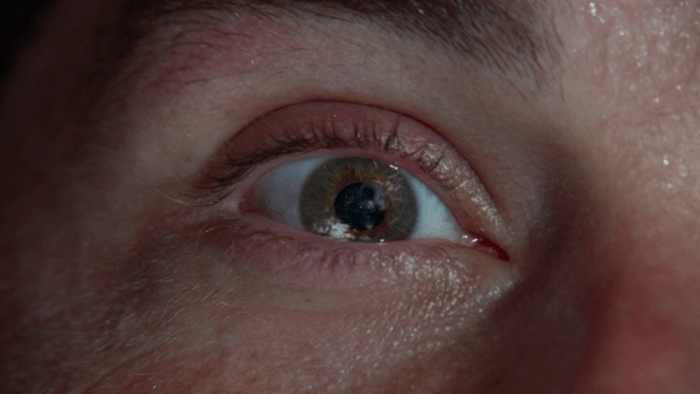
A close-up of a man’s eyeball. As tense music plays, the eye opens wide, reflecting a canopy of bamboo.
A wider shot, zooming out: the man wears a suit and tie. His face is scraped. He may be in shock.
A sound from the forest. A yellow labrador retriever walks out of the trees.
The injured man rises, finds a minibar bottle of vodka in his pocket, and runs through the trees. He comes to a beach, where the camera slowly pans to reveal the catastrophic wreckage of a trans-oceanic flight, survivors screaming and frantic.

“Who are you?” It’s a tinny, artificial voice.
We look down on a conference room: a long wooden table surrounded by twelve chairs. The carpet forms concentric rings of green and yellow.
There is a woman on the table, wearing sensible blue business skirt, blouse, and beige heels. She is face down, arms splayed as though she fell from above.
“Who are you?” the voice asks again. There is a little intercom box on the table, near the woman’s head. She begins to stir.
“Hello?” the woman asks, looking at the box in confusion. There is a beat of silence.
“I’m sorry,” the voice says. “I got a little ahead of myself. Hello there, you on the table. I wonder if you’d mind taking a brief survey?”
That Familiar Feeling
The first scene was the opening of LOST, the show best known for popularizing the mystery box genre and irritating its fans with an unsatisfying ending. The second scene is from Severance, the new mystery box darling that’s currently rolling out its second season on Apple TV+.
There’s a striking similarity between the openings of these two shows, nearly two decades apart. A person waking up in a strange environment, inviting the character and the audience to immediately start wondering “what’s this all about?” (And as an aside, if anyone ever tells you that you should never start a story with a character waking up, feel free to point them toward these lauded, high-budget shows.)
I have spent a good amount of time thinking about mystery boxes (and writing my own), and the current popularity of Severance provides an interesting opportunity for reflection. After all, LOST was hugely popular and widely praised for much of its run, with many critics and fans souring only at the conclusion or in the last season.
Is a show like Severance bound for a similar fate? Or will it be a shining example of how to do it right?
What’s In the Box?
So what elements contribute to a show like this working or falling apart?
First, it has to be going somewhere. That implies two things: the writers have to know the answers ahead of time, and the answers have to be interesting. If the story is built up by throwing around mysteries too liberally, without careful concern for how it all fits together, then it inevitably won’t. And even if the biggest mysteries manage to get wrapped up, audiences will be frustrated when the path along the way is littered with plot holes.
This was perhaps the biggest failing of LOST. The show runners changed across seasons, and are on record admitting that they introduced mysteries without knowing all the answers or the final resolution of the series.
However, it’s not enough to know what you’re doing. You also need the trust of your audience. A mystery box show can earn that trust in a couple ways. The first is to set up and pay off smaller mysteries. These can be arcs within an episode or questions about a particular character; anything that shows foresight and planning, without necessarily giving away too many major plot points. Bigger reveals are less frequent by necessity, but a steady drip of smaller reveals are what builds up audience trust. Severance has done this fairly well, usually dropping a “big reveal” every couple episodes.
Finally, it pays to reward the audience for noticing the details. Smart writers will leave breadcrumbs and clues for the super-sleuths to find and interpret. LOST fans were known for insane frame-by-frame analysis of seemingly mundane details, including many things that simply didn’t end up mattering.
While there’s no way to prevent determined fans from going through the irrelevant details with a fine-toothed comb, LOST included many details that practically shouted “this is a clue!” but never had a satisfying explanation (like those six numbers that kept showing up everywhere).
Mystery is not Enough
The mysteries are obviously an important engine of the “mystery box” genre, but they can’t be the only thing driving the story. Even the most mystery-centric story must have compelling characters and interesting relationships between them.
One of the greatest insights in Chuck Wendig’s Damn Fine Story is that the inner emotional story should drive the external action. Star Wars isn’t just a story about galactic war, it’s about the Skywalker family drama that will ultimately decide the fate of the galaxy. The mystery box needs to be inhabited by compelling characters, and they should be driven by their own needs to try to find out what is going on.
The characters in LOST had a very straightforward reason to solve the mysteries around them (at least in the first few seasons): they were stranded on an island and wanted to go home. To a certain extent, this is true in Severance as well. The “innies” live their lives trapped within the confines of their underground office complex, even if their bodies and the other half of their brain gets to go home at night.
A more subtle and more powerful way to drive the story is to tie the characters’ arc and growth to the resolution of the mysteries. If the character needs to solve the mystery to mend a broken relationship or understand their purpose, they’ll be driven to find answers.
In LOST, this manifested in the long-running debate between characters who believed in free will and choice, vs. those that thought their experiences were driven by unalterable fate. In Severance, the mysteries are direct impediments to at least four different romantic relationships. If those characters want to be together and be happy, they need to resolve the mysteries surrounding them.
The Danger of Success
The biggest threat to quality on a mystery-centric show is runtime, and there is an obvious impulse to drag out a successful story to maximize its money-making potential. Unfortunately, the longer the story goes on, the harder it is to maintain the tension. It’s difficult to keep the audience’s interest across seasons without moving the goal-posts or introducing long digressions.
Even worse, stretching out the development increases the likelihood that the outside world will intrude: from writers’ strikes to key actors and personnel leaving, to network executives foisting questionable demands onto the creatives responsible for crafting a good story.
Every episode or chapter is another opportunity to accidentally introduce loose ends, red herrings, and irrelevant details. There is a constant danger of diluting the elements that make the story exciting.
Gravity Falls — A Mystery Box that Delivers?
While Apple slowly releases new episodes of Severance on a weekly cadence, I also happen to be watching another mystery box show with my kids: Gravity Falls.
Admittedly, Gravity Falls is a slightly different beast. It’s first and foremost a funny cartoon for kids, even if it does have some jokes thrown in for the parents and those unexpected tonal shifts that define a good “dramedy.” However, it is a mystery box, and the slightly simplified formulas of a kids’ show help to show off how a mystery box can be done well.
The show follows the classic “monster-of-the-week” formula, with stand-alone episodes that add depth to the characters, interspersed with key episodes that advance the bigger, ongoing plot. Having originally run on TV before the rise of streaming, the show limits itself to two seasons, but these are old-fashioned TV seasons, totalling 40-episodes. It’s a run that might still outdo a show like Severance, with seasons under 10 episodes. Regardless, it’s fairly tight compared to LOST.
The show builds mystery in a lot of small ways: secret codes in the credits, callbacks and background details, and generally rewarding the fan base for digging deeper. And mystery isn’t the sole draw: there is character building and tension in the relationships, with overarching themes of siblings growing apart, and the challenges of maintaining ties in the face of growing up.
Gravity Falls does a fantastic job spreading out the clues and resolutions across episodes. It doesn’t try to save all the secrets for a huge ending. In fact, most of the mysteries are resolved before the end, with a finale that focuses on defeating the big villain and answering the ultimate emotional question of the show: will the two sets of sibling relationships (adult brothers and kid brother and sister) survive and thrive, or end in estrangement?
Don’t Let me Down, Ben and Dan…
Back to the original question. Will Severance satisfy, or will it be another LOST?
The answer, of course, is that we won’t know until the final episode. There is still plenty of time for the people behind the show to make bad decisions. I have reason to be hopeful though.
So far, Severance hasn’t been overly stingy with clues and reveals. While certain plot points (cough-cough-goats-cough-cough) feel worryingly LOST-esque, I’m still willing to believe the show-runners’ claim that they have a clear ending in mind.
The characters have had fantastic arcs so far, and they’re tied nicely into the central mysteries. But we’ve seen this before. They need to stick the landing.
I’ll be watching the season two finale with fingers crossed.
 Words Deferred