The Read Report — Sept and October 2024

We’re doubling up two months again! Why? Because I didn’t read much in September, and by golly, I’m all about providing maximum quality to my readership.

Where possible, I’ve included Bookshop affiliate links instead of Amazon. If any of these books pique your interest, please use those links. I’ll get a small commission, and you’ll support real book stores instead of private islands for billionaires.

Dune, the Graphic Novel — Vol. 1, 2, 3

Adapted by Brian Herbert and Kevin J. Anderson

Illustrated by Raul Allen and Patricia Martin

Dune is one of those perpetually evergreen sci-fi books that has somehow managed to maintain relevancy for more than half a century. This graphic novel adaptation of the book comes on the heels of the big budget Denis Villeneuve movies (despite the fact that those movies also have graphic novel adaptations).

I’ll admit that I had uncertain expectations for these books. Dune is fairly dense, as evidenced by its longevity and the very different adaptations that have been made over the years. These three volumes cover the plot of the original book, but there was no way to make it work in comic form without significant trimming. Even beyond that, Dune is a book that is often dialogue-sparse and heavy on characters’ internal thoughts, and this is a challenge that any visual adaptation needs to overcome.

The framing in the first book mostly stays out of the way. It’s nice and clear, but avoids any interesting or dangerous choices. There are a few multi-panel zooms and pans; a variety of big and small, wide and narrow panels; but almost no verticality in a medium where pages are taller than they are wide, and not a single curved line. It’s all rectangles, all the time.

However, the second and third books expand into a much wider variety of framing techniques. There are several pages with interesting nested circular frames, and a little bit of blending with nebulous or absent frames. It’s not quite the insane level of frame shenanigans you’ll see in something like Sandman: Overture, but it’s still praise-worthy.

The art is a little inconsistent, but never bad. There are a few faces and figures that come across as stilted or flat. It improves steadily in the second and third volumes. If I was disappointed, it was only because the whole package didn’t quite live up to the potential shown in some of the best, gorgeous full-page spreads. Hoo-boy, that full page sandworm reveal shot is fantastic. Color is used to great effect, with the characters and elements of House Atreides shaded blue, in contrast to the reds and pinks of House Harkonnen and the planet of Arrakis.

It tells the story competently, but I would have really loved to see more of that classic sci-fi strangeness. For all of the aspects of Dune that feel tropey in modern sci-fi (cough-cough-desert-planet-cough), it is a book where the people, places and cultures feel genuinely foreign and weird. The best aspect of the much-lampooned 1984 David Lynch movie adaptation was that it leaned into that weirdness. Even the Hollywood-friendly Villeneuve movies capture some of that magic with the Sardaukar throat-singing, insectoid spaceships, and psychopathic man-baby Harkonnen aesthetic. Here, the clothes, the technology, the landscapes all look a little too normal.

The story did, as I expected, suffer in some ways due to the inherent trimming that had to happen to fit into the graphic novel form factor. There is no room for expanded dialogue or exposition. The writers do take advantage of the ability to make characters thoughts visible to the reader. Ultimately, this is a slightly abridged version of the story, but there are only a couple of places where the development feels rushed as a result. The story isn’t broken, but it’s occasionally bent and loses some nuance.

My daughter (who didn’t really pay attention when I was reading the original book with my son) decided to read these books as soon as I was done with them. While I thought they might serve as a lighter, easier introduction to Dune, especially for a younger reader, her opinion was that it was still pretty confusing.

The Subtle Knife

By Philip Pullman

This is the second book in the Dark Materials trilogy, which I’m working through for bedtime reading with my children.

The Subtle Knife is a very different book from The Golden Compass. The first book takes place entirely in a secondary world, and feels like a traditional fantasy novel. It follows Lyra Belacqua, who is the classic precocious child/chosen one archetype. This second book takes Lyra into our world and another fantasy world, and introduces a second viewpoint character named Will Parry.

Will’s story is darker and hits a little closer to home, since he hails from the “real” world, and his problems, while extreme, are more relatable. I was curious to see how his story connects to Lyra’s. It’s clear that there are parallels between the two worlds, so I assumed the two characters are entangled in ways they don’t understand.

Pullman doesn’t lock us into a strict POV—the book jumps between Will and Lyra—but it does feel like Will is heavily favored, and certainly seems to make more meaningful choices. Lyra often seems to be pulled along as a sidekick, and this is a significant demotion of her character after the first book. I wonder if this pairing would have felt more natural if Pullman had included parts of Will’s story in the first book, even if Will and Lyra didn’t cross paths until the second.

The book ends with a strange series of events. An important character dies for a reason that was only lightly hinted at once. Another major character dies because he forgot that he had a “get out of jail free” card until it was too late. The villains, after being completely stymied for the entire book, are suddenly pretty effective. And it looks like book three is going to be even moreso Will’s story, at least to begin with.

The feeling I had when reading The Golden Compass was that this is a serious kids’ fantasy series that doesn’t quite succeed at achieving the plot, deep characterization, and world-building that other YA fantasy has achieved in the last couple decades. That feeling is not going away here.

I do still believe that Pullman has some genuine weirdness in his setting and plot that deviates unusually far from the classic Tolkien fantasy formulas, and I really hope that it will blow up in book three.

The New Age of Apocalypse

By Larry Hama, Akira Yoshida, Tony Bedard
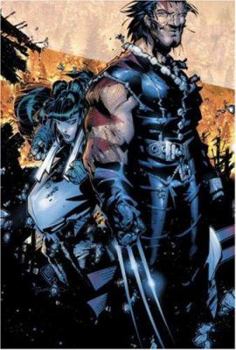
As I mentioned in my August recap, I discovered a lost box of superhero comics when I moved to my new house. This month, I re-read the “new” Age of Apocalypse.

The original Age of Apocalypse was a big cross-book event that ran for four or five months across all of the X-Men books in the mid ’90s. It’s my favorite thing in superhero comics, although that is probably a function of my age when it hit, the state of Marvel at that time, and a good dose of classic nostalgia. I also don’t really read superhero comics anymore, so there’s really no opportunity for anything to usurp it.

The New Age of Apocalypse is the trade paperback collection of a limited-run series that released for the 10-year anniversary of the original event and picks up the story in the same alternate universe where the originals left off.

The book is drawn in the same heavy-lined, anime-inspired style of the Ultimate X-Men books I reviewed in the August read report. This style is clean and easy to read, and the artists are certainly skilled and make it work, but something about it just rubs me the wrong way. It’s a little too cartoony.

The story follow’s Magnetos X-Men as they try to pick up the pieces in the wake of Apocalypse’s collapsed North American empire. There is a mystery element, with Mr. Sinister playing the villain, but the resolution of that mystery ends up being…kind of dumb. There is a soap opera quality of over-the-top character motivations and emotions, and some of the characters change their minds seemingly at the drop of a hat. If I’m being charitable, I’d say that the writers tried to cram too much plot into relatively few issues, and this explains the abruptness of the action and mood swings of the characters.

Much like Ultimate X-Men, the New AoA feels like a classic comic book story with classic comic book failings. It’s a little more disappointing to me, but that’s only because I have such a fondness for the original AoA.

On that note, my box of old comics does include almost the entire run of the original Age of Apocalypse. I’m a little afraid to read those issues again, lest I discover that it’s not quite as good as my faded and nostalgic memory would claim. But I might do it anyway.

The Witcher: The Tower of Swallows

By Andrzej Sapkowski

Dear God, I did it! After several months of promising that I would get back to it, I finally finished this book.

The Tower of Swallows is the penultimate volume in the main five-book Witcher series, and it suffers a bit of the classic long fantasy series syndrome. All of the characters are wandering across the land, spending a long time trying to get somewhere for something to happen.

Our three main characters, Ciri, Geralt, and Yennefer, are all split up for this entire book, and I suspect this is a lot of what slows it down. They each have their own cast of secondary characters in orbit, and while a lot is happening, it still ends up feeling like all the pieces are being lined up just right for everything exciting to happen in the final volume.

That said, it’s still a good book in a great series. The setting, heavily inspired by Polish mythology, continues to shine. The world feels alive with complexity and depth, and even the characters with supernatural powers are often at the mercy of bigger cultural and political forces.

I’m beginning to feel that Sapkowski’s literary calling card is his ability to build a narrative through a dozen little frame stories. The book is a mix of flashbacks and retellings of events from different perspectives: a bard’s memoirs, a late night story next to the hearth, or the testimony of a soldier on trial for treason. It’s to the author’s credit that all of these blend together into a cohesive quilt of smaller stories.

With any luck, I’ll finish the final volume before the end of the year. I’ve really enjoyed my time with the Witcher and his cohorts, and I’m hopeful that Sapkowski will answer the remaining questions, finish off the biggest villains, and bring it all to a satisfying conclusion.

Dissecting Influences — Sci-Fi From My Childhood

If you’ve been around here for a while, you might remember that my favorite writing podcast is Writing Excuses. In Episode 17.7, the team discussed dissecting your influences.

We all have stories we love, whether they be books, shows or movies. The idea of this episode was that it can be useful to take apart our favorite things and figure out why we like them, because it guides us toward things that matter to us. The themes and ideas that draw us to these works will often be fertile ground for our own writing. And while it may seem obvious that we all know exactly what we like in media, the truth is that we often leave those stones unturned. It might even be surprising to dig into what really brings us joy in a favorite movie or book.

After listening to this episode, I started compiling a list of my own favorite media. It wasn’t hard to start. In fact, it was hard to stop. The things closest to mind were mostly books I had read recently or old favorites that I’ve been re-reading with my kids. But I soon started to remember books from childhood, poetry, and even influences outside fiction altogether.

With this list in hand, and continuing to add to it, I thought it might be fun to dissect my own writer brain in public. I have to limit myself to a reasonable size for a blog post, so I’m going to pick a somewhat arbitrary classification to pull out a handful of entries.

The Grown-Up Sci-Fi of My Childhood

That’s right, it’s some of my first loves in science fiction, way back when I was still in school. The actual dates of publication vary quite a bit, from 1965 to 1994, and these are all novels aimed at adults. One of the things that drew me into these books was the faintly illicit idea that I, as a child, could read stories intended for grown-ups. It felt like a window into ideas and worlds I wasn’t yet allowed to enter. Going from “Choose Your Own Adventure” and Goosebumps to heady books like Dune is a real shock to the system.

On that note, let’s start with Herbert’s masterpiece.

Dune

Having read this book at least three times—and one of those times quite recently—I have a hard time going back to the headspace I was in when I read it originally. I think I was in high school, and I’m pretty sure the reason I started reading it was because I saw a mention of it where someone said it was as influential in science-fiction as Lord of the Rings was in fantasy.

I think Dune is a pretty great book for young people who are starting to get into science fiction. On the one hand, it reduces the many political and economic complexities of the far future into a feudal culture where the only thing that matters are the machinations of a handful of powerful factions. The protagonist, Paul, is a ducal heir with adult responsibilities, but he’s still not quite an adult. Interestingly, the whole feudal system and it’s quasi-European royalty end up falling apart by the end of the book, with young Paul engineering their downfall at the hands of colonized people.

I remember this book being interesting because it sets up a world where people and decisions hundreds of years previous can have profound and complicated effects on the present. It’s a world of complex, interrelated systems that nobody can completely understand, and even a single person putting a wrench in the gears in just the right way can totally change the universe.

I also genuinely love Paul’s relationship with his own psychic powers. He hates them. He is constantly vacillating between seeing the future and being unable to steer it, or losing that sight and the fear of not knowing. I don’t think I’ve ever read a book that handled that kind of power in quite the same way.

I have to at least mention the other books in the (original) Dune series. I read them all, although not right away. I don’t think any of them quite measure up to the original, but I appreciate how strange they are, and Herbert’s audacity in choosing to set them thousands of years apart in far-flung futures that are less and less similar to our own modern lives.

Ender’s Game

Another book with a child protagonist? Possibly a theme. Ender in this book is much younger than Paul is at the beginning of Dune, but he deals with some comparable drama. This is another book that I re-read recently with my kids.

This book was astounding in a few different ways. Firstly, while it’s not exactly dystopic fiction, it does depict a world where war with aliens has resulted in hardship for average people and a government with dictatorial power. We learn early on that Ender is special because he’s a “third.” In a world where the government limits how many children each couple can have, he is a rarity.

All of the main characters are children: Ender and his siblings, and all of the kids at the battle school. Parents and adults are present, but they have little time “on-screen.” Like the dictatorial government, they show up periodically and force some seemingly arbitrary and often cruel new rules onto the children, but it’s the children and their relationships that matter. This is a book that understands what it feels like to be a child, to feel like adults don’t give you all the information and many decisions are left completely out of your hands.

Ender is bred to be a soldier and a leader. He’s trained for it. He is subjected to insane cruelty, to the point where he ends up having to kill other children to defend himself, all because it’s part of the program. But the ultimate cruelty happens at the end of the book, when he discovers that the supposedly wise adults who forced this horrible life on him didn’t even understand the enemy that they trained him to kill. The entire war is nothing more than an interspecies miscommunication, and he finds out by accident.

And then he leaves. He finds the one person he loves and who loves him: his sister. They get on a spaceship and fly away. He leaves behind all the systems of abuse and control that defined his entire life. Maybe a metaphor for growing up.

The “Ender” series continues on. Speaker for the Dead, Xenocide, and Children of the Mind are all great books, but again I feel like the original is still the best. The series is similar to Dune in the way it jumps large spans of time in a wildly changing galaxy. The Dune series eventually had a bunch of new books written much later, by Herbert’s son. I heard they were terrible and I never read them. The “Ender” series, on the other hand, had more and more books still written by Orson Scott Card, but I got to the point where I just wasn’t that interested by yet another rehash of the same story from a different secondary character’s perspective.

Before we move on, it’s worth mentioning that I’m still disappointed that Orson Scott Card turned out to be a homophobe and the sort of person who politely states their deeply held and hateful beliefs. Card was one of my early writing heroes, and I still hold his books on writing in high esteem, but as a person, he really bums me out. He kind of did the whole “J.K. Rowling” thing before Rowling.

The Uplift Saga

While the above two entries are the first (and I would argue, most important) books in a series, David Brin’s “Uplift” books are inseparable in my mind. There are six of them, in a pair of trilogies:

  • Sundiver
  • Startide Rising
  • The Uplift War

…and…

  • Heaven’s Reach
  • Brightness Reef
  • Infinity’s Shore

I suspect this series might be the most influential set of books in my childhood, but I came at them in a very weird way. I’m honestly not sure if I even remember it correctly. I know I read them out of order, because I bought one of these books at a garage sale, completely unaware that it was part of a series. I can’t be sure, but I think it was The Uplift War, the third book in the first trilogy.

That might sound a little insane to some readers, but it’s something I did multiple times as a kid. I even read through the fifth book in a series once, and didn’t realize it was part of a series until the ending completely failed to resolve the plot. One of the crazy things about being a child is that the world makes no sense. Every time you open a “grown-up” book, it’s like being transported into a completely new universe. Of course it’s confusing. Everything is confusing when you’re a child. It’s the ultimate introduction to the concept of “in media res.”

While Dune imagines a sci-fi future with no aliens whatsoever, and Ender’s Game has only the buggers, who seem to be mindless insectoid killing machines, the Uplift books are absolutely chockablock with all sorts of aliens. They are not your usual little green men. They are crabby things with 360° vision or energy creatures that live in the corona of the sun. They are varied and logical for the environment they came from.

The Uplift books depict a humanity that has just made contact with a galaxy full of aliens. There is a galactic culture. It is full of aliens who are much more advanced and powerful than humans, and we are forced to very abruptly change our own assessment of how awesome we are.

Humanity has started the process of advancing the intelligence of chimpanzees, dogs, gorillas and dolphins through genetic manipulation and technology. It turns out this is a pretty damn important concept to all the aliens, who call it “Uplift.” In fact, it’s the glue that binds all these different cultures together, as the uplifted races are forced into millennia-long servitude to the race that gave them the gift of sentience, and the races providing “Uplift” have a higher social position. Of course, the top dogs of the galaxy aren’t excited to see the newcomers, humanity, get that kind of respect, let alone the servitude of multiple freshly uplifted species.

Again, we have a fictional world that is too big for its characters. Hell, even the entire human race (and super-dogs/chimps/gorillas) is just trying to keep from drowning in a galaxy where almost everything is out of their control. I think, as a child, I was fascinated by the idea that everything we know and have ever known on planet Earth might be utterly inconsequential in the wider universe.

Overtime?

I have to admit, when I started writing this article I thought I might not have that much to say. Now I’m almost 2,000 words into this, everyone has probably stopped reading, and I only made it through half the books I intended.

I’m going to call it here. I found this to be a really fun exercise, but I’m curious if anyone else will be interested. I got more out of it than I thought I would, not the least of which is the desire to go and re-read the entire Uplift series. If anyone enjoys this, I might make it a regular feature. I have a lot of books, shows, and movies on my list.

Reblog: 7 Writing Tips from Dune — Justin Kownacki

Dune was one of my favorite movies of the past couple years. The book is a sci-fi classic with clear opportunities for a blockbuster Hollywood treatment, but over the decades we’ve only gotten a couple…flawed…attempts to adapt it to the large and small screen.

For me, the Denis Villeneuve movie finally hit that sweet spot where it follows the book, but isn’t afraid to make the story its own. All the pieces fit together. It feels like Dune. I can’t wait for part 2 to release.

I found Justin Kownacki’s blog recently, and I love the way he digs deep into storytelling. In this article, he provides a phenomenal analysis of Villeneuve’s Dune, and points out several elements that make it work so well.

Special effects aren’t the only reason why Frank Herbert‘s 1965 sci-fi novel Dune has been so notoriously hard to adapt for film or TV. The first book in Herbert’s epic saga introduces readers to a complex story world that spans across multiple planets, political conflicts, alien technologies, and secretive religions. Squeezing it all into one film — even at 2.5 hours long — was always going to be a tough job.

The 2021 adaptation of Dune by writer-director Denis Villeneuve and screenwriters Eric Roth and John Spaights solves this problem by cutting the story of the Dune novel in half. Although this choice angered some critics who feel like the movie “just ends in the middle of the story,” it actually ends at a point that satisfies the script’s central question. So while this choice may not be satisfying in the traditional “what happens next” sense, it does work in the “what change is this film trying to document” sense.

But in order for Dune to work at all, its screenwriters had to tell a lot of story at a relatively brisk pace. (In fact, while I thought pacing was one of the places where Villeneuve’s Blade Runner 2049 fell short, I’d say he just about nails it in Dune.)

So, why does Dune work so well as an adaptation?

Let’s look at seven ways Villeneuve, Roth, and Spaights solved some of the biggest problems in any epic adaptation: exposition, story structure and the pace of information.

Check out the rest over at Justin Kownacki’s blog!

The Read/Write Report

These past two weeks I’ve been reading a wide variety of things and doing more thinking about writing than actually writing.

Finishing Dune

First up, I finished reading Dune with my twelve-year-old at bedtime. His reaction to the conclusion was something like, “Wait, that’s the end?” It’s a fair reaction. The book does wrap up the plot quite nicely, destroying or subjugating all the villains while the heroes essentially take over the galaxy in a massive gambit. But this is also a book that is constantly looking into the future. Paul has his visions. The Bene Gesserit have their centuries-long plans. And nearly every chapter begins with quotations from a character who is only introduced near the very end of the book. It sets you up to want more.

Dune remains one of my favorite science fiction books. Its feudalism-in-space style gives it a timeless quality, and it addresses certain themes that still feel pretty fresh today.

Guards! Guards!

Moving on from Dune, we’re now reading “Guards! Guards!” at bedtime. This is one of Terry Pratchett’s “Discworld” books. There are 41 of them total, and I think I’ve read about half of those over the years. This happens to be one that I haven’t read, and I was excited to discover that it seems to be the first book to focus on the Night Watch of Ankh-Morpork. The books tend to follow a few different groups of characters, such as The Witches, The Wizards of Unseen University, and the Night Watch. I’m looking forward to reading the origin stories of a number of characters who show up in many of the later books.

Pratchett is truly a treasure, simultaneously creating an amazing fantasy world and also infusing it with brilliant British humor. My closest comparison is Douglas Adams, although he wrote science-fiction comedy. I always find it sad how few books we got from Adams, and I take solace in the huge number that Pratchett was able to write before his death (which still felt too soon).

Reading a new Pratchett book is comfort food. The only sad part is that someday I will have read them all, and I won’t get to have that experience again.

The Order of the Pure Moon Reflected in Water

Weeks ago, while cruising around writing Twitter I saw some recommendations for wuxia-inspired novellas. I bought the e-books on a whim, and now I’m working through them.

The first one I finished was The Order of the Pure Moon Reflected in Water. Although it’s a book that includes several fights and a little bit of magic, it is mostly a story that focuses on the tribulations and relationships among the members of a group of outcasts in the Tang Dynasty. It’s lighthearted and even funny in places without being straight comedy. It’s a fun read.

The author, Zen Cho, uses a fantastic trick that I plan to steal. Whenever the tension rises to a peak—an illegal sale goes awry or the group gets attacked by bandits, for example—Cho reveals one of the characters’ closely guarded secrets or a bit of their back-story, to the reader and to the characters. Not only are the characters in trouble, but their relationship is thrown into flux by this sudden addition of new information.

I think this is tricky to do in an organic way, but when it’s done well (like it is here) it takes an exciting scene and kicks it into an even higher gear. It also ensures that the characters have some new problems to work out as soon as they manage to resolve the mess they’re currently in.

I was a little disappointed by the end of the book; not because it was bad, but because it was short and it felt like it was only just getting going. The stakes never felt very high for the characters, and they never seemed to be in very much danger for very long. I was left wanting more of these characters and this setting, driven by a bit more danger and excitement.

What I’ve Been Writing

Not that much, if I’m being honest. I took a mini-writing-break, both from the blog and from my fiction.

I’ve got two short stories percolating in my head: one about using time travel for performance art, and one about the annoyances of reincarnation. I’m planning to work on at least one of those by the end of this week.

Of course, I also need to keep working on Razor Mountain, which remains my highest writing priority. Maybe I’ll try switching back and forth to stay fresh and motivated.

The Read/Write/Watch Report

No storytelling class this week, so I’m here with the low-down on what I read and wrote, with a bonus of what I watched.

What I Read

I’m still reading through Dune, out loud, with my oldest child. We’ve finished part two, and moved into the last third of the book. While “feudalism in space” can sometimes seem a little silly, it does lend the book a timeless feel. I think you could change the setting to the middle ages (or a fantasy world based on the middle ages) and very little about the plot would have to change. And there’s no retro-futuristic technology that makes it obvious that the book was written half a century ago.

Of course, that is a pretty good indicator that Dune isn’t very “hard” sci-fi, but that doesn’t bother me. I appreciate sci-fi that really incorporates the scientific elements and futurism into the plot, but I don’t mind a little space fantasy. And sometimes, I think the fetishization of hard sci-fi by a certain readership just results in books that are full of exquisitely detailed technology and populated by dull cardboard characters.

Keeping up the comic book kick I’ve been on lately, I also started rereading Scott Pilgrim. It’s such a weird mix of nerd culture and awkward young people and goofy fourth-wall breaking fun. It surprises you with the semi-serious arc of the titular main character thinking he’s a pretty great guy, only to slowly realize that he’s poisoned every romantic relationship he’s ever been in. Plus, it has a movie adaptation that actually works in spite of all that weirdness, thanks to the genius of Edgar Wright and his close collaboration with the author, Bryan Lee O’Malley. I might just watch that again once I’m done with the books.

What I Wrote

I finished the first draft of a short story, “The Incident at Pleasant Hills.” It’s about rich teens trying to rebel in an over-populated and under-resourced future, and the moral complications of pursuing your own happiness instead of actively sacrificing to make the world better.

It’s been a while since I wrote any short stories, and this one just flowed right out. As soon as I finished, I started thinking about some cleanup that needed to be done, including the removal of a couple side-characters that ended up not really having much purpose. I’m going to let it sit for a few days though, so I can come at it with fresh eyes for the edit.

What I Watched

I’ve really cut back on watching TV and films over the course of the pandemic, and I honestly didn’t have much to cut back on in the first place. However, my wife and I had a date night, and we went out to see an actual movie in an actual theater. It’s quite the thing. All of the theaters in our area seem to have converted into the kind that are a fancy, big-chaired, liquor-and-food-serving extravaganza. Which is a big improvement over the cheap, sticky and uncomfortable theaters of my youth.

We saw the movie Everything Everywhere All at Once, and it was the strangest and most enjoyable thing I’ve allowed into my eyeballs in quite some time. I wish we could cut 50% of the superhero movies, sequels and reboots and just fund deeply weird, lovingly-made things like this.

I don’t want to spoil too much, but the basic premise involves a middle-aged woman who is not having a great time in life, who finds out that she has the ability to connect her brain to other versions of herself across infinite universes. This lets her tap into her alternate-selves’ life experiences and skills, which is pretty necessary because she also finds herself in a fight against a big bad evil that’s rampaging across all these universes.

A lot of the fun of the movie is that it doesn’t shy away from the “anything is possible” aspect of infinite universes. You are going to see. some. things. The story also does a great job of tying the really big story of war across infinite universes with the small and personal story of this woman and her family relationships. It’s a fantastic illustration of one of the principles Chuck Wendig talked about in Damn Fine Story: the stakes can be incredibly huge, but it doesn’t matter unless they are also something personal to the characters, something we can all relate to in our own lives.

The Read/Write Report

This week, instead of the usual storytelling class that I have with my daughter, we just set aside some time to write together. It was nice to have that time set aside, and I think we may switch to a schedule where we have our “class” every other week, and just have a scheduled writing time for the weeks in-between.

However, one of the things I’ve really enjoyed about our writing class (and documenting it on the blog) is the opportunity to review what I read and wrote over the past week. I figured I can continue to do that even if I don’t have a separate topic to discuss as well.

What I Read

I continued to work my way through The Unwritten, finishing volumes 5, 6 and 7. This series is my favorite read of the year so far, and quickly becoming one of my favorite graphic novel series of all time.

One of the tricks that The Unwritten pulls off amazingly well is the constant expansion of the story. It’s a mystery at its heart, with the main characters trying to figure out the motivations and powers of their enemies, and even trying to understand how the world around them actually works. In each volume, our understanding expands. We learn more about the world, which reveals more questions and raises the stakes.

I’m already thinking about a dedicated post talking about the series once I’ve finished, so I won’t dig too deep now, but I’m thoroughly enjoying it.

I’m continuing to read Dune aloud at bedtime with my oldest son. It has been years since I last read Dune, so I get to come at it with fairly fresh eyes.

I’ve been struck by Herbert’s style, which is equal parts florid and terse. He seems almost allergic to conjunctions, and is happy to connect multiple sentences with nothing more than commas. He frequently has paragraphs that consist of a single short sentence, or even a fragment. And yet, there are moments when he waxes poetic, when he’s describing the geography and environment of the desert planet Arrakis, or when delving into the characters’ thoughts on philosophy and politics.

Like many works of science-fiction that have been able to endure for decades, Dune is a strange book. It is a mix of prescient futurism and anachronism.

It is infused with environmentalism and ecological systems inextricably tied to the human populations that live within them. It offers a generally positive view of Islamic cultures. It imagines a universe where people have rejected artificial intelligence, and spent centuries exploring, advancing and honing the possible modes of human thought.

It also imagines a far-flung spacefaring society that is fundamentally feudal, governed by all-powerful emperors and lesser royals, where the populations of ordinary people have no meaningful say in the structure of their society. The only competition for power comes from the Spacing Guild, who monopolize space travel; the CHOAM company, who monopolize life-extending spice; and the Bene Gesserit, who use social, political, and even religious manipulation to infiltrate the other powers and perform experiments in long-term eugenics. Power is almost exclusively amoral and self-serving. It’s not the sort of future most of us would be eager to experience first-hand.

Having read all of the Dune books (at least the ones by Herbert himself), I never felt that any of them stood up to this first one in the series. They are interesting though, because they do a better job revealing Herbert’s interests in vast timelines; huge interconnected systems; and ideas of humanity behaving as a single collective organism, with the fates of individuals being dictated more by the drives of the super-creature than any individual choices they make.

What I Wrote

I got about halfway through Razor Mountain chapter 9. I also started writing a short story that I’m calling “The Incident at Pleasant Hills.” The idea was inspired by a Story Engine prompt, and I used a slightly modified version  of Firewater’s Cube brainstorming method to flesh out the characters and setting.

I think I was in need of other fiction to work on alongside Razor Mountain. I’m still enjoying writing Razor Mountain and I’m committed to finishing it, but it’s nice to have small things to work on alongside the novel that I know I’ll still be working on for months to come.