

Book | E-Book | Audiobook (affiliate links)
Haruki Murakami is a bestselling Japanese author whose novels have been translated into dozens of languages. He’s one of those literary writers who lives in the borderlands of literary magical realism and sci-fi/fantasy. My first introduction to his work was the monstrous tome 1Q84, which is almost 1200 pages.
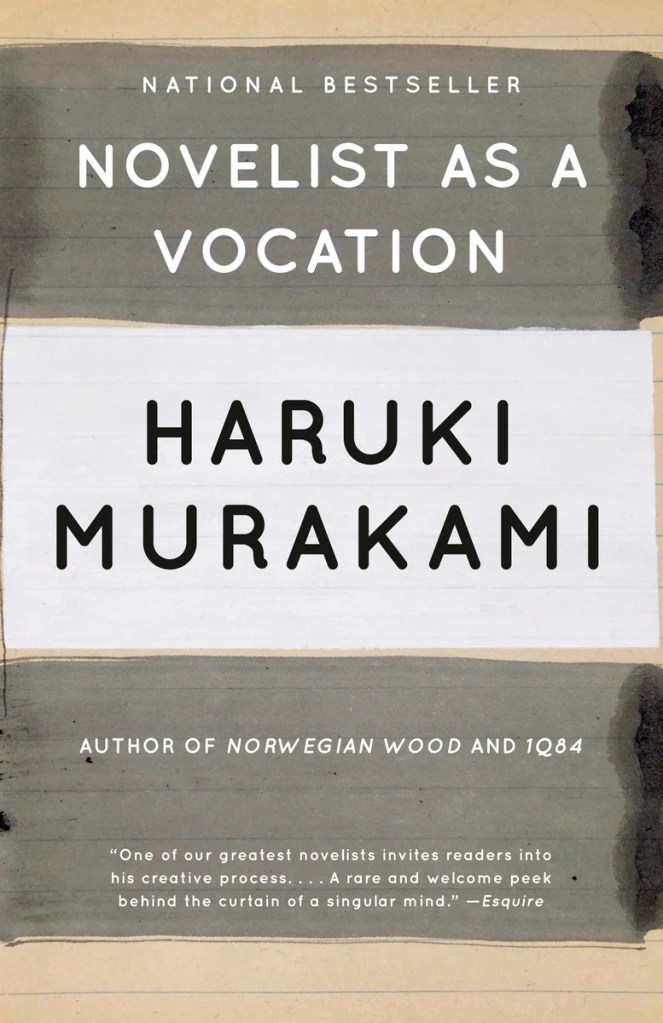
Novelist as Vocation is a book about writing, but if you’re hoping for a technical manual or detailed tips on voice or pacing, this is not the book for you. The closest analogue I’ve read is Stephen King’s On Writing.
King’s book is half memoir, half writing advice. Murakami’s book also has a memoir component, but any writing advice is almost incidental. Murakami seems loathe to put himself on a pedestal with the implication that his advice might be valuable, but he does describe his writing process in some detail.
The book is split into a dozen chapters, each one standing alone and covering a different topic. Half of these chapters started life as essays Murakami wrote years ago and set aside, eventually being published as a serial feature in a Japanese literary magazine. The rest were written later to fill out the book.
For those who are fans of Murakami, the chapters “Are Novelists Broad-Minded” and “Going Abroad – A New Frontier” provide the most history of his career and insight into the man and his view of the world. For those seeking concrete advice, the chapters “So, What Should I Write About?” and “Making Time Your Ally: On Writing a Novel” give an overview of the author’s entire process leading up to, writing, and rewriting a novel.
If nothing else, Novelist as Vocation reinforces the common view of Murakami as a successful author who never quite fit into the literary establishment in Japan or internationally. He comes across as idiosyncratic and sometimes odd, having never been formally trained, and making a start at writing much later in life than many of his literary peers. Getting a glimpse of the man through these chapters, it seems almost obvious that this would be the person behind these unusual novels.
Murakami is self-deprecating and self-important in turns, on the one hand brushing off some critics’ poor reviews of his works and style, but then bringing it up so often that I can’t help but think it hurts him more than he would like to admit. He knocks his own writing as nothing special, but also repeatedly calls back to the prize he won for his first novel and his broad success since then. If nothing else, the fact that he wrote this book about his own life and writing has a certain egoism built into it.
Murakami also serves as a good reminder for any writer who is worried about not having an MFA, worried about starting later in life, or simply feeling like an outsider in the literary world: there are many definitions of and paths to success in writing, and we should not be discouraged or afraid to forge our own way.
 Words Deferred