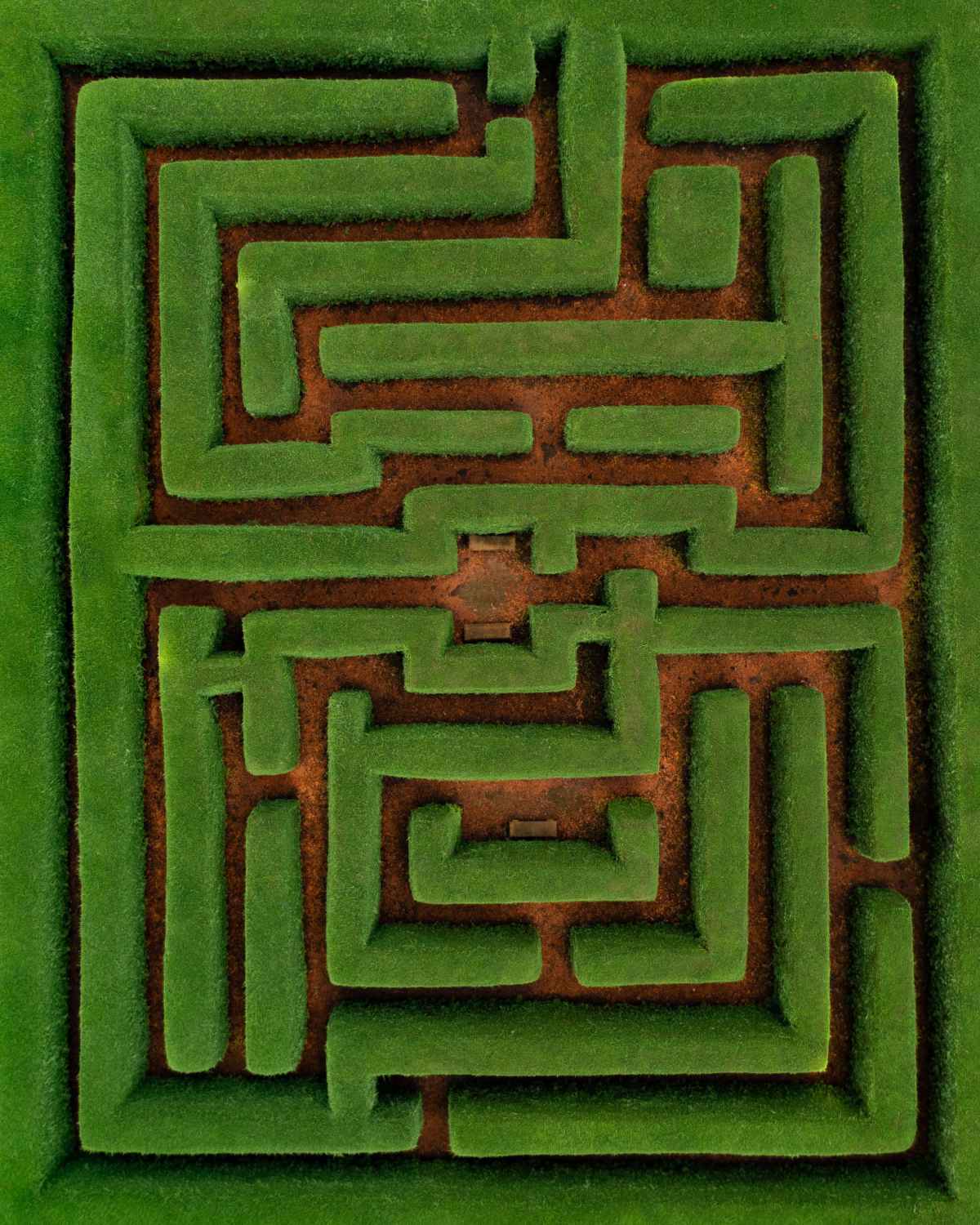
House of Leaves — Story as Labyrinth

House of Leaves is a 2000 novel by Mark Z. Danielewski. I don’t have a very precise memory of when I first read it, but it must have been about fifteen years ago. It is a formative book for me, and parts of it took up permanent residence in my head. Yet when I reread it this past October, I had to admit that I had no memory of large swaths of the book. That seems somehow appropriate for a sprawling, layered story with unreliable narrators and intentional inconsistencies.

Despite being a best-seller that continues to be reprinted, House of Leaves feels like a cult classic. It has ardent fans, but it seems too esoteric and weird to be truly mainstream. The people who love it will be the first to admit that it is not an easy read, and the people who hate it will declaim it barely readable at all. It generates the same sort of divisive conversations as Ulysses (or Homestuck).

After my recent reading, I dove down the rabbit hole of online information, arguments and discussions about the book. I learned about some of the many things I had missed. I was amazed and a little appalled by the number of secrets hidden in the text, the number of subtle allusions and not-so-subtle codes. I have to admit that I may now be a member of the strange cult obsessed with this book. So, while I touched on it briefly in my October Read Report, I feel obligated to write something more about House of Leaves.

I don’t have much interest in writing traditional reviews, but this is a review of sorts. If nothing else, I hope it gives you an idea of what the book is like, and whether you’re likely to love it or hate it.

Zampanò

The title page of the book says, “Mark Z. Danielewski’s House of Leaves, by Zampanò, with Introduction and Notes by Johnny Truant.” The origins and provenance are purposely muddled. The intermingling of stories and frames, reality and fiction, starts before the first word.1

The book starts with Johnny, but we’ll start with Zampanò.

Zampanò is a blind old man who lives by himself in a run-down apartment. He has done his best to seal up the windows and the crack under the door. Among his few possessions is a battered trunk filled with notes and a half-finished manuscript for a scholarly analysis of a film called The Navidson Record.

We can infer a little about Zampanò from his work. It is riddled with footnotes, and certainly makes a variety of assertions about The Navidson Record, but these are all suspect. He often discusses the visuals, despite being blind. Johnny’s notes point out that there is no evidence that a film called The Navidson Record ever existed (even within the story) and the many works of criticism for the film that Zampanò cites are fabricated as well.

Johnny never meets Zampanò. He only hears things about him second-hand.2 He talks to the various people who came to read to the old man. He hears about Zampanò’s ritualistic daily walks around the perimeter of the apartment complex’s overgrown courtyard.

Ultimately, the only real interaction between Zampanò and Johnny is that the old man dies, and Johnny’s friend Lude gets him into the apartment to look for interesting stuff left behind. Johnny takes the trunk full of Zampanò’s half-finished book, and begins to read and edit it.

That’s where his troubles really start.

The Navidson Record

The Navidson Record doesn’t exist. Johnny tells us that pretty early on. But the portions of the book that belong to Zampanò are so persistent in their certainty that they make it feel real.

Zampanò describes The Five and a Half Minute Hallway and Exploration #4, viral videos that spread via bootleg VHS and the early internet. They both turn out to be excerpts from The Navidson Record. The first shows a door in an exterior wall that opens onto a hallway that cannot possibly exist. The second shows the endless maze of dark rooms at the other end of that hallway.

Zampanò describes the film itself. Famous photojournalist Will Navidson moves, with his partner, Karen Green and their two children, to an old house in rural Virginia. Giving up more dangerous projects like war photography, Navidson plans to document this new stage in their lives with video journals that he and Karen keep, as well as motion-activated cameras set up around the house. The pair’s internal traumas and external relationship struggles are present, but suppressed. For a time, the house seems idyllic.

Then, it begins to change shape. At first this is subtle, a matter of a mere 1/4 inch across its entire length. Then individual rooms begin to change size. Navidson becomes obsessed with measuring these tiny changes, but they soon become so obvious that measurement is not necessary. A new hallway appears between two rooms. A door appears in an exterior wall, but it doesn’t open onto the yard. It leads to an apparently endless maze of hallways, rooms, and stairs, unlit and frigid.

The tensions between Will and Karen quickly reach a breaking point. She wanted to escape the fear that accompanied Will going out into danger to capture his photos. But the mysterious extra-dimensional portion of the house is too alluring. He is desperate to explore it.

Instead, he brings in outsiders: a scientist, and a trio of expert mountaineers. While he remains in the house, manning the radio at “base camp,” the three explorers set out on a series of expeditions, surveying the ever-changing architecture beyond the impossible hallway and even taking samples from the walls. They carry his video cameras with them.

These videos document the rare moments when the dimensions of the house visibly change around them. They document the strange way things break down within the bowels of the house; markers and supply caches shredded or vanished, buttons and zippers disappearing from their clothing. They document the eerie growl that sometimes passes over them like a wave, or follows at a distance.

And though they aren’t collected until much later, they document exactly how everything goes horribly wrong.

Exhibits and Appendices

The last section of the book contains six “exhibits” and three appendices. However, to say that these are the conclusion of the book is only technically true. Just as Johnny’s narrative inserted into footnotes encourages the reader to jump back and forth between layers of story, other footnotes point to the appendixes and encourage the reader to dig into them in the first few chapters.

The exhibits are unfinished. They are things that Zampanò hoped to include: scientific analysis of the samples Navidson and others took from the house, reproductions of interviews, a section on architecture, an excerpt from an Air Force manual, and some of Karen’s medical records, along with related excerpts from psychiatric literature.

The first appendix is filled with the writings of Zampanò. Johnny’s note tells us that these are included to shed more light on the man. Notably, among Zampanò’s poems is an untitled fragment that contains the only reference to the book’s title within the text:

Little solace comes

to those who grieve

when thoughts keep drifting

as walls keep shifting

and this great blue world of ours

seems a house of leaves

moments before the wind.

The second appendix contains Johnny’s items: sketches and polaroids, poems and collages, his father’s obituary, and “The Three Attic Whalestoe Institute Letters,” correspondence between Johnny and his erudite and apparently schizophrenic mother, long institutionalized.

These letters are arguably the most important thing in the appendices, and act almost as a third narrative alongside Zampanò’s and Johnny’s, revealing and clarifying many details from Johnny’s account, and raising new questions.

Formatting

Some footnotes are referenced in multiple places. Some are missing. Most use numbers, but some use a variety of strange symbols that may or may not relate to the text. There are footnotes to footnotes, occasionally several levels deep.

But beyond the unusual use of footnotes, there are many other formatting oddities in House of Leaves.

There is the use of color: house always appears in blue, several struck sections in red, and one particular phrase in purple.

A single bar of music is printed sideways, running vertically down the page.

In two different sections of The Navidson Record, the shape of the text reflects the shape of the narrative or the shape of the house.

It is contained within 
sidebars or blue-bordered
squares, running forward
and backward along the
pages, turned sideways and
upside down.


It is spread out,

only a few words per page,

as the characters run,

frantic,

through the labyrinth.


It is drawn out slowly, as the text explores the meaning in a few slowed frames of film.


It is cramped and tight,
as the halls of the
house narrow,
sloped in
diagonals
as
the
explorers
move downhill,
separated by a vast
gulf of


white space


when they encounter a chasm.

Although the story itself is sometimes unclear or frustratingly abstract, it is this shaping of the text on the page that presents the first barrier a reader must overcome to form any connection with House of Leaves. But it is also an invitation to the reader. The text practically demands interpretation. Why these colors? Why this formatting? Why must I follow a footnote to a footnote to a letter in Appendix B?

Your instinctive reaction to this—excitement or irritation—is a good indicator of whether you will enjoy the book.

Secrets

. . . . . . Related Things. . . . . . 

. . . . MyHouse.WAD . . . . . . . . .
. . . . . . .Labyrinth. . . . . . . .
House of Leaves Reddit. . . . . . . .
. . . . . . . . . . . . . . . . . . .
. . . . . . . . . You Should Have Left
.House of Leaves Forum. . . . . . . .
. . . . . . . . .Cumaean Sibyl. . . .
. . . . . . . . . . . . . . . . . . .
. . . . . . . The Whalestoe Letters .
. . . Jacob and Esau. . . . . . . . .
. . . . . . . .Haunted. . . . . . . .
House of Leaves - TV Pilot. . . . . .
. . . . . . . . . . . . . . . . . . .
. . . . . . . . . Minotaur. . . . . .
. . . . . Only Revolutions. . . . . .
. . . . . The Backrooms . . . . . . .
.Ergodic Literature . . . . . . . . .
. . . . . . . . . ? . . . . . . . . .

A few of the fooTnotes contain Huge lIstS of places, names of archItectS, etc., etc. At first glaNce, these appear tO be poinTless. AsTute readers, after discovering tHe sEcret cOdes spelled out iN PeLafina’s “Whalestoe Letters” through misplaced capital letters and acrostics, have applied the same codes to these lists, and discovered that theY also contain hidden Messages. One codE, embedded in the Navidson Record, SeemS relAted to those letters. Another spells Danielewski’s full name.

In my hardcover edition, there are also hundreds of 4-diGit hExadecimal codes imprinted on the inside of the cover. Some enterprising individual determined that these describe part of a music file: a snippet from the companion album to the book, Haunted, by Poe (the stage name of Danielewski’s sister).

Do these secrets add anything meaningful to the story? Hard to say, but they certainly evoke a feeling that there are hidden meanings everywhere in House of Leaves, if only the reader is willing to dig deep enough.


  1. How many levels of frame story are there? Well, there’s the Navidson Record, and all the collected ephemera around it: interviews and articles, books and art, arguments, analysis and critique. There’s Zampanò’s written analysis of the film. There are Johnny’s notes on Zampanò’s work. And there are the fictional editors, who chime in occasionally to clarify a point or cite a source that Johnny never got around to. There is Danielewski, the real author, almost invisible. But there’s also Johnny’s institutionalized mother, Pelafina, who sends him letters (or does she) of varied lucidity. The really obsessive fans have their own theories about her, but I won’t spoil them.3 ↩︎
  2. Johnny’s story is told in notes and footnotes, denoted only by a different font. Sometimes these notes comment on Zampanò’s work, but they often wander away from the subject at hand, into long and meandering anecdotes from Johnny’s life. As the book progresses, they become less and less decipherable, entire pages of run-on sentence. ↩︎
  3. Even more perplexing, these frames are fuzzy; the stories leak out of their original context. Late in the story, Johnny encounters a group of strangers who are obsessed with a story that has been passed around the early internet, and it turns out to be a version of the account we’re reading. In Zampanò’s summary of The Navidson Record, Will Navidson, lost within the labyrinth of the house, burns his final matches to read a book, and the book is House of Leaves. These examples of impossible recursion are never explained. ↩︎

The Read Report — October 2023

This is the monthly post where I talk about what I’ve been reading. As usual, if you’re interested in any of these books, please use the included Bookshop.org links instead of Amazon. It helps independent bookstores, and I get a small affiliate commission.

Sandman: Dream Hunters

By Neil Gaiman

Having finished rereading all the books in the main Sandman series, I figured I would top it all off with the two stand-alone Sandman volumes. The first of these is Dream Hunters, which was published three years after the 1996 wrap of the main series.

Dream Hunters comes in the form factor of a graphic novel, but it is actually an illustrated short story in five parts. There are a variety of different layouts, including many full page illustrations and some two-page paintings and both horizontal and vertical splits. There is even a double-fold-out illustration, four pages wide. Amano’s inks, pencils and watercolors mingle to create a variety of effects, sometimes clear, other times murky or abstract.

The story is a retelling of a Japanese folk tale, “The Fox, the Monk, and the Mikado of All Night’s Dreaming.” A magical fox falls in love with a lonely monk who maintains a small and forgotten shrine. When a powerful sorcerer tries to kill the monk in his dreams, the fox intercepts those dreams to protect him.

This is one of those classic Sandman side-stories where Dream is involved, but only as a side character. It’s a good story with great art, but not really necessary to pick up unless you’re already in love with the series.

Sandman: Endless Nights

By Neil Gaiman

Unlike Dream Hunters, Endless Nights is a proper comic. This is an anthology of stories, each with a different illustrator, and each one focused on one of the seven Endless: Death, Dream, Desire, Delirium, Destruction, Despair, and Destiny. Again, these could be considered side-stories to the main series, but they feel closer to the main series in tone and style, and they do offer a few interesting tidbits for die-hard fans.

Some light is shed on Dream and his interactions with Desire, when they attend a gathering of sentient stars some few billion years ago. We see what might be the first of Dream’s many ill-fated romances, and the source of animosity between Dream and Desire. We also get to see what Destruction is up to in his exile, and hints that he may yet reach a kind of friendly ambivalence with his family, even if they never quite see eye-to-eye.

I really like Endless Nights. If The Wake was the epilogue to the main story, then this feels like a reunion.

Harry Potter and the Prisoner of Azkaban

By J.K. Rowling

I continue to work through the series with my kids. This third book feels like the inflection point to me, still largely plotted in a way to appeal to relatively young kids, but beginning to ramp up the darker themes.

At this point, it’s clear there is something of a formula that the books follow. Again, it leans on couple of mysteries to keep the plot moving. Again, there is a red herring that is pushed hard. Where this book differs is in the long third act, which wraps everything up with a fun time-travel sequence that has to interweave with a series of events that we already read from a different point of view.

While it’s popular to knock the Harry Potter books these days, especially for their plot holes, the time travel opens up a pretty egregious one. Sure, as in Back to the Future, a big deal is made over the “dangers” of seeing yourself while time traveling. But then main characters do it anyway, and it turns out perfectly fine. Unlike Back to the Future, the Harry Potter books barely mention time travel again, which is a little hard to swallow.

House of Leaves

By Mark Z. Danielewski

I didn’t intend to read House of Leaves again. I was talking with my son about the Backrooms, and how it seemed like it was inspired by House of Leaves. I went to grab my slightly beat-up paperback copy and discovered that it wasn’t on the shelf. Then I remembered I had loaned it to a friend, years ago. So I ordered myself a new copy.

When the book arrived, I popped it open, just to enjoy the sections where the text went all wonky. I went back to the beginning, to see how it started. Before I knew it, I was fully absorbed. It’s probably been over ten years since I last read it, and there was a lot I had forgotten.

House of Leaves is a strange book. At its heart is a horror premise: a house that somehow contains an infinite, shifting, maze-like series of rooms and corridors, where one might become lost forever. Wrapped around that core are multiple layers of frame stories and linguistic complexity.

I could go on about this book, but it’ll have to wait for another post. Suffice to say that it’s just as enjoyable as I remembered, and I highly recommend it to anyone interested in reading something genuinely weird.

What I’m Reading in November

With NaNoWriMo looming, I probably won’t be reading much. If I do get ahead and end up with some free time, I expect I’ll finally get back to The Witcher or delve into a new comics series.

See you next time!

The Genre of Inscrutability

I recently watched a show called Bee and Puppycat: Lazy in Space with my kids. The show has had an interesting life, starting as a web short, kickstarting a full series, and then getting a sort of semi-sequel series on Netflix that encapsulates the earlier versions in the first couple episodes. For what it’s worth, I only watched the Netflix series.

The show is a silly and deeply weird cartoon about a lazy girl named Bee and an interdimensional space puppy/cat/thing. Bee is fired from her job for the aforementioned laziness, and Puppycat helpfully takes her to the interdimensional temp agency to do strange odd jobs across the universe every time the pair needs a little cash.

At first glance, Bee and Puppycat is just a goofy cartoon, but it is so strange that I found myself thinking about it quite a bit once we had finished the series. Like a curious kid, I wanted to take this show apart and try to understand how it works.

The Legacy of Adventure Time

Adventure Time was a cartoon that exploded into pop culture. It combined absurdism, surrealism, and what I now think of as millennial-style non-sequitur humor with storylines that took unexpectedly emotional turns and occasionally addressed serious topics from silly angles. While it started as ostensibly a kids’ show, it grew a fanbase that was largely young adults.

Adventure Time changed in tone over the course of its ten seasons, perhaps due to a change in show-runners, influence from its fan-base, or its creative staff getting older. The earlier seasons are whimsical and light, often silliness for silliness sake, while the later seasons seem more burdened by the serious undertones, a little more self-conscious, but also trying to be more than just a series of goofy bits.

Clearly, a lot of cartoon television talent was cultivated around the show, because people involved in Adventure Time have gone on to work on many other well-crafted shows. Among that diaspora, the influence of Adventure Time and its aesthetics are clear. Stephen Universe, Over the Garden Wall, and Bee and Puppycat all share some of that Adventure Time DNA.

The Genre of Inscrutability

The world of Bee and Puppycat is strange and mysterious, and we’re dropped right in the middle of it. Initially, it has some of the trappings of the mundane world. A girl losing her job at the café and needing to do odd jobs to make ends meet is a fairly ordinary premise. But this quickly spirals into stranger and stranger territory. What kind of creature is Puppycat, and where is he from? Is Bee actually a robot? Why is her landlord a small child, and why does his comatose mother cry magical tears that transform everything they touch? Why is pretty much everything and everyone on her island home so bizarre, and yet nobody seems to care?

Mysterious settings aren’t uncommon. In fact, they’re a great way to pull the audience into a story. Pretty much all speculative fiction (sci-fi, fantasy and some horror) create a secondary world that the audience has to figure out. And while older examples of these genres might have front-loaded exposition and lengthy prologues, time and experience have shown that the most effective way to get into this kind of story is to throw the audience right into the middle of it, and help them to figure it out as they go along.

The implicit promise in most of these stories is that the setting is a puzzle that the audience will be able to solve, piece by piece. At the beginning of the Lord of The Rings, all we know about are hobbits and the Shire and a weird old guy named Gandalf. It’s only later that we learn about elves and dwarves and orcs and ents and more elves and the Numenorians and the Maiar, etc., etc. The extreme fans will read and re-read and glean all the little hidden details, and spend hours debating what the heck Tom Bombadil is. But even the average reader will know quite a lot about Middle Earth by the time they get to the end of the third book. Tolkein lays it all out on the page.

What’s interesting about Bee and Puppycat is that it takes place in a mysterious world full of interesting details, but it doesn’t do much to explain how they all fit together. It doesn’t lay everything out. The setting is a puzzle, but the pieces are all mixed up, and a few of them might be missing altogether.

I’ve started to think of this kind of story as the Genre of Inscrutability.

A Very Bad Idea That Seems to Work Anyway

To be in the Genre of Inscrutability, a story has to have a few key things:

  1. A fantastical setting – it may be similar to the real world, or wildly different, but it’s clear that the setting has some unreal rules at play.
  2. The fantastical elements aren’t explicitly addressed.
  3. There’s some mechanism to make that okay

    Now, thing number one is straightforward enough, but thing number two immediately gets us into trouble. Good storytellers know that you don’t show the gun on the mantle unless it’s going to go off, and you don’t set up a mystery that you don’t intend to resolve. The resolution of the mystery and the catharsis that comes out of it are necessary to make a mystery story feel complete. Thing number two seems like a Very Bad Idea from a storytelling standpoint, which is what makes it interesting.

    The big question, then, is how do we do thing number three? How do we make it okay? To answer that, I think it’s helpful to look at more examples.

    Examples

    The Bee and Puppycat series hints at Puppycat’s past without actually explaining very much. We’re shown what Bee is, but it’s never explained why she was created, or where her “father” is. I still have no idea what’s up with Cardamon or his mom. However, Bee and Puppycat isn’t really about these things at a structural level. The episodes tend to focus on relationships and interactions between Bee and the other characters, or occasionally just between the other characters.

    Jeff Vandermeer’s Ambergris stories also contain unexplained mysteries. The city is founded on the ruins of a much older (perhaps much more advanced) city inhabited by the mushroom dwellers. The mushroom dwellers go into hiding beneath the city, and collect the refuse the city-dwellers leave behind. While individual mushroom dwellers are superficially weak, it is implied that they are collectively powerful—enough to completely empty the city of inhabitants during The Silence, and perhaps to retake the city permanently in some indistinct future. Who or what they are is never really explained. However, the city and its history are just backdrops to these stories. The mushroom dwellers make it clear that the city itself is a transitory state. There was a before, and there will be an after. They are a natural, elemental force set in opposition to the crass, industrial humanity of Ambergris.

    Mark Danielewski’s House of Leaves is a book about a book about a film that tells the story of Will Navidson and his family moving into an old house, which slowly reveals itself to be a supernaturally shifting non-Euclidian space. The book relies on the multiply nested frame stories and footnotes to construct a sense of verisimilitude as well as mystery. Though all of it is fictional, receiving the story through a game of telephone with multiple unreliable narrators only adds to the intrigue. It feels like stumbling into a particularly vivid and heavily documented conspiracy theory.

    Did the Navidson Record ever actually exist, or is it just the crazed ramblings of Zampano? Did the house itself ever exist? And if it did, how did it come to be? How long has it been there? We are never given answers to any of these questions. Instead, we are expected to wonder.

    How to Make It Okay

    The Genre of Inscrutability builds a setting full of mysteries that it doesn’t intend to resolve. This is not to be confused with something like LOST, a very unfortunate show that intended to resolve its mysteries and catastrophically failed to do so. Here, we are talking about purposeful inscrutability.

    As we see in Bee and Puppycat, one way to make this okay is to keep that mystery separate from the tension and catharsis. If the story is about whether the main character will follow his dreams and leave his small town to go to culinary school, his mysterious island home is just interesting set-dressing. When he overcomes his fears and decides to go, the tension is resolved in a satisfying way. The mysterious setting is still present, but it’s not blocking the satisfying resolution of the story.

    Ambergris shows another possibility: a setting so grandiose in scope that it is not fully knowable. I cannot know every nook and cranny of my home city. I certainly cannot know all of its long history. Likewise, Ambergris is a setting with fuzzy edges. We might know some of its history, its inhabitants, its streets and buildings, but we cannot know all of it. There is vague malice lurking beyond the torn edges of the map, monsters that might just come up out of the ground one night and whisk everyone away. Such a setting makes the characters feel small and weak in a very big and dangerous world.

    House of Leaves fully leans into the mystery. The mystery is entirely central to the book. The book itself is a puzzle box, a literary game. It doesn’t give away all the clues, because that would be too easy. You have to want the answers and work for them. You can theorize and guess, but at the end of the day, the book just winks, shrugs, and walks away. It’s up to you to convince yourself you’re right, based on the evidence at hand. House of Leaves forces the reader into the position of the conspiracy theorist, just like its numerous narrators.

    In Medias Res

    When I was a young whippersnapper, I once accidentally read the sixth book in a seven-book series. I didn’t know it was part of a series. I didn’t find out until I got to the end and found the whole series listed out. It was a very disconcerting experience. It is the ultimate form of in medias res.

    This is exactly the experience that the Genre of Inscrutability cultivates, but it’s a dangerous game. Some readers won’t put up with it. I have no doubt that all of the stories I talked about above have left readers and viewers behind. Not everyone wants to work to enjoy a story, and no matter how the inscrutable story tries to make it okay, it is requiring extra effort from the audience.

    On the other hand, the inscrutable story offers a real depth of experience to a dedicated fan. One need only look at the wikis, forums and social media conversations to see that fans of this kind of content derive a huge amount of satisfaction from combing through every detail of the work, and then discussing it with other fans. But woe unto the author who accidentally inserts some small error that the fans latch on to as a meaningful clue. Even if you don’t intend to reveal all the answers, internal consistency is still important.

    If you know of any other stories that you think fall into the Genre of Inscrutability, let me know in the comments. I’d love to find other examples.

Storytelling Class — Style/Substance

Every once in a while, my daughter Freya and I have a “storytelling class.” Really, it’s just a fun opportunity to chat about writing stories. This time, our topic was style and substance.

We always start with two questions: What did we read and write recently?

What Did We Read?

Freya is getting close to finishing the first Wheel of Time book. I asked her if she was excited to continue with a series that has fourteen books. She said she thought she might be 70 before she finishes. She also just started the “Janitors” series, though she hasn’t gotten far enough to form an opinion yet.

I have been working my way through my beautiful new Ambergris hardcover. City of Saints and Madmen was a formative book for me, and I’m excited to now have it in a single massive tome alongside Jeff Vandermeer’s other Ambergris stories. I was however, a little disappointed to find that they actually removed some of the appendices that appeared in the original, so now I have to keep my copy of City of Saints and Madmen as well.

In non-fiction, I started Ways of Being at the recommendation of Cory Doctorow, although I’m only a few pages in.

What Did We Write?

Freya has kept busy writing for school work, and hasn’t worked on any fiction recently. After my Covid break, I’ve been working on getting back into Razor Mountain.

Style and Substance

Each story consists of two parts—two sides of the same coin—style and substance. You can think of “substance” as “what the story is about” and style as “how the story is told.” Substance is the meaning. Style is the actual words. By some definitions, substance is good, while style is just the shallow surface layer. However, when it comes to fiction, each story is really a melding of the two.

Schools of Thought

At the risk of being a little controversial, I’m going to define two schools of thought, and I’m going to call them “genre fiction” and “literary fiction.” I put them in quotes because each story is a special snowflake, and I’m about to speak in broad generalizations, so take it all with a grain of salt.

The “genre fiction” school of thought is that substance takes precedence. Genre fiction sometimes even devalues style. Common genre fiction advice suggests that, when reading a great book, the reader should forget they’re reading and get lost in the story—that is, in the plot and the characters. The descriptive text should become transparent. Authors should endeavor to become invisible, and never call attention to themselves.

The “literary fiction” school of thought holds that style is quality. Literary fiction tends to put a higher value on authorial voice. The advice here is that a great book should be overflowing with the author’s unique voice, and the reader should be transported into the mind-space of the author. Mechanics like plot and character are nice, but they need to be described through transcendent prose. Anyone can tell a story. A true author tells it in a way that only they can.

False Dichotomies

Like most dichotomies, this one is artificial. Style and substance aren’t strictly opposing forces (although they can sometimes fight each other). Some authors make the mistake of crafting page after page of beautiful prose that doesn’t really  tell a story, while others create intricate plots by placing row upon row of flat words like bricks in a wall.

Readers, like authors, are unique, and there are audiences for both of these styles. Science fiction has a big audience that revels in clever plots and is fine with a lack of ornamentation. Likewise, there are plenty of literary fiction readers who care more about delicious sentences than characters who actually go somewhere and do something.

As an author, you can make your own choices about what you value. You may choose to focus on substance, or style, or try to find a happy medium. However, it’s important to understand that there are trade-offs. The more stylized your prose is, the more your reader will have to work to understand what’s going on. Some readers will appreciate the extra layers of complexity, but others simply won’t be interested, and may just put the story down. Focus on style inherently takes some focus away from the substance.

Examples

We looked at a few of my personal favorites when it comes to literary style.

Douglas Adams’ Hitchhiker’s Guide series is a relatively mild example, where most of the stylistic flourishes could be described as “literary comedy,” twisting language for fun and amusement.

Mark Danielewski’s House of Leaves is a book with literally complex text that stretches sentences across pages, forms shapes and pictures, and wraps around upon itself. But it is also a narratively complex work, presented by a character named Johnny, who details the work of his acquaintance, Zompano, who himself took detailed notes based on videos shot by a third character, Navidson, whose descriptions of his ever-shifting, labyrinthine, and spatially inconsistent house form the heart of the story.

Finally, there’s Vandermeer’s more recent work, Dead Astronauts, a book that is so dense and challenging to decipher that it almost feels encoded.

These are wildly different examples of a strong authorial voice put to use for different purposes. While Adams is extremely readable, House of Leaves ranges from straightforward prose to deep complexity. Dead Astronauts is lyrical and dreamlike, but so obfuscated in parts that I found it off-putting. And there are many other examples of other authors doing entirely different but equally interesting things with language.

Choosing a Style

Depending on the type of writer you are, you may find that you default more toward one end of the spectrum than the other. There’s nothing wrong with that. Many authors are influenced by their own favorite writers and stories, and you may like to write the same kind of stories that you like to read.

I find that memorable quotes and phrases tend to come from style-heavy writers. Substance-heavy writers tend to make unforgettable stories where you don’t necessarily remember any of the words in particular. I loved The Martian when I read it a year ago. I remember some of the structure (maybe because I blogged about it) but I don’t remember a single line from it.

Sometimes particular stories will speak to you in a certain way. Just because you normally write very straightforward sci-fi space operas doesn’t mean you can’t do a bunch of clever stylistic embellishment in a complicated, self-referential time-travel story.

As with most things in life, it can be good to experiment. You might discover that you can find joy in more kinds of stories than you previously realized. Or you may find that a particular story calls for a particular style.