The Read Report — May 2023

Good God, I read a lot of books in May. You can find out more about why in another post.

I don’t have the desire or time to write full-on blog posts for every book I read, but I’ve come to appreciate how blogging gives me an opportunity to reflect a little bit more explicitly on what I got out of a book. So, I’m going to start writing these monthly posts to talk about what I’m reading.

If you’re interested in any of these books, please use the included Bookshop.org links instead of Amazon. It helps independent bookstores, and I get a small affiliate commission.

Ways of Being: Animals, Plants, Machines: The Search for a Planetary Intelligence

By James Bridle

This triply-titled book is the kind of non-fiction that is perfect for fiction writers. It’s full of interesting ideas that could spark a story. Bridle is a little bit “out there,” but this exploration of intelligence comes at an old topic from an interesting perspective.

The book postulates that we should consider a lot more under the umbrella of intelligence than we typically do. The human definition of intelligence always seems to be “things that humans do,” and Bridle argues that this definition dramatically limits our understanding of the universe.

As you might guess from the title, Bridle argues that various animals, plants and machines all have their own varied forms of intelligence, often radically different from our own. He provides some interesting examples to back up his opinions, although some of the leaps of logic toward the end of the book didn’t quite land for me.

The Way of Zen

By Alan Watts

This is an introduction to the basics of Zen Buddhism, along with some history and context.

Alan Watts was an odd duck. A British-born writer and speaker who gained popularity after moving to California in the 1950s, he was a priest before becoming enamored with Asian religions and philosophy, and he found a receptive audience in the hippie movement.

I don’t really know if Watts is much appreciated in more mainstream or traditional Zen circles, but he has an entertaining style and a knack for explaining abstract concepts through metaphors and parables aimed at a western audience. His many recorded philosophical lectures have found new life on the internet in the YouTube era.

Becoming a Writer

By Dorothea Brande

I wrote a whole post about this one.

The Black Tides of Heaven / The Red Threads of Fortune

By Neon Yang

A fun pair of fantasy novellas set in an Asian-inspired secondary world. Despite a pair of royal twins and a magic system based around elements, these books feel original and fresh. Quick reads full of action and adventure.

What I really appreciated about these books was that all of the magical fantasy action was driven by relatable and varied interpersonal conflicts: disagreements between parents and children, irritation with in-laws, and the loss of loved-ones.

The first book also successfully tricked me into believing that it would end with a big fight, then switched it up at the last second and gave me a more cerebral conclusion.

Animal Farm

By George Orwell

Originally published in 1945, Animal Farm is a skinny little book that Orwell sometimes described as a fairy story. It’s a modern (for its day) fable about a group of animals that take over the farm, only to have their noble rebellion slowly subverted back into tyranny.

I’ll be the first to say that allegorical novels aren’t exactly the sort of thing I’m very excited to read, and I probably wouldn’t have read this if it wasn’t considered such a classic. However, it’s a very quick read, and entertaining enough that I didn’t regret it.

In many ways, this book feels like an early prototype of Orwell’s 1984, which was published only four years later. Many of the same ideas appear in that book, but in less simple, satirical forms.

The Wes Anderson Collection / The Grand Budapest Hotel

By Matt Zoller Seitz

These are big “coffee table” books with some great illustrations and images from the movies.

The original book spent a good amount of time on each of Anderson’s first seven movies. While I’m not much of a movie critic, I do have an appreciation for experts talking about the things they love. This was an interesting look into that world. While a lot of it is specific to filmmaking, there are some useful tidbits about building good stories in general.

The second book is a bit thinner, but focused entirely on a single film. For my money, Grand Budapest is Anderson’s best work, but this still felt like more of a deep dive than I needed on the one movie, especially when contrasting it with the first book.

While they may make more of these books as the director continues to make movies, I think these two were enough to satisfy me, and I’ll get off the ride at this stop.

Flash Futures

(Anthology, edited by Eric Fomley)

This was one of my backer rewards from a Kickstarter for The Martian magazine. It’s an anthology of sci-fi flash fiction, generally on the darker side. I have to admit, while there were some enjoyable stories here, I prefer the drabbles on the site.

I think flash fiction is one of the hardest formats to write. I enjoy drabbles and micro-fiction because it’s hard to even tell a coherent story at that length. Pulling it off is a bit of a magic trick. At the 500 or 1000 words of a flash piece, you still can’t tell very much story, but you also don’t have the incredible tightness of a drabble, where you’re fighting to fit every single word and forced to cut words in clever ways.

Hellblazer: Out of Season (Volume 17)

Written by Mike Carey

Art by Chris Brunner, Leonardo Manco, Marcelo Frusin, Steve Dillon
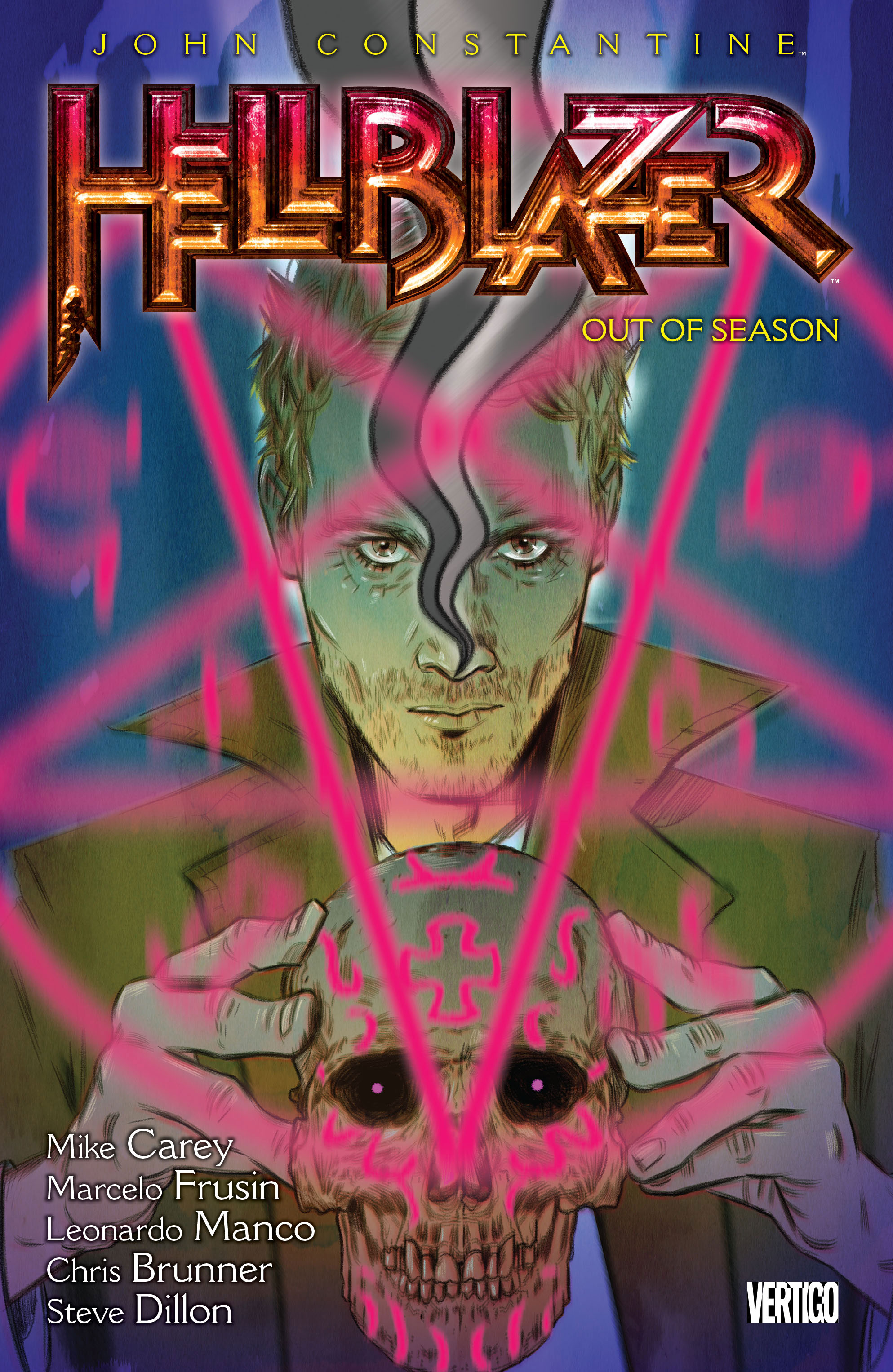
This was a random pick from the library.

I love Constantine as a character, and his whole milieu, but how many times can there be a worldwide supernatural apocalypse event? It seems like it happens every year or so in these books. I really prefer the smaller, more intimate story arcs that focus on just how miserable it is to be in Constantine’s social circle.

I will say, this is a pretty great connecting arc. The twist at the end is interesting, and it creates new characters and problems. It’s a great example of finishing a chunk of episodic story by building a lot of new scaffolding that future stories can be built upon. That’s not always an easy thing to achieve. Good lessons for anyone who wants to write a series.

The Sandman: Overture

Written by Neil Gaiman

Illustrated by J.H. Williams and Dave Stewart

Not my first time reading this, and it won’t be my last. If you love comics and you haven’t read this book, you are missing out.

It is, by far, the most beautiful Sandman book, and that is a high bar. There are no straight-edged standard panels here. It’s a master-class in all the different ways a comics page can be composed. While the original Sandman was often very dark and brooding, Overture contrasts its serious blacks with all sorts of psychedelic color.

I’ve read some complaints about the story not being as good as the originals. And that might be true, but I also don’t think it’s too far off the original series. Neil Gaiman does his usual Neil Gaiman things, crafting stories that feel simultaneously new and old, familiar and strange, playing around in one of the worlds where he is most comfortable.

Although this is a prequel, I think it definitely ought to be read after the original run. Narratively, the story comes before the other books, but the references and emotional beats are clearly designed as a follow-up.

Reading this again gave me the itch to read even more Sandman. So…

Sandman: Preludes and Nocturnes (Volume 1)

Written by Neil Gaiman

Illustrated by Sam Keith, Mike Dringenberg, Malcolm Jones III, Kelley Jones

The big, bad original, from the early days of DC’s Vertigo imprint.

Despite Morpheus (a.k.a. Dream) being almost infinitely old when we first meet him, this is a fantastic origin story. It’s a satisfying arc in its own right, as Morpheus is trapped, escapes, and then has to regain his tools and repair his kingdom. It also sets the tone for the entire series: a delightful mix of modern and ancient stories in a new mythological frame.

Almost all of the issues collected here are dedicated to the main plot, with the exception of the final one. “The Sound of Her Wings” remains one of the greatest single issues of a comic of all time, characterizing Death as a whimsical, kind, and profoundly compassionate older sister to Dream.

What I’m Reading in June

In June I’ll be continuing my re-read of the original Sandman series. I’m also delving into the Witcher series and a brand new TTRPG.

What I Learned From The Unwritten (Part III)

Having gone through the first four volumes in Part I, and the next four volumes in Part II, I finally arrive at the end. Just when the heroes seem to be at their strongest, rescuing a whole host of characters from Hades, Tom gets whisked off to another world entirely, leaving the others behind on an Earth that’s rapidly falling into a chaotic maelstrom of stories and reality.

Sometimes a Crossover is Less Than The Sum of Its Parts

The ninth volume of The Unwritten is a crossover with another (and arguably bigger) Vertigo series: Fables. I have only read a couple of the Fables books, so I know the basics. The Fables are castaways from fairy tale worlds, with the main series focused (at least initially) on a group living in modern day New York. Having not read the whole series, I had to make some assumptions about what’s going on in this crossover.

From what I can tell, Tom finds himself in an alternate version of the Fables universe where pretty much everything has gone to shit. One of the protagonists has become an antagonist here, and another is imprisoned. All the Fables are on the run from an evil that has nearly succeeded in taking over all of their worlds, with his seat of power in the hollowed-out shell of New York city.

Of course, this could also just be much further down the O.G. Fables timeline than I have read. I don’t know.

This illustrates an inherent problem with crossovers. Your target audience is people who enjoy both of these stories, but many people will only be fans of one. They will have little or no background in the other story. You can’t make assumptions—you have to explain everything that matters to the crossover story, and ideally try to avoid boring your core audience who already understands.

However, an even bigger problem than not knowing is not caring. I haven’t read all the Fables books because the ones I did read didn’t make me excited enough to go buy more. I was excited about The Unwritten. All I really wanted out of this story was to see what happens to Tom. However, Tom spends a good chunk of the crossover storyline stuck in his wizard alter-ego, Tommy Taylor, which was always intended to be a Harry Potter pastiche. The story is mostly a Fables story, where the “real” Tom gets one big confrontation and one big revelation at the very end.

As a result of all this, I found Volume 9 to be the least interesting to me, personally. Everything Tom got out of this storyline could be summarized in a few paragraphs in the next book. In fact, it is. I have no doubt that die-hard Fables fans find much more to enjoy, but for me it was one big aside to the main story.

Don’t Give Characters a Breather

As authors and as readers, we sympathize with well-written characters and often want them to be happy. But they can’t be happy. They always have to be in a tug-of-war; they always have to be struggling. Whenever they succeed, there has to be a new challenge waiting in the wings—preferably a bigger challenge, or the momentum of the story begins to peter out.

As Wilson Taylor says, “Nobody ever lives happily ever after, Tom. If that were to happen, the story would have to stop. Because it’s sustained on the endless agonies and exertions of the hero. The twists and turns of the plot resemble a maze. But they’re the very opposite of a maze. There are no wrong turnings. Just one way through, and one end point. At the close of each book, we promise…a respite. A moment’s peace, and a moment’s all it is. But believe me, lad—that’s as close as you’re ever going to get to a happy ending.”

The End is Never Really The End

And on that note, the very last page of The Unwritten is a title page. It has the credits listed, like the start of any other issue. And then you turn the page, and it’s done. Armageddon has more-or-less happened, and nearly all of the mainstay characters have disappeared. Only one is left. But rather than end on this note of “victory, but at what cost?” we get a title page. The tantalizing expectation of something more. Our last character is heading off in search of the others. It’s the beginning of a new adventure that we don’t get to see.

It’s a bold move, and one that clearly annoyed some people, going by the reviews. It worked for me, because I don’t mind ambiguous endings. In stories and in real life, the beginnings and endings are all a matter of where you choose to start and end the story. The characters were around before the first words, and at least some of the characters, the world…something…will continue on after the last words.

As authors, we tend to think a lot more about the backstory, the bits that happen before the first words. Those inform everything that happens in the story itself. But it’s also worth thinking about the post-story, the epilogue, even when it doesn’t get written. The trajectory of the characters and world after the events of the story inform the story as well. The real world didn’t magically appear the moment you were born, and it won’t disappear into the void when you die. A good story will feel the same way, like things are going to keep happening, whether the reader is there to see them or not.

A Tiny Bit of Review

As I’ve said before, I’m not very interested in writing traditional reviews. Instead, I prefer to look at a story and see what useful ideas I can pull from it. But I’ll indulge a little bit here.

I really liked The Unwritten. I read through the entire series, and then I went back and skimmed through a lot of it as I was writing these three posts. Even on cursory examination, I picked up on things I had missed the first time. I look forward to letting the story rest for a while and giving it a thorough rereading in a year or two.

It’s not without its weak points. It dragged for me in the Fables issue, and there were definitely a few plot points that worked on an emotional level and made a nicely-shaped story, but didn’t make logical sense for me when I stopped to think about them. Overall, they don’t detract much from the work. This is my second-favorite Vertigo series, after the incomparable Sandman, and in my top five favorite comics series of all time.

I guess I’m just a sucker for a “Power of Stories” narrative. I already think that stories have the power to shape the way we see the world, and in The Unwritten, stories have that power literally as well as figuratively. The universe bends to the story and the ways we interpret it. It’s a sort of mass hallucination. One that I’m happy to partake in.

What I Learned From The Unwritten (Part II)

Last time, I took some lessons from the first four volumes of The Unwritten. This time, I’m going to look at volumes 5-8. These volumes encompass some interesting turning points in the series. The heroes seem to have defeated the “bad guys,” even if it does come at a high cost. The mysteries deepen, a few new major characters are introduced, and some old characters come back.

What really makes these volumes great is that they don’t just continue the story that was started in the first four. They take it in new and unexpected directions. Each question that gets answered introduces yet more questions. All in all, it sets up the last three volumes so that you really have no idea what to expect as the story comes to its conclusion.

Moving the Goalposts Can Be Exciting

The first few volumes set up a shadowy cabal as the villains who cause all sorts of trouble for the protagonists, especially their chief henchman, Pullman. All of the bigwigs in the cabal are largely interchangeable and never characterized in much detail. It’s Pullman who is causing trouble on the ground for the heroes while the leaders of the cabal are safely hidden, and he’s the one they have to worry about. But Pullman is also the one villain who is given a back-story, revealed in drips and drops.

When the heroes actually have some success bringing the fight to the shadowy cabal, it might seem obvious that Pullman is just a Man in Front of the Man trope. But his motives turn out to be quite different from a “standard” villain. Almost exactly halfway through the story, the entire direction of the plot turns in a new direction.

Tropes are dangerous. If the reader thinks you’re just retelling a story they’ve heard before, they’ll quickly lose interest. However, tropes can be useful building blocks if you want to subvert expectations.

Tropes are just story elements that show up over and over again. They’re the canyons gouged by the flow of stories over the centuries, the comfortable shapes that stories like to fall into. A savvy reader will see parts of a trope and anticipate that the rest is forthcoming. However, you can make them a little less certain by including some elements that break the trope. Eventually, you can tear the trope apart in some unexpected plot twist, and it can be immensely satisfying. 

Sometimes these twists seem obvious in hindsight, but as a reader it’s very easy to get pulled into those deep currents that tropes provide. It’s a great way to disguise where the story is going.

Exposition Can Be a Reward

The Unwritten is great at introducing characters right in the middle of something. Tom Taylor’s dull life is turned upside down within the first few pages of the first volume. Lizzie sets those events in motion, but not in the way that she hoped. And Ritchie meets Tom in a French prison right before it explodes into chaos. The story forces the reader to hit the ground running. First, it shows you who the characters are and makes you care about them. Only then, and slowly, does it start to reveal their back-stories and the paths they took to get here.

By making you care about the characters first, the story makes exposition exciting. We want to know more about these people. How the heck did they get in these situations?

If these parts of the story were told in sequential order, they would be less interesting. They’re the lead-up to the exciting action that makes up the bulk of the story. But by withholding them for a while, they become a reward for the reader. Even better, they offer an opportunity to understand why the characters are the way they are. Learning about the events that shaped them provides new context to everything they’ve done so far in the story.

Epilogues Can Be Prologues Too

Almost every volume of The Unwritten, each major story arc, ends with a seemingly unrelated episode. After seeing the latest exploits of Tom, Lizzie and Ritchie, we might be transported to the Winnie-the-Pooh-inspired Willowbank Wood, to meet Pauly the lovable rabbit, who sounds a lot like a New Jersey mob thug and seems a bit out of place. We might be taken back a century or three to see the exploits of various famous storytellers and how they became entangled with the cabal. Or we might meet Daniel, a directionless young man with a degree in literature who finds himself taking a job that involves reading books all day with hundreds of other people in a featureless underground bunker.

Each of these little stories is an abrupt jump to a new time and place, with new characters. Each one eventually ties in to the main plot, but when the reader first encounters them, they seem like non-sequiturs. In this quiet lull at the end of an arc, when the story has just answered some questions and provided a small, satisfying conclusion, a brand-new big mystery is introduced. Namely, “who are these people and what the heck is going on?”

The next volume invariably jumps right back into the story of Tom et al., leaving these epilogues hanging unresolved for a while. Later on, when they tie back into the main story, there’s an “aha!” moment. These parts of the story are made more exciting simply by being told out of order. They’re also a great way of keeping up the tension in the parts of an episodic narrative where tension has just been relieved (at the end of an arc).

But Wait, There’s More…

The Unwritten is a big series, and I have one more post in me before we get to the end. Next time I’ll be covering the last few things I learned from the final volumes: 9-11. See you then.

What I Learned From The Unwritten (Part I)

The Unwritten is a Vertigo comics series published from 2009 to 2015, written by Mike Carey. I picked up the first few trade paperbacks by sheer chance, when my wife found them at a garage sale and thought they looked interesting. After devouring those four, I bought the remaining seven books in the series.

The Unwritten takes place in a world similar to ours, and follows Tom Taylor, whose father published a massively best-selling series of books starring a boy wizard named Tommy Taylor. Tom makes a meager living on the convention circuit by virtue of being the character’s namesake. Early in the story he becomes the target of a secret society that uses stories to manipulate and control the world, and finds out that his father was somehow involved with them as well.

The Unwritten is a modern comics masterpiece that intertwines its own original story with real history and dozens of famous works of fiction. It starts with the classic idea that stories have the power to change the world, and then asks what would happen if that were literally true.

This is a big series of books, so I’m going to cover it in a couple posts. First, volumes 1–4.

Everything is a Gun on the Mantle

Callbacks are powerful, and The Unwritten makes liberal use of them. Characters  are often introduced in short scenes where it’s not entirely clear what’s going on. The story steps away, only to revisit them later and explore them more deeply. Scenes from the Tommy Taylor novels and from other works of fiction are shown early in an episode and become relevant later on. And some ideas keep coming back again and again, like the vampire, Ambrosio, never quite being dead for good.

These callbacks use the principle of minimum necessary information to pull the reader along without bogging down the story. But they’re not just one-and-done. In Damn Fine Story, Chuck Wendig calls this “echoing.” The gun on the mantle need not be thrown away as soon as it’s fired. It can be fired again and again. It can turn out to have historical significance and emotional significance. This layering of narrative makes the reader feel rewarded for simply paying attention, seeing these through-lines keep building and building.

The Unwritten covers a lot of history, back to the very first stories and ahead to the end of the world. But that history is doled out carefully, in small helpings. It takes most of the series for the reader to finally see the whole picture. Each new plot twist seems inevitable, because the groundwork was laid for it by the elements that came before.

Leave Breadcrumbs

I skimmed through the books again as I was writing this, and I immediately discovered several tiny references that I had missed the first time around. These were little clues about what was going on, and which mysteries would become important later. Missing them didn’t hurt my enjoyment of my first read-through, although I’m sure they’d add to the experience of a reader who caught them. Perhaps it’s even better to catch them on a re-read, and discover that I can still find new things in a story whose shape I already know.

Breadcrumbs like these also give the reader an important sense that the author knows where the story is going, which is particularly relevant in episodic media like TV and comics. Many of us have been burned by stories like Game of Thrones or LOST where the authors threw down exciting mysteries and conflicts, but couldn’t come up with commensurate payoffs because they didn’t have a clear plan for the end. Breadcrumbs and callbacks let the reader know that the author is leading them somewhere. It’s hard to enjoy a story until you trust that the author is going to bring you somewhere interesting.

Form Follows Function

The Unwritten plays with a variety of different forms. News broadcasts show up in several places as a series of small TV stills with a ticker along the bottom of the “screen” and the voice-over text just below. There are also times when the characters are browsing the web, and pages of various sizes and shapes are shown shuffled and overlapping, to give the sense of time passing in a jumble of scattered information.

Stories from ancient and recent times are interwoven into the narrative, and are illustrated in different ways. The medieval Song of Roland has washed-out colors and heavier line work. The Tommy Taylor books-within-the-book are slightly more cartoony. Dickens looks like woodcut. The Winnie-the-Pooh-inspired fictitious Willowbank Wood is all pastel watercolors. The Nazi propaganda Jud Süß is black and white, with the red of swastikas providing the only color.

Beyond the visual style, the prose itself changes between these different types of stories. Even more interesting are narrative jaunts, like the issue that reveals Lizzie Hexam’s past. Rather than give the reader a definitive version of events, we get a choose-your-own-adventure story, and different branches paint the characters as sinister or sympathetic, in their own control or manipulated by others. The result is a character whose back-story exists in a quantum superposition of different states.

Sometimes, the way the story is told is what makes the story worth listening to. Memento just isn’t a very interesting story if it’s told linearly. House of Leaves would lose its punch without the multiple frame stories and the parts where the text starts wandering around the page and turning back on itself. The ordering of the narrative and the presentation are the layers of the story that the reader directly interacts with. Even if they aren’t the “meat” of the story, they are responsible for a lot of the flavor.

More to Come

Next time, I’ll dig into volumes 5–8.

The Read/Write Report

This week, instead of the usual storytelling class that I have with my daughter, we just set aside some time to write together. It was nice to have that time set aside, and I think we may switch to a schedule where we have our “class” every other week, and just have a scheduled writing time for the weeks in-between.

However, one of the things I’ve really enjoyed about our writing class (and documenting it on the blog) is the opportunity to review what I read and wrote over the past week. I figured I can continue to do that even if I don’t have a separate topic to discuss as well.

What I Read

I continued to work my way through The Unwritten, finishing volumes 5, 6 and 7. This series is my favorite read of the year so far, and quickly becoming one of my favorite graphic novel series of all time.

One of the tricks that The Unwritten pulls off amazingly well is the constant expansion of the story. It’s a mystery at its heart, with the main characters trying to figure out the motivations and powers of their enemies, and even trying to understand how the world around them actually works. In each volume, our understanding expands. We learn more about the world, which reveals more questions and raises the stakes.

I’m already thinking about a dedicated post talking about the series once I’ve finished, so I won’t dig too deep now, but I’m thoroughly enjoying it.

I’m continuing to read Dune aloud at bedtime with my oldest son. It has been years since I last read Dune, so I get to come at it with fairly fresh eyes.

I’ve been struck by Herbert’s style, which is equal parts florid and terse. He seems almost allergic to conjunctions, and is happy to connect multiple sentences with nothing more than commas. He frequently has paragraphs that consist of a single short sentence, or even a fragment. And yet, there are moments when he waxes poetic, when he’s describing the geography and environment of the desert planet Arrakis, or when delving into the characters’ thoughts on philosophy and politics.

Like many works of science-fiction that have been able to endure for decades, Dune is a strange book. It is a mix of prescient futurism and anachronism.

It is infused with environmentalism and ecological systems inextricably tied to the human populations that live within them. It offers a generally positive view of Islamic cultures. It imagines a universe where people have rejected artificial intelligence, and spent centuries exploring, advancing and honing the possible modes of human thought.

It also imagines a far-flung spacefaring society that is fundamentally feudal, governed by all-powerful emperors and lesser royals, where the populations of ordinary people have no meaningful say in the structure of their society. The only competition for power comes from the Spacing Guild, who monopolize space travel; the CHOAM company, who monopolize life-extending spice; and the Bene Gesserit, who use social, political, and even religious manipulation to infiltrate the other powers and perform experiments in long-term eugenics. Power is almost exclusively amoral and self-serving. It’s not the sort of future most of us would be eager to experience first-hand.

Having read all of the Dune books (at least the ones by Herbert himself), I never felt that any of them stood up to this first one in the series. They are interesting though, because they do a better job revealing Herbert’s interests in vast timelines; huge interconnected systems; and ideas of humanity behaving as a single collective organism, with the fates of individuals being dictated more by the drives of the super-creature than any individual choices they make.

What I Wrote

I got about halfway through Razor Mountain chapter 9. I also started writing a short story that I’m calling “The Incident at Pleasant Hills.” The idea was inspired by a Story Engine prompt, and I used a slightly modified version  of Firewater’s Cube brainstorming method to flesh out the characters and setting.

I think I was in need of other fiction to work on alongside Razor Mountain. I’m still enjoying writing Razor Mountain and I’m committed to finishing it, but it’s nice to have small things to work on alongside the novel that I know I’ll still be working on for months to come.