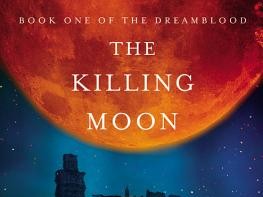
The Killing Moon — Read Report

Book | E-book | Audiobook — Bookshop/Libro affiliate links

The New York Times calls Jemisin “The most celebrated science fiction and fantasy writer of her generation.” She has repeatedly won every major sci-fi/fantasy award, and when she’s not winning, she’s usually nominated. In short, I’ve heard great things about Jemisin for a while now, but I’ve never read her work. The Killing Moon was published in 2012, so I’m a couple decades late to the party.

I’ve been listening to a lot of audio books lately, and I’ve taken it as an opportunity to fill in some of these major gaps in my genre knowledge. I knew nothing about this book going in, I just saw it on Libro.fm while searching for something new to listen to on my commute.

The Killing Moon takes place in an Egyptian-inspired secondary world, a desert land with a loose pantheon of gods shared across nations. The technology is in the neighborhood of bronze or iron age, with the swords, spears, and armor a fantasy reader would expect.

There is magic in this world, specifically dream magic—narcomancy—attributed to the power of the goddess Hananja. But this is not a world where the gods are close. If they do exist, they are distant and do not meddle.

The story follows master Ehiru and apprentice Nijiri, gatherers who use narcomancy to collect magical energy from souls and guide them to the afterlife. This magical killing, sanctioned by the state of Gujaareh, is usually a gift reserved for the willing but sometimes used as a form of capital punishment for those deemed corrupt.

The pair are assigned to chase down Sunandi, a foreign ambassador accused of corruption. But they soon discover themselves embroiled in a conspiracy that goes to the highest levels of their order, and to the prince of Gujaareh himself. It threatens to reveal long-buried secrets about the near-mythological founding of their country, the religious order surrounding Hananja, and the true nature of narcomancy.

Settings and Sentiment

About a third of the way into The Killing Moon, I found myself struggling. I wasn’t feeling that compulsion to continue that usually accompanies a fantastic book. With all of the hype around Jemisin, I was expecting to be blown away, and I found myself a little disappointed.

I have a hard time pointing to any particular issue. The writing is solid. The world is well-constructed. The plot is perhaps a little slow to get going. However, I was consuming this as an audiobook, and I’m coming to realize that is not a mode of reading that makes it easy to analyze a story in detail.

One thing I can point to is the setting. I am thoroughly burnt out on the “elves and dwarves in medieval Europe” school of fantasy, so I was hoping that the Egyptian-inspired world would prove interesting. However, aside from the names and the desert, I don’t think it made much of an impact. It’s still swords and sorcery. It’s still mighty kings and high priests and big battles and political machinations.

Jade City makes for an interesting comparison. It is also a fantasy book inspired by an underused geographical region, and another one that I read as an audiobook. Jade City imagines a world that is recently industrialized and recovering from war, akin to post-WWII Asia. It eschews the kings and kingdoms so common in fantasy, and imagines a complicated web of politics, religion, and family ties that feels more modern. It limits its scope to roughly two generations of recent history and the capital city of a small island nation. The result is a setting that feels fresh and richly detailed, and I believe that’s in large part because it’s not trying to cover a thousand years and an entire world, as so many fantasy stories do.

Another frustration I noticed is that practically every character in The Killing Moon is miserable all the time. Moments of levity or happiness are brief and far between. Everything is bad, and it’s getting worse. This is certainly an engine to drive the plot, but I found that it ground me down and made it tiring to be with these characters for an extended length of time.

There are a few twists near the end that piqued my interest and substantially improved my opinion of the book overall. I was also relieved to discover that the plot wraps up nicely, because I was expecting it to end with a cliffhanger. The Killing Moon is billed as the first book in the Dreamblood duology, but they apparently only share a setting and can be read as independent books.

(A side note, as I’m reading so much fantasy lately. I sometimes find it exhausting that the norm for this genre is huge tomes and multi-book series. If I’m trying an author to see if I like their work, I don’t want to commit to a 1500 page odyssey. Just one more way it feels like we’re still slavishly copying Tolkien. Where are all the high-quality standalone fantasy books?)

It’s Not You, It’s Me

I don’t like giving negative reviews. If I don’t like a book, I’ll often just not talk about it. I’d much rather discuss what makes good things work. I can’t help but feel that I’m heaping unnecessary negativity on The Killing Moon. I don’t think it’s a bad book. To the contrary, all of the components are here for a great book. It’s well written; it just didn’t resonate for me and I don’t entirely understand why. Maybe part of that was having my expectations calibrated by all the acclaim and awards I know Jemisin has accrued.

Oddly, this only makes me want to read another book by Jemisin. Is it this particular book that doesn’t work for me? Only one way to find out.

After some searching, I see that the Broken Earth trilogy seems to be the most recommended. It made history by winning the Hugo three years in a row, for all three books in the series. Plus, it apparently uses second person POV extensively, and that’s certainly an ambitious choice. I’ll try that next.

Reference Desk #14 — MasterClass

MasterClass is an online learning platform. They split their courses into about ten different high-level topics, and one of these topics is writing. If you’ve been on the internet at all in the last couple years, chances are pretty good that you’ve seen a few ads for MasterClass. I’ve certainly been seeing these ads for ages, and while they sometimes caught my interest, I always balked at the price. However, I also noticed that the roster of instructors they were advertising was getting more impressive over time.

As you’ve probably guessed by the title of this post, they finally got me. I decided to subscribe and see whether it’s worth the money or not.

Big Names and High Production Values

MasterClass wears its business strategy on its sleeve. They get extremely well-known celebrities in a given field to make a series of instructional videos, and then they charge an all-access subscription fee for the platform. All of their marketing banks on these big names drawing people in. Of course, it’s perfectly fair to note that these celebrity creators may be great at what they do, without actually being very good teachers. On the other hand, this is a risk you run with almost any class. At least if you’re familiar with what they’ve made, you have some idea whether you’ll appreciate what they can do.

In the “Writing” category, MasterClass currently has twenty courses. The instructors span a broad range of genres and formats, including fantasy and sci-fi (Neil Gaiman, N. K. Jemisin); kid lit and YA (R. L. Stine, Judy Blume); thrillers (James Patterson and Dan Brown); screenwriting and TV (Aaron Sorkin); and nonfiction (Malcom Gladwell).

Along with the high-profile instructors, MasterClass really leans into the production values. Each instructor appears to have one or two custom-built sets that they teach from, to set the mood. The sections of each class are split up with little musical interludes and graphics or video snippets that lead into the title card. The overall effect is something like a well-produced documentary.

If your main goal is to mainline great writing advice directly into your brain as quickly as possible, you may not care about these little flourishes. Personally, I found it immensely soothing to get to sit in a cozy little private study, shelves packed with books, while grandpa Gaiman gave me advice about writing.

My Experience So Far

At the time of writing, I’ve watched the Neil Gaiman course, and I’m about halfway through the N. K. Jemisin course. My experience is based on that. Other courses maybe structured differently.

What I’ve found thus far is that these courses are very conversational. They’re a bit like getting to have an extended talk with a great author. They are not focused on exercises or activities. As far as I can recall, Gaiman suggested only one or two exercises throughout his series. Jemisin suggested several in a section on world-building, but these pretty quickly fell off in favor of general advice. If you’re looking for very hands-on, workshoppy courses, you may find the videos to be less interactive than you’d like.

However, alongside the video instruction, each course also includes a downloadable workbook. From what I’ve seen so far, these workbooks aren’t really referenced in the videos at all. In fact, it was only as I was digging around the website to write this post that I found them. The workbooks are supplementary material that follows what was talked about in the videos, and may be better for those that want a workshop feel. Now that I know the workbooks exist, I’m inclined to go through them as I watch the videos. You could just as easily watch the videos first, then dig into the workbooks.

The length of the video series vary from course to course, but a typical length seems to be 2-5 hours. For example, Jemisin’s course is a little under four hours, and Gaiman’s course clocks in just under five hours.

In addition to the web app, MasterClass provides mobile apps. I’ve spent more time watching (or listening) to the videos on my phone than I have while sitting at the computer. The app does its job well enough, although I find it a little annoying that it always seems eager to show me new videos, when I usually want to go to my bookmarked list or pick up where I left off on my current course.

The Downsides

The biggest hurdle for some people is going to be the price. I realize that it’s a privilege these days to have a comfortable, steady income. MasterClass advertises $15 per month, but that’s a little misleading, as they only have annual subscription plans. The most basic plan will make the most sense for most people, at $180 per year. There are more expensive plans, but the only additional features you get are offline viewing on mobile, and the ability to watch on more than one device simultaneously. These don’t strike me as worth the additional money unless you’re looking for some kind of corporate team subscription.

The other thing that may turn people off the platform is the amount of content. Although MasterClass has a lot of big, recognizable names, they do not have a broad selection. Other platforms, like Udemy, boast tens or hundreds of thousands of courses while providing far less curation — pretty much anyone can create a course, and user have to rely on user ratings to sort the good from the garbage. Those platforms necessarily use a pay-per-course purchase system.

If you’re only interested in a single genre or format of writing, you will probably only have a couple of classes on MasterClass that match your interests. The all-access subscription is an inherently better deal if you’re paying that price for ten or twenty classes that you’re interested in. If you’re only interested in one or two classes, that subscription fee starts to seem significantly worse.

Is It Worth It?

This is a question that you’re going to have to answer for yourself by browsing the site (and depending on your finances, possibly checking your bank account). Look at the instructors and see how many classes interest you. Look into the other categories and see if there’s anything good there. The big advantage of the Netflix-style subscription is that you can watch as much as you want for the same flat rate.

Personally, I’m excited to watch the courses that pertain to sci-fi, fantasy and suspense. After that, I plan to branch out into other genres and styles. While I may not be writing a screenplay any time soon, I’m interested in hearing what an expert like Aaron Sorkin has to say about the topic.

So far, I’m pretty happy with the courses I’ve watched. Having tried some other learning sites through my day job, MasterClass has some nice quality-of-life features and general polish that is lacking on other platforms. However, if you don’t care much about aesthetics, you might be miffed that some percentage of your fee goes toward these shiny bits instead of more content.

At the very least, I think it was worth the initial fee to try the platform for a year. The real test will be when my subscription comes due. I may post a little follow-up at that time, when I decide whether to keep it going.