The Read Report — July 2024

Since I took a month away from blogging in June (and I was so busy that I only read one book), this will include my June reading as well.

Where possible, I’ve included Bookshop affiliate links instead of Amazon. If any of these books pique your interest, please use those links. I’ll get a small commission, and you’ll support real book stores instead of a fifth vacation house for a billionaire.

Going Postal

By Terry Pratchett

This is my favorite Discworld book, and Pratchett is at the top of his game. There are a couple of additional books that came after this, but sadly he was likely fighting dementia at that point, and I think later books like Unseen Academicals suffered for it.

Moist von Lipwig is a confidence man who starts the book by getting hanged. He’s given a reprieve by Vetinari, ruler of the city, and given the job of postmaster. The Ankh-Morpork post office is a dilapidated disaster, but he’s aided by Mr. Pump, a golem bodyguard/probation officer, the elderly “junior” postman Groat (who attributes his health to horrifying homemade herbal remedies), and the young postman apprentice Stanley, a boy who isn’t quite all there and has an abiding obsession with collecting pins.

Moist spends the first half of the story looking for ways out of his forced government service. However, he’s a showman at heart, and he soon discovers that his brand of hype and hyperbole is well-suited to getting people excited about sending mail. Unfortunately, the post has largely been replaced by Clacks—a network of semaphore towers that act as a fantasy telegraph system.

The Clacks were built by high-minded engineers, but the original owners have all been ousted or murdered by clever corporate raiders, who are doing their best to extract as much value as possible while running the whole company into the ground. By delivering the mail once again, Moist finds himself in their crosshairs, and it doesn’t help that he’s falling in love with Adora Bell Dearheart, the disaffected, chain-smoking daughter of the Clacks’ dead founder.

Pratchett is a fantastic comedy writer, but he doesn’t get praised enough for his intricate plots or his characters that make you care, even if they’re all rather silly. This book is filled to the brim with all of that. If you’re only going to read one Discworld book, it should be Going Postal.

Poison for Breakfast

By Lemony Snicket

This was a re-read with my children. It is still one of my favorite books, and you can read my review from a couple years ago.

Ender’s Game

By Orson Scott Card

Another re-read with my kids. This was a formative sci-fi book for me when I was young, and it holds up fairly well.

This is one of those books with some content that some adults probably wouldn’t want their kids reading, like children murdering other children. And yet, my children really enjoyed it, and didn’t seem especially traumatized. I guess we’ll see how they turn out.

I appreciate that Ender’s Game is populated by many characters who do terrible things, but the narrative is not judgmental. As a reader, you’re free to form your own opinions about whether each character’s actions are justified or reasonable, without feeling like the book is trying to steer you to a particular conclusion.

It’s a book about growing up, and war, and the terrible things people do to one another, often for reasons that seem justifiable or even absolutely necessary at the time. It is also about the way that history often judges those actions in its own context, ignoring those justifications.

Go: A Complete Introduction to the Game

By Cho Chikun
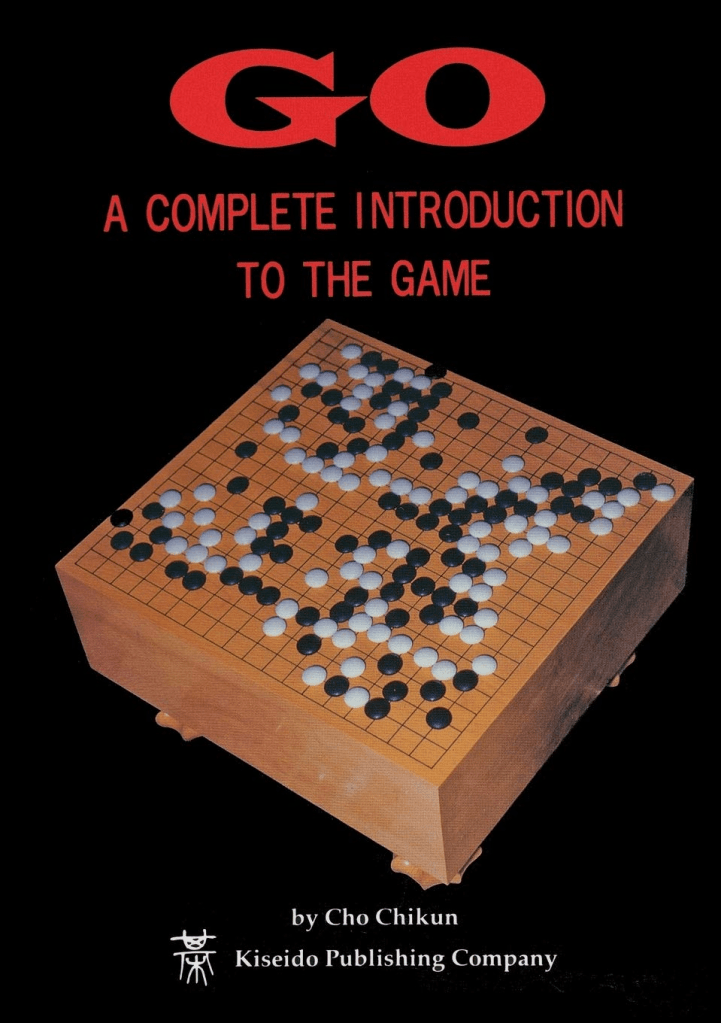
As I was getting back into Go, I re-read this excellent beginner’s guide in the SmartGo app. Cho Chikun is one of the most famous professional players in modern times, and the Japanese player with the most titles.

This book deftly introduces all the important aspects of Go rules and basic strategy, while alternating chapters about the history and cultural significance of Go. It’s a perfect introduction to the game (or re-introduction, in my case).

Double Digit Kyu Games

By Neil Moffatt

Another book from my SmartGo library.

In amateur Go, players start at a rank of 30 kyu. As they improve, their rank decreases down to 1 kyu, then to 1 dan, and up to 7 dan. As you might expect, players with double digit kyu ranks are beginners and casual players.

While most books about Go are written by pro players for obvious reasons, Moffatt wrote this as a moderately high (1 kyu-ish) amateur. He’s close enough to still remember and understand why the players of these games make the mistakes they do.

Moffatt also goes into more detail than usual in explaining the merits and disadvantages of each move, often exploring various alternatives. They result is a set of thorough game deconstructions that are very useful aids for an amateur player to recognize their own shortcomings.

Lore Olympus, Vol. 1

By Rachel Smythe

I bought this on a whim while on vacation, mostly on the authority of a positive blurb by Kieran Gillian (of Die and other comics), and a brief skimming of the art. Unfortunately, this book was not for me.

I don’t read a lot of romance, but I’m not strictly opposed to the genre. This, however, was just too much irritating teenage angst and not enough mythology for my tastes. When the romance hinges on everybody being afraid to voice how they feel, and the conflict stems from people hating each other for basically no reason, I get bored.

As far as the art goes, the character work is nice, but these characters live in a world composed of colored smears. This lack of any background detail is something that seems to be more and more common in indie comics, and while I understand it, I do miss the crispness that you see more in high budget superhero comics.

Hellblazer: The Red Right Hand

By Denise Mina and Mike Carey

Illustrated by Leonardo Manco, Cristiano Cucina, John Paul Leon
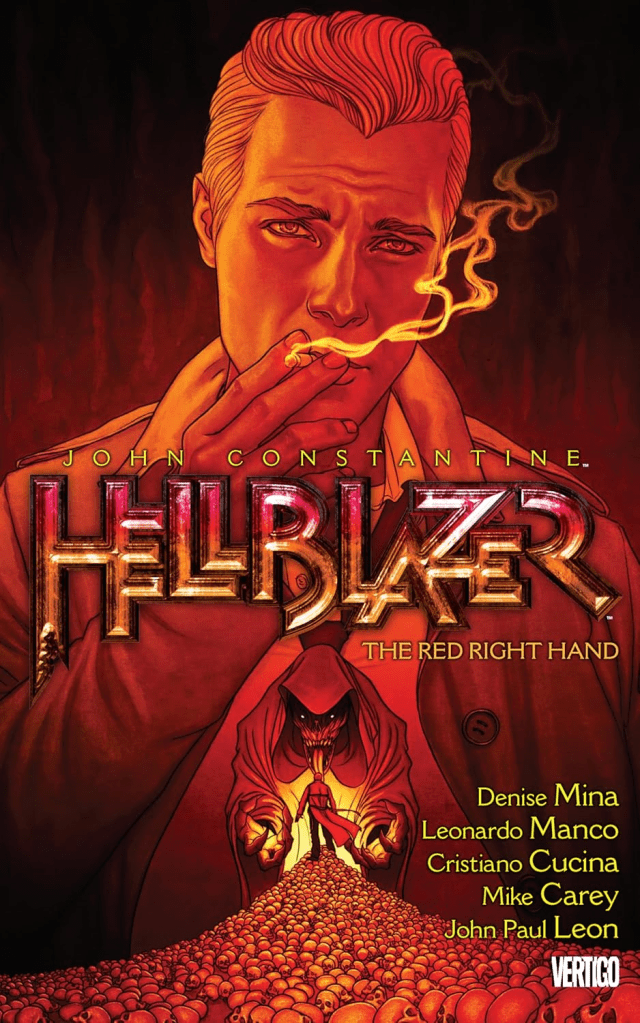
I do love me some John Constantine, but this collection wasn’t my favorite. There are two story arcs here: one where Constantine enters into a trap, and one where he gets out of it.

The typical Constantine story usually has a mystery twist, and this is no exception. Unfortunately, the twist didn’t shock me, it just made me shrug. Maybe if I were reading the series in sequence I would be better prepped as a reader.

It’s also not uncommon for Constantine to have some plan that only gets revealed when everything seems hopeless. Here, he doesn’t have much of a plan at all.

A collection of Constantine’s friends show up midway through, and it feels like deus ex machina, but even they don’t actually do very much. They muddle through, and the eventual resolution to the situation hardly feels like any of the characters had agency.

The last issue in this volume is a stand-alone one-off story, and it’s a classic, solid Hellblazer story. It made me a little sad that the rest of the book didn’t hold up as well.

Writing Advice from Lemony Snicket

I recently reviewed a book by Lemony Snicket called Poison for Breakfast. It’s a delightful little book that has much to do with writing and stories, and as such, Snicket manages to sneak in a little helpful writing advice for authors.

Here are Lemony Snicket’s three rules for writing a book:

It is said that there are three rules for writing a book. The first rule is to regularly add the element of surprise, and I have never found this to be a difficult rule to follow, because life has so many surprises that the only real surprise in life is when nothing surprising happens.

The second rule is to leave out certain things in the story. This rule is trickier to learn than the first, because while life is full of surprises, you can’t leave any part of life out. Everything that happens to you happens to you. Often boring, sometimes exhausting, and occasionally thrilling, every moment of life is unskippable. In a book, however, you can skip past any part you do not like, which is why all decent authors try not to have any of these parts in the books they write. But few authors manage it. Nearly every book has at least one part that sits on the page like a wet sock on the ground, with the reader stopping to look at it thinking What is this doing here?

Nobody knows what the third rule is.

And as a bonus, advice for writing a good sentence:

Almost always, shortening a sentence improves it. A nice short sentence feels like something has been left out, which helps give it the element of surprise.

Genuinely helpful writing advice, or confusing nonsense from a silly book about bewilderment? I’ll leave it for you to decide.

Lemony Snicket Proves I Can Love Literary Fiction

This is a review — a word which here means, “an excuse to write about a book that I like” — for the book, Poison for Breakfast. This book was written by Daniel Handler, who sometimes calls himself Lemony Snicket when he’s writing books. He mostly uses straightforward language, and when he doesn’t, he likes to define the words he’s using, as I just did, above.

Poison for Breakfast is a book that takes its time getting where it’s going, but it does get there. So I’m going to take my time getting where I’m going in this review. I’ll start by talking about music and books.

How I’ve Felt About Music

I first recall really paying attention to music, beginning to realize that I might have opinions about music, in middle school. Those opinions were mainly whether I liked a particular song or not. For some music lovers, there is a particular genre they fall in love with, and it becomes a lifelong passion. I had no conception of genre, at first. That came sometime later.

When I did develop opinions about genre, they were mostly vague and negative ones, influenced, if not outright parroting, my parents’ tastes. I recall “hating” techno, rap, and country music, or at least saying that I did.

As I grew into an adult, I made it a point of pride to seek out opinions and ideas that challenge or conflict with my own beliefs, whether that be in politics, religion, or music. I’ve been an adult for many years now (a shocking number, when I stop to think about it), and I’ve sought to listen to a wide variety of music. Luckily, we live in a world where there are still a few independent radio stations and innumerable streaming services, not to mention Bandcamp, YouTube, and all the other places where artists can make their work available to the world without much interference.

I’ve learned that there is no genre of music I truly dislike. The trick is to find a single song that I can appreciate. From there, I always find more. Rather than genres that I “hate,” it turns out I just have genres where I’m pickier.

A Little Cognitive Dissonance

From a very young age, I’ve been attracted to genre fiction. I loved books about aliens when I was a child. Around the time I was discovering opinions about music, my mother’s co-worker introduced me to The Lord of the Rings, and from there I was thoroughly hooked on fantasy as well as sci-fi.

As I grew and my tastes in music expanded, so did my tastes in literature. Once again, all it takes is finding one book to serve as a gateway into a new genre. While I once may have eschewed non-fiction or romance, I’ve discovered a love of all sorts of non-fiction in recent years, and a few romances too (even if they do have a sci-fi bent).

I just talked about how I like to keep an open mind and expand my interests. It might seem absurd then, that I would shy away from any genre of literature. But the absurdity of it doesn’t make it any less true.

Literary fiction, which oddly has become as much a closed-off genre as sci-fi or fantasy, has long left a bitter taste in my mouth. Since this is a label more controversial than most genre labels, I’ll provide my own controversial definition: “fiction that is more interested in playing with words than in telling a compelling story.” This is a definition that encompasses quite a lot of “traditional” Lit-Fic, while also allowing something like Vandermeer’s Dead Astronauts, which many people might exclude, to perhaps straddle the border.

I might trace my early dislikes in music to my parents tastes, but I have a harder time tracing my literary dislikes. I’m sure it didn’t help that school foisted onto me some of these lit-fic “masterpieces,” like Catcher in the Rye or The Great Gatsby, without adequate context and certainly before I was mature enough to appreciate much about them. I have gone back to a few of these books in recent years, and discovered that they at least have something to offer, even if I didn’t fall in love with all of them.

Literary Fiction

Writing a review of a book that barely mentions the book itself is considered bad form by many people. With this in mind, and having now taken a leisurely drive around the metaphorical block, let’s return to where we started this somewhat strained music/literature metaphor.

This is one of those books that, by my own definition, qualifies as literary fiction. And I enjoyed it quite a lot. Not only that, but what I enjoyed most was the words, rather than the story. I enjoyed it because it was literary fiction.

One could argue (with good supporting evidence) that this book does have a plot. It begins with Snicket, the narrator, who is told by anonymous note that he has eaten poison for breakfast. He spends the rest of the book trying to solve this mystery, though his methods mostly involve meandering around town and becoming lost in thought. It’s a tiny plot, but also a tiny book. This little bit of story is just enough to let the book focus on what it really wants to do, which is play with words.

Poison for Breakfast is so full of delightful sentences that I started marking the bits I liked with little scraps of paper. By the time I finished, there was a nice, thick ruffle of scraps sticking out. The book is full of anecdotes and asides that seem like non sequiturs until you read a bit further and find that they’re referenced again and again; linguistic winks and nods, like inside jokes with the reader. It wraps back around on itself. It pulls disparate threads together and twists them into delightful and surprising shapes.

There are motifs, like sets of rules that turn out to really only be one rule from a certain point of view, or that a good story must be bewildering, or the contents of the narrator’s breakfast, left-justified like poetry with each individual food on its own line:

Tea

with honey,

a piece of toast

with cheese,

one sliced pear,

and one egg perfectly prepared

And there is death. This is a book that mentions brutal prison camps; and death by starvation, and old age, and of course, poison.

Winks and Nods

A book about being poisoned might not sound like a child-friendly book. And perhaps it isn’t. Like Snicket’s other books, this is a book that observes the world with a child-like wonder, and discusses it with mostly simple and straightforward language. It’s a book that seems to understand a child’s perspective. It is more of a child-understanding book. It feels like the sort of conversation you might have been lucky enough to have as a child, with an adult who spoke seriously and honestly, and didn’t sugar-coat the truth or dumb-down the complicated. An adult who understood how to speak with children as equals.

By virtue of being both author and narrator, Snicket places himself where he can freely talk about his love of language and literature, and the books, poems, songs, and ideas he likes, while also illustrating that joy in his own words.

The second-to-last chapter takes all the little callbacks, the little winks and nods, and ties them all together in a neat little bundle. It’s the big reveal at the end of the magic show. And in the final chapter, Snicket sets to work writing the story you are in the midst of reading, making the whole thing feel like the cycle of chicken and egg (which is itself another repeated motif from earlier in the book).

Poison or Antidote?

Poison for Breakfast reminded me that I can love literary fiction, even if it’s not the first section I visit in the book store. As an added bonus, this is a book ostensibly for children, so I will get to enjoy it a second time when I read it to mine. With any luck, they won’t spend years thinking that they dislike whole categories of things when they are, in fact, just a little bit picky.