The Read Report — April 2024

Here in Minnesota, April showers have brought May…showers. It’s been rainy, drizzly, or just generally damp. Everything is slowly greening up, and Spring is going to sproing the moment the sun comes out.

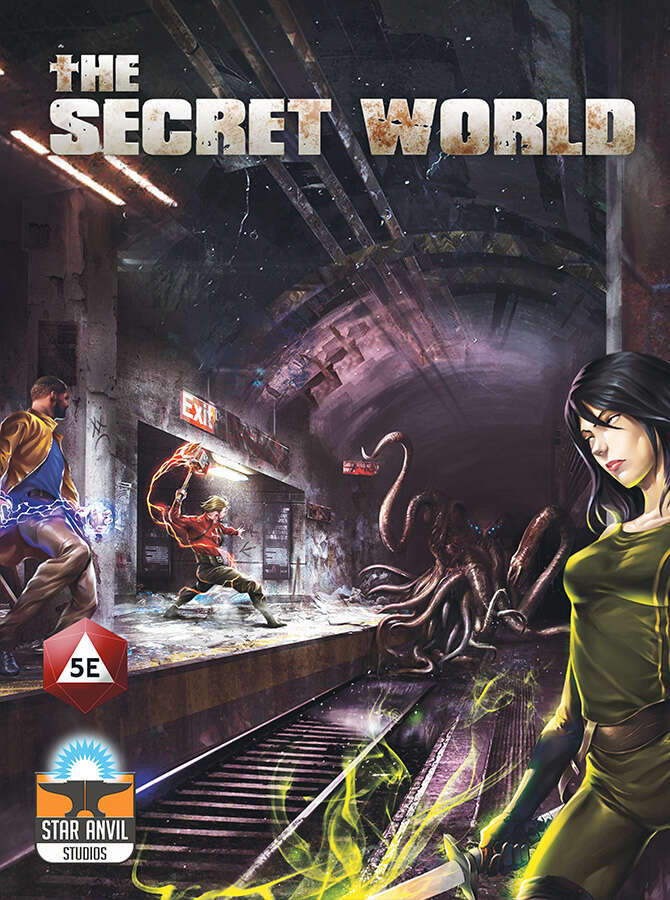
This past month, I finished my read-through of the main series League of Extraordinary Gentlemen comics, I got back into Terry Pratchett’s Discworld books with my kids, and I finally received my Kickstarter-backed edition of The Secret World TTRPG.

Where possible, I’ve included Bookshop affiliate links instead of Amazon. If any of these books pique your interest, please use those links. I’ll get a small commission, and you’ll support real book stores instead of mega-yachts for billionaires.

League of Extraordinary Gentlemen, Volume 3: Century

Written by Alan Moore, Illustrated by Kevin O’Neill

After the first two volumes of League, I was a little disappointed in The Black Dossier, which was more backstory than story. I was curious to see where Volume 3 would take us. As it turns out, it’s both forward and backward in time.

As the subtitle suggests, the book covers a full one hundred years of the League.  The main storyline of Black Dossier took place in the 1950s, but the story of Volume 3 begins just before the coronation of King George V, which is mid-1911, assuming the date in the alternate timeline of League lines up with real world history. This version of the League sees Mina Harker and Allan Quatermain joined by the immortal Orlando; occultist Thomas Carnacki; and gentleman thief A. J. Raffles.

The mystery that these characters seek to unravel throughout the book is the work of a cult founded by Oliver Haddo, who turns out to be a body-hopping mystic intent on creating the antichrist. The more immortal members of the League, Mina, Quatermain, and Orlando, investigate the cult over the course of the century. Their failure to stop the cult is matched by the cult’s own failure to create a proper apocalyptic monster.

This century sees the League eventually crumble, Mina falling into a drug-and-mysticism-induced fugue, Quatermain reviving his abusive relationship with Heroin, and Orlando getting lost in the violence of war.

It isn’t until 2009 that the League’s long-time mystical benefactor, Duke Prospero, contacts a reformed Orlando, who springs Mina from a mental institution. They join up with Allan just in time to confront the Harry Potter-esque magical antichrist, who is put down by an entirely appropriate modern myth who I’ll refrain from naming, lest I spoil the fun.

This third (technically fourth) volume once again shows the League as mostly ineffective. They are still involved in the big movements of the world, but none of their meddling does much good.

With the move away from steampunk Victorian England, some more recent pop-culture references inject fresh fun into the series, although I couldn’t help noting that twisted versions of Harry Potter have already been done elsewhere, and in my opinion, more effectively.

League of Extraordinary Gentlemen, Volume 4: The Tempest

Written by Alan Moore, Illustrated by Kevin O’Neill

In this final volume of the main-line League books, Mina Harker, Orlando, and the freshly recruited Emma Night (a.k.a. M) are all that remains of the League in alt-history 2010.

In some ways, Volume 4 has learned lessons from the weak points of the previous books. The authors are playing with formats again, bringing back the 3D glasses sections and including parts reminiscent of classic superhero comics. These format-shifts add variety without being as gimmicky as Black Dossier.

The story alternates between three time periods. The 1970s sections follow superhero squad The Seven Stars, organized by Mina while disguised as Vull the Invisible. In 2010, the time travelers seek Vull and any remaining superheroes. In the 30th century, an apocalypse has occurred and a desperate few freedom fighters engineer a trip back in time to prevent the catastrophe.

The true history behind the League and the reason for its existence are finally revealed to be part of a vast conspiracy that also encompasses British Military Intelligence (with a host of oblique James Bond references) and Shakespearean-era faery politics.

While League has never shied away from killing off major characters, Volume 4 is perfectly happy to burn all the bridges. While a few characters manage to escape disaster and even find some semblance of happiness, the entire setting burns down around them, with time travelers making it clear that the cataclysm won’t be cleaned up for hundreds of years.

League of Extraordinary Gentlemen is a series built on literary references, and it has finally run the full gamut of time periods. This feels like a suitable ending. (At least until the thirtieth century, when I fully expect Alan Moore’s frozen head to be revived for Volume 5.)

Feet of Clay

By Terry Pratchett

I finally finished reading the Harry Potter series with my children last month. After that, I decided we ought to jump into some lighter fantasy, returning to the nearly inexhaustible Discworld series.

Pratchett has crafted a fantastic setting and populated it with a gigantic cast of interesting characters, but each book tends to follow particular groups. Feet of Clay follows Sam Vimes and his city watch in Ankh Morpork. The city’s patrician, Lord Vetinari, is being slowly poisoned, and it’s up to the Watch to figure out whodunnit.

The mystery provides the structure of the story, but the joy of any Discworld book is in the wonderful craft and comedy that Pratchett puts into almost every sentence, and the interactions between the characters. I think the craft of comedy writers tends to be underappreciated, but Pratchett at his best is as good as anyone out there.

The Secret World – 5e TTRPG

By Star Anvil Studios

The Secret World began life as a 2012 MMORPG. Sadly, 2012 was one of the last few years when game developers still believed that the market for MMOs was infinite, and that it might somehow be possible for someone…anyone…to dethrone the longtime king of the genre, World of Warcraft.

While Secret World did a bunch of interesting, innovative things, it was really the modern, urban, “every conspiracy theory is true” setting, slow-burn mysteries, and brilliant writing that set it apart. Unfortunately, that wasn’t enough to overcome its clunky gameplay. The game stumbled along for several years, eventually spawning an updated, free to play re-launch and a few smaller games in the same universe.

I won’t lie. When I heard about a table-top RPG based on the IP, I was excited. The setting and story were always the best part of the Secret World, so a TTRPG made perfect sense to me.

The rules are based on 5th Edition Dungeons and Dragons, lightly adapted to a more modern, more urban setting and the Secret World character system. At this point, 5e D&D is probably both the most popular and most disliked TTRPG system out there. Because it’s so ubiquitous, and many people directly equate role playing games with D&D, it’s the obvious choice when adapting an IP that most people have never heard of. No point in limiting your audience.

Unfortunately, 5e has its downsides, and I suspect that the Secret World has once again paired its fun settings and stories with clunky gameplay systems. The book’s creators, Star Anvil Studios, might realize this, because as soon as they finished this edition, they announced a new Kickstarter to bring the Secret World setting to the Savage Worlds rule set. Or maybe it’s just a way to cash in in the IP by writing a new book that is 70% the same as the old book.

The 5e core book defines nine classes that will be familiar to anyone who has played Secret World Legends. Everyone is a spellcaster to some degree, but two of the classes are all about the spells. There is no true multi-classing, but there are Secret Architypes, which are like mini-classes that characters can collect as they level. Only one can be active at a time, but they can be swapped with a short rest. It feels like a fun way to scale characters horizontally, but I wonder if high-level characters will feel too much like a jumble of abilities.

The biggest draw, to me, is the setting, and the book wisely dedicates about 60% of its pages to the world, with descriptions of a large number of NPCs, the factions, and a good amount of the history and lore from the games. Sadly, there are limits to how much can fit in a single core book like this. The game will still likely be much more fun in the hands of a game master who knows their way around the Secret World setting.

There was a single premade adventure released as a part of the Kickstarter materials. I would love it if Star Anvil was able to craft a couple more, although I won’t be holding my breath.

What I’m Reading in May

I’m still reading The Witcher. For my short story fix, I’m thinking I’ll tackle a sci-fi novella collection from the 80s. And I’ve got a book of writing advice that has been calling my name for a while. See you in May!

The Read/Write Report – January 2023

It has been a while since I did one of these posts, but the new year seems like a great time to jump back into it. Here’s what I’ve been up to lately.

Vacation

At the end of 2022, I took what is probably the longest vacation I’ve taken in the past 15 years—three whole weeks. The last two weeks of the year were “stay-cation” around the house, and in the first week of 2023 my family escaped the snow and cold of Minnesota and went down to Florida.

I stayed fairly busy during my time at home, and we did quite a bit of sightseeing and beach time while in Florida, but I was able to do about twice as much writing as I typically do. Most of this went into Razor Mountain, but I couldn’t entirely resist poking at side projects and some potential future blog stuff. But I’ll talk about those things another day (maybe).

New Year’s Resolutions

I generally don’t put much stock in New Year’s resolutions, but I’m trying one this year. I’m not a person who tends to collect many possessions, with a couple notable exceptions. Firstly, as you might expect from a writer, I tend to collect a lot of books. I have a couple shelves full of physical volumes I haven’t yet read, and a handful of e-books on the Kindle.

I’m also a sucker for video games and, to a lesser extent, board games. There are a lot of inexpensive video games these days, especially with various services competing to offer the best sales. So I wish-list a lot of games and buy them when they’re cheap.

My not-too-serious resolution for the year is to not buy any new books or games, and try to work through the backlog that I already own. We’ll see how that goes.

Recent Reading

As usual, I have ongoing bedtime reading with my kids. We finished Startide Rising and moved on to The Uplift War, the last book in David Brin’s first “uplift trilogy.” It has been interesting, because these were formative books that I read in my teenage years, but I actually remember very little about them. I’m certainly seeing things that I missed when I was young.

On my own, I’ve started a slim little volume called Invisible Cities, by Italo Calvino. The book is framed as conversations between Marco Polo and Kublai Khan, where Polo describes the many cities that he’s visited in his travels.

I’ve been sitting on an idea for a fictional city for years, but I’ve never quite figured out whether it fits into a novel, a TTRPG, or something else. Invisible Cities is one of the pieces of fiction that I’m investigating to find some inspiration with my own fictional city.

Waiting for the Secret World

In November, a Kickstarter project popped up on my radar: The Secret World TTRPG.

The Secret World was originally an MMORPG released in 2012, back when people still believed that a new game would someday overthrow World of Warcraft. It was moderately successful on launch, but it was a little clunky, didn’t get a lot of updates, and slowly lost players over time. In 2017 it was relaunched with some new systems as the free-to-play Secret World Legends. That iteration was equally unsuccessful, and it eventually went into maintenance mode while the developers moved on to other projects in order to keep paying the rent.

Secret World, in both its iterations, was a very strange MMORPG. While the gameplay itself never really shined, it had a fantastic story, amazing settings, great voice acting, and some interesting puzzle design that was often a bit like an ARG. It’s a little cosmic horror, a little X-Files, with some Jules Verne and The Matrix thrown in for good measure. It still has a cult following, and those that love it stick around because of the story.

A TTRPG seems like a perfect fit for this kind of rich, expansive setting, so I’m excited to see what Star Anvil come up with. A few people have voiced concerns that it will be using the Dungeons and Dragons 5E rules, which may not be a perfect fit for this style of game. However, that’s the most popular TTRPG around, so I can’t really fault a small indie studio with a relatively unknown property for hedging their bets.

The current goal for releasing the book is October 2023, and over-funded Kickstarter projects aren’t exactly known for meeting their deadlines. , the project got me itching for some science-fiction or science-fantasy TTRPGs. To scratch that itch, I dug into two other games: Shadowrun 6e, and Cyberpunk Red.

Shadowrun

I’ll be honest. Shadowrun 6e seems like a mess. Both gameplay and setting feel like they took the “kitchen sink” approach, with a lot of different fantasy ideas and sci-fi ideas all fighting for attention, while nothing really stood out to me. Some of the ideas, like big dice pools, seem fun. But, having never played Shadowrun, I felt like the core book really didn’t give me a good feel of what it would be like to play, and I didn’t get enough of the setting to feel comfortable running a game. I think any core rule book should have snippets of gameplay or an example adventure, and this had neither.

I was a little leery of spending any more money on the game, so I tried looking in the…somewhat legally gray areas of the internet…for campaign books. The 6e adventure books I found were still frustratingly vague about actual gameplay, and seemed to largely eschew the mission-based play described in the core book.

By the time I got through the book I was fairly irritated, and I went down the rabbit hole of reddit posts and forums. As far as I can tell, Shadowrun players spend about half of their time debating which version of Shadowrun to use, or which bits to cannibalize from all the different versions. 6e doesn’t seem to be popular. And I started regretting purchasing the book at all.

Cyberpunk Red

To soothe myself, I moved on to another venerable franchise, one that recently had a very over-hyped video game made in its image: Cyberpunk. The latest iteration of Cyberpunk is called Cyberpunk Red. It is also quite recent, and interestingly, it seems to have been made alongside the development of the video game.

One of the challenges of the game’s namesake genre is that it was popularized in the 80s, and in some ways it has become retro-futurism. Cyberpunk Red takes an interesting approach to modernization. Rather than rewrite history, Red moves it forward. In the “Time of the Red,” decades have passed since previous Cyberpunk games (and their outdated references). The world has changed. It’s still an alternate-history version of our world where technology advanced faster than it did for us, but letting a few decades pass allowed the creators to change the setting so that it feels like it’s exploring and expanding upon today’s problems, not the ones that were relevant thirty or forty years ago. It’s an elegant solution.

It may not be fair to compare Cyberpunk Red to Shadowrun, but I read them back to back, so I’m going to do it anyway. Cyberpunk Red pretty much addresses all of the things that irritated me about Shadowrun. Where Shadowrun is all over the place with fantasy and sci-fi tropes, Cyberpunk Red is laser-focused on its cyberpunk setting. There are lots of character options: you can play as a rock star, mid-level executive, or freelance journalist, as well as the soldier and hacker types you’d expect from the setting. You can outfit yourself with all sorts of cybernetic hardware. But everything fits nicely in the setting. Everything seems to make sense.

The book includes a thousand-foot view of world history and geopolitics, but it focuses on a single city. This overall focus makes it feel like Cyberpunk Red can dig a lot deeper into the details of the setting. Even better, it includes a meaty section on how to run the game, some fiction to get a feel for the setting. It doesn’t include an example adventure, but there are a couple small free ones easily found online.

Back to the Grind

With my long vacation at an end, I’m back to work, kids are back at school, and we’re getting comfortable with our routines again.

My main writing project remains Razor Mountain, and I look forward to finishing it in 2023. After that, I’m going to have to think about what to do with this blog—I’ve been working on that book in some form for almost the entire life of Words Deferred. It’ll be an exciting new adventure!

For now, I still have a ways to go, and I’m back in my normal writing routine. Look for a new chapter next week.