
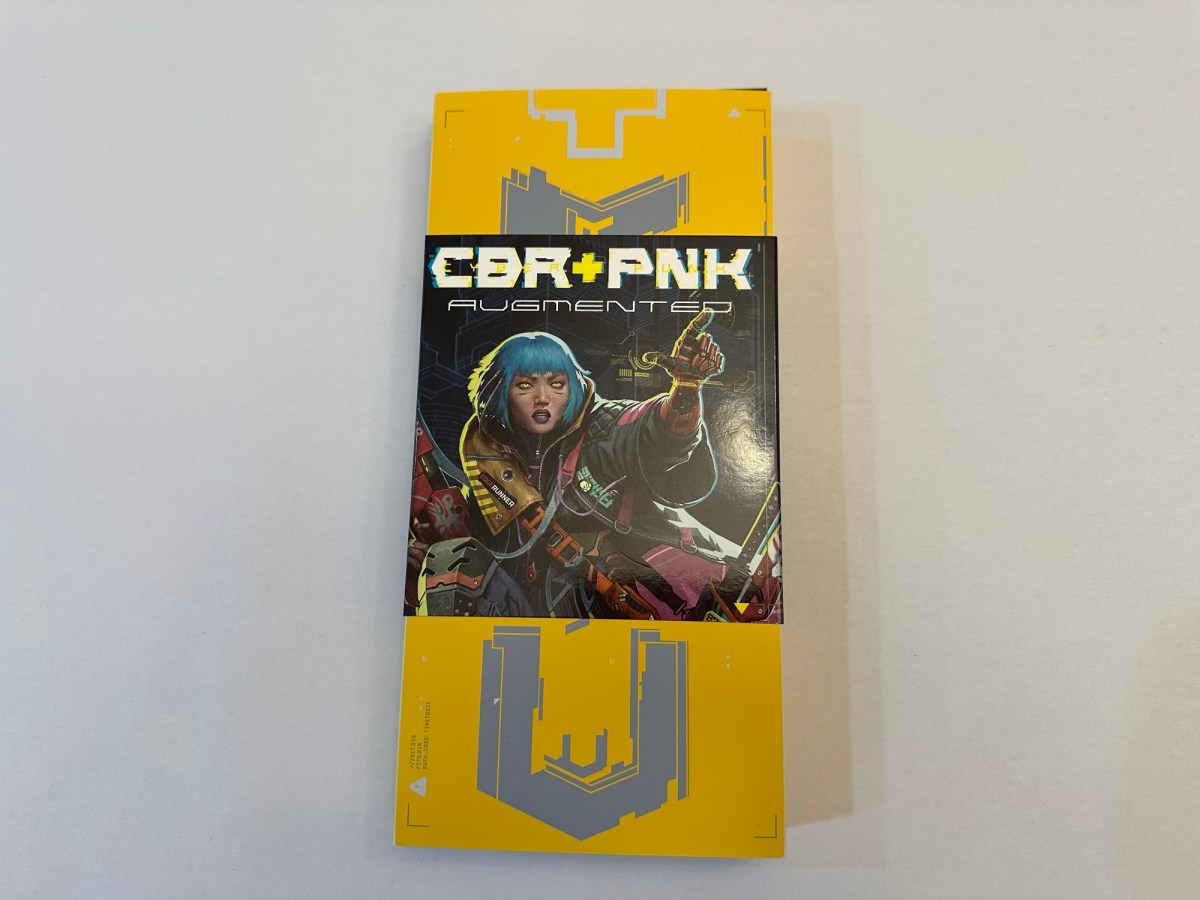
I received CBR+PNK (“cyber plus punk”) as a holiday gift, and while I haven’t had a chance to play it yet, half the fun of TTRPGs is in leafing through the materials, enjoying the art, and trying to figure out how the rules fit together and how it will actually play.
CBR+PNK bills itself as “Cyberpunk one-shots forged in the dark.” It gets its story DNA from its namesake, Cyberpunk, the gritty dystopic future setting that has recently found fresh life in the popular Cyberpunk 2077 video game and Cyberpunk RED core rules update. However, its rules are based on a stripped-down version of Blades in the Dark, a fiction-first, fast and simple ruleset with a core mechanic of rolling d6 pools.
The Package
CBR+PNK is clearly broadcasting its goal of being a light, low-prep, pick-up-and-go game. The form factor is less than half the bulk of a typical core rule book; a slick little fold-out box filled with laminated pamphlets, all held together by a sturdy sleeve.
The lamination means these should stand up well to the typical abuses of game nights, including spilled drinks. It also allows players and GM to mark up their pamphlets with whiteboard markers and reuse them across sessions.
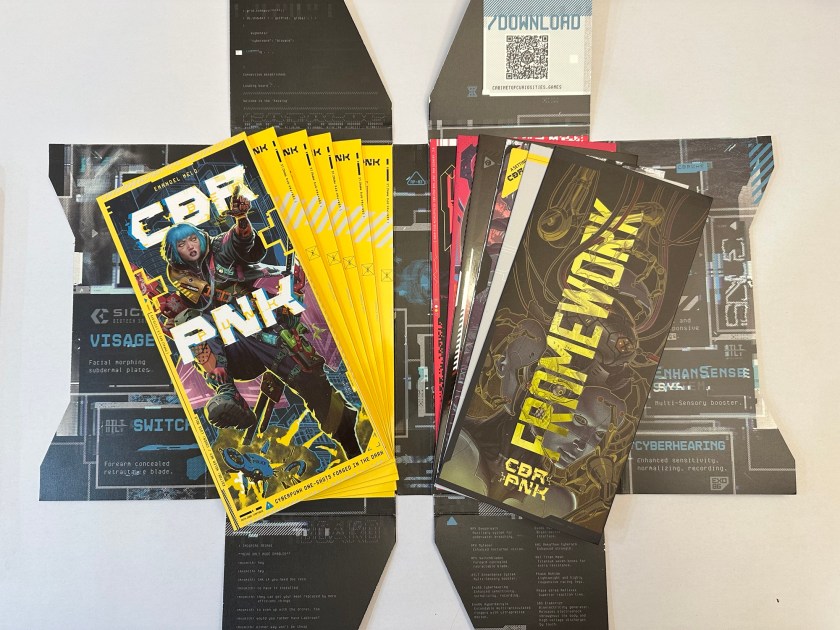
The left fold of the packet contains includes a “GM protocols” pamphlet and 5x player “runner files”—a combination character sheet and mini instruction manual. The right half contains a variety of odds and ends: optional mechanics, settings and runs.
The Framework
The players play as criminal or semi-criminal agents, mercenaries with specialized skill sets who might come together for assassinations, heists, sabotage, or other high-stakes operations at the behest of shadowy contacts promising huge payouts.
Unlike games that cater more to long campaigns where player characters can grow over months or years, the characters in CBR+PNK are veterans on their last mission, hoping to finish the run and get out of the game alive.
There are some optional rules for running CBR+PNK campaigns over multiple sessions (and supplements to that effect on Itch.io), but it’s tailored for one-shots, and I suspect the rules might feel thin in places for a long story across many missions.
As part of initial setup, each character has an “angle.” Are they out for revenge? Trying to buy a luxury flat to get their family out of the slums? Paying off a bookie? Searching for a missing friend?
At the end of the run, each player decides how they will leverage the results of the mission to try to satisfy this broader character goal, then rolls a special skill check with various bonuses. This is the final payoff or disaster.
Setup
The game is designed to be low-stress for the GM. That’s achieved in three ways—few rules, spreading some load to players, and minimizing prep.
It’s suggested that the GM figure out the mission objective, a couple locations and assets (people, data, vehicles, etc.), and 3-6 obstacles that players may have to overcome.
Players come up with their character’s name, look and “angle,” then assign points to the four “approaches” (broad attributes like Aggressive and Smart) and the 11 “skills” (narrow attributes like Close Combat and Coding). All of these attributes max out at 2, keeping bookkeeping simple.
Players also pick a cybernetic augmentation and a Load of Small (3), Medium (5), or Heavy (7), which impacts how much they can carry, but also how fast, conspicuous, and stealthy they are.
That’s about all that’s needed to start the game.
Play
Play revolves around three primary mechanics: Action Rolls, Stress, and Harm.
When a player tries to do something risky or difficult, they make an action roll. The GM decides the threat (risk) level, consequences of failure, and effect of success. Players can try to shift this equation to their advantage with gear or tactics, and the GM can increase the difficulty by doing the same for the bad guys. The player can also choose to simultaneously boost both risk and reward.
The roll uses a pool of d6s based on the sum of the Approach and Skill used and takes the highest roll(s). Rolling multiple 6s is a critical success, a single 6 is regular success, 4-5 is partial success with negative consequences, and 1-3 is outright failure. This basic system should feel very familiar to anyone who has played Forged in the Dark or Powered by the Apocalypse games.
Stress is a penalty pool that players can fill (up to 7) to get a variety of benefits. They can Push their own action or Assist another player’s action to add dice for an action or improve the effect. They can activate a cybernetic augmentation. Or they can perform a Flashback.
Flashbacks are a fun mechanism for coming up with new fiction on the spot. The player gets to describe something that happened before the mission that impacts the current action or predicament (and presumably helps them). The GM decides the Stress cost based on how outlandish this gamified retcon is.
Gear works similarly, but without the stress cost. Players decide they packed an item when they need it. The only caveat is that you can’t produce more gear from your pack than your Load number allows.
Harm is what often (but not always) happens when the characters fail an action, and it’s a replacement for more common hit point systems in other games. It’s a three-level system where L1 is superficial damage, L2 is serious injury, and L3 is severe. Stacking multiple lower-level harms results in an injury the next level up. L4 kills the character.
The Extras
The FRAMEWORK pamphlet is an odd combination of rules clarifications, quick lists for GMs, and rules for an odd campaign mode built around a series of session-long flashbacks. It feels like this really wanted to be part of the GM pamphlet and ran into the limitations of the form factor.
The HUNTERS pamphlet provides optional mechanics for what amounts to boss enemies, and seems like a pretty cool thing to add to a run once you’ve got the hang of the basics.
The +WEIRD pamphlet is a build-your-own Shadowrun, adding some light fiction to bring magic into the world, meta-human backgrounds, and magical abilities that slot into the character sheet just like cybernetic augments. It’s another set of optional rules, but trying to do a lot more than HUNTERS. It feels a little slim for what it’s trying to do, which is a lot.
The PRDTR pamphlet provides a setting—a base on Ganymede where a worker insurgency fights against corporate overlords. The colony is falling apart, infested with out-of-control mutant jungle and an engineered living weapon (definitely not the trademarked alien from Predator). It includes several starting points and missions, NPCs, a simple graph-map of locations on the base, and random events. All in all, a nice selection of components to build a mission from. A team synergy mechanic is also included, but this didn’t seem to add much, and I’d consider not bothering if I was running it.
The Mona Rise Megalopolis pamphlet is a very different take on a setting, with random tables for just about everything randomizable in this simple game, packed with what I assume are references to characters and locations from William Gibson’s Sprawl trilogy. Unfortunately I haven’t read those books, and this falls pretty flat as a stand-alone artifact without that context.
Finally, the Mind the Gap pamphlet is a complete example run, with a fun bubble-story setting, a simple three-act structure, and a twist. My biggest pet peeve for TTRPGs is when they don’t provide examples of play to help understand the game flow and rules, and this goes a long way in that regard.
Final Thoughts
This package is cool and slick, but also limiting. They’ve crammed every millimeter of these quad-fold pamphlets with text, and in some cases it feels like another page or two would have been beneficial.
As a prospective GM, I had to jump between all the pamphlets and do some internet searching to understand threat/effect and harm. Harm is the one case where the game makes a choice that I think adds significant complexity over other common mechanics like HP and well-defined status effects.
Like many, I cut my teeth on D&D. These days, I really like the FitD/PbtA style of fast, low-rules, fiction-first play. It’s so much less intimidating than running something like a D&D campaign whether that be from a book or homebrew.
That said, they also have limitations. I haven’t run a longer campaign in one of these systems, but I expect it would feel very different from something crunchier.
I’ve been looking for something relatively easy to play with the kids, so I expect I’ll find time to play this sometime in 2026. I’ll post a follow-up when I do.

 Words Deferred