Razor Mountain — Chapter 1.2

Christopher sat in the pilot’s seat. He still felt like a passenger, panic-stricken and helpless while his body seemed to act of its own accord. There was some part of him that knew what it was doing. A part he wasn’t familiar with. A part that took in the situation without emotion and formulated a plan.

The lights and screens in front of Christopher flickered and died. He had touched nothing. The noise of the engines changed timbre, then cut out entirely, leaving only the roar of the wind.

He looked for landmarks through the windows. If he was anywhere close to his original destination, the only human habitation this far north would be small towns and villages. He didn’t see any lights on the ground.

Tentatively, he gripped the flight stick. This felt like a point of no return. He knew nothing about the plane, but it had apparently been flying itself. Was there an autopilot? In any case, he was introducing his own control into the equation. Whatever happened next, good or bad, would be his own fault.

The plane was going to crash. That was an inescapable fact. He probably couldn’t land a plane under the best conditions. Were there parachutes? He didn’t know where they would be.

A crash would almost certainly kill him. People survived plane crashes sometimes, but it was all down to luck. Would it be better to jump? Avoid the crash altogether? Without a parachute, he’d be splattered across some mountainside.

People jumped out of planes in action movies. They’d jump an absurdly long distance, land in water, and be running and gunning a scene later. Of course, that wasn’t real life. Still, real people jumped long distances into water. Cliff divers. Olympic divers.

He tried turning the plane, ever so slightly to the left. His instinct told him that he would have to really muscle the yoke, but it was actually a lot like driving a car. The plane slowly banked to the left. The nose nudged forward as well, and Christopher had to pull back to keep it level.

It was eerily quiet without the sound of the engines, leaving only the noise of the wind across the outside of the craft.
Christopher continued to bank gradually left, afraid that any attempt at a tighter turn would send the craft spinning out of control. He squinted into the dark landscape below, looking for the telltale glint of moonlight on water. All he saw was a shadowy mix of pines and rocky ridges.

When he finally saw water, he immediately realized he had two major problems. First, it was difficult to tell exactly where the water was. A glint here or there didn’t tell him how big the body of water was, or where the shore was. Second, he was very high, moving very fast. He didn’t know how big the waves on a placid mountain lake might be, but they were barely pinpricks of light from his vantage.

He tried to hold the plane in a wide, lazy spiral, in hopes of slowly descending while keeping the lake in view. The plane felt sluggish, and Christopher quickly discovered that his own internal sense of balance was fighting him up in the air. There was no flat horizon for reference. He was surrounded by jagged peaks, indistinct against the clouded sky. He felt the plane accelerating, nose too far forward, but when he pulled back to compensate, he had the sudden sensation that the nose was far too high, headed toward a catastrophic stall.

Christopher felt panic reaching up from his stomach into his chest. He he had been holding his breath, and his teeth hurt from clenching. He had no training. There was no way he could keep the plane level, and it was even more far-fetched that he’d be able to manage a nice spiral down to the water.

Instead, he turned the plane until the moon was more or less behind him, then tipped the nose down. He thought the water was beneath and perhaps behind him now. The plane was descending fast. The trees below, still indistinct, felt uncomfortably close. Facing the nearby mountains, snow-dusted ridges aglow in the moonlight, he realized that he was now below the tops of the larger peaks. If he kept going, he would crash head-on.

He continued in the same direction as long as he dared, feeling like he could vomit at any moment. He could only guess at the distances. Finally, he began to turn. He kept the nose of the plane slightly down, and felt the pressure of the g-forces before he realized he was in a much tighter turn than before. The entire airplane shook.

“Jesus, Jesus, Jesus,” Christopher said under his breath, yanking the control back the other direction. Now the nose was too high. Christopher could see stars peaking through the clouds, directly ahead. He couldn’t see the ground.

His mind was blank with fear. He had no idea how to control this thing. He was going to die.

At that moment, an overwhelming sense of detachment hit him. He felt his adrenaline-soaked body, but it was like a machine he was driving — one step removed from him. Likewise, his panicked thoughts were muffled, like someone was shouting in a room down the hall.

That other part of Christopher, detached from the emotion and the bodily chemicals, guided him. Look for the moon. Aim toward it. Find the moonlight on the water as you approach.

It wasn’t like talking to himself, where he was really carrying both sides of a conversation. This felt more like some internal filter had shut down. Like a door had opened in his chest, allowing these instructions in his guts to make their way up to his brain.

Wherever the instructions came from, they had a better grip on the situation than he did, so he did his best to follow them. With the nose of the aircraft already too high in the sky, it wasn’t hard to find the moon, still some 45 degrees to his left. He stopped fighting the controls and let the plane continue its too-tight bank toward the moonlight. He did his best to tip the nose back toward the earth.

The moon moved toward the center of the windshield, then continued past, still accelerating. Christopher pulled back slowly, still keeping the nose down. He nearly fell out of the seat. The plane shook so hard he thought it might break in half. The moon was high and at an angle now, but coming back in the right direction.

The clouds around the moon parted, imparting fresh light on the landscape, and Christopher became aware of a ridge as the plane was passing over it. It could have been five feet below, or fifty.

He didn’t see the glint of the moon on the water until it was already beneath the plane. How big was the lake? Was it too late now? Wasn’t he still too high up?

It doesn’t matter, the internal voice told him. There was no way he could bring the plane around again, and even if he could, the moon would be behind him and it would be nearly impossible to see the water. It wouldn’t matter how high he was.
Jump now, and there’s a chance. Wait, and there isn’t.

Christopher forced himself to let go of the controls, jumped out of the seat and tried to run down the narrow aisle between seats. He misjudged how tilted the plane was, and veered hard into a seat, knocking the breath out of him.

He continued down the aisle, struggling to breathe, grabbing the chair backs and pulling himself more than walking. The nose of the plane was plunging now. He reached the back of the plane, the rearmost seat quickly becoming a ledge that held him on a steepening slope. His backpack and the other luggage strained at the netting that held them. There would be no time to extricate anything.

Christopher half-crawled, half-climbed the rear seat to reach the doorway. It had a lever slightly inset, with a helpful red arrow painted beneath. He pulled it in the indicated direction with a satisfying “thunk.” It barely opened, thrumming in the wind.

Christopher had expected it to slam open or even be torn off, but the door faced the wrong direction — the airflow was holding it closed. He gave it a shove, but was only able to move it an inch or two before it slammed back.

He found a foothold in the metal connections between the seat and the floor, pressed his back and shoulder against the door, and pushed. The handle dug into his back. The door gave a few inches, and he held it, trying to push hard enough to lock his knees. The gap was wide enough to force an arm through. He took a deep breath and shoved again, trying to force his upper body through. As the roaring wind whipped at his hair, he tried not to imagine what would happen if the door slammed shut with his head in it.

Squirming and shoving, Christopher forced his upper body through the door and became intensely aware that he was hanging out of a plane. The clawing fear in his chest tried to reassert itself, but the calm calculation that was driving him left no room for doubt.

What he was doing was insane. He would probably die. But the alternative was to definitely die. There was no time, and there was no room for argument.

He pushed with arms and legs, the metal door scraping his back and stomach and tearing the hem of his shirt. He felt a button pop, and then, as though that were the last thing holding him in, he slid out of the aircraft and into the night sky.

He tumbled violently end-over-end, first screaming and then vomiting into the cold night air. He wanted to curl into a ball, to hide from the wind that tore at him, but that quiet internal voice told him he needed to stabilize and orient himself. He flung his arms and legs out wide, centrifugal force aiding him against the wind, his tumble slowing to a ponderous pirouette.

A shoe tumbled past. It was his own, pulled off his foot as he slid through the plane door.

There was a sudden flash of light, an instant sunrise, followed a fraction of a second later by a shockwave of heat and noise. Christopher had just enough time to register a fireball outlining trees and rocks in searing light, and pull his limbs in before he was engulfed in pain.

<< PREVIOUS ] [HOME] [ NEXT >>

Razor Mountain — Chapter 1.1

The cave was night-dark and claustrophobic, crowded with indistinct shapes. Christopher struggled to identify his surroundings through eyes bleary with sleep. All around him was loud buzzing; it permeated his body. He pressed his palms to his eyes and breathed deep, trying to clear his head.

His surroundings were shadowy, but Christopher could make more sense of the shapes around him as he blinked away his grogginess. The hunched shapes were seats. He fumbled around, felt the thin padding beneath and behind him, felt the armrests.

Christopher’s perception shifted and he understood what he was seeing. Not a cave; an airplane cabin. Why had he thought it was a cave? Moonlight illuminated the small, round windows. The prop engines buzzed. Now that he was paying attention, Christopher could feel their vibration through his seat.

He tried again to blink away the sleepiness that clung like cobwebs. Even when he had pulled all-nighters in college, he hadn’t felt this brain-dead. This was worse than a hangover.

The other salespeople had warned him against sleeping on planes. Better to hold out and hit a new time zone running. They all had their little rituals and superstitions for effective travel. He had rolled his eyes, but it all seemed less absurd now, as his brain pounded against his skull.

He tried to stand and found himself still seat-belted. He fumbled the clasp open and got to his feet, immediately banging his head on the sloped ceiling above. For a moment, pain cut through the fog of his thoughts.

It was too dark in the passenger section of the little plane. Before he had dozed off, Christopher recalled little LEDs along the aisle floor between the seats, and recessed lights hidden in the seam between wall and ceiling. This little plane had pairs of seats back-to-back, and he was facing the tail. He had to turn around to face the front of the plane. There were only eight pairs of seats in the passenger area, and Christopher’s was in the middle.

The seats were all empty.

Christopher took a few tentative steps forward, sidling up the narrow aisle. Nobody was slouching or sleeping against the window. The seats were definitely empty. Hadn’t there been passengers on the plane with him?

He struggled to remember, stepping back toward his own seat. There were two pairs of seats ahead of him, and one pair behind. Beyond that was the tiny toilet that faced the boarding door, the privacy curtain open, the toilet unoccupied. What little space was left in the tail end was taken up by the luggage area, separated from the passengers by netting that attached to hooks along the walls, floor and ceiling. The netting was detached from several of the floor hooks. Christopher’s travel backpack lay on the other side, next to a black duffel bag and a large travel suitcase with a blue and green floral pattern. Those other bags weren’t his. They had to belong to someone.

He tried to think back to boarding the little plane in Anchorage. It felt like a long time ago. Christopher had never tried any drugs stronger than alcohol or coffee, but he wondered if this was what it might feel like. Like there was a gauzy separation between his sense of self and the thinking part of his brain.

There had been a person, a man, who had stepped onto the plane before him. Younger, Christopher thought. Dark hair, parted. Jeans and a brown sport coat. The coat stood out vividly. It was a very “70s TV professor” look that reminded Christopher vaguely of the suit his father had worn in old wedding photos.

There had been a middle-aged woman too. Older than Christopher, maybe in her forties? She had boarded after him and gone to one of the front seats. All he could picture of her was a tight bun of blond hair, loose wisps of gray at her temples.

Had they landed and taken off again, all while he slept? Wasn’t it a direct flight? He found his boarding pass in his pocket, but it was impossible to read the smudged text on the low-res picture of Alaskan mountains and forests. Why was it so dark?

In the curve where ceiling met wall above each seat, there were shapes and depressions. Christopher ran a hand along them, trying to find some button or control for the lights. He found what felt like a vent, and what might be a light in a sort of ball socket that allowed it to rotate. There was no control for the light, as far as he could tell.

The plane shuddered and lurched, forcing Christopher to grab on to the seat back. He froze as a thought meandered through the maze of his brain. He looked toward the front of the plane.

He had only ever flown on large commercial flights. He was used to thinking of the passenger area of the plane being a separate universe from the pilot’s cabin. He had vague memories of a time before 9/11 when kids could meet the pilot in the middle of a flight and the cockpit was wide open and friendly, but all of his adult life, the doors to the front of any passenger plane had been locked like a vault.

On this little plane, however, there was only a curtain between the eight passenger seats and the two-seat cockpit of the plane. Christopher could ask the pilot to turn on the interior lights. He could ask what had happened to the other two passengers. He’d probably feel like a fool when the pilot explained the flight plan that was no doubt printed on his boarding pass.

He felt a heart-thumping trepidation sidling up the aisle toward the cockpit. He tried to think exactly what he wanted to ask the pilot. The plane lurched again, and Christopher fell forward. He tried to grab the faux-wooden partition that bordered the curtain, but missed and got tangled in the curtain itself.

The curtain was attached to a rail with metal rings, and there was a series of snaps as they tore away. The curtain slid to the side, and Christopher stumbled awkwardly against the partition, halfway into the cockpit, left arm still wrapped in the curtain.
The only light in the cockpit came from the glow of the instruments: panels of LEDs, switches, buttons, dials and levers, and three small monitors. They illuminated two empty seats.

Christopher stared at the myriad instruments for a moment. The monitors showed a little representation of the plane superimposed over lines that must be altitude or angle or something, and a crawling topographic map of mountainous terrain, overlaid with dozens of readouts, numbers, dials and graphs.

Christopher knew there were reasonable explanations for the missing passengers. He had no trouble coming up with potential explanations for that. When he saw the pilot’s seat empty, however, his mind stopped working for a moment. There was no explanation for Christopher being on a plane with no pilot.

He looked through the front windshield. They were definitely in the air. The moon was visible among wispy clouds, off to the left. The darkness below was rough and textured: pine forest and snowy rock. Glints of moonlight on water. The ground appeared worryingly close, but it was difficult to tell by the moonlight.

Christopher could feel his own heart, beating too fast in his chest. He heard his breathing over the buzz of the prop engines. He looked past the curtain, down the aisle to the luggage area at the back of the plane. He was incredibly alone.

The mental fog that had surrounded him since he woke now threatened to envelop him completely. He was numb. He was aware of his own hands shaking, but he couldn’t feel them. His body was something entirely disconnected from him.

He felt something else: a wordless voice, a stream of dispassionate information at the back of his head. It told him, with neither interest or judgment, that he needed to act immediately or he was going to die.

[HOME] [ NEXT >>

Razor Mountain Development Journal #47

This is part of my ongoing series where I’m documenting the development of my serial novel, Razor Mountain. Be forewarned, there are spoilers ahead! You can start from the beginning here.

Last Time

I added and updated the fiction sections of the blog, and I set up Razor Mountain on Wattpad and Tapas.

Reminiscing Before The Starting Gun

Forty-seven weeks. That’s how long I’ve been working on Razor Mountain.

I brainstormed and researched. I outlined and outlined again. I created an author profile and a book description. I made a book cover. I wrote the first couple of chapters, revised them, sent them out for feedback, and revised some more.

As I did all that, I took you along for the ride and did my best to document the whole process in these journals. I hope you found it useful, or at least interesting, to follow along.

It’s been a long journey. The better part of a year, and about twice as long as I originally expected it would take. Now, everything is ready. Mostly. As it turns out, it always feels like there’s more I could do to prepare. I think a lot of writing is like that. You can always put in more time and eke out a little improvement. But at some point you hit diminishing returns and you’ve got to move forward.

This is the last pre-production journal. It’s time to publish, baby!

There’s Gonna Be Some Changes Round Here

I’ve settled into a comfy blog cadence:

  • Monday – A post about writing craft
  • Wednesday – A mini-post or reblog
  • Friday – A Razor Mountain development journal

Starting next week, I’m adding Razor Mountain episodes into the rotation. I’d like to post a chapter a week, but it will depend on how quickly I can write and polish them. I’ll also be splitting longer chapters into multiple “episodes,” since serial services (and readers) seem to prefer lots of smaller episodes.

I’ll still be writing these journals, but I’m going to switch to a journal per chapter instead of one per week like I’ve one up to now. I’m also going to continue writing my usual weekly post about craft.

The new schedule will look something like this:

  • Monday – A post about writing craft
  • Tuesday/Wednesday/Thursday – One or more Razor Mountain episodes. Sometimes a mini-post or reblog.
  • Friday – A Razor Mountain development journal

Not too different. Just a little more nebulous around the middle of the week, and hopefully with even more content. I’m still keeping the weekends open, because I don’t like weekend deadlines, and because I generally see more traffic during the week anyway. Lots of you coming into the office on Monday and reading blogs. I see you.

Results

I did more little revisions on Chapter One and Two. Like picking a scab. I worked on Chapter Three. I figured out how I’m going to adjust the posting schedule to accommodate Razor Mountain episodes. And I vacillated between nervousness and excitement about publishing.

Razor Mountain Development Journal #46

This is part of my ongoing series where I’m documenting the development of my serial novel, Razor Mountain. Be forewarned, there are spoilers ahead! You can start from the beginning here.

Last Time

I continued revising and editing chapters one and two. I created a book cover that I’m satisfied with.

Preparing For Launch

I have to admit that I slacked on the writing front this week. I made small tweaks to my first two chapters, but I’m waiting on reader feedback to do another big editing pass. I really need to get myself in “writing mode” if I’m going to start pumping out weekly episodes. Luckily, if there’s anything having a blog has taught me, it’s that deadlines are a great motivator.

There’s really not that much left to do before I embark. However, there are still a few of those non-writing tasks that need to be done. First, I finished setting up a Razor Mountain project on the two services that I’m planning to use for serial publishing: Wattpad and Tapas. I considered some other services, or even something like Substack, but I think it will end up being a lot of busywork keeping these updated along with the blog. My hope is that publishing on multiple platforms will increase visibility, but I’m also going to be evaluating their strengths and weaknesses for future projects. I may stick to one in the future, or dump them for something like Kindle Vella (which has exclusivity requirements).

I already ran into one annoying issue: while Tapas allows scheduled posts, Wattpad does not. That is a real downer for me, since I always prefer to schedule posts, and it would be nice if I could post new parts everywhere at the same time. Wattpad will just have to be a little out of sync.

Site Improvements

While I’m writing for the sake of writing, I do hope that posting Razor Mountain on other services will bring some new readers to the blog. In anticipation of that, I did some cleanup and improvement that I’ve been meaning to for a while.

I spruced up the Razor Mountain page by adding the book cover and description. I also added pages for microfiction and drabbles under the fiction section, so those little stories aren’t buried in old posts. Finally, I updated my “About” page with my author profile.

I’ve been looking at changing the blog theme, but I haven’t found a theme that I’m entirely happy with, so the search for that will continue. I may also make adjustments to the home page.

Results

I added and updated the fiction sections of the blog, and I set up Razor Mountain on Wattpad and Tapas.

Razor Mountain Development Journal #45

This is part of my ongoing series where I’m documenting the development of my serial novel, Razor Mountain. Be forewarned, there are spoilers ahead! You can start from the beginning here.

Last Time

I revised Chapter One, with special attention to the opening. I spent time evaluating options for book covers.

More Book Cover Action

Much like in my writing, I’m finding that making a good book cover is not about the first draft. It’s about revision, revision, revision. I am, admittedly, trying to be cheap and do it myself, instead of dropping cash on the many fine businesses that would be happy to provide professional artists to help me out. I got myself into this mess, and I’ve been doing my best to get myself out of it.

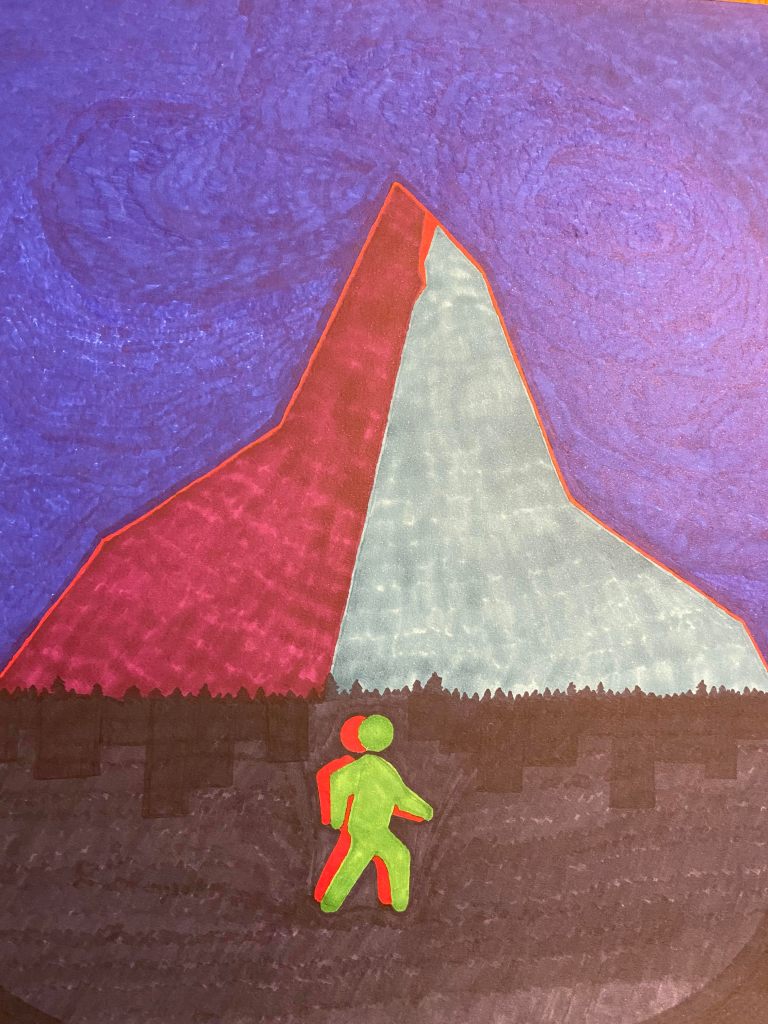
A couple weeks back, I had rough ideas for what a Razor Mountain cover might look like. First and most obvious thing: with a title like that, it pretty much has to have a mountain on the cover. Apart from that, the book is in many ways about duality: past and future, acceptance and denial, life and death, God-Speaker and Christopher. That’s not necessarily an easy concept to get across visually, but I had a vague idea of the mountain being split in half, and the shape of a person in a dark space beneath it, also split or doubled. I imagined a line down the middle, with the regular colors on one side, and a photo-negative effect across the other side.

I continued to think about what I wanted. I looked at lots of book covers. I researched tools and techniques and companies and prices. I wrote a post about it.

I tried creating a prototype by hand, with colored Sharpie felt-tip pens. I enjoy doodling and painting from time to time, but I was not particularly satisfied with the result in this case. It does look slightly better in person — the lighting is bad and the colors are pretty washed-out in this photo — but it’s not something I want to put on the front of my book.

Welcome to Disappointment Mountain.

Next, I moved on to Canva. I started by modifying their premade templates. My next cover was certainly better, but it’s a little too simple, with even fewer visual elements than the Sharpie disaster. It also looks a bit outdated, like a paperback cover from the 70s. In retrospect, the font is more of a fantasy font, with a vaguely runic look. Still, this looks like a book cover to me, even if I’m not that excited about it.

There’s probably dwarves in that there mountain.

I came back a few days later, energized to make another attempt. With some Canva experience under my belt, I trolled through Pexels for royalty-free images of mountains, silhouetted people, cities, etc. I also fired up GIMP (a.k.a. GNU Image Manipulation Program) and did some light editing. I’m hardly a graphic designer, but I’ve played around with GIMP and Photoshop in years past, so I can do some simple things like filters or gradient transparency.

The end result was actually pretty close to my original vision. I spent a surprisingly long time on little tweaks, like the silhouette of hills that separate the top section from the bottom. Fonts are also incredibly difficult to get right. I spent ages flipping between fonts. I still vacillate between this being too cheesy and just right. It definitely feels more like a thriller font.

I also created several different layouts with these same elements slightly rearranged. Unfortunately, different services want square (or even circular-cropped) “cover” images, and in some cases I may want the image without the title and author overlaid, for cases when they already appear in text nearby.

More Revision

I don’t have too many specifics to report on the editing front. I took several more passes through the first two chapters, mostly making small line edits. Now they’re going to my first beta reader, my wife. I’ll be back to looking for more critique partners and beta readers this upcoming week.

Results

I continued revising and editing the first two chapters and I created a book cover that I’m satisfied with.

Razor Mountain Development Journal #44

This is part of my ongoing series where I’m documenting the development of my serial novel, Razor Mountain. Be forewarned, there are spoilers ahead! You can start from the beginning here.

Last Time

I wrote a rough draft of the last chapter and started getting into revisions on Chapter One.

The Hook

As I talked about in a post earlier this week, I spent some time refining my first sentence, first page, and first chapter. I started with the hook.

In the rough draft, my opening paragraph is this:

The cave was a dark, low tunnel, crowded with formless shapes. Christopher struggled to identify his surroundings through eyes bleary with sleep. There was a long roar, followed by a thump. A buzzy, persistent rumble emanated from the darkness around him. Christopher rubbed his eyes and blinked several times, breathing deep and trying to clear his vision.

The first thing I did was get rid of the roar and the thump. I originally intended them to be the sound of other passengers jumping from the aircraft, and the door shutting behind them, while Christopher is still out of it. There’s no more mention of it later on, and it just ends up being confusing and slowing things down slightly. I rearranged and reworded almost all of the rest of it, although the meaning changed very little.

The cave was night-dark and claustrophobic, crowded with indistinct shapes. The cave was night-dark and claustrophobic, crowded with indistinct shapes. Christopher struggled to identify his surroundings through eyes bleary with sleep. All around him was loud buzzing; it permeated his body. He pressed his palms to his eyes and breathed deep, trying to clear his head.

Hopefully the question of where Christopher is and what is happening is enough to hook the reader, without being too confusing. Part of that relies on me quickly revealing more about what’s happening in the remainder of the first page.

The First Page

My goal in the first page is to get across a couple of ideas:

  1. Christopher feels strange, as though he’s been drugged.
  2. He realizes that he is not in a cave, he is in the passenger cabin of a small plane.

Next, as quickly as possible, I need to reveal that the passengers are missing, the pilot is missing, and Christopher is in a world of trouble. This leads naturally into the rest of Chapter One, which is all about answering the question, “what is he going to do about it?”. I think the rough draft does this decently well, so I worked on saying more with fewer words, rewording each of the next 4-5 paragraphs.

This is what my first page looks like, after some revision:

The cave was night-dark and claustrophobic, crowded with indistinct shapes. Christopher struggled to identify his surroundings through eyes bleary with sleep. He was surrounded by loud buzzing; it permeated his body. He pressed his palms to his eyes and blinked repeatedly, then breathed deep, trying to clear his head.

Although his surroundings were shadowy, Christopher could make more sense of the shapes around him as he blinked away his grogginess. The hunched, round shapes were seats. He fumbled around, felt the thin padding beneath and behind him, felt the arm rests.

Christopher’s perception shifted and he understood what he was seeing. Not a cave; an airplane cabin. Why had he thought it was a cave? Moonlight faintly illuminated the outlines of the small, round windows. The prop engines buzzed. Now that he thought about it, Christopher could feel their vibration through his seat.

He tried again to blink away the sleepiness that clung like cobwebs. Even when he had pulled all-nighters in college, he hadn’t felt this discombobulated. This was more like a bad hangover.

Christopher had been skeptical when one of the other salespeople in the department warned him not to sleep on planes when traveling. Better to hold out and hit a new time zone running, one of the veterans had said. Christopher had thought he was exaggerating.

He tried to stand and found himself still seatbelted. He fumbled the clasp open and stood fully, immediately banging his head on the sloped ceiling above. Christopher felt a sudden head rush from standing too quickly, but the pain of his bruised scalp helped to cut through the fog of his thoughts.

It was too dark in the passenger section of the little plane. Before he had dozed off, Christopher recalled little LEDs along the aisle between the seats; recessed lights along the seam between wall and ceiling. He had to turn around to face the front of the plane. Unlike the large passenger planes Christopher had flown on for other trips, this little plane had seats back-to-back, with some facing forward and some facing the rear of the plane. There were only eight seats in the passenger area, and Christopher’s was near the back, facing the tail.

The seats were all empty.

The First Chapter

To revise the rest of Chapter One, I looked at the order of events and made sure I was happy with everything that happened, and what order it happened in. I did end up making some small adjustments from the outline, which is to be expected.

Next, I took several more passes through the chapter to look specifically for some of the things I mentioned in my “firsts” post: adjectives and adverbs, sound, character voice, and pacing. It’s a long chapter (although it’s getting a little shorter in editing), and I still need to spend more time with it to get through all these improvements.

After that, I’ll pass it to my first reader/editor — my wife — and I’ll make more revisions based on her evaluation.

Cover Work

I’ve also been looking at options for cover art. As long as I’m experimenting (and not strategizing for an Amazon e-book bestseller), I thought I might try to make a cover myself. However, when it comes to visual art I’m a somewhat enthusiastic dabbler. I have no formal training. I just occasionally make things for my own enjoyment.

So, I tried making a cover, and I didn’t much like it. Then I started digging more seriously into other options, from paid services to DIY. I can say right now that I won’t be spending a ton of money on a cover (and boy can you spend a lot of money on a cover), but I’m still looking. More to follow.

Results

I revised Chapter One, with special attention to the opening. I spent time creating a book cover that I didn’t like, and then evaluating other options for book covers.

Razor Mountain Development Journal #43

This is part of my ongoing series where I’m documenting the development of my serial novel, Razor Mountain. Be forewarned, there are spoilers ahead! You can start from the beginning here.

Last Time

I finished writing the first draft of Chapter Two and read Clan of the Cave Bear.

Writing the Last Chapter (Almost) First

With the rough drafts of the first two chapters done, I jumped ahead — way ahead, to the final chapter. This isn’t something I’ve tried before, but I thought it would be interesting. I’ve done a lot of outlining and plotting for this book, so I already have a solid idea where everything is leading, both in terms of plot and in terms of character arc.

Writing the last chapter actually turned out to be a lot easier than writing the first and second chapters. Part of that was that it ended up being shorter. There isn’t all that much action. I think a much bigger factor, however, is that the first two chapters were introducing the two plot threads of the book to the reader. The last chapter just has to lead reasonably out of the rest of the book, and come to a satisfying conclusion. At this point, most of that hasn’t been written yet, so I can imagine what it will all be, and write my ending accordingly.

Obviously, this means anything I choose to change along the way may invalidate part of the ending chapter. That’s fine. I expect that by the time I get everything written out, I’ll have to re-jigger the last chapter in a variety of ways. What it really seems good for is to highlight some of the themes and ideas that I really want to push at the end. Now, as I make my way through the book, I can look at that and work on pushing those things as I go, so it all builds up organically.

Writing the final chapter also gives me some ideas about the emotional resonance I want at the end. It’s more about how I want the ending to feel than the plot information I need to get across. All that really happens is that Christopher makes a decision, and acts upon that decision.

The First Revisions

The last chapter was a fun experiment, but if I want to start publishing chapters, I need to get my beginning into shape. My first and second chapters have had some breathing room, and now it’s time to go back and revise.

My first drafts are strictly to get words on paper (or pixels on screens, in this case). Sometimes the words come out amazing, but more often I end up with lots of clunky sentences that generally get across what I was going for, some digressions that seemed interesting in the moment, a few bits that I like, and maybe a couple phrases that feel fantastic. In short, it’s a mixed bag.

I like to give first drafts a little time to fade in my memory before going back to them. Some things that seemed great during the actual writing will feel less great when I reread them later. Sometimes the rough patches where I was just dumping words to get the point across and move on actually turn out to need less work than I thought. It’s hard to pretend you’re a reader of the text you, yourself wrote, but I don’t think there’s a better tool for pulling that trick off than a break between the writing and the reading.

I started working on revisions for Chapter One this week, but there’s plenty more to do.

The challenge I always face when I start revising (especially if it’s been a while) is the temptation to go straight to line editing. It’s easy to read a few sentences and find a word here or there that can be improved, a typo or some missing punctuation. For me, at least, that’s what jumps out immediately.

However, I fight that urge. Instead, it’s better to look at the larger pieces. I try to look for any reason to reorder scenes, rearranging dialogue, or otherwise make big adjustments first. By focusing on larger structural revisions before getting into the nitty-gritty, I try to avoid wasting time changing small things that are liable to need rework anyway after structural revisions.

Results

I wrote a rough draft of the last chapter and started getting into revisions on Chapter One.

Razor Mountain Development Journal #42

This is part of my ongoing series where I’m documenting the development of my serial novel, Razor Mountain. Be forewarned, there are spoilers ahead! You can start from the beginning here.

Last Time

I finished the first draft of Chapter One, and started writing the first draft of Chapter Two. I had to adjust my writing expectations to match my current schedule.

Chapter Two, and Reining in Research

I was better at time-management this week. I slept more, I focused more, and I was able to get Chapter Two finished. Once again, this felt like a lot of work because I had to set up a new viewpoint character and a whole new setting. Time will tell whether it feels easier going forward, but it at least feels like I have a starting point to work from for the rest of the book.

I continued to get bogged down in research, but I purposely limited my research time this week. Writing characters in pre-history is interesting, because we don’t have much information about how people lived that far back. Trying to research this is an infinite rabbit hole. My approach so far has been to look at archaeological evidence (around Alaska and elsewhere), and to extrapolate from the traditions of Alaskan native peoples. One of the nice things I’ve discovered is that there seems to be some concerted effort to keep these traditions alive. I’ve been able to find a variety of information, including school lesson plans that outline specific aspects of these cultures. The challenge, however, is that I know I’m barely scratching the surface.

I’ll probably write more about this at some point, but there are strategies for effective research that doesn’t stop the writing in its tracks, especially for a first draft where you just want to get some words out.

  1. Try to describe the shape of the thing you don’t know — and thus want to research. (E.g. burial traditions among Alaskan native peoples.)
  2. Determine if that thing is plot critical. (For example, the plot requires that someone digs up an old artifact while preparing to bury a dead character.)
  3. If it is plot-critical, research enough that you know the plot will work, or how you will change it to work.
  4. If it is not plot-critical, limit your research and finish writing, making notes where you need to go back and research more.

It’s easy to feel like research is important — and it often is very important! But actually writing the story is pretty important too, and you have to strike a balance if the work is going to actually get done.

Interestingly, I think I spent as much research time on Chapter One as I did on Chapter Two, even though the research for Chapter One was relatively unimportant stuff, like the layout of small passenger aircraft. In Chapter Two I am, in a lot of ways, building a fantasy world loosely based on real cultures. While having a setting tens of thousands of years in the past gives me some leeway, I want to craft something respectful, interesting, and believable. However, I was much better at keeping my desire to research in check while I wrote Chapter Two. I asked myself what was plot-critical, and I made more notes that I will have to come back to. As a result, I have a rough first draft to build on.

This chapter was also a little shorter, at about 3,500 words. That puts the first two chapters at a total of about 8,700 words. Assuming that average holds for the whole book, it would come out to about 180,000 words, which is unreasonable for most genres. Even for genres where giant tomes are more commonplace, like Fantasy (and to a lesser extent, Sci-Fi), that’s on the big side.

These are still first draft, unedited numbers. My goal for editing will be to say more while cutting word count.

Reading Clan of The Cave Bear

I have to admit something slightly embarrassing. I think of myself as a fairly fast reader, but I started this book about two months ago, and at the beginning of the week I was about 40% through. The book has been a slog for me. I’ve started and finished at least two other books in the time that I’ve been reading this one.

If I wasn’t curious about the parallels with Razor Mountain, I think I probably would have stopped reading somewhere in there. However, I set aside time this week, and I was able to hit 80% on the ol’ e-reader. I do feel like the story pulled me along more in the latter half, and I’ll probably be done in another day or two.

Since I was reading this as a sort of comp title, I was going to just discuss the book in one of these development journals, but I think there’s enough to talk about (both related and unrelated to Razor Mountain) that I’m going to put it in its own, separate post.

Next Steps

In the upcoming week, I’m going to try the experiment I talked about previously: writing the last chapter at the start of the project. I’ll probably leave it as a rough draft, and see how much needs to change by the time I’m done with the book.

After that, I need to revise and polish those first two chapters. Those are my sample for prospective critique partners/beta readers.

Finally, I have one last non-writing task: some sort of cover art. At this point, I’ve considered doing it myself (expecting mediocre results), commissioning an artist in my family, and paying real money to professionals (ugh). If you have any experience with or thoughts about the right way — or most cost-effective way — to get good cover art, let me know in the comments.

Results

I finished writing the first draft of Chapter Two and read most of Clan of the Cave Bear.

Razor Mountain Development Journal #41

This is part of my ongoing series where I’m documenting the development of my serial novel, Razor Mountain. Be forewarned, there are spoilers ahead! You can start from the beginning here.

Last Time

I wrote part of the first pass at chapter one, and thought about the bits I want to write and polish before I start publishing chapters.

Real Life Intrudes

I’m still trying to come to grips with the new family schedule with the kids back in school. Unfortunately, the way it shakes out, I have to get up significantly earlier than during the summer. It follows, then, that I have to get to bed earlier. I haven’t been doing that very well, and as a result I feel approximately half-dead.

As you might expect, a state of partial undeath is not particularly conducive to good writing. Or any writing, frankly. I used to do the majority of my writing at night, after the kids went to bed. Now, it’s starting to look like most of my writing time and energy will be on the weekends.

All this to say that I had hoped to get through chapter two this week, and that didn’t happen. I made some progress, but once again I spent a lot of my time doing research.

When I was thinking about getting the first couple chapters done, I would have sworn that I started with two chapters from Christopher’s perspective. Turns out I actually have chapter one in Christopher’s point of view, and chapter two in God-Speaker’s point of view. As a result, I’ve been doing a lot of reading about indigenous Alaskan groups, in order to flesh out my stone-age Beringian tribe.

How Fast Can I Write, Actually?

Stephen King famously suggests that writers should write 1000 words per day. Is that first draft? Final? Does he do his editing on the side? I don’t know.

I’ve certainly gone through more than one November at NaNoWriMo speed (1667 words per day), and even had the occasional 3-5k day. Those aren’t sustainable rates for me. I did expect that a few thousand words per week would be fairly doable. I’m reevaluating that now.


My schedule is part of the problem. I also think things may go faster once I’m a bit further in. The biggest issue may be that this is going to be a serial story. I’m going to be publishing chapters as I go, so I really want to get them as polished as possible up-front. If I were writing a “normal” novel, I would write a rough draft of the entire book, then go back to revise and edit. Now, I’m going to have to combine the initial draft and at least some revision time together, up-front, which makes each chapter take longer than my rough-draft-words-per-minute rate might otherwise imply.

I also want to be able to publish frequently and regularly enough that readers will stay interested. Since I’m having a hard time getting through a chapter of rough draft per week, I can’t really plan to publish on that schedule. That might be okay though. My chapters are generally going to be 2,000–5,000 words, but many of these serial stories seem to be broken up into smaller chunks: around 1,000 words. I assume this is a natural evolution catering to small screens and short attention spans. I should probably embrace it. I don’t intend to chop the book into a hundred chapters, but I will look more seriously at chopping chapters into several smaller parts, and posting those either weekly, or more frequently when I am able.

Results

I worked on writing the first draft of chapter two. I began to admit my own limits under my current schedule.

Razor Mountain Development Journal #40

This is part of my ongoing series where I’m documenting the development of my serial novel, Razor Mountain. Be forewarned, there are spoilers ahead! You can start from the beginning here.

Last Time

I wrote my author bio. I also did some research into online critique groups.

Writing is Hard

This week was an exhausting one, with work and family busyness sapping my writing energy. The weather is sidling toward the cooler end of the thermometer, and school is back in session for my kids — with a few extra pandemic complications to contend with.

After planning and outlining Razor Mountain for the majority of the year, the book still managed to sneak up on me. I find myself wishing I had sorted more of the publishing setup as I worked through the outline. However, I finally made the big leap and started writing. Not a huge amount, but as much as I could manage this week. I haven’t quite finished my first draft of chapter one.

I suppose I should be more triumphant. I started writing! Unfortunately, it didn’t feel that triumphant. It felt…tiring. I could blame the surrounding circumstances of a busy week, or the broader state of the world. And I’m sure those things deserve some blame, but not all of it.

I don’t know how it works for other writers, but for me the start of the novel is always the hardest part. When the book is entirely in my head, it exists in a bright, gauzy haze of lovely, perfect ideas. It’s not concrete enough to have rough edges yet. Even when I’m outlining, I end up squinting at it enough that it still looks pretty great. But when I start putting one word in front of another, that’s when I really have the opportunity to start doubting myself. There’s no more hiding behind the vagueness of incomplete ideas. I now have to actually perform the telepathic alchemy of sending ideas between minds using only my words.

Even with an outline, there are a million details to figure out and decisions to make during the writing process. Most importantly though, each novel has its own distinct sound, and I’m not quite sure what Razor Mountain sounds like yet.

The First and Last Chapter

This is a project full of experiments, so why not add another? Something I see authors occasionally write about — but I’ve never personally done — is writing the last chapter of the book before the rest. The idea is not to have a completed last chapter, or even a fully functional draft of the last chapter, but to have an idea of the ending that you’re aiming for as you work your way through the story.

For a while now, my intent has been to have parallels between chapter one, the last chapter (41), and God-Speaker’s last chapter of Act I (chapter 16). Chapters 16 and 41 involve God-Speaker and Christopher in the cave of the artifacts. In chapter one, Christopher wakes up on a small plane, slightly drugged, in the dark. Because of some faint trace of God-Speaker’s memories seeping in, and because of his groggy state, Christopher sees the plane initially as a dark cave. Only after he wakes up a little bit does he realize where he actually is.

The Razor Mountain Prototype

As I think about what the book should sound like, I need some pages to work with — some word-clay to shape. Razor Mountain starts with two Christopher chapters, to get the reader into his adventure, before switching to God-Speaker’s point of view for chapter three. I think these three chapters, plus the experimental final chapter, make a good selection to start with. My current plan is to write rough drafts of these chapters. Then I can begin to polish, figure out the voice, and have a three-chapter sample for potential beta readers and critiquers. I’m also hoping to get an idea of how fast I can realistically write this thing in a way that I’m proud of.

Once I have that done and have readers lined up, I just have to get through the final publishing setup. I’ll probably spend a few days updating and revamping the website. The blog schedule will change, as I’ll continue publishing development journals for each chapter alongside the chapter itself.

After that, there’s nothing to do but write as fast and as well as I can.

Results

I wrote part of a first draft of chapter one, and thought about the bits I want to write and polish before I start publishing.