2024 is my year of short stories. In this weekly series, I talk about the stories I’m working on, from idea and draft to submission.
Stories in Progress – 2
Submissions This Week – 1
Submissions Currently Out – 3
Rejections This Year – 9 (4 personalized)
Quick Update
I don’t have much in short story news this week. It turned out to be busy, so I got little writing done. Bluefinch remains just shy of fully revised.
I was excited to discover a brand new, pro-rate-paying magazine that specializes in speculative fiction drabbles: 100-Foot Crow. In fact, it’s so new that it hasn’t actually published yet. The timing is perfect, since I got a quick, personalized rejection for Tom, Dick, and Derek a few days ago.
That’s all for now. I hope to have more news next week.
Anyone who has been keeping up with the blog lately will know that 2024 is my year of short stories. I’ve been writing short fiction and submitting it to publications. As a result, I’ve been using Duotrope quite a bit.
Duotrope includes a database of publisher information and a submission tracker for authors. (It’s not the only one: Submission Grinder and Chill Subs are out there too. Duotrope is just the tracker I’ve been using.) So, I thought I’d write about a few tips and tricks that I’ve discovered that make the submission process a little easier.
1. Search by Title
The Duotrope publisher search has a lot of options, so you might be surprised (as I was), that there is no option for the actual title of a publication.
For some reason, Duotrope decided that this belonged in its own section. The “Find by Title/Name” option in the Search menu gives you the option of inputting a partial or exact name. If you don’t quite remember the name of a publication, you can also try searching by alphabetical index.
2. Find Publishers for a Piece
Once you’ve added a story to your Duotrope submission tracker, it will show up on your “List of Pieces” page under Account -> Pieces.
When the piece is ready to be sent out, you can always search for publishers by manually entering the length, genre, and other parameters. But you don’t have to.
Instead, just click the “Publishers” link next to your story on the “List of Pieces” page. This will automatically populate a search with the information you’ve entered in the piece’s description.
3. Publishing News
The Publishing News section of the site shows publishers that have been recently added. Since brand-new publications are inherently less well-known, they may represent a good opportunity to get a story in front of editors that are hungry for content, with relatively small slush piles.
Publishing News also has a section for publishers that have recently opened to submissions, which can be another good way to find fresh options, especially when those publications are only briefly open to submissions.
4. Track Themes and Deadlines
Some publications are only open for submissions during specific windows. This is especially true for themed issues or anthologies. Duotrope can track these submission windows and deadlines.
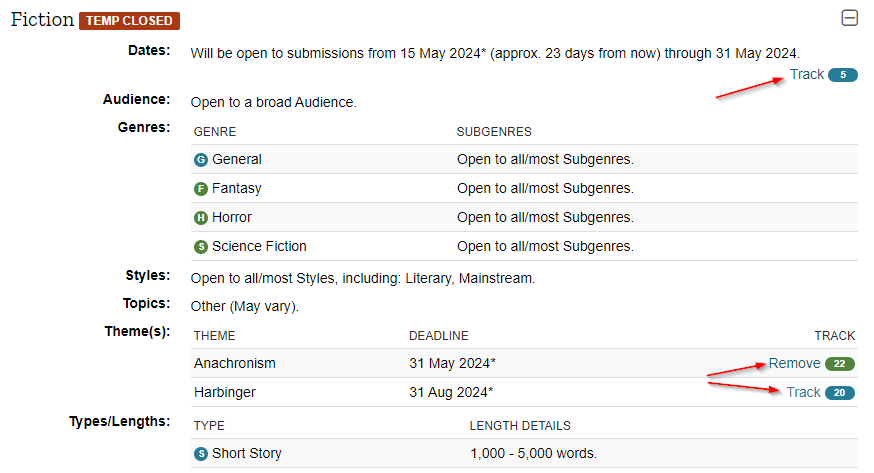
On a publisher’s detail page, general submission windows will be listed under the Dates heading, and specific themes will be listed under Theme(s). In each of these sections, there will be a Track link and a colored bubble listing the number of Duotrope users who are already tracking.
In the Account menu, you can visit “Themes and Dates” to see a convenient list of everything you’ve chosen to track.
5. Deadline Calendar
Whether or not you’re tracking any Themes or Deadlines, you can access the Theme and Deadline Calendar under the News section of the menu, or from the link at the top of the Theme tracking page.
By default, the calendar shows a list of all the themed submissions and deadlines in Duotrope, but you can filter by genre, payment, or your personal favorite publishers.
6. Overdue Responses at a Glance
Duotrope’s Submissions view shows information for all your tracked stories that are out on submission. It includes a trove of information, including some that makes it easier to decide if you need to follow up.
This view shows how many days each submission has been out, as well as the average response time reported by Duotrope users and the estimated response time provided by the publisher. But the status icon also has four different color options for pending responses.
Normally, the status is gray, but it will turn yellow if the submission has been out longer than the normal response time, and red if it exceeds the publisher’s stated response time. In some cases the publisher may state that they don’t always respond to submissions or don’t respond to status queries. In these cases, the icon will turn purple.
Of course, as with all things, you should confirm the publisher’s information on their website before blindly trusting Duotrope. It’s usually right, but occasionally there are discrepancies.
7. The Reports
Reports may sound dry and boring, but there are a few useful lists available there.
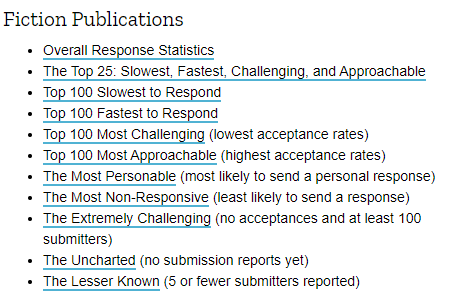
Authors who are sick of waiting for long response times can check the 100 fastest publishers to respond. Looking for feedback? Check the list of publishers most likely to send a personal response. Just trying to get a story accepted somewhere? Consider the list of publications with the highest reported acceptance rates.
What Else?
Do you use Duotrope? Are there any interesting features I missed? If you use a different tracker, I’d love to hear what they offer that Duotrope does not. Let me know in the comments.
2024 is my year of short stories. In this weekly series, I talk about the stories I’m working on, from idea and draft to submission.
Stories in Progress – 2
Submissions This Week – 2
Submissions Currently Out – 3
Rejections This Year – 8 (3 personalized)
Critiques and Rejections
This week, I finished what I started last week and caught up on my Critters critiques.
While not as exciting as an acceptance, I did receive two more personalized rejections in the past two weeks—one from a bigger publication, and one somewhat smaller. Still, it’s always nice when an editor says they want to see more of your work.
Finishing the Finch
I continued to edit “The Bluefinch and the Chipmunk” this week, incorporating all the feedback. I initially thought these would be relatively small, but in the end I found a few bigger changes to make, including a new ending.
For the third week in a row, I think I’m almost done. I’m going to let the story sit for a few days and come back to it with fresh eyes before doing the (hopefully) final cleanup.
2024 is my year of short stories. In this weekly series, I talk about the stories I’m working on, from idea and draft to submission.
Stories in Progress – 2
Submissions This Week – 0
Submissions Currently Out – 2
Rejections This Year – 7 (2 personal)
Critique Week
I received great feedback on The Bluefinch and the Chipmunk, but I always under-estimate how long it will take to incorporate so much feedback. There won’t be any major changes, but I haven’t gotten through all the edits yet.
Once again, it’s clear that stories just over 2000 words get the best response on Critters. Anything shorter only counts for half credit, and people are naturally drawn to shorter stories because it’s the least amount of effort. It’s unfortunate for longer stories, but longer stories are also a lot tougher to sell, so it makes sense to subtly encourage tight word counts.
I’m still surprised, when I receive critiques, to see just how differently people can read the same short story. There’s always at least one response that completely misses a major plot point that everyone else got, and this time, I also got another response saying that the exact same plot point was too obvious.
As mentioned last week, I also submitted a lot of critiques. I didn’t quite get my ratio back up to 100%, but I’m very close.
My 100-word mini-story, Tom, Dick, and Derek came back to me again, with a personalized rejection. I suppose one nice thing about markets that specialize in microfiction is that they can churn through the slush pile relatively fast.
I’ll be sending it out again in the upcoming week, although I’m a little less sure about how well it fits the next couple of publications on my list.
Well, we’re halfway through April, but I’m just getting around to my monthly reading recap. This month was mostly continuing series: The Witcher, League of Extraordinary Gentlemen, and finally finishing Harry Potter with my kids.
Where possible, I’ve included Bookshop affiliate links instead of Amazon. If any of these book pique your interest, please use those links. I’ll get a small commission, and you’ll support real book stores instead of mega-yachts for billionaires.
Hemingway is often cited as the pinnacle of American short fiction, and I haven’t read any of his work since college. Perfect for my year of short stories. However, this particular collection is 650 pages, and I only managed about half of that in March, so I’ll be continuing in April.
If you’ve heard anything about Hemingway, it was probably that he’s known for his short, terse sentences. While those sentences are certainly present, he actually mixes up his sentence styles quite a bit. I feel like this description of him has been cargo-culted through undergrad English programs for decades. Possibly unpopular opinion: many of his best sentences are quite long.
While the majority of Hemingway stories are quite short and straightforward, the language is sometimes a little bit of a slog. We’re far enough removed from the times and places in these stories that it’s like visiting another land. The style and word choice is old fashioned enough that it’s sometimes like translating a different dialect. It’s not like parsing Shakespeare or anything, but I’m probably getting less out of it than a contemporary reader would.
None of these stories are particularly plot-heavy, and many are vignettes with scarcely any plot at all. They capture a feeling and a place and time, but I find myself wishing that more would happen.
If you’re a modern reader who is acclimated to fast-paced, plot-heavy stories, and you’re not interested in the historical value or the literary prose, I can’t really recommend reading all of the Complete Hemingway. However, I think anyone with an interest in short fiction should read at least a few of his more famous stories.
War is raging between the kingdoms of the north and Nilfgard. The Witcher is recovering from a near-fatal beating at the hands of the traitorous sorcerer, Vigilfortz. Ciri has become a bandit in Nilfgard, (though Nilfgard claims she is safe under the protection of the Emperor). Yennefer is gone, missing after the battle at the sorcerer’s conclave.
We appear to have reached the section of the fantasy series where the main characters are all split up and must fend for themselves. For Ciri, this means having to survive for the first time without the protection of Geralt or Yennefer, and falling in with a very bad crowd.
For Geralt, the Witcher, this means coming to grips with the possibility that he is not strong enough to protect the people he loves without some help. Despite himself, he collects a motly crew that includes his longtime bard friend, Dandelion; Regis, the old alchemist with a dark secret; Milva, the human archer allied with the non-human scoi’atel rebellion; and a caravan of kind-hearted dwarves scavenging and collecting refugees in the wake of battle.
Yennefer’s absence remains a mystery for most of the book, but she comes back into the story with a meeting of a new alliance of sorceresses from the north and Nilfgard. As usual, the wizards are always plotting ways to control the events of the world. Unfortunately, those plans still involve Ciri.
The strength of the Witcher books thus far is the way the story integrates the large-scale political machinations and battles with the personal connections between characters.
Written by Alan Moore, Illustrated by Kevin O’Neal
We begin with John Carter and Gullivar Jones as leaders in a war of many races on mars. One alien race, holed up in a fortress, escapes in rockets headed for earth. Thus begins the Martian invasion of tripods, a la War of the Worlds.
The first volume of League was so short and introduced so many characters that there was limited opportunity to delve into each one. It worked, partly, because the source material was already familiar. In Volume 2, there is space for more characterization: romance, betrayal, and plenty of fractures and disagreements between the League’s members (as well as Bond, M, and the British government).
If Volume 1 was the origin story, Volume 2 feels like an abrupt finale. Two members of the League end up dead and the rest are estranged by the time the story is over.
The weakness of the series so far is that all these exciting characters have so little control of their own lives. The violent and self-centered Hyde and Griffin act on their own impulses, mostly to their detriment. Mina and Quatermain, and to some extent Nemo, are the “good kids” of the group, who actually follow orders, and are once again used to carry out actions they don’t understand or necessarily agree with. While the League plays a major role in the fight against the martians, I couldn’t shake the feeling that they were side characters in their own story.
Volume 2 concludes with a thirty-page illustrated travelogue that hints at several earlier iterations of the League, composed of literary characters from previous eras. It also hints at the future.
Like the Quatermain story at the end of the first volume, this was too tedious for me, and I ended up skimming by the end. There are tantalizing references to the previous Leagues and the adventures of Allan and Mina will have after the Martian invasion. But much like Calvino’s Invisible Cities, endless descriptions of fantastic places become dull when they have no characters or plot to anchor them.
Written by Alan Moore, Illustrated by Kevin O’Neal
Set in the same alternate universe as the first two volumes, we’ve jumped to 1958. The totalitarian post-war Big Brother government has just fallen in England, and Mina Harker and Allan Quatermain are back after years abroad.
Black Dossier expects the reader to have slogged through the travelogue at the end of Volume 2, which contains a lot of mostly elided story. It explains where the pair have been all these years, why they are young-bodied and effectively immortal, who the heck this Orlando character is, and what exactly is up with the Blazing World.
Black Dossier is a very strange comic, a time-jumping multimedia extravaganza. It begins as an ordinary comic, as Mina and Quatermain trick a rather nasty version of James Bond into gaining them access to military intelligence records. They proceed to find the black dossier of information about all the different incarnations of the League, and make their escape.
Safely back at their boarding house lodgings, they begin to read the dossier. Then the narrative pauses to show the contents of the files.
The rest of the books shifts back and forth between Mina and Quatermain in ’58, fleeing military intelligence, and the dossier’s files, which range from lost Shakespearean folios to memoirs and maps, to borderline erotica/porn.
This book is incredibly horny. It makes some sense, with the pulp fiction roots that the series embraces wholeheartedly, but at a certain point it just comes across as a little juvenile, especially when some sections have no purpose in the story and exist just to be sexy.
The book ends with a 3D glasses chapter, and a play on the end of midsummer night’s dream — instead of comparing stories to dreams, it plays on the way science fiction has shaped the world over the years.
The League books have always been a mix of high-brow and pulpy. Unfortunately, the whole experience is pretty uneven. Some sections are dull and self-indulgent, feeling more like a collection of backstory notes than proper story, and it’s frustrating that you need to cross-reference everything to get a sense of exactly what’s going on.
This final book of the series eschews the structures that have held fast through the previous books. Harry isn’t going to school. He’s on the run, searching for the immortal lich villain’s phylacteries horcruxes. The story alternates between a series of narrow escapes and heists.
The death of a secondary character at the end of the fourth book was fairly shocking compared to the surrounding material, but the tone is so much darker by this final book that major characters are dying every few chapters.
The biggest problem I have with this book is how much time the three protagonists spend wandering, with no idea what to do. They fight, separate, come back together. They argue and complain. The middle of the story gets bogged down and doesn’t seem to be going anywhere. It’s too bad, because the first third and last third of the book are packed with good action.
Right in the center of this soggy middle is a sequence where the main characters acquire an important macguffin without any effort on their part. This is all explained much later, but it still feels like a major success falling into their laps almost accidentally.
Finally, I have to complain at least a little bit about the amount of info-dumping that occurs in the last couple chapters of the book. The biggest info-dump comes through the pensieve, a magical device that allows Harry to view other people’s memories. This device is Rowling’s exposition machine in the latter half of the series, but it is exercised to such an extent in this book that we effectively get a whole chapter of wading through memories. I can’t help but feel that this was a bit of a cop-out, allowing Rowling an easy way to reveal all the important secrets of a major character right at the end, without any of the messy difficulties of figuring out how the characters could discover that information.
With all that said, and the occasional other complaints I’ve lodged in earlier Read Reports, the series holds up pretty well. It feels relatively unique in the way its voice changes so significantly from the beginning of the series to the end. It also creates a huge cast of interesting characters. So even if I may be irritated by the inconsistencies of the magic or the incredible dysfunctionality of wizard society and government, the story still gets me to care about what’s happening to Harry and his friends.
What I’m Reading in April
I’m going to be finishing off the League of Extraordinary Gentlemen with Volumes three and four. I’ll be reading the fourth novel in the Witcher Saga, Tower of Swallows. I’ll also be doing my best to finish The Complete Short Stories of Ernest Hemingway.
2024 is my year of short stories. In this weekly series, I talk about the stories I’m working on, from idea and draft to submission.
Stories in Progress – 2
Submissions This Week – 1
Submissions Currently Out – 3
Rejections This Year – 6 (1 personal)
Are Drabbles a Long Shot?
I got a rejection and re-sent “Tom, Dick, and Derek” this week. It’s a drabble, and I’m still unsure whether it really has a chance at any publications that don’t specialize in super-short fiction. There are still a couple paying markets that I have lined up for it. If none of those pan out, I’ll see if there are any good non-paying drabble markets out there.
Critique Catch-Up
Critters has a policy requiring members to submit a critique approximately three out of every four weeks—a participation ratio of 75%—to ensure that each submitted story gets a good amount of feedback. I’ve been slacking lately, and my participation ratio has fallen to about 85%. Not a big deal, but I like to stay around 100% so I have a nice buffer.
I decided this week was as good a time as any to catch back up. As an added bonus, Critters offers one “Most Valuable Critter” token to the person who does the most critiquing in a week, so if I write several, I have a chance of getting that. The MVC token is used to send a story straight to the front of the queue (which normally takes 2-3 weeks).
Finishing “Bluefinch”
Speaking of the Critters queue, my story “The Bluefinch and the Chipmunk” reached the top and was sent out this week. I’ve already received a good number of critiques, and I expect a few more to trickle in by Wednesday, when the Critters week ends.
I’ve already begun synthesizing that feedback into changes I plan to make, so hopefully I can finish those final edits and send it out by the end of the week. Unfortunately, between extra critiques and these edits, I have good reasons to put off “Red Eyes” for the week. I’ll get back to it next week.
2024 is my year of short stories. In this weekly series, I talk about the stories I’m working on, from idea and draft to submission.
Stories in Progress – 2
Submissions This Week – 0
Submissions Currently Out – 3
Rejections This Year – 4 (1 personal)
A Little Bit of Burnout
The past two weeks were a one-two punch of stress in my day job and things going on in my personal life, leaving me with less time and energy for writing. While I initially coped with this in the usual way (mild self-recrimination), I decided that I’d try to be a bit healthier and just cut back on writing time until everything leveled out.
Helpfully, all of my stories that were out on submission have remained out, so I was able to spend all of my limited writing time on editing Red Eyes. As expected, it’s going to be a good amount of work to fix it up.
My other work in progress, “The Bluefinch and the Chipmunk,” is working its way through the Critters queue and should go out for critiques in the middle of next week. When I get that feedback, I’ll probably switch over to that story again. It’ll give me a nice break, and once I’ve incorporated reader feedback I’ll have another story ready to submit. Then I can go back to finish up “Red Eyes.”
2024 is my year of short stories. In this weekly series, I talk about the stories I’m working on, from idea and draft to submission.
Stories in Progress – 2
Submissions This Week – 1
Submissions Currently Out – 3
Rejections This Year – 5 (1 personal)
Stories in Progress
This week, I had a single incredibly fast rejection—coming back in less than two days. This is not a small publication either, so that’s quite impressive. It’s interesting how much variation there is—some places ask you to give them 90 days to respond!
I edited “The Bluefinch and the Chipmunk,” which was a fairly quick process. Now it’s in the Critters queue for critique (and on my kitchen counter for my in-house readers). I’ll come back to it later in the month, when I have all that feedback in hand.
Unfortunately, the next old story I’m working on is considerably larger and rougher around the edges. It’s almost 7,000 words, which is getting into territory that will limit the places I can submit it. If possible, I’d like to chop it down to less than 5,000, but I’m not yet sure if that’s something I can manage. It may require some architectural changes.
I’ve got a busy few days coming up, so I fully expect that those edits will take up my writing time for the next two weeks.
Goals for Next Week
Major reconstructive surgery on the story tentatively titled “Red Eyes.”
Earlier this week, I mentioned personalized rejections. Lo and behold, Aeryn Rudel, the rejectomancer himself, recently provided a timely post about acceptance rates, personal rejections, and the editorial thresholds authors have to cross to actually sell a story.
Submission tools like Duotrope and Submission Grinder provide some rough statistics for reported acceptance rates, but even these have low sample sizes, and inevitably suffer from some systemic inaccuracies.
However you slice them, the numbers are daunting, with hundreds—or even thousands—of submissions being whittled down to only a handful of acceptances. This is the cruel math of short fiction publication. It’s nice to get some perspective from someone who has been submitting a lot of short fiction for years, and is kind enough to share his experience with the rest of us.
Recently, I was discussing the chances of getting published at some of the big genre markets with my author pals, and a few numbers were thrown around, some by yours truly. These numbers were mostly guess-work. None of us really know the exact percentage chance we’ll make it out of the slush pile and onto the editor’s desk, to say nothing of our chances of actually getting published. Then I remembered a few markets had actually told me how close I’d gotten to publication in their rejections, relating my near miss in terms of percentages.
2024 is my year of short stories. In this weekly series, I talk about the stories I’m working on, from idea and draft to submission.
Stories in Progress – 1
Submissions This Week – 2
Submissions Currently Out – 3
Rejections This Year – 4 (1 personal)
Let’s Get Personal
Two stories returned to me this week, both rejections. No problem; I’m developing that thick skin that’s needed for short story submissions. I get a story back, I send it out again, and I keep working on the next thing.
I was pleased to note that one of these rejections was “personal.” If you’re not familiar, there is a bit of a spectrum of rejections for short fiction. The typical rejection response says something to the effect of “Thank you for submitting, we read it and we decided to pass. Good luck elsewhere.” Short, polite, clearly uninterested. There’s really no useful information you can glean from a rejection like this. They might have hated it, or thought it was just okay. Because there are so many people submitting fiction, the vast majority of responses fall into this category, usually upwards of 90%.
However, many publications also have slightly more encouraging variations on rejection. These are usually along the lines of “We liked your story, but we have to reject it anyway.” That may mean that some editors/readers liked it and others didn’t, or that they liked it, but not as much as other stories. Unfortunately, the nature of the business is that a magazine will often have more good stories than they can publish.
A personal rejection is still not a sale, but it’s nice to have a magazine with pretty good pay rates (and thus, lots of submissions) telling me that they’d like to see more of my work.
Delving Into the Trunk
As I mentioned last week, I decided to open up my metaphorical trunk of old stories. It was fun to go back and look at how many stories I’ve written over the years. Not surprisingly, there are a number of these old short stories that are just not very good. They’ll be staying in the trunk. However, I was also surprised to discover several old stories that held up pretty well. In fact, I found three stories that I think are worth dusting off.
Admittedly, these stories need some work. I like to think that my skills are still steadily improving, and I immediately identified some opportunities to make these stories better. Two of them are too long and need better endings. Those will take a fair amount of effort. But the shortest one just needs some polishing.
That first old story is called “The Bluefinch and the Chipmunk,” and I’ve already done one editing pass. I’ll probably do one or two more in the upcoming week, put it in the Critters queue for critique, and start hacking one of the bigger stories down to a manageable size.
I’m happy that I dug up these old stories, because one of my current weaknesses is my ability to edit. This gives me an opportunity to work on that.
Developing a System
It’s still the first quarter of the year, and I feel like I’m just beginning to hit my stride in this project. So far, I am really enjoying it, far more than I thought I would. There is a joyous momentum to writing and submitting short stories that is just not present when writing a novel. A novel requires so much focus for so long that it’s sometimes hard to remember what life was like before you began the project, and hard to believe that it will someday end.
Writing short stories is a kind of willful amnesia. It’s a burst of intense focus to make a little thing as perfect as possible, and then it goes out into the world to meet its fate. Maybe it will succeed, maybe it will fail. In the meantime, I get to make something completely different.
Researching markets and submitting stories might sound like an unpleasant distraction to writers who want to focus completely on craft, but I’m finding the logistics of submissions interesting as well. Even with tools like Duotrope or Submission Grinder, it’s a surprising amount of work to find the “best” fit for a given story, especially when you’re optimizing for themes and pay rates. I haven’t even dealt with simultaneous submissions or publications that ask you to wait some amount of time before submitting something else. It’s a lot to track.
Right now, I’m still figuring out what’s important and what isn’t, and each submission feels like a new little adventure. Eventually, I expect to develop a rhythm, and I’ll find that I’m carrying out the same tasks for each submission. When I get to that comfort level, I’ll write a post describing that process, and hopefully it will save some new author a little bit of effort when they decide they want to start submitting their own short stories.
Goals for Next Week
Get a draft of “The Bluefinch and the Chipmunk” ready for critique.
Start editing another old story, tentatively titled “Red Eyes.”














 Words Deferred