When You Aren’t Inspired, Trust Process

As I approach the final leg of writing my serial novel, Razor Mountain, I feel like I’m finally on the other side of the difficult middle. The central 50% of novels almost always feel like the hardest part to me, and I know I’m not alone. However, I have a big advantage on this project: posting it on the blog gives me deadlines and external accountability.

When I finish writing a chapter, sometimes I feel pretty good about it, and sometimes I’m disappointed. But I set myself a schedule, and I keep writing more chapters and posting them. Sometimes, my only consolation is in telling myself that I can always perform major revisions after the thing is done.

On the good days, writing feels like making art, but on the bad days it feels more like working an assembly line. Clock-in, spend a few hours sticking words together, and clock-out. It’s not glamorous, but it’s often what needs to be done.

Is It A Good Day?

I recently binged through the incredible 32-episode documentary Double Fine PsychOdyssey, which follows the seven-year development of the game Psychonauts 2. Even if you’re not particularly interested in video games, it’s a fantastic study in the complexities and interpersonal challenges of building a creative project with a large group of people.

Tim Schafer, who is something of a game design and writing legend, has a habit of daily writing when he’s working on a project. Over the years he has accumulated piles of old project notebooks that he can look back on. This offers an amazing archaeological view into how these stories grew and changed over the course of development.

Early in the documentary, Schafer flips through a few pages of the notebook for the original game, Psychonauts. These pages contain the first mentions of many of the ideas that became central to the story, although he had no way knowing it at the time. Schafer reads these tentative forays into ideas that now seem predestined, laughs quietly to himself and says, “that was a good day.”

What’s interesting about these “good days” is that they’re often not obvious when we’re living in them. It’s only in retrospect that we can see what works and what doesn’t.

Doing the Work

Cory Doctorow has a great article about this, called Doing the Work: How to Write When You Suck.

In those years, I would sit down at the keyboard, load up my text-editor, and try to think of words to write. Lots of words occurred to me, but they felt stupid and unworthy. I would chase my imagination around my skull, looking for better words, and, after hours, I would give it up, too exhausted to keep chasing and demoralized by not having caught anything.

That feeling of unworthiness and stupidity has never gone away. There are so many days when I sit down to write and everything that occurs to me to commit to the page is just sucks.

Here’s what’s changed: I write anyway. Sometime in my late twenties, I realized that there were days when I felt like everything I wrote sucked, and there were days when I felt really good about what I had written.

Moreover, when I pulled those pages up months later, having attained some emotional distance from them, there were passages that objectively did suck, and others that were objectively great.

But here’s the kicker: the quality of the work was entirely unrelated to the feeling I had while I was producing it. I could have a good day and produce bad work and I could have a bad day and produce good work.

What I realized, gradually, was that the way I felt about my work was about everything except the work. If I felt like I was writing crap, it had more to do with my blood-sugar, my sleep-deficit, and conflicts in my personal life than it did with the work. The work was how I got away from those things, but they crept into the work nonetheless.

This is a profound realization. There is a freedom in just writing (rather than trying to write well) that can be necessary to actually get anything done. The louder your internal editor is, the more important it becomes to be able to turn it off.

What Cory experienced is something I’ve noticed as well. I often don’t feel very good about my writing in the moment. It’s only when I come back to it later that I can take notice of the parts that I like. That’s not to say I don’t need editing. I always find plenty of things to improve. But most of the time my opinion of my writing is higher when I’m reading it back than when I’m in the process of writing it. I just can’t trust my own opinion while I’m writing.

And even if it turns out to be bad, I can always fix it later.

Writing as Manual Labor

As I get older and more experienced, I am more and more drawn to the idea of writing as manual labor. When I treat writing as a simple project of putting one word after another, it takes away the pressure to make those words great. I get the words written faster, and with less anguish.

I don’t always know if what I’m making will be good. I would love to feel constantly inspired—to have the muse always looking over my shoulder and making suggestions—but inspiration comes fitfully.

Sometimes the muse only strikes because I gave her room and did the work.

Reblog: Don’t dribble out morsels of information within a scene — Nathan Bransford

Today’s reblog comes from Nathan Bransford, who discusses some of the nitty-gritty details of getting across information when a scene is on the move.

Sometimes it’s hard to know when to reveal different pieces of information. Bransford suggests the simple and expedient route: give the reader the information they need to understand the scene, and give it to them up-front. Don’t make a scene a puzzle to piece together as you read it.

When you’re honing the narrative voice within your novel, you will likely get into all sorts of trouble if you try too hard to faithfully recreate a character’s contemporaneous thoughts. You probably won’t give the reader the context they need and you’ll risk disorienting the reader with inadequate physical description.

Remember, the narrative voice is storytelling to a reader. You are not transcribing the literal thoughts of someone in an alternate world (unless you’re writing something very experimental). It weaves in a character’s contemporaneous thoughts, but you have to make sure the elements the reader needs are present.

One major pitfall of trying too hard to stay true to a character’s thoughts is that some writers will wait for a “pause” in the action before they show the character observing their surroundings and concoct triggers for characters to look at things.

Read the rest over at Nathan Bransford’s blog…

Some Thoughts on Writing Diverse Characters

I am a middle-aged (or at least approaching), white, cis-het man. I’m upper middle class, and I live in the American Midwest.

You would be hard-pressed to come up with a more demographically precise human representation of “The Man” than myself. It’s fair to say that I won the lottery when it comes to privilege. As a writer with that sort of background, the past decade or so has been interesting. There are a lot more discussions (and arguments) about diversity—about who is writing and who is being written.

What “The Man” Worries About

A blogger that I follow recently posted about some of their concerns around wanting to write characters from other cultures, and worrying about getting it wrong. Is it fair to write about other cultures because you’re interested, or is that cultural appropriation? How do you write about someone different without accidentally falling into stereotypes? Is it somehow wrong to even want to tell those stories, when they don’t “belong” to you?

I’ve struggled with some of these questions myself. I happen to be the owner of a half-finished novel populated entirely by people from China and various parts of Africa. It’s a book that I began partly because I thought it would be interesting to explore a sci-fi future where China has become the world’s leading super-power, supplanting the USA (as many have postulated it eventually would). Likewise, the African Union, with many political and economic ties to China, supplants the EU in many ways.

I started writing that book years ago, before I spent much time thinking about the challenges of writing characters who are very different from myself, and before I really noticed the modern English-speaking world  openly debating these kinds of questions. One of the reasons I haven’t finished it is precisely because of those questions.

This post is not a sad story about how hard it is to be a writer like me in this day and age. I think it’s fairly obvious that my background still gives me advantages in the world of writing and publishing. I certainly believe there are much stronger headwinds for writers in a wide variety of marginalized groups.

The questions I’m interested in exploring are personal, and honestly, self-serving. What should I write, and how can I do it well?

What Should I Write?

The first big question is whether I should even be trying to write diverse characters—that is, characters with backgrounds significantly different from my own in terms of race, gender, sexuality, ability, or various other attributes.

To me, this is more a question of extent. We are all different from each other. Writing anything from the perspective of a character who isn’t myself already requires that I step out of my skin and try to understand a different perspective. Science fiction and fantasy already have a certain amount of this built-in.

However, there is obviously a spectrum of characters that are more or less similar to me. For example, my protagonist in Razor Mountain is the same ethnicity, gender and orientation as me, lives in the same region, and has a very similar job. If I start to change those things, like the characters in my older unfinished novel, where do I start to get into dangerous territory, and what exactly makes it dangerous?

The critics of all things woke might pose this as a defensive question: when do I run the risk of being canceled? But that misses the nuance of asking why someone might be upset by what I wrote. Writing a character becomes “dangerous” when I start to speak for someone in an arena where they are different from myself. This is where I run the risk of getting it badly wrong. People who are similar to that character may then feel alienated or even attacked by my inaccurate portrayal of them.

On one hand, I could simply avoid writing any characters that I think might be “too” different from myself. But if we say that nobody should write characters very different from themselves that doesn’t much help to better represent a variety of people in our literature, and it forces writers to create an artificial box around themselves to contain and limit all their writing.

This seems to me like a fearful way forward; supposedly safe, but ultimately bland. On the other hand, inclusion for the sake of inclusion is equally artificial. If I’m going to write a character, it should be because they interest me and fit the story, not to meet a quota or feel good about myself or “do the right thing.”

I don’t think it’s a good idea to be afraid to write characters that are different from myself, but I understand that I need to take responsibility for being accurate (in all the complex ways that can be interpreted). It’s also not my job to tell someone else’s story. A story that is largely about the experience of being gay or being black is almost certainly better told by someone who has lived it.

How Can I Do It Well?

That brings me to the next question. If I am going to write diverse characters, how can I do it respectfully and well?

First and foremost, do the research. Write like a journalist. Things presented as facts should be factual. If I’m going to write about characters living in a sci-fi future version of China, I had better learn as much as I can about what it’s like to live in China today, and make some smart extrapolations about what it might look like in the future.

Maybe unintuitively, I think the same principles apply to understanding people. This kind of research consists of listening to the people within that group. Find interviews or things they’ve written. Thanks to the internet, it’s possible to find people and make friends across the world more easily than ever before. It’s not uncommon these days to hire specific readers for feedback, although that feels a little uncomfortably transactional to me.

The big traps for someone like myself are the temptation to inject my own opinions and feelings into different characters instead of being honest to real perspectives. There are a lot of tropes and stereotypes floating around, often created by people very similar to myself. Primary sources are vitally important. Also, no group is a monolith. It’s worth exploring different viewpoints within a group, if you can find them.

Final thoughts

Ultimately, I see writing diverse characters as an issue of respect. Flippantly writing characters that fulfill tropes and stereotypes is not only a disservice to people who identify with those characters, it’s lazy writing. I think it’s good that we’re having these conversations, and beginning to elevate a greater variety of voices. We all benefit from that, and our literature is richer.

There are a ton of great resources out there, but I’ll link to a couple here, and they have their own lists that will get you started down the internet rabbit-hole:

Razor Mountain Development Journal — Chapter 25

This is part of an ongoing series where I’m documenting the development of my serial novel, Razor Mountain.

You can find my spoiler-free journals for each chapter, my spoiler-heavy pre-production journals, and the book itself over at the Razor Mountain landing page.

Narrative Convergence

God-Speaker’s chapters throughout Act II have been jumping through time, showing key moments in God-Speaker’s evolution. They’ve also shown the evolution of Razor Mountain and its people. In this chapter, the narrative is finally approaching the present day. For the first time, we can start to see the same things from both God-Speaker’s and Christopher’s perspective.

This gives me the opportunity to set up some narrative tension by revealing things in God-Speaker’s chapters that will pay off in Christopher’s chapters. Sometimes tension comes from not knowing what will happen next. Sometimes it’s more exciting when the reader can guess what’s happening, but the characters don’t know.

God-Speaker’s Cabinet

The two new characters introduced in this chapter are Reed and Cain, and they are both members of God-Speaker’s cabinet. However, I looked through my notes and I had no record of what their actual positions are. I was certain I had thought about this when I was first developing the story, but it turns out that writing a book is a messy process, and I either lost those notes or never wrote them in the first place.

Internally, to the citizens of Razor Mountain, the cabinet is a secret arm of the US government that handles the day-to-day operations in the city. Only God-Speaker and the secretaries themselves know the truth about who runs the city. The populace “knows” that the secretaries report to a higher authority, but they’re told it’s the President of the United States and the military. God-Speaker doesn’t need to worry that the population will try to overthrow their autocratic king, because they don’t know that they have a king.

When deciding what positions there should be in this cabinet, I looked at the US presidential cabinet for inspiration. Razor Mountain is a sort of city-state, so a lot of those positions make perfect sense. Others are completely unnecessary (ambassador to the UN) and a few just need to be tweaked.

I wanted a large enough group to seem like a reasonable governing body, and to allow for interesting interactions between members.

These are the positions I ended up with:

  • Secretary of the Treasury – Responsible for overall budget, accounting, and income and outflows across all departments. Administers local banking system.
  • Secretary of Agriculture – Responsible for local farming and food processing. Works with the Trade Coordinator for food imports from outside.
  • Secretary of Commerce – Responsible for most non-food businesses internal to the mountain. Works closely with Secretary of Labor and Trade Coordinator.
  • Secretary of Labor – Responsible for labor conditions, allocation of labor across industries, work safety, etc.
  • Secretary of Housing – Responsible for maintaining and expanding housing supply within the mountain as needed for the population.
  • Secretary of Energy – Responsible for generation and distribution of electric power, lighting, and certain energy-related trade (batteries, generation equipment, etc.)
  • Secretary of Education – Responsible for the school and university system.
  • Director of Media – Responsible for producing local media, importing external media, censorship.
  • Director of Intelligence Operations – Responsible for gathering internal and external intelligence, as well as most external interaction with outsiders for trade.
  • Secretary of Science and Technology – Responsible for science and tech R&D, manufacturing, and external trade. Collaborates with Intelligence Ops for external hacking.
  • Director of Military Operations – Responsible for military within the mountain and the area around the mountain. Collaborates with Intelligence Operations for external military and espionage ops.
  • Trade Coordinator – Responsible for import/export and maintaining trade. Collaborates with Intelligence Operations for external negotiations and obfuscation.

I decided that Cain is the Secretary of Energy. He is very focused on his particular field, and is especially excited about developing and constructing new electric generation and distribution technology.

God-Speaker would be constantly thinking about how to balance power between the cabinet members, and play them off each other so that nobody can ever feel secure or think about turning against him. To this end, I thought he would avoid involving the Secretaries of Intelligence Operations and Director of Military Operations when it comes to investigating their fellows. Instead, he turns to Reed, the Secretary of Labor, who naturally collaborates with the Secretary of Energy on his big building projects.

Resolving Mysteries and Emotional Catharsis

My goal throughout most of this book has been to draw the reader in with a series of mysteries. However, it’s not structured like a classic “who-done-it.” It’s not building up to a revelation that wraps up the plot. Instead, in Act III I will be trying to rapidly resolve most of the open questions that have given the story momentum so far.

Unraveling these mysteries will reveal more about God-Speaker and Christopher, and those revelations will leave Christopher with some difficult things to do, and some difficult choices to make. The end of the story will not be about big mysteries, it will be about the choices Christopher decides to make and why he decides to make them.

This whole structure goes back to one of the big lessons I learned from Chuck Wendig’s Damn Fine Story: the big, world-shaking stakes should be tied directly to the main character’s “smaller” but more relatable personal stakes.

It will be up to Christopher to decide what the outcome is, for himself and for the world.

Next Time

Next chapter, we go back to Christopher as the two narrative worlds begin to collide.

Razor Mountain — Chapter 25.2

Razor Mountain is a serial novel, with new parts published every week or two. For more info, visit the Razor Mountain landing page.

A long shaft of light slid across the room when Reed opened the door, scattering new angular shadows across the space. God-Speaker could see that Cain was indeed waiting outside. He was a big man, both rotund and taller than Reed. His shadow stepped out of view as he made space for Reed to exit. The two men exchanged perfunctory greetings; God-Speaker couldn’t make out Reed’s whispery voice, but Cain’s jovial response was clear.

“You look tired. Better get some rest.”

The big man entered and closed the door behind him, shutting out the external light and plunging the room into half-darkness again.

“You certainly do like to lurk in the shadows, don’t you?” Cain asked as he approached, his shoes tapping across the stone floor until he reached the island of the huge plush rug that encompassed the desk and chairs.

God-Speaker smiled. “I was thinking earlier this evening that there’s something about the campfire aesthetic that appeals to me.”

“The light is only beautiful in its contrast with the darkness,” Cain said. “And vice-versa, of course. I know I’m in charge of keeping the lights on, but I think both have their allure.”

Where Reed was dapper in an old-fashioned way, Cain was much more casual, wearing a work coat and jeans that wouldn’t be out of place at a construction site. He carried a small leather satchel with a shoulder strap. As he sat, he adjusted it to sit on his lap and opened the flap.

For a moment, God-Speaker couldn’t see what was in the satchel. His thoughts flashed to the pistol under his desk and the small knife concealed on his belt. He remained still in his seat, his elbows on the desk, his fingers steepled in front of his face.

Cain took out a tablet and a folder of papers, setting them on the desk while he closed the satchel, unslung it, and set it next to his chair. Then he picked up the tablet and began tapping the screen.

“The agenda for this meeting was a little unclear,” God-Speaker said. “Did you have something in particular you wanted to discuss?”

Cain had been scheduling more meetings recently, and the topics were beginning to range far beyond the projects he had inherited from his predecessor just two years earlier. God-Speaker had known when he appointed the man that he was more of an ambitious and energetic personality than God-Speaker would typically appoint to a cabinet position. He had to ride the knife’s edge to find those who would do their jobs competently, but not overstep their bounds and start thinking too much for themselves.

“I wanted to talk about the new high-efficiency geothermal plans,” Cain said. “I know the initial proposal was for a pilot plant that would run alongside existing generation. But I’ve been running numbers. We set up a miniaturized version in one of the unused expansion chambers, and it’s already looking like it’s a good fifteen or twenty percent better than we anticipated.”

God-Speaker frowned. “Where did this miniaturized version come from? I don’t remember seeing any budget with something like that in it.”

Cain’s smile faltered only for a fraction of a second. He shifted in his seat.

“It was manufactured under the R&D budget. It’s only something like two percent of the total outlay. I thought it prudent to investigate the construction and maintenance process before we got to the pilot plant. Now, though, I’m thinking this could be the future of all our generation going forward. It could be a huge savings. It could pay for itself in a matter of a few years.”

God-Speaker sighed.

“The pilot plant isn’t even scheduled yet.”

“Yes, and I’d like to discuss that, too.”

God-Speaker held up his hands to stop Cain before he continued.

“The numbers are interesting, and I think it is quite possible that you are right about the technology. It probably deserves more investigation, and it may very well be revolutionary. But I am concerned about the reallocation of funds without any sort of accounting crossing my desk.”

“I think this is the most important thing my department can work on right now.”

God-Speaker rubbed his eyes. “You have made that abundantly clear.”

“So what’s the problem?”

“The problem is that you are acting unilaterally. I expect my cabinet to work together to look at all aspects of any major projects. That includes handling budgets and accounting with the Treasury, it includes scheduling the working time with Labor, it includes coordinating the manufacturing with Science and Technology. Most importantly, I expect to be included in the decision-making process for any major project, because I have the final say as to whether or not it goes forward.”

Cain clenched his jaw. “Do you think I’m incorrect in my assessments of this technology?”

“It’s not simply a yes-or-no, stop-or-go question,” God-Speaker said. “It is a matter of scheduling and budgets and resources. You have jumped into this position with both feet, and I appreciate your passion for the job. But you are only one member of the cabinet, and even if you have complete understanding of the concerns under your purview, you have relatively little experience, your department is only one slice of the pie, and you need to consider all of the other concerns that the other secretaries and myself must take into account. Every one of them was appointed because they’re competent, but it’s not enough to simply be effective in your particular area. You need to collaborate as well.”

Cain looked down at his tablet screen, shaking his head slowly.

“Is there any schedule for when these projects might move forward? What are other people working on that justifies the budget more than this?”

“I think that’s a bigger topic than I want to address this evening,” God-Speaker said. “If you’d like, we can do a round-table overview of everyone’s major projects at a full cabinet meeting. But that’s not something I’m going to throw at everyone last-minute. I’d need to give everyone time to prepare for a presentation like that.”

“And then we could discuss adjusting budgets?” Cain asked.

God-Speaker shook his head. “There are procedures for setting budgets. Is this an emergency? Because I’m not inclined to spend a huge amount of time rearranging budgets mid-year for something that isn’t extremely pressing.”

“It will pay for itself.”

“Not immediately.”

The two men sat and stared at one another.

“As I said,” God-Speaker continued, “I appreciate your passion. But I also need to know that you can work within the system and you can collaborate and make compromises. Sometimes that will be frustrating, but it is a necessity.”

Cain stood abruptly.

“I think you’re wrong. You’re not giving this due consideration.”

“You’re welcome to your opinion,” God-Speaker said. “As you might expect, I disagree with your assessment. I have to balance a great many things to keep this place running smoothly.”

“Fine,” Cain said, turning on his heel and heading toward the door. “I look forward to that cabinet meeting where we can see all these other vital projects.”

God-Speaker cleared his throat.

“Your bag.”

Cain turned, walked back, and picked up the satchel, shoving his tablet and papers into it. Without looking at God-Speaker, he turned again and left the office, closing the door hard behind him.

God-Speaker took a deep breath and let it out slowly. For a moment, he had thought that Reed might have been right in his misgivings about this meeting, but there was no bloodshed. His Secretary of Energy appeared to wear his heart on his sleeve, but God-Speaker sensed that he was holding something back. For some reason, despite his apparent openness, there was something hard to read about him. God-Speaker wondered if he was reading too much into Cain’s motivations, or not enough.

<< PREVIOUS ] [HOME] [ NEXT >>

Razor Mountain — Chapter 25.1

Razor Mountain is a serial novel, with new parts published every week or two. For more info, visit the Razor Mountain landing page.

God-Speaker sat in the half-light of his office, silent but for the scratching of his pen. The heavy paper was scored with musical staffs, and he toiled over it with a fountain pen. For writing cleanly and precisely, it was objectively worse than a modern pen or computer program, but there was something about the tactility of the pen and paper that was deeply satisfying to him and it looked better on the desk—alongside the inkwell—than a more modern implement.

A special bookshelf next to the desk was dedicated to the reams of music he had written over the years. He wrote and re-wrote it, playing with modern and ancient forms, little dalliances and sweeping epics. However, it was his symphony (his “first symphony” as he thought of it) that he spent most of his time on. He wrote it and re-wrote it, tweaked it for years, and then threw it away and started again. There were dozens of versions on the bookshelf, and many more lost to time. Long ago, he had dared to imagine it being played, but it never was. It always felt incomplete, and he wouldn’t allow it to be played until it was truly done.

The office was equipped with the sort of lights ubiquitous beneath the mountain, cleverly channeled daylight or carefully tuned artificial light, inset into the ceiling so that it filled the room indirectly. God-Speaker kept those lights off in the evenings. He much preferred using the antique lamps that had been tastefully placed here and there around the big room. Something about being at the center of a pool of yellow light felt right to him, something about the darkness around the edges of the room that the light couldn’t quite penetrate. Maybe it reminded him of traveling with his people in the old days, huddled around the campfires at night. Back then, the darkness beyond the firelight had seemed infinite and full of danger. Here, he knew the limits of the darkness. It was well-contained within stone walls, beneath the crushing weight of the mountain above.

God-Speaker made use of technology, but he didn’t relish the aesthetics of glass and plastic and chrome that were so prevalent these days. He was more comfortable surrounded by his leatherbound books in their wooden bookshelves, his richly upholstered furniture and lamps of brass and iron and stained glass. The office was filled with a faint but powerful scent of old and cherished things: dust and leather, wine and ink.

God-Speaker himself seemed to belong in this place as much as the books on the bookshelves or the furniture and rugs. He was a carefully maintained relic, and he was currently showing his age. He had gotten in the habit of staying with the same body longer in recent centuries. There were advantages to being accustomed to his vessel. He could focus on more important things. But he also felt the aches and pains. He slowed down, and he was beginning to feel that little bit of mental fog creeping in. He would make the jump soon, and relish the freshness and energy that came with it.

However, he had a situation to resolve first. At this point, he had a well-honed sense for little things out of place, signs that something was working against his grand designs. He suspected that someone, perhaps even a member of his inner circle, was working against him in subtle ways. It made him nervous, as it always did, and he had to remind himself that he had dealt with betrayal many times before. Traitors thought themselves so clever, rarely understanding the insurmountable advantages of an opponent with hundreds of lifetimes of experience.

As if the world moved by God-Speaker’s direction, there was a knock at the door directly across from him, in the half-darkness. He sealed the inkwell and set it and the pen aside. He pushed the sheafs of music to the other side. Then he pressed a button beneath the desk.

“Enter.”

The man who came in was tall and thin, with wispy red hair that was perpetually uncertain about which direction it ought to be facing. Reed Parricida: the Razor Mountain Secretary of Labor. He wore a black suit and narrow tie that further accentuated his thinness. He wore large, thick glasses that slightly magnified his eyes, completing the vaguely insectoid ensemble.

“I’m sorry to call you in so late.”

“Is there some sort of emergency, sir?” Reed’s voice was quiet, just barely more than a whisper.

“Not an emergency, but a serious situation that must be carefully addressed.”

Reed walked into the pool of light and sat in the chair across the desk from God-Speaker. He sat with his right foot set up on his left knee, his right elbow on the arm of the chair, his chin cradled in his right hand as he stared intently at God-Speaker.

“I’m going to ask you to do something entirely outside of your usual responsibilities,” God-Speaker said. “It will require the utmost discretion, and I expect no word of it to leave this room.”

“Understood.”

“I have reason to believe that Cain Dolus has been secretly working to expand his influence, and he may be making plans to assassinate me.”

Reed’s magnified eyes widened behind the glasses.

“Cain? Are you sure? He’s always struck me as…well, a little dull.”

God-Speaker nodded. “I was skeptical too, but I’ve been noticing things that concern me. It is also possible that there is a conspiracy among more than one of your fellow secretaries.”

“That is…disturbing.”

God-Speaker shifted in his chair. “By virtue of your position, you have good reasons to be involved in Cain’s major building projects. I would like you to very quietly look into those projects. I am especially interested in any cases where he has been diverting funds or doing any unusual accounting.”

Reed’s narrow brow furrowed. “I appreciate the seriousness of this situation, and your trust in bringing this to me,” he said, “but surely there are others better-suited to this sort of investigation. Someone from Military or Intelligence Operations?”

God-Speaker leaned back in his chair, looking up at the shadowed ceiling.

“I think it’s likely that any traitors will be more guarded around Reese and Cas. I also need to be absolutely certain that neither of them are involved in this before I bring them on board. Besides, you have good reasons to be involved in Cain’s projects, and those two do not.”

God-Speaker didn’t mention that he wanted to avoid looking weak in the eyes of his Directors of Military and Intelligence Operations. The fewer people were aware of the situation, the less likely anyone would entertain any seditious ideas.

Reed sighed. “I understand.”

“I’m sorry to put this burden on you,” God-Speaker said.

“No need to be sorry,” Reed said, sitting up straight in his chair. “I’ll start my investigation first thing tomorrow.”

“Very good,” God-Speaker replied. “I’ll set up a daily meeting to discuss anything you find.”

“Anything in particular I should know?”

“Not at this point. I’d like to see what you can dig up before we share notes. You may find some avenues of inquiry that I hadn’t considered.”

“Understood.”

Reed stood, and God-Speaker did as well.

“I’ve asked Cain to come talk to me tonight as well. He’ll probably be waiting outside when you leave. Try not to look suspicious.”

Reed frowned. “Are you sure that’s a good idea?”

“We often meet at odd hours,” God-Speaker said. “It’s best not to change routine at this point.”

“Do you want me to stay?”

“I don’t think that’s necessary. I know how to defend myself, and I will be on my guard. Besides, I think a direct personal assault would not be a good way to carry out the crime and get away with it.”

“Very well. Can you send me a message after your meeting to confirm that nothing happened?”

God-Speaker smiled a tight smile. “Of course.”

<< PREVIOUS ] [HOME] [ NEXT >>

State of the Blog — February 2023

It’s that time again. Since I started this blog, I’ve done a “State of the Blog” post every six months. This is the fifth such post.

One of the key tenets of this blog is an open writing process. I’ve brought that to my serial novel, Razor Mountain, with my development journals, and I bring it to the blogging process with these posts. While the Razor Mountain development journals focus mostly on fiction writing, these posts are about blogging in general.

Previous Posts

Metrics

Let’s start with the numbers:

  • Years blogging: 2.5
  • Total Posts: ~315
  • Total Followers: 128
  • Monthly views: 530 (average over last 3 months)

Search vs. Direct Traffic

The split between search traffic and direct traffic has stayed roughly the same in the past few months. Something like 75% of the traffic I get is from search, with one hero post and a handful of other mid-ranked posts capturing most of those views. The remaining 25% looks like it’s mostly from regular readers, and they’re mostly reading my new posts each week. As you’d expect, comments and likes come mostly from the regulars, while views are mostly the drive-by-searchers.

That search engine traffic varies quite a bit from week to week and month to month, so I’m in the odd position where my stats often aren’t driven much by what I posted recently, and instead come down to how many people wandered in from Google.

Slower Growth?

As I looked back at previous six-month windows, I saw fairly consistent growth in numbers. Usually, my views would just about double over the course of six months. The past six months were the first time where that wasn’t really the case. On average, those stats still went up, but not at that exponential rate.

Complicating the issue is that the numbers didn’t show a consistent trend. As you can see from the graph, there were a couple of fairly low months and a very high month. Turns out a lot of people have extra time to catch up on their blogs in the last two weeks of December.

It will be interesting to see what the next six months look like. This just isn’t a ton of data points to infer much from. I’m not really looking to change what I do based on these numbers—I won’t be doing a bunch of SEO stuff or using more clickbait-y titles. I’d love to see the blog keep growing, but if it does it will be because I keep posting what I enjoy posting, and people find it and like it too.

Approaching the End of Razor Mountain

There are ten chapters left in Razor Mountain. That number may change a little as I work through Act III, but that’s still well over 2/3 done. Plus, as an experiment, I already wrote a first draft of the last chapter at the start of the book. So as long as I can keep up my current pace, I should have all my chapters done before my next State of the Blog post.

I’ve been thinking about what happens next. First, I know I’m going to take a break from the book to get a little distance. Then I’ll be rereading and digging into whole-book edits and polish. I worked extra hard on the front-end to make these episodes as good as they could be when they are released, but I know that there will be a lot of opportunities to go back and further improve and tighten the story.

The bigger long-term question is what I want Razor Mountain to be. Right now, it lives on the blog, and on Wattpad and Tapas. I wanted this to be an open experiment, and I’m very happy with how it has gone. But with a rare few exceptions, traditional publishers are not interested in publishing a book that is already out in the world. I may decide to explore self-publishing, just in case there are folks out there who would be willing to throw a few bucks my way for a copy of the final book.

What Lies Beyond

Razor Mountain has been an integral part of my blog almost since its inception. My posting schedule changed when I went from pre-production to actually posting chapters, and it will probably change again when I get into editing. Then, at some point, I’m going to be done with the book, and there will be a big gap to fill in the posting schedule.

I have a few ideas of what I would like to work on next. I would love to spend at least a few months writing nothing but short stories and really grinding submissions to publishers. I also have dreams of writing a TTRPG campaign setting—I know there is a decent chunk of my regulars who are into that sort of thing, and I think it would bring in some new readership as well. I’ve been kicking around ideas for a setting for years, so it would be great to get it out of my head and onto paper.

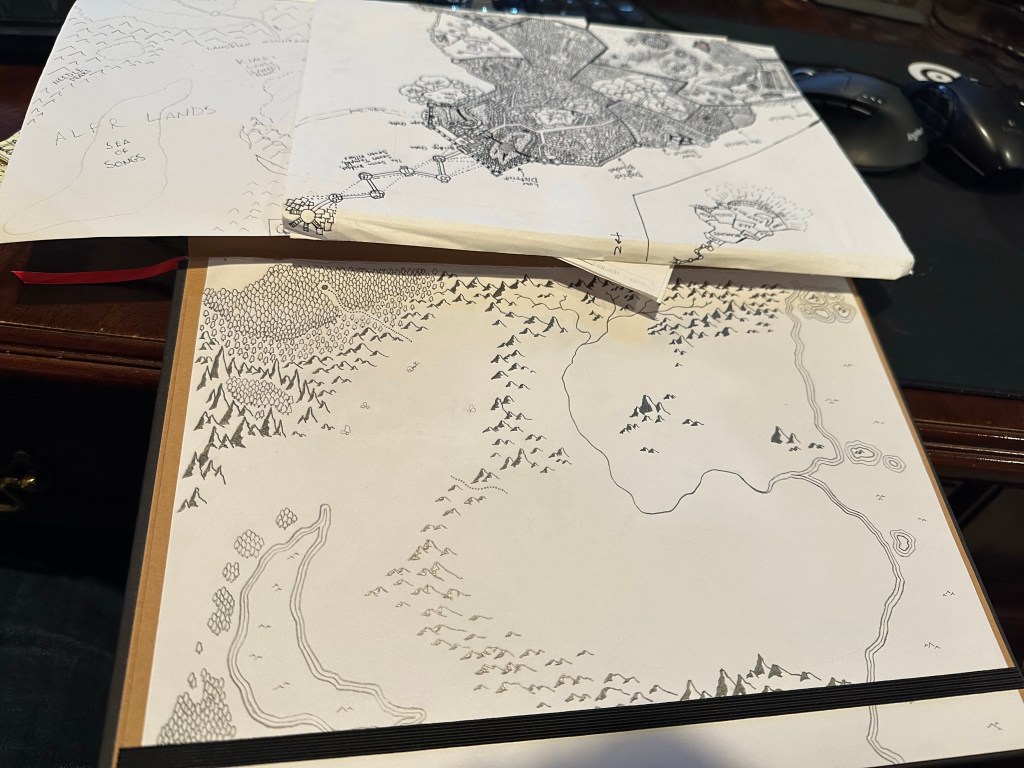
I hear that people love maps…

Whichever project I choose to do next, it’s very likely that I will end up posting less frequently. I love the blog, and it has been very satisfying to get to a point where I put out at least three posts most weeks, but I also want to produce more fiction and other work that I won’t end up posting to the blog. Since there are only so many words I can produce in a given week, that necessarily means I will end up stealing time from the blog for other projects.

That’s okay. In some ways, I feel like the blog has grown up. It’s no longer a baby blog where I post my thoughts into the void. I have regular readers that I recognize, and writing and blogging friends that I occasionally trade comments with. I don’t want to stop blogging, but I feel like the blog can continue to grow and thrive with a little less care and feeding than I’ve been putting into it so far.

See You Next Time

That’s it for this time. I’ll see you in another six months for the three-year blogoversary!

Razor Mountain Development Journal — Chapter 24

This is part of an ongoing series where I’m documenting the development of my serial novel, Razor Mountain.

You can find my spoiler-free journals for each chapter, my spoiler-heavy pre-production journals, and the book itself over at the Razor Mountain landing page.

Outlining is Hard

Once again, I am making small adjustments to the outline for the end of Act II. The end-result is two more big God-Speaker chapters, and one small Christopher chapter left to write. I don’t remember having to do much rearranging in Act I, but I feel like I’ve been doing a lot of it in Act II.

Originally, I decided to do more outlining up-front for Razor Mountain than I normally would. I wanted to make sure I knew all the answers to the questions so that I didn’t pull a LOST and write myself into a corner. In that sense, my outline has served me very well. I have a good idea of everything that I need to keep track of and reveal as I go.

The reason the chapters have changed is mostly to accommodate the flow of the story, which I don’t always have a good feel for until I’m actually in the middle of writing. What makes sense in the outline doesn’t always make sense as a sequence of scenes, especially as little things change along the way. So, I’m still writing everything that was in the outline, but slightly adjusting the order it appears in.

The fact that I have two different narratives in different time periods gives me some additional flexibility. Each narrative still follows a linear sequence, but I can choose how I switch between them in order to maximize the mystery or create the most tension.

Exposition is Hard

This chapter, much like the previous one, is a bit of an exposition dump in the form of conversation. I’m taking advantage of the assumption that Speares can be a little forthcoming with Christopher because he’s not leaving Razor Mountain, and anything he knows won’t be going back out into the world.

The challenge of Razor Mountain is that there is a lot of history and a lot of things I’ve had to figure out for the story to make sense, but it’s hard to get all of that across when most of the characters don’t actually know the truth about it. I also need to be careful of “prologue syndrome,” over-explaining all the back-story just because I know it and not because it’s necessary for the reader to understand the plot.

Next Time

The climax of Act II includes a two-chapter episode of God-Speaker’s story. The recent God-Speaker chapters jumped through time, but this bigger episode will give me room to introduce a couple new characters and jump into Act III with some big revelations.

Just in case anyone picked up on it—yes, it’s Jules Verne who wrote Journey to the Center of the Earth, not H.G. Wells as Speares says. She’s just not very well-versed in old-school “scientific romance” stories.

Razor Mountain — Chapter 24.3

Razor Mountain is a serial novel, with new parts published every week or two. For more info, visit the Razor Mountain landing page.

Once again, the streets turned them back around toward the city proper.

“Can we walk anywhere?” Christopher asked, probing for information.

“Of course not,” Speares said, “but most of the places that are off-limits to you are also off-limits to any civilians, so they’re already locked up tight. If you want to go into town, we can do that.”

“Sure. Aren’t you worried I’ll see things I shouldn’t, as a prisoner? Aren’t you worried about telling me all these things?”

“Not really,” she said. “I already told you, you’ll probably be here indefinitely, and you’ll be given the same kind of basic access that any civilian would have. If, for some reason, they decided to lock you up again, well, you’d be locked up, and it wouldn’t much matter what you’ve seen or heard.”

“Comforting,” he said. “And if they somehow decide I can leave?”

She stopped walking and looked at him askance.

Christopher held his hands up, as though warding her off. “I know, I know. No chance at all. Still, I’d rather not make it any less likely than it otherwise would be.”

“I actually had one other important thing to talk to you about,” she said. “I’ve been trying to figure out the best way to tell you.”

“That’s either ominous or exciting.”

“It’s probably neither, which is what I really wanted to make sure you understood,” she said. “I submitted that motion you asked for, but the tribunal has temporarily deferred your case.”

“What does that mean?”

“It means they set it aside for the moment.”

“I’m not a complete idiot,” Christopher said. “Why did they set it aside?”

“Well, some of the questions I’ve been asking about you were flagged in our systems. Someone in the cabinet seems to have taken an interest in you.”

Christopher frowned. “I assume you’re talking about government, not furniture?”

“Yes.”

“As in, the president’s cabinet?”

“No, no,” she said, hurriedly. “Not quite that high up. There’s a cabinet just for Razor Mountain. The military and civil authorities all get their marching orders from the cabinet. There are secretaries for various different departments, and those departments are in charge of all the different aspects of government here.”

“So some Secretary of Excavations or whatever wants to know what I’m doing here?”

“Sure, something like that.”

Christopher sighed in exasperation. “What does that actually mean for me?”

“Well, it may not be a secretary, it may just be someone who works in their office. And I doubt they would outright fight a tribunal ruling, but they do have sway as long as that ruling hasn’t been handed down yet.”

“You think this person might actually intervene and get me a ticket home.”

“That’s exactly what I didn’t want you to infer,” she said. “Their interest could mean a lot of things. It might mean more questions. It might mean you get some additional privileges. A friend in high places, so to speak.”

“And?” he said, reading her hesitant tone.

“And…it means there is now a non-zero chance that you could actually get what you want. Not a good chance, but a chance. A hell of a lot more than there was yesterday.”

<< PREVIOUS ] [HOME] [ NEXT >>

Razor Mountain — Chapter 24.2

Razor Mountain is a serial novel, with new parts published every week or two. For more info, visit the Razor Mountain landing page.

Speares led him down the stairwell, going slow for his benefit. His body was still stiff and sore, but he already felt far better than he had the previous day. It was amazing what having basic needs fulfilled could do for a person. He wondered if he was actually supposed to be let out like this, or if Speares was feeling sorry for him. She did seem to be genuinely chagrined about his situation, but she didn’t strike him as someone who would break the rules.

They left the apartment building, and Speares led him deeper into the stone-bound neighborhood, away from the central cavern. She held her notebook open in one hand as they walked. The questions today focused on the details of the bunker and the landmarks around it. Christopher suddenly wondered what the purpose of this questioning was.

“Are you trying to figure out where the bunker is?” he asked. “I assumed your people knew where all those buildings are.”

“I’m not trying to figure anything out,” she said. “If we’re being honest, I’m just told what to ask about.”

“I could probably point out the location on a map, if that would be helpful,” he said.

“It might be,” she replied. “I’d have to get hold of a map though. Let’s put a pin in that.”

“Do you think they actually lost a whole bunker?”

She smiled. “As ridiculous as it sounds, it wouldn’t completely surprise me. There are a number of out-buildings, and they’re all well-hidden, for obvious reasons. From what I know, they aren’t all continuously populated. And in my experience, the bookkeeping isn’t always stellar.”

The narrow street wrapped around in a wide loop, eventually turning back toward the center of the city. They came to a cross-street, and Speares took a left, leading him into another side neighborhood.

“How old is this place?” Christopher asked. “It seems like it would take ages to carve this all out of the rock, even if there were already some caves here. I can’t imagine any caverns this size would form naturally.”

“I’m afraid I don’t know much about the engineering behind it,” she said. “I know that there has always been somewhere in the city where they’re drilling or digging, as far back as I can remember. The excavations aren’t exactly fast, but they just keep at it, day in and day out.”

“Someone must have designated the money for all this though. The president or something? When did it start?”

She smiled. “That’s the kind of knowledge that’s way above my pay grade. The laws around Razor Mountain have changed over the years, but it’s been around in some form for well over a century. Nobody living here today was around when they first started digging holes. Or if they are, they aren’t talking about it.”

“That’s crazy. How much of this could they even do with early 1900s technology?”

Speares lowered her voice mock-conspiratorially. “Well, there are all sorts of rumors. And only ninety percent of them are insane conspiracy theories.”

“Is that even a fair thing to call it?” Christopher asked. “As an outsider, I think it’s safe to say you live inside a giant conspiracy theory.”

“Fair,” she said, “but I’ve heard everything from hollow earth, H.G. Wells kinds of theories to ancient aliens. A lot of people subscribe to the theory that big chunks of these caverns were already carved out perfectly, and nobody knows how. They were just found.”

“What do you think?”

“I think, like most things, it’s probably a lot more straightforward and less interesting than anyone believes. I think someone clever figured out how to dig out the caverns, maybe a long ways back, when people wouldn’t have thought it possible. And then they just kept digging, using whatever new technology they could. I certainly have a hard time believing some of the crazier rumors. I think this place has always been a government project, or at least became one very early in its history.”

Christopher thought in silence for a moment.

“That sounds reasonable, even if I have a hard time believing that anyone could make this place without spending insane amounts of money.”

“I don’t get to see the bills,” Speares said, “but who’s to say they don’t spend insane amounts of money?”

“Surely someone would notice that much secret spending.”

Speares shrugged. “There are a lot of government programs that are…less than transparent. All those three-letter spy agencies have big budgets, and we don’t know what they get spent on.”

“Someone, somewhere is keeping tabs on those programs though,” Christopher said, questioning the words as soon as they exited his mouth.

Speares gave him a look like he was a small child making proclamations about things he didn’t understand.

“Yeah, okay. I still think it’d be essentially impossible to keep something so big and expensive hidden for so long.”

“You didn’t know about it, right?” Speares said.

“Of course not.”

“And that’s why you’re in…this whole situation,” she said, gesturing vaguely at Christopher.

“Yeah,” Christopher said. “That whole ‘effectively imprisoned for life despite doing nothing wrong’ situation.”

“That’s the one.”

<< PREVIOUS ] [HOME] [ NEXT >>