Reference Desk #17 — Story Engine: Deck of Worlds

If you’ve been around here for a while, you might remember my review of The Story Engine. The Story Engine is part card game, part tool for generating semi-randomized writing prompts. I’ve used it as a fun way to brainstorm ideas for short stories, and I’ve found that it works well for me. As someone who enjoys card and board games, it’s just a much more fun and tactile way to generate ideas than sitting in front of the notebook with pen in hand.

Recently, the folks behind the original Story Engine kickstarted a new product in the same vein. It’s called the Story Engine: Deck of Worlds. Deck of Worlds is another card-based brainstorming game, but this time it’s focused on settings instead of plots. It’s billed as a tool for storytellers and TTRPG game masters to easily generate interesting and deep settings.

I received my order right before the holidays, and I was able to take Deck of Worlds for a test drive.

What’s In the Box?

The base set of cards for Deck of Worlds comes in a flat box with a plastic insert, magnetic latch, and a heavy tagboard sleeve that guarantees it will stay closed. This is nearly identical to the box that the original Story Engine came in, and the build quality is good. It’s the sort of box you’d expect from a premium board game.

However, the original Story Engine had many expansion packs that added more cards, and Deck of Worlds is the same. If you add extra cards to your set, you’ll quickly fill up the small amount of extra space in the box. Luckily, the creators of the Story Engine are well aware of this problem, and they’ve created a new card box with dividers that is capable of holding all the cards, even if you’ve got every single expansion. They’re inexpensive, so I got one for my original Story Engine set as well as my Deck of Worlds.

I also received three expansion packs for Deck of Worlds. “Worlds of Chrome and Starlight” is the science fiction expansion, “Worlds of Myth and Magic” is the fantasy expansion, and “Worlds of Sand & Story” is the deserts expansion. I chose these because sci-fi and fantasy are my two favorite genres to write in, and I have a TTRPG project percolating with a strong desert component.

Much like the original product, the Deck of Worlds main box includes a slim “guidebook,” which describes the intended ways to use the Deck of Worlds—although the creators are clear that there is no wrong way to play.

The Card Types

There are six card types in the Deck of Worlds: Regions, Landmarks, Namesakes, Origins, Attributes, and Advents. According to the guidebook:

  • Regions establish a setting’s main terrain type and act as a hub for other cards
  • Landmarks add geographical sites and points of interest
  • Namesakes combine with Regions or Landmarks to create in-world nicknames
  • Origins record significant events of the area’s past
  • Attributes highlight present-day features of the area and its people
  • Advents introduce events that may change the area’s future

Regions are the only cards with a single prompt on them, and have a nice background that illustrates the geography of the setting. Landmarks have two prompts to choose between, and each one has a background illustration. The other four card types have a symbol and color to identify the card type, and four different prompts to choose from.

Building Basic Settings

The simplest way to play with Deck of Worlds is to create small settings, or “microsettings” as the guidebook calls them. These will typically be built around a single region (terrain type) and a single landmark, like a building.

For my test run, I built a few of these microsettings. First, I chose the prompts I liked best and combined the cards. Then I expanded or focused the results, writing a little blurb about each setting. I only spent a couple minutes on each of these examples.

The Grassland of Crowds

The museum’s founding piece is a huge fulgurite dug out of a sandy hill. The museum was built around this dug-out hill, and the piece is displayed, unmoved, where it was found.

The “lightning festival” grew in this area, and is held during the season of rainless storms. People display all kinds of art. One of these presentations is voted the winner of each festival and incorporated into the museum.

The Scree of Rivers

(Cyberpunk) The scree was mined for the long, winding veins of precious metals near the surface, leaving a maze of narrow, shallow canyons and piles of leavings. Rivers form when it rains. A grey market meets here periodically, protected from government scanners by the trace metals in the rock, with lots of escape routes and hidey-holes for quick getaways.

Not sure about the prophecy bit.

City of Sand and Story
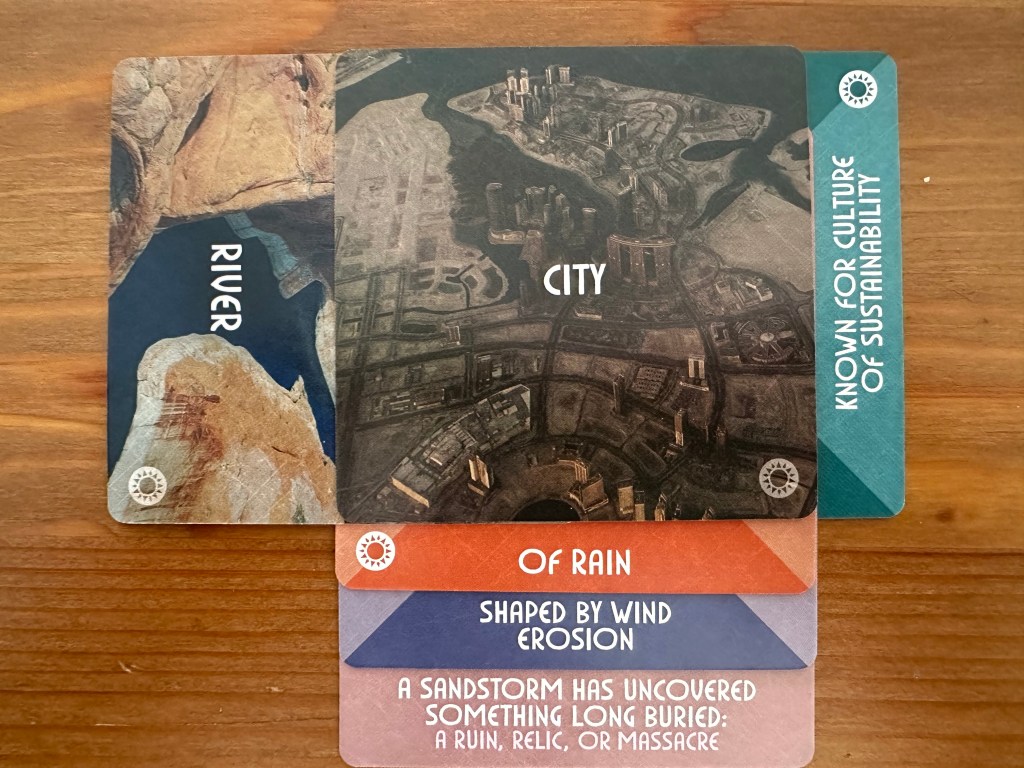
The City of Rains is nestled in rocky mountains in a desert. During the wet season, the mountains funnel moisture and clouds and it rains on the city, creating a temporary river. All inhabitents capture as much water as possible, to live on and trade for the rest of the year. They plant crops along the river while it lasts.

A recent sandstorm uncovered caverns in the rock beneath the city, leading to underground ruins and vast cisterns. The discovery of so much water could upend the economy of the entire region

Complex Settings

The guidebook also includes some rules for building more complex settings out of multiple microsettings. There is really no limit to the number of smaller settings you could combine. There are optional rules, including a “meta-row” for attributes of the larger area as a whole, a “sideboard” of extra cards to give you more choices when selecting any given card type.

To test this out, I built a setting from four different microsettings, using the meta-row (on the left) and sideboard (on the right).
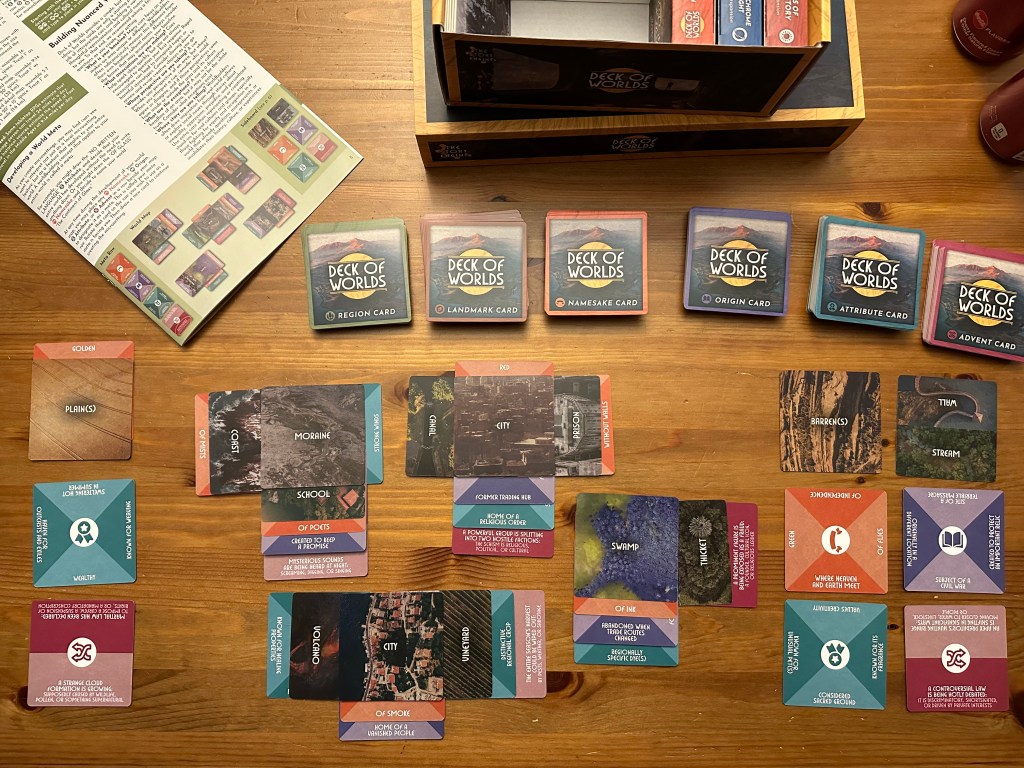
The Golden Plains

Once known as a wealthy region, but its reputation is fading. The area has been covered with strange dark clouds for weeks, but there is little rain.

In the North: The Red City

Home of a religious order, this city was built on a river and filled with canals. It was once a hub of commerce, but the river grew over the years and eventually overflowed its banks south of the city, disrupting the flow and creating a vast swamp.

Now, the priests of the Red City ply a darker trade: they’ve made the city into a prison for the worst criminals. The prison is the center of the old city, and is called “The Prison Without Walls.” It is surrounded by deep and fast-running canals, and is only accessible by a single, heavily-guarded bridge.

The priests have traditionally been led by a patriarchal lineage of high priests, but now a lowly priestess is gathering a following among priests and prisoners alike. She has radical ideas of rehabilitating prisoners instead of working them to death as penance for their crimes.

In the South-East: The Swamp of Ink

These thickets were once hunting grounds of the nobility, until the river overflowed and the land became swampy.

The few people who still live here are led by an excommunicated priest from the Red City. They harvest “swamp mites,” tiny, stinging crawfish that can be ground into fine black dyes. Travelers from the North recently called out the priest as an exile, and he imprisoned them, but there is unrest and talk of rebellion among the people.

In the West: The Moraine

The coast of mists is the western edge of the Golden Plains region.

The Moraine is the home of the School of Poets. It was created by a celebrated poet who was known as a cantankerous jerk. The only woman who ever loved him, muse of his thousand poems, made him promise to teach other poets his craft.

The school is rumored to be haunted. While most of its inhabitants don’t take this seriously, many students have recently complained of strange and disturbing noises coming through the stone walls.

In the Southwest: The City of Smoke

A city on the slopes of an inactive volcano, built atop the ruins of the “old city,” which was destroyed by the last eruption.

Hot springs in the city are warmed by the heart of the volcano. They supposedly have healing properties, and draw tourists who hope to have their injuries or sickness cured.

Vineyards planted in the fertile volcanic soil use a unique variety of small, golden grapes, harvested after the first frost to make sweet wine.

The dark clouds that have shrouded the region threaten the growth of the grapes and the year’s wine harvest.

Takeaways

Overall, I’m pretty happy with the Deck of Worlds so far. It has a very similar feel to the original Story Engine. The cards strike a nice balance by giving you a few options to pick from, but also limitations that force your brain to make interesting and occasionally surprising connections between seemingly unrelated things.

Like any sort of brainstorming, not every single idea will be a good one. The randomization means that sometimes you get combinations that just fall flat or fail to inspire. Some of this depends on your own creativity and willingness to explore.

Like the original Story Engine, the quality of the product is great. The new boxes are an improvement, allowing me to keep all my original and expansion cards together in a form factor that takes up less space than the original box.

I don’t necessarily like all the rules suggested by the guidebook, but it’s easy to tweak the process until it works for you. They’re just cards, and they can be arranged however you see fit. The extra rules for bigger settings are a little complicated for my tastes, but the end result in my experiment had some interesting ideas that I wouldn’t mind exploring further.

The guidebook also has more rules that I didn’t get into, for collaborative multiplayer and for combining Deck of Worlds with the original Story Engine. All of that feels like more complexity than I want when I’m brainstorming—I would much rather create smaller ideas and then mix and match myself. However, I’m sure this style of prescribed creation could work for others.

Finally, I think this could be a great tool for GMs/DMs who run custom table-top RPG campaigns. I’ve long believed that the best way to approach TTRPG worlds is the “billiards” style described by Chris Perkins, where you set up a number of interesting locations full of interesting characters, and then let the player characters bounce around between them, setting events in motion.

The Deck of Worlds is a great way to invent these little islands of content, and I think it would be pretty easy to create quick and dirty sessions with very little prep, especially if you’re using a lightweight rule set.

Where to Get It

The Deck of Worlds and its expansions are available directly from the Story Engine website. In addition to the Sci-fi, Fantasy and Desert expansions I chose, there are Horror, Coastline, and Arctic expansions. If you’re planning to use the deck for tabletop RPGs, they also have expansions for lore fragments, cultures, and adventure prompts.

Razor Mountain Development Journal — Chapter 22

This is part of an ongoing series where I’m documenting the development of my serial novel, Razor Mountain.

You can find my spoiler-free journals for each chapter, my spoiler-heavy pre-production journals, and the book itself over at the Razor Mountain landing page.

Developing God-Speaker

In this chapter, I had two important things I wanted to accomplish. The first thing: showing a formative event for God-Speaker, where he once again loses someone close to him.

As I’ve mentioned previously, God-Speaker only gets about half as many chapters as Christopher in the book. This is partly because it draws out some of the mysteries, and partly because I want it to feel more like Christopher’s story than God-Speaker’s story.

In Act II, each of the God-Speaker chapters really needs to pull its weight in terms of developing God-Speaker’s personality, and revealing his long, long history. The challenge for me is that these chapters jump drastically through time and feature characters that only appear in a single chapter.

When a character dies, I usually want it to make a big impact on the reader. In the case of Strong Shield and Sky-Watcher, the reader barely knows these characters, and can’t really be expected to feel much for them. However, the purpose of these characters is really just to be foils for God-Speaker in different ways. They don’t have much development, but they have to help to build God-Speaker’s character.

Sky-Watcher accepts her own death with dignity, but God-Speaker does not. After all, he’s been alive for many lifetimes at this point, and he’s used to getting what he wants.

The Mechanics of Magic

The voices deep inside the mountain still aren’t completely explained. That’s a mystery that I want to draw out. However, there are plenty of hints about their origins that many readers will pick up on.

The voices provide God-Speaker with knowledge that would otherwise be far beyond human technological understanding at these points in time. This allows God-Speaker and his little civilization to excavate the underground city and make it livable.

The voices also give God-Speaker other powers, powers that seem to be beyond mere technological advancement. They give him the ability to live far beyond a normal human lifetime by transferring his consciousness to a new body. In this chapter, I also try to explain the mechanics of the “oracles,” specially trained people who can use the voices to move their consciousness through time instead of space.

I’ve found it a little challenging to clearly describe the mechanics of the “magic” while not making it feel like straight exposition. I may revisit this in a later editing pass.

Approaching the Present

In my outline, there are only two God-Speaker chapters left—in Act II and in the book as a whole. The final act of the book will belong to Christopher. These last two God-Speaker chapters will both take place in the same time period, bringing us within a couple decades of the modern day, in the final big time jump of the narrative.

This is an exciting part of the book for me, because it’s where the two main characters’ narratives finally come together. It also marks the point where a lot of the mysteries will be resolved.

Next Time

We’re back to Christopher for a long chapter. We’ll see a little bit of the modern state of the underground city, and see that things are not quite right. Christopher is still trying to get back home, but it seems less likely than ever that he’ll ever leave Razor Mountain.

Razor Mountain — Chapter 22.2

Razor Mountain is a serial novel, with new parts published every week or two. For more info, visit the Razor Mountain landing page.

They sat together, facing each other in the middle of the chamber. The strange symbols and shapes that adorned the metal walls of the room glinted like ghosts in the unearthly light.

God-Speaker had grown adept in tuning the voices, ignoring them when he wanted to, or bringing them to the fore of his mind. Now, he let them come to him. They never tired, never faded. They were always desperate to sing about past glories and times long-forgotten. They needed an audience. Without someone to listen, they went mad. Without someone to listen, they truly had no way to act upon the world around them. This, above all else, they couldn’t bear. It was as close to death as they could come. Always, they were seeking entry into his mind, but he was too different, to strange to them.

The background hum came into focus, and God-Speaker heard the individual voices, sometimes harmonic and synchronized, sometimes dissonant and syncopated.

“Listen closely to the voices,” he said. “Listen for the differences, the high notes and the low notes, the fast and the slow. They are like a rushing river, very loud, but composed of many different sounds.”

He opened his eyes to slits to look at her. Her own eyes were closed, her eyebrows scrunched down in concentration, her lips pressed tight together.

“I hear the low voice,” she said. “But it comes and goes. I can’t follow it.”

They went on, as he carefully described the rhythms and sounds he heard. He described the individual voices and the groups. Sometimes the voices brought particular feelings or ideas to the fore, and he mentioned them. Sky-Watcher’s face grew more creased and furrowed as the minutes passed. Her cheeks flushed and a bead of sweat ran down her temple, though the chamber was cool and dry.

God-Speaker pushed her, even though she was clearly exhausted. She had less and less energy these days. He knew he should stop. She was not making any progress. But he needed something. He had to believe in some sudden epiphany where it would all come together. It would happen for her the way it had for him, when he first heard the mountain speak so long ago. That too was a desperate time. Perhaps it was only such an experience that could make it happen.

If it was to happen, it would not be tonight. He let himself admit it.

“We should stop,” he said.

Sky-Watcher opened her eyes and nodded. She took a deep breath and her shoulders sagged.

“Alright. Just give me a minute before we go back.”

It was several minutes before she was ready. He waited in silence. She was tired, and he didn’t want to rush her or cause her any more stress. He already regretted pushing her so hard, but he was driven by the iron-hard ball of fear at the bottom of his stomach.

Finally, she turned and struggled to stand up. He rushed to help her.

He remembered their long hikes in the woods surrounding the mountain, laying in the snow in the middle of the night and staring up at the stars. There were no long hikes anymore.

They made their way along the dark, narrow path. He walked behind her, one hand on the smooth stone wall and the other on her waist. She led the way, setting a pace that was comfortable for her, and he was ready to catch her if she stumbled in the darkness.

They crossed the main avenue of the mountain city, but it was late now, and the street was quiet.

Finally, they came to the last ordeal, the stairway. She had to stop twice to catch her breath at the landings. God-Speaker wanted to say something, but there was so much to say that the words stuck in a tangled mass in his throat.

They reached the doors to his apartments, and he unlocked them with the brass key that hung on a chain around his neck. Inside, she led him to the balcony, the one that faced the outside world. Sensing where they were going, he took a blanket from a chair along the way. As they stepped out, the cold air stung him. He tried to wrap the blanket around her shoulders, but she shrugged it off.

“Let me feel the air for a moment.”

The balcony was built to be invisible from below, blending into the rock. From within, it offered an unparalleled view of the surrounding country, harsh and beautiful. They looked out on the slope of the mountain below, the patches of forest and bare rock and water. The moon was bright, giving a sharp white edge to the trees and snow-dusted ridges. Distant lakes shone like silver coins.

God-Speaker laid the blanket out on the balcony, and they lay down next to each other. Sky-Watcher took his hand and held it ferociously. He realized then that she had also spent their walk back trying to find the words to express something.

“This is where I belong,” she said. “Not down beneath the mountain.”

He wondered if that was a faint accusatory tone in her voice, or only disappointment. But there was happiness too. She was always happiest under a starry night sky.

“Have you been able to use the new telescope?” he asked. It was a marvel of engineering, even by Razor Mountain standards, housed in a chamber a little further up the slope.

“No,” she said, “not very much.” There was a catch in her voice.

He tried to find the right words.

“I am sorry, if I’ve caused you pain. I know this is not what you want to be doing.”

She shook her head and squeezed his hand. He turned and saw that she was crying.

“I’m sorry. It hurts us both, what is happening to me. You’ve taught me so much…there is only one thing I’ve wanted to teach you, but I don’t know how.”

“It’s okay,” he said.

“No, it isn’t,” she replied. “Not for you.”

“I don’t…”

She put a hand on his cheek, gently turning his head to face her.

“This is okay,” she said. “This right here, you and I, on this blanket under the stars. This is all we need.”

Now he had to close his eyes to stop the tears.

“I cannot lose you.”

“You can,” she said. “It will be alright.”

“It isn’t!”

“Even you,” she said, “have your limits. I’m not afraid of dying. You don’t need to be afraid either.”

“I can’t live without you.”

She kissed his forehead. “That’s a choice you must make. Besides, how many others have you seen come and go? How many have you outlived?”

“It’s not the same.”

She shrugged. “It’s the same to the stars. It’s the same to the mountain. It might feel different to you and to me, but it’s not. It’s just what happens.”

“There’s still time,” he said. “You can do what I do. You don’t have to die.”

“You cannot put all your happiness upon that,” she said. “I have tried, for you. I will be sad to let you go. But if that must happen…it will happen. I can accept that. I’m happy that I had these nights under the stars. That is enough for me.”

“You could stay with me forever,” he said.

“Forever is too much,” she replied. “Everything has an ending.”

He opened his mouth, then closed it again. He wanted to shout, to plead. He couldn’t accept it. But he could see the weariness on her face. He pulled the blanket close around them, and she looked up at the heavens while he studied the reflections of the stars in her dark eyes.

He didn’t realize he had fallen asleep until he was jolted awake by a dream of falling. The same dream he had so often these days, of falling through a crack deep in the mountain, into an endless abyss. He blinked blearily. He was cold, and she would be freezing.

He pulled himself up onto his elbow to look down at her. Sky-Watcher lay under the night sky, her face serene. She still stared up at the stars, but the twin mirrors of her eyes were dull, and there was a slackness to her expression. He held a hand to her cheek. She was too still and too cold.

The panic rose in his chest as he felt for her heartbeat in the vein at her neck, but there too he felt only stillness.

<< PREVIOUS ] [HOME] [ NEXT >>

Razor Mountain — Chapter 22.1

Razor Mountain is a serial novel, with new parts published every week or two. For more info, visit the Razor Mountain landing page.

God-Speaker paced between the rooms of his newly expanded home. He tried to focus, to appreciate the small details of each room and the sheer amount of clever engineering and human labor that went into the construction. Instead, he kept forgetting his inspection, catching himself standing in one room or another, eyes glazed. His mind was a buzzing hive of thoughts, distractions heaped upon distractions.

A hallway connected the rooms of his apartments in a long line. During the day, light was piped in from above. Now, as evening deepened, the faintly flickering natural gas lamps illuminated the rooms from hidden recesses. The walls were cut directly from the stone, smoothed and polished to reveal the natural strata and variations of the mountain. In some places, they were carved into delicate arabesques and geometric motifs. The floors were tessellated stone tile in every color that occurred within the mountain, stylized depictions of the local wildlife, perfectly interlocked.

At either end of the hallway was a balcony. One faced outward from the mountain, offering an unparalleled view of the surrounding landscape. The other looked inward, down on the perpetually growing city within the mountain itself. God-Speaker made his way to this inner balcony and looked down on the main street from the peak of the man-made cavern. His vantage point was only ten feet above the low rooftops, but it was still a marvel that this had all been solid stone only a few lifetimes ago.

He felt the rumbling in the distance as much as he heard it. The excavators would be working sixteen hour days until the latest expansion was done.

God-Speaker stretched, trying to straighten his stiff spine. His body was rapidly losing the suppleness of youth, and once again he felt the aches and pains of age creeping in. It was a familiar pattern, but no less irritating for it. In a few more years it would be time to finalize the replacement.

The sound of the entry doors unlocking came from down the hall. It was a the sound of stone mechanisms sliding and thunking into place, not loud, but designed to be audible from any room. Even with a key, nobody could enter without him knowing.

He left the balcony and walked to the entryway. A stone face was carved into the wall next to the doors. Its jaw hid a mechanism that could bar the doors from within. The doors were already open, and he could see beyond, to the winding staircase that led up from the caverns below.

Sky-Watcher stood in the doorway. She wore her long black hair in a loose braid that fell to her shoulder. Her eyes were such a dark brown that there was no discernible separation between the iris and pupil. Those eyes were wells of mysterious darkness in her otherwise expressive face.

“Are you going to let me in, or must I stand here while you admire me?” she asked.

He moved aside to let her in, but he continued to admire her. Her olive skin was freckled with deep brown moles. Her nose had a slight crookedness, where it had been broken when she was a child. But as she passed him, he saw an unfamiliar gauntness, her cheekbones more prominent than usual.

“Have you been eating well?” he asked.

She shrugged. “I sometimes have some trouble keeping the food down,” she said.

“Have the herbs helped at all?”

“They lessen the nausea a little. But you said yourself that they do not treat the problem itself.”

“No,” he said. “They do not. I have spent days consulting the voices of the mountain, and there is no natural remedy. There are things we could make, but…it would take machines. Skills and practice. Time we do not have. We won’t be able to do these things for many years.”

She sighed. “As you have said.”

“There is only one way,” he replied. “You need to hear the voices. You need to do what I do. Did you try again this morning? Did you feel anything more?”

She shook her head. “I hear what I have always heard. Faint murmurs, and nothing more.”

His brow creased. “You can’t be complacent. They are there, if only you can hear them.”

She shrugged again, irritatingly indifferent. “It is not my place to hear the voices, my love. It is your place. You speak to the spirits, and I watch the stars.”

“The oracles hear the voices too,” he said. “You can do this.”

“The oracles cannot do what you do,” she replied.

“It is different,” he said, “but not so different. My connection to the voices is clearer. I can know what they know and see what they have seen. I can cast my mind out in the current moment. I can touch other minds. The oracles cannot reach out to other minds. They can only find themselves. They send their minds back along the thread of time and find themselves. They can send back important messages. As long as I can send messages through the oracles, no disaster can befall us. We can send a warning back to ourselves.”

“But you’ve never sent a warning,” Sky-Watcher said.

“I will send one about your condition,” God-Speaker said. “Or rather, my future self already sent the message.”

She shook her head. “I still don’t understand. You say you sent the message because I died. But if we find a cure for me, that won’t happen. Things will be different. The message will be different.”

“I can still send the same message,” he replied.

“But things will be different. It won’t happen the way it happened before.”

He shrugged. “Even the voices don’t completely understand how it works. We cannot send messages forward, the way we can send them back. It may be that there are many threads of time.”

“Then there may be another God-Speaker out there who is alone.”

“Perhaps. But he has given me the opportunity to save you.”

“If I could do what you do.”

“I know you can,” he said. “I will help you.”

“Very well,” she said. “I have energy enough for one more try tonight. But you must promise me that afterward we will lay beneath the stars.”

“Of course.”

She turned and took his hand, leading him out to the staircase as the stone doors slid closed behind them. The path was long and winding, but the stairs themselves were shallow and punctuated by wide landings. Eventually they came to another, smaller door. After they passed through, this one closed seamlessly into the smooth wall behind them, almost perfectly hidden, and they came out into the mazes of hallways that ran among the living spaces on the outskirts of the larger caverns.

They walked briefly down the central avenue, passing stores and workshops. A few of his people passed and nodded respectfully or pressed a fist to their chests in salute. Then God-Speaker and Sky-Watcher entered another branching series of hallways, this time on the opposite side of the cavern. A concealed door at the back of this hallway opened onto a small room with a low, narrow exit into darkness.

There were no gas lights, no cleverly engineered mirrors to channel sunlight into the depths. This was a hidden path, and he wanted it dark. It was a sacred place, and the walk through the void seemed somehow appropriate. It was the way he had first come to this place.

There was no real danger. The floor of the path had long ago been smoothed, and the cracks and crevices filled in. With hands on both walls, one only needed to walk forward. The glow ahead was so faint at first that it was impossible to tell if it was even there. With each twist and turn, it intensified.

Finally, they came to the cylindrical chamber. The light was still weak, but somehow hit the back of his eyes with an uncomfortable intensity. It left streaks of blue in his vision when he blinked. The room seemed to rise endlessly above them, where the light faded into darkness before it could find a ceiling.

God-Speaker stepped into the chamber and turned as Sky-Watcher entered. She raised a hand to guard her eyes from the harsh light, but she tripped at the small lip at the threshold. God-Speaker jumped forward to catch her.

“I’m fine,” she muttered, but God-Speaker felt the way she sagged in his arms, the effort of standing up on her own feet again. Instead, he gently lowered her and himself to their knees.

“You are not fine. You’re getting worse.”

She sighed. “You said yourself that I would.”

“All the more reason to do this,” he said.

“Tell me again what I must do,” she said. “Lead me with your voice.”

<< PREVIOUS ] [HOME] [ NEXT >>

Reblog: The Mystery Box Is Broken — Justin Kownacki

Today’s reblog is courtesy of Justin Kawnacki, who discusses the “mystery box” style of storytelling, as popularized by J.J. Abrams and the show LOST. This kind of storytelling has driven many of the biggest successes on TV and streaming in the last decade or two.

Still, shows like LOST and Game of Thrones prove that just because you can capture audience attention with this formula, it isn’t necessarily easy to wrap up these shows in a satisfying way, or even in a way that avoids outright enraging your audience.

In the case of Lost, those myseries were compelling questions like: Who are all these people? Where are they? Why are they there? (When are they there?) How did their plane crash? How will they survive? What unseen force is behind all of this? Who can we trust?

In the Abrams formula for storytelling, more mysteries = better stories, because every new answer creates more new questions. This means the audience will keep coming back to scratch their intellectual itch, and spread the word about the mysteries in the process.

To be fair, in the case of Lost and other stories that have used this model — including Game of ThronesWestworld, and nearly every Christopher Nolan film — he’s mostly right. Audiences do love mysteries, and they enjoy trying to piece hidden clues together in order to see if they can figure out the ending before everyone else does.

But: a mystery is not necessarily a story.

In theory, there’s nothing wrong with using the Mystery Box as a storytelling tool.

The problem is the way it’s been used, and the troubling effect it’s had on audiences.

Let’s take a look at the impact of the Mystery Box on pop culture, and then consider one tweak to the formula that could fix nearly everything that’s wrong with it.

Read the rest over at Justin Kownacki‘s blog…

My Writing Process — 2022

One of the goals of Words Deferred has always been to open up my writing process for everyone to see. I don’t claim to have the perfect process, and I think the best way to write will ultimately be different for each writer. However, there’s surprisingly little talk among writers about the day-to-day details of what writing is like, and I want to do my small part to change that.

As the end of the year approaches, I thought it would be interesting to look at the writing I’m doing and the tools I’m using in 2022. Then I can look back on this next year and see how things have changed, or if they’ve stayed the same.

Ideation

Writers are known for carrying little notebooks and jotting down ideas whenever and wherever they appear. In the past, I’ve carried pocket-sized notebooks, but I went entirely digital several years ago.

My digital notebook of choice is Microsoft OneNote. I have separate tabs for general brainstorms and ideas, short stories, novels, blog posts, lists of books I might eventually read, and more. When I need to take notes on the go, I just jot them down on my phone. OneNote synchronizes automatically between phone and laptop, with only occasional weird formatting issues.

My OneNote. There are a lot of pages hidden under those headings…

Novel Writing

For novels, when I’m ready to go beyond the idea-gathering stage, I move all my notes from OneNote into Scrivener.

As far as I am concerned, Scrivener is the best novel-writing application out there. Where it really shines is in the way it lets me split a big project into nested parts. I split Razor Mountain into folders for each act, then split out each chapter into its own document under those folders. I have separate sections for major characters, locations and other research notes.

With a click of a button, I can look at the chapter summaries on a cork-board view, and I can drag-and-drop chapters in the document tree to rearrange them, something that has been really convenient as I’ve merged and moved chapters in Act II. Scrivener also has built-in support for “snapshots,” which I use to save each revision of each chapter. I typically save at least a rough draft, a second draft after some editing, and a third draft once I’ve gotten reader feedback.

To ensure that my work is fully backed up, I save my Scrivener files to Dropbox, which copies them across my computers and my phone for safe-keeping. I do have the mobile version of Scrivener, but I almost never use it. I love taking notes on my phone, but I do not enjoy long-form writing on that tiny keyboard.

Serial Publishing

I’m publishing Razor Mountain as a serial in three places: here on the blog, on Wattpad, and on Tapas. I chose to do this so that I could get a feel for the different platforms, and to try to increase the visibility. However, I haven’t done much to promote the Tapas or Wattpad versions, so pretty much all of my regular readership is on WordPress. I keep telling myself that I’ll eventually put some love into Tapas and Wattpad, and that may actually happen at some point. Either way, I’ll continue on all three until Razor Mountain is finished.

Because I’m posting to three platforms, my process for this is a little bit insane. It goes something like:

  1. Write the first draft and first round of edits in Scrivener.
  2. Copy it to Google Docs for easy beta reader feedback. Fix the formatting that doesn’t transfer nicely.
  3. Make changes based on feedback in Scrivener, and decide how to split the chapter into multiple posts.
  4. Copy it to a OneNote template with the brief description at the top and links to previous/home/next at the bottom.
  5. Copy from OneNote to WordPress. Schedule the posts.
  6. Copy from OneNote to Wattpad. Fix all the formatting that doesn’t transfer nicely. (Wattpad has no way to schedule posts.)
  7. Copy from OneNote to Tapas. Fix the formatting that doesn’t transfer nicely. Schedule the posts.
  8. On the scheduled day, chapter parts automatically post to WordPress and Tapas.
  9. I have to manually post the saved draft to Wattpad. I also have to update the previous/next links in the WordPress post, and I need to add links to the Razor Mountain home page. Depending on how busy I am, I sometimes forget to do these things, and I typically don’t catch it until I start posting the next chapter.

Some of this complexity comes from posting in three places, each with their own idiosyncrasies. It’s obnoxious how often copy/pasting between tools and websites causes the formatting to be lost. It’s doubly obnoxious that Wattpad doesn’t let me schedule posts.

I suspect there is probably a way to add WordPress links (previous/next and home page) that point to a scheduled post and only work once the post is “live.” I haven’t spent the time to figure it out though.

Short Stories

The majority of my writing time this year went toward Razor Mountain and the blog, but I have managed to sneak in a few short stories.

For microfiction, drabbles, and flash fiction, I often just work in OneNote. Unlike novel writing, I sometimes do work on short short stories on my phone, and I typically do not need organizing features or formatting more complex than italics and bold.

For longer stories, I usually use Microsoft Word on the laptop. Oddly, I copy to Google Docs for easy beta reader feedback, but I never really write in it. I’ve been using Word for years and I’m comfortable with it.

For all of my stories, I save everything to Dropbox to make sure it’s backed up. When it comes time to find places to submit stories, I use Duotrope.

Blogging

My blogging schedule has fluctuated over time, but these days I try to post Razor Mountain chapters every other week.

Unless a chapter is around a thousand words or less, I will break it into 2-3 parts of about a thousand words each. I’ve read that 500-1000 words is the sweet spot for keeping readers’ attention for blogs, and a slim majority of my WordPress readers are on mobile, where a post of that size feels bigger on the page than it does on a full-size monitor or tablet. Tapas and Wattpad don’t have that kind of detailed dashboard for writers, but they do say that most of their readers are also on mobile.

Along with the chapters themselves, I write a development journal for each Razor Mountain chapter. Sometimes I post the chapter parts earlier in a week (e.g. Wednesday and Thursday), and the development journal on Friday. If I have three parts in a chapter or get a little behind, I will sometimes post the development journal the following Monday. I used to worry about maintaining an exact schedule, but nowadays I just aim for a schedule and adjust as needed.

I write blog posts unrelated to Razor Mountain on the “off” weeks, and sometimes for the Monday of Razor Mountain weeks as well. I’ve been blogging long enough now that I have a few ongoing series of posts, so I will often mix one of those posts with something stand-alone in a given week.

I’ve gotten in the habit of posting reblogs every other Wednesday. Writing three blog posts in a week is too much for me, and reblogs are low-effort (while hopefully still interesting content). They occasionally result in some cross-pollination with the other blog’s readership. Their main purpose is to serve as a good motivation for me to regularly read other writing blogs. I maintain a list of interesting articles and blog posts in my OneNote, and trawl through them for these reblogs.

For the header images on my posts, I use Pexels. I don’t usually do any picture editing apart from cropping. If I have a really difficult time finding an image that I’m happy with, I will occasionally check Unsplash. Both of these sites offer pictures that are free to use and do not require specific license language to be displayed.

(If you’re blogging, please do yourself a favor and always check the licensing and make sure you’re attributing correctly. There are trolls out there who will sue you for hundreds of dollars, even for such non-crimes as using the incorrect version of Creative Commons. And if the image isn’t licensed for your use, don’t use it!)

I make it easy on myself and always use the same cover image for Razor Mountain chapters, and pictures of mountains for development journals. For all other posts, I just search for terms vaguely related to the content.

I always write my blog posts in OneNote, do an editing pass, and then copy/paste them into WordPress. I almost never publish a post immediately. Instead, I schedule them for 7:00am CST on a subsequent day—usually Monday, Wednesday or Friday.

Tracking

My latest endeavor is to try to get a better understanding of how I’m using my writing time. Lately, I’ve been using ClickUp. I like it for charting “deadlines,” even if they’re entirely self-imposed, and laying out a schedule of things I intend to write.

And even though I’ve explicitly said in the past that I don’t want to end up tracking things in Microsoft Excel, I’ve been doing a little bit of tracking in Excel. I haven’t found a great way to roll up the time spent on different projects in ClickUp in a way I like. Excel makes it dead simple to make a few columns and track days, projects and half-hour increments. It’s all compact and easy to eyeball, and there’s always an easily searched website that will tell you how to translate a few columns into an interesting graph, even if Excel formulas make me feel a little dirty.

This tracking stuff is still in flux, and I expect it to change. In every other respect I am an old man, set in my ways. It’ll be interesting to check back in next year, and see if anything is different.

This post is already much longer than I planned, so I’ll end it here. Hopefully it was interesting to see how another writer works. If you’re an author who writes about your own process, I’d love to read about how you’re working. Leave a comment or a link to a post of your own.

New Year, New Look

Welcome to the new, slightly more spiffy Words Deferred!

Since I have a little end-of-year vacation time, it seemed like a perfect opportunity to update the site design. The old layout felt a little too “Geocities” for modern times, and I’ve been thinking about changing it for a while.

If you’re reading this in a subscription email or the WordPress Reader view where the content is stripped from the layout, you may not have noticed anything different. If you actually still visit the site, I hope you find it to be a much cleaner experience.

If anyone is curious, the old theme was Syntax, very slightly customized. The new theme, somewhat confusingly, is named Twenty Sixteen.

The Syntax theme didn’t have a sidebar, so I ended up throwing a jumbled mess of stuff onto the Words Deferred home page in somewhat random sequence. I suspect it didn’t provide the greatest first impression to new visitors. Of course, you hope that people won’t judge a book by its cover, but you also know that at least some amount of cover-book-judging is inevitable. Now, I’ve moved all the navigational content to the sidebar, freeing up the home page to be much more focused.

The one other big thing that annoyed me about the Syntax theme was the menu. It was weirdly hidden by default. I liked that it stayed out of the way of the main content, and was always accessible, but I missed having a static menu. The Twenty Sixteen theme has a static menu up-top, where it’s still out of the way of the content. It’s no longer accessible when you’re scrolled down the page, but I can live with that.

If you’re a reader who actually visits the site, please leave me a comment and let me know what you think about the changes. If you only read via email, WordPress Reader, RSS, etc., and this makes no difference to you, I’d be interested to hear about that too.

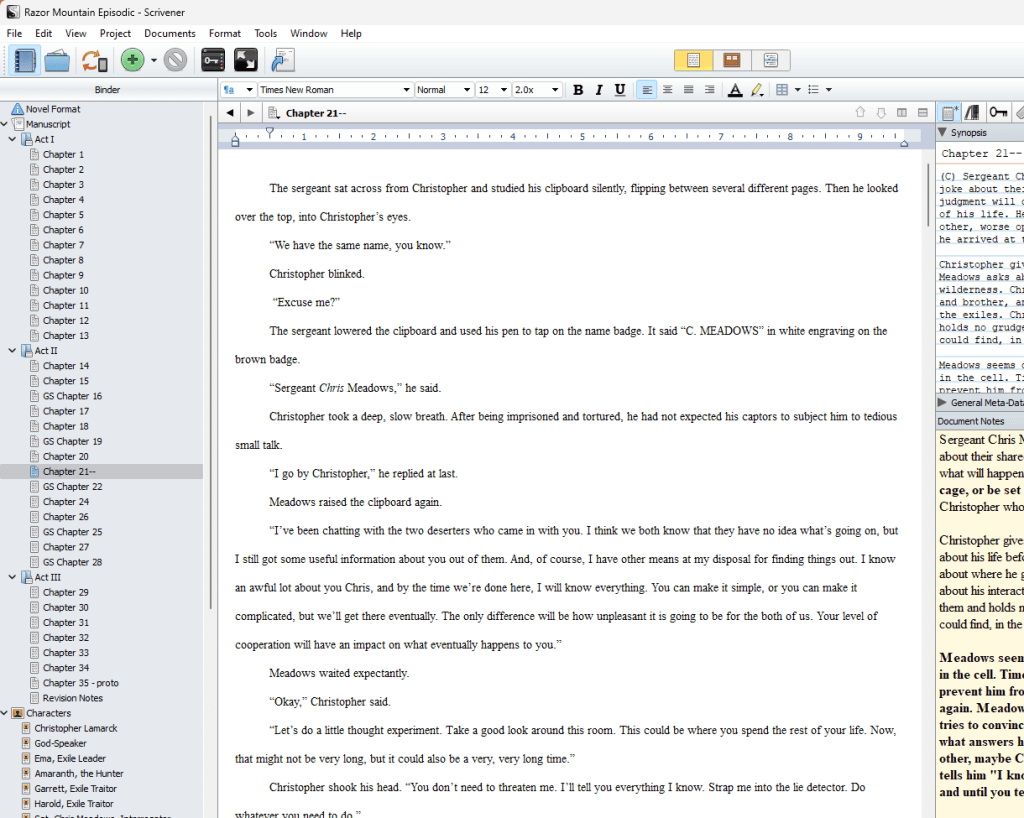
Razor Mountain Development Journal — Chapter 21

This is part of an ongoing series where I’m documenting the development of my serial novel, Razor Mountain.

You can find my spoiler-free journals for each chapter, my spoiler-heavy pre-production journals, and the book itself over at the Razor Mountain landing page.

Anchor Scenes

When it comes to writing, I am a planner. To a lot of people, that just means having an outline rather than writing and seeing what comes out. However, there are really several phases to planning, especially when it comes to a big project like a novel.

For me, the first phase of planning is really just collecting ideas. There has to be some set of ideas that get me excited enough to say, “Yeah, I want to put hundreds of hours of effort into making this book.” Often, these ideas aren’t enough to provide a start-to-finish synopsis of the story, but they are important moments, so they tend to be the things that cluster around the beginning, the end, or act breaks. Occasionally, they’re just something cool that happens in the middle, and that’s fine too.

That collection of exciting ideas are like mountain peaks in the fog. They’re moments in an incomplete story. To make a real story, I have to figure out all the obscured parts—I have to blow away all that fog in between.

Before I really start to put together a proper outline (and even while I’m outlining), I tend to act out those scenes in my head and think about what the characters might do and say. Sometimes I come back to the same scene over and over and discover new details or different directions they could go.

For Razor Mountain, these were things like Christopher waking up alone on the plane and the moments leading up to jumping out; his journey into the wilderness, and facing the choice of going back to safety or continuing on without any certainty of success; or God-Speaker falling down into the depths of the glacier and discovering that the stone god is broken and he is utterly alone.

A lot of the ideas in this chapter came to me later in the process, but it still feels like one of those anchor scenes. When I first conceived this book, I didn’t know about Chris Meadows yet. I didn’t have a complete understanding of Razor Mountain, and I didn’t know exactly how Christopher would get there. What I did know was that Christopher would have to be broken down completely. He doesn’t know it yet, but this is the experience that allows him to really change.

The rest of the story will be about him figuring out why he is who he is, and whether he wants to do something to change that.

Capturing Dreaminess

I got to play around with style a little bit in this chapter. Christopher is in a dreamlike state, sleep-deprived and tortured on top of everything else that has happened to him since the beginning of the book.

I wanted parts of this chapter to feel more concrete, as though we’re with him in the room, and parts to be more dreamlike, to the point where it’s not entirely clear what is real and what is hallucination, what is memory, and what is happening in the moment.

To make time feel disjointed, I added an unusual number of narrative breaks within the chapter. The story jumps back and forth between (what we can assume to be) multiple interviews with Sergeant Meadows and descriptions of Christopher’s mental state and thoughts. I also used an unusual number of short sentences and sentence fragments in the dialogue and descriptions to show how unfocused and disjointed his thoughts are. A side-effect of this is that longer sentences stand out, and I used that to draw attention to one or two things.

The third trick I used was substituting italics for quotes in some of the dialogue. I think this makes Christopher’s quoted dialogue feel more immediate, while Meadows’s italicized dialogue makes him seem more distant. It also has the side-effect that it’s much easier to follow the back-and forth without any dialogue tags. There’s no description in these parts either—just two disembodied voices—and that also adds to the dreamlike quality.

Finally, I added a section where I switch to first-person for the first time in the book. Honestly, I suspect I wouldn’t have had the guts to try something like this if I hadn’t read and analyzed The Martian and seen how many times Andy Weir jumped between perspectives and tenses, and how seamless it all felt.

I initially tried the change in perspective to untangle some gnarly sentences where it just wasn’t clear which person the pronouns were referring to. However, I kept it because it puts the reader deep into Christopher’s perspective at the exact moment when he is most vulnerable. This is a big reveal of something only lightly hinted at, a key piece of Christopher’s background.

With any stylistic experiments there’s a risk of failure, but I’m happy with how this chapter turned out. I think the experiments paid off.

Next Time

In chapter 22, we’re coming back to God-Speaker, once again leaping ahead through history. We’ll see a formative time in his life, and a little more information about Razor Mountain, the mysterious voices within, and their powers.

Razor Mountain — Chapter 21.3

Razor Mountain is a serial novel, with new parts published every week or two. For more info, visit the Razor Mountain landing page.

Is there a difference between thinking and speaking? I’m not sure. Sometimes I only think, and the words come out into the air. Meadows can hear the thoughts. He answers them. Asks more questions. There are always more questions, even if a lot of the time they’re the same questions.

He’s lying. He doesn’t know anything. He’s just hoping that if he pushes me enough I’ll say something that will prove he was right all along.

Is he lying? He knew things about my job, about my family. Things I didn’t tell him.

Did I think them? He can hear the thoughts.

I’m sitting at the table, and then I’m sitting in my cell. They make me get up and run around the halls. Endless, empty gray hallways. But then I’m jogging in my cell.

I eat something, but I don’t know what it is.

Have you ever killed someone?

“Yes.”

Tell me.

“We used to go to the beach on these family trips. It was a long car ride. He wouldn’t shut up. I was so sick of him by the time we got there.”

Who?

“My brother.”

Does he have a name?

“Yes.”

Well?

“I think I was mad, too, because I wasn’t a very good swimmer. I took swim lessons, but I still wasn’t very good. He was a natural. He could swim circles around me, literally. It’s hard, the first time you realize your younger brother is better at something than you are.”

You were jealous.

“Maybe. I was too young to really examine how I felt.”

What happened?

“I think I just wanted to get away for a while. But it was stupid. I went out into the water, like he wouldn’t be able to get me, out there.

“When he came out, he was worried about me, and that made it even worse. I was tired and bad at treading water, but I didn’t want to admit it. I was too far out. By the time I realized that, I couldn’t make it back by myself. I was so damn ashamed that I needed his help.”

You wanted to get him back for that?

“No. I was only ashamed at first, and then something clicked in my head, the kind of thing that our parents were always telling us when we fought, about how we should rely on each other. I thought if we could just get back, things would be different. We could help each other instead of just fighting all the time.”

What happened?

“We didn’t make it back. He was too small to carry me. He shouldn’t have had to.”

I asked you if you’ve ever killed someone.

“It was my fault. I was just a kid. I didn’t know things like that could happen in real life.”

Are you kidding me? Do you think this is a joke?

“No. Do you?”

The stainless steel table was in the snow now. They must have moved it.

It was cold, but it felt good to be outside again. The harsh wind was cut by the bright sunshine. Christopher felt the warmth of it on his face. It was hot, actually. Hot, and running down his cheeks. He touched it gingerly.

Blood. Sticky on his hands. Blood running down his face from his ears.

He opened his eyes. He was sitting in the corner of the cell. The banging sound pounded him like a physical force. He held up his hands. They were clean.


They’re arguing again, downstairs in the kitchen. The voices rise and fall, one male, one female. Why do they think he can’t hear them?

Of course, he’s withdrawn. What do you expect when he goes through something like this?

It’s a formative point in his life. He just needs time. Jesus, we all do.

What if he needs more than just time?

Like what?

He opens his eyes and sees his own fists pounding against the bars. They fall to his sides and he sinks down. The stone floor is so cold.

There’s an engine deep in his chest that is slowing down. It’s been running his whole life, and he never noticed it until now.

Maybe it’s okay to just stop, to let go. Maybe dying would be a relief. No more pressure, no more fighting.

Maybe it wasn’t so bad, what happened. It’s just something that happens. It’s peaceful.

Christopher lay down on the floor of the cell. This time, he didn’t black out. He felt a velvety darkness enveloping him. It was a warm blanket. Whatever happened, everything would be okay.

<< PREVIOUS ] [HOME] [ NEXT >>

Razor Mountain — Chapter 21.2

Razor Mountain is a serial novel, with new parts published every week or two. For more info, visit the Razor Mountain landing page.

Time frayed at the edges. Sometimes Christopher thought it was day or night, but there was no evidence one way or the other. His body was desperate for some semblance of normalcy. It felt like night when the air was so cold that frost started to form on the metal bed. It felt like day when the lights were so bright that he had to press his hands over his eyes and hope that he wouldn’t go blind.

He entered a new state of exhaustion. He didn’t sleep, he simply lost time. His brain shut down. The banging noise didn’t matter, the light didn’t matter. His body simply did it. It could have been seconds or hours that he was unconscious. He had no way to know.

A soldier brought him a plastic tray of food that he ate without tasting. Reconstituted mashed potatoes? A rubbery piece of meat that might be chicken? It was hard to remember. He ate it all with his bare hands. A half-size plastic bottle of water, swallowed in a single gulp, and still not enough to quench his thirst.

“You came here with two brothers, the deserters. How did you meet them?”

It was a tricky question. The exiles in that old, ruined building were afraid of Razor Mountain. Christopher remembered that. He held no ill will for most of them, although the brothers hadn’t done him any favors.

“I was just trying to find any other people out here,” Christopher said. “I had a map, from the bunker. It showed other buildings. So I tried to hike to them. But I ended up lost and low on supplies.”

Meadows touched the back of his pen to his chin. “And they took you in?”

“They decided to use me as a bargaining chip,” Christopher said. “At least Garrett did, and Harold went along with it.”

“You didn’t want to come here?” Meadows asked.

“You can see how well it’s working out for me,” Christopher said. A staccato squawk of a laugh came, unbidden, out of his mouth.

“You said you wanted to get back home,” Meadows said.

Christopher nodded. “And if anyone out here can make that happen, I guess it’s you. But they seemed afraid of Razor Mountain.”

“They are deserters,” Meadows said. “They have to face the consequences of their actions.”

“Garrett decided he wanted back in,” Christopher said, “and he seemed to think that bringing me as a peace offering would make it all okay.”

“Did he really?”

Christopher thought about it.

“Maybe not. Harold said that he didn’t think it would work. I think Garrett was just desperate and clinging to whatever hope he could find.”

“What about the others?” Meadows asked. “The brothers weren’t alone.”

Christopher took a deep breath. He realized that his eyes were wide. His face betrayed him. His body was a thing not entirely under his control any more.

“You’re protecting them,” Meadows said. “Is that really the strategy you want to take here? Providing cover for traitors?”

“They gave me shelter and food. I’d be dead if they hadn’t.”

“That doesn’t absolve them of their crimes. It’s not your responsibility to defend them.”

“It doesn’t matter,” Christopher said. “I don’t know where they are. It was someplace abandoned. Underground. I’m sure Garrett and Harold could tell you more.”

“That’s not relevant. I’m here to find out what you know,” Meadows said.


When he first woke, on the plane, he had thought for a moment that he was in a dark cave. Why would he think that? Now he was actually in a cave, or at least underground. It felt like a normal building, except that there were no windows. No sun, no moon, no sky or stars. No time passing. No buzzing of airplane engines in the dark that wasn’t a cave.

How did you get here?

“I told you. It was a business trip. A sales trip. I was selling software.”

Did you actually sell anything?

“It’s a new job. I’m new. I’m not very good at it, yet. At least they were nice about it.”

So no. Who are you working for?

“Peak Electric Solutions.”

Who are you working for?

“Look, I told you.”

Who are you working for?

“What’s the fucking point of this? What do you expect me to say? You want me to just make something up?”

I want you to tell the truth. By the way, you have a little blood there, on your forehead.

“I think I hit my head on the table.”

What’s the most blood you’ve ever seen?

“I…why?”

Answer the question.

“I guess, I used to get nosebleeds, pretty bad ones, in the winter when the air is too dry. Sometimes it would just go for five or ten minutes. The wastebasket would just be full of bloody tissues.”

That’s it?

“I think so.”

Have you ever killed someone?


Coming back from a sleep-deprivation blackout wasn’t like waking up. It was like one of those movies where someone overdoses and they inject adrenaline directly into the person’s heart. It was being off, and then being on again.

He sat at the table, both jittery and exhausted. The soldier must have come. Must have taken him from the cell and brought him to sit at the table. He didn’t remember it, but it must have happened.

Meadows sat down in the chair opposite him. Had Meadows come in through the door? When?

“How are you doing today, Chris?”

“Is it day?”

“I’m hoping we can have a productive conversation.”

“Me too.”

“Hey, that’s great. For that to happen, I’m going to need you to tell me the truth.”

“I keep telling you the truth,” Christopher said. “Except maybe about the deserters, at first, because I feel like I owe them. But then I ended up telling you what little I know about them, anyway. At least, I think I told you.”

“You’re not filling me with confidence here,” Meadows said.

“I’m having a real hard time deciding what is actually happening,” Christopher said.

Meadows sighed and set his clipboard down on the table, snapping the pen under the metal clip.

“I can assure you that this is definitely happening,” he said. “I’m trying to help you here, but you’re not making it easy.”

“Look,” Christopher said. “Look. I’m telling you the truth. What answers are you looking for? If you tell me what you actually want, maybe, somehow, I can help.”

“Chris, I’m not going to give you a free pass here. I’m not going to give you a map of where you can lie and where you can’t. I know more about you than you realize. I know you’re lying, and until you tell me the truth, this will only get worse for you.”

Christopher felt his eyes overflowing with tears. He pressed his palms against them until he saw stars.

“I don’t know what you want. I can’t do this anymore.”

Meadows was standing next to the door. Had he stood up?

“I’m sorry to hear that, Chris. If that’s the case, then we’re going to have other questions to discuss. For example, do we put you in permanent storage, or do we line up the firing squad?”

<< PREVIOUS ] [HOME] [ NEXT >>