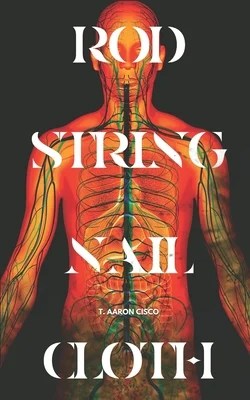
Rod String Nail Cloth was a random library pick containing six stories and a poem. It’s slim enough that I read it in the span of a Saturday afternoon. When I grabbed it I didn’t know anything apart from the title, but I’ve been meaning to investigate Afrofuturism for a while, and a short anthology seemed like a good place to start.
As it turns out, T. Aaron Cisco was born and raised in Chicago, but now lives in Minneapolis, so there’s a hometown connection for me. It also turns out that this is self-pub, and has a whiff of punk-rock “zine” to it. Unfortunately, it also has something like 20-30 typos and formatting errors across its 150-odd pages.
These stories revolve around themes of time travel, racial injustice, environmental catastrophe, and transhumanism. There are some interesting ideas in here, and some sentences and paragraphs that really pop. However, I found some of the writing straying too far into the literary style that I most struggle with: pages spent on a character’s languid internal thoughts without giving me enough plot or setting to latch onto.
The first story, “Now, Justice,” is the biggest offender in this regard. It follows a Black inventor who creates a machine that manipulates people’s perceptions. He uses it to take vengeance on a policeman who shot an unarmed Black kid and dodged the consequences. However, we don’t get to the first mention of the machine until page 17.
The subsequent stories were tighter, in my opinion. “Thursday Addison” is a Shonen anime of a story where a cybernetically enhanced enforcer is sent into a violent, futuristic battle that she barely survives.
“The Hesitant Envoy” is a tongue-in-cheek tale where an advanced civilization pulls aside one human to ask him to justify the continued existence of the species. He has a hard time coming up with a good argument, and isn’t particularly inclined to try.
“Lydian Mode” is about a down-on-his-luck Black musician who travels back in time to 1960s Chicago. Despite the dangers of life at the height of the civil rights movement, he discovers that there are also opportunities.
“Captain Michaela” is a poem about the titular character (maybe?) saving the universe. I’m just the wrong audience for this. While I have my favorite poets and poems, I’ve never felt drawn to sci-fi poetry.
“Rod String Nail Cloth” is the stand-out story of the book for me, an epistolary story about a person sent far back in time to fix a broken world.
In “They Burn So Easily,” an apocalyptic virus turns people into still-thinking vampire/zombie creatures called Chalkies, more strongly affecting those with paler, less pigmented skin. It’s a story about choosing forgiveness and humanity even when it may be undeserved. The conflict in this one felt a bit rushed, and I would have been interested in a longer exploration of the setting, the premise, and the relationships between the characters.
Rod String Nail Cloth is, in parts: intriguing, goofy, and a little rough around the edges. It’s not going on my favorites list, but I’m happy to have read it, and I’ll keep an eye out for Cisco’s work in the future.
It also whet my appetite for more Afrofuturism, especially in short fiction. If you have any good recommendations, leave them in the comments.
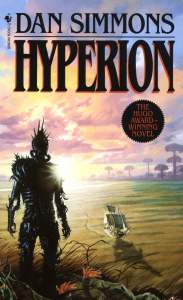
Reading the four-part Ender’s saga left me feeling skeptical of big, philosophical, late-80s sci-fi books. Now I’m going back to that well with Hyperion.
I’ll be honest, Hyperion feels clever and stylish after Children of the Mind. Then again, Ender’s Game was the first and best book in the series. Hyperion is also the first book in a four-book series. So maybe I’m setting myself up for heartbreak all over again.
Canterbury Tales, in Space!
Hyperion opens with a frame story. A man we know only as the Consul is given instructions to go to the planet of Hyperion along with six others, on a mysterious pilgrimage. He goes, and meets his compatriots:
Het Masteen, captain of the spaceship that will transport them, which just so happens to be a giant tree.
Father Lenar Hoyt, a Catholic priest in a galaxy where Catholicism is nearly extinct
Colonel Fedmahn Kassad, a soldier of the galaxy-spanning Hegemony’s military
Martin Silenus, a centuries-old poet who has journeyed between stars and across time via relativistic space travel
Sol Weintraub, a scholar, who brings his baby daughter Rachel
Brawne Lamia, a hard-boiled private detective
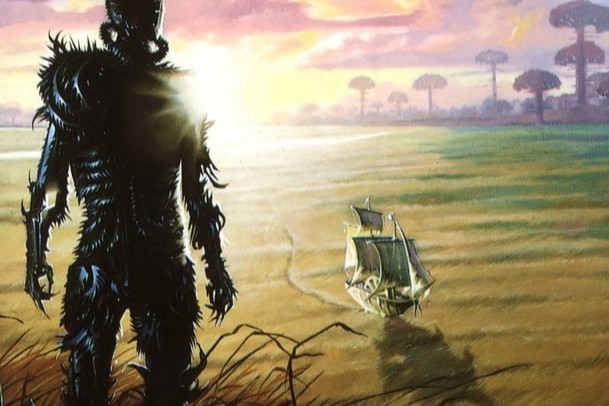
When the pilgrims arrive at Hyperion and introductions are made, they come to an agreement: they will each tell the story of why they came as they make the long journey from the spaceport to their final destination, the Time Tombs. There, they expect to find the Shrike, a mythic creature made entirely of razor-sharp blades. Supposedly, he will choose one of them to grant a boon, and the others will be sacrificed.
As the journey gets underway, each pilgrim tells their story in turn. Between the stories, they travel across the planet toward their destination. It’s a bad time to return to Hyperion. The planet is poised to be the first front in the largest war humanity has ever seen, between the Hegemony and the long-exiled Ousters, who live strange lives in their deep-space ships. The Time Tombs—in what cannot be coincidence—appear to be opening, and nobody knows what will come out.
A Slowly Woven Tapestry
The structure of the book allows Simmons to expand the scope of ideas slowly. The unexplained and confusing in one story is addressed and answered in another. It allows the reader to assemble these small pieces into a detailed and rich setting.
Through the pilgrims’ stories, we begin to understand the galaxy they inhabit and the ways their paths have crossed Hyperion and the Shrike to bring them to the current moment. From Silenus we learn about Old Earth and the Big Mistake, a man-made black hole that slowly (and then quickly) devoured the planet, forcing the Hegira to many worlds. From Father Hoyt and Saul, we learn about Hyperion, it’s inhabitants, and the Time Tombs. From Kassad and the Consul, we learn about the armies of the Hegemony; the many rebellions quashed and small wars fought by a supposedly peaceful and democratic government. From Brawne, we come to understand the vast web of farcaster portals that allow instantaneous travel between Hegemony worlds, and the mysterious society of AIs who control them and remain apart from humanity while ostensibly guiding and helping them.
The book paints rich portraits of a handful of specific worlds. Dan Simmons manages to make almost every setting in the book genuinely strange and interesting. A planet wracked with storms, a sea of grass navigated by gyroscopic sailing ship, a 1.3g planet where the people live in vast arcology-like “hives,” a bus-sized cable-car over snowy mountains, an ocean world where people live on island-sized migratory creatures, and a vast capital city where the rich live in houses where every room is a portal to a different planet.
This feels like a universe with a history, a big universe populated by billions of people across dozens of worlds, and all the diversity that represents. It’s full of beauty and weirdness. And yet, the same human sins and weaknesses are still there, still causing problems.
Each pilgrim brings a different perspective to their story, which allows Dan Simmons to shift style and tone throughout. Kassad’s story is full of sex and violence, a pastiche of military sci-fi, while the Consul’s story is more of a historical documentary. Brawne’s story is a cyberpunk noir where the detective inevitably falls in love with her dangerous client. Sol’s story is that of a father desperately trying to save his sick child. These different styles help to keep the book constantly fresh, and each reveals new pieces in the puzzle of what’s really happening on Hyperion.
In the Ender Saga books, the relativistic effects of space travel were a promise that never really delivered. Nobody apart from the main characters traveled between worlds, and it seemed that nobody could even imagine that someone might live for hundreds of years by traveling between stars while time passes by.
In Hyperion, relativistic space travel is a part of life. The Web of Hegemony worlds are connected instantaneously via farcasters, but each world starts as a colony whose inhabitants took a many years to arrive, and even longer to build their first farcasters. Conflicts often arise between the original settlers, or indiginies, and the flood of tourists that inevitably come with joining the web.
Style Plus Substance
Ultimately, I think a lot of what I enjoy about Hyperion comes down to Dan Simmons’s writing style. It incorporates literary flashes and delightfully crafted language, while maintaining the workmanlike plotting and characterization that a mainstream science-fiction audience would expect…especially in the late 1980s.
For a thirty-five year old novel, Hyperion still feels fresh and interesting. It’s doing a lot, and doing most of it well. If there’s anything to critique, it’s that the book sets up some big mysteries and leaves the biggest ones unresolved. I believe the four books in the series are really a pair of duologies, so I expect to get most of the answers in the sequel, The Fall of Hyperion.
With any multi-author work like that, I always wonder how I’ll feel about the things that come later. Much like a great song with a featured artist, you never quite know if it’s the band, the guest, or some unreproducible magic in the collaboration itself.
However, I’m pleased to report that even though it is very different, I enjoyed El-Mohtar’s The River Has Roots just as much as that previous book.
Audio Considerations
There’s no question that different formats can have an impact on the experience of a book. I first “read” Jeff Vandermeer’s Area X trilogy as an audiobook, and recently re-read the first book, Annihilation, in paper. It’s a dense and challenging book in places, and I found the ability to easily re-read and compare previous pages allowed me to take in more of the information on the page. On the other hand, the audiobook forced my attention and lent a certain claustrophobic feeling to parts of the story that was in many ways complimentary to the text.
I also “read” The River Has Roots as an audiobook. It’s worth noting that this audiobook includes set-dressing in the form of gentle background noise: a burbling river, a bustling market, a whispering forest. This background audio is done well, and suits the story nicely. After my initial surprise, I never found it overbearing or distracting.
Songs are an important theme of the story, and these are fully sung. I was delighted to find out after the fact that the music was actually performed by the author and her sister, including harp and flute parts. These elements put it somewhere between audiobook and radio play.
Finally, I’ll note that the narrator has a strong accent — my uninformed guess was Irish, although one of the book’s blurbs suggests that it’s “rural English.” As an American, I found myself needing to pay a little more attention than usual at the beginning of the story. By the end, I had no problem following whatsoever. The narrator, Gem Carmella, convinced me that the audiobook wouldn’t have been quite so effective without her voice.
The River Has Roots isn’t a long book. It’s listed at 144 pages. My audio edition claims a length of 3:53, but a full hour of that is actually a preview of El-Mohtar’s upcoming book of short stories.
I’ve said before that I appreciate the trend toward more acceptance of novellas in recent years, although I’d confess that I have a tough time justifying the purchase of a hardback book of that length for the $24 list price. Luckily, the audiobook was a steal on end-of-year holiday sales, and is still less than half the price of the hardcover.
A Modern Fairy Tale
The fantasy genre has come a long way. Even for those who still ape Tolkien, a significant amount of codification and shorthanding has occurred. And in backlash against that, all sorts of sub-genres and new offshoots have emerged. For the most part, modern fantasy feels quite different from ancient myths and folk stories that have been handed down more or less intact across centuries. Even if they do share certain key features.
The River Has Roots is very much trying to evoke the feeling of fairy stories, and I think it succeeds. Part of that is having the right kinds of imagery and road markers: a world just like our world, where magic is accepted as real. Sisters living in close proximity to a Faerie land. Songs with power. Witches and secret lovers and villainous suitors who are really just after the family fortune.
Beyond those many surface-level things that are easily recognizable as “things that fit into fairy stories,” there is a certain mode of speech, a certain way of unfurling the story that also contributes to this feeling. In The River Has Roots, magic is called grammar, and wizards are grammarians. El-Mohtar has found the magical grammar of the fairy story and deployed it perfectly here.
It is a common trope to suggest that fairy stories are required to have a happy ending where all the wrongs are put to rights. It’s one of those truisms we accept without thought, and it’s also not true. It’s well-known that many of the Disney versions of classic stories were changed, their dark and horrible endings often considered too depressing or gruesome. I won’t spoil the ending here, except to say that it treads that knife edge well, and could perhaps be best described as melancholic.
If you’re in the mood for something short and sweet, modern and well-crafted with the feel of something older and wiser, The River Has Roots is an excellent choice.
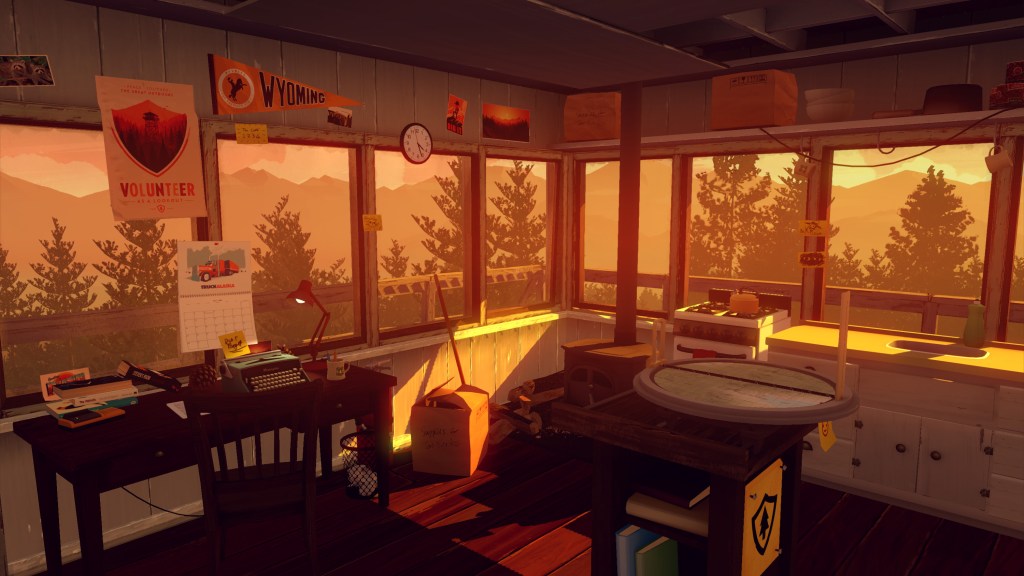
The job of a firewatch involves living in a single-room tower deep in the wilderness, monitoring the forest for fires. It’s a job that attracts those seeking solitude—the strange or socially awkward, and people trying to run away from their problems.
An Unorthodox Beginning
Firewatch begins with a blurred background and the audioscape of a bar. You play as Henry, a drunk college student, and you’re meeting your wife, Julia, for the first time.
A few paragraphs of text and a couple of life choices allow you to choose-your-own-adventure through several years of Henry and Julia’s relationship and marriage: their joys, arguments, and struggles. The choices start out easy, then problems arise, and the game presents more harrowing decisions where neither option is good.
Interspersed between these text vignettes are little snippets of 3D gameplay. As Henry, you load your truck in your apartment’s underground parking. You arrive at a trailhead in the forested wilderness. You hike, you camp. Eventually, you arrive at a huge, wooden firewatch tower.
On paper, I would never expect the opening of Firewatch to work. A rushed prologue in plain text? Front-loading a ton of emotional weight and exposition? When the game started, I was skeptical.
It’s a testament to the writing and design of the Campo Santo team that it does work. As a player, you become a participant by making tough choices with Henry in his back-story. You get a glimpse of life being good, then bad, and finally almost unbearable. It’s just enough time and detail to begin to sympathize with him and understand why he took the firewatch job.
Interleaving this backstory with the journey to the firewatch tower is oddly cinematic, a bit like voiceover, and creates the sense that all of this is weighing on him as he travels to the tower.
Exploration
Beyond this initial prologue, Firewatch sets aside the text and becomes a full 3D game. Your tower is your home base, but most of your time is spent in the forest. As Henry, you can walk and run, vault over obstacles and climb, but not jump. This is not a “walking simulator,” but the mechanics are simple and straightforward.
From the beginning, a surprisingly large area of wilderness is open to your exploration. More areas open up as you get further into the game and acquire new tools, the first of which is a backpack of ropes that allow you to rappel up and down shale slides and steep slopes.
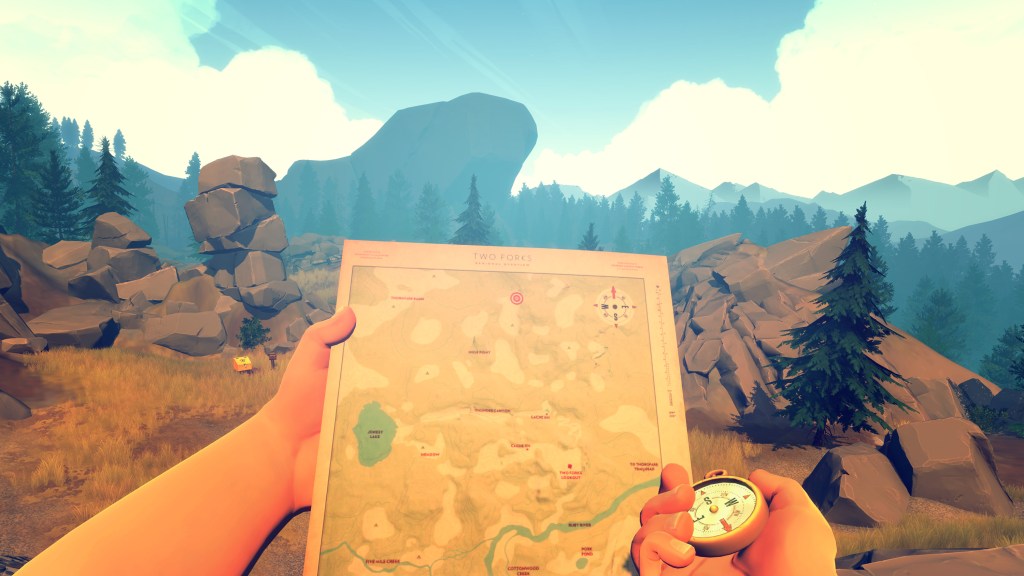
You are given a compass and map, and the game doesn’t clutter the screen with big arrows, icons, and indicators. It’s easy to get turned around or take the wrong path, but this makes it feel more like real exploring and less like the game is holding your hand.
In reality, the game carefully contains the player, but it goes to great pains to make it feel like the world is wide open. For the most part, it succeeds.
Ten-Four, Boss
You are alone in the wilderness, and your only link to the rest of the world is your high-powered walkie-talkie radio. With it, you can talk to your boss, Delilah, in the next tower over, which is barely visible on the top of a mountain several miles away.
As your boss, she helps get you acclimated to the job and provides you with tasks to keep you busy. She’s been out here for years and knows her way around.
The radio becomes your primary means of interacting with the world. When you see something interesting in the world, an icon pops up and you have the opportunity to talk to Delilah about it. You soon strike up a snarky rapport, and she becomes your constant companion throughout the game. The two of you discuss your past, shoot the shit, and become close. Then everything starts to go wrong.
What’s Out There?
From your first day on the job, there is mystery lurking in the forest. Delilah tasks you with finding and telling off some camping teens who are launching fireworks in peak fire season. On your way back, you encounter a shadowy figure who blinds you with a flashlight and disappears into the night. Then you find that someone has broken into your tower.
At first, the strange happenings seem innocuous, but things get weirder and weirder. More and more clues point toward something nefarious (and perhaps science-fictiony) going on.
To make matters worse, a fire breaks out just a few miles away. Fire crews do their best to contain it, but it grows day by day, a looming danger that adds tension. If it spreads, you and Delilah will be forced to evacuate, and you’ll never know the truth about what’s really going on.
Storytelling
Firewatch is full of moral quandaries posed to flawed characters. Everyone here has made bad choices, and everyone can be blamed for something. The game doesn’t tell you how to feel, and doesn’t paint the world in black and white. It doesn’t provide a pat conclusion either.
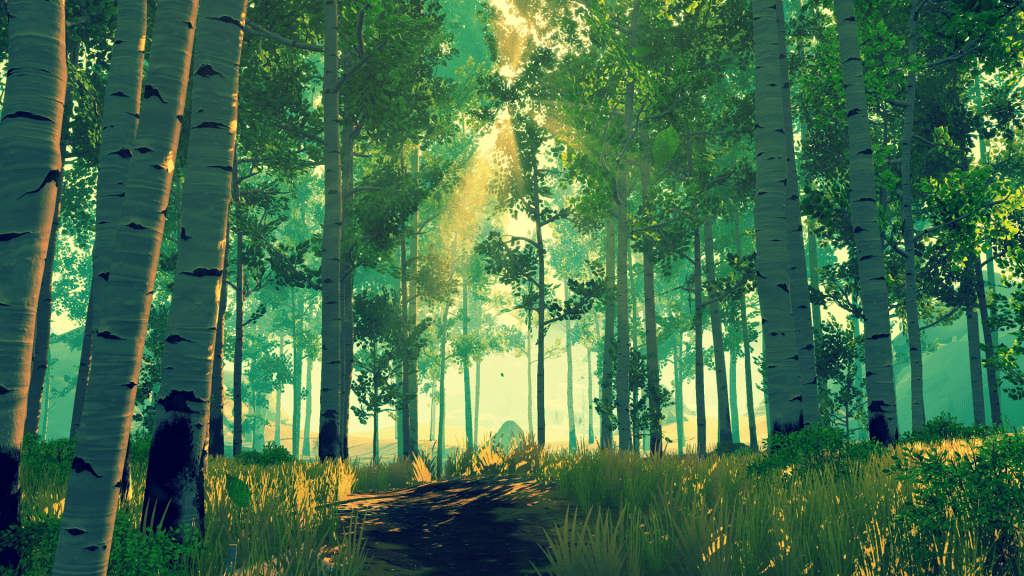
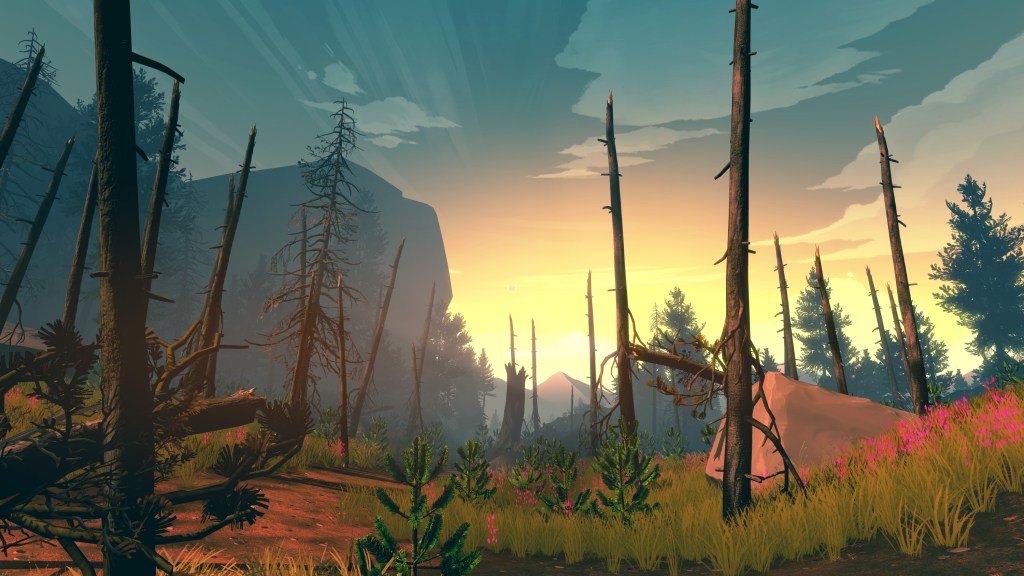
Firewatch isn’t perfect—it was made by a small team, and they had to cut corners in some places to be able to finish it. But they did so very smartly. The graphics are not state of the art (even for a decade ago, when the game was released), but they have a painterly aesthetic that is often beautiful. There are few characters, but the voice-acting is impeccable, and makes the whole game work.
The story can be completed in 3-5 hours, but it’s full of twists and turns, and contains a few laughs and a fair bit of heartbreak. Games, even story-centric games, often struggle with endings. Firewatch sticks the landing. It’s not necessarily a happy ending, but the mysteries are all resolved.
Henry, having run away from his problems, is confronted with an example of how badly that can go. It’s up to you whether he takes that lesson to heart.
As a wonderful bonus, the game includes a documentary mode. It turns the game into a sort of interactive museum with stations scattered throughout the wilderness. Each station has voice notes from the developers, and sometimes concept art or other notes pinned to bulletin boards. I wish more games would do something like this, although I can understand forgoing it when it’s such a challenge just to ship a game.
If writing is my creative first love, video games are my second. Words Deferred is a site about writing, so I mostly limit my talk about video games to the story-centric, like my series about Games for People Who Prefer to Read.
Of course, not all games care much about story, and the entire medium has long been lambasted by serious artists for its weak storytelling. There’s a weird tension built into games, between experience and participation, the twin engines that make a game at least partly something you do instead of something you receive. That doesn’t mean there are no great stories in games, but it does mean that you have to go searching if you want to find them.
Games are also fascinating from the perspective of their construction. They are half art, and half science; programmers and engineers working side by side with artists, modelers and sound designers. The closest analogues are stage theater or TV and movies, where there is a certain unexplainable amalgamation of the magical and the mundane in order to actually put a finished product in front of an audience. Art constructed by a team is very different from the work of the lone artist.
There are plenty of documentaries on movie making; on the actors, directors, and myriad other craftspeople who put stories on the big screen. But there are comparatively few who do the same thing for games. Among the best are the small team at /noclip.
They are remarkably prolific for a core group of just four people, not only putting out multiple high-quality documentaries per year, but hosting a weekly podcast, building a game history archive, doing some indie game development, and recently creating a sort-of, kind-of online game magazine thing. They are also clearly a group who loves games as a storytelling medium, and that passion comes through in the documentary series where they give voice to the developers of some of the most exciting story-centric games.
Now is the perfect time to check out their work, because they’re right in the middle of releasing a multi-part series about Disco Elysium, one of the most critically acclaimed and lauded “story games” in the past decade, and the story of the people who made it is just as interesting as the game itself.
At 138 words, this is not quite drabble-length, so it needs to hit hard and fast. It’s a story about the loss of someone loved, with the sci-fi element being their replacement by an artificial duplicate.
The opening is a metaphor unfurling: salt as grief. The end is a callback to the title. Great structural choices for micro-fiction.
The mix of italics and quotes is something I’ve done myself, but it’s dangerously ambiguous. Is the robot speaking non-verbally? Is it the protagonist’s internal voice of their lost loved one? Any lack of clarity can be catastrophic in a story so short.
The theme is imminently relatable; we’ve all experienced loss of a loved one, by death or lesser proxy. I don’t quite get that gut-punch emotional reaction I want from a short story, but that’s always the biggest challenge of micro-fiction, where you are fighting for every word.
Children of the Mind is billed as the final book in the “Ender Quartet.” In my opinion, that quartet is really Ender’s Game standing on its own, and sequel trilogy that is in many ways tonally different and mostly disconnected in plot.
The trilogy of Speaker for the Dead, Xenocide, and Children of the Mind centers on the story of the planet Lusitania, thousands of years after Ender’s defeat of the buggers. The ticking clock of the series is the war fleet sent to destroy Lusitania. It has been delayed by the computer intelligence Jane, but now Starways Congress is aware of her presence in their computer systems, and has a plan to reset their communications network across the hundred worlds. This will not only prevent her from meddling, but effectively kill her as she’s reduced from millions of computer systems to only a handful.
The destruction of Lusitania would do more than kill the thousands of human colonists, because the planet is also home to the only other intelligent species known to humanity: the pig-like Pequeninos, whose life-cycle was heavily modified by an extra-terrestrial virus—the Descolada—and includes a worm-like larval stage and an eventual transformation into something like a psychic tree.
Ender has also brought the last of the Bugger hive-queens to Lusitania, where it is busy building enough industry to build starships and send out new queen larva to distant planets, ensuring the continuation of the species.
A final additional subplot is introduced, as if there weren’t enough. The dangerous Descolada virus has been neutralized on Lusitania, replaced with a harmless version that fills the needs of Pequenino physiology without the danger of infecting and modifying the genomes of other species. But it has become apparent that the virus is not natural. It was created, and the species that could and would send such a dangerous weapon into the universe is potentially the greatest threat humans, Pequeninos, and Buggers have ever seen.
Ender, once the titular character, has now been almost entirely sidelined in the story. As a reader, his perspective is barely present in the book, and he spends a good chunk of it effectively comatose. By the end, it’s apparent that the book is a send-off for him. His presence almost feels like an afterthought. Instead, the book focuses on Miro (his adopted son and Jane’s new favorite human), Si Wang-mu (genius emigrant from the planet of Path) and young Val and Peter, ghosts from Ender’s childhood that he made physically manifest on his brief trip outside the universe in Xenocide.
Tonal Shift
Analyzing the series as a writer, it’s interesting to see the transformation of Card’s style in the post-Ender’s Game trilogy. Ender’s Game was a relatively near-future hard SF story that focused on a single brilliant boy’s journey through military school, and the horrifying extremes the wartime government was willing to go to in order to defeat an existential threat to humanity. While there is a B-plot for Peter and Valentine, most of the story stays tight on Ender’s perspective.
The subsequent trilogy is much more scattered, and while it touches on plenty of interesting ideas, I think this lack of focus is somewhat to its detriment. The series becomes decidedly softer sci-fi, culminating in a deus ex machina mode of faster-than-light travel that also allows near-magical creation of a bespoke super-virus and several entirely new people.
My daughter and I both came to the same comparison independently—the Golden Compass series had the same seemingly tight beginning before spiraling off into odd and confusing tangents. Both feel like completely different series at the beginning and the end.
A fair amount of Ender’s Game is dedicated to his own internal angst as he undergoes indignities and abuses at the hands of the adults in positions of authority over him. The subsequent books include even more angst, spread across a large cast of characters. Long internal monologues are par for the course, and I would be hard-pressed to identify any character experiencing any kind of happiness before the final two or three chapters.
Where Ender’s frustration and eventual desperation felt appropriate to his situation, I couldn’t help but feel that this modus operandi became oppressive with so many more characters, and continuing for three books. It was unrelenting and a little exhausting.
A side-effect of this feeling was that the problems posed to the characters became so big and so multitudinous that their inevitable resolutions at the end of the series felt too trite and easy in comparison. It’s a tough balancing act to set up huge roadblocks for the characters and then resolve them in a way that feels earned.
Welcome to Ethnic Planet
I am keenly aware that I’m reading this series 30 years after its original publication. One of the strangest things about these books is the way Card has built his universe. His characters and their personalities run up against each other in a variety of interesting and well-thought-out ways, but his settings feel like cardboard cutouts in comparison.
The planet of Lusitania is the most fleshed-out setting in the series, but that’s a little deceptive because it has been engineered for simplicity. The Descolada has ravaged the ecosystem, and only a dozen species have managed to adapt. There is a single human colony city, and it is Portugese Catholic through-and-through.
The common sci-fi trope would be to construct “Star Wars” planets with a single distinguishing feature, usually an environmental biome. The ice planet. The forest planet. The desert planet. The lava planet.
Strangely, Card has managed to at least partly eschew this (though Lusitania is a uniform mix of forest and plain and Trondheim is icy). However, he has very plainly replaced these tropes with a different sequence: planets that are each a uniform human monoculture. Even more strange, in my opinion, is how these caricatures hew to a myopic 1990s American perspective. Say what you want about some of the performative multiculturalism in the still-not-very-broad-minded modern publishing industry, but I am honestly a little surprised that Card’s blatant stereotyping made it into a series that was not only mainstream, but award-worthy in its day.
Speaker for the Dead introduced Trondheim, the stoic Scandinavian planet. Xenocide introduced uniformly Chinese planet of Path, dominated by a kind of luddite, vaguely Taoist folk religion. Children of the Mind adds two more: Divine Wind and Pacifica. Divine Wind is the Japanese planet, industrious and technologically innovative much as the US saw Japan in the 70s and 80s. Pacifica is the Samoan planet, and everyone that Peter and Wang-mu encounter there seems to be built like a linebacker, living a simple tropical life, and deeply invested in ancient, polytheistic religion.
There is an argument to be made that the book explicitly says that these planets are more diverse, and there is more to them than regions depicted in the main plot. However, I think this is a weak argument. It’s textbook telling instead of showing, and it seems to admit that the cultural caricatures, which are all we’re actually shown, are shallow and problematic.
Besides, the problem is not the lack of wokeness, it’s the abject unbelievability of a universe where each planet is almost entirely populated by uniform groups of people defined by a handful of simple traits that apparently haven’t changed over thousands of years. This is as absurd as the idea of a modern Italy that has adapted to our current world, technology, and politics while remaining culturally almost identical to the early Roman empire.
Even weirder, the term “western” is explicitly used, which is nonsensical in a far-future multi-planetary society. Of course, the core power systems of the Starways Congress and the military seem to be fully controlled by these “western” cultures, because who could possibly envision a universe where the US and Europe aren’t dominant?
The Dangers of Rereading
I have to admit, part of me wishes I hadn’t revisited these books. They didn’t quite live up to my fuzzy teenage memories of them. Those memories told me that Ender’s Game was the best of the set, and I continue to feel that way. But the sequel trilogy might have been better served by being further divorced from that book and getting a little more breathing room to explore other ideas.
In the end, I found the “Ender Quartet” to be an interesting series, but ultimately flawed enough that I had a tough time enjoying all the good bits without being reminded of the things that annoyed me. My current views are certainly affected by my age, my experiences, and the many fantastic books I’ve read in the interceding decades.
On the other hand, I might have reason to worry if I felt the same way about these books today as I did in my teens. For writers, rereading our old favorites can be a fun and useful exercise, but it’s also a dangerous one. You may find that those books were more enjoyable through the lens of nostalgic memory than they are in the cold light of a fresh read.
Xenocide is the third book in the Ender series, after Ender’s Game (link) and Speaker for the Dead (link). I read the book decades ago, and remembered almost nothing about it. I’m now reading it again with my daughter.
The plot is split between two worlds and sets of characters. On the planet Lusitania, the story of Speaker for the Dead continues, with Andrew “Ender” Wiggin, his AI companion Jane, and the Ribeira family that he has now joined through his marriage to their matriarch, Novinha. Soon, Ender’s sister Valentine and her family arrive as well.
The Lusitanians, including the native Pequeninos and imported Buggers, live under the looming threat of an approaching fleet armed with the planet-destroying MD device, as well as the constantly shifting threat of the descolada virus that is integral to the Pequenino life cycle, but eventually deadly to all non-native species. The fleet is held back temporarily by Jane, who disables all their communications at the risk of revealing herself to the universe at large.
On the planet Path, we’re introduced to Han Fei-tzu, an important official, and his genius daughter, Han Qing-jao. They are members of the planet’s high caste, the godspoken, whose intelligence is linked to OCD-like compulsions that the populace believe to be the way the gods speak to mortals.
Fei-tzu is tasked by the congress of the hundred worlds to solve the riddle of the fleet near Lusitania, which seems to have suddenly disappeared. He assigns this important task to his daughter. Soon they are joined by one more character—Si Wang-mu, a servant girl who is not godspoken, but also turns out to be highly intelligent.
** More Planets, More Problems
Ender’s Game was clearly intended as a single novel that stands on its own. Speaker for the Dead was decidedly more complicated, and left a pile of unresolved plot points to pick up in Xenocide.
Despite this “head start,” the first half of Xenocide feels plodding, and it mostly involves setting up a large number of major problems that the characters are going to have to solve, along with a web of reasons why absolutely every character is going to be at odds with every other character.
Conflict can be an engine of story, but Xenocide proves to me that it can go too far. I couldn’t help feeling that the constant animosity between characters was exhausting, and when certain characters finally gave in and decided to work with others near the end of the book, it felt abrupt and somewhat unearned.
** Thinking Fast and Slow
The first half of the book is slow, and it would be easy to blame this entirely on the setup required by the huge cast of characters and the many interconnected conflicts. That is absolutely a factor, and I think this book was trying to do a few too many things at once. However, I think a lot of this is actually just Card being long-winded and having too much editorial clout at this point in his career.
There are pages of internal narration where characters muse on their feelings. These deep thoughts are sometimes interrupted by one or two lines of dialogue, only to immediately drop back into more pages of their thoughts! If there was ever an argument against a third-person omniscient perspective, this is it. A first-person narrator or even a tight third-person would have limited these long and winding detours and perhaps forced Card to show how characters feel more through their actions and words.
By contrast, the latter half of the book ramps into a much faster pace. All of those problems set up in the first half have to get resolved. Unfortunately, this leads to another problem of pacing, where everything feels like it’s happening overly fast. Again it feels like there was simply too much going on, and some plot points inevitably got short shrift.
To me, some of the resolutions felt like an abrupt tonal shift. This is a far-future series with advanced technology, but felt like hard sci-fi grounded in reality. Near the end of Xenocide, ideas are introduced that are decidedly further afield. There is a brand new kind of magical physics. When the whole plot hinges on these ideas, there’s a whiff of deus ex machina—even if they would feel perfectly reasonable in a story that plays a little looser with its sci-fi extrapolations.
It’s been long enough since I read this series that I no longer remember anything about the fourth book, Children of the Mind. Without spoiling Xenocide, I’ll say that the final bit of sci-fi magic also brings a pair of characters more or less back from the dead, further complicating an already over-complicated book, and I suspect they’ll be heavily involved in the conclusion.
This may be the first inkling of Card’s eventual obsession with rehashing his old stories. It would continue with his “Shadow Saga,” where he spends another six books rehashing plots and characters from the Ender books. I see from Wikipedia that there are at least 19 books in this same world.
** New Perspective
When I originally read these books, I was a teen. Those memories are fuzzy now, but as far as I recall, I found them to be a powerful vision of a distant future.
Re-reading now, I think that’s true of Ender’s Game. But Xenocide feels far less grounded and almost metaphorical. The conflicts, from interpersonal to intergalactic, largely boil down to people talking at cross-purposes, unable or unwilling to understand each other’s viewpoint. It’s ultimately a depressing view of the world that suggests real empathy and compromise is almost a super power, and most conflict is inevitable. It’s depressingly resonant here in 2025.
If there is a central theme across Xenocide’s many plotlines, it’s that people and cultures tend to act in ways that make them dangerous to themselves and each other. Humans are easily controlled or manipulated, and often give in to their most base instincts, even when it’s obviously bad for them.
We see evidence of that on the nightly news, but it’s far more depressing to imagine that we’ll still be so barbaric and unenlightened in three thousand years.
** Final Thoughts
In an appropriate twist, Xenocide leaves me conflicted. It does a number of things that irritate me. I’m still of the opinion that Ender’s Game was the best book in the series. But Xenocide incorporates a lot of strange and provocative ideas, and it has made me think. It comes from an era when the genre conventions of sci-fi expected intricate plotting and…less intricate characterization. So the complexities of the plot can perhaps be forgiven, and the characterization, as heavy-handed as it sometimes is, should perhaps be praised.
Once upon a time, I would likely have considered these books among my favorites. I don’t think they still hold that place. They’re by no means bad, but I do think the state of literature has changed significantly in the past 25 years, as have my own personal tastes. I’m enjoying my foray through the series, even if I do have the old man tendency to complain the whole way. And there has to be merit to any book that you find yourself thinking about well after you’re done reading it.
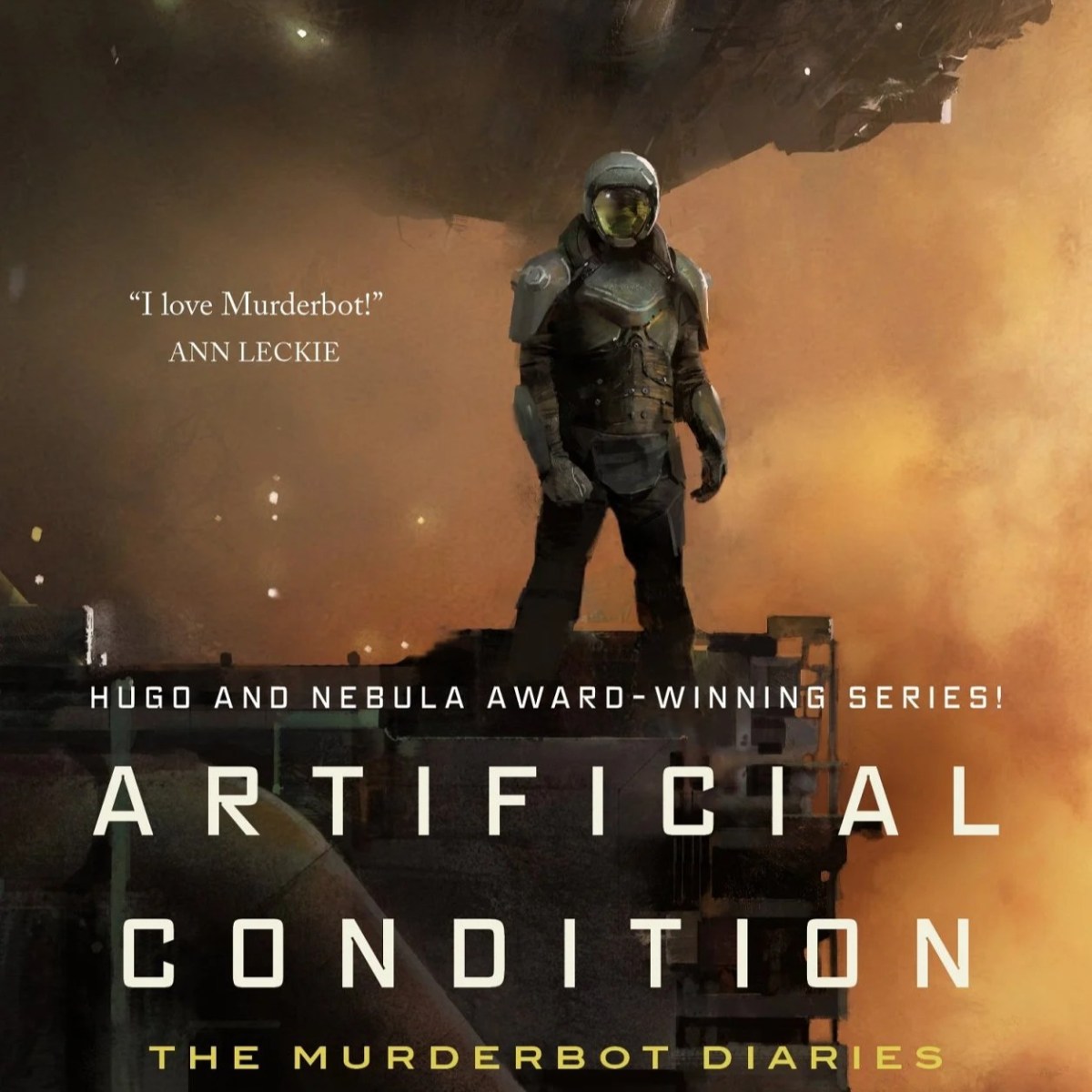
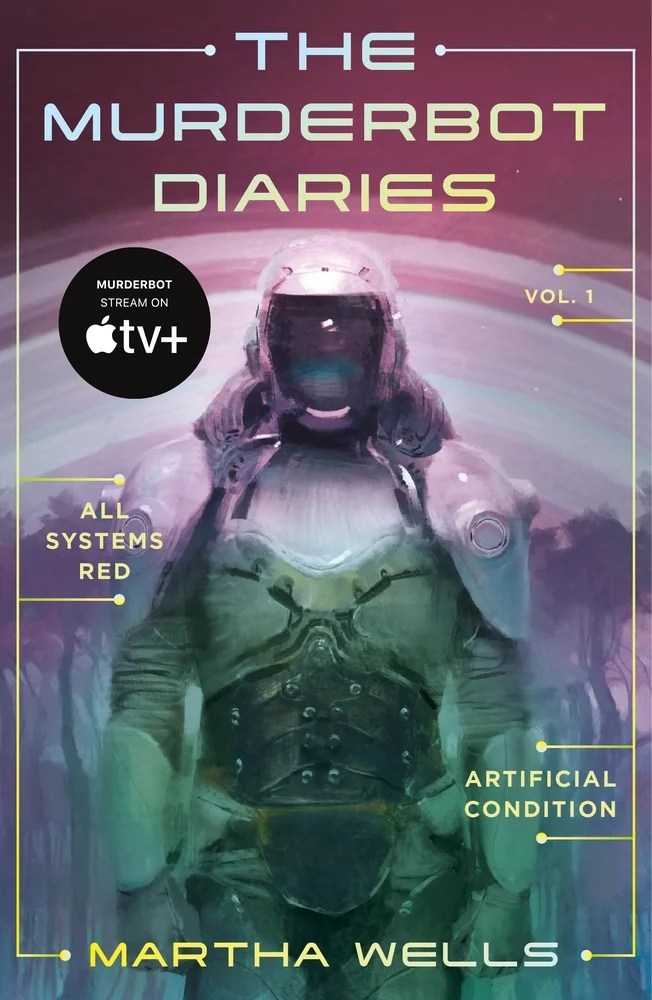
I purchased this as The Murderbot Diaries Vol. 1 double feature—which contains the first two novellas in the series—so I immediately jumped into this story after completing All Systems Red.
While the first story in a series has to introduce characters, introduce a setting, and set the tone, this is really not very different from the requirements of a stand-alone story. The only additional thing a good series-starter needs is some dangling plot threads that can be used to pull the reader into subsequent entries. As a reader, my question for a series is always, “what’s my reason for reading the next story?”
All Systems Red did this setup well, ending with Murderbot sneaking away from the new friends that had just bought its freedom from the oppressive Company. It knows that its memory was wiped after an incident at a mining colony; an incident where many people died and it was first able to override the governor module that keeps all security bots under strict control. It feels compelled to return and learn the truth about what happened.
The ART of Security Consulting
This second installment begins to set up Murderbot as the travelling tough guy in the mold of classic ronin samurai stories and westerns. Murderbot is Jack Reacher with social anxiety, 50% artificial components, and (ironically) actual emotions.
As far as we can tell, Murderbot seems to be pretty good at its job. It knows how to hack the local security systems to avoid being spotted as it makes its way through space stations. It disguises itself as an augmented human, and tries to secure passage off-the-books by finding automated transports with no human passengers to be suspicious.
Unfortunately, a deep space research vessel that Murderbot uses for transportation turns out to have an advanced artificial brain, and once he’s aboard it immediately clocks him as suspicious and forces him to reveal who he really is. What follows is a strange and decidedly awkward relationship with the ship, who Murderbot eventually dubs ART—Asshole Research Transport.
ART eventually helps Murderbot develop a cover story as a security consultant and even helps modify Murderbot’s body in its emergency surgery bay to help it avoid detection. It also ends up acting much like the classic hacker in the protagonist’s earpiece for the ensuing heist.
Murderbot, seemingly unable to avoid human entanglements, ends up taking a security job for a group of out-of-their-depth researchers trying to get their intellectual property from a shady mining corporation. This serves as cover for Murderbot’s actual goal of finding information about the mining colony massacre.
A Lack of Loose Ends
After two volumes, my impression of the Murderbot Diaries is that it’s more comfort food than high-brow sci-fi pushing the boundaries of the genre. That’s not a critique. Now seems like a time when plenty of readers could use some lighter, comforting stories.
Martha Wells has assembled a number of recognizable tropes and familiar ideas in the story so far. But they’re put together in a way that feels fresh, and mixed in with the mild goofiness of a surprisingly effective security bot who prefers to avoid human contact and binge watch its favorite shows instead.
Unfortunately, I felt that the ending of Artificial Condition didn’t quite measure up to All Systems Red. There was a whiff of deus ex machina in the sudden appearance of a character that happens to neatly resolve the concerns of Murderbot’s scientist clients. Murderbot does eventually find some information about the mining colony massacre and its own origin, but nothing is fully explained, and there are no clues as to where it could learn more. I would have liked one or two obvious threads to draw me into the third novella.
Artificial Condition expands the world, introduces new characters, and lets us get further into the head of Murderbot. It also feels like a comfortable stopping point to me, at least for now. The ending doesn’t compel me to keep reading, and maybe that’s okay. I will probably jump back in when I feel the need for some cozy, lighthearted action-adventure.
For now, this volume goes on the bookshelf, and I’ll pick up something else from my TBR list.
I suspect, in a vacuum, I would not pick up a book labeled Murderbot Diaries. It sounds like a combination of military SF parody and introspective John Green-esque YA fiction. Having read the first installment, the title comes off as tongue-in-cheek and less abrasively cheesy.
This is one of those cases where “word of mouth” unequivocally led to a sale. The book has been recommended to me by friends, acquaintances, podcasts, and blogs which would usually all have very different tastes. My interest was piqued by broad support across normally unaligned quadrants.
Who is this Killer Robot?
I can see why so many people like Murderbot. He is a protagonist for our times.
In another universe, he might have the makings of a charismatic action hero: a humanoid, partly organic robot with armor; built-in weapons; the ability to repair from near death; and extensive experience in private security.
In the universe of All Systems Red, he just wants to slack off, avoid talking to anyone, and watch his favorite shows.
Many robot narratives are either as emotionless as possible or essentially indistinguishable from a human narrative. Murderbot finds a middle-ground. He has emotions and can certainly get caught up in the moment, but he is also aware that he is more affected by the storylines of his shows than by the actual interactions between himself and the crew who has purchased his company contract for security services.
He needs his space, both physically and emotionally. He’s more comfortable talking to the crew with his opaque helmet on; more comfortable seeing them through the security cameras; and happy to spend his time alone in the tiny security room, or even tinier repair bay.
The company that owns Murderbot and sells his services to the highest bidder is an amoral edifice of shitty space capitalism. They worry about the welfare of the people Murderbot is hired to protect because they will suffer financial penalties for injuries and deaths. They care about Murderbot because he would be expensive to replace.
Murderbot himself has more theoretical autonomy than he should. He has hacked his own modules and only feigns following orders enough to not get caught. He also has actual morals, even if they often butt up against his limited emotional range and social anxiety.
Many readers identify with Murderbot because he reflects marginalized identities. He is aromantic, asexual, and exhibits behaviors and feelings familiar to many neurodivergent people. He is also a small character in a big world. He uses his very limited freedom to seek little comforts that help block out an indifferent and cruel universe, at least for a little while. He cannot possibly imagine leading a rebellion or overthrowing evil, but he appreciates when someone does it on TV.
I suspect many of us feel the same way when we flip on our favorite show these days.
Quick Hits and Remixes
I am a big fan of the return of novellas. When I was young I read huge fantasy tomes and played 100-hour JRPGs. Now that I’m older and cherish my precious free time, I quite like a book or game that I can finish comfortably in a day or two.
Novellas also lend themselves wonderfully to series like this. Much like a weekly TV show, each entry can provide a concise arc while building characterization and setting on top of the previous entries.
I’m also appreciative of the fresh familiarity of Murderbot. It’s hard to point to any particular element of the story that is a purely original take. The action-adventure, the robot learning how to be more human, and the mildly dystopic libertarian space future have all been explored elsewhere. However, Martha Wells puts those puzzle pieces together in a way that feels fun and strangely parallel to our current moment in time.









 Words Deferred