Book | E-book (affiliate links)
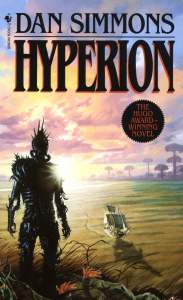
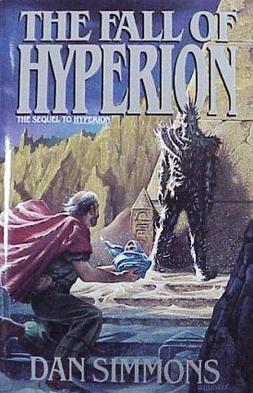
The Fall of Hyperion is the second book in the Hyperion Cantos. It is the sequel to Hyperion, and although the two Endemion books pick up a related story in the future of the same universe, the two Hyperion books really form a complete pair.
They are an interesting duo of books to compare. Hyperion has only a few long chapters, each a self-contained story. As the first half of a series, it makes little attempt to resolve loose ends. The Fall of Hyperion has a very large number of short chapters and has many mysteries to wrap up and plot points to resolve.
Severn, Gladstone, and the Pilgrims
Hyperion followed the stories of the seven Shrike Pilgrims, who make their way to the so-called Time Tombs, finding themselves alone in a dire situation as the galaxy sits on the brink of war. The Ousters, humans who long ago committed to life in wandering deep space colonies, face off against the Hegemony, a culture stradles hundreds of planets with instant-travel “farcaster” portals and a central government.
The Fall of Hyperion introduces the character of Joseph Severn, who takes his name from a friend of the ancient poet, John Keats. Severn is a “cybrid”—a hybrid of human biology and an AI personality, with the artificial memories of John Keats embedded in his mind. As if that weren’t enough, Severn is in some ways the twin of Johnny, the dead cybrid lover of one of the Shrike Pilgrims.
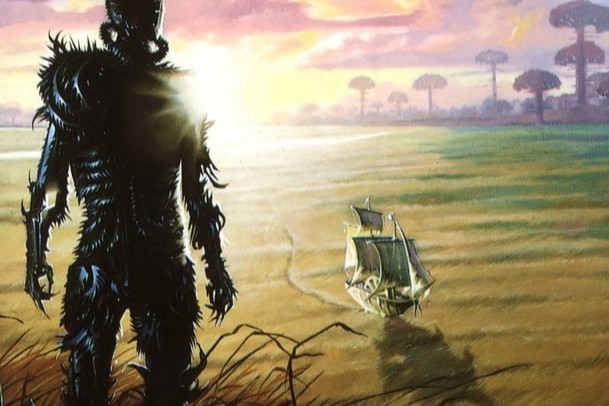
Severn is hired by Hegemony CEO Meina Gladstone, ostensibly to draw her portraiture in what is expected to become a defining moment of the Hegemony’s history. For most of the book, chapters alternate between Severn and the Shrike Pilgrims. The Pilgrims work to discover the mysteries of the Time Tombs and how they relate to the Shrike, a four-armed, semi-mythic, razor-covered metallic monstrosity that seems inextricably linked to the tombs and a far-future war where humankind fights for its existence.
It eventually becomes apparent that the chapters alternate because Severn has the unique ability to “see” the pilgrims’ activities in real time through his dreams, and it is because of this that Gladstone wants to keep him close.
The Hegemony’s war with the Ousters heats up and threatens to spill out of the Hyperion system, into the web of farcaster-linked worlds. But the pilgrims and Severn soon learn that the Ousters may not be the biggest threat. The Core of hyper-intelligent AIs, inventors of the farcasters and aloof patrons of the Hegemony, are revealed to be split into three competing factions. At least one of these is Hell-bent on creating a machine god and wiping out humanity.
The Challenges of Mythic Sci-Fi
The greatest strength of Hyperion becomes the main weakness of The Fall of Hyperion. The first book manages to build an epic space-opera universe and populates it with characters and stories pulled from other genres. The overall effect of the Pilgrims’ quest and their adventures is a mythical-feeling quest in a far-future setting.
Hyperion gets away with this partly because it only dips its toes into galactic politics and space wars and AI metaverses. But the sequel has to gather the loose ends into a somewhat logical and satisfying conclusion. As a result, it digs deeper into many of the sci-fi elements and strips away some of the hand-wavy magic of the universe by explaining how it all works. Of course, the AIs and quantum physics of eight centuries in the future are still magic, just with a technobabble vocabulary.
I do appreciate that the resolution really resolves the story (even if it does leave one very specific opening for the sequels). The two books make a satisfying series. But the second book feels more like “standard” space opera and doesn’t quite achieve the same highs of the first book.
That said, my favorite chapter across both books comes from The Fall of Hyperion, and follows Meina Gladstone as she traverses many worlds by farcaster on the eve of war. Rarely does sci-fi achieve such a sense long history in its setting or capture so well the feeling of insignificance in the face of a vast universe.
Is Dan Simmons Problematic?
Coincidentally, as I was re-reading these books, Dan Simmons passed away. I clicked through a few articles and quickly learned that he is widely considered problematic. I hadn’t come across much in these books that raised my hackles, so I ventured down the Internet rabbit hole to see what random strangers found objectionable.
The answer was mostly in his other books. It turns out historical and alt-history fiction is a more fertile ground for outright racist tropes. However, I did find some specific complaints with the Hyperion books, and I thought they offered interesting insights into modern readers.
Firstly, some people are just excited to pile on. Hating things online has long been a popular pastime, and hating on awful people has the added bonus of letting the hater feel superior and righteous.
A notable number of criticisms come from “readers” who pretty clearly haven’t read the material. They complain about unreasonable interpretations of the material, or complain about something insignificant when there are clearly better examples for their argument elsewhere in the books. At best, these are readers who quit after the first few chapters.
One critic took offense at the use of the r-slur by one of the characters, in reference to a tribe of people with a parasite that revives them whenever they die, but degrades their mental faculties each time. This is an interesting case, because the first book was published in 1989.
For younger readers unfamiliar with the history, I suspect it comes across as weirdly blatant use of a nasty slur. These readers seem unaware of the shifting moral terrain of scientific terms around mental disabilities over the course of the 20th century. I think it’s fair to assume that this particular usage of the r-word was considered relatively innocuous in ’89. The modern, offensive, and derogatory usage of the word (and pushback against it) came mostly in the following two or three decades. Similarly, the word “oriental” is used once or twice. That might have been a bit dated in ’89, but I don’t think it would have seemed nearly as off-color as it does today.
These books are “only” 40 years old, but that is enough time for the language and the culture to change. I may be the old man yelling at clouds, but this shallow maligning of the author’s intent and tone strikes me as willful disinterest in any non-negative interpretation.
That said, there are parts of these particular stories that don’t hold up well to modern sensibilities. Simmons indulges in a few Star Wars-style monolithic planets, including a Catholic planet, a Jewish planet, and an Islamic planet. None of these are explored in great detail, but the Islamic planet is suggested to be a place where holy war and fanatic religious hatred are normalized.
There’s also no question that the book embodies a full-on male gaze. It definitely doesn’t pass the Bechdel test. On a list of important characters, the top fifteen contains—at most—three women. Only two of them meaningfully impact the plot. And yet there are a number of sex scenes focusing almost exclusively on female anatomy.
Of course, sex in sci-fi is hardly a big deal, especially in a world where romantasy is a wildly popular genre. I’d also argue that the most gratuitous examples in these two books come from the story of the meathead action hero, whose focus on sex and violence make some sense for his character.
I don’t defend Simmons’s character. It certainly sounds like some of the books I haven’t read contain more racist and questionable material. For what it’s worth, the first two Hyperion books mostly avoid it.