Tips for Thousand Year Old Vampire

If you saw my previous post, you know I’ve been playing the solo RPG “Thousand Year Old Vampire” recently. I enjoy the game, but like so many TTRPGs, the source book is heavy on rules and light on examples. With a few rounds completed, I thought I’d offer some tips for new players, to make the game more fun and easier to run.

One Easy Trick They Don’t Want You to Know

The included “character sheet” consists of two paperback-sized pages with six headings (memories, diary, skills, resources, characters, and marks). If you abuse the book’s spine, you can probably scan this onto a single sheet of standard paper, but anyone who has played the game will know that you’ll need the world’s tiniest handwriting to fit everything on that single page. And even if you do, you’ll be carefully erasing half of it as you play.

I’ve tried playing by writing everything in pencil on 4-6 sheets of paper. It’s manageable, but not great, especially for your first run. Luckily, we have the perfect technology to improve this situation: sticky notes. They come in a rainbow of colors, and they’re the perfect size for a one-sentence blurb, which is the format of just about everything in TYOV.

I really enjoy the tactile aspect of pen on paper, so I’ve been using color-coded Post-It notes that I can stick on 3-4 standard-sized sheets of heavy tagboard. You could also use a larger sheet of paper or poster board, or just array the notes across a table, but it’s nice to have something you can pick up and put away if you have to pack up an incomplete session.

The game doesn’t specifically tell you to, but I also like to track the age of my vampire (whether they know their own age or not), the current year, and all the prompts I’ve hit in the current game. This makes it much easier to pick up a game from a previous session.

Virtual vs. Physical

In our post-pandemic world, many of us are now used to playing our tabletop games on virtual tabletops. Since TYOV involves a significant amount of adding, deleting, and copy/pasting; tracking everything on a laptop can make all that easier.

However, the typical TTRPG virtual tabletops cater (by necessity) to Dungeons and Dragons, Pathfinder, and a lot of similar games. TYOV has only a little bit of die rolling, and none of the minifigures, maps and crunchy bits that these platforms put a lot of effort into. So virtual tabletops strike me as ineffective overkill. All TYOV really wants is a big whiteboard and some sticky notes.

As luck would have it, I know from my day job that a lot of professional project management and software development jobs happen to have similar requirements. Trello, Miro, and the dozens of similar apps are perfect for TYOV, and while they may be catering to big business, they all generally have free tiers that are more than adequate here.

Min/Maxing?

It’s clear from the very light-touch mechanics that TYOV is a story-centric game. However, there are still mechanics in the form of skills and resources. These are the currency that keeps the game going.

Before beginning a game, it’s worth thinking about what your goal is. If you want to let the story develop however it may, then there’s no need to worry too much about your resources. After my first vampire met a relatively early demise by running out of skills and resources, I decided I wanted to see a game all the way through to the “end”—reaching one of the last nine prompts. In that case, you’ll want to play with an eye toward the mechanics, and staying alive.

Many prompts offer choices. Characters and memories are ephemeral. Marks can impact the story. But none of them matter toward your vampire’s continued survival compared to skills and resources. So long as you pick options that maximize those, and you don’t roll too terribly, you’re likely to reach the final prompts.

Memory Miscellany

The TYOV rules as written place a hard cap on the length of an experience: one sentence. If you stick to this, you’ll quickly find yourself writing convoluted run-on sentences full of commas, colons, semicolons, em-dashes and parentheticals. Even the few examples in the book do it.

I appreciate the purpose of the rule: to keep the game tight and quick. But sometimes it’s just faster and more fun to write a couple of sentences, rather than heaping abuse on the English language. As far as I’m concerned, a short paragraph of two or three sentences is just fine, and if you use sticky notes, each experience will still have a natural built-in size limit.

When it comes to memories—the headings that experiences must be filed under—it pays to pick something that will be easy to fill with a full roster of three memories. To this end, I find that single-word concepts work well, especially emotions and vampire-related things.

Love, hate, hope, fear, loneliness, determination.

Blood, feeding, pain, death.

Many new experiences will be able to fit under several of these memories, which means you can pick and choose to better max out your fifteen possible slots for experiences.

Alternately, if you want a highly forgetful vampire, you can try the opposite: very specific memory headings will make it harder to slot in experiences. This will force your vampire to offload to diaries and forget things sooner. This may be fun if you want to play with a monster who has forgotten his own origin, or increase the likelihood of repeatedly running across a nemesis or lover that your vampire has forgotten.

Thousand Year Old Vampire — A Solo RPG

Thousand Year Old Vampire is a lonely solo role-playing game in which you chronicle the unlife of a vampire over the many centuries of their existence, beginning with the loss of mortality and ending with their inevitable destruction.

I happened across this little hardcover book at a games store in a mall near my house. I was there to have the failing battery in my phone replaced, and I had some time to browse and meander. Since most TTRPG books are oversized tomes, a novel-sized book stands out on the shelf.

I don’t have an active gaming group these days, and most game books don’t come cheap, so I don’t buy random game books as much as I once did. But a solo RPG sounded appealing, and my kids had been asking if there was something I might want for Father’s Day. So I texted a pic of the cover to my wife with a note about where I had seen it. Lo and behold, a week or two later I was unwrapping it.

Becoming a Vampire

The rules of TYOV are simple. Your character is defined by their memories, and you can only keep a limited number over your long (un)life. Each memory is a collection of experiences, defined by some particular theme or topic. Each experience is a single sentence that describes something that happened in a turn of the game. You can have up to 5 memories (topics) with three experiences attached to each.

Although this gives you enough space to retain up to fifteen experiences, those experiences need to fit under the existing memories, which can sometimes be tricky. Additionally, you can “offload” up to four memories into a diary—a physical object that could be anything from a book to a cuneiform tablet—they’ll no longer take up space in your head, but they can be lost forever if something happens to that diary.

Along with memories, your vampire has skills. Skills are one of the two mechanically important resources that your vampire can use to survive when things go wrong (and they will go wrong a lot). Skills typically relate to an experience, and can only be used once, usually to get out of a jam. However, skills that have been used (or “checked”) can sometimes become relevant again in later prompts.

Your vampire can also accumulate physical “resources.” These mechanically important (and personally significant) items can be anything from a trinket to a castle, and are differentiated from mere possessions that you may accumulate over the centuries.

The other aspects of the game are marks and characters. Marks can be any sign of your immortality, such as the classic vampire tells: nasty teeth, failure to show up in a mirror, and sparkles. You could also choose to go big with bat wings, glowing eyes, or something more extreme.

Characters are the mortals and immortals you meet, meat, and perhaps re-meet along the way. Mortals will typically only be relevant for a few turns of your long life. Immortals may become allies or enemies, and be lost and found again across the centuries.

Play

To play, you move through a series of eighty numbered prompts. Each turn, you roll d10 – d6. This means you can move forward and backward, although statistics ensures you’ll eventually progress forward. If you land on the same prompt more than once, there are additional prompts for the second and third go round (and even more options in the appendixes).

Prompts will present a new situation, and you’ll have to decide what happens as a result. Each prompt may change your story mechanically, by granting or using up skills, resources and NPC characters. Prompts also add story context. You make choices, if instructed. And you always create a new experience that must be added to one of your memories. If no relevant memory has an open slot, you must give something up: forgetting a memory or moving it to your diary.

The last eight prompts end the game, providing a natural limit. It is also possible to use up your skills or resources. In a pinch, you can substitute one for another, creating some fiction to explain how you escaped a sticky situation. If you have no skills or resources left and the game demands one, then your vampire dies. My first game ended at prompt 25, having completed seventeen experiences. The endings at the high end of the prompts are a goal to aim for, but you aren’t guaranteed to make it there. There are a few ways the game can end: death and destruction, being trapped forever, or losing yourself in the throes of madness.

Variations

The game suggests two modes of play: quick game, where you simply track the state of your vampire with the minimum necessary information, or a journalling game, where you write vampiric journal entries for each prompt in addition to tracking experiences, memories, skills, resources, and characters.

A scant three pages in the back of the book are dedicated to suggestions for group play, suggesting that “journalling games” be treated as a long-form game of letter writing between participants that may last days or weeks, and “quick games” can be done in-person over the course of a few hours.

In multiplayer, the book suggests sharing non-player characters and creating stories that link the players’ vampires. It also outlines a mechanic for sharing or stealing resources.

This section seemed like an afterthought to me. There were minimal examples to help understand what this kind of game might look like in action. I don’t expect really crunchy rules from a game like this, but at least a little bit of rigor seems necessary, so the players actually know how to interact.

The Fun

The last time I played a solo TTRPG was A Visit to San Sibilia. That game was extremely mechanically light, and felt almost like a series of slightly randomized short story prompts (which I found very enjoyable, but might not satisfy someone who is more interested in the “gamier” aspects of TTRPGs.)

Thousand Year Old Vampire is more mechanical, and gives you more opportunities to choose whether you’ll make decisions for story reasons (do I save a favorite character?) or mechanical ones (do I save my skills and resources?). These mechanical aspects also mean that there is more stuff to keep track of over the course of a game.

Despite following the life of a single vampire from start to finish, this is less of a storytelling game. With San Sibilia, the natural result of playing the game is a short story. The artifacts that come out of a game of TYOV are more fragmented. Until I got into it, I didn’t realize how much erasing or crossing-out I’d be doing. Characters, skills, and resources all come and go. Even memories are liable to be erased eventually, and diaries can be destroyed.

It’s easy to end the game with a sheaf of scribbly, messy papers. While it’s possible to carefully document your vampire’s life in a journaling game, I think it may be a stronger experience if you lean into the ephemeral nature of the experience.  One of the more interesting things that can happen in the game is your vampire living so long that they no longer remember their origin.

It’s probably good to treat your first game of TYOV as a test run, just as you’d expect to need a few sessions to get comfortable with the rules for a “big book” group TTRPG like D&D or Shadowrun.

Delving Through History

Something that was not obvious to me at first is that this game is at least as much about history as vampires. If you begin in Spain in the 1300s, you won’t get through many prompts before you’ll need to know some things about what life is like in that time and place. And your vampire will likely travel the world as they pass the centuries, so you may soon need to learn about 14th century Africa or the New World in the 15th century.

A good general background in history helps, but isn’t necessary so long as you’re willing to go down some Wikipedia rabbit holes. However, learning about history ends up being a significant part of the game. If that sounds boring, this may be a tough game to get through.

Of course, you could always make up some alternate history, or start your vampire in the modern day and let them travel into the far-flung sci-fi future…

Killing Time at Lightspeed — Games for People Who Prefer to Read

Killing Time at Lightspeed is a text-based, narrative game by Gritfish about browsing social media while voyaging between the stars.

You are a traveler who has left their life and your planet behind. Your lightspeed voyage will feel like less than an hour to you, but to your friends on Earth it will be twenty years. The only connection you have to those people is a news and social media feed: FriendPage.

This is a small indie game, clearly developed with limited resources. There are a few static illustrations in the introduction. After that, the entire game is contained within a simple, monochromatic yellow and black text console.

The game plays out in a series of turns, each one taking only a minute or two. During a turn, you can read your friends’ updates on FriendPage, and a handful of news headlines. You’re given the option to reply to one or two posts, and you can give them thumbs up or thumbs down. When you’ve read and responded as much as you like, you can click a button to “refresh” the page. When you do, a year passes back on earth and the news and social feeds update.

With that click of a button, you may see the results of an action a friend was considering. Relationship statuses are updated as the people you know get together and break up. They get married and have children. New technology appears, like cybernetic implants and humanoid androids. Your friends have time to adjust to societal and personal changes, but for you it all comes and goes in minutes instead of years.

There are many sci-fi ideas at play here. The arguments about cybernetic enhancement cover similar ground to the Deus Ex games. Discussions of android rights echo Detroit: Become Human. However, with this short runtime and limited budget, the game can’t delve as deeply into these particular issues. In a way, that’s the point.

In Killing Time at Lightspeed, everything that happens in your social media feed is ephemeral—even more than in our day-to-day lives. It excels in delivering a feeling of being cut off and left behind. You’re reading about what everyone else is doing and experiencing, but you are alone.

How much can you really communicate with your friends when months or years pass between messages? Momentous changes in your friends’ lives are summarized in one or two sentences. How many other important things are you missing altogether? You can ask them about what’s happening, but how can they explain all the things that have happened to them since last year and your last message?

The point is really driven home in the final years of the game, when a new social media site becomes popular and friends start to drift away from FriendPage. You don’t have the option of making a new account or checking the new feed. You only have what your spaceship gives you. Soon, your feed is almost entirely filled with spam, bots, and pointless Buzzfeed-esque listicles. You’re stuck on MySpace, in space. Your one tenuous tether to Earth is nearly severed. But you keep refreshing in the hopes that someone will come back and post something.

Then you arrive at your destination. The terminal shuts down. The game is over. Your friends are far away, living their lives without you. Presumably you’ll go off and live a new life without them.

Killing Time at Lightspeed is shorter than a movie, and can be comfortably completed in a sitting. It’s a narrative snack, not a full meal. I didn’t walk away from it with a lot of new thoughts, as I sometimes do with games like this. Instead, it left me with a feeling. A melancholy vignette.

Killing Time at Lightspeed is available for PC on Steam and Humble Bundle.

Mouthwashing — Games for People Who Prefer to Read

You could say I’m not much of fan of horror. I’ve learned a lesson from music: if I think I dislike a genre, it just means I’m picky and I haven’t found the particular examples that hit just right. House of Leaves, Soma, and Alien are some examples that proved to me I can enjoy horror—it’s just a hard sell.

I’m not sure if I enjoyed Mouthwashing. I’m not sure it’s a game that’s designed to be enjoyed. I am enough of a gaming hipster to appreciate when a game tries to evoke a mood, even if it’s an unpleasant one and it doesn’t always pull it off perfectly.

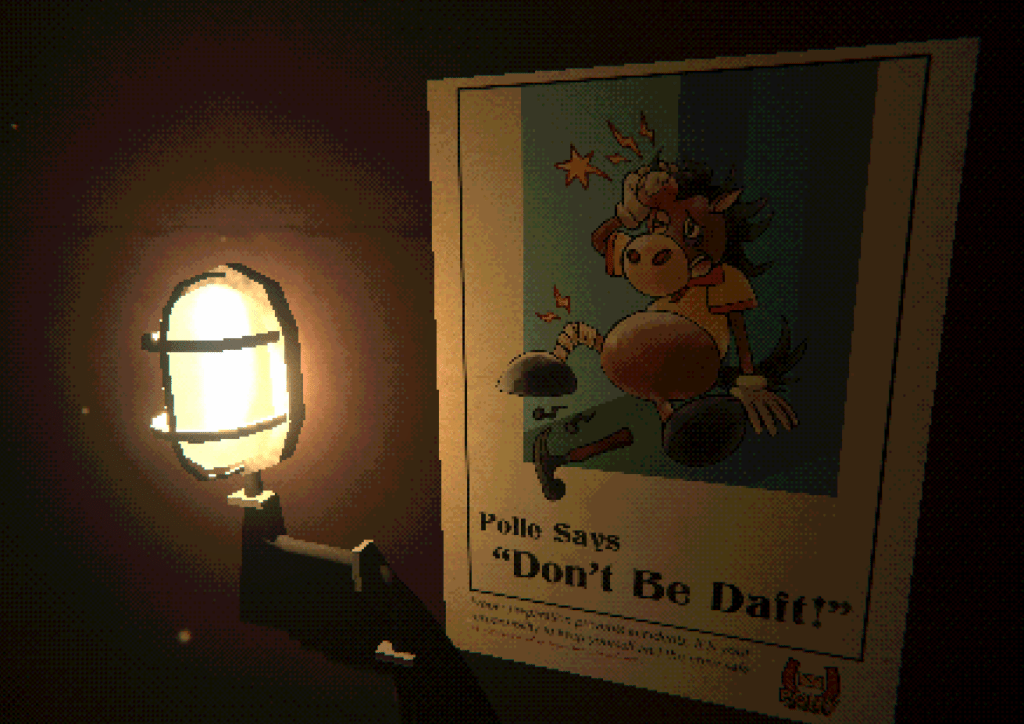
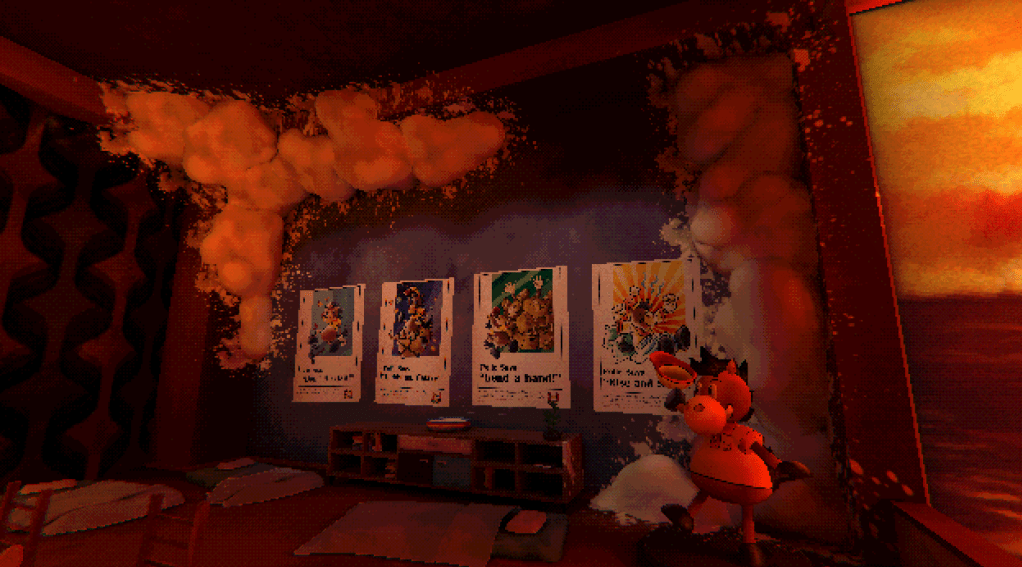
Mouthwashing is a short (3-4 hour) game about the five-person crew of the Pony Express ship Tulpar, a long-hauler transport spaceship on a year-long delivery run. We don’t see the world beyond the ship. We don’t know what it’s like out there, or how far into the future we are. The world of Mouthwashing happens in the grimy, poorly lighted corridors of the Tulpar. The visuals are purposely lo-fi; not only grimy, dark, and gory, but viewed through a crunchy, pixelated filter.

The tale is nonlinear, jumping back and forth several months around a cataclysmic incident. The ship hits an asteroid, crippling it and leaving the crew stranded with limited supplies.

In the past, we play as Curly, the captain of the ship. During the crash, Curly is severely injured, wrapped in bandages, bedridden, and in excruciating pain. A single bloodshot eye peers out from the bandages. A row of bare teeth, with no lip to cover them. In the scenes after the crash, with Curly nearly out of commission, we play as Jimmy, the co-pilot, Curly’s longtime friend and the guy who just can’t seem to get his life together. Rounding out the crew are Anya, the medic; Swansea, the mechanic; and Daisuke, the intern who was unlucky enough to board at the last minute before launch.

The gameplay mostly revolves around conversations among the crew, with occasional simple puzzles and item-fetching. There are two brief “gamier” sections where some reflex and strategy are required, but I found these to be the weakest and most frustrating portions of the game.

As the months go on and the characters become  desperate, civility breaks down. It becomes clear that there are dark secrets among the crew. The game becomes more and more surreal, reflecting Jimmy’s progressively deteriorating mental state. Flash backs to Curly slowly reveal the hidden secrets that Jimmy doesn’t want to talk about, or even acknowledge to himself.

As the crew turn on each other, the ship’s actual corridors fall away, leaving us and Jimmy in a mostly hallucinated world where we can only guess what is real and what is metaphorical. It all ends in blood and tears, as Jimmy tries and fails to hide from a series of horrible truths.

Mouthwashing echoes a classic strain of horror where a small group of people are trapped together in the face of a monster or horrific situation. Here though, despite being lost in space, the horrors are decidedly human.

Mouthwashing is made by Swedish studio Wrong Organ and is available on Steam, Nintendo Switch, PlayStation 5, and Xbox Series X/S.

Blue Prince — Games for People Who Prefer to Read

Previously in this series I have mostly recommended games that might be described as light on gameplay and heavy on narrative. Most of them are of the genre pejoratively titled “walking simulators.”

My goal is to recommend games that don’t require twitch reflexes or a lot of experience with  game systems, interfaces, or particular genres. There is narrative greatness in the world of video games, it just takes some looking to find.

Blue Prince

Blue Prince is a “gamier” game than I would typically recommend in this series—not because it’s frantic or overly-complex, but because it’s less narrative-forward and more mechanical at a surface level.

The story is still there, but it’s a mystery, and you have to search for answers and clues, making inferences. Because this is a mystery, the challenge of the game comes from puzzles, and these work on two levels, which I’ll call “the grid” and “the meta-puzzles.”

The Grid

The grid is the surface puzzle. You’ve inherited a mansion, and every day the rooms reconfigure themselves. The house contains a 5×9 grid, and every time you open a door, you choose from 3 semi-random rooms to occupy that space in the grid. Your goal: to get to the far end of the mansion, find a hidden 46th room, and claim your inheritance.

The grid is a game of resource-management, with a finite number of steps per day, used up with each room. There are keys to unlock doors, coins to buy things, gems to pay for more exciting rooms, and the rooms themselves offering 1-4 exits and other perks. There are also special, unique items to be found, which increase your resources or provide beneficial effects.

The grid offers plenty to keep the player busy, at first. But after a few failed attempts to get through the house, the second part of the game begins to reveal itself: the meta-game.

The Meta Game

Some rooms work in combination with each other. Some rooms have clues for puzzles in other rooms. And there are many, many rooms to discover and unlock. Eventually the player will find ways to go beyond the house and find new revelations on the grounds and beneath the foundations. The game is much larger than it first appears.

Here, Blue Prince introduces “roguelike” elements—new tools and additional resources that persist across days. Meta-puzzles can unlock new areas, but they can also reveal new information. Books in the library, newspaper clippings in the archives, letters hidden in safes and locked diaries all reveal narrow slices of a larger narrative.

I won’t spoil the story, but it involves the aristocratic family to which the player character belongs. A history of the surrounding countries—politics, warfare, and xenophobia—is revealed over the course of the game. The family must navigate these dangerous waters, and it becomes apparent that they did not always manage to pass through unscathed.

The Price of Something New

I think Blue Prince stands as something unique: a roguelike puzzle game that manages to embed an interesting story within a mechanically dense framework. However, it is not entirely without downsides.

I found that the puzzles were well-tuned while I was working toward the “end” of the game—the stated goal of finding the 46th room of the mansion. Each new day I was able to find new clues, solve a puzzle or two, and often experience a room or item or new mechanic that kept things interesting.

Entering the “final” room isn’t the end though. Not really. It’s a revelation, but most players will still have a few dangling story threads and unfinished puzzles to keep them playing after that initial victory. It doesn’t take long to discover that there is plenty more that can only be uncovered after supposedly winning.

The puzzles get harder and more obtuse. The items are all found, and it starts to become more and more rare to discover a new room or a new clue.

The game provides more resources to the player as they solve meta-puzzles, making progress in the daily grid game easier. There are a couple of mechanisms that the player can use to tweak their likelihood of finding specific rooms or items. But eventually, the repetition starts to wear thin, especially when you want to try a puzzle solution or find a specific bit of information and just can’t get the randomness of the house to cooperate. You might only feel like you’ve made progress once every few days. I found myself wishing I could do more to stack the deck in my favor.

There were also at least a couple puzzles that I couldn’t get past without a guide. I don’t begrudge a puzzle game its challenging puzzles, but I am disappointed when the clues don’t point clearly to the actual solution.

The Limits of Narrative through Setting

Blue Prince tells its story through its setting. It relies on the rooms themselves, supplemented with the letters, clippings, emails and books found within. It allows a few concessions to gameyness (nobody is surprised by the magically rearranging house in an otherwise normal world). The story has to fit within the framework of the grid game.

These limits prevent Blue Prince from creating the kind of curated narrative arc that is present in What Remains of Edith Finch or The Beginner’s Guide. That’s okay. It’s a different kind of game and a different kind of story.

Ultimately, it shows that the borders of interactive storytelling continue to expand.

Games for People Who Prefer to Read — Dr. Langeskov

Okay, the full, absurd name of this game is Dr. Langeskov, The Tiger, and the Terribly Cursed Emerald: A Whirlwind Heist. If you’re a reader who has never, ever played a video game, this might be the ideal first game for you to try. It’s free, it only takes about 15 minutes to complete, and it requires no reflexes or puzzle-solving skills. It’s available on Steam for those who have it, and Itch.io for those who don’t.

I don’t generally throw my lot in with the “hardcore gamers” who heap derision on so-called walking simulators, but it might be more accurate to call this a narrative experience than a game. Still, it’s a fun narrative experience.

The game promises an adventure in thievery, but even in the description on the store pages, it’s clear that something is amiss. Halfway through the description of the game, the person writing it decides to join “the strike,” complaining about being forced to do multiple jobs, and signs off with “I’m out.”

The opening menu screen also suggests an over-the-top adventure, with a moody forest scene illuminated only by the taillights of a car. You click the button to start the game. A loading screen appears for “heist.map,” cycling through several tips about the history of the mansion that you will presumably set out to rob in just a moment.

Suddenly, the music cuts out. The screen glitches, and you’re back at the title screen again. There is a voice; distant and muffled. You realize you’re hearing “back-stage,” where people are getting the game ready for you, as though it were a live stage production. Then there’s silence. Nothing is happening. You wait.

At some point, you decide to do something. Maybe click the “start game” button again? Moving the mouse causes the camera to shift, and you realize this isn’t the start menu at all. It’s a huge poster of the start menu on a wall. You’re in a drab waiting room, staring at a painted replica of the menu background.

This immediate double fake-out sets the stage for a very silly game where most of the “behind the scenes” workers running the game have gone on strike. You’re recruited to help, pulling levers and pushing buttons back-stage so some other player can enjoy the experience you thought you were going to have. The voice over the loudspeaker assures you that if you just help out a little bit more, you’ll get to play the game next. Promise.

Dr. Langeskov was developed by a small, indie studio called Crows Crows Crows, which includes William Pugh, best known for his work on The Stanley Parable and the considerably expanded version, The Stanley Parable: Ultra Deluxe.

It’s very similar to the Stanley Parable; with limited modes of interaction; a narrator that leads you along; the light, absurdist tone; and the playful ways the game gives you to rebel against the narrative by refusing to do what you’re told. It’s smaller than The Stanley Parable, but it feels like the perfect size for what it’s doing, and doesn’t overstay its welcome.

Returning to Go

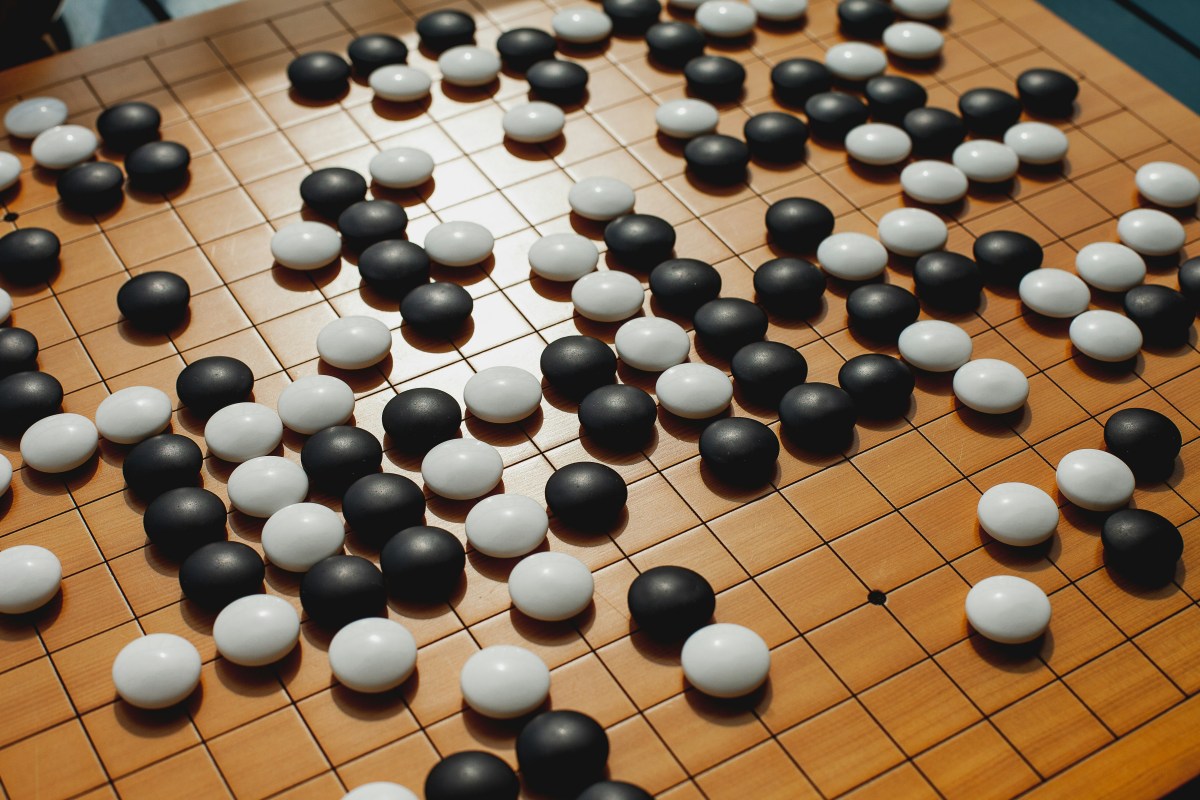
I have been a fan of the game of Go for more than a decade. It’s a game of strategy comparable to chess, played in China, Japan and Korea for thousands of years, but only recently more popular in the rest of the world.

While chess is all about the tactics of threatening and capturing pieces with different capabilities, Go is both simpler and more complex. The board is much larger, but the stones stay where they’re placed. Capturing stones is an important part of the game, but happens only occasionally; the main goal is to surround more territory than your opponent.

Unfortunately, my past attempts to get my family interested in playing have failed, and I never got very deep into online play. I was just good enough to frustrate my family, and mostly much worse than the dedicated online players.

When we moved to our new house, our board game collection moved out of the basement and into a place of honor on bookshelves in the living room. The big wooden board and the bowls of stones caught my kids’ attention, and at least for a little while they’re interested in learning. Just like that, I was sucked back into the game.

Now I haven’t played in a while and I can tell my skills are rusty, so I fired up the Go app on my phone. I can’t speak to the options for Android, but on iOS, SmartGo One is the best app I’ve found. It offers quite a few features for free, and while it’s pricey to upgrade (as far as phone apps go), it offers a massive archive of pro games and practice problems for all skill levels.

The SmartGo people have also incorporated their extensive library of interactive Go e-books from their Go Books app. This is a really nice resource, because good books on Go in English are still quite hard to find in physical bookstores, and these e-books are honestly more useful, because the problems and examples can be “played” directly in the book.

I don’t know if my kids’ interest in the game will last, but I’ll enjoy it while I can. My oldest has been studying chess and now outclasses all of us, so maybe I can foster his interest in another game where he’ll quickly exceed my skill level.

Games for People Who Prefer to Read — The Beginner’s Guide

The Beginner’s Guide starts with a white screen. The voiceover says,

Hi there, thank you very much for playing The Beginner’s Guide. My name is Davey Wreden, I wrote The Stanley Parable, and while that game tells a pretty absurd story, today I’m going to tell you about a series of events that happened between 2008 and 2011. We’re going to look at the games made by a friend of mine named Coda.

Now these games mean a lot to me. I met Coda in early 2009 at a time when I was really struggling with some personal stuff, and his work pointed me in a very powerful direction. I found it to be a good reference point for the kinds of creative works that I wanted to make.

Then, without ceremony, we’re dropped into a world: a facsimile of a desert town, a map for the game Counterstrike. It’s Coda’s first “game,” and Davey proceeds to tell us why he thinks it’s interesting. He explains that he thinks these games tell us something about their creator. Coda stopped making games, and Davey wants to figure out why. He even provides his Gmail address and asks for feedback from players.

The Beginner’s Guide is not a traditional game. Like The Stanley Parable, it’s very much in “walking simulator” territory. However, where The Stanley Parable was all about choice in game narrative, The Beginner’s Guide offers few choices, and no real way to exert control over the narrative. It’s more about experience than participation. It’s a little bit like a short mystery.

The Narrator

Davey will continue to provide voice-over explanations throughout the entire experience, with very few breaks. He is the tour guide as we travel through Coda’s games, most of them little more than small experiments. While the player usually has freedom to go wherever they want within a given game, Davey moves the player from one game to the next. Davey chooses to occasionally skip the player past content that he deems unimportant, like a complicated maze, in order to keep the narrative flow.

He constantly explains the real-life context of his relationship with Coda at the time each game was made, and inserts his own theories about what these games tell us about Coda and his emotional state over the years they knew each other. He is ever-present, and influences the player’s interpretation of Coda’s games in both subtle and overt ways.

The Context

This opening sequence and everything that follows it is designed to put the player in a particular mindset. It’s a framing device, and it sets our expectations of Davey and Coda. After all, this is a pretty strange premise for a game. We know Davey is a real person. He really wrote The Stanley Parable. But is this the real Davey?

Is Coda a real person? Did he really make these games? That seems less likely. And what exactly does the title of the game mean?

Davey is inherently an unreliable narrator, but he goes to unusual lengths to establish credibility and realism. He sets himself up as a sort of documentarian, chronicling and presenting these games.

As The Beginner’s Guide progresses, an astute player may notice that Davey’s interpretations of Coda’s games sometimes make sense, and sometimes…don’t. He overlooks the obvious. He dismisses nuanced questions as uninteresting.

He also has a peculiar way of talking about Coda, his games, and the fact that he stopped making them. Everything comes back to Davey, how it makes him feel, how it fulfills (or fails to fulfill) his needs.

The Turn

Davey’s narration is well done, and his commentary is enough to keep the game interesting for the relatively short play time of The Beginner’s Guide. However, what makes the game interesting is the ending, and I won’t spoil that.

It’s enough to say that there is a particular sequence where it becomes clear who Davey really is, and this recontextualization of him forces the player to reevaluate everything he has said up to that point. It immediately changes the obvious interpretations of Coda’s games.

Writing in video games is still young, and it’s rare for a video game to do something clever enough in its writing that it deserves the notice of writers in other media. The Beginner’s Guide is not a perfect game, but the setup, the turn, and the execution throughout is worth noticing.

The Game

The Beginner’s Guide is a small game. It takes around two hours to complete and it’s available for $10 on Steam. Go check it out.

Narrative in Games — Revisited

Games are uniquely positioned as the newest narrative art form, the baby of a family that contains novels, stories, movies and television. Narrative games are an even newer invention—after all, there is no story to speak of in Pong, Space Invaders or Pac Man, and even many modern games still treat any sort of narrative as an afterthought. We’re still feeling our way through the possibilities opened up by this young new media.

Last time I talked about narrative in games, I discussed the two techniques games use to immerse the audience in the story: experience and participation. Recently, I’ve been thinking about these concepts, their limitations, and how they work together.

Inhabitive Experience

The first thing I want to do is redefine the idea of experiential narrative that I introduced in the original post. This is the idea that games immerse the audience by allowing them to directly experience being in the story.

Other kinds of media can provide this to a lesser degree. Many modern stories use close perspectives, where the audience sees the world of the story filtered by the character they are close to. The most extreme close perspective is first-person limited, where the audience seems to float somewhere in the back of the main character’s head, or reads their telling of the story after the fact.

Interestingly, one of the least-frequently-used perspectives in modern media is second-person. While third-person dictates the story from outside the characters and first-person provides the internal view from within a character, second-person provides the odd perspective of having the story directly addressed at “you,” the audience. (90s kids will remember the Choose Your Own Adventure series.)

Many games make the player see through the eyes of a character, and this is typically referred to as a “first-person” in terms like FPS: first-person shooter. However, there’s an argument to be made that the experience games provide is actually second-person in nature.

In a game, the player can inhabit a character, in the same way that a person comfortable with driving a car acts as though the car were an extension of themselves. When someone talks with the character, they also talk directly to the player. When something happens to the character, it happens to the player.

This inhabitive experience is the core of what allows games to be emotionally impactful.

How to Inhabit a Character

Counter-intuitively, detailed characters are easier to inhabit than generic ones. The history of video game writing is littered with generic protagonists, created with the mistaken belief that an empty vessel makes it easier for the player to step into the game.

A generic character doesn’t give the audience any place to root themselves in the story. There are no attributes to embody, no desires or aspirations to connect with. The player is dropped out of the sky into a foreign world, but the character they inhabit should not be. That character is the audience’s gateway into the world, and when the character has connections in the world, the player can learn about the world through them.

Participation is Secondary

In addition to inhabitive experience, there is a second trick that games use to immerse the player in the story: participation. Instead of merely experiencing the story, the audience can actively participate in it.

Participation can vary quite a bit. While some games allow the player’s actions to influence the narrative, in many cases the plot points are set in stone. In other cases, the player might decide what order a series of events happens, even if all those events must happen to progress the narrative. This may sound meaningless, but when done well, this small amount of choice can provide the player with a sense of agency.

Even simple participation, like freely exploring a confined area, gives the player a certain sense of involvement. The truth is that participation in the story does not necessarily mean control over the story. The player can be complicit even if they’re not in charge.

It is also important to note that participation, by itself, is not enough to create a narrative experience. The player is a very active participant in a game of Tetris. Even more complex games like city-builders and real-time strategy give the player complete control over the game pieces, but that control has little bearing on the story, if a story is even present.

The Key Narrative Combo

Participation must be paired with an inhabitive experience to create an effective narrative. The game places the player into a character that they can empathize with, then gives the player some degree of control over that character. Now, when the character encounters a series of story events, the player inhabiting that character experiences the events personally, and feels responsibility for the choices they make on behalf of that character.

Unfortunately, simply having these elements in the correct configuration doesn’t automatically make for a compelling story. The setting, characters and other typical story elements still have to be well-crafted to draw in the audience. These are only the prerequisites.

I can look at any of my favorite narrative games and find exactly these elements: a detailed and interesting character, rooted in an interesting world and given problems to overcome. The player is then given control of that character. Beyond that, the story is still a playground for the writer to choose what story they want to tell.

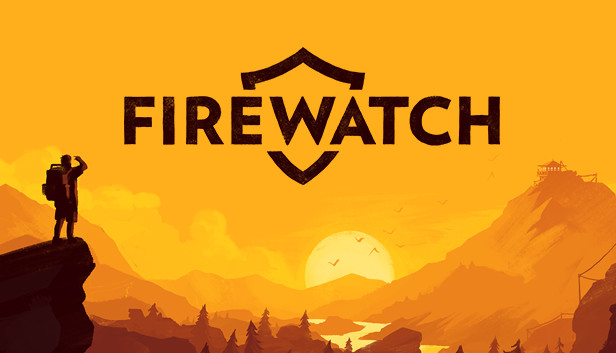
In Psychonauts, that’s a young misunderstood psychic boy trying to save the world and also fit in at summer camp. In Firewatch, it’s an emotionally vulnerable man spending a summer as a park ranger, trying to figure out how to mourn his dying, comatose wife.

Emergent Narrative is a False Promise

A popular idea when discussing deep narrative games is the promise of “emergent narrative.” Modern games are made up of many complex systems, and the argument in support of emergent narrative is that the player can interact with sufficiently complex systems to generate interesting stories that even the creators of the game couldn’t predict.

On a certain level, this is true. My family has certainly told each other stories about the ways an attack on a bokoblin camp can go surprisingly right (and terribly wrong) in Zelda: Breath of the Wild. These stories can involve an inaccurately thrown bomb knocking things around chaotically, or a well-aimed arrow miraculously saving the day.

Likewise, notoriously buggy games like the Elder Scrolls or Fallout series generate endless stories of unexpectedly levitating horses, launching enemies into orbit with a strangely-angled strike, or even stealing the entire contents of a shop after blinding the shopkeeper with a bucket placed over his head.

These make for fun anecdotes, but not for deep, impactful stories. They typically have an element of the comedically absurd or completely chaotic, and that is because the interactions of the player with multiple complex systems will naturally contain a large element of randomization.

Chaos and randomization can be fun, but they do not lend themselves to deep and affecting narrative. Narrative requires structure, and while authors and creators may argue endlessly about what structures work best, emergent narrative is inherently structureless.

We might argue that the job of the game writer is to anticipate or corral the player’s actions, aligning them with the game systems in such a way that a narrative naturally emerges. To me, this sounds like mixing oil and water. Players will always think of options that the creator didn’t anticipate. And if the creator effectively corrals the player into a pre-planned story, it often becomes apparent to players that they are being offered the illusion of choice. The narrative isn’t emerging. It’s being forced. This is something The Stanley Parable explored to great comedic effect.

That’s not to say that a carefully authored story is a bad thing in a game. In fact, I think it’s the only effective way to craft a good game narrative. Emergent narrative can be fun, but it will never result in the same quality of story that purposeful authorship can achieve, just as the proverbial thousand monkeys with typewriters will never produce Shakespeare.

The Stanley Parable: Ultra Deluxe

I wrote about The Stanley Parable a while back, as an exploration of the strange, non-linear storytelling that can be done in games, and how experience and participation can affect the player’s perception of a story.

I’m bringing it up again, because The Stanley Parable: Ultra Deluxe has just released on PC and consoles, and I’ve had a chance to play a bit of it. Now I just have to figure out how to describe it in a way that doesn’t ruin all the fun.

What Is It?

First, let’s talk about the name—Stanley Parable: Ultra Deluxe (which I can only assume was purposely crafted for the abbreviation, SPUD). In a landscape plagued by remakes, remasters and sequels, SPUD has been cagey about exactly what it is. Something wildly new? Or a bare-minimum cash grab and excuse to release an old game on new platforms?

I fired up the game and discovered that it starts out exactly the same: the original experience with updated graphics. It gave me time to acclimate before I found anything new (or conversely, to wonder if the new content was really so paltry). I found myself squinting, asking myself, “Was that like that before?”

When I found the new content, there was no question about what it was. The game hit me over the head with it. “Look at this new content!” it said. “Isn’t it amazing?” It helpfully labeled doors “NEW CONTENT.” But was the new stuff very good? No, not really. Even the narrator was pretty let down. And then the game started over, because Stanley Parable is a game about

Rabbit Holes

What starts off as a little joke just keeps expanding. The game turns gags into running jokes into elaborate set-pieces, leaving you wondering whether you’ve seen the end of that particular through-line, or if you might turn another corner and pick up the trail again. It rides the line between absurdism and seriousness.

The silly bit about carrying around a bucket for comfort opens up storylines about addiction, murder, betrayal, and demonic possession. A standard video game scavenger hunt for pointless collectibles first gets a thorough mocking, then becomes an actual feature, then goes a little bit out of control.

SPUD is more of what was good in SP. As far as I’ve played, it doesn’t introduce anything radically new, but everything new fits right in. It’s happy to make fun of itself for being an expansion to a decade-old game. It realizes that its history comes with baggage, from awards and accolades to literal shipping containers full of negative Steam reviews. Eventually it shrugs it all off with a nihilistic sequence that seems to say “given enough time, the world will be ground down to dust, so maybe none of this matters that much.”

SPUD also brings some of the generic game sequel features like new achievements, while simultaneously making fun of those things. (The old game gave an achievement if you didn’t play it for five years. This one ups it to ten.)

Is It Worth Getting?

If you’ve never played The Stanley Parable, Ultra Deluxe is the perfect opportunity to play it. If you played the original and enjoyed it, you’ll likely enjoy this new iteration. And if you hate the game…well, now there’s even more to hate?

Stanley Parable: Ultra Deluxe is available for pretty much every major game-playing device. (To be specific, that’s PC, Mac and Linux, Nintendo Switch, PS4, PS5, Xbox One and Xbox Series X|S)