With any multi-author work like that, I always wonder how I’ll feel about the things that come later. Much like a great song with a featured artist, you never quite know if it’s the band, the guest, or some unreproducible magic in the collaboration itself.
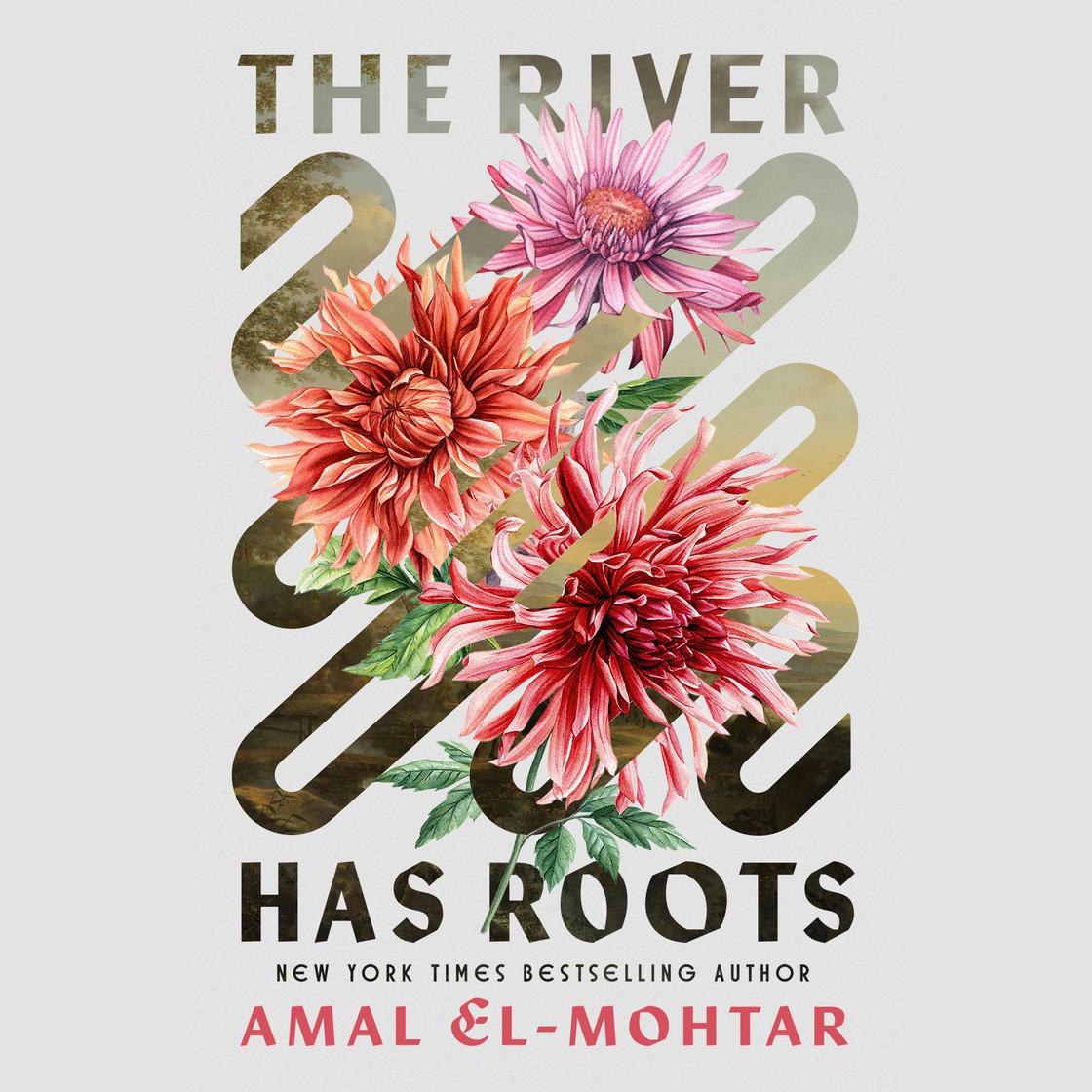
However, I’m pleased to report that even though it is very different, I enjoyed El-Mohtar’s The River Has Roots just as much as that previous book.
Audio Considerations
There’s no question that different formats can have an impact on the experience of a book. I first “read” Jeff Vandermeer’s Area X trilogy as an audiobook, and recently re-read the first book, Annihilation, in paper. It’s a dense and challenging book in places, and I found the ability to easily re-read and compare previous pages allowed me to take in more of the information on the page. On the other hand, the audiobook forced my attention and lent a certain claustrophobic feeling to parts of the story that was in many ways complimentary to the text.
I also “read” The River Has Roots as an audiobook. It’s worth noting that this audiobook includes set-dressing in the form of gentle background noise: a burbling river, a bustling market, a whispering forest. This background audio is done well, and suits the story nicely. After my initial surprise, I never found it overbearing or distracting.
Songs are an important theme of the story, and these are fully sung. I was delighted to find out after the fact that the music was actually performed by the author and her sister, including harp and flute parts. These elements put it somewhere between audiobook and radio play.
Finally, I’ll note that the narrator has a strong accent — my uninformed guess was Irish, although one of the book’s blurbs suggests that it’s “rural English.” As an American, I found myself needing to pay a little more attention than usual at the beginning of the story. By the end, I had no problem following whatsoever. The narrator, Gem Carmella, convinced me that the audiobook wouldn’t have been quite so effective without her voice.
The River Has Roots isn’t a long book. It’s listed at 144 pages. My audio edition claims a length of 3:53, but a full hour of that is actually a preview of El-Mohtar’s upcoming book of short stories.
I’ve said before that I appreciate the trend toward more acceptance of novellas in recent years, although I’d confess that I have a tough time justifying the purchase of a hardback book of that length for the $24 list price. Luckily, the audiobook was a steal on end-of-year holiday sales, and is still less than half the price of the hardcover.
A Modern Fairy Tale
The fantasy genre has come a long way. Even for those who still ape Tolkien, a significant amount of codification and shorthanding has occurred. And in backlash against that, all sorts of sub-genres and new offshoots have emerged. For the most part, modern fantasy feels quite different from ancient myths and folk stories that have been handed down more or less intact across centuries. Even if they do share certain key features.
The River Has Roots is very much trying to evoke the feeling of fairy stories, and I think it succeeds. Part of that is having the right kinds of imagery and road markers: a world just like our world, where magic is accepted as real. Sisters living in close proximity to a Faerie land. Songs with power. Witches and secret lovers and villainous suitors who are really just after the family fortune.
Beyond those many surface-level things that are easily recognizable as “things that fit into fairy stories,” there is a certain mode of speech, a certain way of unfurling the story that also contributes to this feeling. In The River Has Roots, magic is called grammar, and wizards are grammarians. El-Mohtar has found the magical grammar of the fairy story and deployed it perfectly here.
It is a common trope to suggest that fairy stories are required to have a happy ending where all the wrongs are put to rights. It’s one of those truisms we accept without thought, and it’s also not true. It’s well-known that many of the Disney versions of classic stories were changed, their dark and horrible endings often considered too depressing or gruesome. I won’t spoil the ending here, except to say that it treads that knife edge well, and could perhaps be best described as melancholic.
If you’re in the mood for something short and sweet, modern and well-crafted with the feel of something older and wiser, The River Has Roots is an excellent choice.
I’ve been reading Jeff VanderMeer’s Booklife, and I was struck by one of his anecdotes. He had secured a limited edition 500-book print run of a novelette with a small press. To promote the release, he arranged an interview with Wired.com, and a quick blurb on BoingBoing.com. To get these, he worked with the publisher to provide a link to a free download of the same story in PDF—a link that would eventually be clicked 20,000 times.
VanderMeer’s description of the back-and-forth of promoting his story wasn’t what surprised me, it was my own reaction to it. My first thought was that it was a bit of a waste. Surely some of those people downloading the story would have bought a physical copy, right?
He was pleased with this result, at least partly because it led to other opportunities down the road. But I had to interrogate my own reaction. Why did the free download strike me, at least initially, as a bad idea?
The answer, of course, has to do with money. My thought was that this is a fairly successful professional author. Why give work away? The actual answer is complex: the high number of downloads led to later opportunities, the promotion helped sell out the print run, and the market for novelette-length work is very limited (and was even more so ten or fifteen years ago when this occurred.) However, my own reaction made me wonder if I’ve become overly-fixated on getting paid as a measure of the value of writing.
Like many amateur authors, I’ve spent years wondering what it would take to be able to write as a full-time job. Writing is a competitive field, and on the whole, not well-paid. It’s no surprise that so many of us become laser focused on seeking any opportunities we can find. But is that really why we’re writing? Does getting paid do us any good if it becomes the reason to write?
I realize these are not new questions. Artists have always struggled to find balance between art and commerce, and that isn’t getting any easier in a world hell-bent on commodifying art into “content.”
It’s good to sit down every once in a while and think about priorities. Is it better to be paid, or be more widely-read? Is it better to be published, or to improve your craft? Better to write in the format that has a market and a readership, or in the format that interests you? Are you motivated by making the stories you love, or the ones someone else wants to read?
Another month has passed, and I’m here to talk about books.
There are a lot of them. Really, a shocking number of books. They keep coming out!
Despite my best efforts, I haven’t read them all. But I promise, I’m working on it. Let’s talk about the ones I finished in May.
Where possible, I include Bookshop and Libro affiliate links instead of Amazon. If any of these books pique your interest, please use those links. I’ll get a small commission, and you’ll support real book stores instead of luxury ice for billionaires’ cocktails.
As I mentioned last time, I’ve been getting into audio books as a way to read more. The three-books-in-one Area X collection was my second audio book purchase, and it was a fantastic choice. I’ve loved Jeff VanderMeer’s work for years, but between the Borne books and the Southern Reach series, he might just be my favorite author.
Annihilation begins with a simple premise: there is a place somewhere in the coastal US where something supernatural or alien has taken root. (The exact location never entirely clear, but it’s in the South, and VanderMeer himself lives near Tallahassee.) This place, dubbed Area X, is surrounded by an invisible barrier that vanishes any living creature that crosses it. The only entrance or exit is a gate of scintillating light.
The government has surrounded Area X with a military blockade, created a cover story of “ecological catastrophe,” and created a clandestine organization called The Southern Reach to study it, because that’s the sort of thing governments do.
We enter into this situation with The Biologist, one of four members of the 12th expedition sent into Area X. Her fellows are The Anthropologist, The Surveyor, and The Psychologist, who also serves as the expedition’s leader. They are discouraged from knowing anything about each other, even their real names.
Within Area X they encounter mysteries and monsters, and The Biologist soon has reason to believe that the Southern Reach knows more about Area X than it has told the members of the expedition.
Annihilation was shorter than I was expecting, only six hours as an audio book, but it’s packed full. Each chapter provides new revelations about the situation or unfurls new backstory about the characters in a way that kept me constantly revising my understanding of what was going on. And even so, the central mystery of “what is Area X” kept the story moving forward.
It’s interesting to see themes from VanderMeer’s other books present here. His stories are off the map. Deep in the unknown. Places that feel alien, and characters that often feel alien despite being human.
The man is obsessed with fungus as a vector for our fear of parasites, a foreign body that brings death—or transformation. Mushrooms and mushroom-people figured heavily in the Ambergris stories. He also clearly has a deep love for ecology and nature, especially coasts and tidal pools. The Biologist, with her aquatic obsessions, mirrors the protagonists of Dead Astronauts, another book by VanderMeer.
This feels like cosmic horror, but subtle. It says the world is unknown, and unknowable. Inscrutable. It reminded me of House of Leaves. You can’t trust the laws of physics, the constancy of space and time. There is a feeling of Area X holding forbidden knowledge that will destroy anyone who comes across it.
As soon as I finished Annihilation, I jumped into Authority. I was hooked.
It starts with a twist that immediately grabbed me. One of the characters in the first book wasn’t who they pretended to be. Everything I knew from the 12th expedition was turned on its head.
This time, we follow the brand new director of the Southern Reach, a man who insists on being called Control— though it quickly becomes apparent that very little is actually in his control.
He has been brought in to replace the old director and “fix” the Southern Reach. Central, a shady government agency that may or may not be the CIA, is concerned that the organization is rotten—somehow infected or sympathetic toward Area X despite the directive to contain and control. They have become too close to the problem.
Control arrives just in time for the debriefing of the survivors of the 12th expedition, despite at least some of them appearing to be dead at the end of the first book. One of these survivors is The Biologist.
Beyond the weirdness of Area X and secret government organizations vying for power, Control has to contend with all the difficulties of being the outsider brought into a dysfunctional organization he doesn’t understand, to be in charge of people who don’t trust him and quietly resist any significant change.
As is often the case with clandestine organizations, Control soon realizes that he really doesn’t know everything going on at the Southern Reach or at Central. He is being manipulated from all sides while becoming more and more obsessed with the mysteries of Area X.
Even worse, the past has been purposely muddied. There have been far more than twelve expeditions, but the numbers are reused, the members lied to. The facts are hidden from all but the highest-ranking officials. The previous director’s notes indicate that Area X is expanding, though there seems to be no outward sign of it.
Control cannot even trust himself. The Southern Reach uses hypnosis to condition and control the members of the expeditions, and it seems increasingly likely that Central uses the same conditioning on its own people. Can he be sure of what he knows? Can he be sure of who he is?
The first book ended in personal catastrophe: death and failure for the 12th expedition. The second book ends in what appears to be a global catastrophe as Area X suddenly and rapidly expands, not only extending its border, but surpassing it, spreading its seeds out into the wider world. Control flees, but like everyone who spends time at the Southern Reach, he can’t really get away, and he finds himself returning to Area X.
If Authority has a hypothesis, it’s that nobody is truly in control. You can take a name or a title, you can construct borders to protect yourself, you can perform as much rigorous, scientific categorization and classification as you’d like. It won’t stand up in the face of the unknown.
Annihilation and Authority mostly follow linear narratives, even if information about the past is revealed in bits and pieces throughout. Acceptance is decidedly non-linear. It intermingles three stories.
The time before the border fell over the Forgotten Coast is told by Saul Evans, lighthouse keeper and former preacher. He encounters the Séance and Science (S&S) Brigade, a weird collection of locals who investigate strange phenomena from scientific and paranormal angles, and somehow seem to be intimately involved in the eventual advent of Area X.
The time after Area X appeared is told by the director of the Southern Reach who preceded Control. She reveals the origin of the organization, some of its ties to Central, and what really happened across the many expeditions and years of investigation.
The present, then, is told by Control and The Biologist—or at least something that looks like The Biologist, but calls herself Ghost Bird. Control is drawn to Area X, repulsed by it, obsessed with it and terrified of it. Ghost Bird has a connection to Area X that she does not completely understand. They both suspect she is the only one who can stop it.
In the aftermath of the border’s expansion, the pair trek through the pristine wilderness of Area X, to the island off the coast. They meet an old friend and formulate a desperate plan to return to the buried tower that forms the heart of Area X, to stop the threat it poses to all of humanity.
The trilogy is built as something of a mystery box, with the ultimate question for readers being the cause and purpose of Area X. Is it supernatural? Alien?
I’d argue that VanderMeer is better than most at constructing this kind of mysterious narrative while still giving up big, exciting revelations along the way, but there are plenty of questions left to answer going into book three. To his credit, most of the questions are answered by the last page.
There are revelations about the origin and purpose of Area X, but they are oblique. Some readers will be satisfied with that, either constructing their own head-canon from the pieces, or accepting that there will always be a little uncertainty. On the other hand, I’ve seen plenty of folks online still looking for more clarity.
Personally, I came well-prepared, having read another VanderMeer series first — the not-quite trilogy of Borne, The Strange Bird, and Dead Astronauts. Those books are delightful explorations of language in a post-apocalyptic future, but they’re challenging and they leave a lot of questions unresolved. In comparison, the Southern Reach trilogy is practically overflowing with answers.
And luckily, there may be more. After ten years away, VanderMeer recently released a fourth Southern Reach book: Absolution. (Of course it has to start with A.)
What I’m Reading in June
When do you know you’re reading too many books at the same time? Right now, I’m halfway through an audio book that I listen to in the car. I’m also halfway through an e-book that I can read in spare minutes on my phone. And I’m halfway through a physical book that I keep next to my bed.
Next month, expect to hear about some sci-fi short stories, one of the most award-winning fantasy authors of recent times, and yet more from Jeff VanderMeer.
I’m also considering a change in format. I originally started these Read Reports as a way to combine my thoughts on a few books into a single post, but now I’m finding that it ends up being an awfully long post when I write about a month’s-worth of books.
So let me know in the comments — do you like these consolidated Read Reports, or would you rather have bite-sized posts on one book at a time?
This is the monthly post where I talk about what I’ve been reading. As usual, if you’re interested in any of these books, please use the included Bookshop.org links instead of Amazon. It helps independent bookstores, and I get a small affiliate commission.
I was surprised how quickly this volume rushed into the plot that would drive this entire arc. For the first time, we see Dream meet with all of the other Endless, except for the still-unrevealed “prodigal.” His elder brother, Destiny, calls them together for a meeting, because his book (which describes everything that will ever happen) tells him that’s what’s he’s going to do.
In previous volumes, it was revealed that Dream was once in love with a mortal, and when she rebuffed his advances, he got very grumpy about it, and threw her in hell, where she’s been for a few thousand years. For some reason, Dream’s siblings bring this up, and amazingly, for the first time, he realizes that this was a pretty shitty thing to do.
He embarks off to Hell, and Gaiman cleverly sets us up to think that Lucifer is going to fight Morpheus, but when Dream arrives, he finds the Lightbringer shutting everything down. He gets his revenge on Dream by giving him the keys to an emptied Hell.
The rest of the book follows Dream as various old gods come to his kingdom to ask for the keys to Hell, a piece of prime psychic real estate. We see him for the first time as a royal figure, with these mythological figures seeking his favor. He turns out to be adept at navigating the politics of the situation, and he manages to get rid of the key and free his former girlfriend in the process.
I think this might be the first volume that is completely free of any superhero references, which is no big deal in modern comics, but was probably a rarity when it first released.
Volume 5 revisits Barbie (no, not that one), who was first introduced in Volume 2, The Doll’s House. She’s split with Ken (no, that that one either) and now lives in New York, in an apartment building with a whole new set of interesting neighbors. In Volume 2, we saw bits and pieces of Barbies dreams, which were an ongoing fantasy tale where she was the protagonist. Here, we find out that she hasn’t been dreaming for months, and when her dreams return, they bring some very real nightmares with them.
I’m hardly an arbiter of wokeness, but I will say that this story was written in 1991, involves a lesbian couple, a trans woman, and a homeless person with implied mental illness, and feels surprisingly modern and respectful in the way it treats all of these characters. The world around them doesn’t always treat them kindly, but the narrative explores them honestly as people with good aspects and interesting flaws, rather than caricatures.
This volume also barely involves Morpheus. The apartment building crew venture into Barbie’s strange dreams and confront an invading creature. Only at the very end does Dream show up, giving us a few tidbits of info about his past.
I have to say at this point that I had forgotten how meandering the series is. There are certainly bits and pieces of connective tissue: characters that keep coming up, and the ongoing theme of Dream learning how to be more “human” and a bit less of a stodgy, immortal curmudgeon. And hints of a feud with Desire. I’m now halfway through the original run, and there’s no clear overarching conflict apparent. Yet. Luckily, the world, the characters, and the writing are so good that I don’t much mind.
The city of Ambergris left a strong impression on me, and I decided about a year ago that I needed to explore more of Jeff Vandermeer’s work. So I picked up Dead Astronauts, only to find it almost inscrutable. Then I discovered it was actually the second book in a series. I finally got back around to picking up the first book, and that is Borne.
Vandermeer has once again created an amazing setting in the confines of a city. We learn that the Earth has been ravaged by environmental catastrophe and bioengineering run amok, but apart from this, very little is revealed beyond the City. The City has no name, and it is a ruin surrounded by harsh desert. It is inhabited by scavengers, and by Mord, the kaiju-esque 3-story-tall bear. Mord and many other creatures were engineered by the also-unnamed Company, which exists as a huge, white building at the edge of the city, abutted by the holding ponds where the bio-waste and failed experiments are dumped, to eat each other and be eaten, and sometimes to escape into the City.
Borne is about a scavenger, Rachel, and her partner and lover, Wick, a sort of freelance bioengineer who once worked for the Company. They protect and defend their base of operations, a half-ruined apartment building, from scavengers, from another Company alumn called The Magician, and from Mord and his monstrous bear minions. Rachel discovers a piece of biotech, which she calls Borne, who turns out to be a sentient shapeshifter and becomes a sort of surrogate child to her.
I find Vandermeer fascinating because he is frequently riding the very edge of the Principle of Least Necessary Information. This book and the Ambergris stories are all a kind of puzzle that manages to propel you forward through the story while scrounging for hints and clues about what exactly is going on. I devoured this book in a day, because I couldn’t stop reading.
The Strange Bird is a hundred-page story set in the same world as Borne. It starts with some tantalizing bits outside the City, as the titular Strange Bird escapes from a bio-engineering lab and sets off in search of…something…it’s not sure what, but it knows it’s got to find it.
After a series of adventures that leave it considerably worse for wear, the bird arrives in the City and is captured by The Magician. This middle part of the story covers some of the same events from Borne from a different viewpoint, providing more context around the events toward the end of that book.
Eventually, the bird escapes once more, in an entirely new form, and continues its journey. When it finally arrives at its destination, it discovers that the thing it was looking for is long gone, but the ending is bittersweet and it still manages to find some peace at the end of the road.
I was excited to return to Dead Astronauts, now that I had the first two stories in the series fresh in my mind. If Borne rides the edge of Least Necessary Information, Dead Astronauts jumps head-first off the edge. It is experimental in the extreme, living somewhere between poetry and novel. In my original reading, I was lost. With the added context of Borne and The Strange Bird, I was able to follow the story, but I’d be lying if I said I understood everything.
Dead Astronauts has four parts. In the first part, we follow the three “astronauts.” They are Moss, an ever-changing plant creature in the form of a human, Grayson, an actual astronaut with a robotic eye, and Chen, a former Company bio-engineer who sees the world in equations. These three have made it their mission to destroy the Company, and to this end, Moss shunts them between parallel universes to try to find a version of the City and the Company where they can gain an advantage. The Company, however, also coordinates between parallel universes, and in the end, the Company seems to overcome them.
The second part shifts perspective (and uses the rare second-person!) We follow a character who remains unnamed for almost the entire section, living homeless in a city that may be a past version of the City, or may be another place entirely. Creatures from the Company begin to appear , followed by the Company’s agents, biological and robotic. There are pale men who may have some relation to Wick from Borne, and a duck with a broken wing, an innocuous creature that turns out to be a horrible monstrosity.
In the third part, we learn more about what goes on inside the Company. We learn about Charlie X, a character who has appeared in the first two stories in smaller roles, and how intertwined he is with everything that has happened. While we get more information, the origin and the nature of the Company are never entirely explained. Is it responsible for the ruination of earth? Or did it merely take advantage of it? And just how many of its tentacles did it send out across parallel universes? Vandermeer gives plenty of tantalizing clues, but no clear answers.
The final part of the story follows the blue fox, another bio-engineered creature that has appeared here and there in the other stories. The fox shares a connection with Moss, and it can also cross between parallel worlds. In this final part, the different storylines become intertwined across time and the different versions of the city. Causes and effects are all mixed up in twists and loops.
Reading these three books in order, I enjoyed them immensely. If you can accept that not everything will have a clear answer, and you’re interested in puzzling through some of the mysteries, I would highly recommend the series. This is pretty much the pinnacle of literary science-fiction.
I’ll continue The Sandman series, and pick The Witcher series back up as well (in fact, I’m already halfway through the next book). I’m also eyeing some unread books on my bookshelf by Terry Pratchett and Andy Weir. See you in a month.
I have an imaginary city, and I don’t know what to do with it.
I’ve been building it, on and off, for years. It’s a setting without a compelling story attached. I’ve considered using it for a TTRPG campaign. I used it as the backdrop for a not-very-interesting NaNoWriMo attempt. I’ve thought about giving up on it and putting it on the shelf forever, but I don’t really want to. So I’ve been on the lookout for ideas; interesting ways to use a city like this in my fiction.
The best examples of cities in fiction still place the city secondary to the characters and plot: Ambergris, New Crobuzon, Ankh-Morpork—they are all intricately crafted cities, but they’re still backdrops to the real action. Ambergris is probably closest to the city as a character, and Vandermeer even includes a fairly dry history of the city in the original book. But the city is mixed up with a much larger milieu of interconnected characters, events and ideas (including the author himself) that that loop around each other in a kind of metatextual Ouroboros.
I picked up Italo Calvino’s Invisible Cities because I hoped it would be a guide. It is a book about many imaginary cities, as described by the explorer Marco Polo to the emperor Kublai Kahn. I hoped that it would show me some interesting new ways I might use my own city.
An Endless Road Trip
I hoped that a book about imaginary cities would be unabashedly focused on setting, but it really isn’t.
With the exception of occasional short dialogues between Marco Polo and Kublai Kahn, every page describes a city. And yet, I couldn’t name for you any individual city, or tell you what’s interesting about it. Despite being a short book, it feels like an endless montage of places without any meaning or context.
The descriptions of the cities are well-written, and many of the cities are interesting. They are described not just in architecture, but in the culture of the people who live there, and sometimes even more vaguely, as the “character” of the city, the way it feels, without any explanation as to why.
There’s a city on stilts. A city dominated by a huge aquarium, where the people perform auguries by the movements of the fish. A city where the inhabitants pick up and move to an entirely new place periodically, leaving a series of municipal corpses in their wake.
Fifty-five cities come and go in this way. It’s a road trip with no stops, passing through city after city with only a brief observation, and then forgetting about it as soon as it’s in the rear-view mirror. It feels a bit like traveling a great distance, but not experiencing any of it.
No Resolution
Ultimately, I didn’t finish the book. I found myself less and less inclined to read it, and it sat on my desk for weeks.
I got to the end by skipping over at least a dozen cities. I skimmed the descriptions, hoping that some sort of connective tissue would become apparent—something that would tie these disparate places and ideas together. Finally, I just read the remaining dialogues between Marco Polo and Kublai Kahn. Maybe they would discover some deeper meaning in this endless stream of cities.
Unfortunately, they did not. Even at the end, the dialogue between the explorer and the king didn’t come together in a satisfying way. There was no resolution, because there was no tension. I was given no questions to ask, so there were no answers I cared about. No last-minute revelation to salvage the thing.
In reading the glowing reviews of Invisible Cities, there is a lot of talk about the mingling of prose and poetry. I can’t help but feel that this book falls into the category of literary fiction that I find insufferable: fiction where the mechanics matter more than the content. It is a book full of beautiful writing, and many inventive descriptions of imaginary cities and cultures, and I can’t bring myself to give a shit about any of it. The characters have no depth, the plot is barely existent, and I find nothing to relate to on a personal level.
Setting is Not Enough
Invisible Cities was not the guidebook I was looking for. It didn’t give me any magic formula to craft fiction focused on setting. If anything, it reenforced my belief that a setting by itself—no matter how intricate and deep—is not enough to be interesting.
I recently watched a show called Bee and Puppycat: Lazy in Space with my kids. The show has had an interesting life, starting as a web short, kickstarting a full series, and then getting a sort of semi-sequel series on Netflix that encapsulates the earlier versions in the first couple episodes. For what it’s worth, I only watched the Netflix series.
The show is a silly and deeply weird cartoon about a lazy girl named Bee and an interdimensional space puppy/cat/thing. Bee is fired from her job for the aforementioned laziness, and Puppycat helpfully takes her to the interdimensional temp agency to do strange odd jobs across the universe every time the pair needs a little cash.
At first glance, Bee and Puppycat is just a goofy cartoon, but it is so strange that I found myself thinking about it quite a bit once we had finished the series. Like a curious kid, I wanted to take this show apart and try to understand how it works.
The Legacy of Adventure Time
Adventure Time was a cartoon that exploded into pop culture. It combined absurdism, surrealism, and what I now think of as millennial-style non-sequitur humor with storylines that took unexpectedly emotional turns and occasionally addressed serious topics from silly angles. While it started as ostensibly a kids’ show, it grew a fanbase that was largely young adults.
Adventure Time changed in tone over the course of its ten seasons, perhaps due to a change in show-runners, influence from its fan-base, or its creative staff getting older. The earlier seasons are whimsical and light, often silliness for silliness sake, while the later seasons seem more burdened by the serious undertones, a little more self-conscious, but also trying to be more than just a series of goofy bits.
Clearly, a lot of cartoon television talent was cultivated around the show, because people involved in Adventure Time have gone on to work on many other well-crafted shows. Among that diaspora, the influence of Adventure Time and its aesthetics are clear. Stephen Universe, Over the Garden Wall, and Bee and Puppycat all share some of that Adventure Time DNA.
The Genre of Inscrutability
The world of Bee and Puppycat is strange and mysterious, and we’re dropped right in the middle of it. Initially, it has some of the trappings of the mundane world. A girl losing her job at the café and needing to do odd jobs to make ends meet is a fairly ordinary premise. But this quickly spirals into stranger and stranger territory. What kind of creature is Puppycat, and where is he from? Is Bee actually a robot? Why is her landlord a small child, and why does his comatose mother cry magical tears that transform everything they touch? Why is pretty much everything and everyone on her island home so bizarre, and yet nobody seems to care?
Mysterious settings aren’t uncommon. In fact, they’re a great way to pull the audience into a story. Pretty much all speculative fiction (sci-fi, fantasy and some horror) create a secondary world that the audience has to figure out. And while older examples of these genres might have front-loaded exposition and lengthy prologues, time and experience have shown that the most effective way to get into this kind of story is to throw the audience right into the middle of it, and help them to figure it out as they go along.
The implicit promise in most of these stories is that the setting is a puzzle that the audience will be able to solve, piece by piece. At the beginning of the Lord of The Rings, all we know about are hobbits and the Shire and a weird old guy named Gandalf. It’s only later that we learn about elves and dwarves and orcs and ents and more elves and the Numenorians and the Maiar, etc., etc. The extreme fans will read and re-read and glean all the little hidden details, and spend hours debating what the heck Tom Bombadil is. But even the average reader will know quite a lot about Middle Earth by the time they get to the end of the third book. Tolkein lays it all out on the page.
What’s interesting about Bee and Puppycat is that it takes place in a mysterious world full of interesting details, but it doesn’t do much to explain how they all fit together. It doesn’t lay everything out. The setting is a puzzle, but the pieces are all mixed up, and a few of them might be missing altogether.
I’ve started to think of this kind of story as the Genre of Inscrutability.
A Very Bad Idea That Seems to Work Anyway
To be in the Genre of Inscrutability, a story has to have a few key things:
A fantastical setting – it may be similar to the real world, or wildly different, but it’s clear that the setting has some unreal rules at play.
The fantastical elements aren’t explicitly addressed.
There’s some mechanism to make that okay
Now, thing number one is straightforward enough, but thing number two immediately gets us into trouble. Good storytellers know that you don’t show the gun on the mantle unless it’s going to go off, and you don’t set up a mystery that you don’t intend to resolve. The resolution of the mystery and the catharsis that comes out of it are necessary to make a mystery story feel complete. Thing number two seems like a Very Bad Idea from a storytelling standpoint, which is what makes it interesting.
The big question, then, is how do we do thing number three? How do we make it okay? To answer that, I think it’s helpful to look at more examples.
Examples
The Bee and Puppycat series hints at Puppycat’s past without actually explaining very much. We’re shown what Bee is, but it’s never explained why she was created, or where her “father” is. I still have no idea what’s up with Cardamon or his mom. However, Bee and Puppycat isn’t really about these things at a structural level. The episodes tend to focus on relationships and interactions between Bee and the other characters, or occasionally just between the other characters.
Jeff Vandermeer’s Ambergris stories also contain unexplained mysteries. The city is founded on the ruins of a much older (perhaps much more advanced) city inhabited by the mushroom dwellers. The mushroom dwellers go into hiding beneath the city, and collect the refuse the city-dwellers leave behind. While individual mushroom dwellers are superficially weak, it is implied that they are collectively powerful—enough to completely empty the city of inhabitants during The Silence, and perhaps to retake the city permanently in some indistinct future. Who or what they are is never really explained. However, the city and its history are just backdrops to these stories. The mushroom dwellers make it clear that the city itself is a transitory state. There was a before, and there will be an after. They are a natural, elemental force set in opposition to the crass, industrial humanity of Ambergris.
Mark Danielewski’s House of Leaves is a book about a book about a film that tells the story of Will Navidson and his family moving into an old house, which slowly reveals itself to be a supernaturally shifting non-Euclidian space. The book relies on the multiply nested frame stories and footnotes to construct a sense of verisimilitude as well as mystery. Though all of it is fictional, receiving the story through a game of telephone with multiple unreliable narrators only adds to the intrigue. It feels like stumbling into a particularly vivid and heavily documented conspiracy theory.
Did the Navidson Record ever actually exist, or is it just the crazed ramblings of Zampano? Did the house itself ever exist? And if it did, how did it come to be? How long has it been there? We are never given answers to any of these questions. Instead, we are expected to wonder.
How to Make It Okay
The Genre of Inscrutability builds a setting full of mysteries that it doesn’t intend to resolve. This is not to be confused with something like LOST, a very unfortunate show that intended to resolve its mysteries and catastrophically failed to do so. Here, we are talking about purposeful inscrutability.
As we see in Bee and Puppycat, one way to make this okay is to keep that mystery separate from the tension and catharsis. If the story is about whether the main character will follow his dreams and leave his small town to go to culinary school, his mysterious island home is just interesting set-dressing. When he overcomes his fears and decides to go, the tension is resolved in a satisfying way. The mysterious setting is still present, but it’s not blocking the satisfying resolution of the story.
Ambergris shows another possibility: a setting so grandiose in scope that it is not fully knowable. I cannot know every nook and cranny of my home city. I certainly cannot know all of its long history. Likewise, Ambergris is a setting with fuzzy edges. We might know some of its history, its inhabitants, its streets and buildings, but we cannot know all of it. There is vague malice lurking beyond the torn edges of the map, monsters that might just come up out of the ground one night and whisk everyone away. Such a setting makes the characters feel small and weak in a very big and dangerous world.
House of Leaves fully leans into the mystery. The mystery is entirely central to the book. The book itself is a puzzle box, a literary game. It doesn’t give away all the clues, because that would be too easy. You have to want the answers and work for them. You can theorize and guess, but at the end of the day, the book just winks, shrugs, and walks away. It’s up to you to convince yourself you’re right, based on the evidence at hand. House of Leaves forces the reader into the position of the conspiracy theorist, just like its numerous narrators.
In Medias Res
When I was a young whippersnapper, I once accidentally read the sixth book in a seven-book series. I didn’t know it was part of a series. I didn’t find out until I got to the end and found the whole series listed out. It was a very disconcerting experience. It is the ultimate form of in medias res.
This is exactly the experience that the Genre of Inscrutability cultivates, but it’s a dangerous game. Some readers won’t put up with it. I have no doubt that all of the stories I talked about above have left readers and viewers behind. Not everyone wants to work to enjoy a story, and no matter how the inscrutable story tries to make it okay, it is requiring extra effort from the audience.
On the other hand, the inscrutable story offers a real depth of experience to a dedicated fan. One need only look at the wikis, forums and social media conversations to see that fans of this kind of content derive a huge amount of satisfaction from combing through every detail of the work, and then discussing it with other fans. But woe unto the author who accidentally inserts some small error that the fans latch on to as a meaningful clue. Even if you don’t intend to reveal all the answers, internal consistency is still important.
If you know of any other stories that you think fall into the Genre of Inscrutability, let me know in the comments. I’d love to find other examples.
I bought City of Saints and Madmen on a whim, many years ago. I suspect I was too young to properly appreciate it back then. In fact, I don’t clearly remember if I even finished it. Regardless, it left a strong impression on me and it has influenced my own work.
The book was my introduction to the New Weird, a genre that is even more difficult to define than most genres. These stories of the city of Ambergris are like fantasy in that they create a secondary world, but there are no wizards, no magic, no elves. There are elements of steampunk in the presence of post-industrial technologies, but they are props, not the focus. There are certainly elements of horror, as these stories are often dark and bleak, unsettling and violent. There is more than a touch of the literary, the savoriness of phrasings and narrative in unusual, twisted forms.
Recently, an even larger Ambergris anthology was printed, and I had to buy it. It is a massive tome, combining three books—City of Saints and Madmen, Shriek: An Afterword, and Finch.
Unfortunately, I discovered that this new version is missing almost everything from the appendix of the original book of City of Saints and Madmen. Even more unfortunately, this so-called appendix is almost half of the book, and it adds far more than just ancillary information. So despite having bought the new edition, I have to keep the old book for the huge chunk they cut out.
As usual, I don’t like to write ordinary reviews (and I’d be hard-pressed to review this strange book, anyway). Instead, I want to talk about what I’ve learned from it.
1 – Don’t be Bound by Traditional Narrative Forms
Vandermeer didn’t just write an anthology of ordinary stories. Instead, he presents the city of Ambergris through various narrative lenses. There are ordinary stories, but there are also pamphlets of civil history and family history, notes from psychiatrists, and a slightly deranged monograph on a fantastical type of giant squid. Hell, the squid monograph even has a ridiculously long bibliography of completely made-up sources.
Presenting fiction in some of these forms might seem like a bad idea, but Vandermeer makes it work. “Dradin in Love,” the first story, pulls you into the book with a strong narrative, providing an introduction to the city and piquing your interest. Then he expands the setting through a guidebook essay, “The Hoegbotton Guide to the Early History of Ambergris.” He keeps it light with snarky footnotes from the author, an irritable historian who considers himself above writing a cheap guide, but still does it for the easy money.
“The Transformation of Martin Lake” follows Lake, an artist who will become famous in Ambergris for his oil paintings, through the most formative period of his life. Inserted between these scenes are the speculations and interpretations of his work by a famed art critic. As the story eventually reveals the dark secrets of his success, we see that the critic’s analysis is wildly inaccurate.
In “The Strange Case of X,” we witness an interview between a psychiatrist and his patient. The story flits from third person to first person, to the raw transcript of the interview and back again. The patient, X, turns out to be a stand-in for Vandermeer himself, institutionalized because he has become so obsessed with the fictional city that he can no longer differentiate between the real world and his own creations.
Then (at least in the original printing) we reach the purposely mis-capitalized AppendiX, itself presented as a collection of items found in X’s room at the asylum after he mysteriously disappears. Within this frame are more stories and tidbits, letters and codes. The sheer variety of forms keeps you wondering what you’ll encounter next, and in a subtle way they help to build the verisimilitude of Ambergris. This is a city with a history, with surrounding geography, with politics and art and beauty and danger, as well as hundreds of thousands of people going about their business.
Many of these forms involve multiple characters with differing opinions and interpretations. There is Lake and the critic. There is the dry history of Ambergris, and historian’s irritated footnotes. There is the interview with X, and the psychiatrist’s interpretations. Just as real people often come at reality from different angles, the characters in Vandermeer’s stories are constantly vying for narrative control.
2 – A Web of References is a Puzzle to Solve
“Dradin in Love” opens the book with a gripping story, but it also sets up much more of the book than the reader will realize at first. It introduces the Religious Quarter, Albumuth Boulevard, the river Moth, the distant city of Morrow, Borges Bookstore and the Hoegbotton and Sons mercantile empire. It introduces the delights and horrors of the Festival. Dradin and his former teacher, Cadimon, and the ubiquitous musical genius of Voss Bender.
In every single section of the book, every story and essay and letter, there are scattered little references to the people, places and things of Ambergris. Some are large and glaringly obvious. Others are extremely subtle, and sometimes even inserted into what seems to be purposely dull writing (a bibliography and glossary, for example) in order to obscure them. Characters and places that seem to be little more than decoration in one story reappear in unexpected places later on.
Once again, this makes the random selection of literary bits and bobs slowly congeal into a much more unified whole as you read deeper into it. It also encourages the reader to pay attention to all the details. The kind of reader who loves to solve mysteries and riddles will begin to see the book as a puzzle, and each subtle reference clicks into place like another piece, forming a larger picture.
Of course, the danger with this style of writing is that the reader may not want a difficult book that they have to “solve” to find satisfying. They may not want to wade through bibliographies and glossaries to find some small connection between Martin Lake and Dradin Kashmir. They may not be tantalized by the coded section at the end of the psychiatrist’s letter. They may simply be irritated. But the readers who like that sort of thing will feel rewarded by what they have found, and there is magic in the idea that you may not have caught all the secrets on the first read-through.
3 – Setting is an Engine of Story
Something I find myself often referencing is Lincoln Michael’s post “On the Many Different Engines That Power a Short Story.” Writers talk constantly about character- and plot-driven fiction, but there are really an astonishing number of ways to make a story work.
I think City of Saints and Madmen is definitive proof that setting can power a story. This ramshackle collection of elements should not feel unified. There are characters, yes, and there is plot, here and there. But it is the city of Ambergris that ties it all together. All of the other elements are in service of that. Even the author of Ambergris, X, finds himself in thrall to it, the city seemingly dictating its own creation.
I have to confess that I find this heartening. I’ve had a fictional city of my own that I’ve been slowly building for a few years, but I’ve struggled to find characters and plots that I find satisfying. I’ve considered short stories, a novel, and even a TTRPG setting. Maybe I should just follow the lesson of Ambergris. Maybe the city itself is the story.
Every once in a while, my daughter Freya and I have a “storytelling class.” Really, it’s just a fun opportunity to chat about writing stories. This time, our topic was style and substance.
We always start with two questions: What did we read and write recently?
What Did We Read?
Freya is getting close to finishing the first Wheel of Time book. I asked her if she was excited to continue with a series that has fourteen books. She said she thought she might be 70 before she finishes. She also just started the “Janitors” series, though she hasn’t gotten far enough to form an opinion yet.
I have been working my way through my beautiful new Ambergris hardcover. City of Saints and Madmen was a formative book for me, and I’m excited to now have it in a single massive tome alongside Jeff Vandermeer’s other Ambergris stories. I was however, a little disappointed to find that they actually removed some of the appendices that appeared in the original, so now I have to keep my copy of City of Saints and Madmen as well.
In non-fiction, I started Ways of Being at the recommendation of Cory Doctorow, although I’m only a few pages in.
What Did We Write?
Freya has kept busy writing for school work, and hasn’t worked on any fiction recently. After my Covid break, I’ve been working on getting back into Razor Mountain.
Style and Substance
Each story consists of two parts—two sides of the same coin—style and substance. You can think of “substance” as “what the story is about” and style as “how the story is told.” Substance is the meaning. Style is the actual words. By some definitions, substance is good, while style is just the shallow surface layer. However, when it comes to fiction, each story is really a melding of the two.
Schools of Thought
At the risk of being a little controversial, I’m going to define two schools of thought, and I’m going to call them “genre fiction” and “literary fiction.” I put them in quotes because each story is a special snowflake, and I’m about to speak in broad generalizations, so take it all with a grain of salt.
The “genre fiction” school of thought is that substance takes precedence. Genre fiction sometimes even devalues style. Common genre fiction advice suggests that, when reading a great book, the reader should forget they’re reading and get lost in the story—that is, in the plot and the characters. The descriptive text should become transparent. Authors should endeavor to become invisible, and never call attention to themselves.
The “literary fiction” school of thought holds that style is quality. Literary fiction tends to put a higher value on authorial voice. The advice here is that a great book should be overflowing with the author’s unique voice, and the reader should be transported into the mind-space of the author. Mechanics like plot and character are nice, but they need to be described through transcendent prose. Anyone can tell a story. A true author tells it in a way that only they can.
False Dichotomies
Like most dichotomies, this one is artificial. Style and substance aren’t strictly opposing forces (although they can sometimes fight each other). Some authors make the mistake of crafting page after page of beautiful prose that doesn’t really tell a story, while others create intricate plots by placing row upon row of flat words like bricks in a wall.
Readers, like authors, are unique, and there are audiences for both of these styles. Science fiction has a big audience that revels in clever plots and is fine with a lack of ornamentation. Likewise, there are plenty of literary fiction readers who care more about delicious sentences than characters who actually go somewhere and do something.
As an author, you can make your own choices about what you value. You may choose to focus on substance, or style, or try to find a happy medium. However, it’s important to understand that there are trade-offs. The more stylized your prose is, the more your reader will have to work to understand what’s going on. Some readers will appreciate the extra layers of complexity, but others simply won’t be interested, and may just put the story down. Focus on style inherently takes some focus away from the substance.
Examples
We looked at a few of my personal favorites when it comes to literary style.
Douglas Adams’ Hitchhiker’s Guide series is a relatively mild example, where most of the stylistic flourishes could be described as “literary comedy,” twisting language for fun and amusement.
Mark Danielewski’s House of Leaves is a book with literally complex text that stretches sentences across pages, forms shapes and pictures, and wraps around upon itself. But it is also a narratively complex work, presented by a character named Johnny, who details the work of his acquaintance, Zompano, who himself took detailed notes based on videos shot by a third character, Navidson, whose descriptions of his ever-shifting, labyrinthine, and spatially inconsistent house form the heart of the story.
Finally, there’s Vandermeer’s more recent work, Dead Astronauts, a book that is so dense and challenging to decipher that it almost feels encoded.
These are wildly different examples of a strong authorial voice put to use for different purposes. While Adams is extremely readable, House of Leaves ranges from straightforward prose to deep complexity. Dead Astronauts is lyrical and dreamlike, but so obfuscated in parts that I found it off-putting. And there are many other examples of other authors doing entirely different but equally interesting things with language.
Choosing a Style
Depending on the type of writer you are, you may find that you default more toward one end of the spectrum than the other. There’s nothing wrong with that. Many authors are influenced by their own favorite writers and stories, and you may like to write the same kind of stories that you like to read.
I find that memorable quotes and phrases tend to come from style-heavy writers. Substance-heavy writers tend to make unforgettable stories where you don’t necessarily remember any of the words in particular. I loved The Martian when I read it a year ago. I remember some of the structure (maybe because I blogged about it) but I don’t remember a single line from it.
Sometimes particular stories will speak to you in a certain way. Just because you normally write very straightforward sci-fi space operas doesn’t mean you can’t do a bunch of clever stylistic embellishment in a complicated, self-referential time-travel story.
As with most things in life, it can be good to experiment. You might discover that you can find joy in more kinds of stories than you previously realized. Or you may find that a particular story calls for a particular style.
This is a review — a word which here means, “an excuse to write about a book that I like” — for the book, Poison for Breakfast. This book was written by Daniel Handler, who sometimes calls himself Lemony Snicket when he’s writing books. He mostly uses straightforward language, and when he doesn’t, he likes to define the words he’s using, as I just did, above.
Poison for Breakfast is a book that takes its time getting where it’s going, but it does get there. So I’m going to take my time getting where I’m going in this review. I’ll start by talking about music and books.
How I’ve Felt About Music
I first recall really paying attention to music, beginning to realize that I might have opinions about music, in middle school. Those opinions were mainly whether I liked a particular song or not. For some music lovers, there is a particular genre they fall in love with, and it becomes a lifelong passion. I had no conception of genre, at first. That came sometime later.
When I did develop opinions about genre, they were mostly vague and negative ones, influenced, if not outright parroting, my parents’ tastes. I recall “hating” techno, rap, and country music, or at least saying that I did.
As I grew into an adult, I made it a point of pride to seek out opinions and ideas that challenge or conflict with my own beliefs, whether that be in politics, religion, or music. I’ve been an adult for many years now (a shocking number, when I stop to think about it), and I’ve sought to listen to a wide variety of music. Luckily, we live in a world where there are still a few independent radio stations and innumerable streaming services, not to mention Bandcamp, YouTube, and all the other places where artists can make their work available to the world without much interference.
I’ve learned that there is no genre of music I truly dislike. The trick is to find a single song that I can appreciate. From there, I always find more. Rather than genres that I “hate,” it turns out I just have genres where I’m pickier.
A Little Cognitive Dissonance
From a very young age, I’ve been attracted to genre fiction. I loved books about aliens when I was a child. Around the time I was discovering opinions about music, my mother’s co-worker introduced me to The Lord of the Rings, and from there I was thoroughly hooked on fantasy as well as sci-fi.
As I grew and my tastes in music expanded, so did my tastes in literature. Once again, all it takes is finding one book to serve as a gateway into a new genre. While I once may have eschewed non-fiction or romance, I’ve discovered a love of all sorts of non-fiction in recent years, and a few romances too (even if they do have a sci-fi bent).
I just talked about how I like to keep an open mind and expand my interests. It might seem absurd then, that I would shy away from any genre of literature. But the absurdity of it doesn’t make it any less true.
Literary fiction, which oddly has become as much a closed-off genre as sci-fi or fantasy, has long left a bitter taste in my mouth. Since this is a label more controversial than most genre labels, I’ll provide my own controversial definition: “fiction that is more interested in playing with words than in telling a compelling story.” This is a definition that encompasses quite a lot of “traditional” Lit-Fic, while also allowing something like Vandermeer’s Dead Astronauts, which many people might exclude, to perhaps straddle the border.
I might trace my early dislikes in music to my parents tastes, but I have a harder time tracing my literary dislikes. I’m sure it didn’t help that school foisted onto me some of these lit-fic “masterpieces,” like Catcher in the Rye or The Great Gatsby, without adequate context and certainly before I was mature enough to appreciate much about them. I have gone back to a few of these books in recent years, and discovered that they at least have something to offer, even if I didn’t fall in love with all of them.
Literary Fiction
Writing a review of a book that barely mentions the book itself is considered bad form by many people. With this in mind, and having now taken a leisurely drive around the metaphorical block, let’s return to where we started this somewhat strained music/literature metaphor.
This is one of those books that, by my own definition, qualifies as literary fiction. And I enjoyed it quite a lot. Not only that, but what I enjoyed most was the words, rather than the story. I enjoyed it because it was literary fiction.
One could argue (with good supporting evidence) that this book does have a plot. It begins with Snicket, the narrator, who is told by anonymous note that he has eaten poison for breakfast. He spends the rest of the book trying to solve this mystery, though his methods mostly involve meandering around town and becoming lost in thought. It’s a tiny plot, but also a tiny book. This little bit of story is just enough to let the book focus on what it really wants to do, which is play with words.
Poison for Breakfast is so full of delightful sentences that I started marking the bits I liked with little scraps of paper. By the time I finished, there was a nice, thick ruffle of scraps sticking out. The book is full of anecdotes and asides that seem like non sequiturs until you read a bit further and find that they’re referenced again and again; linguistic winks and nods, like inside jokes with the reader. It wraps back around on itself. It pulls disparate threads together and twists them into delightful and surprising shapes.
There are motifs, like sets of rules that turn out to really only be one rule from a certain point of view, or that a good story must be bewildering, or the contents of the narrator’s breakfast, left-justified like poetry with each individual food on its own line:
Tea
with honey,
a piece of toast
with cheese,
one sliced pear,
and one egg perfectly prepared
And there is death. This is a book that mentions brutal prison camps; and death by starvation, and old age, and of course, poison.
Winks and Nods
A book about being poisoned might not sound like a child-friendly book. And perhaps it isn’t. Like Snicket’s other books, this is a book that observes the world with a child-like wonder, and discusses it with mostly simple and straightforward language. It’s a book that seems to understand a child’s perspective. It is more of a child-understanding book. It feels like the sort of conversation you might have been lucky enough to have as a child, with an adult who spoke seriously and honestly, and didn’t sugar-coat the truth or dumb-down the complicated. An adult who understood how to speak with children as equals.
By virtue of being both author and narrator, Snicket places himself where he can freely talk about his love of language and literature, and the books, poems, songs, and ideas he likes, while also illustrating that joy in his own words.
The second-to-last chapter takes all the little callbacks, the little winks and nods, and ties them all together in a neat little bundle. It’s the big reveal at the end of the magic show. And in the final chapter, Snicket sets to work writing the story you are in the midst of reading, making the whole thing feel like the cycle of chicken and egg (which is itself another repeated motif from earlier in the book).
Poison or Antidote?
Poison for Breakfast reminded me that I can love literary fiction, even if it’s not the first section I visit in the book store. As an added bonus, this is a book ostensibly for children, so I will get to enjoy it a second time when I read it to mine. With any luck, they won’t spend years thinking that they dislike whole categories of things when they are, in fact, just a little bit picky.








 Words Deferred