Hummingbird Salamander — Read Report

Book | E-book | Audiobook (affiliate links)

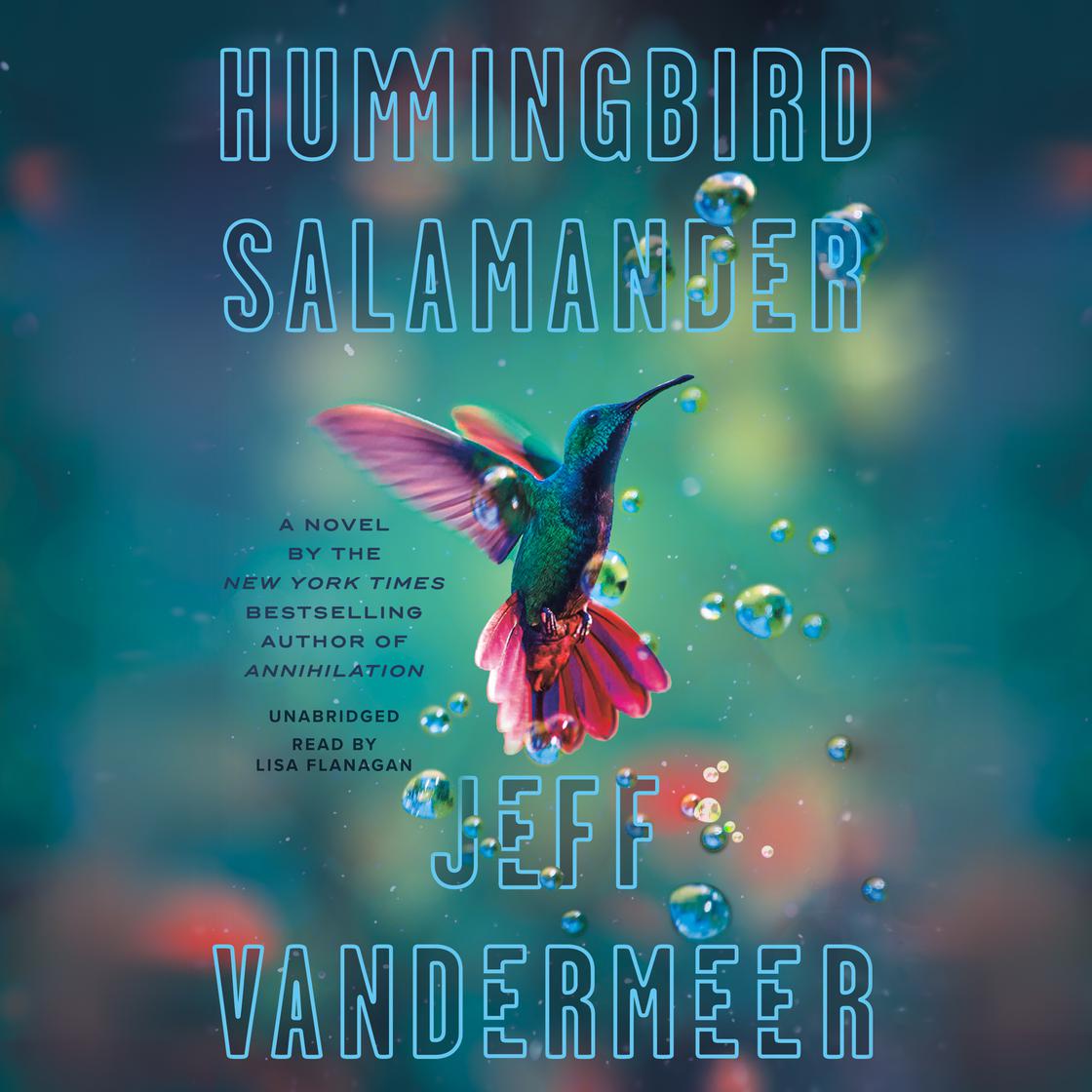
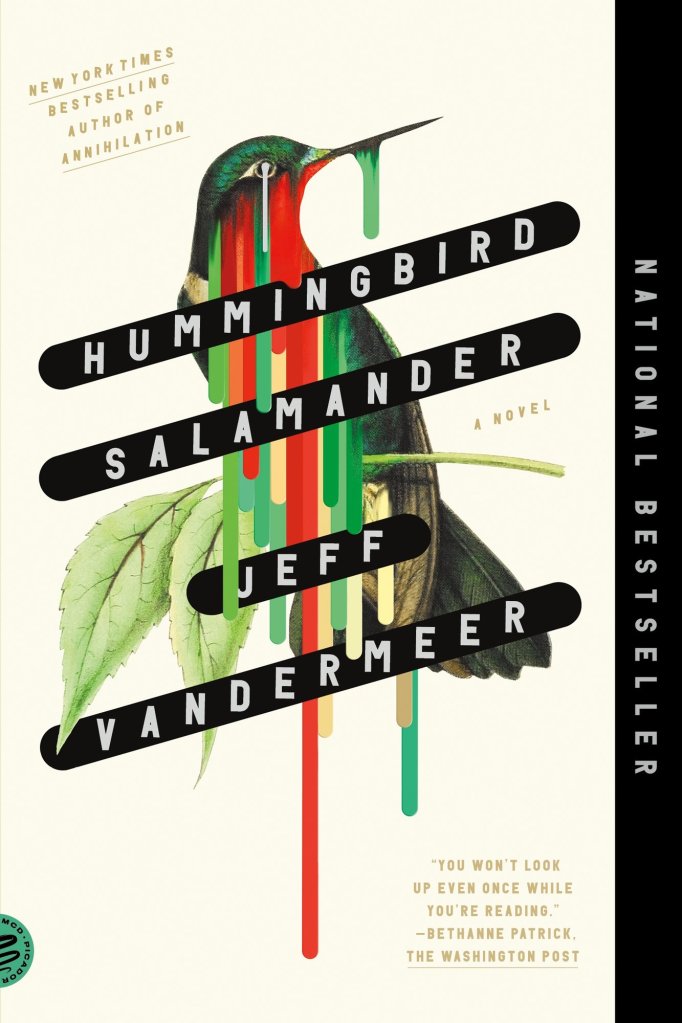
Jeff VanderMeer has hovered at the top of my favorite authors list since I read Borne and Dead Astronauts. The Area X trilogy only cemented that position. I had understandably high hopes for his latest book, Hummingbird Salamander.

Hummingbird Salamander stays close to the modern day in a way that will feel familiar to William Gibson fans. There are science fiction elements, but they are very restrained compared to VanderMeer’s previous work.

Borne was almost Joycean in a way that made it a challenging read. Hummingbird Salamander is much more straightforward, even if VanderMeer can’t stop himself from adding literary flourishes. It comes across as more of a suspense/thriller story than anything he has written in recent years.

Eco-Terrorism and Generational Trauma

It’s not particularly hard to pick out the bigger themes running through VanderMeer’s work. Ecology is the most obvious. His stories explore the ways humans interact with the world around them, and how social and technological factors intertwine with the natural world. Area X seems to exist in a relatively near future where climate change continues apace and a mysterious section of coastline is hidden behind government claims of a localized ecological catastrophe. The Borne stories describe a far-flung future city where most of what survives is the result of extreme genetic manipulation.

In Hummingbird Salamander, humankind’s fraught relationship with nature is again front and center. The story begins with a note that leads the protagonist, Jane, to a storage unit. The note contains the words “Hummingbird” and “Salamander,” with some mysterious dots in between. The storage unit contains an actual, taxidermied hummingbird of a variety that turns out to be extinct. These clues lead Jane into a deadly mystery that involves poaching and the illegal wildlife trade, as well as eco-terrorism and organized crime.

Jane lives in an America that is on the brink. Extreme weather is normalized. Ecological collapse is commonplace. Pandemics are perpetually imminent. It turns out that society fails in more of a whimper than a bang, and most things in life are getting slowly, steadily worse. But people still have jobs, family, and lives. Jane has all of these things. She’s a private security analyst, a mother, and a wife. She stands out as an unusually tall, strong woman who has excelled at weight lifting and body building, but has an otherwise normal, middle-class existence.

Another common theme among VanderMeer books is generational trauma, and in some ways this is just ecology at an individual level. A family is an environment, and as our current world is shaped by the mistakes made by our forefathers and ancestors, our personal hangups and dysfunctions are shaped by those who raised us, and those who raised them.

Jane’s dysfunctions are revealed slowly in fragments and flashbacks, only becoming fully apparent in the final third of the book. In many ways, this is the story of everything she does wrong, and why.

Where it All Breaks Down

Hummingbird Salamander is a well-written book. It has rich and detailed characters, an interesting setting, and touches on timely topics. And after some consideration, I have to admit that it is the most unenjoyable VanderMeer book I have read. This book and I have irreconcilable differences, and they are, unfortunately, at the very heart of the story.

From the first chapters, Jane is obsessed with the hummingbird and the mystery it represents. And sure, there is a reason for why the two words on the note would be important to her. But even with all the answers that are eventually revealed, I can’t help but feel that her obsession is unreasonable.

I might be able to overlook that questionable motivation if I had some sympathy for Jane. But in spite of her horrible upbringing, I find it hard to root for her. There are a handful of moments in the book where Jane shows affection for her teenage daughter and long-suffering husband, but these seem like afterthoughts. These people are hindrances, distractions from her obsessive pursuit of the central mystery. When it becomes apparent that unraveling the mystery might be dangerous, she barely spares a thought about how that could impact her “loved” ones.

In the end, she makes choices that destroy her family and ruin their lives, but she can barely muster a moment of self-reflection or regret. Her coworkers are caught up in the maelstrom. Strangers are hurt and killed because of her. She simply doesn’t care. She gets tougher and meaner as the book goes on, but she was cold and indifferent to begin with.

I will admit, as a husband and father of a teenage daughter I may be especially well-positioned to dislike Jane and her choices. Other readers with different backgrounds might have an easier time identifying with her and sympathizing. I enjoy flawed characters. I just need them to have enough redeeming qualities to get me on their side.

All Cloud, no Silver Lining

I think you’d be hard-pressed to find anyone who’d say VanderMeer’s work shows a positive attitude or hope for the future, but the pessimism has never been as apparent as it is here. A straightforward reading suggests that we might have to hit rock-bottom (as individuals and as a species) before things will get better. And even then, they might not.

Jeff’s other work balances that dark and dismal worldview with genuine strangeness and wonder. There’s a reason he was one of the leading voices of the New Weird/Slipstream movement. His worlds are shadowy and unfamiliar, but also unexpectedly delightful. Nobody loves a tidal pool the way this man loves a tidal pool. He describes coastlines like French poets describe their lovers. Hell, in Borne, the post-apocalyptic city is effectively ruled by a kaiju-sized, magically levitating super-bear, and the scariest villain is a regular-sized (but very menacing) duck.

There’s almost none of that here. The drones have gotten a little fancier and the world’s gone to shit. No impossible sci-fi. No crazy weirdness. Just a mysterious note in a grim world that eventually leads to violence and heartbreak.

The Missed Twist

I don’t want to be too down on this book, and I’ve already gotten more negative than I really like. The fact is, I plowed through it, and I did want to know the answer to the mystery. I wanted to know how it all turned out. But the entire time I was reading, I kept waiting for the twist that would help me finally understand Jane and why she was doing all this.

That twist never came.

The Read Report — July 2023

This is the monthly post where I talk about what I’ve been reading. As usual, if you’re interested in any of these books, please use the included Bookshop.org links instead of Amazon. It helps independent bookstores, and I get a small affiliate commission.

Sandman: Season of Mists (Volume 4)

By Neil Gaiman

My re-read of the Sandman series continues.

I was surprised how quickly this volume rushed into the plot that would drive this entire arc. For the first time, we see Dream meet with all of the other Endless, except for the still-unrevealed “prodigal.” His elder brother, Destiny, calls them together for a meeting, because his book (which describes everything that will ever happen) tells him that’s what’s he’s going to do.

In previous volumes, it was revealed that Dream was once in love with a mortal, and when she rebuffed his advances, he got very grumpy about it, and threw her in hell, where she’s been for a few thousand years. For some reason, Dream’s siblings bring this up, and amazingly, for the first time, he realizes that this was a pretty shitty thing to do.

He embarks off to Hell, and Gaiman cleverly sets us up to think that Lucifer is going to fight Morpheus, but when Dream arrives, he finds the Lightbringer shutting everything down. He gets his revenge on Dream by giving him the keys to an emptied Hell.

The rest of the book follows Dream as various old gods come to his kingdom to ask for the keys to Hell, a piece of prime psychic real estate. We see him for the first time as a royal figure, with these mythological figures seeking his favor. He turns out to be adept at navigating the politics of the situation, and he manages to get rid of the key and free his former girlfriend in the process.

I think this might be the first volume that is completely free of any superhero references, which is no big deal in modern comics, but was probably a rarity when it first released.

Sandman: A Game of You (Volume 5)

By Neil Gaiman

Volume 5 revisits Barbie (no, not that one), who was first introduced in Volume 2, The Doll’s House. She’s split with Ken (no, that that one either) and now lives in New York, in an apartment building with a whole new set of interesting neighbors. In Volume 2, we saw bits and pieces of Barbies dreams, which were an ongoing fantasy tale where she was the protagonist. Here, we find out that she hasn’t been dreaming for months, and when her dreams return, they bring some very real nightmares with them.

I’m hardly an arbiter of wokeness, but I will say that this story was written in 1991, involves a lesbian couple, a trans woman, and a homeless person with implied mental illness, and feels surprisingly modern and respectful in the way it treats all of these characters. The world around them doesn’t always treat them kindly, but the narrative explores them honestly as people with good aspects and interesting flaws, rather than caricatures.

This volume also barely involves Morpheus. The apartment building crew venture into Barbie’s strange dreams and confront an invading creature. Only at the very end does Dream show up, giving us a few tidbits of info about his past.

I have to say at this point that I had forgotten how meandering the series is. There are certainly bits and pieces of connective tissue: characters that keep coming up, and the ongoing theme of Dream learning how to be more “human” and a bit less of a stodgy, immortal curmudgeon. And hints of a feud with Desire. I’m now halfway through the original run, and there’s no clear overarching conflict apparent. Yet. Luckily, the world, the characters, and the writing are so good that I don’t much mind.

Borne: A Novel

By Jeff Vandermeer

The city of Ambergris left a strong impression on me, and I decided about a year ago that I needed to explore more of Jeff Vandermeer’s work. So I picked up Dead Astronauts, only to find it almost inscrutable. Then I discovered it was actually the second book in a series. I finally got back around to picking up the first book, and that is Borne.

Vandermeer has once again created an amazing setting in the confines of a city. We learn that the Earth has been ravaged by environmental catastrophe and bioengineering run amok, but apart from this, very little is revealed beyond the City. The City has no name, and it is a ruin surrounded by harsh desert. It is inhabited by scavengers, and by Mord, the kaiju-esque 3-story-tall bear. Mord and many other creatures were engineered by the also-unnamed Company, which exists as a huge, white building at the edge of the city, abutted by the holding ponds where the bio-waste and failed experiments are dumped, to eat each other and be eaten, and sometimes to escape into the City.

Borne is about a scavenger, Rachel, and her partner and lover, Wick, a sort of freelance bioengineer who once worked for the Company. They protect and defend their base of operations, a half-ruined apartment building, from scavengers, from another Company alumn called The Magician, and from Mord and his monstrous bear minions. Rachel discovers a piece of biotech, which she calls Borne, who turns out to be a sentient shapeshifter and becomes a sort of surrogate child to her.

I find Vandermeer fascinating because he is frequently riding the very edge of the Principle of Least Necessary Information. This book and the Ambergris stories are all a kind of puzzle that manages to propel you forward through the story while scrounging for hints and clues about what exactly is going on. I devoured this book in a day, because I couldn’t stop reading.

The Strange Bird

By Jeff Vandermeer

The Strange Bird is a hundred-page story set in the same world as Borne. It starts with some tantalizing bits outside the City, as the titular Strange Bird escapes from a bio-engineering lab and sets off in search of…something…it’s not sure what, but it knows it’s got to find it.

After a series of adventures that leave it considerably worse for wear, the bird arrives in the City and is captured by The Magician. This middle part of the story covers some of the same events from Borne from a different viewpoint, providing  more context around the events toward the end of that book.

Eventually, the bird escapes once more, in an entirely new form, and continues its journey. When it finally arrives at its destination, it discovers that the thing it was looking for is long gone, but the ending is bittersweet and it still manages to find some peace at the end of the road.

Dead Astronauts

By Jeff Vandermeer

I was excited to return to Dead Astronauts, now that I had the first two stories in the series fresh in my mind. If Borne rides the edge of Least Necessary Information, Dead Astronauts jumps head-first off the edge. It is experimental in the extreme, living somewhere between poetry and novel. In my original reading, I was lost. With the added context of Borne and The Strange Bird, I was able to follow the story, but I’d be lying if I said I understood everything.

Dead Astronauts has four parts. In the first part, we follow the three “astronauts.” They are Moss, an ever-changing plant creature in the form of a human, Grayson, an actual astronaut with a robotic eye, and Chen, a former Company bio-engineer who sees the world in equations. These three have made it their mission to destroy the Company, and to this end, Moss shunts them between parallel universes to try to find a version of the City and the Company where they can gain an advantage. The Company, however, also coordinates between parallel universes, and in the end, the Company seems to overcome them.

The second part shifts perspective (and uses the rare second-person!) We follow a character who remains unnamed for almost the entire section, living homeless in a city that may be a past version of the City, or may be another place entirely. Creatures from the Company begin to appear , followed by the Company’s agents, biological and robotic. There are pale men who may have some relation to Wick from Borne, and a duck with a broken wing, an innocuous creature that turns out to be a horrible monstrosity.

In the third part, we learn more about what goes on inside the Company. We learn about Charlie X, a character who has appeared in the first two stories in smaller roles, and how intertwined he is with everything that has happened. While we get more information, the origin and the nature of the Company are never entirely explained. Is it responsible for the ruination of earth? Or did it merely take advantage of it? And just how many of its tentacles did it send out across parallel universes? Vandermeer gives plenty of tantalizing clues, but no clear answers.

The final part of the story follows the blue fox, another bio-engineered creature that has appeared here and there in the other stories. The fox shares a connection with Moss, and it can also cross between parallel worlds. In this final part, the different storylines become intertwined across time and the different versions of the city. Causes and effects are all mixed up in twists and loops.

Reading these three books in order, I enjoyed them immensely. If you can accept that not everything will have a clear answer, and you’re interested in puzzling through some of the mysteries, I would highly recommend the series. This is pretty much the pinnacle of literary science-fiction.

Reamde

By Neal Stephenson

I already wrote another post about this book, so I won’t say any more here.

What I’m Reading in August

I’ll continue The Sandman series, and pick The Witcher series back up as well (in fact, I’m already halfway through the next book). I’m also eyeing some unread books on my bookshelf by Terry Pratchett and Andy Weir. See you in a month.