Recommendations

Blogs are ancient technology, an elegant weapon from a more civilized age, and nowadays they can be found mainly in museums. However, back in their heyday, blogs were so popular that their authors would post lists of their favorite blogs on their own blogs in a sort of blogception. They called it a blogroll. Yes, people once used the term “blogroll” with utter seriousness.

Being an ancient artifact myself, I’ve been thinking for a while that I ought to make one of these blogroll things. I’ve also occasionally thought about off-topic posts where I talk about my favorite music or movies, but we all know that successful blogging requires total focus on your chosen topic, and if I veered off into something like music, I’d never get any views or subscriptions ever again.

Luckily, I’ve found a loophole. I’ve created the Recommendations page! It’s in the menu! You can get to it from every page!

Now I can have lists of my favorite blogs, books, movies, games, TV, music, tabletop games, and more—all without cluttering up that precious RSS feed—another ancient technology that I’m sure you’re all using. I’ll be updating these lists…sometimes. Occasionally. Whenever I come across something so good it needs to go in a top ten list for a while.

And as long as we’re being off-topic, feel free to comment and tell me about whatever show, movie, song, game, book, podcast, TTRPG, or anything else that’s got you excited today.

Monetizing Myself

Being a writer is strange. You have to be full of yourself to believe that others will want to read these things you’ve written, but you also need to be insecure enough to spend endless hours obsessively revising and improving those same things.

Gone are the days when a moderately successful writer could live out of a Parisian hotel. Now, you’re lucky if you don’t have to be your own marketing department and shell out thousands up front for an editor, while still holding down a day job.

Money and writing often feel like a Venn diagram that’s just two separate circles. The writerly split self-image is necessary here too. You’ve got to simultaneously think that someone might actually want to pay you, and continue working hard even when nobody does.

This is all a very roundabout way of explaining that I’ve added a new page to the menu where you can support me by buying things on Bookshop.org, signing up for Libro.fm, or directly sending me a dollar. I don’t expect that anyone is clamoring to give me their money just because I run this little blog, but now the option is there, just in case.

Monetization Options

That begs the question, what would I need to do to be “worthy” of a random dollar here or there from passing internet pedestrians?

In the modern futuristic gig economy, the cool thing to do would be to set up some kind of crowd-funding or techno-patronage system like a Kickstarter or a Patreon. I’d be interested in doing something like that some day, but it would require having a plan, a good sales pitch, and an exciting product or service provided on a deadline.

In the writing and fiction space, there are a few successful examples of this in print magazines and web zines. It varies from just another magazine subscription system to added bonus content or physical editions, to just regularly begging for donations. I also occasionally see individual authors monetizing, which usually involves either a Substack/Medium blog subscription, or a little storefront for selling self-published work.

The paid blog route really requires a time and effort investment in blogging or newsletters. That’s something I know I could do, because I’ve written fairly consistently and frequently for this blog in the past. However, it would make this feel more like a job—without any guaranteed paycheck. I enjoy blogging and the meta aspect of discussing everything writing-related, but I see it as a fun side project to my fiction. Monetizing the side project would force it to be the main project, and I don’t want fiction to be a side gig to the blog.

For the Patreon route, I’d want to send out fiction as a reward. I’d be hesitant to commit to something like a new story each month, but building up a set of 12 stories in advance sounds feasible. Heck, it could be a good way to give new life to stories that have already been published, without the hassle of trying to sell reprints to magazines or anthologies.

I could also see doing something with Razor Mountain, if I ever get around to properly revising it. A novel might be more appealing for some readers than a collection of short stories, and I could add in some of the material I documented about the process of writing a novel, which was the main appeal (at least to me) of that whole project.

Finding an Audience

Crowd funding doesn’t do any good without a crowd. The real challenge is getting any project like this in front of people who might be legitimately interested in it.

I’ve blogged long enough to know that it’s not easy to build an audience. Having work published and blogging with focus and consistency are probably the two best ways to build that, but there’s also a strong element of luck. Even with all three, it can take years or decades to find people, and it’s easy to lose them by shifting focus or just taking time off.

I have been hesitant to put any monetization on the blog because my audience just isn’t very big. On the other hand, it’s not clear when the right time is to start monetizing. My current thinking is that as long as it’s unobtrusive, it’s unlikely to turn people off, and I can start small and figure things out as I go.

What’s Next?

As usual, I’ll treat this as an experiment and try to be open about it in case the information is useful to others. I don’t have any specific plans and I don’t expect to add more monetization soon.

I’m interested to hear from any other bloggers/authors who are doing any kind monetization. What have you tried? What works or doesn’t work for you? Let me know in the comments.

State of the Blog — Aug 2024

Amazingly, it has been almost four years since I started this blog. It has become such a part of my life that I have a hard time remembering the days when I didn’t send my thoughts out to the internet on a semi-weekly basis.

I strive to document my process, if only for the curiosity of other writers—from my Razor Mountain project documenting the first draft of a novel, to my NaNoWriMo series, to my current series where I’m spending the year writing and submitting short fiction.

My “State of the Blog” posts document the blog itself. I used to do these every six months, but I switched to a yearly schedule in 2023.

Previous Posts

Metrics

  • Years blogging: 4
  • Total posts: 473
  • Total followers: 149
  • Monthly views: 299 (average over last 3 months)

The Year of Short Stories…and Less Blogging

The fairly obvious narrative when comparing the stats to 2023 is that the blog has slowed down considerably. In my first three years, I averaged 126 posts per year, which is about 2.5 posts per week. This year, I produced only 95 posts, or 1.8 posts per week, and the daily posts during last year’s NaNoWriMo even skew that a bit higher compared to the rest of the year. Sheer posting volume isn’t the be-all, end-all for a blog, but it does have an impact. All other things being equal, more posts make the stats go up.

I did plan to reduce my post frequency in 2024, although I ended up posting even less than I planned. Part of that was the intrusion of non-writing priorities. I moved to a new house, and my family and day job have kept me plenty busy.

Part of it was that I didn’t have a project like Razor Mountain, which lent itself to frequent posts. My “Year of Short Stories” series was, in some ways, the replacement for my Razor Mountain series, but that’s one post per week and occasionally less.

Another explanation for these statistics is the sort of content I’ve been posting. Razor Mountain (and the NaNoWriMo series, to some extent) had the advantage of an ongoing story to bring readers back on a regular basis, as well as the “development” portions that were more focused on the writing process. I’m very purposely excluding my actual fiction from my “Year of Short Stories” series, because you can’t sell first rights to a story if it’s already been publicly published—even on a blog. I’m writing approximately the same amount, but less of it is blog fodder.

I also don’t expect that “Year of Short Stories” is always the most exciting content for my readership. I hope it provides some value, if only for writers to compare to their own experiences and expectations, but I do it partly for myself. It gives me a record of what I’ve been working on, and motivates me to keep making progress every week.

New Content

Seeing the WordPress graphs go up is not the most important thing in the world, but I would like to feel that I’m providing something interesting for more readers. To that end, I have been thinking about how to spruce up the blog and post more. However, I am still committing the bulk of my writing time to work that isn’t going up on the blog. I think it’s the only way to progress my writing career. So, I want to post more things that readers like. I just don’t want it to take too much time or effort. Easy, right?

My first new experiment is the Story Idea Vault series, which started this past week. I’m excited about this, because I think most writers like prompts and ideas, and these are easy posts to write. I have huge documents full of story ideas, so I could write weekly posts for years without running out. This also gives me a good excuse to do a little brainstorming every week or two, in order to come up with new ideas.

And while I haven’t been posting as much in 2024, I’ve developed a backlog of half-finished posts. I may put a little more time into finishing some of those to give the blog more life. Still, what I would really like to find is another ongoing series that focuses more on the craft side of writing, as these are the type of posts that have mostly been MIA in the past year.

Razor Mountain

I was recently contacted by one of my old beta readers for Razor Mountain, wondering about the status of the story. I was a little sad to tell them that it’s effectively on hiatus.

As much as I enjoyed the experiment of writing a novel in public, the first draft is really only half of the work. To make it the best book it can be, I would need to dedicate months of effort to revision and critique. That would be a nice second act to the Razor Mountain series, and I do think it’s important to shed light on that part of the process. There is depressingly little writing about the struggles of editing and revision (and not just the grammar and copy-editing parts).

Unfortunately, writing Razor Mountain in public means that it would be very difficult to get a traditional agent or publisher interested in it. Unless the blog suddenly blew up and got millions of views, traditional publishing doesn’t want something that people have already seen. And despite my best efforts, I just can’t get myself excited about self-publishing.

I understand, at an intellectual level, that self-pub is a significant chunk of the landscape these days, and that it’s the way that many authors make their careers. Even so, I grew up in the era where traditional publishing was the only game in town, and I still have a certain…romanticism?…bias?…toward trad pub. Could I feel satisfied with a physical copy of my book, if I hadn’t first convinced a jaded, chain-smoking agent and an overworked, sassy editor that the book was worth spending time and money on? I don’t know. Say what you want about my biases, but we all have to follow the path that feels right. For me, that doesn’t include self-publishing, at least for now.

I haven’t given up on properly finishing Razor Mountain, but I won’t be picking it up again in 2024. I’m enjoying writing short fiction and getting involved in all the aspects of writing from idea to submission. It’s fun and satisfying to produce a heap of stories in the time that one novel would take. That doesn’t mean Razor Mountain is dead. It’s sleeping. I just need to figure out how to get excited about it again.

Thanks for Reading!

If you’re one of my regular (or even occasional) readers, know that you’re appreciated. As writers, we’re all throwing words out into the world and hoping that someone will read them. You doing that for me may not feel like much, but it’s nice to be heard.

If you have any thoughts about Words Deferred, or more generally, what you’re looking for or enjoying in blogs, feel free to drop a comment and let me know.

State of the Blog — February 2023

It’s that time again. Since I started this blog, I’ve done a “State of the Blog” post every six months. This is the fifth such post.

One of the key tenets of this blog is an open writing process. I’ve brought that to my serial novel, Razor Mountain, with my development journals, and I bring it to the blogging process with these posts. While the Razor Mountain development journals focus mostly on fiction writing, these posts are about blogging in general.

Previous Posts

Metrics

Let’s start with the numbers:

  • Years blogging: 2.5
  • Total Posts: ~315
  • Total Followers: 128
  • Monthly views: 530 (average over last 3 months)

Search vs. Direct Traffic

The split between search traffic and direct traffic has stayed roughly the same in the past few months. Something like 75% of the traffic I get is from search, with one hero post and a handful of other mid-ranked posts capturing most of those views. The remaining 25% looks like it’s mostly from regular readers, and they’re mostly reading my new posts each week. As you’d expect, comments and likes come mostly from the regulars, while views are mostly the drive-by-searchers.

That search engine traffic varies quite a bit from week to week and month to month, so I’m in the odd position where my stats often aren’t driven much by what I posted recently, and instead come down to how many people wandered in from Google.

Slower Growth?

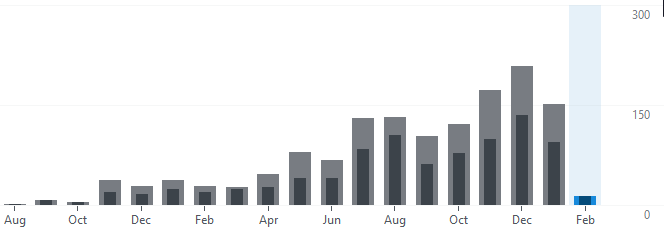
As I looked back at previous six-month windows, I saw fairly consistent growth in numbers. Usually, my views would just about double over the course of six months. The past six months were the first time where that wasn’t really the case. On average, those stats still went up, but not at that exponential rate.

Complicating the issue is that the numbers didn’t show a consistent trend. As you can see from the graph, there were a couple of fairly low months and a very high month. Turns out a lot of people have extra time to catch up on their blogs in the last two weeks of December.

It will be interesting to see what the next six months look like. This just isn’t a ton of data points to infer much from. I’m not really looking to change what I do based on these numbers—I won’t be doing a bunch of SEO stuff or using more clickbait-y titles. I’d love to see the blog keep growing, but if it does it will be because I keep posting what I enjoy posting, and people find it and like it too.

Approaching the End of Razor Mountain

There are ten chapters left in Razor Mountain. That number may change a little as I work through Act III, but that’s still well over 2/3 done. Plus, as an experiment, I already wrote a first draft of the last chapter at the start of the book. So as long as I can keep up my current pace, I should have all my chapters done before my next State of the Blog post.

I’ve been thinking about what happens next. First, I know I’m going to take a break from the book to get a little distance. Then I’ll be rereading and digging into whole-book edits and polish. I worked extra hard on the front-end to make these episodes as good as they could be when they are released, but I know that there will be a lot of opportunities to go back and further improve and tighten the story.

The bigger long-term question is what I want Razor Mountain to be. Right now, it lives on the blog, and on Wattpad and Tapas. I wanted this to be an open experiment, and I’m very happy with how it has gone. But with a rare few exceptions, traditional publishers are not interested in publishing a book that is already out in the world. I may decide to explore self-publishing, just in case there are folks out there who would be willing to throw a few bucks my way for a copy of the final book.

What Lies Beyond

Razor Mountain has been an integral part of my blog almost since its inception. My posting schedule changed when I went from pre-production to actually posting chapters, and it will probably change again when I get into editing. Then, at some point, I’m going to be done with the book, and there will be a big gap to fill in the posting schedule.

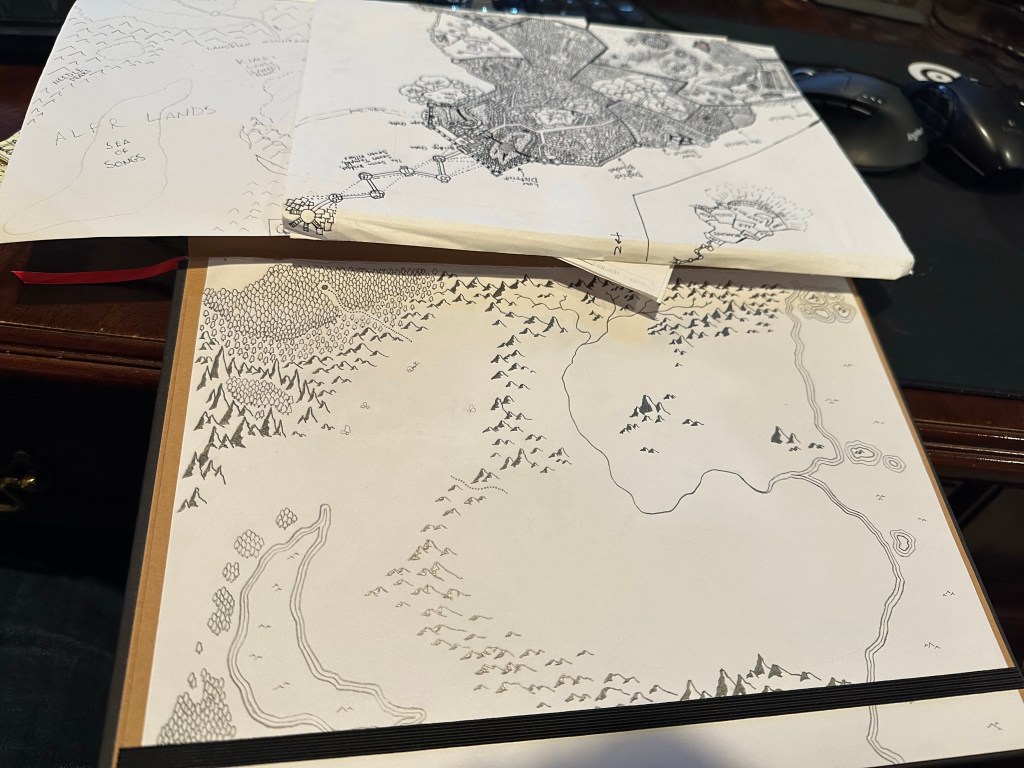
I have a few ideas of what I would like to work on next. I would love to spend at least a few months writing nothing but short stories and really grinding submissions to publishers. I also have dreams of writing a TTRPG campaign setting—I know there is a decent chunk of my regulars who are into that sort of thing, and I think it would bring in some new readership as well. I’ve been kicking around ideas for a setting for years, so it would be great to get it out of my head and onto paper.

I hear that people love maps…

Whichever project I choose to do next, it’s very likely that I will end up posting less frequently. I love the blog, and it has been very satisfying to get to a point where I put out at least three posts most weeks, but I also want to produce more fiction and other work that I won’t end up posting to the blog. Since there are only so many words I can produce in a given week, that necessarily means I will end up stealing time from the blog for other projects.

That’s okay. In some ways, I feel like the blog has grown up. It’s no longer a baby blog where I post my thoughts into the void. I have regular readers that I recognize, and writing and blogging friends that I occasionally trade comments with. I don’t want to stop blogging, but I feel like the blog can continue to grow and thrive with a little less care and feeding than I’ve been putting into it so far.

See You Next Time

That’s it for this time. I’ll see you in another six months for the three-year blogoversary!

State of the Blog — Aug 2022

Dang y’all! Somehow it has been two years since I started this blog. It’s honestly hard to believe.

One of the key tenets of this blog is an open writing process. I’ve brought that to my serial novel, Razor Mountain, with my development journals, and I bring it to the blogging process with these “state of the blog” posts every six months or so.

Metrics

  • Years blogging: 2
  • Total Posts: ~250
  • Total Followers: 87
  • Monthly Views: ~375 (average over last 3 months)

I do my best to not worry too much about visitors, views, and all the other bloggy statistics, but I do keep an eye on them. In the past six months, I really have nothing to complain about as far as the graphs and numbers. I don’t pay much attention to the totals. I’m small by most standards. All I really look for is growth, and the blog has been growing steadily. It took until this May to hit 2,000 total views, and a couple weeks ago I hit 3,000 total views.

One Post to Rule Them All?

One interesting statistic that has become apparent over the last few months is that I have a single post that has out-performed all the others, by a considerable margin.

Great Writing Can You Say Hero? is a post from about a year ago. I had intended to start a series of posts talking about some of my favorite pieces, but I’m distractable, and I’ve never written another of these posts. Views for this post have steadily increased over the past few months, to the point where now they account for about 50% of the views I get every single day!

It’s important to note that I did not intend or expect this. I just wrote a post, and hoped (as I always do) that it would be interesting for others. This particular post hit a search algorithm sweet spot.

You see, there is a steady flow of people looking for Junod’s story about Mr. Rogers, and not very many search results on Google. Because of this, my post shows up near the top of results for several similar searches. This traffic is almost entirely driven by Google.

This is a potent illustration of the power of search engines to drive traffic. This is why people spend so much effort chasing SEO. However, the million dollar question is whether this traffic is actually good for me. I just happen to be capturing views in search of something else. On the other hand, the more people who read the blog, the more likely that some of them will be interested and come back.

The next six months will be interesting, because I’m also seeing search engine-driven traffic on a couple other posts on a much smaller scale. We’ll see if these other posts start to grow in a similar way.

The Long Tail

Even setting aside the search engine traffic, I’ve now reached a point where the post of the day is usually not the primary driver of traffic. On days when I post something new, it is almost always out-performed by a random assortment of my past articles.

This is why so much advice for “content creators” boils down to “keep making a steady stream of new stuff.” On rare occasions, you’ll make an outlier that performs better than most of your other stuff, but you’ll also create a large body of work that collectively draws in a bunch of people over time.

Looking Back and Setting Goals

These six-month reviews are partly about looking back, and partly about re-evaluating what I’m trying to achieve.

Looking back, I feel like I’ve really hit my stride. I have a steady rhythm of alternating weeks: Razor Mountain episodes and a development journal one week, then two writing-related posts and a reblog the following week. Every once in a while I skip a post. I’m not a robot. And I no longer worry about maintaining a perfect schedule.

I usually have a backlog of ideas for posts. Sometimes I do a series on a topic, sometimes I do one-offs. I’ve become a lot more comfortable with off-the-cuff posts and less editing. I’ve also become a lot less stressed about throwing my work onto the internet where everyone can see it. (There will probably always be a little pang of stress about that, but I think that’s probably healthy.)

My goals right now are:

  • Finish Razor Mountain
  • Write a couple of short stories alongside the novel
  • Write more, and especially write more fiction
  • Think about what’s next for the blog after Razor Mountain

See You Next Time

That’s all I’ve got for this two-year blogoversary. Thanks for reading, and we’ll check back in six months.

State of the Blog – Feb 2022

It’s been six months again, and here we are at another “State of the Blog” post.

I write these partly for myself, and partly for other bloggers who are interested in what someone else is experiencing. Part of creating things for other people is about presenting an experience. Assuming you’re not completely cynical and opportunistic, a blog is going to be at least a little personal, but there’s a temptation to put the best version of yourself forward. Unfortunately, that often means that nobody wants to talk about their statistics or their experiences, unless those statistics and experiences paint them in a very positive light.

This blog is largely built around the idea of openly talking about the process of writing, the ups and downs and the unaltered details. The goal of these “State of the Blog” posts is to openly talk about the blog itself, and how I feel it’s going.

Goals

Six months ago, I gave these overarching goals. These all still apply today.

  • To hold myself accountable to a writing schedule
  • To develop an audience of readers
  • To provide something useful to other writers
  • To make connections with other writers

Blogging is the best tool I’ve found so far to keep myself writing on a regular basis. If I don’t write anything else, I am still writing 2-3 blog posts per week. In years past, I have often gone weeks or even months without writing, so this is very positive for me. That said, I still want to be writing more fiction than I am, and I need to figure out more strategies to motivate myself to do that.

Developing an audience is slow going. I think that’s partly because I’m not putting out fiction quickly or consistently, and partly just because it takes time and effort to catch eyeballs, and only a certain percentage of people are going to be interested. I’m continuing to see steady growth, so I’m not too worried about that, but certainly getting more good work out there wouldn’t hurt.

Providing something useful for other writers and making connections with them go hand in hand. Again, based on the statistics, it seems like more and more people are appreciating what I’m posting. I’ve also been working on making connections with other writers who blog regularly and have work that interests me. That’s a slow and tedious process of internet search-an-find, but it is rewarding to discover someone who posts great content, and even better if they like what I’m doing as well.

I have a couple short-term goals for the next six months:

  • Post Razor Mountain chapters more consistently and more frequently
  • Find more great writing blogs to follow

Metrics

  • Years blogging: 1.5
  • Total Posts: ~165
  • Total Followers: 62 (and 9 on Twitter)
  • Monthly Views: ~175 (average over last 3 months)

I try not to put too much stock in statistics, but if I’m honest, it’s hard to not pay a little bit of attention. So I take my data points during these six month intervals. Since this is the third of those intervals, I can start to make some comparisons between those three samples.

The short takeaway is that everything is just about double what it was six months ago. In terms of raw growth, that’s still closer to exponential than linear. It’s slower than it was between the six month mark and the one year mark, but I don’t think that’s terribly relevant when dealing with small numbers. In general, if the lines continue to go up, that translates to more people finding and liking the site.

I crossed the 1,000 view mark in December ’21, after about 15 months of blogging. At the current rate, I’d expect to hit the next thousand by May ’22, five months later. Not huge numbers, but steady improvement.

“Engagement” feels like a gross web business buzzword, but what’s probably more important is that I’ve seen more engagement in likes and comments. Comments are still hard to come by, but that’s to be expected. From what I’ve seen, it’s not uncommon to see anywhere from 25:1 – 100:1 ratios of views to comments. It’s just a lot easier to get people to read what you’ve written than it is to get them to comment on it.

In the next six months, I’d obviously like to see numbers continue to grow, but my biggest indicator of success will be more comments and likes. Feedback is great. Dialogue is even better.

Reblogs

In the past six months, I’ve started doing Wednesday reblogs more frequently. Basically, any week where I don’t post Razor Mountain chapters, I’ll post a Wednesday reblog. I’ll be honest, part of this is that it’s low-effort. I love the blog, but I also limit the time I spend each week on the blog. Hopefully this is a good way to highlight something that I found interesting or useful for other writers, without taking too much time away from other projects.

So…yeah, let me know if you like the reblogs, or if they just clog your feed. I can adjust accordingly.

Razor Mountain

Six months ago, I was still outlining and doing pre-production work on Razor Mountain. Since then, I’ve finished outlining and done all of the book-adjacent tasks like writing the back cover and designing the front cover. I’ve posted five chapters. That’s progress.

I made quick progress initially, then slowed down around the holiday season. Thanks to some real-life factors, I ended up feeling overwhelmed by the schedule I was trying to maintain. I’m now in a more relaxed place, and thinking about trying to push chapters out with a little more frequency.

I do enjoy the cadence of putting out a chapter in 2-3 parts throughout a week, and following it up with a Friday Razor Mountain Development post to talk about the process of writing the chapter. I think it will be interesting to look back on those development journals when the book is done, to see how it has evolved since I first started outlining.

I’m continuing to post chapters to Wattpad and Tapas alongside the blog, but my audience on those platforms is just about nonexistent. It’s understandable since I haven’t put much effort into networking with other writers on those platforms, and I’m not in the more popular genres and styles that I see on their front pages. For now, I’ll keep posting. There’s no point worrying too much about promotion until you have something you really want to promote. At some point when I have more chapters posted (or maybe even the entire book) I’ll dig into those platforms and make a little more effort to draw some attention.

Next Stop: Two Years

I continue to have lots of ideas for stand-alone blog posts and series. I used to worry that I might run out of ideas for a blog, but having written for this long, I’m now confident that I won’t run out any time soon. I have one specific series in the works that I’m excited about—more on that in a week or two.

That’s all I have for now. See you again in six months, for the two-year anniversary of Words Deferred.

Razor Mountain Development Journal #47

This is part of my ongoing series where I’m documenting the development of my serial novel, Razor Mountain. Be forewarned, there are spoilers ahead! You can start from the beginning here.

Last Time

I added and updated the fiction sections of the blog, and I set up Razor Mountain on Wattpad and Tapas.

Reminiscing Before The Starting Gun

Forty-seven weeks. That’s how long I’ve been working on Razor Mountain.

I brainstormed and researched. I outlined and outlined again. I created an author profile and a book description. I made a book cover. I wrote the first couple of chapters, revised them, sent them out for feedback, and revised some more.

As I did all that, I took you along for the ride and did my best to document the whole process in these journals. I hope you found it useful, or at least interesting, to follow along.

It’s been a long journey. The better part of a year, and about twice as long as I originally expected it would take. Now, everything is ready. Mostly. As it turns out, it always feels like there’s more I could do to prepare. I think a lot of writing is like that. You can always put in more time and eke out a little improvement. But at some point you hit diminishing returns and you’ve got to move forward.

This is the last pre-production journal. It’s time to publish, baby!

There’s Gonna Be Some Changes Round Here

I’ve settled into a comfy blog cadence:

  • Monday – A post about writing craft
  • Wednesday – A mini-post or reblog
  • Friday – A Razor Mountain development journal

Starting next week, I’m adding Razor Mountain episodes into the rotation. I’d like to post a chapter a week, but it will depend on how quickly I can write and polish them. I’ll also be splitting longer chapters into multiple “episodes,” since serial services (and readers) seem to prefer lots of smaller episodes.

I’ll still be writing these journals, but I’m going to switch to a journal per chapter instead of one per week like I’ve one up to now. I’m also going to continue writing my usual weekly post about craft.

The new schedule will look something like this:

  • Monday – A post about writing craft
  • Tuesday/Wednesday/Thursday – One or more Razor Mountain episodes. Sometimes a mini-post or reblog.
  • Friday – A Razor Mountain development journal

Not too different. Just a little more nebulous around the middle of the week, and hopefully with even more content. I’m still keeping the weekends open, because I don’t like weekend deadlines, and because I generally see more traffic during the week anyway. Lots of you coming into the office on Monday and reading blogs. I see you.

Results

I did more little revisions on Chapter One and Two. Like picking a scab. I worked on Chapter Three. I figured out how I’m going to adjust the posting schedule to accommodate Razor Mountain episodes. And I vacillated between nervousness and excitement about publishing.

State of the Blog — August 2021

Has it been a year already?

In the spirit of being open about my process and progress, I decided to do a State of the Blog post every six months. This gives me a chance to evaluate my work, and hopefully will be helpful to others.

Goals

Why am I blogging?

  • To hold myself accountable to a writing schedule
  • To develop an audience of readers
  • To provide something useful to other writers
  • To make connections with other writers

This is the context that helps me decide how well I’m doing.

I started the blog around August 2020, deep enough into the pandemic to know that it wasn’t going away any time soon. Like many people, I was tired of the dread-induced lethargy, and looking for some creative outlet. I also needed something to help me keep my writing on a schedule; something to keep me accountable.

I didn’t have a plan exactly, but I did have a bunch of ideas. I’ve made vague attempts at blogging before, and they’ve never gone anywhere. This time, I was determined that if I was going to do it, I’d do it properly.

I had the idea of writing a serial novel, released episode by episode. I have a love of writing, and I knew that I enjoy sharing what I’ve learned with others. So before I started, I forced myself to list 100 possible topics for blog posts — to make sure I had enough fodder to keep me posting twice a week for at least a year.

The Metrics

  • Months blogging: ~12
  • Posts: ~85
  • Followers: 29 (and 9 on Twitter)
  • Monthly Views: 93 (average over last 3 months)

These numbers are small. That doesn’t bother me. I’d love to reach a bigger audience, but the important thing is the trend line, and the numbers are steadily growing. I can still get excited when I set a weekly or monthly record in some metric, and right now that’s happening pretty frequently.

Two Posts

After the first few months, I settled into a consistent schedule. On Mondays, I post something about the craft of writing. On Fridays, I post a development journal, where I document my progress on my serial novel, Razor Mountain. I always write my posts early, do a fairly quick editing pass, and schedule them for release.

This basic two-posts-per-week model has worked pretty well. The Monday post provides variety. I can write a Reference Desk post about useful tools, or a post about writing concepts like hooks, conflict, or outlining. Meanwhile, the Friday Razor Mountain posts provide consistency.

Writing these two posts per week also gave me a good baseline for how much time I could devote to the blog. I’m not a full-time writer. I have a day job and other projects keeping me busy. I needed to make sure I wasn’t trying to write more for the blog than I could sustain long-term. Two posts per week was good for me.

Three Posts?

After months of that cadence, I’ve started experimenting with more content. Part of this was finding things that I enjoy posting about, and that readers would enjoy reading. Part of it was finding ways to avoid dramatically increasing the time I spent writing for the blog each week.

I’ve decided to add a Wednesday post to my weekly schedule. I set myself a rule that I can’t spend more than an hour on a Wednesday post. These posts can be shorter and/or sillier than my other posts. I’m also trying to tie them into my other writing projects. Some examples of these Wednesday posts are my series on Twitter microfiction and my “ground-breaking” Writing RPG™.

I still consider the Wednesday post optional. I may skip it sometimes.

The Future

My biggest goal right now is to finish outlining and prep for Razor Mountain. Once that’s done, my posting schedule will probably change again. I still plan to post weekly development journals to talk about the writing process, but I’ll also be posting the actual chapters/episodes.

Being an inveterate planner, I will be writing chapters ahead of my posting schedule, so I have time for beta reader critique and revision. I plan to post episodes on other services as well, and I’ll be going into the details of that process.

I’m also working on interacting more with other bloggers. As a classic writer introvert, it takes a bit of effort to overcome the imposter syndrome and convince myself to comment on other blogs, even when I think I have something to contribute.

I’m also trying to reblog more of the good writing craft posts that I see, especially on days when I don’t have my own content scheduled. It took me a few months to find a decent list of WordPress blogs in my wheelhouse, but now I’m regularly seeing post in my feed that are worth sharing.

Next Stop

I’ll see you back here in six months, for the 1.5 year blogiversary!

Writing: The RPG™

In the halcyon days of the mid-2000s, the exploding popularity of alternate reality games got a lot of Silicon Valley types excited about the power of games to motivate people. For a few years, investors were happy to throw money at any product that included the word “gamification.” A handful of useful or interesting products came out of that wave of gamification, like StackOverflow and the StackExchange network it spawned, but a lot of attempts at gamification just slapped points and badges on drudge work in the vain hope that people would suddenly love it. Those products all sucked, and mostly disappeared.

Still, the idea of gamification isn’t completely useless (probably). I’ve browsed the ARG scene in years past, strictly as a casual observer, not a front-line puzzle-solver. In the best cases, it’s an interesting vehicle for storytelling, and it can be pretty amazing how effective a small group of people are at solving a problem when they’re all having a good time and feel like a community. I read Jane McGonigal’s book, Reality is Broken, and while I didn’t exactly come away believing that gamification can fix all the world’s ills, I think it can sometimes be useful as a way to self-motivate.

So anyway, that’s why I sometimes think about treating real-life writing as a role-playing game.

Character Creation

Do you want to play Writing: The RPG™? You can! All you have to do is follow these easy steps that I’m making up on the spot. Get yourself a couple pieces of paper.

  1. Select a character name. This can be your real name, or a pen name, or the name of a friend who has a better name than you.
  2. Select a title. This should be something cool like Iron Pen, Word-o-mancer, or Page Slayer.
  3. Select your starting class. This is a general category of writing or writing-related stuff. Writer, Editor, Blogger, or Reader are all good classes.
  4. Select your starting sub-class. This is more specific than your class: Sci-Fi Writer, Short Story Writer, Fashion Blogger, etc.

Character Growth

Your character levels up by gaining experience points. You start at level 1. To gain a level, you need to get as many experience points as (your next level) x 2. So you need 4 XP to level up to level 2, and 6 XP to level up to level 3.

To gain experience, you have to  do stuff related to your classes.

  • A basic, unexceptional amount of work is worth 1 XP. This might be something like writing 1000 words or a short blog post.
  • Completing a task for the first time gets you a First Time Achievement, worth 2 XP. This is stuff like “First Thousand Words Written,” or “First Blog Post,” or “First Short Story.” You also get an achievement for the 10th time and the 100th time. After that, you’re an expert and you don’t get experience for doing that thing anymore.
  • Completing tasks that are very big or very difficult gets you an experience bonus: 5 XP or 10 XP, depending on how big and monumental you think it is. Finishing a novel or having your favorite author retweet you might fall into this category.

Writing: The RPG™ supports unlimited multi-classing. You can add as many new classes or sub-classes to your character as you want to. To add a class or sub-class, you have to complete a related task. You can’t get the Editor class until you’ve edited something. (Like really edited. Edit a chapter of your novel or something. Just fixing a couple sentences doesn’t count. This is serious business.) If you want the Blogger class, you need to post a blog post, and if you want to subclass into Fashion Blogger, that blog post better be about fashion, dangit.

What’s the Point?

There is none. It’s just a silly game. But maybe it’s a silly game that could actually motivate you to do something you kind of already wanted to do anyway? That’s what gamification is supposed to be good for, after all.

What do you think? Can we come up with more rules? I hearby release Writing: The RPG under a Creative Commons public domain license (no doubt giving up my chance to make millions from a half-assed afternoon blog post). Leave a comment with your additional rules, modifications, complaints, or erotic fanfic mash-ups down below.

Writing Advice…Advice

When I was younger, I would devour a book or blog on how to write, and I’d think, “Okay, maybe this is the one that will stick. Maybe this is the one true path that will work for me.” Maybe I can write just like Stephen King, or Neil Gaiman, or Sue Grafton, or even Strunk and White.

Inevitably, I would do my best for a few days or a few weeks, and then I’d start to drag my feet. Or I’d miss my thousand words per day for one day, and then two, and then I’m hardly on the writing-a-thousand-words-per-day plan anymore, am I?

Trying to follow these myriad, often-conflicting pieces of writing advice can be exhausting. Every time you find a process that doesn’t work, it can be even more dispiriting. They’re a bit like fad diets.

Yet, I have a shelf of books about improving your writing. I follow blogs about improving your writing. My own blog is all about writing and learning about writing. I love this stuff. I love the analysis of the writing process almost as much as the actual writing. So how do we make that learning process more useful, and less painful?

Today, I don’t want to talk writing advice. I want to talk about how we take writing advice. Writing advice…advice. Meta-advice, if you will.

Remember Who You Are

If you go look in the mirror right now, chances are pretty good that you won’t see Stephen King or Neil Gaiman. (If you do, get them a warm drink and a typewriter in a corner and they’ll stay out of your way.)

When someone successful puts out writing advice, it’s easy to say, “Look how well it worked for them.” We focus too much on the “look how well it worked,” and ignore the “for them” part.

We all have different life experiences, different internal machinery. We live in different times, places and circumstances. Even if those wildly successful writers could provide the exact book-length recipe that lead them to their wild success, it wouldn’t work the same way for the rest of us. We have different circumstances, and different mental cogs and flywheels that make us tick.

This gets said sometimes, in various ways, but usually not loudly enough. The first thing to accept is that we each have our own recipe for success. It’s going to be different from everyone else’s recipe.

Instead of trying to replicate someone’s recipe, step back and try some of their ingredients.

Pick and Choose

Let’s mix metaphors. Look at all that writing advice like the classic American buffet. There’s everything from pancakes and steak to crab legs and raspberry ice cream. There’s way too much.  A lot of these things don’t really belong together. Some of it is fresh, some of it has been sitting there a while. See, the metaphors are all food-related. It’s fine.

If you try to take everything from the buffet, you’re going to have a bad time. If you only take one thing…well, why are you at the buffet? Instead, pick a few things that seem to go together. Things you think you’ll like. Pick and choose.

I know myself better than any author with a book on writing knows me. I know what I’m good at and not-so-good at. When I hear some advice, I can think about it and have a gut instinct about whether it will be good or bad for me.

Unfortunately, I don’t know myself perfectly well. There are probably some things that would sound awful to me at first hearing, but actually work pretty well. There are certainly things that seemed like a good idea at the time, but ended up working terribly for me.

When following writing advice, pick and choose what sounds good. Once in a while, maybe try something that you’re skeptical about, just in case it surprises you. Follow that advice for a while. If it works, keep it. If it doesn’t, don’t be beholden to it. Throw it away and try something else.

Let it All Wash Over You

When I think of following writing advice, I tend to think of making a plan and putting it into action. It’s a bit of a science experiment. Make a hypothesis, run the experiment, and compare your results to what was expected. (Okay, this one isn’t a food metaphor. Sorry.)

That’s just my personal default mode. You may be different. But there are other ways to learn. As clever, thinking humans, we are great at acquiring knowledge and skills through purposeful study and experimentation. But we still have an ape brain lurking just below the surface. That animal brain, that subconscious, is great at learning just by exposure.

I’ve read plenty of blog posts and a few books on writing that just didn’t inspire me to go out and try doing something new and different. I’ve read some that I enjoyed, but I didn’t come away with a list of things to put into practice. I think that can still be useful. The act of considering the writing process, and listening to other people’s opinions and thoughts on the topic can still exercise those subconscious muscles. Your ape brain will take bits and pieces, mix them into your subconscious stew, and pour out a big helping the next time you put words on a page. (I did it! We’re back in food metaphors!)

Raise Each Child Differently

As a parent of three children, I know for a fact that my parenting style has changed over the years. My oldest got a different experience that the middle child or the youngest. As a young parent, I worried about things that I now know are no big deal. As an older parent, I have new worries that my younger self never considered. And regardless of order and what I’ve learned along the way, each of my children is their own person, with a unique personality and way of seeing the world.

Have you ever heard writers say that their books (or stories or projects) are like their children? Well, it’s true. Sort of. Each project comes along at a different time in your life. You, yourself, are different when writing them. And each project is its own thing. It has its own needs and its own unique challenges. Just like being a parent of children, when you’re a parent of words, you have to adapt.

It’s one of the most amazing feelings in the world to find a way to get through a book, or even a short story. And it’s really damn frustrating when I find out that what I did last time doesn’t really work that well for the next one. It’s unfair, frankly. But that’s the way it is. One of my favorite quotes lately is Gene Wolf’s: “You never learn how to write a novel. You just learn how to write the novel you’re writing.”

Accept that some projects — maybe every project — will be different. Even if something worked for you previously, don’t feel like a failure when it doesn’t work this time. And keep all your failures in your back pocket. You never know when a project will come along where one or two of those things just happen to fit.

Keep Evolving

There is no silver bullet. No One True Way. I write as well as I can today, and I keep learning new things so that I’ll write a little better tomorrow. Promises of sudden writing super-powers are enticing, just like those diet books that supposedly let you lose 20 pounds in a week. Unfortunately, those promises usually don’t pan out. It’s the steady, incremental improvements that make a real difference over the long term.

Many writers, myself included, like to think about some nebulous point in the future when we will have “made it big.” It’ll all be easy after that. The words will flow out of my keyboard and onto the bestseller lists. I’ll have it all figured out.

Even for the people on the bestseller lists, with the books about how to write, it doesn’t work that way. They still struggle sometimes, and if they’re good, they keep changing up their tactics. They keep learning. Instead of imagining some point of total enlightenment, think of learning as a continuous journey. There is no writing nirvana. It may be a bit sad to accept that we’ll never get to the point where we have it all figured out. But it’s also pretty awesome that we can always get even better than we are today.

That’s It!

That’s the end of my writing advice…advice. We’ll be back to the regular old non-meta writing advice by next week. And I hope you’ll take the things that work for you, for the project you’re working on, and throw away the things that don’t, without a hint of remorse.