Novelist as a Vocation —  Reference Desk #23

Book | E-Book | Audiobook (affiliate links)

Haruki Murakami is a bestselling Japanese author whose novels have been translated into dozens of languages. He’s one of those literary writers who lives in the borderlands of literary magical realism and sci-fi/fantasy. My first introduction to his work was the monstrous tome 1Q84, which is almost 1200 pages.

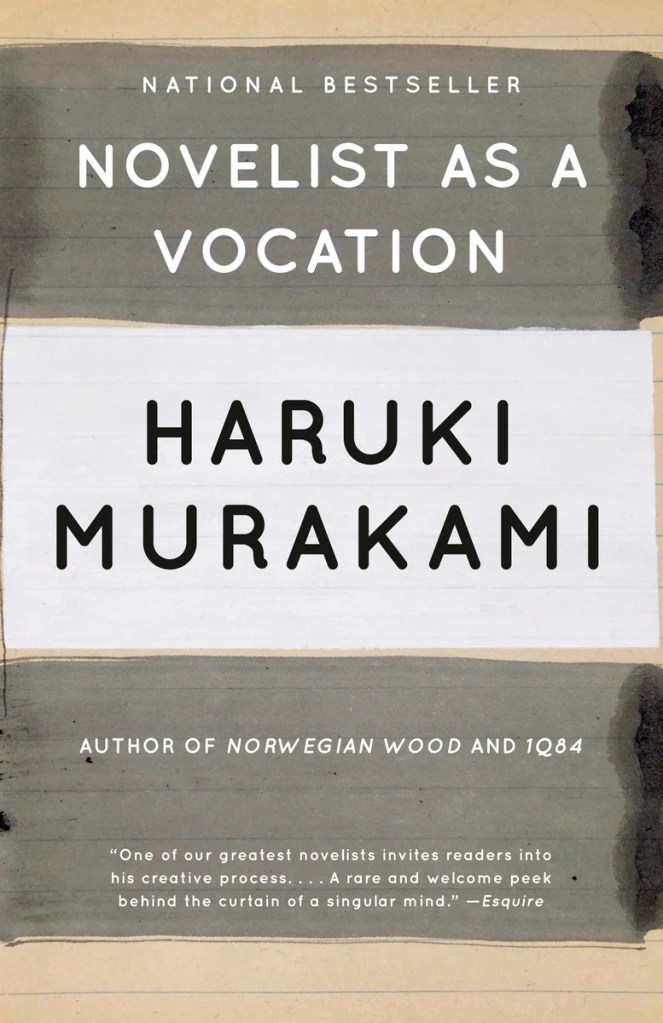
Novelist as Vocation is a book about writing, but if you’re hoping for a technical manual or detailed tips on voice or pacing, this is not the book for you. The closest analogue I’ve read is Stephen King’s On Writing.

King’s book is half memoir, half writing advice. Murakami’s book also has a memoir component, but any writing advice is almost incidental. Murakami seems loathe to put himself on a pedestal with the implication that his advice might be valuable, but he does describe his writing process in some detail.

The book is split into a dozen chapters, each one standing alone and covering a different topic. Half of these chapters started life as essays Murakami wrote years ago and set aside, eventually being published as a serial feature in a Japanese literary magazine. The rest were written later to fill out the book.

For those who are fans of Murakami, the chapters “Are Novelists Broad-Minded” and “Going Abroad – A New Frontier” provide the most history of his career and insight into the man and his view of the world. For those seeking concrete advice, the chapters “So, What Should I Write About?” and “Making Time Your Ally: On Writing a Novel” give an overview of the author’s entire process leading up to, writing, and rewriting a novel.

If nothing else, Novelist as Vocation reinforces the common view of Murakami as a successful author who never quite fit into the literary establishment in Japan or internationally. He comes across as idiosyncratic and sometimes odd, having never been formally trained, and making a start at writing much later in life than many of his literary peers. Getting a glimpse of the man through these chapters, it seems almost obvious that this would be the person behind these unusual novels.

Murakami is self-deprecating and self-important in turns, on the one hand brushing off some critics’ poor reviews of his works and style, but then bringing it up so often that I can’t help but think it hurts him more than he would like to admit. He knocks his own writing as nothing special, but also repeatedly calls back to the prize he won for his first novel and his broad success since then. If nothing else, the fact that he wrote this book about his own life and writing has a certain egoism built into it. 

Murakami also serves as a good reminder for any writer who is worried about not having an MFA,  worried about starting later in life, or simply feeling like an outsider in the literary world: there are many definitions of and paths to success in writing, and we should not be discouraged or afraid to forge our own way.

Reference Desk # 20 — Consider This, By Chuck Palahniuk

(Bookshop.org affiliate link)

I’m always on the lookout for good books on the craft of writing. Over the years, I’ve discovered that there are actually quite a few of them. I have at least a dozen on my bookshelf at any given time, a selection that morphs slowly, like the ship of Theseus. In fact, there are probably hundreds of good books on writing. These books have a tidbit here or there that will lodge in your head, only to pop up at an opportune moment, leading to some small improvement. Or they’ll provide some high-level idea that inspires an adjustment in your way of working.

Consider This is something else. Having just read it for the first time, I think it’s safe to say that it is one of those rare great books on writing. There is an easy way to tell if you are reading such a book. It reads like an autobiography. Writers see the world through writing, and it is only natural that we should get to know each other best through our writing philosophies. A great book on writing feels like you’ve cracked off a little piece of a writer’s soul and slipped it under your ribs. A warm little splinter next to your heart.

The subtitle of this book is, “Moments in my writing life after which everything was different.” I suspect a fair number of writers will count this book as one of those. This is not a book about how to write well. It’s a book about how to write when you are Chuck Palahniuk. And really, what other book could we possibly expect from him?

Postcards From the Tour

If you’re not familiar with Palahniuk (pronounced “paula-nick”), he is the author of Fight Club. He has written more than twenty other successful books and comics, a good amount of short fiction, and a few non-fiction pieces, but if you know him from anything it’s probably Fight Club. His writing career spans over thirty years.

Much like Stephen King’s On Writing, the book is half advice and half anecdotes from the author’s life. Unlike King, whose book is more or less neatly split into the writing parts and the biography parts, Palahniuk’s is a mish-mash.

Each chapter focuses on a particular broad topic: Textures, Establishing Your Authority, Tension, Process. Between these sections are Postcards from the Tour, vignettes from Palahniuk’s life that may or may not directly relate to what comes before and after. He wraps the thing up with a list of recommended reading, and an interesting, brief chapter called “Troubleshooting,” which is essentially a list of problems that you may run into with your work and his suggested solutions.

There are motifs that span the book, like the favorite quotes from authors Palahniuk has known, inscribed alongside tattoo art. “For a thing to endure, it must be made of either granite or words.” “Great problems, not clever solutions, make great fiction.” “Never resolve a threat until you raise a larger one.” And, of course, “Readers love that shit.”

Palahniuk makes it clear that much of the advice he’s providing is not his own. It was given to him by others. He may have taken it to heart, tweaked it, and made it personal, but it is really a collection of advice from all of the people who helped shape him. When Palahniuk makes a point he wants you to remember, he says, “If you were my student, I’d tell you…,” but this is not workshop book. It is not a syllabus to be followed. It’s a conversation between fellow writers.

If You Were My Student

Consider This is packed with small pieces of good advice; so much that it is impractical to dig into all of them here. In fact, I kept running into things that made me pause to consider how they would help me in one way or another with the stories that I’m currently working on, and made me wonder if I needed to revise some pieces I thought were done.

He tells us there are three textures for conveying information: description, instruction, and exclamation. A man walks into a bar. You walk into a bar. Ouch!

He tells us attribution tags can provide a beat within a sentence. Use quotation marks for detail and realness, paraphrase for distance and diminishment.

He tells us the Little Voice is objective and factual. It is unadorned description, the documentary camera. The Big Voice is explicit narration, journal or letter. It is opinionated. Intercutting Big Voice and Little Voice can convey the feeling of time passing.

Palahniuk also makes more than a few suggestions that made me think, “That’s all well and good for Chuck, but what about the rest of us?”

He suggests that each chapter should be a self-contained short story, to the point that it could be published independently.

He suggests a liberal mixing of first, second and third person points of view.

He says we should create a repeated “chorus” to break up the story parts, like the rules of fight club. Use lists, ritual and repetition.

I have an unsettling suspicion. The parts that feel wrong to me—the parts that seem too unique to Palahniuk—might be just as useful as the parts I found immediately helpful. I just haven’t quite grasped them yet. Maybe in five years or a decade they’ll hit me like a lightning bolt and I’ll feel the need to revise all my works in progress yet again.

Readers Love That Shit

If it’s not obvious, I think this is a book on writing that most writers should own. It’s raw and personal, often strange, and very particular to Palahniuk. That’s precisely what makes it work. It’s a collection of writing advice from many writers, all channeled through Palahniuk over a decades-long career. I took copious notes on my first read through, and I have confidence that I will find an entirely new selection of things to consider when I read through it again.