I Have Mixed Feelings About Wattpad Comments

When I decided to write Razor Mountain as a free serialized novel, I figured that I might as well try to get as much exposure as possible. In addition to posting chapters here on the blog, I picked two other services to try publishing on, Wattpad and Tapas.

I will readily admit that I’ve put very little effort into publishing over there. I haven’t done all the tedious little things that people do to get attention on those sites. I haven’t worked hard on graphics or picking the right tags and metadata. I haven’t been going around and commenting on other people’s work to try to get them to read mine. Every once in a while I forget to upload chapters for a couple days after they go up on the blog. (Why, oh why, does Wattpad not have a “schedule post” feature?)

Razor Mountain hasn’t been very visible, and hasn’t caught a lot of eyeballs on these services. I wasn’t that concerned about it—I wanted to spend my time writing, and I figured I might try to drum up more views when I had a larger chunk of the book written.

Comments, Comments Everywhere

Although I haven’t gotten around to optimizing Razor Mountain on those services, a few readers have found the book anyway. As they came through, I began to take notice of the comment system on Wattpad.

The music service SoundCloud shows a waveform for each song. When a listener leaves a comment while listening, the comment appears at that particular point in the song. This lets people tag the moments in a song that they really liked.

Like most comment systems, it has some issues with spam and the general unpleasant behavior of online anonymous people. But it’s an interesting idea that can give the comments more context.

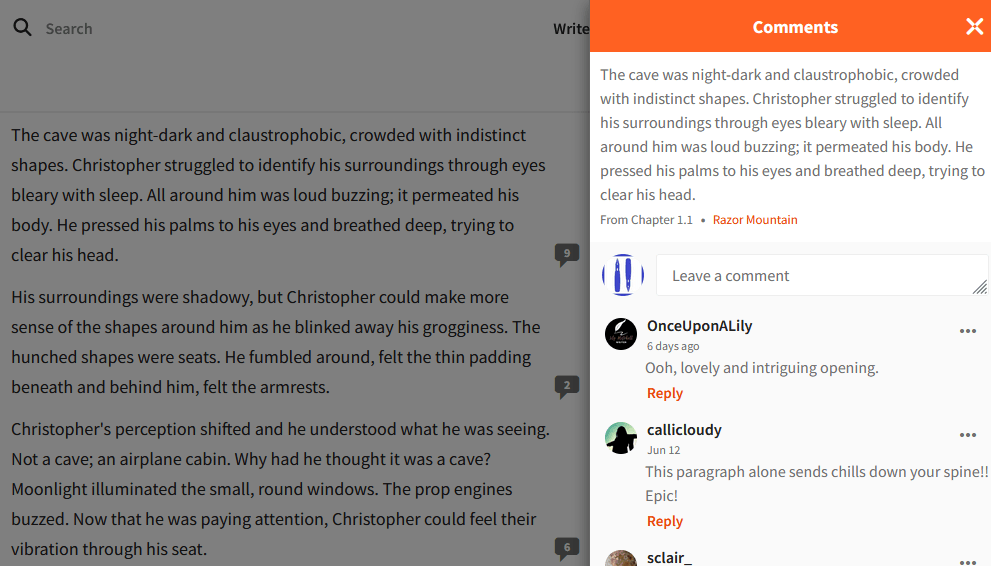
Wattpad has a similar comment system. Instead of simply commenting on a particular chapter or part, readers can leave comments on each individual paragraph, and the number of comments shows in the margins. The comments themselves slide in on a sidebar. Like SoundCloud, their goal is clearly to put those comments in their context. But I’m not sure it works as well here.

It’s possible to listen to a song and jot a quick comment at the same time, but commenting on a story is necessarily going to pause your reading experience.
Short, Quick and Shallow?

Wattpad is a fiction platform designed for readers on mobile, competing directly with social media, and social media is all about capturing attention. Social media encourages short, bingeable pieces of content and simple interaction. It encourages those quick dopamine hits that pull people in and keep them tapping, clicking, swiping.

I won’t get deep into social media commentary here, but I think it’s clearly evident that a lot of these platforms encourage shallow content and interaction as a side-effect of the overriding need to capture as much attention as possible. Complex, deep, or high-effort content and interactions require more effort from a person arriving for the first time, and they’re more likely to “bounce off” and go back to infini-scrolling TikToks.

Wattpad and other mobile-centric fiction services feel like they live in the same ecosystem. Short parts or chapters are encouraged—each story has a view count and number of votes that just aggregate the views and votes on each part. More parts equate to more views, more votes, and higher rankings.

Limiting readers to a comment at the end of a section (like this old-fashioned blog does) tends to garner fewer comments, and those comments tend to be thoughts about the whole thing. Paragraph-specific comments encourage the reader to comment quickly, in the middle of reading, and they encourage prolific commenting.

From what I’ve seen, comments on Wattpad tend to match these expectations this pretty closely. If a reader does comment, they usually leave several on a given part, and they are rarely more than one or two quick sentences.

Feedback

Okay, now that I’m in full, old man, “get off my lawn” mode and complaining about social media, let’s push back. Anyone who has participated in a writing group or critique circle might now be thinking, “Super-specific feedback? Sounds awesome!” One of the reasons that dedicated beta readers, editors, and communities like Critters are so great is that they give you really specific feedback on your work, and that kind of feedback is really needed to polish a piece.

However, if you actively seek out this kind of feedback, you know that not all comments are created equal. It’s great to know when you’ve written something that really works for the reader, and it’s even more vital to know when something doesn’t work. For that to happen, you need thoughtful and honest critique from a reader that wants to help you improve, and isn’t afraid to tell you when something is bad.

For a lot of hobbyist writers, this is a hard pill to swallow. It never feels good to hear that you wrote something bad. But it’s hard to fix it if you don’t know it’s broken.

I don’t see this kind of feedback on Wattpad. I’m sure there are some organized groups that do serious critique, but most readers are just looking for something good to read. If they don’t like it, they’ll stop reading. Many others are writers themselves, but they’re trying to solicit views on their own work.

Perhaps most importantly, all comments are public. Negative feedback, even when couched in positive, polite language, feels a bit like calling the author out in this kind of public forum. The only way to give private feedback to an author is through direct messages, which aren’t even tied to a specific story or part, let alone an individual paragraph.

My Own Experience

I’m not a regular Wattpad reader. I find it frustrating to find stories that actually interest me (although if you like teen and paranormal romance, hoo boy, there’s plenty for you). I have recently put in some effort and sampled a bunch of stories. I’ve tried leaving a bunch of comments throughout a chapter. I mostly find that it brings me out of the flow of the story.

Of the comments I’ve received, it’s hard to gauge how much readers are actually enjoying the story, and how many are just trying to be nice. The one or two comments that have made me consider edits to the story were not because of direct feedback, but because they showed that the reader clearly missed something I had intended for them to understand at that point. That could be useful (if incidental) feedback, but it’s also hard to guess if these readers are actually paying attention, or just skimming their way through.

I’m curious what others think. Do you like the idea of this kind of feedback? Do you think it encourages shallow interaction? Am I expecting too much?

Razor Mountain Development Journal — Chapter 12

You can find my spoiler-free journals for each chapter, my spoiler-heavy pre-production journals, and the book itself over at the Razor Mountain landing page.

Thank God For New Characters

This was a big, exciting chapter for a lot of reasons, and a fun one to write. This marks the end of Act I for Christopher, so a major shift in the story is appropriate.

Christopher’s long isolation is at an end. I get to introduce him to a new character, and then a whole host of new characters. A protagonist who is all alone presents some special challenges, as I’ve discussed in previous development journals, so it’s a relief to be out of that stage. It comes as both a relief and a shock to Christopher to suddenly be around people again, and hopefully readers will feel a little bit of a jolt as well.

This chapter serves as a transition. Rather than jumping into big blocks of dialogue, we start with a few terse sentences. Amaranth’s inability to speak (and her unwillingness to answer all of Christopher’s questions) means that we really only get a few terse sentences of back-and-forth between the two characters.

I really like Amaranth as a character. She comes across as very mysterious initially, but we’ll eventually see that she’s a person with simple motives. Writing her poses a few challenges—it can be hard to clearly describe gestures in fiction. I tend to fall back on a simple description paired directly with the character’s interpretation of what they’re being told. This hopefully helps the reader build an image in their head while making the meaning clear (or unclear, if that’s the goal).

I also had to decide how to depict her written responses in the text. I debated italics and eventually went with bold, just because it stands out more. I think I would ultimately like those “written” lines to be in a font that simulates handwriting, but that is more hassle than I want to deal with right now, especially when I’m posting the story across multiple services, and they each have their own tools and limitations.

Old Mystery, New Mystery

Along with the transition to Act II, we get the resolution of some major mysteries. However, the plot has to keep moving, and these resolutions only lead to new questions. Yes, there are more mysterious structures out here, and yes, there are people in them. But who are they? Why are they here? And why does at least one of them seem intent on shooting Christopher?

This is a balancing act. In this kind of “mystery box” story, the reader needs some mysteries to resolve or at least move forward. Otherwise, it just feels like it’s piling confusion on top of confusion until the reader gets fed up. On the other hand, the story’s momentum is built on those mysteries and getting to their resolutions, so the mysteries need to ramp up in scale and importance until the end, when the biggest payoffs and resolutions can finally happen.

Revision

This chapter and the previous chapter both started as two chapters in the outline (so these were originally conceived as four separate short chapters). I’m happy with how these turned out when reduced and combined.

There are two chapters left in Act I in my outline. These are both God-Speaker chapters, and once again I think it makes sense to combine them. This neatly keeps up the format of two Christopher chapters for every God-Speaker chapter. And while Chapter 12 was a pretty big moment in Christopher’s story, I’d argue that Chapter 13 will be an even bigger moment in God-Speaker’s. It’s the perfect way to wrap up the act.

The start of Act II will also signal a change in the format of the chapters. Christopher’s timeline will continue apace, but God-Speaker’s story is about to jump through time at a much faster pace. This big inflection point is a subtle signal that will hopefully make that more palatable for the reader.

Research

I didn’t have to do a lot of research for this chapter. In fact, the only things I looked up involved elevators. Specifically, what’s at the bottom of an elevator shaft? As it turns out, hydraulics, springs, or a shock absorber, and not much else. It only ended up mattering for a few sentences in this chapter, but I now know a little more about the different types of elevators out there than I did before.

Next Time: Finishing Act I!

That’s all for this chapter. Next time we’ll talk Chapter 13, and the end of Act I for God-Speaker.

Razor Mountain — Chapter 12.3

Razor Mountain is a serial novel, with new parts published every week or two. For more info, visit the Razor Mountain landing page.

They walked. A sliver of moon rose, giving them a little more light to see by, and the girl slowed her pace. Her head still swiveled constantly, watching the shadows.

“What’s your name?” he asked.

She scrawled in the notebook and held it up to the light, still walking.

Amaranth

“Who was shooting at me, Amaranth?” Christopher asked.

She turned to look at him, then closed the notebook and kept walking.

He stopped.

“Look, I’ve had a lot happen to me out here, and none of it makes any sense. Yesterday I didn’t know if anyone even lived out here. Now I’ve apparently got someone trying to kill me. You’ve got to tell me something about what’s going on.”

She wrote in the book.

Be patient. Answers when we get there.

“Where is there?”

She started walking again.

“Look,” Christopher said. “I need you to give me something here, or I’m not going.”

Amaranth turned to face him. He tried to look determined, despite holding the thin blanket wrapped around him and shivering. She half-smiled sadly at him, raised a hand in farewell, and walked backward a few paces before turning and continuing on her way.

Christopher sighed and followed.

“What a skill, to be sarcastic without even speaking.”

They walked for hours, Christopher in sullen silence, Amaranth seemingly in her element. She exuded a confidence and grace moving through the woods.  After a while, he realized that she was leading him through the thickest parts of the forest, keeping them well-hidden from distant eyes.

“Did you leave that rabbit for me?” he asked.

She nodded.

“How long have you been watching me?”

She didn’t reply.

Christopher felt himself beginning to slow. He stumbled. He hadn’t gotten a proper meal or a rest after he set up camp, and the blanket wasn’t an adequate replacement for his coat, especially as the night grew colder. He clenched his jaw to keep his teeth from chattering.

Amaranth glanced back at him, and he thought he caught a hint of concern behind the serious expression.

Finally, she stopped and took out the notebook again.

Wait here.

Christopher looked around. They were still in the middle of the forest, in a place that looked the same as anywhere else they had hiked that night.

“What do you mean, ‘wait here?’” he hissed. “You’re the first person I’ve seen since my plane crashed. I’d rather not be alone in the woods again.”

I’ll come back.

He nodded. There wasn’t much point in arguing. She could run off into the woods if she wanted to, and he would never be able to keep up.

She crept off, and he found a dry patch of soft forest detritus under a big pine. He sat with his back to the tree, the blanket wrapped tightly around him. He instinctively faced south, away from the broken mountain peak and the source of the shooting.

Christopher tried not to nod off, his fingers going numb, wondering if he was cold enough now that he might not wake up again. He could no longer keep his teeth from chattering. He vaguely remembered reading that it was only when the body gave up on shivering that you really knew you were in trouble.

The tiny patches of black sky between the branches were just starting to turn morning gray when Amaranth returned. He didn’t realize he had fallen asleep until she shook his shoulder.

The notebook raised into his field of view as he blinked away the bleariness and tried to focus.

Let’s go. There’s a place up ahead where you can warm up.

She grabbed his hand and helped him to his feet. They trekked onward. The ground grew more uneven and rocky. There were boulders among the trees.

Then they came to a gully that descended into the earth, twisting and turning. It widened and led to a broad depression in front of a wall of rock, a ridge about ten feet high. The depression had become a little pond of dirty, frozen water. Set into the rock face a row of three drainage pipes, each a few inches in diameter and covered with rusted metal grating. They were half-visible, half-buried in the ice. Next to them was a metal hatch with a lever set into it. The design was similar to the door of the bunker, but twice as wide and slightly taller. The bottom of the door was also beneath the level of the ice. Christopher saw chunks had been chipped and cracked away along the frame.

Amaranth led him across the dirty ice, which was slippery in spots and rough in others. There was a number pad in the wall next to this door, just like the bunker, and she shielded it from view with one hand while she punched in numbers. There was a thud from within the door. She pulled the lever, then pointed to Christopher and mimed pushing.

“Teamwork?” he asked, and she nodded. They both put a shoulder against the door and did their best to find purchase on the ice. The door groaned and scraped, and eventually slid about a quarter of the way open. Amaranth slipped inside, and Christopher followed.

Beyond the door was a hallway, perhaps fifty feet long, that looked as though it was cut through solid stone. It was fairly smooth, but not as smooth as the walls of the bunker. It had faint circular scoring, like the marks of some high-powered drill or saw. There were webs of cracks running across the floor, some barely visible, others wide enough that he could stick a finger in. Most of them glistened with cold moisture.

Christopher looked back at Amaranth as she shoved the door closed and pulled the lever back into place. The hatch was keeping out most of the moisture, for now. Surely it would be an issue when the summer thaw came.

“What happened here?” he asked. “The bunker was in great shape. This place looks like it was hit with an earthquake.”

Amaranth shrugged and scribbled in the notebook in the half-light. Circular holes in the hallway ceiling provided diverted sunlight, but it was dim.

Problem with the geothermal. Before my time.

She led him to a similar hatch at the far end of the hallway. This one had no keypad, just a lever. It was in good shape, opening easily. A wave of warmer air washed over them as they entered.

On the other side was a huge space. It was outfitted like an old-fashioned office, with rows upon rows of identical desks. There were filing cabinets here and there. Much of it was knocked over or broken or shoved out of the neat and orderly rows. He found himself in a space near the door that looked like a sort of waiting area, with coat hooks on the wall and two rows of metal chairs all bolted together. The ceiling was higher here, but the light was still dim. A section of the room on his right actually tilted at a disconcerting angle, as if it had sunk a foot or two from the rest of the floor. It was eerie, deserted, and quiet. The air was stale and musty. Christopher felt like he was stepping into a scene from a horror movie.

Amaranth led him on a path through the sea of desks and fallen filing cabinets. She navigated the maze of furniture with the ease of familiarity, and she seemed less guarded and wary than she had been in the woods.

There were papers scattered here and there, occasional coffee mugs, pens and pencils. Christopher was hardly knowledgeable about architecture and design, but it all had a very post-war look to it, maybe the 40s or 50s. A few things, like a winged figure in stained-glass and chrome decorating one wall, seemed older.

They reached the far wall of the huge room and began to follow it to the left. They passed an opening, an empty metal door-frame with broken hinges still attached, but no door. It was a stairwell, but unnavigable because it had been crammed completely full of desks, chairs and filing cabinets, all the way to the ceiling. It was clearly a barricade, and it did not make Christopher feel any more at ease.

A little way further down, they came to a pair of elevators with steel doors, a rainbow of oxidation creeping across them like lichen. Amaranth took a short piece of metal out of her backpack. It looked like it had been broken off some piece of machinery for use as a makeshift crowbar. She wedged it between the doors and pulled them open far enough to put an arm through. After that, they gave way with little effort. The girl banged a syncopated rhythm on the metal door before putting the bar back into her backpack.

She gestured to Christopher, then pointed to the side wall of the empty elevator shaft. Christopher leaned forward and peered into the abyss. There was a ladder along the indicated wall, leading up and down into darkness.

“Up or down?”

Amaranth pointed down.

Christopher took a deep breath and fought back a little vertigo. It was perilous stretching out an arm and a leg to the ladder while clinging to the edge of the opening. Once he had hands and feet firmly planted, he felt a little more at ease. He wasn’t particularly scared of heights, but he was not comfortable hanging in the dark shaft, gripping a rusty ladder.

Amaranth illuminated the shaft with her flashlight while he got onto the ladder and began to descend, but she turned it off and stowed it before she followed. Christopher found himself in nearly complete darkness, with the sound of their feet on the ladder echoing dully around them. When his foot hit the bottom of the shaft, it was a shock.

He stepped out of the way, giving her space to come down. The bottom of the shaft was bare except for what looked like a big shock absorber made of thick rubber, dry and cracked. There was no elevator car, which made Christopher wonder if it was hanging suspended, high above them.

Amaranth reached the bottom of the ladder and stepped past him. She turned on the flashlight again, illuminating a low metal door in the concrete sides of the pit. She banged on it, the same odd rhythm she had used at the top of the shaft. Christopher realized it was a code, or a password. After a moment, the door opened, letting in too-bright light. Amaranth ushered him through.

He had to bend to fit through the door, squinting and half-blind. When he came up, he found himself in a small utility room. Discolored stripes on the walls indicated where shelves had been removed. A man in camouflage fatigues with a bushy beard and wild hair stood in front of him, holding a rifle. It wasn’t pointed directly at Christopher, and the man had his finger on the side of the trigger guard, but his bearing and his stare told Christopher that the gun could be brought to bear quickly, if that proved necessary.

Christopher held his open hands out at his sides as Amaranth stepped out next to him and closed the little door.

Christopher was unceremoniously ushered out of the room, his two armed companions behind him. They walked down another nondescript hallway to another room. This looked like a central area with more hallways and doors leading off in every direction. It felt more like a custodial or maintenance area than the offices above. There were a few chairs and tables crammed into the space, and a group of people. Two were playing cards at a table. Others leaned against the wall, resting or sleeping. Two men stood in one corner, talking quietly. All of them wore the same camouflage fatigues with no insignia. They all stopped what they were doing to silently watch Christopher as he entered.

He glanced back at Amaranth. She tilted her head slightly and raised her eyebrows. He took a deep breath.

“Um. Hi,” he said, addressing the group. “My name is Christopher, and I have no idea what is going on.”

<< PREVIOUS ] [HOME] [ NEXT >>

Razor Mountain — Chapter 12.2

Razor Mountain is a serial novel, with new parts published every week or two. For more info, visit the Razor Mountain landing page.

Christopher jumped up from the fallen log that he had rolled up next to the campfire. He dove into the shadows of the surrounding trees, out of the firelight.

From the sound of gunfire in the distance, the shots had come from the direction of the broken mountain peak. That was the one direction where there was a clear view into the clearing where he had set up his tent.

Silent seconds ticked by. The fire still crackled merrily. The tantalizing smell of the half-cooked rabbit still hung in the air. It lay across the makeshift scaffold of sticks and twine, just above the tips of the flames. Without Christopher to rotate the spit, it would soon begin to burn.

A speculative shot hit the base of a birch just a foot to the right of Christopher’s head, leaving a flap of papery bark hanging loose. Christopher rolled again, further from the fire and the clearing.

He tried to think. He had packed a rifle, but it was on the sled and he had no idea how to find a target. The idea of shooting at someone, even someone who was shooting at him, turned his stomach.

Everything he had brought with him was in the clearing, in the tent or backpack or sled. He had even taken off his coat while he sat by the fire. It lay on the fallen log. If the shooter really was as far away as they seemed, he could easily escape under the cover of the thick forest in the dark. But how far would he get without the coat or his supplies?

A whistle cut through the air. It sounded close. Christopher scanned the shadows at the opposite edge of the clearing. There was a crouched shape there. As his eyes focused on it, a tiny white light flashed at him three times. In those momentary flashes, he could see the faint outline of a person.

It was too much. After weeks alone in the woods, it felt like the world was crashing down on him all at once.

He saw the shadow flit around the outer edge of the clearing, moving toward him quickly and soundlessly. He instinctively scuttled backward into the woods, too frantic to make it onto his feet. The shape crouched next to him, and the light came on again. It was a flashlight, one of those big, serious, black metal flashlights that police sometimes used, probably because they could be used as a weapon in a pinch. It had a hand cupped over the illuminated end, glowing pink and letting only a sliver of light out.

In that sliver of light, Christopher saw a girl in green and brown camouflage fatigues. Her brown hair was pulled back in a tight, short pony tail. She looked young, maybe a teenager. A rifle was slung over her shoulder, the barrel poking up behind her left ear.

She said nothing, but motioned toward the clearing, the fire and his supplies. Then she slashed a hand horizontally in two quick chops and shook her head.

Don’t go that way. Got it, Christopher thought.

She pointed to him, then to herself, then swept a down-pointed finger in a half-circle, pointing across the clearing. She was saying they should both go around the clearing, outside the firelight, and continue to the east. She turned off the light and motioned for him to follow her, both of them just shadows in the trees again.

Christopher was grateful for the direction, the opportunity to not have to make a decision for himself. He clearly didn’t have enough information. It hurt to think about leaving all of his supplies behind, but the idea of going back into the clearing to get them was absurd.

The girl moved much faster than Christopher. She ran ahead silently, then waited for him to catch up before taking off again. When he caught up to her a second time, she put a single vertical finger to her lips. He was obviously being too loud for her.

He raised his eyebrows, shrugged and put his hands out, palms up, in the universal silent gesture for, What the hell am I supposed to do? I’m not a ninja like you.

The whites of her eyes flashed in the darkness as she rolled them and kept going.

They continued for what felt like only a few minutes. Christopher had a hard time guessing how much time had passed. It was long enough that the adrenaline started to fade and he began to shiver without his coat. She stopped and took off a backpack, much smaller than his. She pulled out a thin blanket and handed it to him. He wrapped it around his body. He saw a sizable sheathed knife and a handgun in the bag. The girl took out a dirty, bent, pocket-sized notebook and a pencil.

She turned the light on again, setting the illuminated end into the snow to limit the light it gave off.

She scribbled on the notebook, then held it close to the light.

Who are you?

He reached out for the pencil, but she pulled it to herself as if it was a precious thing. She wrote again.

You can talk. I can’t.

She raised the light a little, then tilted her chin and pointed to her neck. Several vertical scars ran along her trachea.

“Oh,” he said. “I didn’t know.”

She shrugged and pointed at her original question on the page.

“My name is Christopher,” he said. “I…I was in a plane crash a few weeks ago. I’ve been trying to find people. Trying to find a way to get home.”

How did you survive?

“The crash, or afterward?” he asked.

She nodded.

He thought for a moment, trying to figure out how to put it all into words.

She wrote again.

Don’t lie.

He blinked. “I’m not. I’m just not sure how to describe it. It all sounds ridiculous to me. I can’t imagine how it sounds to someone else.”

She waited.

“I jumped out of the plane, before it crashed. I landed in water. Somehow, I didn’t break myself in half, although my knee has been pretty screwed up since then. I think I was probably pretty close to hypothermia, but I found…a door, a hatch in the side of a cliff. And inside, it was warm. There were supplies and beds and running water.”

She stared into his eyes for a moment, then nodded as though satisfied. She wrote in the notebook.

Come with me.

“Where are we going?”

Her pencil hovered over the page for a few seconds.

Maybe we can help each other.

<< PREVIOUS ] [HOME] [ NEXT >>

Razor Mountain — Chapter 12.1

Razor Mountain is a serial novel, with new parts published every week or two. For more info, visit the Razor Mountain landing page.

Christopher shivered, despite the bright mid-morning sun. He squatted and studied the skinned and skewered rabbit as though it were a bomb he had to diffuse. He shaded his eyes and squinted into the surrounding trees. A pair of small birds flitted in the shade, but there was no other movement.

“Why don’t you just come out and talk?” he said, partly to himself and partly to the woods.

Who would be hiding out here in the wilderness, and afraid of Christopher of all people? Sasquatch? Some crazed hermit playing tricks on him?

He stood and shouted into the surrounding woods, trying to sound reasonable.

“I don’t suppose you want to have a conversation? I’m alone out here, and I’d really like to get home.”

The trees absorbed his words, only a hint of his own voice echoing back to him from distant rocks. He waited for a few beats, just in case a mysterious stranger was going to appear. As expected, nobody did.

He sighed, then pulled the stick out of the ground, rabbit and all. There were a few smooth footprints in the snow, leading to and from some nearby trees, and there, they vanished. He didn’t wander around looking to pick up the trail somewhere else. He doubted he would find much.

Someone was out there. They were watching him, but they weren’t too keen on being seen themselves. The rabbit felt like a peace offering, left for this clearly untrained explorer who would no doubt be running out of food at any moment now. Or it could be a trap.

Christopher looked over the rabbit carefully. Could it be poisoned somehow? Full of sharp things?

It didn’t make any sense to think that way. It would be a needlessly complicated way to kill him. After all, there was a good chance that whoever it was could just wait a few days and he’d run out of supplies and freeze to death.

He put the rabbit into a small canvas bag that had previously held the strange jerky bars. He packed a little clean snow alongside it and hung the bag on the outside of his pack, to keep it refrigerated and make sure it didn’t leak rabbit juice on anything. Then he re-situated his gear and continued the way he had been traveling, hauling the makeshift sled behind him.

The snow was shallower under the trees, allowing him to walk comfortably without snowshoes. The branches blocked most of the sun, but they also blocked the wind that gusted periodically through the upper branches, setting the trunks swaying.

If the mystery rabbit-giver wanted to reveal themselves, they would. If they didn’t, all he could do was continue with his plan. There was another dot on the map, another bunker or some kind of structure, and he was going to find it. That was the thing he had some control over.

The day passed in the monotony of hiking that he had become used to. The rhythm of one boot in front of another. The pause to rest, to drink, to take a bite or two of the second-to-last jerky bar. They rhythm of boots again. The wind and the creak of swaying trees.

Christopher had never been the sort of person who was interested in becoming one with nature, but he was starting to feel the odd sensation that all these little rhythms of his life fit neatly into the larger rhythms around him: the cycles of the sun and the moon, the weather, the seasons. He wasn’t sure if that was a sign of personal growth, or if the stress of the situation was getting to him.

That night, he set up his tent in a small clearing surrounded by birch. It felt pleasantly secluded from the surrounding forest, with a view of the sky like a natural skylight, and a parting in the branches that perfectly framed the broken mountain peak to the north.

He built a small fire, then tied together a few sticks with spare twine, forming a slightly uneven scaffold that he could use to spit-roast the rabbit on a stick. It wasn’t exactly fine engineering, but it worked. The meat dripped and sizzled and smelled delicious. The thin limbs began to crisp while the body was still rare, so he cut them off and ate the little morsels of meat off them while he turned the body on the spit. It was delicious, even by his pre-falling-out-of-a-plane standards.

A sharp crack of wood startled him out of his greasy reverie. It sounded like a sizable branch snapping on one of the trees behind him. As he turned to look for falling deadwood, an echoing crack answered it from the direction of the broken mountain.

There was a whump next to him, and a puff of snow a few feet to his right. Another crack in the distance.

A thud accompanied the spray of splintered bark that exploded out of a tree to his left, at head-height.

As the distant crack reached him a second later, he realized someone was shooting at him.

<< PREVIOUS ] [HOME] [ NEXT >>

Razor Mountain Development Journal — Chapter 11

You can find my spoiler-free journals for each chapter, my spoiler-heavy pre-production journals, and the book itself over at the Razor Mountain landing page.

This chapter took extra-long to get through, mostly because I do the brunt of my writing on weekends, and my weekends have been fully booked lately. As usual, it was hard to get back into it, but it felt good once I did.

Combo!

I had originally outlined this as two short chapters, but as I mentioned in previous weeks, I’ve been looking to consolidate as I approach the end of Act I. I think these chapters ended up being better as one than they would have been if they were separated.

The end of the first section is mostly Christopher working himself up to his emotional revelation, which is that he is going to keep going instead of turning around and heading back to the bunker, as he has been telling himself. The second section ends with an external revelation in the form of the rabbit. Both the internal and external aspects move the story in different ways, and I don’t think it would be terrible to have them driving two separate chapters, but they complement each other nicely when put together.

Hints

The inner-focused part of the chapter provides more hints about Christopher’s past. One of the keys with long-running mysteries in a story is to keep the reader thinking about them. Laying down some groundwork early on is not very useful if you then go a hundred pages without mentioning it again. I’ve been trying to keep juggling some of the ongoing mysteries by alluding to them every few chapters. In this case, I want the reader to keep wondering what exactly went on in Christopher’s past.

This chapter also worked to expand how Christopher views himself, at least a little bit. This is challenging when the character is alone for such a large portion of the book. Just having him think about himself constantly doesn’t work very well, and he doesn’t have other characters to play off of and reveal his character in a more passive way. Luckily, lots of things will be changing as we finish off Act I.

Parallels

Finally, my last goal in this chapter is to draw parallels and contrasts between God-Speaker and Christopher. God-Speaker is with his tribe, while Christopher is alone. In the “tribe” timeline, it’s verging on Spring, while Christopher is headed into Winter. Both of them are headed in the same direction: toward the mountain with the shattered peak.

There’s a natural play between these two timelines and main characters, by virtue of them being the stars of the show and the alternating chapters. However, I want to set out some of these simpler comparisons early, because there will be more as the story progresses.

Next Time

That’s all for this chapter. I’m looking at combining another pair of chapters from the outline, which will leave me with three more to close out Act I. See you next time.

Razor Mountain — Chapter 11.2

Razor Mountain is a serial novel, with new parts published every week or two. For more info, visit the Razor Mountain landing page.

As the tent walls darkened around him, Christopher found himself thinking about the past. He wondered if his family had arranged a funeral for him by now. What would people say about him?

He had been to funerals for people he didn’t care for very much. He had an uncle in particular who was a mean drunk. Christopher’s cousin, Susan, had spoken very eloquently about Uncle Dale. Christopher had come away wondering if, perhaps, he had misjudged the old man, at least until he overheard Susan talking about him later in the evening, when everyone had been through a few drinks.

Christopher didn’t think anyone would be speaking ill of him. He didn’t have enemies, so far as he knew. He got along. He was nondescript. If they remembered him for anything, it would be his childhood. And really, they wouldn’t be remembering him; they’d be remembering his brother. They’d be remembering the aftermath that was the rest of his life.

“Christopher kept his head down and stayed out of trouble,” they’d say. “He did his best to make his parents happy. He did well enough at his mundane job that they kept him around, but he was never going to be in upper management, was he? Not in his character.”

He tried to think of the hyperbole they’d use in his eulogy. He couldn’t come up with much.

There’s a kind of cowardice, he thought to himself, that’s not impressive or exciting, like deserting the army the night before the battle. It’s more like failing to stand up to the crowd that you know is wrong. Failing to stand up to anyone, for anything. Just doing the minimum that you think the people in your life want you to do.

He tried to think of a time when he had taken a risk. Nothing since childhood. Children have no conception of risk, they just act and find out later whether it works out or not.

He sat up in the dark. This was it. He was in the middle of the biggest risk of his life. Even this wasn’t entirely his own choice. He had been tossed out of the sky into this ridiculous situation. Every choice available was a bad one. Rot underground or go look for someone in the empty wilderness?

He sat for a while, cross-legged in his sleeping bag with his hands in his lap. His thoughts turned in circles of irritation and despair and self-loathing. He realized he was shivering, his body heat not being captured fully by the sleeping bag.

He fumbled for the lantern and lit it. Fuel was one of his most limited resources. He put on his layers and stepped out into the dark, the lantern providing a little orange bubble of illumination around him. He tried to remember where the closest trees were by the position of the rock and the tent, and trudged off with hatchet and sled. His aim wasn’t perfect, but after a couple minutes he came close enough to the pair of birches to see the lantern light glinting in the snow on their branches.

He went to work, chopping all the dead wood and more besides. He stripped papery bark, slipping it into the pile of wood on the sled.

Back at the tent, he cleared more space in the snow with the collapsible shovel. The air was still, and the sky was clear. The stars were unbelievably bright. It seemed almost offensive to drown them out with a fire, but he was shivering again as he cooled from the work of chopping wood.

He was confident using the flint now, but he lit the fire with a rolled-up piece of birch bark in the flame of the lantern. The shredded bark burned quickly, setting the smallest branches alight, which slowly ignited the larger branches. He split the wettest wood into thin pieces, and only put it on once the rest was blazing. He sat on a low part of the boulder and felt the heat on his face and hands.

The stars were still bright, even with the sparks and smoke and light of the fire rising up to meet them. The bonfire was bright enough that he could see a wide expanse of snow, glittering in every direction. The trees lurked out in the half-dark. Much further away, the sky was revealed to be not quite true black, where Christopher could see the faintest outlines of the mountains, shadow on shadow.

He breathed deep, taking in the strong smell of smoke and his own sweat, and the bright cold air. His thoughts had felt frantic in the tent. Out here, they evaporated. He thought of nothing but these smells and the stars above and the cold smooth hardness of the rock where his fingers ran along a sharp edge. It was the melancholy peacefulness of being completely alone, completely comfortable in nature. It was something he had never felt before.

For a moment, he didn’t care about what had happened or what would happen. He could choose to do anything he wanted.

He realized that he had never really taken choice seriously, as an idea. There were always choices, but there was also always the path he was “supposed” to take. The choices, the crazy possibilities of the world, always seemed like furniture: something to make the place seem a little more interesting. He had a path laid out for him, and the other options were just to look at.

The default path, the reasonable path, was to go back to bed. He would wake up in the morning, pack his tent and his things and trudge his way back to the bunker. He would have just barely enough food. He’d get there and he’d clean himself off. He’d eat a feast of dull and carefully preserved food. He’d sleep in an uncomfortable bed and it would feel amazing. He’d wait out the cold and snow of the winter. Maybe, when summer came, he’d venture out again.

That was the safe path, and he hated it.

The next dot on the map was the same distance as the bunker. Even if he went back and started out again, he wouldn’t stretch his supplies that much further. He was limited by the backpack and the sled, and the amount he could reasonably haul along with him. There was still some faint hope that somebody was out here searching for him. He doubted they would still be searching months from now, when the spring thaw came.

He could at least make a better eulogy for himself, even if he was the only one who knew it.

He sat until the fire burned down to coals, staring up at the stars. When the cold brought him out of his reverie, he doused them and went back into the tent. He undressed and shivered in the sleeping bag until his body heat warmed it up.

He slept, deeper and more peacefully than he had in years.

The next morning, he hummed to himself as he cooked his meager breakfast and packed his things. He hiked north, away from the bunker. The overcast had finally passed. It was sunny, if not particularly warm. It was the kind of winter day that looked perfect through a window, but had a bit of a bite when you were out in it.

He took his time, using the snowshoes to stay on top of the heavy snow. By mid-morning, the land was rising slowly. There were a pair of mountains that had grown closer in the past few days of his trek, though he hadn’t known it with the storm and the poor visibility. He could see a wide gap between them, and peering through was a third peak. That was the one that was oddly broken-looking, as though the top half had been split down the middle. He wouldn’t have to go that far, but it was the perfect landmark to aim for to get to the next dot on the map.

The trees grew more dense again, blocking his view, but he felt confident he had his bearings. He took frequent breaks, snacking and drinking. He tried not to linger over the three remaining jerky bars in his pack.

It would take days to reach the dot. When he arrived, he might have a long and grueling search. For now though, he only had to maintain his course as well as he could. Since the land was relatively flat and he had his compass, that was trivial. He had attention to spare for the birds flitting in the trees, or the occasional shelf mushrooms or bright lichen decorating a trunk.

It came as a complete surprise when he discovered a heavy stick stuck in the ground in his path. On its sharpened upturned end was a rabbit carcass, neatly skinned, gutted, and ready to cook.

<< PREVIOUS ] [HOME] [ NEXT >>

Razor Mountain — Chapter 11.1

Razor Mountain is a serial novel, with new parts published every week or two. For more info, visit the Razor Mountain landing page.

Christopher awoke, aching and feeling like he hadn’t slept at all. Light was just beginning to suffuse the sky. The world was blanketed in knee-deep snow that had settled in layers: dense near the ground, fluffier and lighter above that, with a hard crust on top that broke apart under his feet. The net result was exhausting to wade through. He was grateful to have his snowshoes. He wouldn’t get anywhere trying to trudge around in boots.

He packed his things, eating one of the jerky bars as he worked. His brain shifted into planning mode. He had packed extra supplies, but he had also expected to be at his destination by now. The storm and his detour chasing shadows in the forest had not helped him stay on schedule. He knew it was foolish to expect anything to go to plan when he was alone in the wilderness and so inexperienced, but his general sense was that everything was going poorly. If he didn’t find anything of value, his return would take longer than the outgoing journey. If he really wanted to plan for the unexpected, he was well past the point when he should turn around and go back.

However, he was close, perhaps only a couple hours away from the dot on the map, assuming he was correct in interpreting his surroundings. He could see that the land rose to the north. There was a hill there that looked like it rose above the treeline. He would make that his first destination.

He broke camp while the sun was still hovering at the horizon. His snow shoes distributed his weight enough that he mostly didn’t crack the crust of the snow, and he made good progress until he got to the steeper, rockier crown of the hill, where he had to take them off and scrabble his way up. At the top, he found that he did have a fantastic view of his surroundings. The low sun splashed rosy color across the snow-covered landscape.

The forest grew sparse on the other side of the hill to the north-east, which was the direction he wanted to travel. It opened up into the familiar flat, boulder-strewn terrain he knew from the area around the bunker. Further afield, a pair of small lakes flashed in the light. They looked to be iced over, but the snow had blown over them in drifts, and there was bare ice in the middle. They matched a place on the map that was further east than Christopher had expected, but that put him even closer to his destination than he had thought.

He descended with more confidence in his location, if not in his choices. He traveled over slight rises and descents, with only occasional trees and rocks to break up the monotony. He chose a path around the lakes. It would be a gamble to test the ice, and the edge of the water was hidden by the snow. If he took the path between them, he might very well not know he was out on the ice until he fell through.

The sun still showed late morning when he began to think he was close to his destination. Now came the tricky part. There were no particular landmarks close to the dot on the map. The contour lines were unlabeled, but Christopher thought they probably showed either twenty-five or fifty feet of elevation difference. If the second dot was a bunker like the one he came from, it could be hidden in a fifteen-foot-high escarpment and not show up on the map.

He began to walk slower and meander back and forth. The terrain looked about the same as it had all morning. A small entrance might only be visible from a specific angle or vantage point. His bunker door hadn’t exactly been hidden, but it would certainly be easy for a traveler to overlook.

When the sun reached its zenith, he stopped to eat and drink. His life consisted now of the study of trees and rocks. Nothing else interesting presented itself. His supply of homemade red ribbons was running low, but he decided to use them to demarcate his search area.

He tied them as high as he could on half a dozen trees, to create a rough perimeter. He found himself glancing skyward more and more, all too aware of the passage of time. He hiked to a large rock that stood somewhat close to the center of the area he had marked off. The land was flat. He could see each of the trees with ribbons in the branches from this vantage point. There was no structure. No big cliffs or changes in elevation. If there was something to find here, it was hidden under the snow.

Christopher imagined hatches set flat into the ground, or in some narrow crack that wouldn’t be visible until you came right up to the edge. He knew it was time to turn around and start going back. It was time to give up this ill-conceived plan, do his best to get back to safety, and try to come up with a better one. But he kept searching.

It was mid-afternoon when he slipped and fell hard onto his left side. As he rubbed his bruised elbow, he was thankful that at least he hadn’t landed on his injured leg. Then he felt the ground beneath him. At first, it felt like yet another boulder, picked up thousands of years ago by some glacier, and then placed back down in the long, slow retreat northward. But the flat surface of this rock was oddly pitted. When he scraped away the snow, he saw that it was an aggregate of fine rocks embedded in rough gray substrate. Worn and buried, but easily identifiable as concrete. He used his collapsible shovel to clear more snow.

This had clearly been one large slab at some point, but it was now broken into several pieces, each one meters long. They weren’t flat, they were embedded in the ground at slight angles. In many places, they were blackened or large pieces appeared to be missing.

Once he knew what he was looking for, he began to find more pieces scattered further out from the broken slabs. He went back to his viewing rock, not too far distant, and looked at the area he had excavated from the snow. There was a slight depression there, perhaps only a foot or two lower than its surroundings, although it was hard to tell beneath the snow. There had definitely been a structure here. Perhaps a doorway to something underground, with an angled descent to a hidden entrance?

For a few minutes, Christopher was lost in the exhilaration of the find. It felt like he had accomplished something entirely by his own wits and effort, and in spite of conditions that were far from ideal. That feeling faded quickly as he thought about the implications.

It was a ruin. Whatever had been here was now destroyed. By the looks of the charred concrete, it had been done thoroughly and on purpose. The damage didn’t look recent. But who would put these structures out here, and who would go to the trouble of destroying them? Some sort of military testing ground? Rich people building fallout shelters in the wilderness, and then changing their minds? It only added more confusion to his vague ideas about the intact and well-stocked bunker he had come from.

He sat on the central rock and unfurled his map. He marked an X over the dot with his pencil. Equidistant from him now were the bunker (the dot furthest south), and another dot to the north.

He thought he ought to feel something; anger or disappointment. He felt numb. There was some daylight left, but he unpacked the tent and set it up next to the big rock at the center of his search zone. He opened his pack and took out supplies. It was clear that he had been lying to himself. He had less food than he thought. At the rate he had been consuming it, it wouldn’t last the entire trip back to the bunker. Less than half of the rice and beans remained, and he had only five more jerky bars.

He made a fire and cooked a smaller portion of rice and beans. He refilled his water bottle, cleaned his utensils and packed it all up. It was routine now.

As the sky darkened, he got into the tent and tried to go to sleep, but sleep wouldn’t come.

<< PREVIOUS ] [HOME] [ NEXT >>

Razor Mountain Development Journal — Chapter 10

This is part of an ongoing series where I’m documenting the development of my serial novel, Razor Mountain.

You can find my spoiler-free journals for each chapter, my spoiler-heavy pre-production journals, and the book itself over at the Razor Mountain landing page.

Emotional Arc

This is the first time God-Speaker really feels like a leader. He doesn’t jump into it, he just steps up when nobody else wants to. (As an introvert, this is usually how I find myself in leadership positions as well. It just takes a small step forward when nobody else is willing.)

This entire chapter is a situation going from bad to worse. The rock slide starts it off with a bang, and then the entire landscape is set up to get in the tribe’s way. While things are looking up at the end of the chapter, the entire tribe is worn down. And even if everyone else is feeling better, God-Speaker still intuits that their troubles aren’t really over.

Making a Poultice

This felt like one of those writer rabbit holes that non-writers wouldn’t even think about. I was certainly aware of the idea of a poultice (medicinal herbs and sometimes other stuff pressed into a wound to help it heal). It’s a very old form of medicine. However, I didn’t know whether this was technology that ice-age Beringian people would be likely to have. I also didn’t know what particular plants would be available and useful.

Most of the information I found on poultices and their ingredients were Euro-centric (or at least included originally-European ingredients that were brought to North America much later. I settled on willow bark, which is fairly well-known for containing pain-relieving and anti-inflammatory chemicals similar to aspirin. Having never consumed it, I was surprised to learn that it can have a mildly minty smell. Along with that, I added Devil’s Club, a plant that apparently grows like a weed in parts of Alaska and has long been used in native medicine.

Officially a Novel?

This chapter finishes just shy of the 40,000 word mark, so while we still have a long way to go, it’s at least up to NaNoWriMo length. It also tells me I’m writing at about 1/5 of NaNoWriMo speed.

After some adjustments I made to the outline, the next God-Speaker chapter will be the last one in the first act. Everything is about to get turned upside-down for God-Speaker.

Razor Mountain — Chapter 10.3

Razor Mountain is a serial novel, with new parts published every week or two. For more info, visit the Razor Mountain landing page.

When everyone was done eating and resting, and nobody had any arguments left, it fell to God-Speaker to step first into the cave. Nobody said it, but he sensed that they were waiting for him. God-Speaker wondered if this was what it felt like to be Braves-the-Storm, or Makes-Medicine. It sat like a rock in his stomach. The feeling that others might speak, might argue or offer advice, but he had to take the first step. He had to start walking and hope or trust that the others would follow.

When he did take his first step into the dark throat of the ice, Finds-the-Trail and Braves-the-Storm came a few paces behind him. The rest gathered behind them. As God-Speaker looked back, Finds-the-Trail’s face was grim. He looked as nervous as God-Speaker felt. Braves-the-Storm looked more bent, older than God-Speaker had ever seen him. Far-Seeing was near the back of the group, his face hard to read.

The sounds of the world had been muffled in the ice cracks, but it was even worse in the cave. The soft shuffling of their feet echoed down the tunnel and came back to them. Every time the tunnel turned, God-Speaker expected to see other people, owners of these other footsteps. The ice itself was not completely silent either. It creaked and groaned. It even cracked once, a deep boom directly over their heads that made everyone jump.

Time was lost to them under the ice. It was lighter or darker only because of the thickness of the ice above. They could not guess the direction of the sun or how much of the day had passed. Cracks and tunnels intersected with their cave, but it continued in roughly the same direction, and God-Speaker saw no reason to change their course.

The people kept hiking without pause or complaint, longer than they would have if they were under the open sky. Each twist or turn of the cavern, God-Speaker hoped to see an exit, but the tunnel kept going.

Eventually, there was a change in the echo of footsteps. God-Speaker shuffled his own feet and felt gravel beneath them. He squatted and reached down, as did Finds-the-Trail beside him. It was dirt. Ahead, the tunnel turned again.

They both stood and moved toward the bend. The tunnel widened.

Around the corner, God-Speaker halted, shocked to see a hunched shadow rise up in front of him. There was a flash of movement to his left, and he realized that Finds-the-Trail had thrown his spear. It hit the shadow with a thud, and the shadow roared. More spears flew from either side of them as the others rushed toward the noise and movement.

Finds-the-Trail motioned for God-Speaker to wait. They all stood, watching for any sign of movement. When he was satisfied, Finds-the-Trail rose from a half-crouch and approached the shapes. The other hunters followed. God-Speaker came behind.

Finds-the-Trail retrieved his spear. “A bear mother,” he said. He motioned to a smaller shape pressed beside her. It had also been struck with a hunters’ spear.

Far-Seeing retrieved his own spear and ran a hand over the flank of the beast. “They’re lean,” he said, “she’s been struggling to find enough food. Usually there are two cubs, maybe one was gone already.”

Finds-the-Trail nodded. God-Speaker stood, distracted from their conversation by the feel of cool air on his cheek. There was another bend at the far end of the bear den. The floor here was all dirt, and the shape of the walls was different, rising to a triangular point instead of a rounded tunnel.

Around the corner, God-Speaker felt the wind blow. The tunnel opened out onto trees. It was night outside, and the air was thick with snow. Here, the harsh, echoing quiet of the tunnel faded into the soft quiet of falling snow. To God-Speaker, it was like the first breath in hours.

Braves-the-Storm came up beside him. “A good sign.”

“Makes-Medicine once told me that the spirits sometimes speak through the world around us,” God-Speaker said. “They may be guiding us still.”

The mood of the people changed in moments. They all gave thanks to the spirits of the bears, and set to work butchering them. With new energy, several of the hunters ran out into the snow and chopped branches from the nearest trees to start a fire. Everyone ate bear meat and enjoyed the light and warmth of the fire, and the feeling of breathing fresh air again.

God-Speaker saw smiles around the fire, but this was not the festive feeling they had shared after catching beavers and fish by the lake. This was relief more than joy. There were no stories late into the night. They talked, but they talked quietly still. Soon, they let the fires settle low, and they slept.

God-Speaker and two of the hunters remained awake. He sat with the stone god at the opposite end of the cave opening. The hunters kept watch for predators, though they were unlikely to be prowling in the blizzard, or near a cave that smelled like bears. God-Speaker worried about other, less obvious dangers.

He thought about the words he had said to Braves-the-Storm. They sounded wise, but he could not believe them. The people had made it through the dark cave. They had found meat in an unlikely place. Still, the stone god was silent, and the buzzing from the mountain was only getting louder.

God-Speaker hunched over, exhausted. He closed his eyes and pressed his forehead to the head of the stone god, straining to hear its voice. His chest and arms were chilled by the outside air. His back was warmed by the fire. He breathed in the smells of the cave, animal smells and roasted meat, the musty smoke of smoldering green wood, and the cold clean snow.

He was surrounded by softness. The world faded. The snow left everything silent and white.

He stood alone. The trees, the cave, the people, the stone god were gone. Everything was gone except for the flat white, empty world, and the looming black shape ahead.

The mountain leaned over him and buzzed. God-Speaker could hear it now. Not the buzz of insects. The buzz of voices, so many voices. More voices than he could imagine, far more than he had ever known. They spoke together, but they spoke in different pitches, different tones, some fast, some slow. They spoke in words he had never heard, but he felt their meaning.

They told him that he would come to the mountain, and they told him that his people would be destroyed.

<< PREVIOUS ] [HOME] [ NEXT >>