I recently purchased a solarpunk anthology, and it led me into a minor fixation on this lesser-known sub-genre of science fiction. Last week I wrote an introduction to solarpunk, but I’ve barely scratched the surface. I’ve been exploring the web to find more, and compiling a little syllabus for my own self-directed course.
Since I’m taking the time to write it all down, I figured I might as well put it out as a resource for anyone else who is interested in digging a little deeper. (As usual, I’m providing Bookshop.org affiliate links where possible – these support me and local bookstores.)
It’s interesting to note that most of the solarpunk fiction I’ve found so far is anthologized short stories—fitting considering my renewed focus on short fiction this year.
The term “solarpunk” has been on my radar for a couple years: a fuzzy idea of a genre that has ecology and climate change near its center, and the overused “-punk” suffix that we can no longer trust to have much real meaning.
When I finally picked up an actual solarpunk anthology at my local Half-Price Books, the introduction sent me spiraling down an Internet rabbit hole. I found myself with 30 tabs of solarpunk open, at least that many already combed through, and a small pile of dead links and dead ends.
The term solarpunk is now more than a decade old, but it still exists in the periphery, the outskirts and wild country of sci-fi, futurism, fashion, and politics. It may be a short-lived idea that never achieves critical mass. Only time will tell if it’s something that has actually taken root and begun to grow.
As evidence of this tenuous position, I submit most articles, posts, and papers that mention solarpunk. The vast majority are just like this one: explanations that attempt to answer “What is it, really?”
And yet, there is a cult following. Among this small cohort, there is clearly a hunger for more of this genre and aesthetic. There appears to be a demand that far outstrips the supply (a couple anthologies, small online magazines, and a smattering of discourse).
I’d love to talk about where solarpunk might go, and how it can grow and gain traction. But I’ll have to save that for later posts. First, I have to start where everyone starts. What is solarpunk?
Origins
The first piece of Solarpunk literature generally cited is Solarpunk: Historias Ecologicas e Fantasticas em um Mundo Sustentavel—a 2013 Brazilian anthology, first published in English in 2018.
Another widely cited early work is a Tumblr post that popularized the term on that platform. The tag now has 20k followers.
Well, okay, that’s just my personal position. Others will disagree.
There aren’t any. Not really. This is my position. Others will disagree.
Plants and nature have an obvious place in it. Stained glass and art nouveau have been proposed as a component. Reclaimed and recycled materials, decomposable and natural materials; metal, glass, fabric, stone and wood. Less plastic. Or the polar opposite of Apple’s design philosophies.
A fair amount of ink has been spilled trying to corral an aesthetic, but these attempts often come at it from the wrong direction. You can’t start with an aesthetic and then back into a genre from there. The recognizable elements of cyberpunk and steampunk were distilled from many examples of those genres.
I’d argue that there simply aren’t enough popular examples of solarpunk to achieve the critical mass needed for generally agreed-upon aesthetics to emerge. That’s okay. It’s exciting. The field is still wide open, and resonant ideas still have a chance to shape what the genre might become.
The Politics of Solarpunk
If the “punk” in cyberpunk and steampunk ever held any political connotations, I would argue that they have long been ground down and worn out. The philosophy of cyberpunk is largely nihilistic: a wildly unequal world full of wealth disparity, desperation, and hopelessness, where the unification of corporate greed and governmental control has made the rich practically unassailable. If I were a cynic, I might say it’s a slightly grimier, neon-lighted version of the world we appear to be living in.
The politics of steampunk is anachronistic Victorian British, which isn’t much better.
Solarpunk might have more right to claim “punk” than its older siblings. It has an inherently political core: a belief that the average Joe has the duty to fight back against the status quo, that the system dominated by corporatism, greed, indifference to human rights, and ecological catastrophe must be overthrown. It’s a belief in individualism and self-sufficiency, but also in local small communities, human- and environmentally-conscious economics, and grassroots support systems.
This is a modern twist on the original punk movement of the 70s and 80s, strongly anti-authority and inherently suspicious of both government and corporatism. Wild and chaotic, but also joyful in a way that only people living on the edge of desperation can be.
Solarpunk currently has a streak of willful nonviolence (at least toward people). This, perhaps, runs contrary to the punk ethos that if The Man is going to push you down, you had better go down swinging, and knock some of his teeth out along the way. I suspect there might be a real audience for a rougher, more violent strain of eco-fiction like this, but I’m not sure it could call itself solarpunk.
The Challenges of Writing Solarpunk
The first challenge, as you might already suspect, is trying to define the boundaries of the genre and writing within them. Solarpunk invites you to choose your own adventure, and then find out whether others think you’ve hit the mark.
The second, and much bigger problem, I feel, is that solarpunk strives for a utopic vision, and utopias are dangerously boring. Nobody wants to read a story where all the challenges and difficulties have been smoothed out. That’s why so many utopias turn out to be dystopias once the protagonist discovers a few nasty truths.
Luckily, the road to utopia is rough, and there are plenty of solarpunk stories to be told along the way. I see the best place for solarpunk stories living in the time between the present and some glorious, distant future.
That brings us to the third challenge: imagining solutions to very hard, very real problems. We don’t live in a solarpunk utopia today because there are daunting technological, societal, political, and economic challenges that prevent it. Those conflicts and tensions are fertile ground for stories, but they also require some serious thought about how we should try to overcome them.
The soft sci-fi of technobabble problems and technobabble solutions don’t work well here. The readers of today are all too familiar with climate change, oligopoly, and enshittification. A story that proposes half-hearted or unrealistic solutions to these modern woes will fall flat. It’s not easy to imagine solutions (or even battle tactics) that feel plausible. And yet, this is one of the great delights of science fiction, and a reason why the genre continues to inspire the real future. People use stories to make sense of the world.
Future Positive
I hope this brief introduction has whet your appetite for more. Although it’s young, solarpunk strikes me as a genre that is shockingly well-suited to the current moment. We don’t need the nihilism of cyberpunk or the escapist fantasy of steampunk. We need something grounded and fighting mad.
Solarpunk takes the energy and anti-authority attitude of classic punk, and marries it with determined optimism and ethical technology. It is a rebuttal to the world outside the window, and an opportunity to imagine better futures.
Rod String Nail Cloth was a random library pick containing six stories and a poem. It’s slim enough that I read it in the span of a Saturday afternoon. When I grabbed it I didn’t know anything apart from the title, but I’ve been meaning to investigate Afrofuturism for a while, and a short anthology seemed like a good place to start.
As it turns out, T. Aaron Cisco was born and raised in Chicago, but now lives in Minneapolis, so there’s a hometown connection for me. It also turns out that this is self-pub, and has a whiff of punk-rock “zine” to it. Unfortunately, it also has something like 20-30 typos and formatting errors across its 150-odd pages.
These stories revolve around themes of time travel, racial injustice, environmental catastrophe, and transhumanism. There are some interesting ideas in here, and some sentences and paragraphs that really pop. However, I found some of the writing straying too far into the literary style that I most struggle with: pages spent on a character’s languid internal thoughts without giving me enough plot or setting to latch onto.
The first story, “Now, Justice,” is the biggest offender in this regard. It follows a Black inventor who creates a machine that manipulates people’s perceptions. He uses it to take vengeance on a policeman who shot an unarmed Black kid and dodged the consequences. However, we don’t get to the first mention of the machine until page 17.
The subsequent stories were tighter, in my opinion. “Thursday Addison” is a Shonen anime of a story where a cybernetically enhanced enforcer is sent into a violent, futuristic battle that she barely survives.
“The Hesitant Envoy” is a tongue-in-cheek tale where an advanced civilization pulls aside one human to ask him to justify the continued existence of the species. He has a hard time coming up with a good argument, and isn’t particularly inclined to try.
“Lydian Mode” is about a down-on-his-luck Black musician who travels back in time to 1960s Chicago. Despite the dangers of life at the height of the civil rights movement, he discovers that there are also opportunities.
“Captain Michaela” is a poem about the titular character (maybe?) saving the universe. I’m just the wrong audience for this. While I have my favorite poets and poems, I’ve never felt drawn to sci-fi poetry.
“Rod String Nail Cloth” is the stand-out story of the book for me, an epistolary story about a person sent far back in time to fix a broken world.
In “They Burn So Easily,” an apocalyptic virus turns people into still-thinking vampire/zombie creatures called Chalkies, more strongly affecting those with paler, less pigmented skin. It’s a story about choosing forgiveness and humanity even when it may be undeserved. The conflict in this one felt a bit rushed, and I would have been interested in a longer exploration of the setting, the premise, and the relationships between the characters.
Rod String Nail Cloth is, in parts: intriguing, goofy, and a little rough around the edges. It’s not going on my favorites list, but I’m happy to have read it, and I’ll keep an eye out for Cisco’s work in the future.
It also whet my appetite for more Afrofuturism, especially in short fiction. If you have any good recommendations, leave them in the comments.
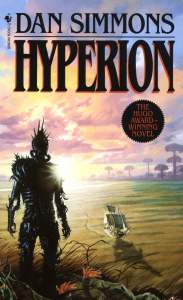
Reading the four-part Ender’s saga left me feeling skeptical of big, philosophical, late-80s sci-fi books. Now I’m going back to that well with Hyperion.
I’ll be honest, Hyperion feels clever and stylish after Children of the Mind. Then again, Ender’s Game was the first and best book in the series. Hyperion is also the first book in a four-book series. So maybe I’m setting myself up for heartbreak all over again.
Canterbury Tales, in Space!
Hyperion opens with a frame story. A man we know only as the Consul is given instructions to go to the planet of Hyperion along with six others, on a mysterious pilgrimage. He goes, and meets his compatriots:
Het Masteen, captain of the spaceship that will transport them, which just so happens to be a giant tree.
Father Lenar Hoyt, a Catholic priest in a galaxy where Catholicism is nearly extinct
Colonel Fedmahn Kassad, a soldier of the galaxy-spanning Hegemony’s military
Martin Silenus, a centuries-old poet who has journeyed between stars and across time via relativistic space travel
Sol Weintraub, a scholar, who brings his baby daughter Rachel
Brawne Lamia, a hard-boiled private detective
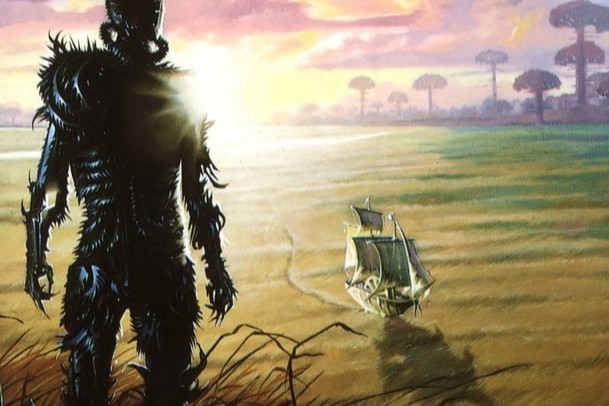
When the pilgrims arrive at Hyperion and introductions are made, they come to an agreement: they will each tell the story of why they came as they make the long journey from the spaceport to their final destination, the Time Tombs. There, they expect to find the Shrike, a mythic creature made entirely of razor-sharp blades. Supposedly, he will choose one of them to grant a boon, and the others will be sacrificed.
As the journey gets underway, each pilgrim tells their story in turn. Between the stories, they travel across the planet toward their destination. It’s a bad time to return to Hyperion. The planet is poised to be the first front in the largest war humanity has ever seen, between the Hegemony and the long-exiled Ousters, who live strange lives in their deep-space ships. The Time Tombs—in what cannot be coincidence—appear to be opening, and nobody knows what will come out.
A Slowly Woven Tapestry
The structure of the book allows Simmons to expand the scope of ideas slowly. The unexplained and confusing in one story is addressed and answered in another. It allows the reader to assemble these small pieces into a detailed and rich setting.
Through the pilgrims’ stories, we begin to understand the galaxy they inhabit and the ways their paths have crossed Hyperion and the Shrike to bring them to the current moment. From Silenus we learn about Old Earth and the Big Mistake, a man-made black hole that slowly (and then quickly) devoured the planet, forcing the Hegira to many worlds. From Father Hoyt and Saul, we learn about Hyperion, it’s inhabitants, and the Time Tombs. From Kassad and the Consul, we learn about the armies of the Hegemony; the many rebellions quashed and small wars fought by a supposedly peaceful and democratic government. From Brawne, we come to understand the vast web of farcaster portals that allow instantaneous travel between Hegemony worlds, and the mysterious society of AIs who control them and remain apart from humanity while ostensibly guiding and helping them.
The book paints rich portraits of a handful of specific worlds. Dan Simmons manages to make almost every setting in the book genuinely strange and interesting. A planet wracked with storms, a sea of grass navigated by gyroscopic sailing ship, a 1.3g planet where the people live in vast arcology-like “hives,” a bus-sized cable-car over snowy mountains, an ocean world where people live on island-sized migratory creatures, and a vast capital city where the rich live in houses where every room is a portal to a different planet.
This feels like a universe with a history, a big universe populated by billions of people across dozens of worlds, and all the diversity that represents. It’s full of beauty and weirdness. And yet, the same human sins and weaknesses are still there, still causing problems.
Each pilgrim brings a different perspective to their story, which allows Dan Simmons to shift style and tone throughout. Kassad’s story is full of sex and violence, a pastiche of military sci-fi, while the Consul’s story is more of a historical documentary. Brawne’s story is a cyberpunk noir where the detective inevitably falls in love with her dangerous client. Sol’s story is that of a father desperately trying to save his sick child. These different styles help to keep the book constantly fresh, and each reveals new pieces in the puzzle of what’s really happening on Hyperion.
In the Ender Saga books, the relativistic effects of space travel were a promise that never really delivered. Nobody apart from the main characters traveled between worlds, and it seemed that nobody could even imagine that someone might live for hundreds of years by traveling between stars while time passes by.
In Hyperion, relativistic space travel is a part of life. The Web of Hegemony worlds are connected instantaneously via farcasters, but each world starts as a colony whose inhabitants took a many years to arrive, and even longer to build their first farcasters. Conflicts often arise between the original settlers, or indiginies, and the flood of tourists that inevitably come with joining the web.
Style Plus Substance
Ultimately, I think a lot of what I enjoy about Hyperion comes down to Dan Simmons’s writing style. It incorporates literary flashes and delightfully crafted language, while maintaining the workmanlike plotting and characterization that a mainstream science-fiction audience would expect…especially in the late 1980s.
For a thirty-five year old novel, Hyperion still feels fresh and interesting. It’s doing a lot, and doing most of it well. If there’s anything to critique, it’s that the book sets up some big mysteries and leaves the biggest ones unresolved. I believe the four books in the series are really a pair of duologies, so I expect to get most of the answers in the sequel, The Fall of Hyperion.
It’s a common misconception that a great idea makes a great story. The truth is that most great stories come down to execution. A great idea with poor execution rarely works, but a great writer can breathe new life into even the most tired tropes.
Like any writer, I have my own treasure trove of ideas that might end up in a story…someday. But why horde them? Instead, I’m opening the vault and setting them free.
Use these ideas as a writing prompt, or come up with your own twist and reply in the comments.
Computational Literature
Early on, computer programming was valued for its practical uses. It overturned industry and transformed society. It was deemed a science, even if computer science wasn’t as rigorous as physics or chemistry.
There were always those who saw the artistry in programming, the code golfers, makers of esoteric languages, and high-minded software architects. But what does artistry matter in the face of trillion-dollar industries and socioeconomic upheaval?
That was before Gustav Nacht, classical painter turned web designer. In retrospect, it’s clear that his genius was on par with greats like Mozart, Nabokov, or Van Gogh. At the time, nobody took his School for Computational Literature seriously.
Nacht pioneered programming languages that were as expressive for humans as they were for computers. Ernest was a language as terse and evocative as the writing of Hemingway, while Faulkner was a language as verbose, complex, and non-linear as the stories of its namesake.
It took decades, but by the time of Nacht’s death, non-programmers reading computational literature had become commonplace, and the ability to program finally seemed destined to become ubiquitous, as more and more people discovered these accessible gateways into the practice.
Nacht’s best students carried on his work, and while some fans might suggest that nobody would ever attain the same artistic heights as Nacht himself, most readers found subsequent generations even more enjoyable.
I received CBR+PNK (“cyber plus punk”) as a holiday gift, and while I haven’t had a chance to play it yet, half the fun of TTRPGs is in leafing through the materials, enjoying the art, and trying to figure out how the rules fit together and how it will actually play.
CBR+PNK bills itself as “Cyberpunk one-shots forged in the dark.” It gets its story DNA from its namesake, Cyberpunk, the gritty dystopic future setting that has recently found fresh life in the popular Cyberpunk 2077 video game and Cyberpunk RED core rules update. However, its rules are based on a stripped-down version of Blades in the Dark, a fiction-first, fast and simple ruleset with a core mechanic of rolling d6 pools.
The Package
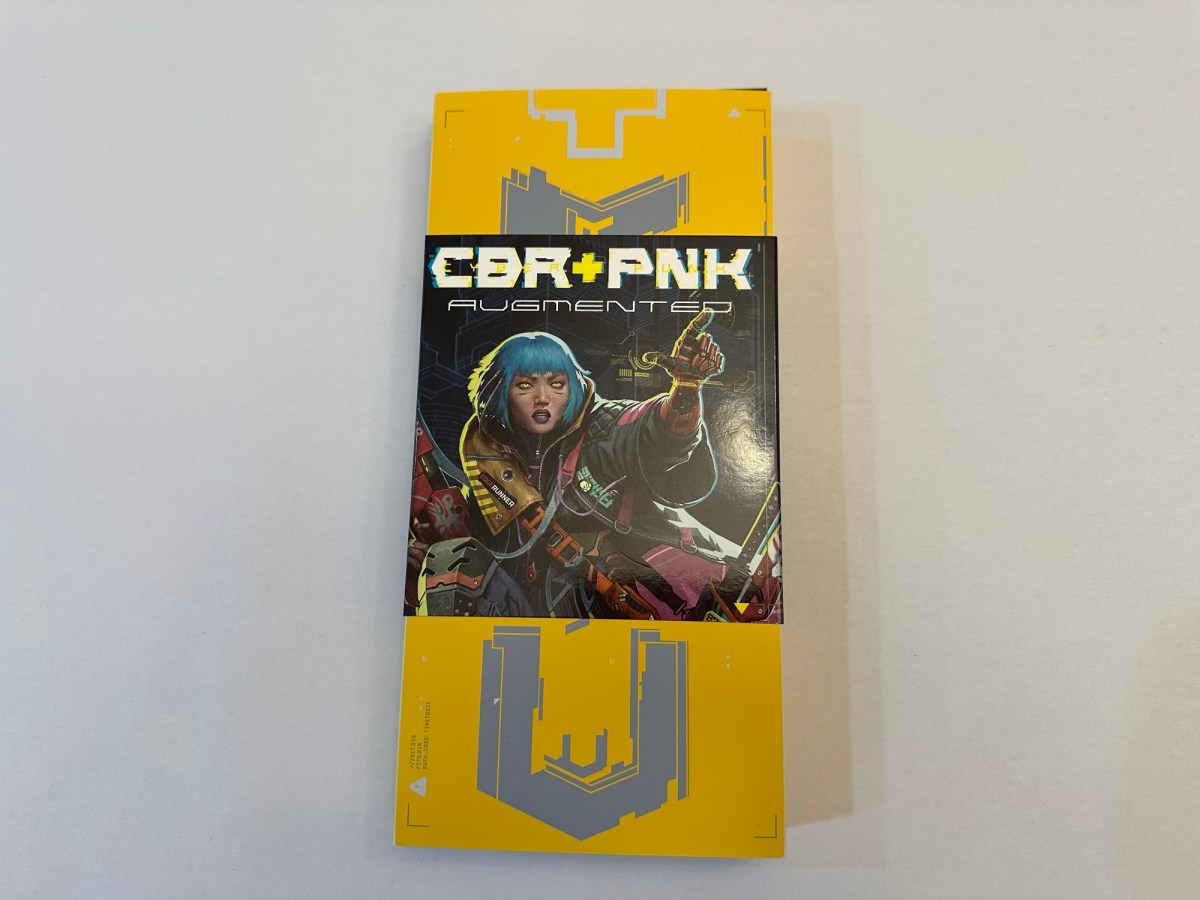
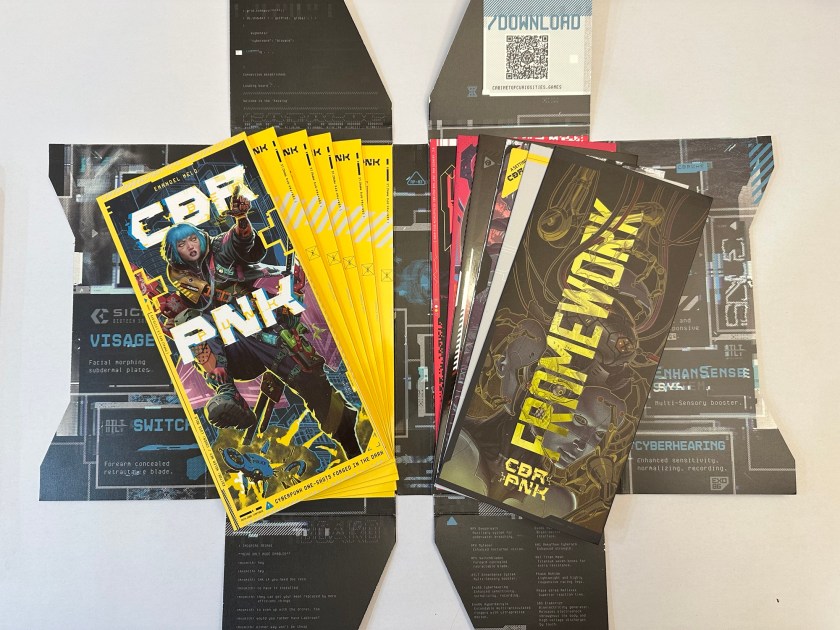
CBR+PNK is clearly broadcasting its goal of being a light, low-prep, pick-up-and-go game. The form factor is less than half the bulk of a typical core rule book; a slick little fold-out box filled with laminated pamphlets, all held together by a sturdy sleeve.
The lamination means these should stand up well to the typical abuses of game nights, including spilled drinks. It also allows players and GM to mark up their pamphlets with whiteboard markers and reuse them across sessions.
The left fold of the packet contains includes a “GM protocols” pamphlet and 5x player “runner files”—a combination character sheet and mini instruction manual. The right half contains a variety of odds and ends: optional mechanics, settings and runs.
The Framework
The players play as criminal or semi-criminal agents, mercenaries with specialized skill sets who might come together for assassinations, heists, sabotage, or other high-stakes operations at the behest of shadowy contacts promising huge payouts.
Unlike games that cater more to long campaigns where player characters can grow over months or years, the characters in CBR+PNK are veterans on their last mission, hoping to finish the run and get out of the game alive.
There are some optional rules for running CBR+PNK campaigns over multiple sessions (and supplements to that effect on Itch.io), but it’s tailored for one-shots, and I suspect the rules might feel thin in places for a long story across many missions.
As part of initial setup, each character has an “angle.” Are they out for revenge? Trying to buy a luxury flat to get their family out of the slums? Paying off a bookie? Searching for a missing friend?
At the end of the run, each player decides how they will leverage the results of the mission to try to satisfy this broader character goal, then rolls a special skill check with various bonuses. This is the final payoff or disaster.
Setup
The game is designed to be low-stress for the GM. That’s achieved in three ways—few rules, spreading some load to players, and minimizing prep.
It’s suggested that the GM figure out the mission objective, a couple locations and assets (people, data, vehicles, etc.), and 3-6 obstacles that players may have to overcome.
Players come up with their character’s name, look and “angle,” then assign points to the four “approaches” (broad attributes like Aggressive and Smart) and the 11 “skills” (narrow attributes like Close Combat and Coding). All of these attributes max out at 2, keeping bookkeeping simple.
Players also pick a cybernetic augmentation and a Load of Small (3), Medium (5), or Heavy (7), which impacts how much they can carry, but also how fast, conspicuous, and stealthy they are.
That’s about all that’s needed to start the game.
Play
Play revolves around three primary mechanics: Action Rolls, Stress, and Harm.
When a player tries to do something risky or difficult, they make an action roll. The GM decides the threat (risk) level, consequences of failure, and effect of success. Players can try to shift this equation to their advantage with gear or tactics, and the GM can increase the difficulty by doing the same for the bad guys. The player can also choose to simultaneously boost both risk and reward.
The roll uses a pool of d6s based on the sum of the Approach and Skill used and takes the highest roll(s). Rolling multiple 6s is a critical success, a single 6 is regular success, 4-5 is partial success with negative consequences, and 1-3 is outright failure. This basic system should feel very familiar to anyone who has played Forged in the Dark or Powered by the Apocalypse games.
Stress is a penalty pool that players can fill (up to 7) to get a variety of benefits. They can Push their own action or Assist another player’s action to add dice for an action or improve the effect. They can activate a cybernetic augmentation. Or they can perform a Flashback.
Flashbacks are a fun mechanism for coming up with new fiction on the spot. The player gets to describe something that happened before the mission that impacts the current action or predicament (and presumably helps them). The GM decides the Stress cost based on how outlandish this gamified retcon is.
Gear works similarly, but without the stress cost. Players decide they packed an item when they need it. The only caveat is that you can’t produce more gear from your pack than your Load number allows.
Harm is what often (but not always) happens when the characters fail an action, and it’s a replacement for more common hit point systems in other games. It’s a three-level system where L1 is superficial damage, L2 is serious injury, and L3 is severe. Stacking multiple lower-level harms results in an injury the next level up. L4 kills the character.
The Extras
The FRAMEWORK pamphlet is an odd combination of rules clarifications, quick lists for GMs, and rules for an odd campaign mode built around a series of session-long flashbacks. It feels like this really wanted to be part of the GM pamphlet and ran into the limitations of the form factor.
The HUNTERS pamphlet provides optional mechanics for what amounts to boss enemies, and seems like a pretty cool thing to add to a run once you’ve got the hang of the basics.
The +WEIRD pamphlet is a build-your-own Shadowrun, adding some light fiction to bring magic into the world, meta-human backgrounds, and magical abilities that slot into the character sheet just like cybernetic augments. It’s another set of optional rules, but trying to do a lot more than HUNTERS. It feels a little slim for what it’s trying to do, which is a lot.
The PRDTR pamphlet provides a setting—a base on Ganymede where a worker insurgency fights against corporate overlords. The colony is falling apart, infested with out-of-control mutant jungle and an engineered living weapon (definitely not the trademarked alien from Predator). It includes several starting points and missions, NPCs, a simple graph-map of locations on the base, and random events. All in all, a nice selection of components to build a mission from. A team synergy mechanic is also included, but this didn’t seem to add much, and I’d consider not bothering if I was running it.
The Mona Rise Megalopolis pamphlet is a very different take on a setting, with random tables for just about everything randomizable in this simple game, packed with what I assume are references to characters and locations from William Gibson’s Sprawl trilogy. Unfortunately I haven’t read those books, and this falls pretty flat as a stand-alone artifact without that context.
Finally, the Mind the Gap pamphlet is a complete example run, with a fun bubble-story setting, a simple three-act structure, and a twist. My biggest pet peeve for TTRPGs is when they don’t provide examples of play to help understand the game flow and rules, and this goes a long way in that regard.
Final Thoughts
This package is cool and slick, but also limiting. They’ve crammed every millimeter of these quad-fold pamphlets with text, and in some cases it feels like another page or two would have been beneficial.
As a prospective GM, I had to jump between all the pamphlets and do some internet searching to understand threat/effect and harm. Harm is the one case where the game makes a choice that I think adds significant complexity over other common mechanics like HP and well-defined status effects.
Like many, I cut my teeth on D&D. These days, I really like the FitD/PbtA style of fast, low-rules, fiction-first play. It’s so much less intimidating than running something like a D&D campaign whether that be from a book or homebrew.
That said, they also have limitations. I haven’t run a longer campaign in one of these systems, but I expect it would feel very different from something crunchier.
I’ve been looking for something relatively easy to play with the kids, so I expect I’ll find time to play this sometime in 2026. I’ll post a follow-up when I do.
It’s a common misconception that a great idea makes a great story. The truth is that most great stories come down to execution. A great idea with poor execution rarely works, but a great writer can breathe new life into even the most tired tropes.
Like any writer, I have my own treasure trove of ideas that might end up in a story…someday. But why horde them? Instead, I’m opening the vault and setting them free.
Use these ideas as a writing prompt, or come up with your own twist and reply in the comments.
Exposure Therapy
The Virtual Experience Technology was designed by neuroscientists and psychologists, manipulating magnetic fields at the brain surface without all of that messy wiring directly into the neural tissue. It could not only generate incredibly detailed sensory inputs, but could also modify the subject’s sensation of time passing. Coming from the sphere of brain science, it’s only natural that it would find its first use as a therapeutic tool.
No, of course it couldn’t modify memory. Not directly. But it could simulate real experiences, so real that they were nearly indistinguishable from life. Even better, these waking dreams could distill hours or days into seconds and minutes. Patients suffering from traumas and phobias could be walked through dozens of carefully designed scenarios in a single treatment session, physically safe at a clinic.
Corporations and militaries noted how effective the V.E.T. was for training. A few used it for interviews, condensing weeks of on-the-job observation into a few hours. And why not apply the same standards to those who were already hired? Why not condense more work into less physical time?
Advocates for justice reform suggested that prison sentences could be effectively commuted by living them out under V.E.T., completing them in a tiny fraction of the real-world time. Advocates for harsher sentencing suggested using similar techniques to stretch sentences into hundreds or thousands of experiential years. If a depraved serial killer was sentenced to a dozen life sentences, why shouldn’t they experience all of them?
Intelligence services quietly adopted the technology to trick subjects into revealing key information. And when the tricks didn’t work, there were whole suites of horrific torture designed to make people talk. No more messy real-world war crimes. These were invisible and undetectable, leaving only mental scars.
It was only reasonable and right that international tribunals put a stop to those horrible practices. Thank goodness they did. The CIA and FSB, MI6 and Mossad, and the Chinese MSS all pledged to shut down those divisions. Notoriously transparent organizations. Happy to let the inspectors double-check their work. They always followed the rules.
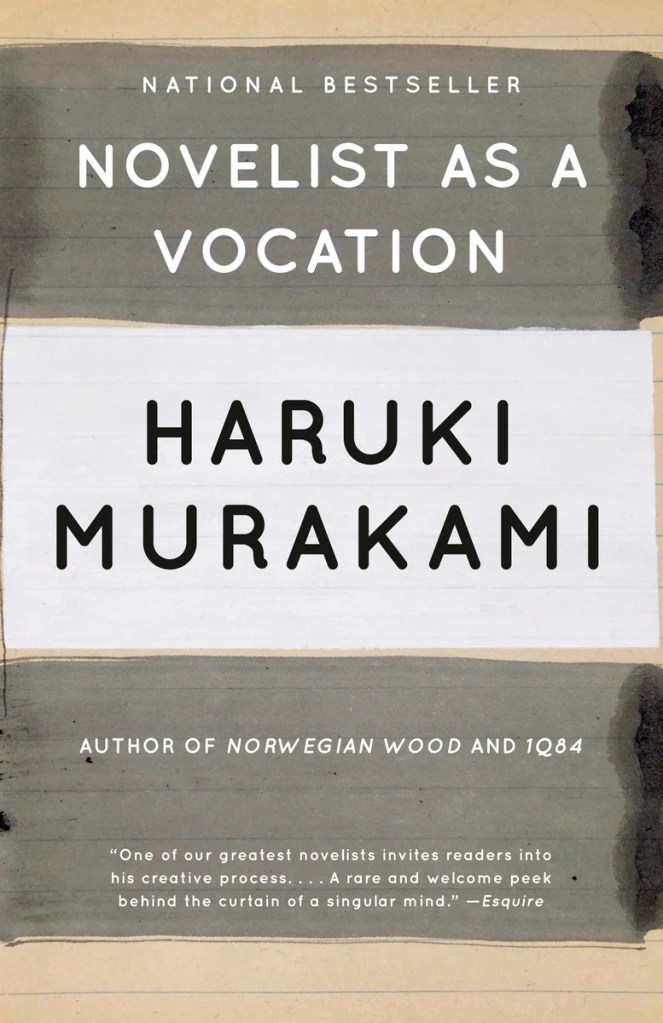
Haruki Murakami is a bestselling Japanese author whose novels have been translated into dozens of languages. He’s one of those literary writers who lives in the borderlands of literary magical realism and sci-fi/fantasy. My first introduction to his work was the monstrous tome 1Q84, which is almost 1200 pages.
Novelist as Vocation is a book about writing, but if you’re hoping for a technical manual or detailed tips on voice or pacing, this is not the book for you. The closest analogue I’ve read is Stephen King’s On Writing.
King’s book is half memoir, half writing advice. Murakami’s book also has a memoir component, but any writing advice is almost incidental. Murakami seems loathe to put himself on a pedestal with the implication that his advice might be valuable, but he does describe his writing process in some detail.
The book is split into a dozen chapters, each one standing alone and covering a different topic. Half of these chapters started life as essays Murakami wrote years ago and set aside, eventually being published as a serial feature in a Japanese literary magazine. The rest were written later to fill out the book.
For those who are fans of Murakami, the chapters “Are Novelists Broad-Minded” and “Going Abroad – A New Frontier” provide the most history of his career and insight into the man and his view of the world. For those seeking concrete advice, the chapters “So, What Should I Write About?” and “Making Time Your Ally: On Writing a Novel” give an overview of the author’s entire process leading up to, writing, and rewriting a novel.
If nothing else, Novelist as Vocation reinforces the common view of Murakami as a successful author who never quite fit into the literary establishment in Japan or internationally. He comes across as idiosyncratic and sometimes odd, having never been formally trained, and making a start at writing much later in life than many of his literary peers. Getting a glimpse of the man through these chapters, it seems almost obvious that this would be the person behind these unusual novels.
Murakami is self-deprecating and self-important in turns, on the one hand brushing off some critics’ poor reviews of his works and style, but then bringing it up so often that I can’t help but think it hurts him more than he would like to admit. He knocks his own writing as nothing special, but also repeatedly calls back to the prize he won for his first novel and his broad success since then. If nothing else, the fact that he wrote this book about his own life and writing has a certain egoism built into it.
Murakami also serves as a good reminder for any writer who is worried about not having an MFA, worried about starting later in life, or simply feeling like an outsider in the literary world: there are many definitions of and paths to success in writing, and we should not be discouraged or afraid to forge our own way.
At 138 words, this is not quite drabble-length, so it needs to hit hard and fast. It’s a story about the loss of someone loved, with the sci-fi element being their replacement by an artificial duplicate.
The opening is a metaphor unfurling: salt as grief. The end is a callback to the title. Great structural choices for micro-fiction.
The mix of italics and quotes is something I’ve done myself, but it’s dangerously ambiguous. Is the robot speaking non-verbally? Is it the protagonist’s internal voice of their lost loved one? Any lack of clarity can be catastrophic in a story so short.
The theme is imminently relatable; we’ve all experienced loss of a loved one, by death or lesser proxy. I don’t quite get that gut-punch emotional reaction I want from a short story, but that’s always the biggest challenge of micro-fiction, where you are fighting for every word.
It’s a common misconception that a great idea makes a great story. The truth is that most great stories come down to execution. A great idea with poor execution rarely works, but a great writer can breathe new life into even the most tired tropes.
Like any writer, I have my own treasure trove of ideas that might end up in a story…someday. But why horde them? Instead, I’m opening the vault and setting them free.
Use these ideas as a writing prompt, or come up with your own twist and reply in the comments.
The Corporate Cold War
When the history books were written, the story started with an exodus of intellectuals and policymakers from the United States and Britain. Their failure to effectively change the festering kleptocracies of their native lands only galvanized them to fight even harder for the more favorable battleground of the EU.
The opening salvo was the unexpected passage of laws that set hard limits on the size of corporations by employee count, profit, and revenue. Any company too large would have to split up. These limits would tighten over time, and any uncompliant company could do no business within the economic block.
The first front of the war was political, with multinational corporations spending billions to influence elections and run ad campaigns. They threatened to abandon Europe, an empty threat, knowing how much it would cost them. They claimed prices would skyrocket. But they underestimated the public vitriol against them.
When political wrangling failed make the problem go away, a legal arms race began. The corps found a hundred ways to split one company into many while maintaining total control and channeling profits to the same shareholders. Regulators updated the rules, and the corporations changed structure again. It took decades of closing loopholes to see the laws really go into effect.
Some of the corps followed through on their warnings, leaving the EU altogether and eating the loss. Others divested themselves of their European branches. But some of the biggest, loudest corporations gave in and broke up in a sudden cascade of shocking announcements. The continent celebrated.
However, the elite shareholder class had been busy consolidating their power in America, Britain, and parts of Asia. As their influence waned in the EU, elsewhere the lines between corporate and political power blurred and fell away.
This, the history books said, was what led to the worldwide split into two socioeconomic blocs: a new cold war. And if there was one thing the gleeful intellectuals of the EU underestimated, it was the amount of bloodshed the rich would embrace to keep their wealth and power. The rhetoric became increasingly violent, demanding that the “continent of socialists” accept “true capitalism” into their borders, no matter the cost.
Armies rallied along the borders. Fingers hovered over the controls that would launch fleets of missiles and drones. And the doomsday clock ticked forward: five seconds to midnight…









 Words Deferred