This is the monthly post where I talk about what I’ve been reading. As usual, if you’re interested in any of these books, please use the included Bookshop.org links instead of Amazon. It helps independent bookstores, and I get a small affiliate commission.
Having finished rereading all the books in the main Sandman series, I figured I would top it all off with the two stand-alone Sandman volumes. The first of these is Dream Hunters, which was published three years after the 1996 wrap of the main series.
Dream Hunters comes in the form factor of a graphic novel, but it is actually an illustrated short story in five parts. There are a variety of different layouts, including many full page illustrations and some two-page paintings and both horizontal and vertical splits. There is even a double-fold-out illustration, four pages wide. Amano’s inks, pencils and watercolors mingle to create a variety of effects, sometimes clear, other times murky or abstract.
The story is a retelling of a Japanese folk tale, “The Fox, the Monk, and the Mikado of All Night’s Dreaming.” A magical fox falls in love with a lonely monk who maintains a small and forgotten shrine. When a powerful sorcerer tries to kill the monk in his dreams, the fox intercepts those dreams to protect him.
This is one of those classic Sandman side-stories where Dream is involved, but only as a side character. It’s a good story with great art, but not really necessary to pick up unless you’re already in love with the series.
Unlike Dream Hunters, Endless Nights is a proper comic. This is an anthology of stories, each with a different illustrator, and each one focused on one of the seven Endless: Death, Dream, Desire, Delirium, Destruction, Despair, and Destiny. Again, these could be considered side-stories to the main series, but they feel closer to the main series in tone and style, and they do offer a few interesting tidbits for die-hard fans.
Some light is shed on Dream and his interactions with Desire, when they attend a gathering of sentient stars some few billion years ago. We see what might be the first of Dream’s many ill-fated romances, and the source of animosity between Dream and Desire. We also get to see what Destruction is up to in his exile, and hints that he may yet reach a kind of friendly ambivalence with his family, even if they never quite see eye-to-eye.
I really like Endless Nights. If The Wake was the epilogue to the main story, then this feels like a reunion.
I continue to work through the series with my kids. This third book feels like the inflection point to me, still largely plotted in a way to appeal to relatively young kids, but beginning to ramp up the darker themes.
At this point, it’s clear there is something of a formula that the books follow. Again, it leans on couple of mysteries to keep the plot moving. Again, there is a red herring that is pushed hard. Where this book differs is in the long third act, which wraps everything up with a fun time-travel sequence that has to interweave with a series of events that we already read from a different point of view.
While it’s popular to knock the Harry Potter books these days, especially for their plot holes, the time travel opens up a pretty egregious one. Sure, as in Back to the Future, a big deal is made over the “dangers” of seeing yourself while time traveling. But then main characters do it anyway, and it turns out perfectly fine. Unlike Back to the Future, the Harry Potter books barely mention time travel again, which is a little hard to swallow.
I didn’t intend to read House of Leaves again. I was talking with my son about the Backrooms, and how it seemed like it was inspired by House of Leaves. I went to grab my slightly beat-up paperback copy and discovered that it wasn’t on the shelf. Then I remembered I had loaned it to a friend, years ago. So I ordered myself a new copy.
When the book arrived, I popped it open, just to enjoy the sections where the text went all wonky. I went back to the beginning, to see how it started. Before I knew it, I was fully absorbed. It’s probably been over ten years since I last read it, and there was a lot I had forgotten.
House of Leaves is a strange book. At its heart is a horror premise: a house that somehow contains an infinite, shifting, maze-like series of rooms and corridors, where one might become lost forever. Wrapped around that core are multiple layers of frame stories and linguistic complexity.
I could go on about this book, but it’ll have to wait for another post. Suffice to say that it’s just as enjoyable as I remembered, and I highly recommend it to anyone interested in reading something genuinely weird.
What I’m Reading in November
With NaNoWriMo looming, I probably won’t be reading much. If I do get ahead and end up with some free time, I expect I’ll finally get back to The Witcher or delve into a new comics series.
As I mentioned last week, I’m hopping back onto the NaNoWriMo bandwagon this year. I’ve participated quite a few times, but for those who are participating for the first time, I thought I would give you some advice and resources for NaNoWriMo newcomers.
Nothing Really Matters Except for the Writing
Let’s get this out of the way up-front. All you need to do is write. Write 50,000 words of a single novel in the month of November, and you’ve won NaNoWriMo. And if you don’t want to do “traditional” NaNoWriMo, set yourself whatever goal you want.
NaNoWriMo is all about writing, so write in whatever way works for you. That said, most of my advice here assumes that you’re doing the standard event.
Set up Your Profile
NaNoWriMo started as a fun challenge among friends, and slowly expanded into the huge event it is now. Likewise, the NaNoWriMo website has evolved over the years to have quite a bit of functionality.
Once you’ve created a login, you have access to your personal profile and a few tools. None of this setup is really necessary to participate, but I find that it helps me to get excited about the event if I set up my profile.
First, under “My Nanowrimo,” you can create an “About me” section and select favorite books and authors. If you have friends doing NaNoWriMo, you can set them as your buddies. Under the “Groups” section, you can join your local writing group. There are groups for most decent-sized cities. If you’re in a rural area, there is probably a group that covers that part of your state. (If you’re not in the US…I’m not actually sure how good the international coverage is. You’ll have to search and find out.)
Create a Project
Under the “Projects” section of “My Nanowrimo,” you can enter some info about the book you plan to write. If you just signed up, the default settings will be for NaNoWriMo, but you can adjust the settings to whatever you want.
Picking a working title and an image to represent your project can be a fun non-writing way to get excited about your project. You can also look at the “Badges” section and award yourself personal achievement badges. There are badges to identify yourself as a planner, “pantser,” or something in-between, and a bunch of other badges for various little actions and achievements.
The badges under “Writing Badges” will be automatically awarded based on the word counts you upload to the site. If you enjoy earning badges, you should glance over these before November starts. To earn them all, you’ll need to write at least 1667 words per day in November, and you’ll need to update your stats on the website each day to earn credit toward badges.
Connect
There are forums under the “Community” section of the website, where you can chat with other participants and find like-minded writers. If you’re interested in meeting up and writing with people in real life, check out the section for your geographical region. People will often schedule events and get-togethers, although what’s available is going to depend a lot on the amount of participants in your area.
Offers
Since NaNoWriMo has become a big event, many companies that sell tools for writers will provide discounts or coupon codes for participants. You can check “Writer’s Resources -> Offers” to see what’s available.
These are typically not amazing deals, but if you’ve been thinking about buying a writing tool like Scrivener (a product I personally like a lot), you can get it a little cheaper by using these codes.
Preparation
While futzing around with your profile on the NaNoWriMo website can be a fun way to procrastinate, you’ll eventually want to get into the actual project. If you’re participating in the traditional NaNoWriMo, you can’t start actually writing until Halloween midnight, but that doesn’t mean you can’t do some preparation before November.
If you’re the sort of writer who likes to outline, this is the most obvious way to prepare. Knowing what you want to write will allow you to hit the ground running. Whether you’re a planner or not, you’ll probably want to think about your characters’ personalities, your settings, and at least a starting point for the plot. NaNoWriMo is mostly about writing a lot of words in a short amount of time, and you’ll have an easier time writing a lot of words if you don’t have to regularly stop and figure out where the story needs to go next.
The most important thing is to find the aspects of the story that excite you. Why do you want to write this story? The more excited you are to write, the less grueling the process will feel. Most writers will regularly encounter frustrating sections in their work, but that excitement is the fuel that can keep you pushing forward when you’d prefer to close the laptop or notebook.
Apart from story considerations, you may want to think about writing logistics. If you don’t already write on a regular basis, it can pay to think about where you’re going to set up shop for the month. Do you plan on writing at a desk at home? The local coffee shop? Will you write on a computer, tablet, or notebook? When will you have time to write each day? Do you need to make adjustments in your schedule during November to ensure you have the time set aside?
If you haven’t been writing on a regular basis, you may not have a good idea of how long it will take you to write 1667 words. If you have the time and inclination, one or two practice sessions might give you a better idea of what you’re capable of. For some people, writing 6-7 double-spaced pages is no big deal. For many of us, it’s hours of work.
You may want to give a heads-up to your family or the people you live with. The event is a lot easier if they are aware of the time commitment you’ve made. These people can also be your biggest cheerleaders, even if they aren’t participating. And if they are participating, then you can support each other.
Psyche Yourself Up
At the most basic level, the strategy for success in NaNoWriMo is simple: start strong, and try to not miss any days.
To start strong, many participants like to join a midnight write-in or local event on November 1st. Late-night diners are common venues, but you can always attend a virtual write-in at the place of your choosing. The more you can boost your word count in the first couple days of the event, the more wiggle-room you’ll have for days where you struggle.
If you have days where you know you won’t be able to write (Thanksgiving is a common one for writers in the USA), you may want to try to write extra beforehand, so you won’t fall behind.
Don’t Forget to Have Fun
NaNoWriMo is a challenge, but it’s meant to be a fun one. If you’re anything like me, it’s easy to fall into the trap of worrying about the goal and forgetting to enjoy the actual experience. Writing can be tough, but we do it because we get something out of it: self-expression, self-understanding, or the simple joy of bringing something new and unique into the world.
Are you participating in NaNoWriMo this year? What are you doing to prepare? Let me know in the comments.
Asteroid City is the latest movie by Wes Anderson, released this summer, but written and filmed during various stages of the COVID-19 pandemic. I’ve touched on Wes Anderson once or twice before. He’s a divisive figure who makes movies with a very particular aesthetic. Some people revere him, some can’t stand him.
Asteroid City is, in many ways, just another Anderson film, with many of his usual virtues and foibles. However, I can’t help but feel there was one way it diverged significantly from other Anderson movies, and it was not a positive change. The problem with Asteroid City is its ending.
What Works
Like so many Anderson movies, Asteroid City starts with a frame. The main story is supposed to be a famous play, while the frame is a documentary about the author and the creation of that play. The brunt of the movie follows the plot of the play, with small asides back to the documentary.
In a pastel pastiche of the 1950s, a young scientist convention brings a number of children and their families to the small desert town of Asteroid City. The festivities are interrupted by the brief arrival of a UFO, and the government puts the town under quarantine. However, the children work together to get news of the situation to the outside world, and this results in public pressure to drop the quarantine. The various people who have come together in this strange situation then leave the town and return to their separate lives.
There are a whole host of fairly obvious correlations to the pandemic quarantine in this plot, and the bonds and romances that develop among the characters in a stressful situation. These are all relatable themes; perhaps the most universally relatable themes available to a storyteller in 2023.
I was a little leery of Wes Anderson delving into science-fiction when I first saw trailers for this movie, but the actual sci-fi elements are quite slight, and mostly played for humor. This works well enough in the Andersonian medium, and there’s even a funny little call-back in the “documentary” portion of the movie, where it’s revealed that the alien in the stage play is a masked Jeff Goldblum, the only scene he appears in.
Where it All Falls Apart
As the plot of the convention and the short-lived quarantine wrap up, the movie shifts back to the documentary. In an acting class taught by Willem Dafoe and populated by most of the cast of the movie, there is a discussion about sleep and dreams. Then the group begins to chant, over and over…
“You can’t wake up if you don’t fall asleep.”
It is this chant that ends the “documentary.” When I talked with my wife afterward, this was also the exact point where she said that she gave up on the movie completely.
It’s Weird, So What?
I think it’s safe to say that the average moviegoer finds most Wes Anderson movies to be weird. These movies usually don’t see wide distribution, and they don’t make blockbuster money; they exist on the edge between Hollywood and low-budget art film. They’re not trying to be a realistic depiction of life, and they’re also not full of bombastic special effects like the typical Hollywood blockbuster.
In my opinion, Anderson movies occupy an interesting niche. They’re clearly on the hoity-toity, film festival end of the movie spectrum, but they’re usually plotted in a straightforward way. They’re open to interpretation, but they’re not inscrutable.
Grand Budapest Hotel is partly a love story, and partly about a man who inherits an expensive painting and earns the ire of a the deceased woman’s murderous family. Moonrise Kingdom is about a pair of kids who run away together in the face of an impending hurricane. Isle of Dogs is about a kid looking for his lost dog. The Anderson movies that appeal to wider audiences are the ones with a surface-level plot that is easily understandable. They contain quite a bit that you can appreciate in a single viewing, even if you’re not worried about the vagaries of cinematography or frame stories or aspect ratios.
These movies are still “weird.” They’re still arty and invite all sorts of deep reading. You just don’t need those things to have fun watching the movie. This is where Asteroid City fails its audience.
Most of Asteroid City follows the ethos of an interesting surface layer on top of deeper weirdness. The parts that take place within the play are straightforward, bright, and funny. The parts that take place in the frame story are less straightforward, but they have their share of jokes, and they take up much less screen time. It’s only at the end where this spirals out of control.
The chanting actors are not at all straightforward. Their mantra, “you can’t wake up if you don’t fall asleep,” has almost nothing to do with the movie on a surface level. It demands that the viewer try to make some non-obvious interpretation in order to square this ending with what they just watched. Anyone in the audience who merely wants to watch and enjoy a movie is immediately excluded.
Even worse, this phrase is chanted over and over and over. The viewer is bludgeoned with it. The movie literally shouts out the importance of this singular phrase. It shows a complete lack of trust in the audience, a fear that we might miss this vital thing if it wasn’t so explicitly spelled out.
You Choose Your Audience
If the movie had ended with the temporary residents of Asteroid City saying their goodbyes and driving away, it would have worked for a “surface-level” audience. It would have welcomed the average moviegoer along with the cinephiles. Instead, it ended with an event that demands interpretation and demeans the audience with a complete lack of subtlety.
And I know, at least anecdotally, that parts of the audience felt excluded. They decided this was not a movie for them.
I don’t know what Anderson was hoping to accomplish with this ending. He may very well have been happy to make something just for the ardent fans. But he made a choice that profoundly affected who can enjoy his movie. These are the kinds of choices we all make in our work, either purposely or by accident.
It’s also worth noting that you can cater to a variety of overlapping audiences. It’s not always a zero-sum game. You can provide an entertaining surface-level plot, with readable character motivations, and still embed deeper ideas, complex metaphors, or mysterious events that are never adequately explained. Nothing can appeal to everyone, but you can make choices that widen or narrow your audience.
There’s nothing wrong with choosing to write something that you know will have a limited audience. If that’s the story you want to tell, then tell it. But think about what you’re doing, and do it as purposely as you can. Make sure you’re not excluding the audience by accident.
The days are getting colder and the leaves are changing. It’s fall, and we all know what that means for writers: NaNoWriMo is coming.
If you’re not aware, NaNoWriMo is National Novel Writing Month, both an event and the organization that runs it. NaNoWriMo happens every year in November, and everyone is invited to try their hand at writing a 50,000-word novel in thirty days.
I’ve talked before about my mixed feelings toward NaNoWriMo. Years ago, I used to feel like missing a NaNoWriMo was a little bit of a shameful thing for an aspiring writer. These days, I’m juggling many writing projects (and the rest of my life), and I know that writing 1667 words per day isn’t always practical or even beneficial.
On the other hand, I haven’t participated in NaNoWriMo since 2019, and I spent over two years working on Razor Mountain, writing only 2-3 chapters per month. As November gets closer, I’ve been thinking that it might be fun to really jam on a different project and get a lot of words written in a short amount of time. I’m glad I spent the time and effort on Razor Mountain, but that’s a damn long time to be mostly working on one big thing. NaNoWriMo could be a nice palate cleanser.
The Prep
I’m a planner at heart, and I’ve found through brutal experience that if I want to succeed at NaNoWriMo and not burn myself out, I need to have a halfway decent outline ready before November. I want to be able to just write, without having to sit and work out plot points.
I don’t have any shortage of ideas for books, but some of them are much more fleshed out than others. I started Razor Mountain with an idea I had already thrown some words at, and I’m planning to do something similar with this year’s NaNoWriMo project. I don’t have a good title yet, so let’s just call it NaNo23.
I didn’t know NaNo23 was a novel at first, but then I went and wrote 10,000 words, and it wasn’t even close to being done. The upside is that I have a great beginning, with characters, setting and plot to extrapolate. The downside is that I’m not sure what exactly the middle or end will be. That’s what I’ll be working on in October.
Despite a good starting point and some time to plan, I expect to have much less of a detailed outline than I did with Razor Mountain. I’m actually looking forward to that. NaNoWriMo ought to be a little messy. I also don’t expect that I’ll actually finish the book in 50,000 words. That’s fine too. I’ll at least come out of November with a good chunk of something new.
The Project
My NaNo23 is an urban fantasy story in a Victorian England-esque setting. (I haven’t decided yet if this is actual England in some alternate history, or a fantasy homage.) The protagonist is Edward Argent, a man who has worked as both soldier and spy, and has seen a great many things he’d rather forget. He’s a little bit Sherlock and a little bit James Bond (or he would be if he wasn’t drugged up and miserable, haunted by his own past).
The magic of this world is very particular: anybody can do it, but it only works with physical objects. By using a particular object repeatedly, it becomes bonded to a person, and it gains power from use. A chef might use a magical spoon to enhance their cuisine. A soldier might imbue his sword with power. These objects are called “totems,” and a person can only have one. It takes time and effort to imbue a totem with power, and it’s a severe blow to anyone to have their totem broken.
There is another class of magic, however, and this is much more rare. Certain people find that they have the ability to create a totem that is not simply an object, but a living creature. These people are known as hexes, and they are so uncommon that the average person isn’t entirely sure they really exist. If they do exist, their power is far greater than ordinary people. They don’t just make a good soup or fence well. They do proper magic: fireballs and invisibility and even changing people’s thoughts. Hexes understand that their power comes from their animal, their familiar, and two minds focusing on the same magic are far more effective than one.
Then there is Edward. Edward is a special kind of hex. As far as he knows, he’s unique. When he wants to use an item as a totem or an animal as his familiar, he thinks about it and it happens. No great effort, no weeks and months of hard work. He can pick up new skills and new animals whenever he has need. He doesn’t advertise this ability. There are dangerous, powerful people who want to use hexes for their own ends. How much more dangerous would the world be for a hex with special abilities?
The Plan
One thing I learned while blogging through Razor Mountain was that some introspection really helps me stay focused and learn from my writing experience. I’d like to do that here, as well. Unfortunately, NaNoWriMo word goals tends to be a slog for me, and I’m not sure how much I’ll want to be blogging on top of those 1667 daily words.
I’ll probably post at least one more time as I do my October prep, and then a few times about the process throughout November.
If you’re thinking about doing NaNoWriMo this year, let me know in the comments. It’s always more fun to do with others.
This is the monthly post where I talk about what I’ve been reading. As usual, if you’re interested in any of these books, please use the included Bookshop.org links instead of Amazon. It helps independent bookstores, and I get a small affiliate commission.
This volume is a collection of stories within a Canterbury Tales-esque frame. A group of strangers from across the Sandman universe get caught in a storm and find shelter at The Worlds’ End, an inn that exists beyond ordinary space and time, and a play on words in a few different ways.
This is, in many respects, the beginning of the end: the final arc of The Sandman series. While this volume is similar to several others, with seemingly disconnected stories set in the same expansive world, it’s laying groundwork for the two volumes to follow.
The end of the book makes this apparent, as the storm quiets, and all the strange guests at the Worlds’ End see a huge procession in the sky. This is a funeral on a cosmic scale, and the dead man is Dream of the Endless.
Finally paying off the foreshadowing in Volume 7 and 8, The Kindly Ones is the largest volume in the series, and the climax of Dream’s story. The dangling plot threads come together, and it’s incredibly appropriate as Dream’s antagonists in this volume are none other than the Fates, who measure and cut the thread of each person’s life.
In the Sandman mythos, the Fates have many aspects, each represented by three women: young, middle-aged, and ancient. They are also called the Furies, embodiment of revenge against those who dare to spill the blood of family.
The Furies are called to action against Dream by Hypolyta Hall, the former super-hero from earlier volumes, who conceived her son within dreams and holds a grudge against Morpheus for “killing” her husband. She’s convinced that Dream has stolen her child. However, the real kidnappers are mere mythological tricksters. It’s Dream’s murder of his own son, Orpheus, that allows the Furies to work against him.
The surface conflict between Dream and the Furies becomes progressively more violent, and we see a number of fan-favorite characters caught in the cross-fire. The bigger question, however, is why this is allowed to happen. Within their specific sphere of influence, the furies have power to equal the Endless, but it seems that Dream is holding back.
Gaiman has shown that he knows how to wrap up a story, so I can only assume that this final ambiguity is on purpose. It’s up to the reader to decide why Dream doesn’t have his heart in the fight. Is he overwhelmed with the shame and guilt of what he did to his son? Is he an exhausted immortal who knows that there will always be another fight, another petty enemy knocking at his doorstep? Does he know himself too well; his obsession with responsibility forcing him into the fight when he could just as easily run away like his brother, Destruction?
In the end, Dream dies. This isn’t a spoiler so much as an inevitability. However, he doesn’t lose. He is prepared for even this eventuality, and a new aspect of Dream appears to take his place.
For my money, this is still probably the single finest volume in comics. Not only does it provide a satisfying conclusion to a great series, but it represents an inflection point in comics that opened the doors to so many great stories in subsequent years.
The Wake is a classic epilogue. The story of Dream (at least the Dream that we’ve followed for 9 volumes) is ended. This last volume sweeps the floors, pus the chairs on the tables, and turns off the lights.
It starts with the funeral that was hinted at in Worlds’ End, a once-in-a-billion-years send-off for one of the Endless. As is appropriate, this somber affair happens in dreams, and many of the side characters from throughout the series are in attendance, even if they don’t all entirely understand what’s happening.
The final few issues are a melancholy mix. We spend a day with Hob, the immortal (but otherwise ordinary) man who met with Dream once each century. His life goes on.
We meet a man exiled from ancient China, who finds himself in one of the “soft places” between waking and dream. He meets the old Dream and the aspect who replaced him. The man doesn’t run from his fate: he meets his exile with dignity.
Finally, we see Shakespeare, near the end of his life. He finishes the second and final play commissioned by the Lord of Dreams. This was the price he paid for the chance to tell stories that would live beyond his own lifetime.
The play is The Tempest, and Dream commissioned it because it is a play about endings. Though he didn’t realize it at the time, we see the possibility that the Lord of Stories wanted just one story about himself. He wanted an ending.
We’re left with the words of a Roman soldier, lost in the place between dreams and waking:
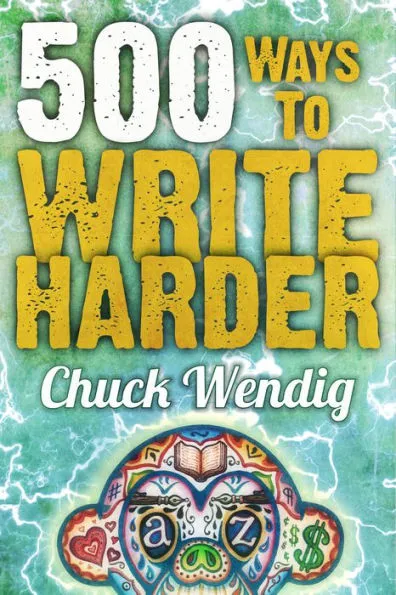
I snagged this book after reading Wendig’s Damn Fine Story. This is an older book, and only barely available as an e-book from one or two retailers.
There was probably a reason for that. On the upside, it only cost a couple bucks.
The book consists of a series of listicles, each on a particular writing topic: antagonists, novel prep, self-publishing, etc. Each has 25 items. It’s apparent that these lists were originally Twitter or blog fodder and were compiled unaltered—a few of them say as much.
I don’t begrudge Wendig for turning these posts into a saleable product, especially since this was published a decade ago, when Wendig was early in his career as a professional writer. The origins of the material show in the lack of cohesive through-line, something that made Damn Fine Story much more satisfying.
Considering the low price, this book isn’t a bad one to pick up, but I wouldn’t suggest reading it cover to cover. Instead, skim through the list of topics and use it as reference. If you’re revising a book (as I am), you might find the section on revision useful. Consult the topics when they’re relevant to you.
This second book establishes a lot of the elements that will repeat through most of the series. Harry spends his summer with his caricature-villain evil aunt, uncle and cousin, before being whisked back to wizard school where he can live happily (apart from wizard Hitler occasionally trying to kill him).
I realized as I was reading this installment that these early Harry Potter books follow a very straightforward formula. A mystery is established early on, and Harry and his friends latch on to a red herring. Clues appear at intervals, and they all seem to support the red herring thesis. In the finale, the truth is revealed, including an explanation for each clue and how it actually pointed toward the real answer.
The first book is all about the kids’ distrust of Snape and the mystery of the package hidden in the guarded corridor. But Snape turns out to merely be a jerk and not the jerk. The second book is all about finding the person opening the chamber of secrets, and the children are fooled into thinking it’s the only adult they actually like and trust. Nope, it’s the ghost of Wizard Hitler!
The moral of the books so far seems to be that adults are untrustworthy. Some are bumbling, some are outright malicious, and a few are well-meaning, but ineffective. Even Dumbledore, often invoked as the most powerful wizard in the world, doesn’t really…do anything useful, at least so far.
As an adult myself, this lesson is a little concerning, but I also know first-hand that adults really are often bumbling, malicious and ineffective. As a starting point for a middle-grade series, it makes a lot of sense. Kids aren’t going to get into interesting adventures if they go whining to the grown-ups whenever they have a life-threatening problem.
What I’m Reading in October
I finished The Sandman series…or did I? There are two more more spin-off volumes: Endless Nights and Dream Hunters. As long as I’m rereading, I might as well include those, right?
I’m also overdue on getting back to The Witcher, and I aim to remedy that with at least one book in October. I’ll be continuing through Harry Potter with my kids, so I expect to get through one or two more of those.
Finally, I’ve started ordering some of the trade paperbacks for comics on my huge list of “acclaimed non-superhero comics of the past 30 years I haven’t read yet.” I’ve been enjoying comics a lot lately, partly because a typical trade paperback is novella-length, and I can feel like I’m reading a lot more books.
I’m still working on revisions for my novel, Razor Mountain. As I read through the chapters, looking for possible improvements, I’m constantly on the lookout for repetition, repetition, repetition.
Is it bad to do the same things over and over? That depends. There’s a lot of rhythm and structure to writing, and repetition can be an important tool if you’re doing it on purpose. It can be an element of personal style or provide structure to a piece. Unfortunately, repetition is often accidental: something you naturally do without realizing, a literary crutch or a sign that you haven’t put enough thought into some aspect of the work.
This is one of those cases where reader feedback is extremely useful. It’s hard to see these problems without an outsider’s perspective, because they naturally live in our blind-spots. When a reader notices repetition, you should scrutinize it.
Shortcuts
Writing fiction is an incredible challenge, because there simply aren’t enough words to fully describe a complete character, setting, or event. All writing is inevitably cutting out information; choosing what is important and what is not. It’s not surprising that writers take shortcuts. We’re constantly looking for things like a phrase that implies a character’s entire thought process, or a description of a smell that transports the reader to a location in the story.
There are also gaps in our thinking. No writer can think through every single detail of a story. There are always shadowy areas of uncertainty lurking around the edges. Even in the areas that we do put thought into, there can be dangers.
The human mind is a little bit like a hive of bees. Sometimes all those buzzing little thoughts work in concert toward a common goal, and sometimes the subconscious goes and causes problems while the conscious mind is not paying attention. We see this every day when people over-use favorite words or insert their verbal tics without even realizing it.
The Process of Noticing
The easiest way to find these troublesome repetitions is by outsourcing the job to others! Readers who aren’t familiar with your story will have a much easier time taking it at face value. After all, you have the best version of the story in your head, and that version will get mixed up with the words on the page, no matter how much you try to keep them separate. Readers have to suss out that story from mere words on the page.
There are also ways of getting more outside your own head. Reading the story out loud is a classic trick for changing your mode of thinking and catching problems that you wouldn’t otherwise catch. Reading out-of-order, a paragraph or sentence at a time, is another trick for assessing the words without getting lost in the flow of the story.
Danger Words
I’ve already mentioned in previousposts that I’m making a list of individual words and phrases that show up too frequently in my own work. For me, many of these words are “softening” or “weakening” verbs and adverbs; words like seemed, mostly, some, early, almost.
Interestingly, you might be able to discover something about yourself and your process by catching these issues. I suspect that I use these kinds of words reflexively, as a way to avoid fully committing to a description or idea. If I’m not entirely happy with the way I’ve described something, I use these words as a way to distance myself from my own description. Of course, that reflex doesn’t make the writing better, it makes it worse.
Luckily, as I notice these words, I can now reassess the description. If I think it’s actually good, I can remove the wishy-washy language and fully commit to my original intention. If I think it’s bad, I can change it.
Another common repetition I’ve found are vague adjectives, like little or flat. These words can add some value, because they refine the reader’s mental image of an object or idea. A little door is certainly more specific than a door, and a flat boulder is more specific than a boulder. The problem is that neither of these descriptions are very specific (how little is a little door), and they’re not as evocative as other adjectives or phrases I could use.
Opinions differ, but I’ve always felt a complete ban on adjectives to be stupid and reductive. They can be useful, but they also bloat a story. They are often “unnecessary” in the sense that they could be removed without breaking the meaning of a sentence, but they add nuance and impact the feel of the story, and that can have value. I personally think that judicious use of interesting adjectives can be the frosting that makes the cake. Depending on how you write, they might even be the cake.
Bigger Problems
Not all issues of repetition exist on the level of individual words or small phrases. Bigger issues can arise on the level of paragraphs, and even chapters. These are often more difficult to identify, because they can’t be confirmed with a simple word processor “find” function, like repeated words.
The simplest kind of repetitive sentences use an identical structure over and over. This often arises in long stretches of dialogue or action:
He said, “No.”
She said, “I think you’re wrong.”
He said, “I don’t care.”
She said, “I don’t, either.”
He swung his right fist. She dodged it. He swung his knee up. She brought her hand down to block it. He jabbed with his left hand. It struck her right cheek.
These are contrived examples, but they show the kind of painful writing that comes from overly-repetitive sentence structure. These are all short sentences, but even long and complex sentence structures can feel repetitive.
Sentences have a rhythm. It can help to visualize more complicated sentences by focusing on their punctuation and conjunctions, because these are the connective tissue that combine individual phrases and clauses into a complete sentence. A series of sentences with a single conjunction (“This and that,” “That but this,” “This or that”) can also create a dull rhythm.
Even consistently long or short paragraphs can be a rhythm that readers notice, sometimes subconsciously. Lengthening or shortening sentences and paragraphs can be a useful tool for speeding up or slowing down the pacing, but when similar lengths are used consistently, regardless of the intended pacing, it can throw off the feel of a scene.
How Often is Too Often?
It’s a unreasonable and counter-productive to suggest that we should completely remove repetition from our writing. After all, it’s a useful tool for style and structure in a wide variety of contexts. I suspect there are no rules of thumb about the “correct” amount of repetition that couldn’t be taken down with a counter-example.
So, as is usual with writing, the answer to the question is, “It depends.” (Yes, I’m aware that I’m repeating the first part of this post.) There are two criteria worth thinking about: when to take a closer look, and when to make a change. It’s easy to make rules of thumb for finding potential issues, but it always pays to look at the specific context when it comes to making changes.
When I’m looking at repeated words in my own chapters, my personal warning alarms go off when I find three or more examples in a single chapter, or examples in almost every chapter. However, just because I find four instances of “nearly” in a chapter doesn’t mean I’m going to change or delete them. To decide that, I look at the specific sentence and paragraph surrounding each one. If I can think of an equally good or better word to use, I’ll change it. If I find that the word isn’t pulling its weight, I might remove it entirely. Sometimes, it’s the perfect word, and I leave it alone.
The Power of Repetition
Repetition can weaken or strengthen your writing. Repetition makes writing weaker when it’s accidental, filling in details that the writer hasn’t thought through, or revealing subconscious processes that the writer hasn’t even noticed. Repetition makes writing stronger when it’s purposeful, to achieve a stylistic effect or provide a particular rhythm or structure.
That’s why repetition is a great target for revisions. Changes can simultaneously shore up weaknesses and create new strength.
This is part of an ongoing series where I’m documenting the development of my serial novel, Razor Mountain.
You can find my spoiler-free journals for each chapter, my spoiler-heavy pre-production journals, and the book itself over at the Razor Mountain landing page.
The book is complete, but there’s still one more thing to do: revise and edit! This final set of journals will follow the editing process.
Slow Going
When this post goes up, Razor Mountain will have been “in revision” for over a month. Unfortunately, I don’t have a whole lot to show for it. I’ve worked through the first few chapters, made some changes, and made notes for later.
In the past, I would probably have chalked that up to laziness and lack of a proper writerly work ethic. More recently, I’ve come to the understanding that if I’m spending a lot of time thinking about the writing, but not actually getting much done, it’s because I have some sort of mental block, and I need to work it out to move forward.
I suspect the problem here was a lack of accountability, or at least the lack of an audience. When I was writing chapters and posting them, there were reasons to keep up a steady pace. If I was slow with a chapter, my wife would often ask when the next one was coming. I would notice the longer-than-usual gap in my blog schedule. I had some feeling that the work was for someone.
Now that I’m revising, that dynamic has changed. I’m not reposting updated chapters, because it seems like a huge mess to track, and because they’re likely to get updated again in subsequent passes.
Luckily, since I came to this realization, I’ve gotten some new reasons to stay motivated and productive.
Progress
Let’s start with what I did get done. I spent some time reworking Chapter 2. This is the chapter that introduces God-Speaker. He has a very bad day when his mentor is unexpectedly killed by a stranger. This stranger is barely a character, and really has no clear explanation or bearing on the rest of the story. He’s just there to jump-start the plot.
No only is this not great storytelling, but it doesn’t really fit with what we know about paleolithic humans, which is that they generally worked together. War and infighting aren’t so much of a thing when everyone has to spend most of their energy just trying to survive for another season.
So, I did the obvious thing. I removed the stranger from the story, and I replaced him with a giant bear: Arctodus simus. The bear still serves the same purpose in the story, it just makes more sense and hopefully doesn’t leave the reader saying “why the heck did that happen?”
Chapter Zero?
There’s an issue that I’ve noticed in both God-Speaker and Christopher’s plot. In both cases, I wanted to start with some action and an inciting incident to drive the story forward. However, the reader hasn’t had enough time to form any attachment to either of these characters. There can only be so much tension when the reader doesn’t really care about the POV character.
One solution I’ve considered is adding earlier chapters to better show the lives of these characters before they’re knocked off-course by a cruel and uncaring universe. The challenge would be to create a new beginning to the book, still pulling the reader into the story without the benefit of all the big events that will happen in the current chapters 1 and 2.
I don’t know what I would put in those chapters yet, but I’m keeping it in mind as I work through the rest of the book.
Critiques
I got a lot of good feedback from Critters for Chapter 1, and after I was done with my bear business in Chapter 2, I submitted that as well. It takes a while to work through the queue, but the feedback came in this past week.
Additionally, I got a bite on my “request for dedicated readers,” which means I’ll have someone who can go through the whole book and provide feedback. This is much more appealing to me than slowly sending it through the standard process chapter-by-chapter, with no guarantee that anyone will follow the whole thing from beginning to end.
Along with that Critters volunteer, I’ve enlisted a handful of friends and family to serve as readers too.
Lighting a Fire
That’s all for now. Having more readers lined up lit a fire under me to do a quick read-through of the whole book and look for any high-level changes I want to make before getting that feedback. I expect that to keep me busy for the next week or two. After that, I’m sure I’ll have my hands full processing the feedback.
This August was the three-year anniversary of Words Deferred. Around that same time I also hit 10,000 views.
Is that a good amount? Who knows. It’s certainly ramped up since that first year, when I was more-or-less shouting into the void.
It’s hard to believe it has already been that long. But then, the flow of time broke sometime in 2020, so now everything gets lost in the temporal vortex.
Anyway, thanks for hanging out and talking about writing with me!
This is the monthly post where I talk about what I’ve been reading. As usual, if you’re interested in any of these books, please use the included Bookshop.org links instead of Amazon. It helps independent bookstores, and I get a small affiliate commission.
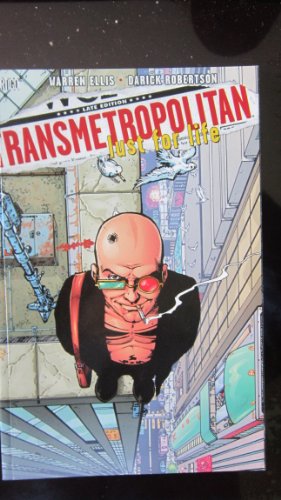
Written By Warren Ellis, Illustrated by Derick Robertson
Transmetropolitan has been on my radar for some time, even though I knew almost nothing about it. It was lodged in my brain alongside a bunch of other 90s-2000s non-superhero comics. I’ve recently discovered just how cheaply you can snag slightly beat-up trade paperbacks of old series at places like ThriftBooks, so I went ahead and purchased the first two volumes of the series just to see if I had any interest.
My feeling coming away from the first volume is that Transmetropolitan is weird for the sake of weird, and that particular brand of “edgy” that was popular in this era, but a little silly in retrospect. It is a depiction of the kind of cultural and technological singularity where almost everything is possible and is probably happening just down the street, but the absolutely schizophrenic nature of that kind of chaos doesn’t really jive with telling a deep or particularly coherent story.
The book begins with former journalist Spider Jerusalem living like a wild-man in a mountain-top cabin surrounded by booby-traps. He is naked, heavily tattooed, and clearly hasn’t gotten a shave or a haircut in a few years. We learn that he was the most famous journalist in a nearby city (simply known as The City), and he gave it all up to move out here. Unfortunately, he signed a contract for a book deal, overdue by five years, and now his publisher is threatening to take the money back. So off he goes, back to The City.
Spider breaks into the offices of his old newsfeed, secures a job and an apartment, removes all his hair with a chemical shower, and gets his trademark glasses out of the totally-not-a-Star-Trek-replicator in his kitchen. Then he turns on the news. There are cryogenic defrostees, people uploaded into nanite clouds, and humans surgically turning themselves into aliens and trying to succeed from The City and create their own colony. As it turns out, these will all be plots for subsequent issues.
The first volume didn’t wow me as an introduction. The chaos of The City struck me as an excuse to just throw any sort of futuristic spaghetti at the wall and see what sticks. The characters all range from unpleasant to outright awful, and I have a hard time taking it seriously when the city is called The City and the protagonist has a name like Spider Jerusalem. But hey, it’s the first volume, and a lot of series don’t find their feet right away, so I started in on the next one…
Transmetropolitan (vol. 2)
Written By Warren Ellis, Illustrated by Derick Robertson
I realized partway through this volume that the post-facts world of Transmetropolitan probably seemed more science-fictiony around the year 2000. Nowadays, it’s hardly any different than world outside my window. This certainly isn’t the first piece of sci-fi to satirize politics and religion, only to find that the future went and outdid them. Being subversive and edgy is not a good way to last—yesterday’s shocks are boring to tomorrow’s audience.
I also came to the conclusion that a lot of what rubs me the wrong way about the series is that it’s packed with big, obnoxious allegory. It’s constantly winking and nudging you.
Transmetropolitan doesn’t have an ongoing arc in these first couple volumes. It’s just a series of unrelated stories. This time, we get one about Spider’s assistant’s boyfriend, who decides to download himself into a cloud of nanites. After that, it’s a cryogenically frozen woman who wakes up and discovers that the future is impossible to acclimate to, and that nobody much cares to try and help her. Then there’s Spider’s tour of the “reservations,” hermetically sealed places throughout The City that are built to preserve different cultures and ways of life. Each of these works pretty well as a stand-alone short story, but it didn’t feel like it was building to anything bigger.
Ultimately, I found that Spider Jerusalem was one of the least interesting characters in his own book. It’s possible that some of these disparate threads will eventually weave back together into a larger story, but I wasn’t feeling it after two volumes. I don’t think I’ll be continuing this series.
This is the second Witcher book that’s billed as a short story collection. And it is, but they end up feeling like more than the sum of their parts. There are bigger arcs happening across these stories, continuing the events from the first book.
In addition to the titular Witcher, Dandelion the bard and the sorceress Yennifer are the other main characters. If there is an overall theme across the book, it’s the angst between Geralt and Yennefer, who are both outcasts and troublemakers in their own ways. They each think they can’t make the other person happy, while also being unable to permanently break things off.
There is also a great deal more world-building happening here, including the first mentions of the Wild Hunt, a mysterious recurring event where ghostly warriors cross the sky and portend disaster and war. These stories are still “low to the ground,” but they incorporate a bit more about the nations and politics of the northern kingdoms.
Of course, it wouldn’t be the Witcher without stories about the interactions between humans and magical creatures, whether that be a shapeshifter stealing friends’ identities or a pompous town mayor in love with a mermaid. It also sets up the series of books to follow, as Geralt meets Ciri, the kid princess whose destiny he inadvertently entwined with his own.
Written By Neil Gaiman, Illustrated by P. Craig Russell
Much like Volume 3, Dream Country, this is a set of mostly stand-alone tales where Dream takes on a minor role. There’s a story about Emperor Norton, the real person who declared himself Emperor of the United States of America, a fable about a clan of eastern European werewolves, a tale of young Marco Polo getting lost (and eventually found) in the desert, and story of a spectacular Baghdad, greater than we ever knew it because it was traded into dreams so it might stay perfect forever.
Unlike Dream Country, there are a few things of note that tie back into the broader ongoing plot. For the first time in the series, we actually see “the prodigal,” Destruction, the one member of the Endless who has abdicated his position. We witness a retelling of the ancient Greek tragedy of Orpheus, who is an oracle, and Dream’s son. We see why Orpheus lives eternally as a severed head, and the cause of the rift between him and his father.
These events lead directly into Volume 7, and it really feels like the meandering main story is picking up steam.
The Sandman: Brief Lives (Vol. 7)
Written by Neil Gaiman, Illustrated by Jill Thompson
The issues of this arc are labeled as “chapters,” and this is probably the most linear and focused volume since the first. The beginning pulls together several threads from earlier stories, and the end implies a whole lot of bad things are in store for Dream.
Each chapter begins with a sequence of cryptic phrases, like this for chapter one:
Blossom for a lady
Want/not want
The view from the backs of mirrors
Not her sister
Rain in the doorway
The number you have dialed…
They turn out to be little landmarks in the story, a game where the reader can try to guess what might happen from these tidbits, and then check items off the list as they come to pass. It got me thinking how excellent the whole series is at these little things. From the surreal Dave McKean covers and interstitial art to the introductory quotes to the entertainingly themed credits, the Sandman books feel like absolutely every single element was labored over more than was really reasonable. All the little things add up.
The story of this volume centers around the duo of Dream and his youngest sister, Delirium (who used to be Delight). Delirium’s personality is somewhere between a young child and a lunatic, and you get the feeling that the rest of the oh-so-serious Endless family is perpetually humoring her. She decides to go looking for Destruction, the brother that abandoned the rest of the Endless and made it clear that he doesn’t want to be found. Delirium asks her siblings to help her, but one by one they brush her off. When she comes to Dream, the most serious of them all, it’s a surprise that he agrees to go with her. So the pair set off to find Destruction.
Eventually, we learn that Dream had ulterior motives, and never really expected to find Destruction. But he takes his responsibilities seriously, and since he promised to help Delirium, he turns to the one person who has the power to find the Endless, even when they do not want to be found: his own son, Orpheus. For this favor, Orpheus (a severed head who cannot die) asks his father to end his suffering.
The book ends with foreboding. They find Destruction, only to have him leave again. Morpheus returns to his realm, everything neatly wrapped up, and then reveals his chalk-white hands stained with his son’s blood. It’s made clear that there are consequences for the Endless when they spill family blood. The only question is what those consequences will be…
Sometimes I look at the Hitchhikers’ Guide omnibus on my shelf and I think sadly about how I’ll never be able to read another Douglas Adams story for the first time. But if there’s anyone who can compare to Adams, it has to be Terry Pratchett. I’m grateful that unlike Adams, he wrote so prolifically.
There are 41 books in the Discworld series, and I’ve been slowly going through them, picking up new ones at Half Price Books whenever I see them. I’m savoring them, because I know eventually I’ll run out.
Small Gods is about an accidental prophet named Brutha, in the desert land of Omnia, where the people worship the god Om. Omnia is a strict theocracy where the church is the central pillar of life, and it’s not uncommon for supposed sinners to have the badness tortured out of them. Faith is of the utmost importance in Omnia, so it’s especially awkward when Brutha discovers that Om is trapped in the form of a turtle with hardly any godlike powers at all, and this is because nobody besides Brutha actually believes in him anymore.
Brutha goes on a hero’s journey, and despite his best efforts he manages to overthrow the Omnian order, restore (real) belief in Om, and generally start making the country a place where people can live their lives without worrying about being randomly tortured.
Small Gods isn’t my favorite Discworld book, but it’s a parody with plenty of laughs and a few sideways glances toward our world. As usual, an average book by Terry Pratchett is quite good by anyone else’s standards.
One of the joys of being a parent is getting to share things you enjoy with your kids. One of the strange things about being a parent of several children (with a few years in-between) is that I’ve shared a bunch of those things with my eldest kids, and my youngest knows nothing about them. So, although I read the Harry Potter books to my eldest son—and my daughter was sometimes in the general vicinity of the reading—I was told that we should read them again. And now we are.
I’ll say here that I don’t agree with Rowling and the garbage she is now known for spewing on social media. I also think it’s fashionable to criticize books by authors who are deemed terrible people. Despite Rowling acting out, I think the Harry Potter books are perfectly enjoyable.
A lot of the complaints about this series are about all the unbelievable aspects of the world-building. There are a lot of problems with the Wizarding World and its interactions with the regular world that just aren’t addressed. And that’s completely true. But I also think it doesn’t really matter.
The odd thing about this series is that it grew up along with its readership. The first book is very much a children’s story, in its form and in the language it uses. It’s not worried about perfectly consistent world-building, any more than Little Red Riding Hood or Goldilocks is, because the shape of the story still works. Part of that is because it borrows from fairy tales, starting with the classic evil step parents (or in this case, aunt and uncle), and the orphan boy who is destined to save the world.
So shockingly, my takeaway is that a super-bestselling book that started a huge pop-culture craze and made more money than some small countries does, in fact, do a lot of things well.
What I’m Reading in September
I’ll continue working my way through the Sandman and Witcher series. I might go for a couple brand-new books about writing that I just got. I also recently compiled a list of highly-rated comics from the last 20 years, and I might start working through some of those.
In my last post, I talked about revising my novel, Razor Mountain, and I mentioned that I was using Critters.org to get some feedback on the early chapters. I was sure that I had talked about Critters previously, in my “reference desk” series about useful tools for writers, but when I went back and looked through old posts, I was shocked to discover that there was no such post. Today, I’m going to remedy that.
Online Critique
I’ve written on a couple occasions about getting reader feedback and why it’s valuable. I think most writers will naturally understand the value of beta readers, editors, and improving writing through several drafts. Revisions without feedback are needlessly hobbled.
However, there’s more than one way to get feedback. An online critique group like Critters has some disadvantages: you won’t necessarily know everyone, and you aren’t engaging with readers face-to-face. You also don’t get to pick your readers, so the feedback may not be quite as tailored as a traditional writing group.
So why use an online critique group? Well, there are some advantages too. Online critique can be asynchronous, making it easier to avoid scheduling issues, and lower-pressure. Feedback is written out, which gives you a useful artifact that you can save and consult as needed during revisions. Since the group is less formal and doesn’t meet in the real world, people can come in and out according to their personal situations. In short, an online group like Critters is less formal than many in-person groups, which can be a good or bad thing.
Critters.org
Critters.org (and its pseudonym Critique.org) is an online writing workshop that has been around since 1995, with over 300,000 critiques in that time. The main, original workshop group is focused on speculative fiction: Science Fiction, Fantasy, and Horror. Since its inception, it has expanded to 17 different workshops covering most genres of fiction, mainstream and literary fiction, and other media such as comics, film, music, photography and more.
Critters is free to use, and always has been, surviving on goodwill donations. It is not exactly a svelte, modern, or flashy website. It still looks and functions a bit like a website from the 1990s—mostly text and links and a big top menu with dozens of pages. It is still maintained by the original founder, Andrew Burt, and a host of minion programs he has created. As a programmer, I feel right at home. For non-programmer writers, I imagine it’s a little bit off-putting.
The mechanics of critique are simple. Members can submit a manuscript via webpage or email by filling out some information and attaching their work. These pieces go into a queue, and each week a dozen or so are “released” to the group. Members then submit their critiques via webpage or email, and those critiques are forwarded to the authors.
To ensure that everyone gets good feedback, critiques must fulfill a minimum length (a paltry 200 words), and any member who wants their work sent out in the queue must submit a critique 75% of the time, or 3 out of every 4 weeks.
Cultivating Culture
A distributed group like this lives or dies by its culture. Plenty of message boards and chat rooms have fallen by the wayside because they didn’t moderate effectively, and became cesspools of hate speech and trolling. Critters has survived so long and continues to be successful because it has developed a culture of respectful and honest feedback.
When signing up for the group, new members are directed to several articles on the site about diplomatic language and effective critique. Authors are also warned that honest feedback can be hard to hear, and that some critiques are well-intentioned, but a little more blunt than you might like.
Members submitting critiques are also required to check a box stating that they have been diplomatic, which is obviously not hard for the malicious to overcome, but serves as a good reminder for those who are acting in good faith.
Of course, like any effective moderation policy, there are ways to escalate bigger issues. I’m sure there have been trolls in the past, but I suspect that Critters has the advantage of being a bit of a dusty niche of the internet, where troublemakers aren’t common and most people are putting forth some effort in order to improve their skills and their work.
My experience has been extremely positive. I have never had any outright problematic critiques, and I could count the number of overly-blunt or tone-deaf critiques on one hand. (Honestly, an occasional rough critique is probably good practice for being in this industry.)
Details
There are a few interesting little details about Critters that aren’t necessarily apparent unless you read through all the documentation up-front.
Partial Credits
Normally, an author submits a story and anyone who provides a critique of the minimum (200 word) length gets credit for participation that week, counting toward the 75% rule. However, if the story is short—under 2000 words—then any critiques will only count for half-credit. This is to encourage readers to critique longer stories, and not just focus on these quick reads. A half-credit does not count toward the 75% ratio until you’ve done two of them.
Critique Counts
It’s possible to see the current number of critiques submitted for each manuscript in the current week. These counts are updated in almost real time. Critters’ weeks run from Wednesday to Wednesday, and a lot of critiques come in over the weekend, so I like to look at the counts before I pick a story for critique. Sometimes one or two manuscripts will have very low counts, so I like to help those folks out. If someone already has 15 critiques, what are the odds that I’m going to be repeating things someone else has already pointed out?
In general, novel chapters get fewer critiques than complete stories, and longer stories get fewer critiques than shorter ones. So, you’re likely to get the most out of Critters if you write a lot of flash fiction, and considerably less if you write novels with long chapters.
RFDRs
RFDRs, or “Requests for Dedicated Readers” are submissions for novels, where the author is requesting volunteers to read the entire book and provide feedback. RFDRs often include chapters of the book, and anyone can still submit a critique for the submitted portion without signing up to read the whole book.
If a reader accepts an RFDR, they contact the author outside of Critters, typically by email, and coordinate the process. Because reading a whole novel is a big ask, completing an RFDR is worth one credit for every 5000 words of the book. So an 80,000-word novel, fully critiqued, would be worth 16 individual critiques! However, if the RFDR agreement is for the whole book, then the reader has to complete the whole thing to get credit. If they give up partway through, it’s up to the author whether they’ll still give credit for the work that was done.
My limited experience is that there are a lot of novels on Critters (about half of all submissions), and not very many people interested in RFDRs. This limits how much an author can get out of critique for a novel, since it takes a long time to send an entire novel through the queue, one or two chapters at a time, and not all readers will have read previous chapters to understand the full context.
Resets
The 75% participation ratio can be daunting, especially if you’re not used to critiquing. It’s easy to miss a couple weeks and fall behind.
I have been a member of Critters for years, but not continuously. I’ve taken months or years off, which will decimate the participation ratio. Luckily, this is a common issue. If you need to take time away, or you fall hopelessly behind, you can submit a request to have your participation ratio reset. You then only need to start submitting a critique each week to be back in good standing and have your work go out in the queue.
Giving and Receiving
Finally, I’ll reiterate something I mentioned on Twitter recently. It’s extremely useful to get feedback on a work in progress, but it’s equally valuable to critique the work of other authors. It’s practice for editing your own work with an unbiased eye. I have discovered problems in my own writing that were only apparent after I wrote critiques of other people’s stories. Sometimes it’s just easier to see an issue in someone else’s work than in your own.
Try It!
If you have a hard time getting a writing group together in the real world, or you simply prefer a less social, asynchronous, or easier-to-schedule option, Critters is a fantastic alternative. I’ve been using it for years, and there are plenty of professional and published authors who are members.
If you’re on the fence, I’d encourage you to give it a try. It’s as simple as submitting a story and doing a few critiques. You’ll likely get feedback from 5-20 people, and you can evaluate the quality for yourself.













 Words Deferred