Blog

Year of Short Stories —Week #4

2024 is my year of short stories. In this weekly series, I talk about the stories I’m working on, from idea and draft to submission.

  • Stories in Progress – 1
  • Submissions This Week – 1
  • Submissions Currently Out – 2
  • Rejections – 1

The First Rejection of the Year

“Tom, Dick, and Derek” garnered my first rejection of the year. This was a turnaround of only a few days, but it’s not too surprising since it’s a drabble and the magazine was only accepting flash fiction. I’m still not entirely sure of the viability of 100-word stories, but I’ll continue submitting to flash fiction publications and see how it goes.

Revisions for Pleasant Hills

This week, I re-read all the feedback I had received for “The Incident at Pleasant Hills” and condensed it into a page of bullet points of things to address, and several more pages of small line edits and suggestions for wording improvements. Most of these are straightforward fixes. A few are things that the story needs, and I just need to figure out where to put them. But there are a couple problems that I don’t have a solution for yet.

One of the things I need to improve about my writing process is handling revisions. I was hoping to be done or close to done with this story last week, but now that I’m in the middle of it, I’ll be happy if I can get it all done in the next week. I’m quickly realizing that writing short stories is a juggling act between keeping finished stories out on submission, and writing and editing new stories.

Themed Submissions

I mentioned last time that I was thinking about trying some themed submissions.

This week, I trolled the Duotrope listings, looking for themed submissions in speculative fiction genres that pay pro and semi-pro rates. I started with the basic search, and was annoyed to find no good search options to filter down to these. So I searched the listings and read the submissions pages. It was only after I had gone through twenty or thirty publications that I discovered Duotrope’s entirely separate page, the Theme and Deadline Calendar, which is designed for exactly this.

Having gone on my own search before discovering these listings, I know it’s not showing everything that’s out there. For example, Apex Magazine’s monthly flash fiction contest doesn’t show up. This probably comes down to how the listings are categorized.

If you’ve got the time and the inclination to write for these themed submissions, it might be worth doing your own research to track them down. However, the Duotrope listing is pretty good, and won’t suck up a whole afternoon.

With a few options in hand, I spent time brainstorming for the Parsec short story contest’s “AI Mythology” theme. I filled a couple pages with Story Engine ideas, but nothing that particularly excited me. I find Story Engine useful because it creates interesting constraints, but in this case, where the theme is already a significant constraint, I think it might be too much.

I plan to come back to these themed submissions every week or two and try other methods of brainstorming. It’s a good exercise to stay productive when I don’t feel like working on the stories in progress.

Fun Find – Plotopolis

Plotopolis is a new site for interactive fiction. It’s launching this winter, but open for submissions and proposals now. If you’re not familiar with interactive fiction, I wrote a post about it. It can be as simple as Choose Your Own Adventure-style branching narrative, or as complex and gamified as Fallen London, with character attributes and an inventory of items.

Interactive fiction has gained some acceptance as gaming in general has entered the cultural mainstream, but it remains a fairly small niche, so it’s nice to see something like this popping up. Hopefully they find their feet and are able to stick around.

Goals for Next Week

Only one goal this week: revise Pleasant Hills! I want to get this one done and out for submission.

The Read Report — January 2024

It’s a new year. I’m working on the pile of books and comics I got for Christmas, and mostly ignoring the books I had planned to read. Someday I’ll get back to The Witcher. Someday.

If any of these sound interesting, please use my bookshop affiliate links instead of Amazon. I’ll get a small commission, and you’ll support real book stores instead of phallic rockets for billionaires.

Signal to Noise

By Neil Gaiman and Dave McKean

I thought I had read nearly all of the Gaiman/McKean comics collaborations, but this one somehow slipped under my radar. Published in 1989, Signal to Noise is almost a prototype of their future work. It’s a little less subtle with its themes than later works, but it still shows that expertise at crafting a story that can be observed from a dozen different angles to reveal some new through-line or idea.

The “noise” cutting through the signal of the story is nonsensical text, hinting at meaning without ever finding it. At the end of the book, it’s explained that this text was produced by a text sampler program, a 1989 prototype of the LLMs that have recently become so prevalent.

McKean’s illustrations are a fever-dream. The filmmaker inhabits a foggy ghost world. The movie in his head is unfocused and clogged with snow. Pops of color cut through: the yellow of a wheel clamp on an illegally-parked car, a red traffic light, a rare splash of green from a potted plant. The story is drowning in monochrome blue-white-gray, and the splashes of color are quick breaths before going under again. The panels shift between purposely similar 4×4 squares (evoking strips of film) and luscious full-page spreads, especially potent in this oversized form-factor.

The main character is a filmmaker, who is dying. He’s composing a movie in his head: people in the year 999, waiting for the new year, when they expect the world to end. A dying man composing a story of the apocalypse. But the apocalypse never came for those people.

For me, the resonating theme of the book is creator’s remorse. The work, when done, is never as good as it was in your head. But there is always hope that the next piece will be the one that works. Still, there is joy in it. A finished piece of art evokes “the feeling that one has clawed back something from eternity, that one has put something over on a nodding god, that one has beaten the system.”

Death: The High Cost of Living

By Neil Gaiman and Chris Bachalo

Continuing the theme of old Gaiman comics, we have short spin-off in the Sandman universe, starring the effervescent goth girl Death, possibly the most popular of the Endless, apart from Dream.

Once each century, Death must spend a day as a mortal, and this just happens to be that day. She meets a boy named Sexton, who happens to have written a suicide note he has yet to act on. He is utterly disillusioned with the world, as only an inexperienced teenager can be.

Death, going by Didi today, explains who she is and invites Sexton to spend the day with her. He does , complaining all the way, and only slowly coming to believe Didi really is the personification of Death.

The magic of the Sandman version of Death is that she knows everyone, and she loves everyone, regardless of how the average human might judge them. She embodies the Christian ideal of kindness that many people aspire to, and none really achieve. So, of course, she goes on a little adventure with Sexton, and it changes him. He gains a new outlook on life. I won’t spoil who ends up dying at the end.

If you like the Sandman universe, this is a fun little jaunt along the edges of it, with a few familiar faces, and a good story in its own right.

Persepolis

By Marjane Satrapi

Persepolis is autobiographical history in the comic tradition of Maus. The author grew up in Iran, living in a well-off family of intellectuals.

The first part of the book is largely about Satrapi’s childhood, and the many revolutionary elements that led to the overthrow of the Shah, followed by the disappointment of groups like the communist revolutionaries when the movement was hijacked by Islamic fundamentalists.

In the second half, Satrapi moves overseas, attends college in Germany. She gets into drugs, spends time homeless, and manages to rebuild her life. After her time abroad, she returns to Iran and finds herself chafing against the rules of the regime.

She finds a boyfriend and marries, but they are almost immediately unhappy. The end of the book is abrupt. She gets a divorce and moves overseas again, this time to France.

Although it’s sometimes disjointed, the book is a great ground-level introduction to the recent history of Iran and a culture that I certainly didn’t learn much about, growing up in America.

There seems to be an inherent dissonance in Iranian culture between public and private life. Despite Islamic theocracy, many Iranians hold on to Persian culture, seeing themselves as independent from the rest of the Middle East. The fundamentalist regime makes the consumption of alcohol and mixed-gender parties illegal, but they still secretly happen with regularity. Head coverings are mandatory and makeup is frowned-upon, but many women flout these rules, even in public when they think they can get away with it. Punishments for breaking these cultural rules can be avoided by paying a fine, which results in the wealthy having much more leeway than the poor.

While it might be cliche, the obvious takeaway is that Western countries have more in common with Iran than the uneducated (like me) might think. There is a thread of fierce personal independence and self-determination in these stories that will feel familiar to anyone who has grown up in America, as will the rifts between social classes and the mismatch between public perception and private reality.

Harry Potter and the Order of the Phoenix

By J.K. Rowling

The Potter read-through with my kids continues. It’s the fifth book in the seven-book Potter series, and everything’s falling apart. Wizard Hitler is back in town, consolidating power in secret. Meanwhile, the government refuses to believe the only evidence: the eyewitness testimony of our 15-year-old protagonist.

As a series of kids’ books, I’m willing to overlook some of the simplicity of world-building that a lot of folks like to harp on, but this book really makes it clear how dysfunctional the “wizarding world” is. There are a great many institutions that are unique in the wizarding world, and that makes it awfully easy to gain and abuse power.

There’s effectively only one wizard newspaper. The government apparently exerts tremendous control over it, and can just squash articles they don’t like. Harry only gets his story published in a homemade conspiracy zine.

There’s a very simple wizard government, with a single head of state that seems to have total control over the unicameral legislature. In fact, it’s not even clear if anyone except the wizard president even needs to sign off on new laws.

There’s a single, hellish maximum-security wizard prison, which seems to be the default punishment for any non-trivial offense. There’s a single wizard bank, just in case the all-powerful government wants to exert economic controls as well. Finally, there’s only one wizard school in the country, so it’s nice and easy to lock down that educational system.

The wizarding world is a model autocracy. No wonder a new wizard Hitler crops up every couple decades.

Anyway, this book marks Harry at his most persecuted. The all-powerful government hates him because he keeps saying that Voldemort is back, and exerts all its power to convince everyone he’s a crazy person. His friends are mostly children, so they can do very little about this. The few adults on his side have created a secret society to try to fight back, because they’d be targets for the all-powerful government if they were open about it.

The theme of being unable to depend on adults really reaches its peak here. The school is taken over by a sadistic pawn of the government, the adults who Harry trusts are picked off one-by-one, and even Dumbledore, who has always been a bit like Old Testament God (distant, but loving authority figure), purposely abandons Harry.

As usual, Harry leads the kids by ignoring all adult advice and doing what he thinks is best. On the one hand, this is a pretty bad idea because he knows full well that all the adults have been hiding a lot of information from him. He doesn’t really know what’s going on. As usual, he’s ignored their warnings. On the other hand, this has worked out well for him in every single book up to this point. Maybe if the adults wanted him to behave, they should have tried a little harder to parent the headstrong super-wizard orphan boy.

Where previous books like Prisoner of Azkaban toyed with the idea that Harry’s poorly thought-out actions might cause real problems, everything always turned out prefectly when he followed his gut. Even the first death of the series in Goblet of Fire was not really his fault. He got played by an adult he trusted. But in Order of the Phoenix, Harry lets his intuition guide him, against the advice of literally everyone, and the result is terrible.

Sure, they get incontrovertible evidence that Voldemort’s back. So that’s nice. It just costs the life of the only person Harry considers family.

There is also a problem of Harry’s personality in this book. He’s constantly angry, and generally mean to all of his friends. In the end, it turns out that he’s being psychically manipulated, but there really aren’t enough hints about what’s going on, so he just comes across as an unpleasant character for most of the book.

Consider This

By Chuck Palahniuk

I won’t harp on this one, since I’ve already written a separate post about it. Suffice to say it’s the best book on writing that I’ve read in a few years.

What I’m Reading in February

Harry Potter continues. I’m halfway through a beautiful hardcover complete edition of the comic Die. I may dig into a stack of anthologies, to stay on-brand for my year of short stories. And there is always the eternal promise of jumping back into The Witcher. It could happen.

See you in February.

Year of Short Stories —Week #3

2024 is my year of short stories. In this weekly series, I talk about the stories I’m working on, from idea and draft to submission.

  • Stories in Progress – 1
  • Submissions this Week – 1
  • Submissions Currently Out – 2

Submitting a Drabble

I reviewed quite a few options this week, and ended up submitting my drabble, “Tom, Dick, and Derek,” to a magazine taking flash fiction submissions. I’ve never sent out a drabble before, and I have no idea whether the incredibly short format will be a disadvantage or not.

As a general rule, it’s a little easier to sell short stories than long ones. In the old days, when everything was on paper, this was a simple matter of limited pages. Magazines cost money to print, and there’s a limit to the number of words that will fit. In a world where many publications are entirely online or have a web component, the limiting factor might be attention, rather than space.

However, I suspect the general rule breaks down when a story gets below about 500 words. While there are plenty of places to sell flash fiction, when the story gets short enough, the format becomes a distinguishing feature. There are a handful of publications that specialize in drabbles, but they’re few and far between.

Critique Revisions

My short story, “The Incident at Pleasant Hills,” is a more traditional short story at roughly 2000 words. I ran it through Critters a while ago, and got a lot of useful feedback. This week, I reacquainted myself with the story and began to re-read all that feedback, distilling it into broader issues and line edits. Hopefully I can finish those revisions this week.

Themed Submissions

While I was scanning publications in Duotrope this week, a few calls for themed submissions caught my eye. These are usually for one-off themed issues of magazines, but they can also pop up for anthologies or writing contests.

This is one of those things that I was aware of, but never really took seriously. Maybe it’s the difficulty of coming up with an interesting story for a specific prompt. Maybe it’s the concern that a story crafted to fit a theme will be harder to sell somewhere else if it’s rejected. However, if I’m going to be spending a year on short stories, it seems like a great time to get my feet wet.

I may spend some time brainstorming ideas for themed submissions this week, but if I don’t get around to it now, I’ll definitely try to dedicate some time later.

Goals for Next Week

  • Finish revising “Pleasant Hills”
  • Begin writing “Portrait of the Artist in Wartime”
  • Brainstorm ideas for themed submissions

(Don’t) Write Every Day

Last week, in the second post of my series on writing short stories, I had already missed my weekly goals. Hardly the end of the world, but I was still a little disappointed in myself.

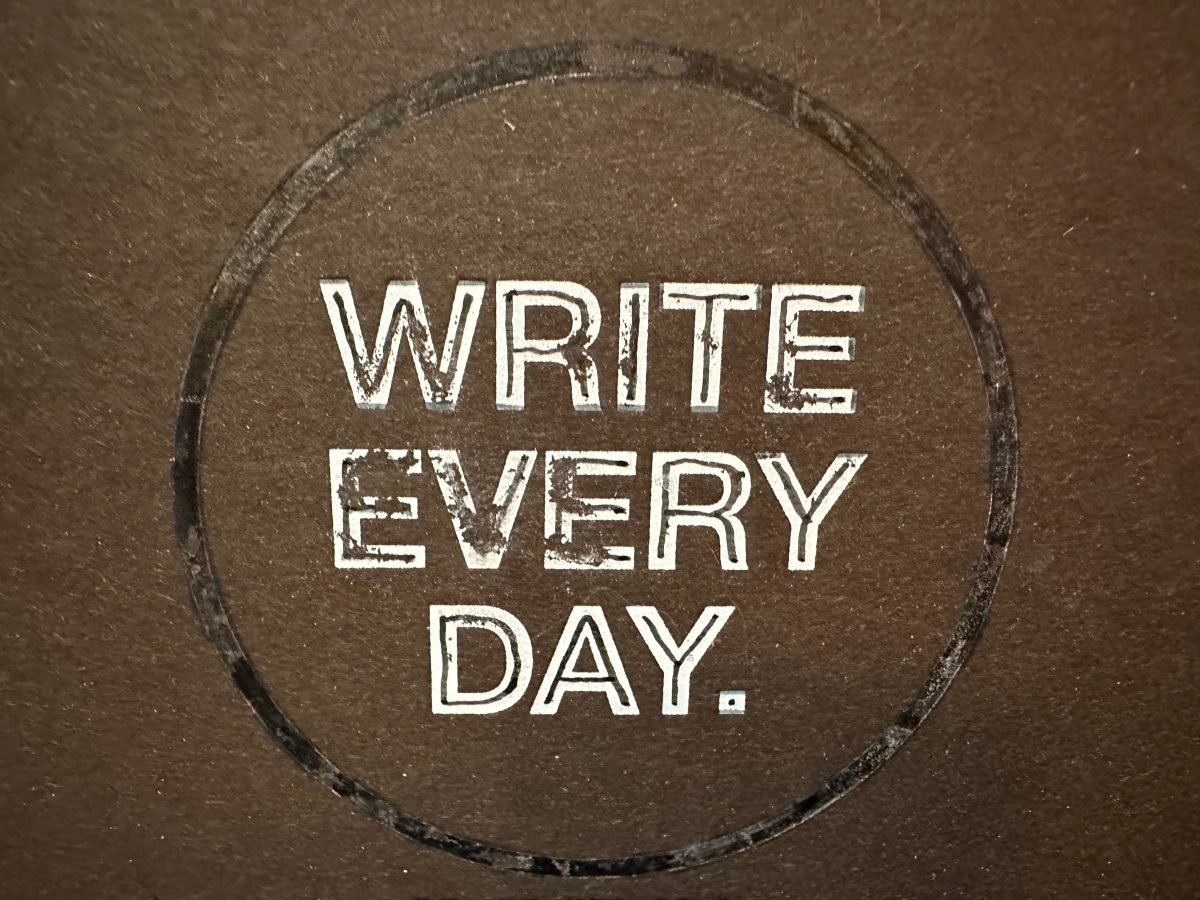
I have a notebook from NaNoWriMo that says “Write Every Day” on the cover. It’s exactly the thing that NaNoWriMo advocates. It might be the most commonly given writing advice. After all, if you want to be prolific, you’re going to need to write a lot. Right?

Well, yes and no.

The reason we have this mantra is because it’s hard. Most of us don’t write every day, even if we aspire to. However, simple aphorisms usually obscure a more complicated truth. Writing every day doesn’t guarantee success, and success doesn’t require writing every day.

The Self-Designed Job

Most of us who write fiction on spec are writing entirely on our own. There is no job description, no education or work history requirements. Nobody evaluated our resumes. We woke up one day and decided to write. Even those of us who have more formal writing jobs are often freelancers or contractors.

It can be powerful to choose your own goals and working hours. It can also be difficult. It’s not as simple as going into the office 9–5. It’s not as easy as having work handed down from a boss. Being self-directed means there are no defined boundaries to the job. You can work too little, or far too much.

I realized a few years ago that I was always setting goals for myself, and almost never satisfied with my own achievement. My performance reviews for my self-defined job were consistently bad. But this is really just my own personality issue. It doesn’t actually reflect my performance. Understanding that, I can more easily recognize that feeling and let it go.

Writing is More Than Writing

It’s not surprising how many writers hate talking about their own work, or trying to sell it. We write because we love writing, not because we want to do writing-adjacent business stuff. Unfortunately, that’s not the real world. If you want people to read what you’re writing, there’s probably some amount of business and self-promotion that needs to be done.

Beyond that, writing is more than putting words on the page. There’s work to be done before the first draft, coming up with ideas and refining them. There’s work to be done after, revising and editing. There are classes, books, and blogs about craft.

There is even the undefinable work of being out in the world, observing people and things, having the experiences that will inform the work. Fiction can only be as interesting as the inner world of the author. That stew of ideas requires ingredients and time.

I’ve even found blogging or journaling to be incredibly useful for my writing. Sometimes experience isn’t enough; it takes reflection to unlock that understanding. I can’t count the number of times that writing about my process resulted in exciting new ideas.

Moving Toward the Mountain

If you’re like me, and you have that voice in the back of your head that complains when you’re not writing “enough,” there are a few things you can do to address it. Make a list of all the things that contribute to the writing. Include things like ideation, editing, and critique. Include that fun business stuff, whether it be sending work to traditional publishers, working on self-publishing, or something as mundane as accounting for taxes. Include reflection, like blogging or journaling.

Ask yourself honestly if you’re allocating enough time to rest, recharge, and feed that stew of ideas that will, in turn, feed your stories. Don’t be afraid of taking a break, or even a vacation. If you want writing to be a “real” job, it should come with sick days and vacation time.

When pursuing goals, there are a lot of different ways to move toward the mountain. Sometimes the path isn’t straight. We have to put words to paper if we’re going to be writers. But not necessarily every day.

Year of Short Stories —Week #2

2024 is my year of short stories. In this weekly series, I talk about the stories I’m working on, from idea and draft to submission.

  • Stories in progress – 1
  • Submissions this week – 0 (1 currently out)

An Unproductive Week, A Cool New Tool

Short post this week, as I ended up being busy and didn’t get much done in the short story department.

I did discover an exciting new tool, Chill Subs. It already provides a publication database and submission tracking tool for writers, similar to the Submission Grinder and Duotrope. Even better, it’s looking to unseat Submittable as the de facto tool for editors to receive and track submissions.

In recent years, Submittable has become almost ubiquitous among literary fiction magazines, pushing the transition from snail mail to electronic submissions for short fiction. But its pricing scheme is predatory. It charges not only a monthly fee, but a fee per submission processed. Since so many literary magazines live on the budgetary knife’s edge, this has helped to drive the now-common submission fees for literary writers hoping to get their fiction published.

I feel lucky to work in genre fiction. The fantasy and science fiction space has more than its fair share of technical people. We’re lucky to have developed tools like Moksha and the Clarkesworld submission system.

Chill Subs aims to bring its own submission manager to market some time in Fall 2024. Their delightful website even allows you to choose how optimistic you are about their chances, updating the language and graphics accordingly. It’s a small team operating with a surprising amount of transparency, and their love of the craft (and the authors and editors) shines through. I don’t know if I’m “confident AF,” but I really hope they succeed.

Goals for Next Week

Same as last time!

  • Revise “Pleasant Hills”
  • Research more publications and submit at least one drabble
  • Begin writing “Portrait of the Artist in Wartime”

Reference Desk # 20 — Consider This, By Chuck Palahniuk

(Bookshop.org affiliate link)

I’m always on the lookout for good books on the craft of writing. Over the years, I’ve discovered that there are actually quite a few of them. I have at least a dozen on my bookshelf at any given time, a selection that morphs slowly, like the ship of Theseus. In fact, there are probably hundreds of good books on writing. These books have a tidbit here or there that will lodge in your head, only to pop up at an opportune moment, leading to some small improvement. Or they’ll provide some high-level idea that inspires an adjustment in your way of working.

Consider This is something else. Having just read it for the first time, I think it’s safe to say that it is one of those rare great books on writing. There is an easy way to tell if you are reading such a book. It reads like an autobiography. Writers see the world through writing, and it is only natural that we should get to know each other best through our writing philosophies. A great book on writing feels like you’ve cracked off a little piece of a writer’s soul and slipped it under your ribs. A warm little splinter next to your heart.

The subtitle of this book is, “Moments in my writing life after which everything was different.” I suspect a fair number of writers will count this book as one of those. This is not a book about how to write well. It’s a book about how to write when you are Chuck Palahniuk. And really, what other book could we possibly expect from him?

Postcards From the Tour

If you’re not familiar with Palahniuk (pronounced “paula-nick”), he is the author of Fight Club. He has written more than twenty other successful books and comics, a good amount of short fiction, and a few non-fiction pieces, but if you know him from anything it’s probably Fight Club. His writing career spans over thirty years.

Much like Stephen King’s On Writing, the book is half advice and half anecdotes from the author’s life. Unlike King, whose book is more or less neatly split into the writing parts and the biography parts, Palahniuk’s is a mish-mash.

Each chapter focuses on a particular broad topic: Textures, Establishing Your Authority, Tension, Process. Between these sections are Postcards from the Tour, vignettes from Palahniuk’s life that may or may not directly relate to what comes before and after. He wraps the thing up with a list of recommended reading, and an interesting, brief chapter called “Troubleshooting,” which is essentially a list of problems that you may run into with your work and his suggested solutions.

There are motifs that span the book, like the favorite quotes from authors Palahniuk has known, inscribed alongside tattoo art. “For a thing to endure, it must be made of either granite or words.” “Great problems, not clever solutions, make great fiction.” “Never resolve a threat until you raise a larger one.” And, of course, “Readers love that shit.”

Palahniuk makes it clear that much of the advice he’s providing is not his own. It was given to him by others. He may have taken it to heart, tweaked it, and made it personal, but it is really a collection of advice from all of the people who helped shape him. When Palahniuk makes a point he wants you to remember, he says, “If you were my student, I’d tell you…,” but this is not workshop book. It is not a syllabus to be followed. It’s a conversation between fellow writers.

If You Were My Student

Consider This is packed with small pieces of good advice; so much that it is impractical to dig into all of them here. In fact, I kept running into things that made me pause to consider how they would help me in one way or another with the stories that I’m currently working on, and made me wonder if I needed to revise some pieces I thought were done.

He tells us there are three textures for conveying information: description, instruction, and exclamation. A man walks into a bar. You walk into a bar. Ouch!

He tells us attribution tags can provide a beat within a sentence. Use quotation marks for detail and realness, paraphrase for distance and diminishment.

He tells us the Little Voice is objective and factual. It is unadorned description, the documentary camera. The Big Voice is explicit narration, journal or letter. It is opinionated. Intercutting Big Voice and Little Voice can convey the feeling of time passing.

Palahniuk also makes more than a few suggestions that made me think, “That’s all well and good for Chuck, but what about the rest of us?”

He suggests that each chapter should be a self-contained short story, to the point that it could be published independently.

He suggests a liberal mixing of first, second and third person points of view.

He says we should create a repeated “chorus” to break up the story parts, like the rules of fight club. Use lists, ritual and repetition.

I have an unsettling suspicion. The parts that feel wrong to me—the parts that seem too unique to Palahniuk—might be just as useful as the parts I found immediately helpful. I just haven’t quite grasped them yet. Maybe in five years or a decade they’ll hit me like a lightning bolt and I’ll feel the need to revise all my works in progress yet again.

Readers Love That Shit

If it’s not obvious, I think this is a book on writing that most writers should own. It’s raw and personal, often strange, and very particular to Palahniuk. That’s precisely what makes it work. It’s a collection of writing advice from many writers, all channeled through Palahniuk over a decades-long career. I took copious notes on my first read through, and I have confidence that I will find an entirely new selection of things to consider when I read through it again.

Year of Short Stories —Week #1

2024 is my year of short stories. In this weekly series, I talk about the stories I’m working on, from idea and draft to submission.

  • Stories in progress – 1
  • Submissions this week – 1 (1 currently out)

Reviewing the Backlog

This first week, I spent some time reviewing short stories that I already have finished and edited.

“Dr. Clipboard’s Miracle Wonder-Drug” is a 1400-word modern fantasy story about a man in a drug trial who experiences an unexpected transformation. It has already been through critique and polishing, and is ready to send out.

In general, there tend to be more venues for shorter stories than longer ones. This is a nice length because most publications will accept it. It’s right on the edge of flash fiction territory (depending on your exact definition).

I recently gave a Critters critique that got me thinking about story titles and the ways they can add to the story itself. I spent some time rethinking this title, and while I didn’t end up finding one I liked better, it was still time well-spent. One of the most valuable things I get out of critiquing others’ work is new insights that I can apply to my own work.

I also have four finished drabbles that I’m fairly satisfied with. One is new, but the other three are already posted here on Words Deferred, so they could only be submitted to publications that accept reprints.

I don’t really know how easy it is to sell drabbles, since they’re so short. I’ve only seen them in a couple of publications that specialize in them, so my guess is that they are harder to place than flash fiction in the 500-1000 word range.

Submitting Stories

Duotrope is a great tool for narrowing down possible places to submit stories. I start by narrowing my search to the appropriate genre(s) and length. I also limit my search to professional pay rates. Well-paying publications are going to be more competitive, but you might as well try. If the story gets rejected, you can always submit to the semi-pros markets next.

However, that filtered list of publications is just the start of the process. The bulk of the effort is in reviewing those publications to find a good fit. After all, it’s a waste of time to submit a story to a place that doesn’t publish what you’re writing.

Duotrope has interviews with the editors of some publications, and these (usually) provide some insight into what they’re looking for. Ultimately, though, the best way to get to know a publication is to read it.

So, I read a few of their stories, if possible, and try to get a feel for what the editors like. Conveniently, a lot of publications these days are online, and it’s common for at least some stories to be available for free.

This all has the added benefits of immersing my brain in good short fiction and giving me a better understanding of what the current market is like in my chosen genres. It feels like a lot of effort now, especially if I decide that a publication isn’t a good fit for the story I’m sending out, but I hope that over time I’ll develop a good feeling for many of these markets, and I won’t have to do quite so much research.

This week, I only submitted one story, “Dr. Clipboard,” and that’s at least partly because I spent a few days deciding where to submit.

Work In Progress

I have one story in progress, a 2000-word sci-fi story called “The Incident at Pleasant Hills,” about the detonation of an architecture bomb with the power to reshape a city. It has been through critique and needs some revisions before it’ll be ready to go out the door.

The final story I’ll talk about this week is one that I’m just starting, tentatively titled “Portrait of the Artist in Wartime.” It’s a science fiction story about a performance artist who uses time travel to create his magnum opus. I’m going to try to write this in the form of an interview with the artist’s former assistant.

It’s interesting to note that the core ideas of both of these stories came from my brainstorming sessions with Story Engine cards.

Goals for Next Week

  • Revise “Pleasant Hills”
  • Research more publications and submit at least one drabble
  • Begin writing “Portrait of the Artist in Wartime”

Reblog: Just Say No to Artificial Intelligence In Your Creative Pursuits — Chuck Wendig

This week’s reblog is a timely rant by Chuck Wendig in the ongoing argument over AI art. Chuck definitely falls on the anti-AI side, which is where I land these days as well.

If I paid an actual artist actual money to paint me Batman and Mario doing the bat-nasty, the artist would be the one executing. The artist is still the artist. I’m just the guy paying the artist and asking them to give me what I want.

This is a great articulation of an argument against “prompt engineers” being artists. Sure, it’s a lot faster to ask AI to generate 50 slightly different versions of the picture you want, but your input is really no different than if you asked an actual human artist to do it. There is a certain serendipitous process of discovery and choice in the work of creating art.

Commissioning art is not the same as making art, no matter how detailed your prompts are.

Check out the full post on Wendig’s blog, Terrible Minds...

2024 is the Year of Short Stories

Early in the life of this blog, way back in 2020, I made my novel Razor Mountain a main feature. I thought it would be interesting to document the process of writing a book from start to finish, and put it out episodically. This had the added benefit of aligning my blogging with the fiction I wanted to complete. It kept me writing, and kept the blog active. I believe the tech bros call this “leveraging synergies.”

However, all good things come to an end, or at least slow to a crawl. I’m still in the process of revising Razor Mountain, but I’ve found that there just isn’t as much worth writing about in the revision process as there was when I was working toward a first draft.

In November, I participated in NaNoWriMo, and it turned into a similar project almost by accident. I started writing about the process every day, and decided to stick with it for the entire month. The result was an extremely smooth NaNoWriMo experience, where I was able to reflect on what I was writing.

2024

Now, a new year has been released from a secret compartment in the ceiling, and threatens to roll over us like that boulder from Indiana Jones. I don’t really believe in New Year’s resolutions, but I do have a new goal for the year, which is both simple and difficult: write, edit, and submit as many short stories as possible.

Since it has worked well for me with other projects, I’m going to try blogging my way through this as well. This is self-serving: I want my writing here to encourage me to accomplish my fiction goals. The current plan is to do weekly updates, but I may adjust that depending on how much I have to say.

For each short story, I expect to

  1. Come up with a concept
  2. Write a draft
  3. Revise
  4. Submit to Critters for feedback
  5. Revise again
  6. Find a suitable publication via Duotrope
  7. Submit the story

As usual with the traditional publishing process, rejection is the norm. So once a story is out for submission, it will likely rack up a number of rejections. Even for successful short story authors, this is pretty normal. It’s rough out there.

As with my previous projects, my goal is to provide transparency for the curious. I’ll be honest about my successes and failures, and I expect there to be plenty of failures. But it should be fun, and I have no doubt I’ll learn a lot in the process.

The Short Story Series

As long as we’re talking about short stories, I’ll take a moment to plug my series about writing short stories. I wrote these in mid-2022. I’ve been thinking about a project like this for a while.

Games for People Who Prefer to Read — The Beginner’s Guide

The Beginner’s Guide starts with a white screen. The voiceover says,

Hi there, thank you very much for playing The Beginner’s Guide. My name is Davey Wreden, I wrote The Stanley Parable, and while that game tells a pretty absurd story, today I’m going to tell you about a series of events that happened between 2008 and 2011. We’re going to look at the games made by a friend of mine named Coda.

Now these games mean a lot to me. I met Coda in early 2009 at a time when I was really struggling with some personal stuff, and his work pointed me in a very powerful direction. I found it to be a good reference point for the kinds of creative works that I wanted to make.

Then, without ceremony, we’re dropped into a world: a facsimile of a desert town, a map for the game Counterstrike. It’s Coda’s first “game,” and Davey proceeds to tell us why he thinks it’s interesting. He explains that he thinks these games tell us something about their creator. Coda stopped making games, and Davey wants to figure out why. He even provides his Gmail address and asks for feedback from players.

The Beginner’s Guide is not a traditional game. Like The Stanley Parable, it’s very much in “walking simulator” territory. However, where The Stanley Parable was all about choice in game narrative, The Beginner’s Guide offers few choices, and no real way to exert control over the narrative. It’s more about experience than participation. It’s a little bit like a short mystery.

The Narrator

Davey will continue to provide voice-over explanations throughout the entire experience, with very few breaks. He is the tour guide as we travel through Coda’s games, most of them little more than small experiments. While the player usually has freedom to go wherever they want within a given game, Davey moves the player from one game to the next. Davey chooses to occasionally skip the player past content that he deems unimportant, like a complicated maze, in order to keep the narrative flow.

He constantly explains the real-life context of his relationship with Coda at the time each game was made, and inserts his own theories about what these games tell us about Coda and his emotional state over the years they knew each other. He is ever-present, and influences the player’s interpretation of Coda’s games in both subtle and overt ways.

The Context

This opening sequence and everything that follows it is designed to put the player in a particular mindset. It’s a framing device, and it sets our expectations of Davey and Coda. After all, this is a pretty strange premise for a game. We know Davey is a real person. He really wrote The Stanley Parable. But is this the real Davey?

Is Coda a real person? Did he really make these games? That seems less likely. And what exactly does the title of the game mean?

Davey is inherently an unreliable narrator, but he goes to unusual lengths to establish credibility and realism. He sets himself up as a sort of documentarian, chronicling and presenting these games.

As The Beginner’s Guide progresses, an astute player may notice that Davey’s interpretations of Coda’s games sometimes make sense, and sometimes…don’t. He overlooks the obvious. He dismisses nuanced questions as uninteresting.

He also has a peculiar way of talking about Coda, his games, and the fact that he stopped making them. Everything comes back to Davey, how it makes him feel, how it fulfills (or fails to fulfill) his needs.

The Turn

Davey’s narration is well done, and his commentary is enough to keep the game interesting for the relatively short play time of The Beginner’s Guide. However, what makes the game interesting is the ending, and I won’t spoil that.

It’s enough to say that there is a particular sequence where it becomes clear who Davey really is, and this recontextualization of him forces the player to reevaluate everything he has said up to that point. It immediately changes the obvious interpretations of Coda’s games.

Writing in video games is still young, and it’s rare for a video game to do something clever enough in its writing that it deserves the notice of writers in other media. The Beginner’s Guide is not a perfect game, but the setup, the turn, and the execution throughout is worth noticing.

The Game

The Beginner’s Guide is a small game. It takes around two hours to complete and it’s available for $10 on Steam. Go check it out.