For this week’s reblog, I want to direct you to Stuart Danker, who’s here to remind us that writing doesn’t always have to be romanticized. Sometimes writing is just work — it’s digging ditches; it’s bricklaying. Sometimes the muse takes a sick day, and you sit down and grind out those words anyway.
My disdain for writer stereotypes didn’t start the moment I joined the industry. In fact, I’d buy more into those hackneyed ideals, holding onto them as if they were my ticket to being the next bestselling author.
One example of this would be me thinking that real writers only wrote when the inspiration struck. “If you have to force it, then it’s not real art,” I used to say.
Never mind the fact that I was simply relaying information from a press release or padding up an annual report. I seriously believed that I needed my muse’s blessings before I could even fire up the word processor.
It’s almost November. If you’re a writer on any sort of social media, you know what that means: National Novel Writing Month. It’s affectionately known as NaNoWriMo and spearheaded by a non-profit company whose founder started with the simple idea of writing a novel in a month. Modern participants do the same thing, specifically striving to write 50,000 words in the 30 days of November.
In recent years, I’ve come to have mixed feelings about NaNoWriMo. For many writers and non-writers, it’s an awesome event. For others, I think it’s counter-productive, and may even turn some people away from writing.
My Experience
I have six different years logged on my NaNoWriMo account: three are successes (at least 50k words in the month) and three are failures. I’ve participated more times than that, but I either didn’t track progress or they got lost in some revamp of the website. (Fun fact: one of those failed projects was a very early idea for Razor Mountain, the novel that I’m currently preparing to publish serially, years later.)
I am a planner, so I’ve come to realize that my success in a project like NaNoWriMo is mostly dependent on whether I’ve put together a decent outline before November. The best I’ve done without an outline is something like 10k words before the story stopped dead and I realized I needed to rework what I had written to have a path forward.
However, an equally important factor for me is how much free time and energy I have. Over the years, I’ve done NaNoWriMo when I was single and when I was married, when I did or did not have a job, and before and after I had kids. I’ve observed just how much my living arrangements and family situation can affect my ability to dedicate a month of evenings to a single project.
At least one year where I failed was the result of falling behind in the first week, and realizing I simply didn’t have the time (or energy to write) that I would need to continue, let alone play catch-up.
What Works
NaNoWriMo was built to encourage people to write. It is especially focused on new and inexperienced writers, even people who have never tried to write fiction before and don’t think they can. The promise of NaNoWriMo is this: you don’t have to be an expert to write a novel; you just have to keep writing one word after another until you’ve stacked up 50,000 of them.
For some, this is a revelation. Writing has a certain mystique (that many writers are happy to encourage) as a process that requires some particular innate talent or even some important credential like an MFA. The truth is that anyone who is literate enough to put words on paper or screen and persistent enough to put down a lot of them can write a book. NaNoWriMo doesn’t claim that book is going to be a bestseller (or even close to publishable), but for some folks, the experience of simply writing a book is enough, even with nothing more expected beyond that. And plenty of people have gone on to do the work, past November, to get that novel published.
The event has developed a huge community, with hundreds of local groups across the globe alongside geographically dispersed virtual groups. Those who are unsure of themselves can search out one of these communities that fits their needs and helps encourage them.
NaNoWriMo is a nonprofit that does great work with a small team. In addition to the online events, it facilitates a Young Writers program that encourages kids to write.
What May Not Work
NaNoWriMo has expanded exponentially since its early years, and tried to provide more options than the “traditional” November event. There’s the project planning NaNo Prep in September and October. There’s the editing and revising “Now What?” series in January and February. There’s Camp NaNoWriMo in April and July, intended to be a less structured way to work on writing projects. Even for the November event, the website will happily let you set whatever word-count goal and timeframe you want for your project.
There’s clearly an ongoing effort to expand the brand here, but NaNoWriMo remains known for one thing: writing a 50,000-word novel in November. After all, it’s built into the name. As much as they’re trying to encourage a variety of options, most people will get involved in the “real” NaNoWriMo, and that has a structure that is going to work well for some people, and poorly for others.
Many will come into the event with little or no outline. If they’re planners like me, writing a whole novel like that may feel impossible. Some will find that they don’t have the time or energy to write 1667 words each day, and feel like setting a lower word count goal is cheating.
In short, a lot of people will fail at NaNoWriMo for a lot of different reasons. If they’re new or inexperienced writers, they may not even understand exactly what those reasons are — especially if they are seeing forum posts and tweets where other writers seem to be having great success and a good time. They’ll just think they’re bad at it.
NaNoWriMo is all about encouraging people to try writing, but in these cases it is very possible for new writers to think “this is what writing is like,” and get burned-out. There are as many different ways to write as there are writers, and some of those ways just don’t jive with “50k in November.”
Don’t Take This Too Seriously
I don’t want this to read like I’m ragging on NaNoWriMo. The organization does a lot of great work. They’ve probably encouraged hundreds of thousands of people who otherwise wouldn’t to try their hand at writing a novel. They try to demystify writing for young people, and help them tell the stories that matter to them. They’re clearly trying to cater to a variety of writers with different styles and techniques.
NaNoWriMo has gotten huge. It’s hard to miss it if you’re tuned in to writing stuff online. I worry sometimes that people who don’t fit NaNoWriMo will be turned off by it; that they won’t realize they don’t have to follow prescriptive writing advice or a monthly goal to be a “real” writer.
If you’ve never tried NaNoWriMo before, I encourage you to do so, if not this year, then next. Even if you think you couldn’t possibly write 50,000 words in a month. Just take it one word at a time.
But if you discover that you can’t do it, or it’s a terrible experience, that’s okay. You’ve learned something about the kind of writer you are. Try it again next year. Prep differently. Or do your own kind of NaNoWriMo with your own goals and limits. To succeed at writing in a way that works for you, you don’t need a website that tells you how much to write and when. You need to find something internal that drives you to write. Then it’s just a matter of putting one word after another.
This is part of my ongoing series where I’m documenting the development of my serial novel, Razor Mountain. Be forewarned, there are spoilers ahead! You can start from the beginning here.
Last Time
I revised Chapter One, with special attention to the opening. I spent time evaluating options for book covers.
More Book Cover Action
Much like in my writing, I’m finding that making a good book cover is not about the first draft. It’s about revision, revision, revision. I am, admittedly, trying to be cheap and do it myself, instead of dropping cash on the many fine businesses that would be happy to provide professional artists to help me out. I got myself into this mess, and I’ve been doing my best to get myself out of it.
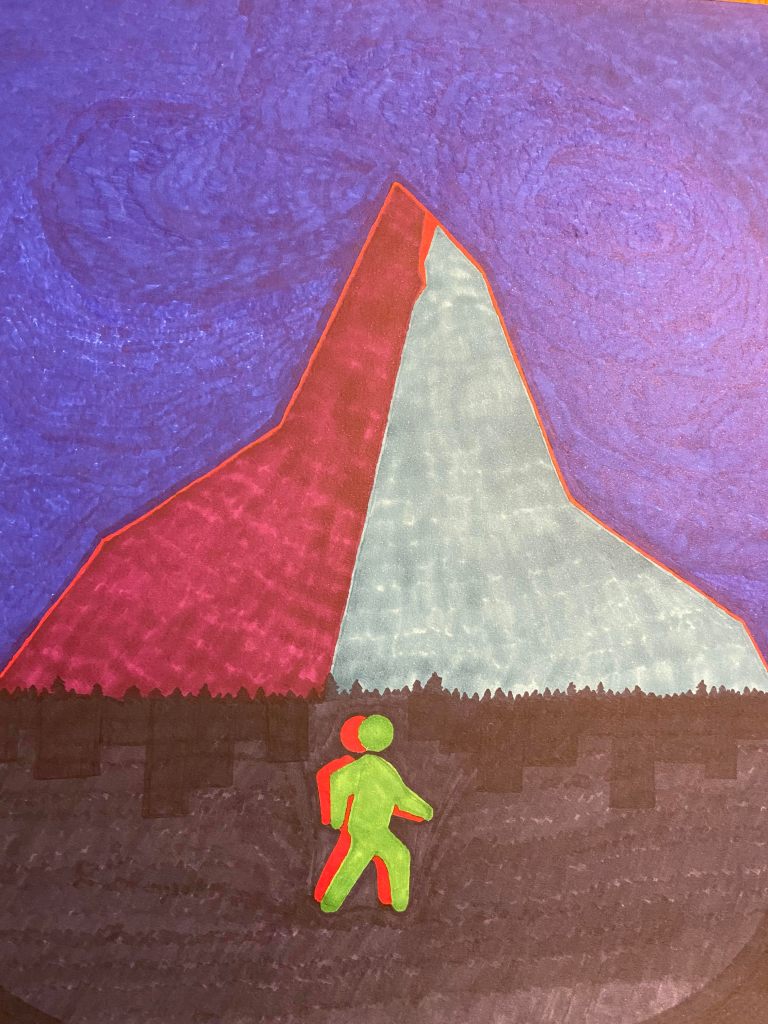
A couple weeks back, I had rough ideas for what a Razor Mountain cover might look like. First and most obvious thing: with a title like that, it pretty much has to have a mountain on the cover. Apart from that, the book is in many ways about duality: past and future, acceptance and denial, life and death, God-Speaker and Christopher. That’s not necessarily an easy concept to get across visually, but I had a vague idea of the mountain being split in half, and the shape of a person in a dark space beneath it, also split or doubled. I imagined a line down the middle, with the regular colors on one side, and a photo-negative effect across the other side.
I continued to think about what I wanted. I looked at lots of book covers. I researched tools and techniques and companies and prices. I wrote a post about it.
I tried creating a prototype by hand, with colored Sharpie felt-tip pens. I enjoy doodling and painting from time to time, but I was not particularly satisfied with the result in this case. It does look slightly better in person — the lighting is bad and the colors are pretty washed-out in this photo — but it’s not something I want to put on the front of my book.
Welcome to Disappointment Mountain.
Next, I moved on to Canva. I started by modifying their premade templates. My next cover was certainly better, but it’s a little too simple, with even fewer visual elements than the Sharpie disaster. It also looks a bit outdated, like a paperback cover from the 70s. In retrospect, the font is more of a fantasy font, with a vaguely runic look. Still, this looks like a book cover to me, even if I’m not that excited about it.
There’s probably dwarves in that there mountain.
I came back a few days later, energized to make another attempt. With some Canva experience under my belt, I trolled through Pexels for royalty-free images of mountains, silhouetted people, cities, etc. I also fired up GIMP (a.k.a. GNU Image Manipulation Program) and did some light editing. I’m hardly a graphic designer, but I’ve played around with GIMP and Photoshop in years past, so I can do some simple things like filters or gradient transparency.
The end result was actually pretty close to my original vision. I spent a surprisingly long time on little tweaks, like the silhouette of hills that separate the top section from the bottom. Fonts are also incredibly difficult to get right. I spent ages flipping between fonts. I still vacillate between this being too cheesy and just right. It definitely feels more like a thriller font.
I also created several different layouts with these same elements slightly rearranged. Unfortunately, different services want square (or even circular-cropped) “cover” images, and in some cases I may want the image without the title and author overlaid, for cases when they already appear in text nearby.
More Revision
I don’t have too many specifics to report on the editing front. I took several more passes through the first two chapters, mostly making small line edits. Now they’re going to my first beta reader, my wife. I’ll be back to looking for more critique partners and beta readers this upcoming week.
Results
I continued revising and editing the first two chapters and I created a book cover that I’m satisfied with.
It wasn’t that long ago that serials seemed like a bygone format — something that worked for Dickens and Dumas, but not really a viable option for the modern author. Now, it seems like serialized fiction is a growing new segment, with big companies making big bets all over the place. There are exciting news announcements around serial fiction every few months.
This spring, we got news of Korean media conglomerate Kakao Entertainment gobbling up both Radish and Tapas. Then, as summer was rolling around, Amazon announced the release of their own serial platform, Kindle Vella. These companies are banking on the growth of stories that cater to short attention spans with reading material that comes in bite-sized pieces. They’re also farming content, optioning the most popular stories for traditional publication or adaptation to streaming services, TV and movies.
Last month, well-known traditionally-published author Salmon Rushdie announced that he’ll be serializing his fiction via Substack.
Lincoln Michel weighs in on his own Substack, Counter Craft:
The success of Substack and similar services have shown writers what most artists in other mediums already knew: there’s a lot of money in fans. Hardcore fans are willing to pay extra to support the artists they love. For extras, yes, but even just to support. And fans seem to like knowing exactly who they’re supporting, meaning that there is a not insignificant number of readers who are willing to, say, pay 5 bucks a month for an individual NYT journalist’s Substack who won’t pay 5 bucks a months for a full NYT subscription.
I’ve done my outlining and prep for Razor Mountain. I wrote my author profile and my book description. I’ve got a couple of chapters in revision, just about ready to go. But I don’t have a book cover.
Why Yes, I Am an Old Man
I grew up in a time where traditional publishing was effectively the only publishing. Self-publishing was basically a scam where unpleasant little corporations tricked authors into spending a bunch of money to print a tiny run of their book that would be available nowhere and bought by nobody.
In that strange and distant age, there was an oft-quoted adage: “In real publishing, money always flows toward the author.” If you’re in traditional publishing, that’s still generally true, but we now live in a world where self-publishing is definitely real publishing and a viable strategy for many authors. But self-publishing means that the author is taking on all of the tasks that were once managed by a publisher, and taking on all the risk that entails. In self-publishing, money doesn’t always flow toward the author. In many cases, you have to spend money to (try to) make money. For me, at least, that takes some getting used to.
Those costs can include a variety of things: copy editors, content editors, proofreaders and sensitivity readers; indexing; book design and formatting; marketing; and cover design. The folks at Reedsy have a good post on how these costs can add up, although they should be taken with a grain of salt since they make their money as a marketplace for exactly these kinds of services.
As an old man who still thinks traditional publishing is pretty cool, I ended up accidentally backing into self-pub in the form of an experiment. I wanted to write a serial novel, putting it out into the world as I wrote it (more or less). There are only a handful of authors that could get a traditional publisher to sign on to a project like that, and let me tell you, I am not one of them. Publishing a serial novel has its own unusual considerations, but at the end of the day, it’s self-publishing, and it involves many of the same considerations that self-publishing any other novel would.
If you’re looking at self-publishing and you need a book cover, what are your options?
DIY
You can do it yourself. But should you?
The obvious advantage of this strategy is that it costs no money, and you have complete control of your cover design. The disadvantage is that it will cost your time, possibly materials, and the quality of the output is going to depend entirely on your skill. If you are a visual artist, this might be feasible for you. Just remember, book covers are a specialized art. Even if you are great at painting, drawing or visual design, it won’t necessarily be easy to create a great book cover.
Before you embark on crafting a book cover, look around for good reference material. Browse Amazon or Bookshop, or go to your local independent bookstore and snap photos of covers you like. Consider your book’s genre and the feel you want the cover to have — thrillers are going to have very different covers from romance or memoir, for example.
There are also services that help to make the process easier. For example, Canva has a book cover design template, along with a variety of pre-built cover designs, free and paid. You can change any of the elements to suit your own needs, from fonts to colors to pictures or illustrations. If you need pictures, you can try searching a free stock photo site, like Pexels. These sites have photos that you can use without paying royalties. Don’t use any pictures without a clear statement of copyright and conditions of use!
If you have experience or are willing to put in the time to learn, professional design software can give you even more creative control. Adobe Photoshop and Illustrator are industry-standard tools that require a purchase, or you could use a free tool like the powerful (and goofily-named) GNU Image Manipulation Program — GIMP.
Canva book cover templates
Friends, Family, and Freelance
For most of us, it’s just not feasible to create our own book cover with a high-enough level of quality. However, you might know someone with the artistic skills you lack. Do you have an artist friend, family member, or coworker whose work you respect? Consider offering them a commission. For the amateur artist, it may be fun to work on a project that actually pays, and it’ll be far less expensive for you than other options.
Be aware though, that you’re going to have to collaborate. You don’t want to end up poisoning an existing relationship if you end up disagreeing on the design. Treat this as a professional relationship — make sure to be really clear about what you want, how much you are paying, and how much freedom you’re giving your artist to adjust and improve the design based on their own artistic sensibilities.
And yes, you should almost always pay. Even if your artist is a friend or family member, they’re doing a professional service for you. You’re trying to make money by publishing — it would be a disservice to your artist to not compensate them for their contribution to your success. Look at freelancer and professional rates, and make sure you’re offering a reasonable fee that you both can agree on. (Occasionally, you may have a hard time convincing your artist to accept compensation. Consider something more personal than cold cash — take them out for a nice meal, or give them a gift you know they’ll appreciate.)
Professionals
This is a broad category, but I’m considering this to cover any artist you do not personally know, who gets paid for their art in any way. This includes amateurs who take commissions, professional freelancers, and commercial services.
If you want to find a freelancer, you can browse sites like Reedsy or Fiverr for artists who are specifically advertising their book cover design services. These are the folks who are mostly likely to have experience in this specific field of design, and some examples for you to look at.
If you have favorite artists on an art site like DeviantArt, you might consider asking them if they’ll create a cover for you on commission. Just be aware that many excellent artists will have never created a cover before, and may not be interested. Even if they are, you’ll want to have a detailed description of what you want.
Finally, there are the corporate options. These are companies who employ professional artists who specialize in book covers. This can be the priciest choice, with some cover options costing upward of a thousand dollars.
On the cheaper end of these services are pre-made book covers. These are somewhat like the Canva templates: professionally-designed covers that can be customized with title and byline. Some services will let you specify minor tweaks to things like the font and sizing of the text, but these are mostly what-you-see-is-what-you-get.
If you’re willing to pay for the most expensive options, you can buy a custom book cover design from one of these services. You provide your input to the company, and they come back with one or more designs. You then pick what you like and make adjustments until it’s just right. This is the most expensive kind of cover design service, but you’re paying for strong creative control and high-quality art and design to get a professional product.
When Ryan Lanz, whose blog I follow, posted his cover reveal, he shouted-out his designers, Damonza, who offer pre-made and custom-order covers. There are at least half a dozen other companies who do similar work that are easy to find with a Google search. I won’t recommend any of these, since I haven’t worked with them and can’t vouch for the quality of service. However, they all have galleries of their work that you can browse to help you make a decision.
Making the Right Choice
Many writers, myself included, want to spend as much time as possible refining their craft — writing! But if you’re going to self-publish, there are business considerations, and you have to take them seriously if you want to maximize your chances of success. As often as we say “you shouldn’t judge a book by its cover,” people do exactly that.
Remember that a book cover is a business decision. You have to decide how important your cover is, and how much time and money you want to put into it. You also need to consider the resources available to you. Maybe you can’t afford a custom professionally-designed cover, but you have an artist friend who is eager to help. Maybe you can sock away a smaller amount of money for a commission or freelancer. Maybe you’re an artist as well as a writer, and you’re willing to put in the effort to make something great in Canva, Illustrator or GIMP.
How about you? Have you self-published? If so, how did you get your book cover? Were you satisfied, or would you try something different next time? Let me know in the comments.
This is part of my ongoing series where I’m documenting the development of my serial novel, Razor Mountain. Be forewarned, there are spoilers ahead! You can start from the beginning here.
Last Time
I wrote a rough draft of the last chapter and started getting into revisions on Chapter One.
The Hook
As I talked about in a post earlier this week, I spent some time refining my first sentence, first page, and first chapter. I started with the hook.
In the rough draft, my opening paragraph is this:
The cave was a dark, low tunnel, crowded with formless shapes. Christopher struggled to identify his surroundings through eyes bleary with sleep. There was a long roar, followed by a thump. A buzzy, persistent rumble emanated from the darkness around him. Christopher rubbed his eyes and blinked several times, breathing deep and trying to clear his vision.
The first thing I did was get rid of the roar and the thump. I originally intended them to be the sound of other passengers jumping from the aircraft, and the door shutting behind them, while Christopher is still out of it. There’s no more mention of it later on, and it just ends up being confusing and slowing things down slightly. I rearranged and reworded almost all of the rest of it, although the meaning changed very little.
The cave was night-dark and claustrophobic, crowded with indistinct shapes. The cave was night-dark and claustrophobic, crowded with indistinct shapes. Christopher struggled to identify his surroundings through eyes bleary with sleep. All around him was loud buzzing; it permeated his body. He pressed his palms to his eyes and breathed deep, trying to clear his head.
Hopefully the question of where Christopher is and what is happening is enough to hook the reader, without being too confusing. Part of that relies on me quickly revealing more about what’s happening in the remainder of the first page.
The First Page
My goal in the first page is to get across a couple of ideas:
Christopher feels strange, as though he’s been drugged.
He realizes that he is not in a cave, he is in the passenger cabin of a small plane.
Next, as quickly as possible, I need to reveal that the passengers are missing, the pilot is missing, and Christopher is in a world of trouble. This leads naturally into the rest of Chapter One, which is all about answering the question, “what is he going to do about it?”. I think the rough draft does this decently well, so I worked on saying more with fewer words, rewording each of the next 4-5 paragraphs.
This is what my first page looks like, after some revision:
The cave was night-dark and claustrophobic, crowded with indistinct shapes. Christopher struggled to identify his surroundings through eyes bleary with sleep. He was surrounded by loud buzzing; it permeated his body. He pressed his palms to his eyes and blinked repeatedly, then breathed deep, trying to clear his head.
Although his surroundings were shadowy, Christopher could make more sense of the shapes around him as he blinked away his grogginess. The hunched, round shapes were seats. He fumbled around, felt the thin padding beneath and behind him, felt the arm rests.
Christopher’s perception shifted and he understood what he was seeing. Not a cave; an airplane cabin. Why had he thought it was a cave? Moonlight faintly illuminated the outlines of the small, round windows. The prop engines buzzed. Now that he thought about it, Christopher could feel their vibration through his seat.
He tried again to blink away the sleepiness that clung like cobwebs. Even when he had pulled all-nighters in college, he hadn’t felt this discombobulated. This was more like a bad hangover.
Christopher had been skeptical when one of the other salespeople in the department warned him not to sleep on planes when traveling. Better to hold out and hit a new time zone running, one of the veterans had said. Christopher had thought he was exaggerating.
He tried to stand and found himself still seatbelted. He fumbled the clasp open and stood fully, immediately banging his head on the sloped ceiling above. Christopher felt a sudden head rush from standing too quickly, but the pain of his bruised scalp helped to cut through the fog of his thoughts.
It was too dark in the passenger section of the little plane. Before he had dozed off, Christopher recalled little LEDs along the aisle between the seats; recessed lights along the seam between wall and ceiling. He had to turn around to face the front of the plane. Unlike the large passenger planes Christopher had flown on for other trips, this little plane had seats back-to-back, with some facing forward and some facing the rear of the plane. There were only eight seats in the passenger area, and Christopher’s was near the back, facing the tail.
The seats were all empty.
The First Chapter
To revise the rest of Chapter One, I looked at the order of events and made sure I was happy with everything that happened, and what order it happened in. I did end up making some small adjustments from the outline, which is to be expected.
Next, I took several more passes through the chapter to look specifically for some of the things I mentioned in my “firsts” post: adjectives and adverbs, sound, character voice, and pacing. It’s a long chapter (although it’s getting a little shorter in editing), and I still need to spend more time with it to get through all these improvements.
After that, I’ll pass it to my first reader/editor — my wife — and I’ll make more revisions based on her evaluation.
Cover Work
I’ve also been looking at options for cover art. As long as I’m experimenting (and not strategizing for an Amazon e-book bestseller), I thought I might try to make a cover myself. However, when it comes to visual art I’m a somewhat enthusiastic dabbler. I have no formal training. I just occasionally make things for my own enjoyment.
So, I tried making a cover, and I didn’t much like it. Then I started digging more seriously into other options, from paid services to DIY. I can say right now that I won’t be spending a ton of money on a cover (and boy can you spend a lot of money on a cover), but I’m still looking. More to follow.
Results
I revised Chapter One, with special attention to the opening. I spent time creating a book cover that I didn’t like, and then evaluating other options for book covers.
In this novella by Max Gladstone and Amal El-Mohtar, Red is a covert agent in a war raging across time. She is advanced beyond what we can comprehend as mere 21st-century readers, able to transform into whatever shape is needed, blending into any time and place, subtly adjusting the strands of causality to build new futures in a constantly shifting multiverse, the way generals build battlefield positions on the field of war.
One day, Red finds one of her carefully-laid plans foiled, and a playful message waiting for her from Blue, her counterpart on the opposing side. A rivalry takes shape, and from it, a romance. Attack and counter-attach across time, punctuated by ever more elaborate (and personal) coded messages.
Structure
For most of the book, each chapter follows one of these agents on a mission to a new place and time. Never enough to understand the purpose exactly, or the larger framing of the time war. Then, the text of a letter from one agent to the other. The next chapter, the point of view swaps.
I wondered at first how long the structure could sustain the story. However, the times and places are varied and tantalizing without being entirely clear, and the slow shift from rivalry to romance is believable and satisfying.
There is also an additional mystery woven throughout — an unidentified seeker that follows Red and Blue from chapter to chapter, studying and absorbing the correspondence they believe to be carefully hidden or destroyed. If they are found out, by their own superiors or the enemy, they will both be undone. Eventually, the back-and-forth structure does break down, and it’s the mystery of the seeker that comes to the fore and carries the story to its conclusion.
Respecting the Reader
In proper time-travel fashion, the story wraps around and through itself, as we discover that the characters are far more intertwined than even they knew. The authors make the wise decision to not go too deep into the details of time travel or the complexities of rewriting timelines across parallel universes. It mostly avoids, through obscurity, the inevitable inconsistencies that tend to bring out the worst kind of overly-pedantic reviewers.
The book doesn’t dawdle around, explaining the exact nature of the war, the two sides, or even the agents. We are thrown into a strange world head-first (many, in fact), and expected to keep up. We know that Red’s Agency faction uses advanced technology and bold tactics, and Blue’s Garden faction uses advanced biology and subtly turns the enemy’s strengths into weaknesses. And that’s enough.
I Feel Seen
The book has, at this point, won pretty much all of the best awards a sci-fi novella is eligible to win. Still, I couldn’t help feeling a bit like it was tailored to me.
I was delighted to find references to strategy in the game of Go (atari and lack of liberties). Granted, Go is probably more popular in the West than ever before, but it still feels like an obscure hobby. The characters also discuss Travel Light, by Naomi Mitchison, a favorite of mine and the best book that I have ever discovered in a Little Free Library. I don’t expect these things to resonate with the average reader, but they further endeared the story to me.
To Summarize
This is the best book I’ve read in 2021, and I’d recommend it to anyone who likes sci-fi, time travel, romance or people who discover what really matters to them, and do everything in their power to protect it. The writing is ornate without being overwrought. The story takes some unexpected (but not unreasonable) twists and turns. It’s a quick read, but feels exactly long enough.
As I’m working on my serial novel, Razor Mountain, I’ve reached the point where I have a rough draft of the first two chapters. In some ways, each of these is a first chapter — each one introduces a separate point of view character, in a different setting and vastly different time periods.
I let these chapters “rest” for a week or two, and then came back to revise them. There are many different ways to revise, but today I wanted to talk a little bit about beginnings, and all of the “firsts” of the book — the first sentence, first page, and first chapter.
If there are any parts of a novel that are more important than the rest, they are the beginning and the end. A good ending will often buy the reader’s forgiveness for weaknesses in the middle of the book. A good beginning, on the other hand, is vital to get the reader interested in the first place, and to tee up all of the wonderful stuff you have planned for the rest of the book.
Consulting Some Books on Writing
Anyone who has followed this blog for a while is probably well aware that I am a collector of writing advice, tips and tricks, so I looked through my collection of writing books and pulled out some pertinent ones. If you can build up a little library of books and writing resources that you like, it can be very helpful to focus yourself by picking out a few related books and skimming or reading the relevant sections before you embark on a particular task.
When I buy a book on writing, I do try to read it right away and internalize what I can. However, I have plenty of these books that I last read five or ten years ago. I’ll be the first to admit that I only have so much storage space in my internal memory to hold on to that knowledge. But that’s the great thing about books — all that knowledge is still there, in external (paper) memory.
I first pulled out The Portable MFA in Creative Writing by the New York Writers Workshop. In the chapter on fiction, it has this to say about story-opening strategies:
The purpose of the beginning of a story is to introduce character and conflict. Another purpose is to catch and hold the reader’s interest. One way to do so is to raise a question in the mind of the reader. Another way is to quickly immerse the reader in the action of the story, to eliminate boring exposition…conflict, when effectively dramatized, also catches the attention of the reader.
This hits a lot of the points I was working toward when I initially planned the beginning of the novel. However, now that I have a draft, I need to make sure that I actually execute my plan effectively. I’ve set up clear questions at the beginning: why does Christopher wake up groggy on a plane where the passengers and pilot have vanished? I need to make sure that I quickly jump into the action of him making this discovery and then attempting to deal with the situation. I also need to show some of his character through his thoughts and actions in this stressful situation.
Next, I moved on to The First Five Pages, by editor-turned-agent Noah Lukeman. This is a text all about beginnings, and while it focuses on crafting an opening that will appeal to agents and editors in the traditional publishing world, the bulk of its advice applies to any fiction opening, regardless of how you plan to publish.
Lukeman suggests several things to trim and improve:
Adjectives and adverbs — This is pretty common writing advice. Replace them with better nouns and verbs, find more unusual or evocative modifiers, or swap-in an analogy, simile or metaphor instead.
Sound — This encompasses myriad vague things: sentence construction and the use of punctuation like comma, semicolon, em-dash, and parentheses; “echoes” like the repetition of character names, pronouns, or unusual words; alliteration and the repetition of specific sounds in close proximity; and resonance, the sound of the language separate from its meaning.
Dialogue — An overuse or complete lack of dialogue, dialogue as artificial infodump, melodrama, or just generally difficult-to-follow exchanges.
Showing vs. telling
Viewpoint, narration, and consistent character voice
Characterization — Not skipping over properly introducing characters in the hurry to move the plot along.
Pacing and progression — Do the individual parts of the story flow together in sequence?
The hook — A really interesting or exciting first sentence that still fits with what comes after.
There are many other sections in the book, but these were the things that stood out to me as I skimmed through it this time.
The Hook
The hook is typically considered the first sentence, or less often the first couple sentences. It is called the hook because that’s what it should do to the reader: hook them and pull them into the story.
The first sentence and first paragraph should be concise and exciting — although you can decide what exactly exciting means for you — action, dialogue, or an interesting premise. It will help if that beginning leads the reader into those key elements: holding interest and elucidating character and conflict.
My intent with Razor Mountain is to start the story with Christopher on the plane. He wakes up (which is admittedly a well-worn trope for a book opening), groggy from being drugged. It is dark. At first, he thinks the poorly lit passenger cabin is a shadowy cave. It is only as he looks around and regains his senses that he realizes where he actually is. I’m also hoping to achieve some symmetry with this opening, where the beginning and end of the first act involves a character in a cave. Likewise the beginning and end of the entire book.
The First Page
The first page or first few paragraphs are an extension of the hook. A hook can be exciting and hold the reader’s interest with all sorts of tricks, but that will only take the reader so far if it doesn’t lead naturally into the rest of the book. The first page is an expansion of the hook.
The hook drops the reader into the story and shows one, maybe two important things to get the reader invested. The first page gives you more space to work, but also demands more. The reader needs to be anchored to a place, or people, or more likely both. Enough of the setting and characters has to be described, in order for the reader to start to envision what’s happening. All of it still needs to keep the reader engaged and pull them along.
The First Chapter
When the reader turns that first page, you’ve achieved an important milestone. You’ve hooked the reader. For the rest of the chapter, you’ll be doing largely the same things, on a broader scale.
The first chapter is a sort of promise. Whether you’re intending it or not, the first chapter promises the reader an idea of what the rest of the story is going to be like. Since it’s happening either way, you had better lean into it, and make that promise count. Maybe you’ll hint at exactly what they’re getting by highlighting the style of the book or introducing important characters and settings. Maybe you’ll foreshadow future events. Or maybe you’ll be subversive, setting the reader’s expectations, only to shock them with a plot twist later on.
Razor Mountain Firsts
Later this week, I’ll talk more about working on the first sentence, page and chapter for Razor Mountain, as well as all of the other revisions I’m working on for Chapters One and Two.
This is part of my ongoing series where I’m documenting the development of my serial novel, Razor Mountain. Be forewarned, there are spoilers ahead! You can start from the beginning here.
With the rough drafts of the first two chapters done, I jumped ahead — way ahead, to the final chapter. This isn’t something I’ve tried before, but I thought it would be interesting. I’ve done a lot of outlining and plotting for this book, so I already have a solid idea where everything is leading, both in terms of plot and in terms of character arc.
Writing the last chapter actually turned out to be a lot easier than writing the first and second chapters. Part of that was that it ended up being shorter. There isn’t all that much action. I think a much bigger factor, however, is that the first two chapters were introducing the two plot threads of the book to the reader. The last chapter just has to lead reasonably out of the rest of the book, and come to a satisfying conclusion. At this point, most of that hasn’t been written yet, so I can imagine what it will all be, and write my ending accordingly.
Obviously, this means anything I choose to change along the way may invalidate part of the ending chapter. That’s fine. I expect that by the time I get everything written out, I’ll have to re-jigger the last chapter in a variety of ways. What it really seems good for is to highlight some of the themes and ideas that I really want to push at the end. Now, as I make my way through the book, I can look at that and work on pushing those things as I go, so it all builds up organically.
Writing the final chapter also gives me some ideas about the emotional resonance I want at the end. It’s more about how I want the ending to feel than the plot information I need to get across. All that really happens is that Christopher makes a decision, and acts upon that decision.
The First Revisions
The last chapter was a fun experiment, but if I want to start publishing chapters, I need to get my beginning into shape. My first and second chapters have had some breathing room, and now it’s time to go back and revise.
My first drafts are strictly to get words on paper (or pixels on screens, in this case). Sometimes the words come out amazing, but more often I end up with lots of clunky sentences that generally get across what I was going for, some digressions that seemed interesting in the moment, a few bits that I like, and maybe a couple phrases that feel fantastic. In short, it’s a mixed bag.
I like to give first drafts a little time to fade in my memory before going back to them. Some things that seemed great during the actual writing will feel less great when I reread them later. Sometimes the rough patches where I was just dumping words to get the point across and move on actually turn out to need less work than I thought. It’s hard to pretend you’re a reader of the text you, yourself wrote, but I don’t think there’s a better tool for pulling that trick off than a break between the writing and the reading.
I started working on revisions for Chapter One this week, but there’s plenty more to do.
The challenge I always face when I start revising (especially if it’s been a while) is the temptation to go straight to line editing. It’s easy to read a few sentences and find a word here or there that can be improved, a typo or some missing punctuation. For me, at least, that’s what jumps out immediately.
However, I fight that urge. Instead, it’s better to look at the larger pieces. I try to look for any reason to reorder scenes, rearranging dialogue, or otherwise make big adjustments first. By focusing on larger structural revisions before getting into the nitty-gritty, I try to avoid wasting time changing small things that are liable to need rework anyway after structural revisions.
Results
I wrote a rough draft of the last chapter and started getting into revisions on Chapter One.
For this week’s reblog, we go over to Writer Unboxed, where Milo Todd discusses the third person narrator as a voice independent from the characters and the author.
So we’ve got this whole “third-person narration” thing. You know it already. It’s that “he/she/they” thing instead of the “I/me/we” thing. The narrator isn’t the protagonist or (usually) any of the playing characters, and so the narrator is kind of floating above everybody’s heads, nonexistent, as lives are lived.
But the thing is, the third-person narrator isn’t floating. They’re not nonexistent. Not really. Rather, they envelope the book, hold it in their hands, and therefore are arguably one of the most crucial elements to your entire story. Just because nobody can see them doesn’t mean they’re not important.





 Words Deferred