The Beginner’s Guide starts with a white screen. The voiceover says,
Hi there, thank you very much for playing The Beginner’s Guide. My name is Davey Wreden, I wrote The Stanley Parable, and while that game tells a pretty absurd story, today I’m going to tell you about a series of events that happened between 2008 and 2011. We’re going to look at the games made by a friend of mine named Coda.
Now these games mean a lot to me. I met Coda in early 2009 at a time when I was really struggling with some personal stuff, and his work pointed me in a very powerful direction. I found it to be a good reference point for the kinds of creative works that I wanted to make.
Then, without ceremony, we’re dropped into a world: a facsimile of a desert town, a map for the game Counterstrike. It’s Coda’s first “game,” and Davey proceeds to tell us why he thinks it’s interesting. He explains that he thinks these games tell us something about their creator. Coda stopped making games, and Davey wants to figure out why. He even provides his Gmail address and asks for feedback from players.
The Beginner’s Guide is not a traditional game. Like The Stanley Parable, it’s very much in “walking simulator” territory. However, where The Stanley Parable was all about choice in game narrative, The Beginner’s Guide offers few choices, and no real way to exert control over the narrative. It’s more about experience than participation. It’s a little bit like a short mystery.
The Narrator
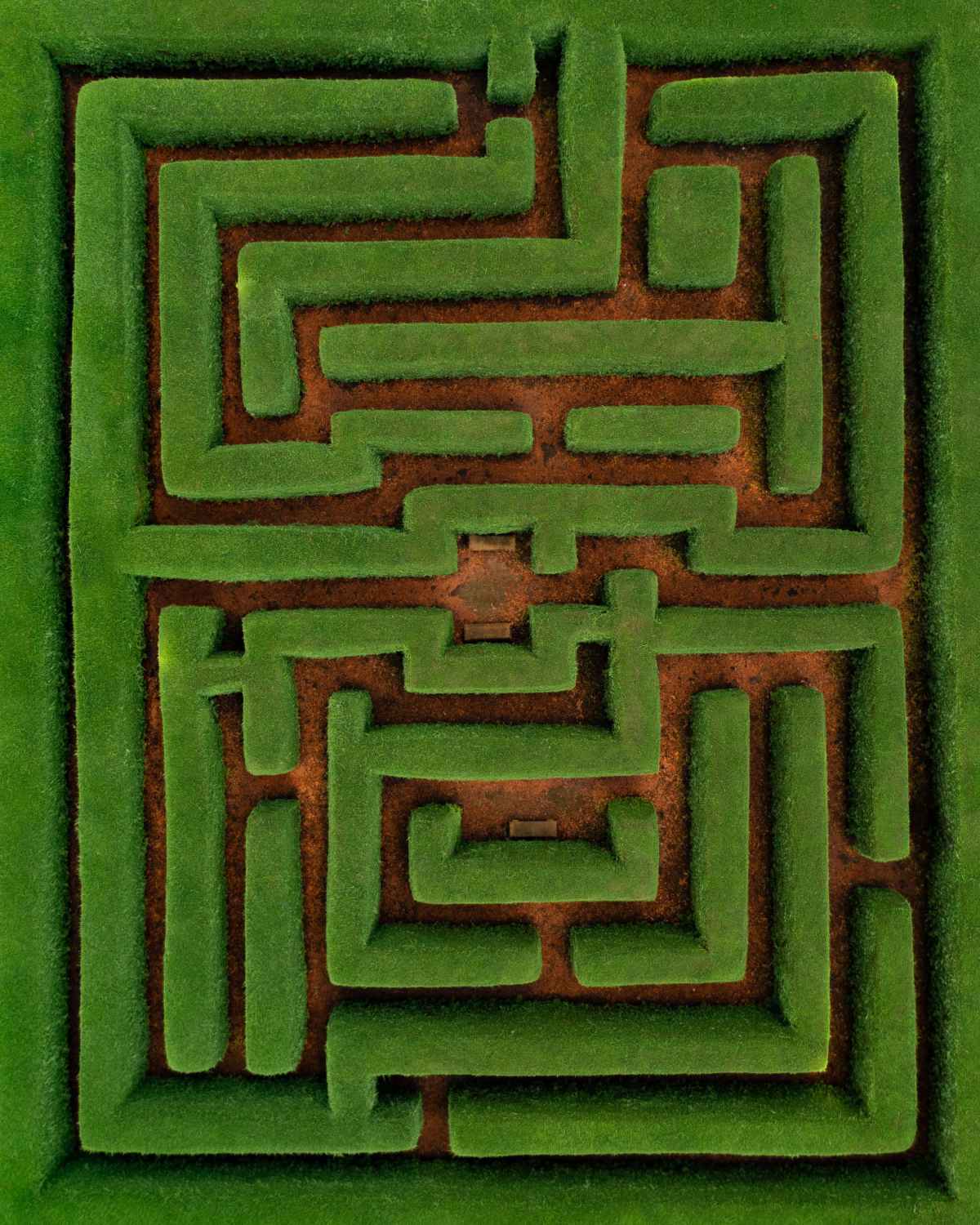
Davey will continue to provide voice-over explanations throughout the entire experience, with very few breaks. He is the tour guide as we travel through Coda’s games, most of them little more than small experiments. While the player usually has freedom to go wherever they want within a given game, Davey moves the player from one game to the next. Davey chooses to occasionally skip the player past content that he deems unimportant, like a complicated maze, in order to keep the narrative flow.
He constantly explains the real-life context of his relationship with Coda at the time each game was made, and inserts his own theories about what these games tell us about Coda and his emotional state over the years they knew each other. He is ever-present, and influences the player’s interpretation of Coda’s games in both subtle and overt ways.
The Context
This opening sequence and everything that follows it is designed to put the player in a particular mindset. It’s a framing device, and it sets our expectations of Davey and Coda. After all, this is a pretty strange premise for a game. We know Davey is a real person. He really wrote The Stanley Parable. But is this the real Davey?
Is Coda a real person? Did he really make these games? That seems less likely. And what exactly does the title of the game mean?
Davey is inherently an unreliable narrator, but he goes to unusual lengths to establish credibility and realism. He sets himself up as a sort of documentarian, chronicling and presenting these games.
As The Beginner’s Guide progresses, an astute player may notice that Davey’s interpretations of Coda’s games sometimes make sense, and sometimes…don’t. He overlooks the obvious. He dismisses nuanced questions as uninteresting.
He also has a peculiar way of talking about Coda, his games, and the fact that he stopped making them. Everything comes back to Davey, how it makes him feel, how it fulfills (or fails to fulfill) his needs.
The Turn
Davey’s narration is well done, and his commentary is enough to keep the game interesting for the relatively short play time of The Beginner’s Guide. However, what makes the game interesting is the ending, and I won’t spoil that.
It’s enough to say that there is a particular sequence where it becomes clear who Davey really is, and this recontextualization of him forces the player to reevaluate everything he has said up to that point. It immediately changes the obvious interpretations of Coda’s games.
Writing in video games is still young, and it’s rare for a video game to do something clever enough in its writing that it deserves the notice of writers in other media. The Beginner’s Guide is not a perfect game, but the setup, the turn, and the execution throughout is worth noticing.
The Game
The Beginner’s Guide is a small game. It takes around two hours to complete and it’s available for $10 on Steam. Go check it out.
This is the monthly post where I talk about what I’ve been reading. The end of the year really snuck up on me. I didn’t have a lot of time to read in November due to NaNoWriMo, and I was busy with holidays in December, so I decided to roll them together into a single blog post.
As usual, if you’re interested in any of these books, please use the included Bookshop.org links instead of Amazon. It helps independent bookstores, and I get a small affiliate commission.
Monster (Vol. 1 – 18)
By Naoki Urasawa
My interest in this series stems from watching an episode or two of the anime based on these books several years ago. Conveniently, one of my co-workers is an avid collector, so I was able to borrow the whole series over my Christmas vacation.
What s stands out about Monster is the subject matter and setting. So much anime and manga follows familiar formulas, and this one is refreshingly different.
Dr. Kenzo Tenma is a Japanese immigrant in west Germany, shortly before reunification. He is a brilliant neurosurgeon with a promising future at a prestigious hospital. He’s a favorite of the hospital’s director, and engaged to the director’s daughter.
However, Tenma has a crisis of conscience after he’s ordered to save the life of a famous performer instead of the poor immigrant worker who arrived first. The next time he has to make a similar choice, he rejects hospital politics, saving the life of a boy shot in the head, while less skilled surgeons are unable to save an important donor who came in shortly after.
Overnight, Tenma’s life begins to collapse. The director refuses to talk to him, his engagement is broken off, and he’s overlooked for promotion. His fortunes turn yet again when the director and two of his allies are found poisoned, and the remaining hospital leadership puts him in charge.
A decade later, Tenma comes across the boy he saved, now an adult. To his horror, the boy seems to be tied up in a string of serial murders, and kills a man in front of the doctor. He reveals that he was the one who poisoned Tenma’s co-workers.
With Tenma once again close to a murder, a federal investigator takes an interest in him, trying to pin all the murders on the doctor. Tenma is wracked with guilt for saving the boy who has turned out to be a monster, but he has no evidence, and only he knows the truth. When the police attempt to arrest Tenma, he decides to flee and chase down the boy he saved, to kill him and stop him from harming anyone else.
The series follows Tenma as he evades the authorities and slowly uncovers the mysterious and disturbing origins of the monster, Johan, while helping people along the way. He uncovers the history of secret psychological experiments on children, and the legacy of the people who once ran those experiments, as well as the damaged children that came out of them.
Set in 1990s Germany and Czechoslovakia, the setting is phenomenally well-executed. The characters are excellent, and the mystery is compelling. Unfortunately, I felt like the story was treading water in some of the later volumes, and the conclusion wasn’t as satisfying as the opening. Regardless, this is still a fantastic manga, and a great story for anyone who is turned off by the usual anime/manga tropes and settings.
The Department of Truth is a comic built on the well-worn fantasy premise that peoples’ collective belief can physically change the world. It feels especially relevant in our current moment, when it sometimes feels like our different political and cultural factions are living in entirely different universes.
Cole Turner is a teacher at Quantico specializing in home-grown American extremism. In the course of his research, he attends a flat-earther convention, where he attends a showing of Stanley Kubric’s fake moon landing tapes before being whisked off with a select group on a private jet to see something even more impossible: the literal edge of the world. The trip is cut short when the group is unceremoniously gunned-down, and Cole is taken in for questioning by a group calling themselves The Department of Truth.
The Department of Truth is the secret government agency responsible for monitoring the effects that collective beliefs have on the fabric of reality, and keeping them in check. What exactly does that entail? Well, that’s the complicated part. They cut down conspiracy theories, killing and ruining lives when they deem it necessary for the greater good. It’s a messy job. The agency’s leader, none other than Lee Harvey Oswald, recruits Cole as a new member.
This first volume does a good job laying the groundwork of setting and characters, and brewing up a big fight. There’s an enemy organization called Black Hat working against the Department of Truth. They are trying to change the narrative, to put real evidence of the conspiracy theories out into the world. They want to reveal and destroy the Department of Truth, and it turns out they’ve been watching Cole for a long time.
Unlike similar stories, this doesn’t shy away from real, modern conspiracies. In this first volume it touches on classics like the Kennedy assassination and the satanic panic, but it also hits Obama’s birth certificate, “pizzagate,” Epstein’s suicide, flat earth, school shooting “crisis actors,” 9/11 as an inside job, and the whole QAnon/deep-state mish-mash. There’s effectively infinite material for them to riff on, since conspiracy theories are practically mainstream these days.
The book also features a gay main character, without making a big fuss about it. Unfortunately, Cole’s personal life with his husband is hardly touched on. Between the conference and his recruitment, he goes missing for a couple of days, and it results in a mildly heated argument. The relationship boils down to one face-to-face scene and a phone call in this first volume. I would have liked to have gotten more, and it would help to flesh out Cole as a character. However, there’s a lot of hinting that his background will tie into the story more and more as we go deeper, so I’m hopeful that there will be more in future volumes.
The art style is grimy, dark, and impressionistic. It’s more about conveying mood than the literal scenery, and the moods are not generally happy ones. Characters’ inner thoughts are expressed as shadowy images lurking behind them. Almost every image is filtered through TV scan lines, ink splatters, deep chiaroscuro shadows, and scribbled linework. This intense abstraction is appropriate for a story where there’s a blurring between truth and fiction, and dark things really are lurking in the shadows.
Unfortunately, the darkness and the abstraction sometimes make it hard to tell what is actually happening. On more than one occasion, I found myself having to re-read a two-page spread because the panel order wasn’t clear from the layout. I don’t mind unusual layouts (Sandman Overture is still my favorite art in any comic, and it almost never uses “normal” layouts), but there’s a real difficulty in not confusing the reader. The Department of Truth doesn’t always quite hit that mark.
Overall, I really enjoyed the Department of Truth, Vol. 1, and I’ll definitely be picking up more of the series.
The Potter read-through with kids continues. This is the middle book of the series, and it feels like a middle book. There are still a few of the kid-centric tropes and patterns that have repeated through the earlier volumes, like a red-herring bad guy and a mystery to be solved. It’s also doing a lot of work to set up everything that’s going to happen in the next three books.
This book clearly signals darker stuff to come, with the main villain finally arriving, and a death near the end of the book. Still, I couldn’t help feel that the dead character wasn’t actually all that important in the grand scheme of the story. There is a broad cast of side characters that have been built up across the first few books, and any one of them dying would have had more impact.
Once again, the biggest lesson this series teaches is that adults are all useless. They’re either outright evil, incompetent, or just don’t trust the kids enough to inform or direct them in any useful way. Of course, this is a theme that’s pretty common in kids’ books. It wouldn’t be fun if the adults took care of everything.
What I’m Reading in January
Harry Potter continues, I dig into more of the comics I got for Christmas, and I’ll definitely (probably) finally return to the Witcher series. See you then.
House of Leaves is a 2000 novel by Mark Z. Danielewski. I don’t have a very precise memory of when I first read it, but it must have been about fifteen years ago. It is a formative book for me, and parts of it took up permanent residence in my head. Yet when I reread it this past October, I had to admit that I had no memory of large swaths of the book. That seems somehow appropriate for a sprawling, layered story with unreliable narrators and intentional inconsistencies.
Despite being a best-seller that continues to be reprinted, House of Leaves feels like a cult classic. It has ardent fans, but it seems too esoteric and weird to be truly mainstream. The people who love it will be the first to admit that it is not an easy read, and the people who hate it will declaim it barely readable at all. It generates the same sort of divisive conversations as Ulysses (or Homestuck).
After my recent reading, I dove down the rabbit hole of online information, arguments and discussions about the book. I learned about some of the many things I had missed. I was amazed and a little appalled by the number of secrets hidden in the text, the number of subtle allusions and not-so-subtle codes. I have to admit that I may now be a member of the strange cult obsessed with this book. So, while I touched on it briefly in my October Read Report, I feel obligated to write something more about House of Leaves.
I don’t have much interest in writing traditional reviews, but this is a review of sorts. If nothing else, I hope it gives you an idea of what the book is like, and whether you’re likely to love it or hate it.
Zampanò
The title page of the book says, “Mark Z. Danielewski’s House of Leaves, by Zampanò, with Introduction and Notes by Johnny Truant.” The origins and provenance are purposely muddled. The intermingling of stories and frames, reality and fiction, starts before the first word.1
The book starts with Johnny, but we’ll start with Zampanò.
Zampanò is a blind old man who lives by himself in a run-down apartment. He has done his best to seal up the windows and the crack under the door. Among his few possessions is a battered trunk filled with notes and a half-finished manuscript for a scholarly analysis of a film called The Navidson Record.
We can infer a little about Zampanò from his work. It is riddled with footnotes, and certainly makes a variety of assertions about The Navidson Record, but these are all suspect. He often discusses the visuals, despite being blind. Johnny’s notes point out that there is no evidence that a film called The Navidson Record ever existed (even within the story) and the many works of criticism for the film that Zampanò cites are fabricated as well.
Johnny never meets Zampanò. He only hears things about him second-hand.2 He talks to the various people who came to read to the old man. He hears about Zampanò’s ritualistic daily walks around the perimeter of the apartment complex’s overgrown courtyard.
Ultimately, the only real interaction between Zampanò and Johnny is that the old man dies, and Johnny’s friend Lude gets him into the apartment to look for interesting stuff left behind. Johnny takes the trunk full of Zampanò’s half-finished book, and begins to read and edit it.
That’s where his troubles really start.
The Navidson Record
The Navidson Record doesn’t exist. Johnny tells us that pretty early on. But the portions of the book that belong to Zampanò are so persistent in their certainty that they make it feel real.
Zampanò describes The Five and a Half Minute Hallway and Exploration #4, viral videos that spread via bootleg VHS and the early internet. They both turn out to be excerpts from The Navidson Record. The first shows a door in an exterior wall that opens onto a hallway that cannot possibly exist. The second shows the endless maze of dark rooms at the other end of that hallway.
Zampanò describes the film itself. Famous photojournalist Will Navidson moves, with his partner, Karen Green and their two children, to an old house in rural Virginia. Giving up more dangerous projects like war photography, Navidson plans to document this new stage in their lives with video journals that he and Karen keep, as well as motion-activated cameras set up around the house. The pair’s internal traumas and external relationship struggles are present, but suppressed. For a time, the house seems idyllic.
Then, it begins to change shape. At first this is subtle, a matter of a mere 1/4 inch across its entire length. Then individual rooms begin to change size. Navidson becomes obsessed with measuring these tiny changes, but they soon become so obvious that measurement is not necessary. A new hallway appears between two rooms. A door appears in an exterior wall, but it doesn’t open onto the yard. It leads to an apparently endless maze of hallways, rooms, and stairs, unlit and frigid.
The tensions between Will and Karen quickly reach a breaking point. She wanted to escape the fear that accompanied Will going out into danger to capture his photos. But the mysterious extra-dimensional portion of the house is too alluring. He is desperate to explore it.
Instead, he brings in outsiders: a scientist, and a trio of expert mountaineers. While he remains in the house, manning the radio at “base camp,” the three explorers set out on a series of expeditions, surveying the ever-changing architecture beyond the impossible hallway and even taking samples from the walls. They carry his video cameras with them.
These videos document the rare moments when the dimensions of the house visibly change around them. They document the strange way things break down within the bowels of the house; markers and supply caches shredded or vanished, buttons and zippers disappearing from their clothing. They document the eerie growl that sometimes passes over them like a wave, or follows at a distance.
And though they aren’t collected until much later, they document exactly how everything goes horribly wrong.
Exhibits and Appendices
The last section of the book contains six “exhibits” and three appendices. However, to say that these are the conclusion of the book is only technically true. Just as Johnny’s narrative inserted into footnotes encourages the reader to jump back and forth between layers of story, other footnotes point to the appendixes and encourage the reader to dig into them in the first few chapters.
The exhibits are unfinished. They are things that Zampanò hoped to include: scientific analysis of the samples Navidson and others took from the house, reproductions of interviews, a section on architecture, an excerpt from an Air Force manual, and some of Karen’s medical records, along with related excerpts from psychiatric literature.
The first appendix is filled with the writings of Zampanò. Johnny’s note tells us that these are included to shed more light on the man. Notably, among Zampanò’s poems is an untitled fragment that contains the only reference to the book’s title within the text:
Little solace comes
to those who grieve
when thoughts keep drifting
as walls keep shifting
and this great blue world of ours
seems a house of leaves
moments before the wind.
The second appendix contains Johnny’s items: sketches and polaroids, poems and collages, his father’s obituary, and “The Three Attic Whalestoe Institute Letters,” correspondence between Johnny and his erudite and apparently schizophrenic mother, long institutionalized.
These letters are arguably the most important thing in the appendices, and act almost as a third narrative alongside Zampanò’s and Johnny’s, revealing and clarifying many details from Johnny’s account, and raising new questions.
Formatting
Some footnotes are referenced in multiple places. Some are missing. Most use numbers, but some use a variety of strange symbols that may or may not relate to the text. There are footnotes to footnotes, occasionally several levels deep.
But beyond the unusual use of footnotes, there are many other formatting oddities in House of Leaves.
There is the use of color: house always appears in blue, several struck sections in red, and one particular phrase in purple.
A single bar of music is printed sideways, running vertically down the page.
In two different sections of The Navidson Record, the shape of the text reflects the shape of the narrative or the shape of the house.
It is contained within sidebars or blue-bordered squares, running forward and backward along the pages, turned sideways and upside down.
It is spread out,
only a few words per page,
as the characters run,
frantic,
through the labyrinth.
It is drawn out slowly, as the text explores the meaning in a few slowed frames of film.
It is cramped and tight, as the halls of the house narrow, sloped in diagonals as the explorers move downhill, separated by a vast gulf of
white space
when they encounter a chasm.
Although the story itself is sometimes unclear or frustratingly abstract, it is this shaping of the text on the page that presents the first barrier a reader must overcome to form any connection with House of Leaves. But it is also an invitation to the reader. The text practically demands interpretation. Why these colors? Why this formatting? Why must I follow a footnote to a footnote to a letter in Appendix B?
Your instinctive reaction to this—excitement or irritation—is a good indicator of whether you will enjoy the book.
A few of the fooTnotes contain Huge lIstS of places, names of archItectS, etc., etc. At first glaNce, these appear tO be poinTless. AsTute readers, after discovering tHe sEcret cOdes spelled out iN PeLafina’s “Whalestoe Letters” through misplaced capital letters and acrostics, have applied the same codes to these lists, and discovered that theY also contain hidden Messages. One codE, embedded in the Navidson Record, SeemS relAted to those letters. Another spells Danielewski’s full name.
In my hardcover edition, there are also hundreds of 4-diGit hExadecimal codes imprinted on the inside of the cover. Some enterprising individual determined that these describe part of a music file: a snippet from the companion album to the book, Haunted, by Poe (the stage name of Danielewski’s sister).
Do these secrets add anything meaningful to the story? Hard to say, but they certainly evoke a feeling that there are hidden meanings everywhere in House of Leaves, if only the reader is willing to dig deep enough.
How many levels of frame story are there? Well, there’s the Navidson Record, and all the collected ephemera around it: interviews and articles, books and art, arguments, analysis and critique. There’s Zampanò’s written analysis of the film. There are Johnny’s notes on Zampanò’s work. And there are the fictional editors, who chime in occasionally to clarify a point or cite a source that Johnny never got around to. There is Danielewski, the real author, almost invisible. But there’s also Johnny’s institutionalized mother, Pelafina, who sends him letters (or does she) of varied lucidity. The really obsessive fans have their own theories about her, but I won’t spoil them.3↩︎
Johnny’s story is told in notes and footnotes, denoted only by a different font. Sometimes these notes comment on Zampanò’s work, but they often wander away from the subject at hand, into long and meandering anecdotes from Johnny’s life. As the book progresses, they become less and less decipherable, entire pages of run-on sentence. ↩︎
Even more perplexing, these frames are fuzzy; the stories leak out of their original context. Late in the story, Johnny encounters a group of strangers who are obsessed with a story that has been passed around the early internet, and it turns out to be a version of the account we’re reading. In Zampanò’s summary of The Navidson Record, Will Navidson, lost within the labyrinth of the house, burns his final matches to read a book, and the book is House of Leaves. These examples of impossible recursion are never explained. ↩︎
Be warned: this post contains spoilers for the movie Arrival.
The fantastic Blade Runner 2049 was the first movie to put Canadian director Denis Villeneuve on my radar. As the sequel to a 35-year-old cult classic, it had every right to be another bland, disappointing Hollywood cash grab. Instead, it managed to capture the essence of what made the original movie great, and built on those themes in a way that somehow felt cohesive. Dune (Part One) in 2021—for my money, the best screen adaptation of a story that has stymied directors for decades—confirmed that the quality of Blade Runner 2049 was no accident.
I recently watched Arrival, a 2016 sci-fi film about first contact with a mysterious, seven-limbed, octopus-like alien race, dubbed “heptapods.” I came away astounded by the story and the execution, and then discovered that this is yet another Villeneuve masterpiece, adapted from Ted Chiang’s Nebula Award winning short, “Story of Your Life.” At this point, I’ll watch any movie Villeneuve makes. I don’t even need to see a trailer.
Arrival follows linguist Louise Banks (Amy Adams), who is recruited by the U.S. Army to attempt to communicate with the aliens. However, our first introduction to Banks is a flashback: tender strings play over her narration as she speaks to her daughter about the nature of memory.
I used to think this was the beginning of your story.
Memory is a strange thing.
It doesn’t work like I thought it did.
We are so bound by time, by its order.
We watch a montage of her daughter as newborn, child, teenager.
I remember the middle.
But all is not well. Her daughter is examined in a hospital room. Banks looks on, her fear written on her face. Conversations with a doctor at the end of a long, dark hallway.
This was the end.
she narrates, as we see her crying over the hospital bed where her daughter lays, head shaved, utterly still.
Moments in the Middle
Life moves on. Banks works as a university professor, and this is where we catch up with her, watching (along with the rest of the world) as twelve alien ships descend to different parts of Earth. The Army comes to recruit her, and she’s whisked off to Montana in a helicopter. She’s partnered with physicist Ian Donnelly (Jeremy Renner), and they begin making regular visits to the alien craft, which opens a section to them once per day.
Inside the ship, they meet a pair of heptapods, who observe them from a separate, misty chamber through a glass wall.
Banks begins the process of communication, discovering that the aliens have a rich written language, but seemingly no concept of linear time. Their script is circular, and each sentence has no defined beginning or end.
They work under the scrutiny of government officials who are so afraid of the aliens that they seem perpetually on the verge of launching an attack. As they learn more about the aliens and their language, Banks also grows closer to Donnelly. But there is still a distance between them. There are more flashbacks of Banks with her daughter. They skirt around the subject of the husband and father who left them.
The source of this lingering depression and detachment is obvious to the viewer. Banks was broken by the loss of her daughter and the estrangement from her husband. Under the pressure of the situation, this is only growing worse. Banks immerses herself in the alien language. Software is built to speed up translation. She begins to dream about the heptapods and their circular sentences.
Things come to a head when diplomacy breaks down between the twelve countries hosting alien craft. China and Russia are poised to attack the aliens, calling them a threat to humanity. Through her incomplete translation of the alien language, Banks has uncovered references to what might be a tool, or might be a weapon. What if the aliens use this weapon on them? What if they give it to one country, but not the others?
At this critical moment, Banks has a revelation. The weapon is the alien language itself. Language shapes thought, and she is so immersed in their language that she begins to think like them. She is no longer bound by linear thought. Cause and effect are simultaneous.
But this isn’t just a revelation to Banks, it’s also a revelation to the audience. She doesn’t just remember the past, she remembers the future as well. She remembers meeting the Chinese general sometime in the future. He will tell her that her phone call to him was the reason he called off the attack. So, in the here-and-now, she steals a sat-phone and calls the private Chinese phone number that she will be told by the general. She says the words he has not yet told her, the dying words of his own wife, “in war, there are no winners, only widows.”
The attack is called off. The lines of communication re-open. The aliens close their ships and leave, saying only that they will return when they need the aid of humanity, in three thousand years.
With the crisis averted, Donnelly and Banks admit their feelings for each other. For Donnelly, this is a joyful moment, but for Banks and the audience, it’s bittersweet. We now know the truth.
Those flashbacks weren’t flashbacks at all. They were memories of the future. She will have a daughter, knowing full well what will eventually happen to her. She will marry Donnelly, knowing that he will leave, that he will be unable to bear the weight of the truth: that she chose this path, even though she knew what would happen.
Flashing Forward
This twist ending works for three reasons.
It is carefully telegraphed.
It relies on extremely familiar story structures.
It ties the personal stakes to the universal.
The opening scenes of the movie are powerful on first viewing. What’s more heartbreaking than a parent losing their child? The audience hears the narration about beginnings, middles, and ends, and takes it at face value: these scenes sketch the outline of a life cut short. But the narration is really a giant hint toward the twist at the end, a hint whose meaning isn’t apparent until it arrives.
Because the story opens with this scene, it needs to be relevant to the ending. Symmetry is critical to a feeling of closure. However, like any good magic act, the film immediately provides a flashy misdirection. What could more effectively distract us from Banks’s personal tragedy than first contact with aliens?
This also creates two sets of stakes: the personal, affecting only Banks; and the universal, affecting every person on Earth. As Chuck Wendig so aptly explains in Damn Fine Story, linking the personal and universal stakes is incredibly powerful. The only caveat is that the audience doesn’t yet understand how the personal and universal stakes tie together.
As the story progresses, we see several “flashbacks,” further illuminating what we believe to be Banks’s past. Modern audiences are so familiar with flashbacks, we automatically assume that these scenes, intercut with the first contact story, must have already happened. There are a few allusions to Banks dreaming these scenes, or woolgathering due to stress and lack of sleep, but it takes almost no effort to convince us that these are flashbacks, because they use a structure that we have seen countless times.
It is only in Act Three, when we have been introduced to the aliens’ non-linear language, where we get hints that not all is as it seems. Banks’s young daughter draws crude figures that look suspiciously like heptapods. Is she prescient? Is Banks mis-remembering or hallucinating? This throws the audience off-balance, revealing that the flashbacks we thought we understood are something we need to question. It primes us for the revelation.
When the twist comes, it is wonderfully effective. Firstly, the protagonist and the audience understand what’s happening at the same time! We feel exactly what Banks is feeling, because we’re all having the same experience.
Secondly, it ties the personal and universal stakes together. This revelation saves the Earth from war, but it also allows Banks to make sense of her life and her perplexing memories of a future that hasn’t happened yet.
Finally, it creates that symmetry between the end and the beginning. The narration from the opening scene lands on us with a new weight. An already powerful scene is supercharged as it becomes the crux of the story.
Arrivals and Departures
Non-linear storytelling works because it allows us to hide important information without frustrating the audience. Simply hiding information while telling a story in sequence is a surefire way to make the audience hate you, but by telling the story out of order, you can create a mystery for the audience to solve where there would otherwise be a series of straightforward events.
Non-linearity is used brilliantly in Arrival, because the characters themselves are experiencing the story out of order. The title is a reference to the aliens arriving on Earth. It is also a reference to the birth of Banks’s daughter, which is both the opening of the movie and, in some ways, the end.
This is the monthly post where I talk about what I’ve been reading. As usual, if you’re interested in any of these books, please use the included Bookshop.org links instead of Amazon. It helps independent bookstores, and I get a small affiliate commission.
Having finished rereading all the books in the main Sandman series, I figured I would top it all off with the two stand-alone Sandman volumes. The first of these is Dream Hunters, which was published three years after the 1996 wrap of the main series.
Dream Hunters comes in the form factor of a graphic novel, but it is actually an illustrated short story in five parts. There are a variety of different layouts, including many full page illustrations and some two-page paintings and both horizontal and vertical splits. There is even a double-fold-out illustration, four pages wide. Amano’s inks, pencils and watercolors mingle to create a variety of effects, sometimes clear, other times murky or abstract.
The story is a retelling of a Japanese folk tale, “The Fox, the Monk, and the Mikado of All Night’s Dreaming.” A magical fox falls in love with a lonely monk who maintains a small and forgotten shrine. When a powerful sorcerer tries to kill the monk in his dreams, the fox intercepts those dreams to protect him.
This is one of those classic Sandman side-stories where Dream is involved, but only as a side character. It’s a good story with great art, but not really necessary to pick up unless you’re already in love with the series.
Unlike Dream Hunters, Endless Nights is a proper comic. This is an anthology of stories, each with a different illustrator, and each one focused on one of the seven Endless: Death, Dream, Desire, Delirium, Destruction, Despair, and Destiny. Again, these could be considered side-stories to the main series, but they feel closer to the main series in tone and style, and they do offer a few interesting tidbits for die-hard fans.
Some light is shed on Dream and his interactions with Desire, when they attend a gathering of sentient stars some few billion years ago. We see what might be the first of Dream’s many ill-fated romances, and the source of animosity between Dream and Desire. We also get to see what Destruction is up to in his exile, and hints that he may yet reach a kind of friendly ambivalence with his family, even if they never quite see eye-to-eye.
I really like Endless Nights. If The Wake was the epilogue to the main story, then this feels like a reunion.
I continue to work through the series with my kids. This third book feels like the inflection point to me, still largely plotted in a way to appeal to relatively young kids, but beginning to ramp up the darker themes.
At this point, it’s clear there is something of a formula that the books follow. Again, it leans on couple of mysteries to keep the plot moving. Again, there is a red herring that is pushed hard. Where this book differs is in the long third act, which wraps everything up with a fun time-travel sequence that has to interweave with a series of events that we already read from a different point of view.
While it’s popular to knock the Harry Potter books these days, especially for their plot holes, the time travel opens up a pretty egregious one. Sure, as in Back to the Future, a big deal is made over the “dangers” of seeing yourself while time traveling. But then main characters do it anyway, and it turns out perfectly fine. Unlike Back to the Future, the Harry Potter books barely mention time travel again, which is a little hard to swallow.
I didn’t intend to read House of Leaves again. I was talking with my son about the Backrooms, and how it seemed like it was inspired by House of Leaves. I went to grab my slightly beat-up paperback copy and discovered that it wasn’t on the shelf. Then I remembered I had loaned it to a friend, years ago. So I ordered myself a new copy.
When the book arrived, I popped it open, just to enjoy the sections where the text went all wonky. I went back to the beginning, to see how it started. Before I knew it, I was fully absorbed. It’s probably been over ten years since I last read it, and there was a lot I had forgotten.
House of Leaves is a strange book. At its heart is a horror premise: a house that somehow contains an infinite, shifting, maze-like series of rooms and corridors, where one might become lost forever. Wrapped around that core are multiple layers of frame stories and linguistic complexity.
I could go on about this book, but it’ll have to wait for another post. Suffice to say that it’s just as enjoyable as I remembered, and I highly recommend it to anyone interested in reading something genuinely weird.
What I’m Reading in November
With NaNoWriMo looming, I probably won’t be reading much. If I do get ahead and end up with some free time, I expect I’ll finally get back to The Witcher or delve into a new comics series.
Asteroid City is the latest movie by Wes Anderson, released this summer, but written and filmed during various stages of the COVID-19 pandemic. I’ve touched on Wes Anderson once or twice before. He’s a divisive figure who makes movies with a very particular aesthetic. Some people revere him, some can’t stand him.
Asteroid City is, in many ways, just another Anderson film, with many of his usual virtues and foibles. However, I can’t help but feel there was one way it diverged significantly from other Anderson movies, and it was not a positive change. The problem with Asteroid City is its ending.
What Works
Like so many Anderson movies, Asteroid City starts with a frame. The main story is supposed to be a famous play, while the frame is a documentary about the author and the creation of that play. The brunt of the movie follows the plot of the play, with small asides back to the documentary.
In a pastel pastiche of the 1950s, a young scientist convention brings a number of children and their families to the small desert town of Asteroid City. The festivities are interrupted by the brief arrival of a UFO, and the government puts the town under quarantine. However, the children work together to get news of the situation to the outside world, and this results in public pressure to drop the quarantine. The various people who have come together in this strange situation then leave the town and return to their separate lives.
There are a whole host of fairly obvious correlations to the pandemic quarantine in this plot, and the bonds and romances that develop among the characters in a stressful situation. These are all relatable themes; perhaps the most universally relatable themes available to a storyteller in 2023.
I was a little leery of Wes Anderson delving into science-fiction when I first saw trailers for this movie, but the actual sci-fi elements are quite slight, and mostly played for humor. This works well enough in the Andersonian medium, and there’s even a funny little call-back in the “documentary” portion of the movie, where it’s revealed that the alien in the stage play is a masked Jeff Goldblum, the only scene he appears in.
Where it All Falls Apart
As the plot of the convention and the short-lived quarantine wrap up, the movie shifts back to the documentary. In an acting class taught by Willem Dafoe and populated by most of the cast of the movie, there is a discussion about sleep and dreams. Then the group begins to chant, over and over…
“You can’t wake up if you don’t fall asleep.”
It is this chant that ends the “documentary.” When I talked with my wife afterward, this was also the exact point where she said that she gave up on the movie completely.
It’s Weird, So What?
I think it’s safe to say that the average moviegoer finds most Wes Anderson movies to be weird. These movies usually don’t see wide distribution, and they don’t make blockbuster money; they exist on the edge between Hollywood and low-budget art film. They’re not trying to be a realistic depiction of life, and they’re also not full of bombastic special effects like the typical Hollywood blockbuster.
In my opinion, Anderson movies occupy an interesting niche. They’re clearly on the hoity-toity, film festival end of the movie spectrum, but they’re usually plotted in a straightforward way. They’re open to interpretation, but they’re not inscrutable.
Grand Budapest Hotel is partly a love story, and partly about a man who inherits an expensive painting and earns the ire of a the deceased woman’s murderous family. Moonrise Kingdom is about a pair of kids who run away together in the face of an impending hurricane. Isle of Dogs is about a kid looking for his lost dog. The Anderson movies that appeal to wider audiences are the ones with a surface-level plot that is easily understandable. They contain quite a bit that you can appreciate in a single viewing, even if you’re not worried about the vagaries of cinematography or frame stories or aspect ratios.
These movies are still “weird.” They’re still arty and invite all sorts of deep reading. You just don’t need those things to have fun watching the movie. This is where Asteroid City fails its audience.
Most of Asteroid City follows the ethos of an interesting surface layer on top of deeper weirdness. The parts that take place within the play are straightforward, bright, and funny. The parts that take place in the frame story are less straightforward, but they have their share of jokes, and they take up much less screen time. It’s only at the end where this spirals out of control.
The chanting actors are not at all straightforward. Their mantra, “you can’t wake up if you don’t fall asleep,” has almost nothing to do with the movie on a surface level. It demands that the viewer try to make some non-obvious interpretation in order to square this ending with what they just watched. Anyone in the audience who merely wants to watch and enjoy a movie is immediately excluded.
Even worse, this phrase is chanted over and over and over. The viewer is bludgeoned with it. The movie literally shouts out the importance of this singular phrase. It shows a complete lack of trust in the audience, a fear that we might miss this vital thing if it wasn’t so explicitly spelled out.
You Choose Your Audience
If the movie had ended with the temporary residents of Asteroid City saying their goodbyes and driving away, it would have worked for a “surface-level” audience. It would have welcomed the average moviegoer along with the cinephiles. Instead, it ended with an event that demands interpretation and demeans the audience with a complete lack of subtlety.
And I know, at least anecdotally, that parts of the audience felt excluded. They decided this was not a movie for them.
I don’t know what Anderson was hoping to accomplish with this ending. He may very well have been happy to make something just for the ardent fans. But he made a choice that profoundly affected who can enjoy his movie. These are the kinds of choices we all make in our work, either purposely or by accident.
It’s also worth noting that you can cater to a variety of overlapping audiences. It’s not always a zero-sum game. You can provide an entertaining surface-level plot, with readable character motivations, and still embed deeper ideas, complex metaphors, or mysterious events that are never adequately explained. Nothing can appeal to everyone, but you can make choices that widen or narrow your audience.
There’s nothing wrong with choosing to write something that you know will have a limited audience. If that’s the story you want to tell, then tell it. But think about what you’re doing, and do it as purposely as you can. Make sure you’re not excluding the audience by accident.
This is the monthly post where I talk about what I’ve been reading. As usual, if you’re interested in any of these books, please use the included Bookshop.org links instead of Amazon. It helps independent bookstores, and I get a small affiliate commission.
This volume is a collection of stories within a Canterbury Tales-esque frame. A group of strangers from across the Sandman universe get caught in a storm and find shelter at The Worlds’ End, an inn that exists beyond ordinary space and time, and a play on words in a few different ways.
This is, in many respects, the beginning of the end: the final arc of The Sandman series. While this volume is similar to several others, with seemingly disconnected stories set in the same expansive world, it’s laying groundwork for the two volumes to follow.
The end of the book makes this apparent, as the storm quiets, and all the strange guests at the Worlds’ End see a huge procession in the sky. This is a funeral on a cosmic scale, and the dead man is Dream of the Endless.
Finally paying off the foreshadowing in Volume 7 and 8, The Kindly Ones is the largest volume in the series, and the climax of Dream’s story. The dangling plot threads come together, and it’s incredibly appropriate as Dream’s antagonists in this volume are none other than the Fates, who measure and cut the thread of each person’s life.
In the Sandman mythos, the Fates have many aspects, each represented by three women: young, middle-aged, and ancient. They are also called the Furies, embodiment of revenge against those who dare to spill the blood of family.
The Furies are called to action against Dream by Hypolyta Hall, the former super-hero from earlier volumes, who conceived her son within dreams and holds a grudge against Morpheus for “killing” her husband. She’s convinced that Dream has stolen her child. However, the real kidnappers are mere mythological tricksters. It’s Dream’s murder of his own son, Orpheus, that allows the Furies to work against him.
The surface conflict between Dream and the Furies becomes progressively more violent, and we see a number of fan-favorite characters caught in the cross-fire. The bigger question, however, is why this is allowed to happen. Within their specific sphere of influence, the furies have power to equal the Endless, but it seems that Dream is holding back.
Gaiman has shown that he knows how to wrap up a story, so I can only assume that this final ambiguity is on purpose. It’s up to the reader to decide why Dream doesn’t have his heart in the fight. Is he overwhelmed with the shame and guilt of what he did to his son? Is he an exhausted immortal who knows that there will always be another fight, another petty enemy knocking at his doorstep? Does he know himself too well; his obsession with responsibility forcing him into the fight when he could just as easily run away like his brother, Destruction?
In the end, Dream dies. This isn’t a spoiler so much as an inevitability. However, he doesn’t lose. He is prepared for even this eventuality, and a new aspect of Dream appears to take his place.
For my money, this is still probably the single finest volume in comics. Not only does it provide a satisfying conclusion to a great series, but it represents an inflection point in comics that opened the doors to so many great stories in subsequent years.
The Wake is a classic epilogue. The story of Dream (at least the Dream that we’ve followed for 9 volumes) is ended. This last volume sweeps the floors, pus the chairs on the tables, and turns off the lights.
It starts with the funeral that was hinted at in Worlds’ End, a once-in-a-billion-years send-off for one of the Endless. As is appropriate, this somber affair happens in dreams, and many of the side characters from throughout the series are in attendance, even if they don’t all entirely understand what’s happening.
The final few issues are a melancholy mix. We spend a day with Hob, the immortal (but otherwise ordinary) man who met with Dream once each century. His life goes on.
We meet a man exiled from ancient China, who finds himself in one of the “soft places” between waking and dream. He meets the old Dream and the aspect who replaced him. The man doesn’t run from his fate: he meets his exile with dignity.
Finally, we see Shakespeare, near the end of his life. He finishes the second and final play commissioned by the Lord of Dreams. This was the price he paid for the chance to tell stories that would live beyond his own lifetime.
The play is The Tempest, and Dream commissioned it because it is a play about endings. Though he didn’t realize it at the time, we see the possibility that the Lord of Stories wanted just one story about himself. He wanted an ending.
We’re left with the words of a Roman soldier, lost in the place between dreams and waking:
I snagged this book after reading Wendig’s Damn Fine Story. This is an older book, and only barely available as an e-book from one or two retailers.
There was probably a reason for that. On the upside, it only cost a couple bucks.
The book consists of a series of listicles, each on a particular writing topic: antagonists, novel prep, self-publishing, etc. Each has 25 items. It’s apparent that these lists were originally Twitter or blog fodder and were compiled unaltered—a few of them say as much.
I don’t begrudge Wendig for turning these posts into a saleable product, especially since this was published a decade ago, when Wendig was early in his career as a professional writer. The origins of the material show in the lack of cohesive through-line, something that made Damn Fine Story much more satisfying.
Considering the low price, this book isn’t a bad one to pick up, but I wouldn’t suggest reading it cover to cover. Instead, skim through the list of topics and use it as reference. If you’re revising a book (as I am), you might find the section on revision useful. Consult the topics when they’re relevant to you.
This second book establishes a lot of the elements that will repeat through most of the series. Harry spends his summer with his caricature-villain evil aunt, uncle and cousin, before being whisked back to wizard school where he can live happily (apart from wizard Hitler occasionally trying to kill him).
I realized as I was reading this installment that these early Harry Potter books follow a very straightforward formula. A mystery is established early on, and Harry and his friends latch on to a red herring. Clues appear at intervals, and they all seem to support the red herring thesis. In the finale, the truth is revealed, including an explanation for each clue and how it actually pointed toward the real answer.
The first book is all about the kids’ distrust of Snape and the mystery of the package hidden in the guarded corridor. But Snape turns out to merely be a jerk and not the jerk. The second book is all about finding the person opening the chamber of secrets, and the children are fooled into thinking it’s the only adult they actually like and trust. Nope, it’s the ghost of Wizard Hitler!
The moral of the books so far seems to be that adults are untrustworthy. Some are bumbling, some are outright malicious, and a few are well-meaning, but ineffective. Even Dumbledore, often invoked as the most powerful wizard in the world, doesn’t really…do anything useful, at least so far.
As an adult myself, this lesson is a little concerning, but I also know first-hand that adults really are often bumbling, malicious and ineffective. As a starting point for a middle-grade series, it makes a lot of sense. Kids aren’t going to get into interesting adventures if they go whining to the grown-ups whenever they have a life-threatening problem.
What I’m Reading in October
I finished The Sandman series…or did I? There are two more more spin-off volumes: Endless Nights and Dream Hunters. As long as I’m rereading, I might as well include those, right?
I’m also overdue on getting back to The Witcher, and I aim to remedy that with at least one book in October. I’ll be continuing through Harry Potter with my kids, so I expect to get through one or two more of those.
Finally, I’ve started ordering some of the trade paperbacks for comics on my huge list of “acclaimed non-superhero comics of the past 30 years I haven’t read yet.” I’ve been enjoying comics a lot lately, partly because a typical trade paperback is novella-length, and I can feel like I’m reading a lot more books.
This is the monthly post where I talk about what I’ve been reading. As usual, if you’re interested in any of these books, please use the included Bookshop.org links instead of Amazon. It helps independent bookstores, and I get a small affiliate commission.
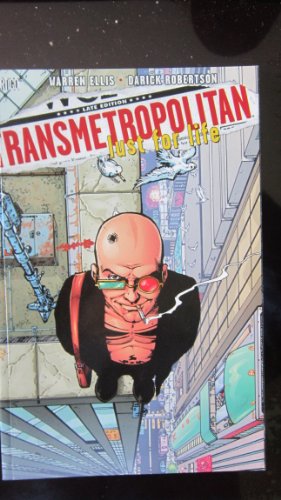
Written By Warren Ellis, Illustrated by Derick Robertson
Transmetropolitan has been on my radar for some time, even though I knew almost nothing about it. It was lodged in my brain alongside a bunch of other 90s-2000s non-superhero comics. I’ve recently discovered just how cheaply you can snag slightly beat-up trade paperbacks of old series at places like ThriftBooks, so I went ahead and purchased the first two volumes of the series just to see if I had any interest.
My feeling coming away from the first volume is that Transmetropolitan is weird for the sake of weird, and that particular brand of “edgy” that was popular in this era, but a little silly in retrospect. It is a depiction of the kind of cultural and technological singularity where almost everything is possible and is probably happening just down the street, but the absolutely schizophrenic nature of that kind of chaos doesn’t really jive with telling a deep or particularly coherent story.
The book begins with former journalist Spider Jerusalem living like a wild-man in a mountain-top cabin surrounded by booby-traps. He is naked, heavily tattooed, and clearly hasn’t gotten a shave or a haircut in a few years. We learn that he was the most famous journalist in a nearby city (simply known as The City), and he gave it all up to move out here. Unfortunately, he signed a contract for a book deal, overdue by five years, and now his publisher is threatening to take the money back. So off he goes, back to The City.
Spider breaks into the offices of his old newsfeed, secures a job and an apartment, removes all his hair with a chemical shower, and gets his trademark glasses out of the totally-not-a-Star-Trek-replicator in his kitchen. Then he turns on the news. There are cryogenic defrostees, people uploaded into nanite clouds, and humans surgically turning themselves into aliens and trying to succeed from The City and create their own colony. As it turns out, these will all be plots for subsequent issues.
The first volume didn’t wow me as an introduction. The chaos of The City struck me as an excuse to just throw any sort of futuristic spaghetti at the wall and see what sticks. The characters all range from unpleasant to outright awful, and I have a hard time taking it seriously when the city is called The City and the protagonist has a name like Spider Jerusalem. But hey, it’s the first volume, and a lot of series don’t find their feet right away, so I started in on the next one…
Transmetropolitan (vol. 2)
Written By Warren Ellis, Illustrated by Derick Robertson
I realized partway through this volume that the post-facts world of Transmetropolitan probably seemed more science-fictiony around the year 2000. Nowadays, it’s hardly any different than world outside my window. This certainly isn’t the first piece of sci-fi to satirize politics and religion, only to find that the future went and outdid them. Being subversive and edgy is not a good way to last—yesterday’s shocks are boring to tomorrow’s audience.
I also came to the conclusion that a lot of what rubs me the wrong way about the series is that it’s packed with big, obnoxious allegory. It’s constantly winking and nudging you.
Transmetropolitan doesn’t have an ongoing arc in these first couple volumes. It’s just a series of unrelated stories. This time, we get one about Spider’s assistant’s boyfriend, who decides to download himself into a cloud of nanites. After that, it’s a cryogenically frozen woman who wakes up and discovers that the future is impossible to acclimate to, and that nobody much cares to try and help her. Then there’s Spider’s tour of the “reservations,” hermetically sealed places throughout The City that are built to preserve different cultures and ways of life. Each of these works pretty well as a stand-alone short story, but it didn’t feel like it was building to anything bigger.
Ultimately, I found that Spider Jerusalem was one of the least interesting characters in his own book. It’s possible that some of these disparate threads will eventually weave back together into a larger story, but I wasn’t feeling it after two volumes. I don’t think I’ll be continuing this series.
This is the second Witcher book that’s billed as a short story collection. And it is, but they end up feeling like more than the sum of their parts. There are bigger arcs happening across these stories, continuing the events from the first book.
In addition to the titular Witcher, Dandelion the bard and the sorceress Yennifer are the other main characters. If there is an overall theme across the book, it’s the angst between Geralt and Yennefer, who are both outcasts and troublemakers in their own ways. They each think they can’t make the other person happy, while also being unable to permanently break things off.
There is also a great deal more world-building happening here, including the first mentions of the Wild Hunt, a mysterious recurring event where ghostly warriors cross the sky and portend disaster and war. These stories are still “low to the ground,” but they incorporate a bit more about the nations and politics of the northern kingdoms.
Of course, it wouldn’t be the Witcher without stories about the interactions between humans and magical creatures, whether that be a shapeshifter stealing friends’ identities or a pompous town mayor in love with a mermaid. It also sets up the series of books to follow, as Geralt meets Ciri, the kid princess whose destiny he inadvertently entwined with his own.
Written By Neil Gaiman, Illustrated by P. Craig Russell
Much like Volume 3, Dream Country, this is a set of mostly stand-alone tales where Dream takes on a minor role. There’s a story about Emperor Norton, the real person who declared himself Emperor of the United States of America, a fable about a clan of eastern European werewolves, a tale of young Marco Polo getting lost (and eventually found) in the desert, and story of a spectacular Baghdad, greater than we ever knew it because it was traded into dreams so it might stay perfect forever.
Unlike Dream Country, there are a few things of note that tie back into the broader ongoing plot. For the first time in the series, we actually see “the prodigal,” Destruction, the one member of the Endless who has abdicated his position. We witness a retelling of the ancient Greek tragedy of Orpheus, who is an oracle, and Dream’s son. We see why Orpheus lives eternally as a severed head, and the cause of the rift between him and his father.
These events lead directly into Volume 7, and it really feels like the meandering main story is picking up steam.
The Sandman: Brief Lives (Vol. 7)
Written by Neil Gaiman, Illustrated by Jill Thompson
The issues of this arc are labeled as “chapters,” and this is probably the most linear and focused volume since the first. The beginning pulls together several threads from earlier stories, and the end implies a whole lot of bad things are in store for Dream.
Each chapter begins with a sequence of cryptic phrases, like this for chapter one:
Blossom for a lady
Want/not want
The view from the backs of mirrors
Not her sister
Rain in the doorway
The number you have dialed…
They turn out to be little landmarks in the story, a game where the reader can try to guess what might happen from these tidbits, and then check items off the list as they come to pass. It got me thinking how excellent the whole series is at these little things. From the surreal Dave McKean covers and interstitial art to the introductory quotes to the entertainingly themed credits, the Sandman books feel like absolutely every single element was labored over more than was really reasonable. All the little things add up.
The story of this volume centers around the duo of Dream and his youngest sister, Delirium (who used to be Delight). Delirium’s personality is somewhere between a young child and a lunatic, and you get the feeling that the rest of the oh-so-serious Endless family is perpetually humoring her. She decides to go looking for Destruction, the brother that abandoned the rest of the Endless and made it clear that he doesn’t want to be found. Delirium asks her siblings to help her, but one by one they brush her off. When she comes to Dream, the most serious of them all, it’s a surprise that he agrees to go with her. So the pair set off to find Destruction.
Eventually, we learn that Dream had ulterior motives, and never really expected to find Destruction. But he takes his responsibilities seriously, and since he promised to help Delirium, he turns to the one person who has the power to find the Endless, even when they do not want to be found: his own son, Orpheus. For this favor, Orpheus (a severed head who cannot die) asks his father to end his suffering.
The book ends with foreboding. They find Destruction, only to have him leave again. Morpheus returns to his realm, everything neatly wrapped up, and then reveals his chalk-white hands stained with his son’s blood. It’s made clear that there are consequences for the Endless when they spill family blood. The only question is what those consequences will be…
Sometimes I look at the Hitchhikers’ Guide omnibus on my shelf and I think sadly about how I’ll never be able to read another Douglas Adams story for the first time. But if there’s anyone who can compare to Adams, it has to be Terry Pratchett. I’m grateful that unlike Adams, he wrote so prolifically.
There are 41 books in the Discworld series, and I’ve been slowly going through them, picking up new ones at Half Price Books whenever I see them. I’m savoring them, because I know eventually I’ll run out.
Small Gods is about an accidental prophet named Brutha, in the desert land of Omnia, where the people worship the god Om. Omnia is a strict theocracy where the church is the central pillar of life, and it’s not uncommon for supposed sinners to have the badness tortured out of them. Faith is of the utmost importance in Omnia, so it’s especially awkward when Brutha discovers that Om is trapped in the form of a turtle with hardly any godlike powers at all, and this is because nobody besides Brutha actually believes in him anymore.
Brutha goes on a hero’s journey, and despite his best efforts he manages to overthrow the Omnian order, restore (real) belief in Om, and generally start making the country a place where people can live their lives without worrying about being randomly tortured.
Small Gods isn’t my favorite Discworld book, but it’s a parody with plenty of laughs and a few sideways glances toward our world. As usual, an average book by Terry Pratchett is quite good by anyone else’s standards.
One of the joys of being a parent is getting to share things you enjoy with your kids. One of the strange things about being a parent of several children (with a few years in-between) is that I’ve shared a bunch of those things with my eldest kids, and my youngest knows nothing about them. So, although I read the Harry Potter books to my eldest son—and my daughter was sometimes in the general vicinity of the reading—I was told that we should read them again. And now we are.
I’ll say here that I don’t agree with Rowling and the garbage she is now known for spewing on social media. I also think it’s fashionable to criticize books by authors who are deemed terrible people. Despite Rowling acting out, I think the Harry Potter books are perfectly enjoyable.
A lot of the complaints about this series are about all the unbelievable aspects of the world-building. There are a lot of problems with the Wizarding World and its interactions with the regular world that just aren’t addressed. And that’s completely true. But I also think it doesn’t really matter.
The odd thing about this series is that it grew up along with its readership. The first book is very much a children’s story, in its form and in the language it uses. It’s not worried about perfectly consistent world-building, any more than Little Red Riding Hood or Goldilocks is, because the shape of the story still works. Part of that is because it borrows from fairy tales, starting with the classic evil step parents (or in this case, aunt and uncle), and the orphan boy who is destined to save the world.
So shockingly, my takeaway is that a super-bestselling book that started a huge pop-culture craze and made more money than some small countries does, in fact, do a lot of things well.
What I’m Reading in September
I’ll continue working my way through the Sandman and Witcher series. I might go for a couple brand-new books about writing that I just got. I also recently compiled a list of highly-rated comics from the last 20 years, and I might start working through some of those.
This is the monthly post where I talk about what I’ve been reading. As usual, if you’re interested in any of these books, please use the included Bookshop.org links instead of Amazon. It helps independent bookstores, and I get a small affiliate commission.
I was surprised how quickly this volume rushed into the plot that would drive this entire arc. For the first time, we see Dream meet with all of the other Endless, except for the still-unrevealed “prodigal.” His elder brother, Destiny, calls them together for a meeting, because his book (which describes everything that will ever happen) tells him that’s what’s he’s going to do.
In previous volumes, it was revealed that Dream was once in love with a mortal, and when she rebuffed his advances, he got very grumpy about it, and threw her in hell, where she’s been for a few thousand years. For some reason, Dream’s siblings bring this up, and amazingly, for the first time, he realizes that this was a pretty shitty thing to do.
He embarks off to Hell, and Gaiman cleverly sets us up to think that Lucifer is going to fight Morpheus, but when Dream arrives, he finds the Lightbringer shutting everything down. He gets his revenge on Dream by giving him the keys to an emptied Hell.
The rest of the book follows Dream as various old gods come to his kingdom to ask for the keys to Hell, a piece of prime psychic real estate. We see him for the first time as a royal figure, with these mythological figures seeking his favor. He turns out to be adept at navigating the politics of the situation, and he manages to get rid of the key and free his former girlfriend in the process.
I think this might be the first volume that is completely free of any superhero references, which is no big deal in modern comics, but was probably a rarity when it first released.
Volume 5 revisits Barbie (no, not that one), who was first introduced in Volume 2, The Doll’s House. She’s split with Ken (no, that that one either) and now lives in New York, in an apartment building with a whole new set of interesting neighbors. In Volume 2, we saw bits and pieces of Barbies dreams, which were an ongoing fantasy tale where she was the protagonist. Here, we find out that she hasn’t been dreaming for months, and when her dreams return, they bring some very real nightmares with them.
I’m hardly an arbiter of wokeness, but I will say that this story was written in 1991, involves a lesbian couple, a trans woman, and a homeless person with implied mental illness, and feels surprisingly modern and respectful in the way it treats all of these characters. The world around them doesn’t always treat them kindly, but the narrative explores them honestly as people with good aspects and interesting flaws, rather than caricatures.
This volume also barely involves Morpheus. The apartment building crew venture into Barbie’s strange dreams and confront an invading creature. Only at the very end does Dream show up, giving us a few tidbits of info about his past.
I have to say at this point that I had forgotten how meandering the series is. There are certainly bits and pieces of connective tissue: characters that keep coming up, and the ongoing theme of Dream learning how to be more “human” and a bit less of a stodgy, immortal curmudgeon. And hints of a feud with Desire. I’m now halfway through the original run, and there’s no clear overarching conflict apparent. Yet. Luckily, the world, the characters, and the writing are so good that I don’t much mind.
The city of Ambergris left a strong impression on me, and I decided about a year ago that I needed to explore more of Jeff Vandermeer’s work. So I picked up Dead Astronauts, only to find it almost inscrutable. Then I discovered it was actually the second book in a series. I finally got back around to picking up the first book, and that is Borne.
Vandermeer has once again created an amazing setting in the confines of a city. We learn that the Earth has been ravaged by environmental catastrophe and bioengineering run amok, but apart from this, very little is revealed beyond the City. The City has no name, and it is a ruin surrounded by harsh desert. It is inhabited by scavengers, and by Mord, the kaiju-esque 3-story-tall bear. Mord and many other creatures were engineered by the also-unnamed Company, which exists as a huge, white building at the edge of the city, abutted by the holding ponds where the bio-waste and failed experiments are dumped, to eat each other and be eaten, and sometimes to escape into the City.
Borne is about a scavenger, Rachel, and her partner and lover, Wick, a sort of freelance bioengineer who once worked for the Company. They protect and defend their base of operations, a half-ruined apartment building, from scavengers, from another Company alumn called The Magician, and from Mord and his monstrous bear minions. Rachel discovers a piece of biotech, which she calls Borne, who turns out to be a sentient shapeshifter and becomes a sort of surrogate child to her.
I find Vandermeer fascinating because he is frequently riding the very edge of the Principle of Least Necessary Information. This book and the Ambergris stories are all a kind of puzzle that manages to propel you forward through the story while scrounging for hints and clues about what exactly is going on. I devoured this book in a day, because I couldn’t stop reading.
The Strange Bird is a hundred-page story set in the same world as Borne. It starts with some tantalizing bits outside the City, as the titular Strange Bird escapes from a bio-engineering lab and sets off in search of…something…it’s not sure what, but it knows it’s got to find it.
After a series of adventures that leave it considerably worse for wear, the bird arrives in the City and is captured by The Magician. This middle part of the story covers some of the same events from Borne from a different viewpoint, providing more context around the events toward the end of that book.
Eventually, the bird escapes once more, in an entirely new form, and continues its journey. When it finally arrives at its destination, it discovers that the thing it was looking for is long gone, but the ending is bittersweet and it still manages to find some peace at the end of the road.
I was excited to return to Dead Astronauts, now that I had the first two stories in the series fresh in my mind. If Borne rides the edge of Least Necessary Information, Dead Astronauts jumps head-first off the edge. It is experimental in the extreme, living somewhere between poetry and novel. In my original reading, I was lost. With the added context of Borne and The Strange Bird, I was able to follow the story, but I’d be lying if I said I understood everything.
Dead Astronauts has four parts. In the first part, we follow the three “astronauts.” They are Moss, an ever-changing plant creature in the form of a human, Grayson, an actual astronaut with a robotic eye, and Chen, a former Company bio-engineer who sees the world in equations. These three have made it their mission to destroy the Company, and to this end, Moss shunts them between parallel universes to try to find a version of the City and the Company where they can gain an advantage. The Company, however, also coordinates between parallel universes, and in the end, the Company seems to overcome them.
The second part shifts perspective (and uses the rare second-person!) We follow a character who remains unnamed for almost the entire section, living homeless in a city that may be a past version of the City, or may be another place entirely. Creatures from the Company begin to appear , followed by the Company’s agents, biological and robotic. There are pale men who may have some relation to Wick from Borne, and a duck with a broken wing, an innocuous creature that turns out to be a horrible monstrosity.
In the third part, we learn more about what goes on inside the Company. We learn about Charlie X, a character who has appeared in the first two stories in smaller roles, and how intertwined he is with everything that has happened. While we get more information, the origin and the nature of the Company are never entirely explained. Is it responsible for the ruination of earth? Or did it merely take advantage of it? And just how many of its tentacles did it send out across parallel universes? Vandermeer gives plenty of tantalizing clues, but no clear answers.
The final part of the story follows the blue fox, another bio-engineered creature that has appeared here and there in the other stories. The fox shares a connection with Moss, and it can also cross between parallel worlds. In this final part, the different storylines become intertwined across time and the different versions of the city. Causes and effects are all mixed up in twists and loops.
Reading these three books in order, I enjoyed them immensely. If you can accept that not everything will have a clear answer, and you’re interested in puzzling through some of the mysteries, I would highly recommend the series. This is pretty much the pinnacle of literary science-fiction.
I’ll continue The Sandman series, and pick The Witcher series back up as well (in fact, I’m already halfway through the next book). I’m also eyeing some unread books on my bookshelf by Terry Pratchett and Andy Weir. See you in a month.
As far as I can remember, this is only the second Neal Stephenson book I’ve read. The first was Snow Crash. As you’d expect from books written twenty years apart, they’re quite different. From this admittedly tiny sample size, I get the impression that Stephenson has undergone the same transformation as William Gibson, from cyberpunk science-fiction to stories that interpret current technology through a futurist lens: stories that say, ”it’s hard to believe it, but these things could happen today.”
Reamde is a book about ransomware, money laundering through MMORPGs, the Russian mob, and Islamic terrorists in China.
1. Style is an Engine of Story
Sentence-to-sentence, Reamde is a fantastically well-written book. Stephenson’s prose reminds me of literary fiction, because it was just as critical to my enjoyment of the book as the characters or plot. However, the style is very different. It’s not lyrical, it’s clean and precise, but that doesn’t make it any less captivating.
The best way I could describe it is that it feels like walking through the story with Terminator vision—everything overlaid with little details, and targets zooming in to focus your attention on important things.
There are many engines that can power a story, and a strong style like this is a great one, if you can manage it. Since it’s all about how you say it, not what you’re saying, it layers nicely with other engines.
2. Eschew Unnecessary Detail
The level of detail used to describe something—a place, a character—can be an important cue to the reader. Describing something in detail indicates its importance, and explicitly limiting that detail shows a lack of importance.
At one point in the book, some characters meet the pilots of the private jet they will be riding on. The pilots’ introduction is sparse: “He greeted the pilot by name.”
The pilots are necessary to the plot, so they have to be mentioned. Stephenson could have come up with a throw-away name, but this gets across the message just as well. It’s a clue that the pilot will only be relevant for a short while. The reader doesn’t have to worry about remembering the name of yet another side character.
When characters are going to be important (or at least stick around for a while), Stephenson makes sure to introduce them in a way that reveals one or two interesting physical characteristics and something that reveals a bit of their personality. This makes them instantly memorable.
The other great use of this technique is to add detail to accentuate things that will be important to the plot. It’s like a miniature “gun on the mantle.” If you spend time describing a key and a padlock, that lock ought to be important. If you leave garbage out in the forest to attract dangerous animals, some dangerous animals had better show up at some point.
3. Coincidences Strain Believability
Incredible coincidences or lucky breaks aren’t unusual in action/suspense stories like this, but they have to be used carefully.
Reamde’s plot really kicks off with one such coincidence, and it results in several characters getting mixed up with the Russian mob. To me, a crazy coincidence works great as an inciting incident.
Where coincidences start to chafe is when they’re used to repeatedly ratchet up the tension, or even worse, to resolve a problem.
There’s an egregious example of this at the end of Act I of Reamde, where everything that happens in the latter 2/3 of the book hinges on a group of hackers who just happen to live in the same run-down tenements as a terrorist cell. In a city of millions.
There are other examples as well, including several chance meetings among the large cast of characters that end up being vital to the plot later on, and many of the characters being players of the in-story MMO, T’Rain, so that there’s always someone available to log on when it becomes relevant to the plot again.
When I got to the part where bad guys were killed by a cougar, I had to stop reading and look up the stats on cougar attacks. Then I just threw up my hands and accepted that this is what I signed up for. That’s not the kind of reaction you generally want from a reader.
4. Beware Pet Characters
Stephenson is deeply in love with Richard “Dodge” Forthrast. He’s the cool, smart guy who gets along in any social strata and knows all the things. He’s a former pot smuggler turned Silicon Valley CEO. He’s bored of being a billionaire, because he’d rather be out solving some new earth-shattering problems. He is the Golden Boy caricature that people like Musk, Zuckerberg and Bezos try to project.
Even in a life-threatening situation, he’s having fun, practically on vacation. It’s really only at the very end of the book where he shows any amount of fallibility. Of course, he makes up for it by being the guy who saves the day.
The strangest thing of all is that this is really not his story. Although the perspective jumps around, the bulk of it is from the perspective of Zula, his niece, and she’s the one with a character arc and the most to lose. Yet the story starts and ends with Dodge.
Because Stephenson is a great writer, Dodge is still a fun character, but I’d like him more if he was a little more human and fallible.
5. Structure is a Double-Edged Sword
Like most suspense stories, Reamde has constantly escalating stakes. Every section is essentially “out of the frying pan, into the fire.” Things could always get worse (or worse in a new way).
The danger of this constant escalation is that it can quickly ramp to extremes (and well beyond). It’s easy to jump the shark.
In Act II, Reamde splits many of the characters up into separate groups in their own bad situations. I realized pretty quickly that the rest of the book was going to be about how everyone long journey to end up back together in one place, for the final showdown.
However, wrangling everyone back to the same place, at the same time, requires introducing another round of characters and another handful of helpful coincidences.
This made the second half of the book feel considerably more meandering. When everyone finally arrived at the final showdown, there were so many characters involved and so much to resolve that there were literally 100 pages of running gunfights.
By that time, the story had escalated to such extremes that my reaction to the bad guy’s final defeat was a combination of exhaustion and relief that it was done.
Bookends
It’s been a while since I read a book that was such a mix of joys and irritations. I love Stephenson’s prose, but this book did not need to be a thousand pages or finish with a novella-length series of shootouts.
Reamde was released in 2011, so I’m thinking I’ll pick up Stephenson’s latest novel, Termination Shock, sometime soon, just to get the full “bookend” experience of his career so far.