Reference Desk #19 — Critters

In my last post, I talked about revising my novel, Razor Mountain, and I mentioned that I was using Critters.org to get some feedback on the early chapters. I was sure that I had talked about Critters previously, in my “reference desk” series about useful tools for writers, but when I went back and looked through old posts, I was shocked to discover that there was no such post. Today, I’m going to remedy that.

Online Critique

I’ve written on a couple occasions about getting reader feedback and why it’s valuable. I think most writers will naturally understand the value of beta readers, editors, and improving writing through several drafts. Revisions without feedback are needlessly hobbled.

However, there’s more than one way to get feedback. An online critique group like Critters has some disadvantages: you won’t necessarily know everyone, and you aren’t engaging with readers face-to-face. You also don’t get to pick your readers, so the feedback may not be quite as tailored as a traditional writing group.

So why use an online critique group? Well, there are some advantages too. Online critique can be asynchronous, making it easier to avoid scheduling issues, and lower-pressure. Feedback is written out, which gives you a useful artifact that you can save and consult as needed during revisions. Since the group is less formal and doesn’t meet in the real world, people can come in and out according to their personal situations. In short, an online group like Critters is less formal than many in-person groups, which can be a good or bad thing.

Critters.org

Critters.org (and its pseudonym Critique.org) is an online writing workshop that has been around since 1995, with over 300,000 critiques in that time. The main, original workshop group is focused on speculative fiction: Science Fiction, Fantasy, and Horror. Since its inception, it has expanded to 17 different workshops covering most genres of fiction, mainstream and literary fiction, and other media such as comics, film, music, photography and more.

Critters is free to use, and always has been, surviving on goodwill donations. It is not exactly a svelte, modern, or flashy website. It still looks and functions a bit like a website from the 1990s—mostly text and links and a big top menu with dozens of pages. It is still maintained by the original founder, Andrew Burt, and a host of minion programs he has created. As a programmer, I feel right at home. For non-programmer writers, I imagine it’s a little bit off-putting.

The mechanics of critique are simple. Members can submit a manuscript via webpage or email by filling out some information and attaching their work. These pieces go into a queue, and each week a dozen or so are “released” to the group. Members then submit their critiques via webpage or email, and those critiques are forwarded to the authors.

To ensure that everyone gets good feedback, critiques must fulfill a minimum length (a paltry 200 words), and any member who wants their work sent out in the queue must submit a critique 75% of the time, or 3 out of every 4 weeks.

Cultivating Culture

A distributed group like this lives or dies by its culture. Plenty of message boards and chat rooms have fallen by the wayside because they didn’t moderate effectively, and became cesspools of hate speech and trolling. Critters has survived so long and continues to be successful because it has developed a culture of respectful and honest feedback.

When signing up for the group, new members are directed to several articles on the site about diplomatic language and effective critique. Authors are also warned that honest feedback can be hard to hear, and that some critiques are well-intentioned, but a little more blunt than you might like.

Members submitting critiques are also required to check a box stating that they have been diplomatic, which is obviously not hard for the malicious to overcome, but serves as a good reminder for those who are acting in good faith.

Of course, like any effective moderation policy, there are ways to escalate bigger issues. I’m sure there have been trolls in the past, but I suspect that Critters has the advantage of being a bit of a dusty niche of the internet, where troublemakers aren’t common and most people are putting forth some effort in order to improve their skills and their work.

My experience has been extremely positive. I have never had any outright problematic critiques, and I could count the number of overly-blunt or tone-deaf critiques on one hand. (Honestly, an occasional rough critique is probably good practice for being in this industry.)

Details

There are a few interesting little details about Critters that aren’t necessarily apparent unless you read through all the documentation up-front.

Partial Credits

Normally, an author submits a story and anyone who provides a critique of the minimum (200 word) length gets credit for participation that week, counting toward the 75% rule. However, if the story is short—under 2000 words—then any critiques will only count for half-credit. This is to encourage readers to critique longer stories, and not just focus on these quick reads. A half-credit does not count toward the 75% ratio until you’ve done two of them.

Critique Counts

It’s possible to see the current number of critiques submitted for each manuscript in the current week. These counts are updated in almost real time. Critters’ weeks run from Wednesday to Wednesday, and a lot of critiques come in over the weekend, so I like to look at the counts before I pick a story for critique. Sometimes one or two manuscripts will have very low counts, so I like to help those folks out. If someone already has 15 critiques, what are the odds that I’m going to be repeating things someone else has already pointed out?

In general, novel chapters get fewer critiques than complete stories, and longer stories get fewer critiques than shorter ones. So, you’re likely to get the most out of Critters if you write a lot of flash fiction, and considerably less if you write novels with long chapters.

RFDRs

RFDRs, or “Requests for Dedicated Readers” are submissions for novels, where the author is requesting volunteers to read the entire book and provide feedback. RFDRs often include chapters of the book, and anyone can still submit a critique for the submitted portion without signing up to read the whole book.

If a reader accepts an RFDR, they contact the author outside of Critters, typically by email, and coordinate the process. Because reading a whole novel is a big ask, completing an RFDR is worth one credit for every 5000 words of the book. So an 80,000-word novel, fully critiqued, would be worth 16 individual critiques! However, if the RFDR agreement is for the whole book, then the reader has to complete the whole thing to get credit. If they give up partway through, it’s up to the author whether they’ll still give credit for the work that was done.

My limited experience is that there are a lot of novels on Critters (about half of all submissions), and not very many people interested in RFDRs. This limits how much an author can get out of critique for a novel, since it takes a long time to send an entire novel through the queue, one or two chapters at a time, and not all readers will have read previous chapters to understand the full context.

Resets

The 75% participation ratio can be daunting, especially if you’re not used to critiquing. It’s easy to miss a couple weeks and fall behind.

I have been a member of Critters for years, but not continuously. I’ve taken months or years off, which will decimate the participation ratio. Luckily, this is a common issue. If you need to take time away, or you fall hopelessly behind, you can submit a request to have your participation ratio reset. You then only need to start submitting a critique each week to be back in good standing and have your work go out in the queue.

Giving and Receiving

Finally, I’ll reiterate something I mentioned on Twitter recently. It’s extremely useful to get feedback on a work in progress, but it’s equally valuable to critique the work of other authors. It’s practice for editing your own work with an unbiased eye. I have discovered problems in my own writing that were only apparent after I wrote critiques of other people’s stories. Sometimes it’s just easier to see an issue in someone else’s work than in your own.

Try It!

If you have a hard time getting a writing group together in the real world, or you simply prefer a less social, asynchronous, or easier-to-schedule option, Critters is a fantastic alternative. I’ve been using it for years, and there are plenty of professional and published authors who are members.

If you’re on the fence, I’d encourage you to give it a try. It’s as simple as submitting a story and doing a few critiques. You’ll likely get feedback from 5-20 people, and you can evaluate the quality for yourself.

Making a Novel Editing Plan

Previously, I talked about using reader feedback and critique to gather information about what needs to be improved in a story. Right now, I’m in the process of gathering that feedback for my novel Razor Mountain.

Today, I’d like to dig into the next part in the process, taking that feedback and deciding what to revise.

Deciding What to Edit

There are two parts to editing: deciding what to change, and making those changes.

Feedback and critique from readers is a great way to get fresh eyes on a project that you’ve been working on for a long time. It’s easy to develop blind spots when you know the story so well, and others can help you find the parts that exist in your head, but not on the page.

The most obvious source of feedback will be your own notes when you re-read your story. It’s important to read as an editor, looking for problems, and you may want to make multiple passes to really focus on different aspects of the story.

Finally, it’s important to pay attention to your personal foibles. Every writer has at least one or two bad habits. These could be broad things like letting your dialogue meander, or specific things like “danger words” you tend to overuse or use to bad effect. For example, I’ve recently caught myself overusing words like “seemed” and “mostly” and “felt,” words that make a sentence less precise.

You might notice these foibles yourself, or a good critique may point some out to you. Either way, it’s good to keep track of them so you can excise them from the current manuscript and work on avoiding them in the future.

The first step in editing is to create a list of things that need fixing. The items on the list can from any or all of these sources. Don’t worry too much about listing every single thing. Editing is an iterative process.

Editing Big to Small

The line between deciding what to change and making those changes can be blurry. When the issue is a typo or grammatical error, the fix is often obvious as soon as the issue is identified. This kind of editing can feel deceptively easy and productive: you just have to read and fix these obvious errors as you come to them. However, some issues are larger. If chapters or scenes need to be rearranged, or a conversation needs to be rewritten, there may be several complicated choices that need to be made.

Different types of edits affect the story at different levels of abstraction. The chapter that needs scenes rearranged might also include a dialogue that needs to be rewritten, which includes a typo or grammatical issue. In this case, fixing the typo may be a waste of time, because it will be deleted when you rewrite the dialogue. That may also be a waste of time though, because in rearranging the scenes, you find that you no longer need that conversation.

The ideal way to address this problem is to identify and fix the big-picture issues first, then systematically drill your way down into smaller and more detailed aspects of the story until you get to the individual sentences and words. Of course, the creative process is rarely that organized and straightforward, but it’s a good ideal to keep in mind.

By trying to address big problems before smaller problems, you can avoid a lot of wasted work. There will always be problems that you discover while working on something else, and that’s okay too. You can always back up to higher levels of abstraction to fix something before diving back into the nitty-gritty details.

The Editing Cycle

While the process I just described may sound totally linear (start big and work your way down), it’s really more complicated than that. Editing is iterative. A change in one place may necessitate an adjustment in another.

Feedback may not all come in at once, and you may discover high-level changes that need to be made when you thought you were down to line edits and little changes to word choice. These are the challenges and frustrations that are part and parcel of editing, especially in large projects like a novel.

The reward for these challenges and frustrations, however, is the transformation of a rough draft, with all of its flaws and blemishes, transformed into a sleek and polished work of art.

Editing Razor Mountain

I suspect I’ll continue to post here and there about editing for the next couple months, since a lot of my writing time and thought will be devoted to editing Razor Mountain. I plan to write at least a couple journals with specifics, but these will be more sporadic than the previous journals.

Feedback and Critique — User Testing Stories

I recently posted the last episode of my serial novel, Razor Mountain. Finishing a novel is a fantastic achievement, so the first thing I did was congratulate myself and take a little break from the book. However, the work isn’t done yet. I still need to edit and polish it to really call it finished.

Writing is often thought of as a solitary process, the lone writer hunched over a keyboard in a dark basement. It can be that way sometimes, but editing is much more effective if it incorporates reader feedback.

User Testing

In my day job as a software developer, we are constantly creating, changing, or improving features in our software. Those changes then go through a gamut of testing, with developers, with quality assurance, and with users. This process gives us feedback to understand whether the people who use the software understand the new features, and what they like or dislike. We can take that feedback and make features easier to use, less confusing, simpler, or more powerful, depending on what the feedback tells us. While there are best practices, acting on feedback like this is equal parts art and science.

Game makers (video games, board games, and table-top RPGs) also often incorporate this kind of user feedback into their creative process. Where business software is all about maximizing efficiency, ease of use and costs, testing and feedback in games is usually about maximizing fun. That might entail fixing bugs or broken rule sets, but it often involved blurrier concepts, like balancing different factions or ramping up tension from the start to the end of a match.

It may seem odd to apply these ideas of testing to a story that you’ve slaved over and poured your heart into, but feedback can be just as valuable for fiction.

Auteur or Aoidos?

There is a popular conception these days of movie directors, show-runners and novelists as genius auteurs who produce intricate stories all at once, from whole cloth. In that worldview, the story is an artifact handed down from author to audience. The audience appreciates the work or dislikes it, and that’s the end of the interaction.

On the opposite end of the spectrum is stand-up comedy. Successful stand-ups often do many shows per week, trying out different jokes in different sets, changing or throwing away what doesn’t work and polishing what does. Some will take their best material and craft a broader story as a through-line. Material may carry through hundreds of performances, with each one being unique. This kind of performance-first attitude isn’t so different from the ancient oral poetry performed by Greek aoidos thousands of years ago.

Both kinds of artists have a story that they want to tell to an audience. The cloistered auteur firmly believes that they are crafting the one, true version of their work, and will brook no other opinions. If the audience doesn’t connect with it, that’s the audience’s problem. The advantage that the performer has over the auteur is that the performer can see exactly what effect their work has on the audience. They can improve and adjust the bits that don’t connect with the audience.

As an author, it’s hard to test your work against a mass audience like a stand-up, but getting feedback from beta readers can achieve some of the same effects at a smaller scale.

Understanding Readers

One of the advantages of a smaller pool of feedback readers is that you can better understand them and categorize their feedback. Not all readers are the same.

Many writers will have family members or friends who are happy to read for them, but will thoroughly sugar-coat any feedback they give because they don’t want to hurt the author’s feelings. Readers who don’t often read your genre may offer to help, but will have a hard time grasping genre conventions that a reader deep in that genre would breeze past. Fellow writers in a writing group will likely have a much better idea of the kind of feedback you want, because it’s the same kind of feedback they want on their own work.

When gathering potential readers, segmenting your audience can be very helpful. It may be useful to adjust what you ask of different types of readers, and it is absolutely necessary to adjust your own expectations. If a random family member wants to read, but you know they’ll only say nice things, feel free to let them. They’ll feel like they’re helping, and you may still get some tidbits out of it. On the other hand, a writer friend in the same genre might be happy to take a list of your concerns for a story and provide a detailed and harshly honest response.

Preparing Readers

You may want to give your readers a set of questions to inform their feedback, especially if you know their particular strengths and weaknesses. You may also have different concerns for different stories.

The good folks over at the Writing Excuses podcast suggest a set of general questions that can apply to any story:

  • What parts were especially awesome, boring or confusing?
  • Were there any parts where it was difficult to suspend disbelief?
  • When did you feel most absorbed in the story?

Often, readers will offer possible fixes for the problems they perceive. It’s up to you whether you want to solicit that kind of feedback, but it’s likely to happen anyway. However, the reader’s feelings are more valuable feedback than their suggested fixes. The reader is always correct about how the story makes them feel. They know exactly where they got confused or bored or excited. They’re just not usually very good at figuring out what to do about it.

Don’t feel obligated to accept a reader’s suggested fix for a problem. Firstly, you may not think it’s a problem. Even if it is, the source of that problem may be somewhere that the reader doesn’t understand—this often happens when different readers point out different issues that stem from the same root cause. You, as the author, have the best understanding of the story your trying to tell, and that expert view will help you triage any problems.

Making an Editing Plan

Soliciting reader feedback is just one of several ways to decide what to change in the edit. In my next post, I’ll talk about making an editing plan and tackling actual changes to the story.

I Have Mixed Feelings About Wattpad Comments

When I decided to write Razor Mountain as a free serialized novel, I figured that I might as well try to get as much exposure as possible. In addition to posting chapters here on the blog, I picked two other services to try publishing on, Wattpad and Tapas.

I will readily admit that I’ve put very little effort into publishing over there. I haven’t done all the tedious little things that people do to get attention on those sites. I haven’t worked hard on graphics or picking the right tags and metadata. I haven’t been going around and commenting on other people’s work to try to get them to read mine. Every once in a while I forget to upload chapters for a couple days after they go up on the blog. (Why, oh why, does Wattpad not have a “schedule post” feature?)

Razor Mountain hasn’t been very visible, and hasn’t caught a lot of eyeballs on these services. I wasn’t that concerned about it—I wanted to spend my time writing, and I figured I might try to drum up more views when I had a larger chunk of the book written.

Comments, Comments Everywhere

Although I haven’t gotten around to optimizing Razor Mountain on those services, a few readers have found the book anyway. As they came through, I began to take notice of the comment system on Wattpad.

The music service SoundCloud shows a waveform for each song. When a listener leaves a comment while listening, the comment appears at that particular point in the song. This lets people tag the moments in a song that they really liked.

Like most comment systems, it has some issues with spam and the general unpleasant behavior of online anonymous people. But it’s an interesting idea that can give the comments more context.

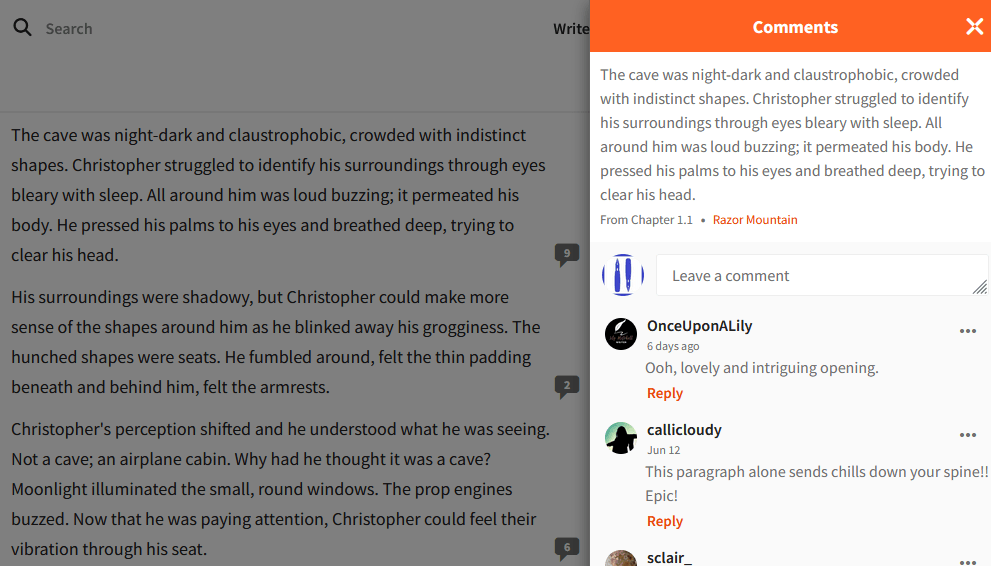
Wattpad has a similar comment system. Instead of simply commenting on a particular chapter or part, readers can leave comments on each individual paragraph, and the number of comments shows in the margins. The comments themselves slide in on a sidebar. Like SoundCloud, their goal is clearly to put those comments in their context. But I’m not sure it works as well here.

It’s possible to listen to a song and jot a quick comment at the same time, but commenting on a story is necessarily going to pause your reading experience.

Short, Quick and Shallow?

Wattpad is a fiction platform designed for readers on mobile, competing directly with social media, and social media is all about capturing attention. Social media encourages short, bingeable pieces of content and simple interaction. It encourages those quick dopamine hits that pull people in and keep them tapping, clicking, swiping.

I won’t get deep into social media commentary here, but I think it’s clearly evident that a lot of these platforms encourage shallow content and interaction as a side-effect of the overriding need to capture as much attention as possible. Complex, deep, or high-effort content and interactions require more effort from a person arriving for the first time, and they’re more likely to “bounce off” and go back to infini-scrolling TikToks.

Wattpad and other mobile-centric fiction services feel like they live in the same ecosystem. Short parts or chapters are encouraged—each story has a view count and number of votes that just aggregate the views and votes on each part. More parts equate to more views, more votes, and higher rankings.

Limiting readers to a comment at the end of a section (like this old-fashioned blog does) tends to garner fewer comments, and those comments tend to be thoughts about the whole thing. Paragraph-specific comments encourage the reader to comment quickly, in the middle of reading, and they encourage prolific commenting.

From what I’ve seen, comments on Wattpad tend to match these expectations this pretty closely. If a reader does comment, they usually leave several on a given part, and they are rarely more than one or two quick sentences.

Feedback

Okay, now that I’m in full, old man, “get off my lawn” mode and complaining about social media, let’s push back. Anyone who has participated in a writing group or critique circle might now be thinking, “Super-specific feedback? Sounds awesome!” One of the reasons that dedicated beta readers, editors, and communities like Critters are so great is that they give you really specific feedback on your work, and that kind of feedback is really needed to polish a piece.

However, if you actively seek out this kind of feedback, you know that not all comments are created equal. It’s great to know when you’ve written something that really works for the reader, and it’s even more vital to know when something doesn’t work. For that to happen, you need thoughtful and honest critique from a reader that wants to help you improve, and isn’t afraid to tell you when something is bad.

For a lot of hobbyist writers, this is a hard pill to swallow. It never feels good to hear that you wrote something bad. But it’s hard to fix it if you don’t know it’s broken.

I don’t see this kind of feedback on Wattpad. I’m sure there are some organized groups that do serious critique, but most readers are just looking for something good to read. If they don’t like it, they’ll stop reading. Many others are writers themselves, but they’re trying to solicit views on their own work.

Perhaps most importantly, all comments are public. Negative feedback, even when couched in positive, polite language, feels a bit like calling the author out in this kind of public forum. The only way to give private feedback to an author is through direct messages, which aren’t even tied to a specific story or part, let alone an individual paragraph.

My Own Experience

I’m not a regular Wattpad reader. I find it frustrating to find stories that actually interest me (although if you like teen and paranormal romance, hoo boy, there’s plenty for you). I have recently put in some effort and sampled a bunch of stories. I’ve tried leaving a bunch of comments throughout a chapter. I mostly find that it brings me out of the flow of the story.

Of the comments I’ve received, it’s hard to gauge how much readers are actually enjoying the story, and how many are just trying to be nice. The one or two comments that have made me consider edits to the story were not because of direct feedback, but because they showed that the reader clearly missed something I had intended for them to understand at that point. That could be useful (if incidental) feedback, but it’s also hard to guess if these readers are actually paying attention, or just skimming their way through.

I’m curious what others think. Do you like the idea of this kind of feedback? Do you think it encourages shallow interaction? Am I expecting too much?

How to Research for Fiction

No matter what you’re writing, at some point you’re going to have to do some research. It may be the details of exoplanets or ion drives for sci-fi. It may be mythology or medieval society for fantasy. It may be the royal court of Victorian England for historical romance. Every genre and style of story can benefit from some kind of research.

However, research can be challenging. Sometimes, the information you want is difficult to find. Sometimes it doesn’t exist. When I started my novel, Razor Mountain, I quickly discovered just how little we know about prehistoric humans more than ten thousand years ago.

Sometimes, there’s far too much information available, and it can be completely overwhelming. It’s easy (and dangerous) to get sucked into endless YouTube or Wikipedia links in the middle of a writing session.

There’s a great discussion around research for fiction on episode 15.41 of the Writing Excuses podcast. Mary Robinette Kowal suggests that the best question to ask is “How little research can I do?” I take that to mean, “how can I do exactly enough research to write this thing well?” Research can be fun or frustrating, but ultimately it only has measurable usefulness if it contributes to the writing getting done.

When trying to limit your research, there are three important questions: when to research, what to research, and how much to research.

When to Research

Research can be done before, during, or after the first draft of the story.

Before starting the actual writing, you may have an outline, but you will be at the point where you know the least about your story, and therefore the least about what you need to research. However, before writing is a great time to do general research about a particular setting, a culture, a time period, or other broad parts of the story’s milieu. This kind of undirected research is a great way to find new ideas that will feed into the story and the characters.

N.K. Jemisin suggests traveling to places that you’ll use as settings in your stories. Of course, that’s only feasible if the setting exists in the modern world (or you can glean something about the past from visiting the present). It’s also time- and money-consuming, and not always practical for many writers or smaller projects. Sometimes Google Maps street view is good enough. However, if you’re making money from writing, travel can sometimes be used as a tax write-off, and a great excuse to see new places.

During the actual writing is when it’s easiest to find smaller details that need to be researched. These may be simple facts or figures to look up, like the three tallest mountains in the U.S., or more general ideas, like what types of fruit you’re likely to find in the green room of a Chinese TV talk show. It’s more rare to suddenly realize you need broad knowledge of a particular setting or culture, but that can happen as well, especially of you are an exploratory writer, and you’re discovering your plot as you go.

After writing the initial draft, research is sometimes an important part of editing. Things that didn’t make sense or need to be expanded may require research.

Putting Off Research and Filling Blanks

Research, especially at a broad level, can be infinite. You can know the answer to the three tallest mountains in the U.S., but if you’re researching the Canadian punk scene in the mid-1970s, you have to go in knowing that there is no end-point. The research is done when you feel like you have enough to write the story.

This mindset of “how little can I research” helps to avoid the problem of research as procrastination. Writers find a million ways to procrastinate, and research can be a dangerous one, because it feels useful. If it’s not putting words on the page, it’s really just a form of entertainment, not productivity.

This kind of undirected research can completely derail a writing session. In Writing Excuses 15.41, Cory Doctorow suggests using the old journalist notations, TK (for “to come”) and FCK (for “fact check”). When you’re writing, and you need a fact that you don’t know, just throw TK or FCK into the manuscript with some placeholder text and keep writing. This can also work when you need to remember something from earlier in the story — was the murder weapon in the study or the library? Just TK it and keep writing.

These strange abbreviations are sequences of letters that tend to not show up naturally in English, so it’s easy to search for them later. You can always come up with your own notations, but I’d suggest you use something that’s easy to search out in a manuscript. You might dedicate time to a research session instead of a writing session, going through these notes and finding what you need to fill in the blanks, without worrying about it detracting from the day’s word count.

Plot or Detail?

Sometimes, research will be needed for details, and sometimes the result of the research will directly affect the plot. The details and little bits that bring the world to life can often be FCK-ed for later. It doesn’t really matter what fruit is available in the green room. It won’t affect what the character does when they go on TV. On the other hand, if you discover that there really aren’t any talk shows on TV in that country, that may derail the next couple of scenes.

It’s important to differentiate between these detail and plot-vital questions. Skipping over a plot-vital question and continuing to write may backfire when you get to the research and the answers turn out to be incompatible with what you’ve written. This is a recipe for depression, as you’re forced to throw away hard work and change the course of the plot.

Details, on the other hand, are relatively safe. They can usually be put off for later research without much consequence. It’s important to understand the difference.

Using What You Know

One of the best ways to avoid research is to already know things. It sounds silly, but it’s true. Chances are, you’ve lived in a few places. You may have a job, and probably know other people who have jobs. You’ve been places. You’ve seen things.

“Write what you know,” is such well-worn writing advice that it borders on trite, but it is undoubtedly the best way to avoid research. In Razor Mountain, I decided that one of my protagonists is a former software developer from Minnesota. That happens to be my current job, and the place I live. There are plenty of other things that I have to research for that book, but any questions that come up about living in Minnesota or working in software will probably be easy for me to answer with my own experience. By using what I know, I can do less work and get the same quality result.

Just be aware that using the same knowledge over and over, to the point of it being a crutch, can be obvious to your audience, and even get a little boring. Not all your protagonists have to be writers, Stephen King. There are other professions.

Don’t Rely on Tropes and Stereotypes

Just because you want to limit your research doesn’t mean it’s okay to cut corners, especially when it comes to people and their cultures. One of the reasons old movies and books with minority characters are so often cringy is because they rely entirely on tropes and stereotypes for those characters and cultures.

Some of this can be avoided by finding readers who live in the places you’re depicting, or come from the same culture as your characters. These days, those people are often called “sensitivity readers.” They’re living research assistants, with the personal experience that you’re lacking. Whatever you call them, they invaluable.

When working with this kind of reader, it’s even better if you can work with them as you write. It’s better to ask questions up-front to avoid plot-breaking discoveries. And your reader will definitely appreciate reviewing work that already works hard to understand who they are or the culture they come from. Of course, like any person who works in a professional capacity to help improve your writing, you may have to pay them. This is skill and knowledge that you’re getting from someone else, and it’s as valuable as something like editing or cover design.

Not Too Much, Not Too Little

Research can make stories feel more real, but it can also be yet another form of writerly procrastination. It’s important to ask “when, what and how much,” as you delve into research. If you can use what you know, you may be able to skip that research and spend more time writing. If you can TK or FCK those detail, you can avoid derailing a productive writing session and come back to that detail later.

Research may seem like a daunting thing that requires travel and first-hand experience, but there’s a lot that can be discovered through the internet, and even through your local helpful librarian and (gasp) books. If you can find experts on a topic, they can be a great resource too. When it comes to depicting a culture or group that you aren’t a part of, finding readers and consultants to fill in those gaps in understanding can be a necessity.

Don’t let research scare you, but don’t let the allure of knowledge distract you from actually getting the writing done either.

Asking For Feedback

No matter what I’m writing — short story, novel, or something else — I’ll start with a first draft, do some amount of editing, and then feel the need for feedback. No matter how great you are at editing and revision, you can’t catch everything. In fact, if you’re me, you can’t catch a lot of things.

As I’m working on my serial novel, Razor Mountain, feedback is going to be interesting. While I’m going to start with a buffer of a couple completed chapters, I’ll be publishing as I write. Unlike my normal process, I’ll be interleaving the first draft writing, editing, and incorporating feedback for different chapters.

Regardless of the project you’re working on, getting feedback is critical to making your writing the best it can be. However, it’s important to understand that you’re not just throwing a manuscript over the wall to your reader and expecting them to toss back some notes. To get the most out of your readers, it can and should be a collaboration!

Who Is Your Reader?

When you’re asking for feedback, consider who you’re asking. If you have friends and family who are willing to read, that’s a fantastic resource. Many writers have a spouse or trusted friends who act as beta readers. You might also have writer friends, a critique group, or fellow writers on a critique website.

The largest differentiator between your early readers will probably be between “regular” readers and fellow writers. Readers tend to look at what they like or dislike about a story, and point out typos and grammar issues. Writers are much more likely to think about story structure or word choice, and to think about how they would do it were they writing your story.

If you use the same readers for several projects, you’ll get to know what feedback they’re good at giving. If you use a big online critique group or service, you might get different people every time. In either case, there’s a simple way to stack the deck in your favor and get more of the feedback that you want. Ask for it.

Know Your Weaknesses

First, think about what your own weaknesses are. What mistakes do you make? Writer, know thyself! The easiest way to do this is to pay attention when you’re editing. Keep track of the errors you fix and the things you improve.

For example, I love asides in the middle of sentences — like this one — and I have to restrain myself when it comes to em-dashes, parentheses, and sometimes colons.

I also tend to hedge when I’m not entirely sure about a moment in the story. For example, I might say that a character felt angry when or seemed upset when it would be more forceful to just say that the character was angry or upset. And then, I usually try to do away with that telling entirely, and show that the character is angry or upset through their actions or words.

If you don’t already pay attention to your editing like this, taking inventory of your foibles as a writer is a great way to improve. It’s also a way to build up a list of things for your early readers to look for.

What Are You Worried About?

When I write, there are some parts of the story that are rock solid. They’re straightforward and I know exactly what I want to do. I write them, and it comes out pretty well. Then there are other parts of the story where I’m less certain that I’m doing the right thing. I know there’s room for improvement. I feel like the character’s actions don’t quite match their personality, or the story is taking a detour, or the words just don’t fit together in the way I’d like.

You’ve probably had similar feelings. We all have parts of the work that we’re worried about, for one reason or another. That’s great. Those are perfect targets for your beta readers. Let them tell you whether you’re right to be worried, or doing better than you thought.

Asking For What You Want

Now we get to the crux of it. You have a list of your writerly tics and foibles. You know the parts of your story that you’re worried about. And you have some readers waiting in the wings.

If you have readers with a particular set of skills, you can always sic them on specific problems. Maybe you have a reader who is great with grammar and spelling. Don’t feel bad telling them to focus on those things. Don’t prevent them from bringing other issues to your attention, but cater to their strengths.

If you have readers who are generalists, or you’re not sure what their feedback strengths are, you can always include a few bullet point notes with your manuscript to guide them. Have them pay attention to a particular character that you’re unsure about, or particular scenes. Also consider whether you want to put these notes up-front at the start, guiding your reader to pay more attention to that particular thing, or at the end where they will prompt your reader to reflect on your concerns after they’ve finished reading.

You don’t always have to be extremely specific either. Maybe you’re worried that your comedic sidekick character, Phil, is unlikable. Rather than asking that directly, you might just ask how the reader feels about Phil. You can suss out their feelings without guiding them too much in one direction or another.

Guided Feedback is Great Feedback

Almost any beta reader feedback is going to be beneficial. When you find good readers, you need to take care of them and nurture them as a precious resource. You’ll find that they’re even more effective when you ask them for the kind of feedback you want.

Nobody knows your story-in-progress better than you do. If you have concerns about some particular part, there’s a good chance they’re justified. Use your beta readers to shore up those weaknesses and turn them into strengths, and your stories will be better for it.