Children of the Mind — Read Report

Book | E-book | Audiobook (affiliate links)

Children of the Mind is billed as the final book in the “Ender Quartet.” In my opinion, that quartet is really Ender’s Game standing on its own, and sequel trilogy that is in many ways tonally different and mostly disconnected in plot.

The trilogy of Speaker for the Dead, Xenocide, and Children of the Mind centers on the story of the planet Lusitania, thousands of years after Ender’s defeat of the buggers. The ticking clock of the series is the war fleet sent to destroy Lusitania. It has been delayed by the computer intelligence Jane, but now Starways Congress is aware of her presence in their computer systems, and has a plan to reset their communications network across the hundred worlds. This will not only prevent her from meddling, but effectively kill her as she’s reduced from millions of computer systems to only a handful.

The destruction of Lusitania would do more than kill the thousands of human colonists, because the planet is also home to the only other intelligent species known to humanity: the pig-like Pequeninos, whose life-cycle was heavily modified by an extra-terrestrial virus—the Descolada—and includes a worm-like larval stage and an eventual transformation into something like a psychic tree.

Ender has also brought the last of the Bugger hive-queens to Lusitania, where it is busy building enough industry to build starships and send out new queen larva to distant planets, ensuring the continuation of the species.

A final additional subplot is introduced, as if there weren’t enough. The dangerous Descolada virus has been neutralized on Lusitania, replaced with a harmless version that fills the needs of Pequenino physiology without the danger of infecting and modifying the genomes of other species. But it has become apparent that the virus is not natural. It was created, and the species that could and would send such a dangerous weapon into the universe is potentially the greatest threat humans, Pequeninos, and Buggers have ever seen.

Ender, once the titular character, has now been almost entirely sidelined in the story. As a reader, his perspective is barely present in the book, and he spends a good chunk of it effectively comatose. By the end, it’s apparent that the book is a send-off for him. His presence almost feels like an afterthought. Instead, the book focuses on Miro (his adopted son and Jane’s new favorite human), Si Wang-mu (genius emigrant from the planet of Path) and young Val and Peter, ghosts from Ender’s childhood that he made physically manifest on his brief trip outside the universe in Xenocide.

Tonal Shift

Analyzing the series as a writer, it’s interesting to see the transformation of Card’s style in the post-Ender’s Game trilogy. Ender’s Game was a relatively near-future hard SF story that focused on a single brilliant boy’s journey through military school, and the horrifying extremes the wartime government was willing to go to in order to defeat an existential threat to humanity. While there is a B-plot for Peter and Valentine, most of the story stays tight on Ender’s perspective.

The subsequent trilogy is much more scattered, and while it touches on plenty of interesting ideas, I think this lack of focus is somewhat to its detriment. The series becomes decidedly softer sci-fi, culminating in a deus ex machina mode of faster-than-light travel that also allows near-magical creation of a bespoke super-virus and several entirely new people.

My daughter and I both came to the same comparison independently—the Golden Compass series had the same seemingly tight beginning before spiraling off into odd and confusing tangents. Both feel like completely different series at the beginning and the end.

A fair amount of Ender’s Game is dedicated to his own internal angst as he undergoes indignities and abuses at the hands of the adults in positions of authority over him. The subsequent books include even more angst, spread across a large cast of characters. Long internal monologues are par for the course, and I would be hard-pressed to identify any character experiencing any kind of happiness before the final two or three chapters.

Where Ender’s frustration and eventual desperation felt appropriate to his situation, I couldn’t help but feel that this modus operandi became oppressive with so many more characters, and continuing for three books. It was unrelenting and a little exhausting.

A side-effect of this feeling was that the problems posed to the characters became so big and so multitudinous that their inevitable resolutions at the end of the series felt too trite and easy in comparison. It’s a tough balancing act to set up huge roadblocks for the characters and then resolve them in a way that feels earned.

Welcome to Ethnic Planet

I am keenly aware that I’m reading this series 30 years after its original publication. One of the strangest things about these books is the way Card has built his universe. His characters and their personalities run up against each other in a variety of interesting and well-thought-out ways, but his settings feel like cardboard cutouts in comparison.

The planet of Lusitania is the most fleshed-out setting in the series, but that’s a little deceptive because it has been engineered for simplicity. The Descolada has ravaged the ecosystem, and only a dozen species have managed to adapt. There is a single human colony city, and it is Portugese Catholic through-and-through.

The common sci-fi trope would be to construct “Star Wars” planets with a single distinguishing feature, usually an environmental biome. The ice planet. The forest planet. The desert planet. The lava planet.

Strangely, Card has managed to at least partly eschew this (though Lusitania is a uniform mix of forest and plain and Trondheim is icy). However, he has very plainly replaced these tropes with a different sequence: planets that are each a uniform human monoculture. Even more strange, in my opinion, is how these caricatures hew to a myopic 1990s American perspective. Say what you want about some of the performative multiculturalism in the still-not-very-broad-minded modern publishing industry, but I am honestly a little surprised that Card’s blatant stereotyping made it into a series that was not only mainstream, but award-worthy in its day.

Speaker for the Dead introduced Trondheim, the stoic Scandinavian planet. Xenocide introduced uniformly Chinese planet of Path, dominated by a kind of luddite, vaguely Taoist folk religion. Children of the Mind adds two more:  Divine Wind and Pacifica. Divine Wind is the Japanese planet, industrious and technologically innovative much as the US saw Japan in the 70s and 80s. Pacifica is the Samoan planet, and everyone that Peter and Wang-mu encounter there seems to be built like a linebacker, living a simple tropical life, and deeply invested in ancient, polytheistic religion.

There is an argument to be made that the book explicitly says that these planets are more diverse, and there is more to them than regions depicted in the main plot. However, I think this is a weak argument. It’s textbook telling instead of showing, and it seems to admit that the cultural caricatures, which are all we’re actually shown, are shallow and problematic.

Besides, the problem is not the lack of wokeness, it’s the abject unbelievability of a universe where each planet is almost entirely populated by uniform groups of people defined by a handful of simple traits that apparently haven’t changed over thousands of years. This is as absurd as the idea of a modern Italy that has adapted to our current world, technology, and politics while remaining culturally almost identical to the early Roman empire.

Even weirder, the term “western” is explicitly used, which is nonsensical in a far-future multi-planetary society. Of course, the core power systems of the Starways Congress and the military seem to be fully controlled by these “western” cultures, because who could possibly envision a universe where the US and Europe aren’t dominant?

The Dangers of Rereading

I have to admit, part of me wishes I hadn’t revisited these books. They didn’t quite live up to my fuzzy teenage memories of them. Those memories told me that Ender’s Game was the best of the set, and I continue to feel that way. But the sequel trilogy might have been better served by being further divorced from that book and getting a little more breathing room to explore other ideas.

In the end, I found the “Ender Quartet” to be an interesting series, but ultimately flawed enough that I had a tough time enjoying all the good bits without being reminded of the things that annoyed me. My current views are certainly affected by my age, my experiences, and the many fantastic books I’ve read in the interceding decades.

On the other hand, I might have reason to worry if I felt the same way about these books today as I did in my teens. For writers, rereading our old favorites can be a fun and useful exercise, but it’s also a dangerous one. You may find that those books were more enjoyable through the lens of nostalgic memory than they are in the cold light of a fresh read.

Xenocide — Read Report

Book | E-book | Audiobook (affiliate links)

Xenocide is the third book in the Ender series, after Ender’s Game (link) and Speaker for the Dead (link). I read the book decades ago, and remembered almost nothing about it. I’m now reading it again with my daughter.

The plot is split between two worlds and sets of characters. On the planet Lusitania, the story of Speaker for the Dead continues, with Andrew “Ender” Wiggin, his AI companion Jane, and the Ribeira family that he has now joined through his marriage to their matriarch, Novinha. Soon, Ender’s sister Valentine and her family arrive as well.

The Lusitanians, including the native Pequeninos and imported Buggers, live under the looming threat of an approaching fleet armed with the planet-destroying MD device, as well as the constantly shifting threat of the descolada virus that is integral to the Pequenino life cycle, but eventually deadly to all non-native species. The fleet is held back temporarily by Jane, who disables all their communications at the risk of revealing herself to the universe at large.

On the planet Path, we’re introduced to Han Fei-tzu, an important official, and his genius daughter, Han Qing-jao. They are members of the planet’s high caste, the godspoken, whose intelligence is linked to OCD-like compulsions that the populace believe to be the way the gods speak to mortals.

Fei-tzu is tasked by the congress of the hundred worlds to solve the riddle of the fleet near Lusitania, which seems to have suddenly disappeared. He assigns this important task to his daughter. Soon they are joined by one more character—Si Wang-mu, a servant girl who is not godspoken, but also turns out to be highly intelligent.

** More Planets, More Problems

Ender’s Game was clearly intended as a single novel that stands on its own. Speaker for the Dead was decidedly more complicated, and left a pile of unresolved plot points to pick up in Xenocide.

Despite this “head start,” the first half of Xenocide feels plodding, and it mostly involves setting up a large number of major problems that the characters are going to have to solve, along with a web of reasons why absolutely every character is going to be at odds with every other character.

Conflict can be an engine of story, but Xenocide proves to me that it can go too far. I couldn’t help feeling that the constant animosity between characters was exhausting, and when certain characters finally gave in and decided to work with others near the end of the book, it felt abrupt and somewhat unearned.

** Thinking Fast and Slow

The first half of the book is slow, and it would be easy to blame this entirely on the setup required by the huge cast of characters and the many interconnected conflicts. That is absolutely a factor, and I think this book was trying to do a few too many things at once. However, I think a lot of this is actually just Card being long-winded and having too much editorial clout at this point in his career.

There are pages of internal narration where characters muse on their feelings. These deep thoughts are sometimes interrupted by one or two lines of dialogue, only to immediately drop back into more pages of their thoughts! If there was ever an argument against a third-person omniscient perspective, this is it. A first-person narrator or even a tight third-person would have limited these long and winding detours and perhaps forced Card to show how characters feel more through their actions and words.

By contrast, the latter half of the book ramps into a much faster pace. All of those problems set up in the first half have to get resolved. Unfortunately, this leads to another problem of pacing, where everything feels like it’s happening overly fast. Again it feels like there was simply too much going on, and some plot points inevitably got short shrift.

To me, some of the resolutions felt like an abrupt tonal shift. This is a far-future series with advanced technology, but felt like hard sci-fi grounded in reality. Near the end of Xenocide, ideas are introduced that are decidedly further afield. There is a brand new kind of magical physics. When the whole plot hinges on these ideas, there’s a whiff of deus ex machina—even if they would feel perfectly reasonable in a story that plays a little looser with its sci-fi extrapolations.

It’s been long enough since I read this series that I no longer remember anything about the fourth book, Children of the Mind. Without spoiling Xenocide, I’ll say that the final bit of sci-fi magic also brings a pair of characters more or less back from the dead, further complicating an already over-complicated book, and I suspect they’ll be heavily involved in the conclusion.

This may be the first inkling of Card’s eventual obsession with rehashing his old stories. It would continue with his “Shadow Saga,” where he spends another six books rehashing plots and characters from the Ender books. I see from Wikipedia that there are at least 19 books in this same world.

** New Perspective

When I originally read these books, I was a teen. Those memories are fuzzy now, but as far as I recall, I found them to be a powerful vision of a distant future.

Re-reading now, I think that’s true of Ender’s Game. But Xenocide feels far less grounded and almost metaphorical. The conflicts, from interpersonal to intergalactic, largely boil down to people talking at cross-purposes, unable or unwilling to understand each other’s viewpoint. It’s ultimately a depressing view of the world that suggests real empathy and compromise is almost a super power, and most conflict is inevitable. It’s depressingly resonant here in 2025.

If there is a central theme across Xenocide’s many plotlines, it’s that people and cultures tend to act in ways that make them dangerous to themselves and each other. Humans are easily controlled or manipulated, and often give in to their most base instincts, even when it’s obviously bad for them.

We see evidence of that on the nightly news, but it’s far more depressing to imagine that we’ll still be so barbaric and unenlightened in three thousand years.

** Final Thoughts

In an appropriate twist, Xenocide leaves me conflicted. It does a number of things that irritate me. I’m still of the opinion that Ender’s Game was the best book in the series. But Xenocide incorporates a lot of strange and provocative ideas, and it has made me think. It comes from an era when the genre conventions of sci-fi expected intricate plotting and…less intricate characterization. So the complexities of the plot can perhaps be forgiven, and the characterization, as heavy-handed as it sometimes is, should perhaps be praised.

Once upon a time, I would likely have considered these books among my favorites. I don’t think they still hold that place. They’re by no means bad, but I do think the state of literature has changed significantly in the past 25 years, as have my own personal tastes. I’m enjoying my foray through the series, even if I do have the old man tendency to complain the whole way. And there has to be merit to any book that you find yourself thinking about well after you’re done reading it.

Speaker for the Dead — Read Report

Book | E-book | Audiobook — Bookshop/Libro affiliate links

Speaker for the Dead is the second book in the Ender’s Game series. The last time I read this, I was probably still a teen.

For Ender and Valentine, it has been two decades since the events of Ender’s Game. But much of that time has been spent on starships traveling at relativistic speeds. A thousand years have passed outside those starship hulls. Humanity has spread across the hundred worlds. Ender’s pseudonymous books, The Hive Queen and The Hegemon have convinced most humans that Ender, “the Xenocide,” was a genocidal monster, and have inspired a secular religion of “speakers for the dead,” who try to eulogize those who have passed with complete honesty.

Ender and Valentine find themselves on the icy, Scandinavian-colonized world of Trondheim, teaching and speaking for the dead, when they hear the news that the only other known sentient alien species, the Pequeninos, have brutally killed a scientist on the tiny colony of Lusitania. A call goes out for a Speaker, and Ender follows it. His sister, however, is married and expecting her first child. For the first time in twenty-two years, they part ways, fully knowing that after the lightspeed journey she will be nearly double his age.

Ender arrives at the Portugese-Catholic colony with two secrets: the egg of the last bugger hive queen, ready to revive the species he destroyed a thousand years previous, and a jewel in his ear that lets him communicate with Jane, the only sentient AI in the universe.

Ender intrudes upon a decades-long family drama. Novinha Ivanova is the colony’s xenobiologist, the orphaned daughter of the original xenobiologists, who died in the process of saving the colony from the deadly alien Descolada plague. In her youth, she was mentored by the colony’s xenologer and fell in love with his son (and apprentice). These two important men in her life, the only people allowed to interact with the Pequeninos, are the ones the aliens choose for strange, ritual murders. And Novinha is determined to keep secret any and all information that might lead others to the same fate.

Speaker for the Dead is a very different book from Ender’s Game. That book was all about Ender’s struggles to overcome adversity at the battle school. Ender is a genius with a variety of remarkable skills, but it works in that context because the challenges stacked against him are so brutal.

In Speaker for the Dead, Ender is even more of a Gary Stu. He is the legendary Xenocide. He is the accidental father of a religion. Not content to have committed genocide, he plans to revive the bugger species. Jane, the AI, chooses him as the only human she will reveal herself to. Even the Pequeninos can only be fully understood by Ender, solving mysteries in days that the xenologers couldn’t penetrate over decades. He immediately gains the trust of almost everyone he interacts with on Lusitania, with apparently little effort.

It’s a testament to the setting and the mystery-driven plot that the book is still good in spite of Ender’s nearly inhuman ability to do whatever he sets his mind to. The alien ecology of Lusitania is interesting and well-conceived, and there are fun twists along the way. The resolution of the mysteries makes perfect sense thanks to the clues peppered throughout the book.

This feels a bit like two books that only come together in the final act. Ender has his own life (and years of post-Ender’s Game history that is only alluded to) before the journey to Lusitania. And many of the important events on planet happen before he leaves or during his long lightspeed transit. Much of the remainder of the book involves teasing out this history and connecting the disparate threads, in the same way the detective pieces together clues in the drawing room at the end of a cozy murder mystery.

The main plot points of Speaker for the Dead came back to me pretty quickly as I was reading. However, I remember very little of the next book, Xenocide, and I’ll be rereading that soon. I’m curious to see if it has more in common with the first or second book in the series.

The Read Report — July 2024

Since I took a month away from blogging in June (and I was so busy that I only read one book), this will include my June reading as well.

Where possible, I’ve included Bookshop affiliate links instead of Amazon. If any of these books pique your interest, please use those links. I’ll get a small commission, and you’ll support real book stores instead of a fifth vacation house for a billionaire.

Going Postal

By Terry Pratchett

This is my favorite Discworld book, and Pratchett is at the top of his game. There are a couple of additional books that came after this, but sadly he was likely fighting dementia at that point, and I think later books like Unseen Academicals suffered for it.

Moist von Lipwig is a confidence man who starts the book by getting hanged. He’s given a reprieve by Vetinari, ruler of the city, and given the job of postmaster. The Ankh-Morpork post office is a dilapidated disaster, but he’s aided by Mr. Pump, a golem bodyguard/probation officer, the elderly “junior” postman Groat (who attributes his health to horrifying homemade herbal remedies), and the young postman apprentice Stanley, a boy who isn’t quite all there and has an abiding obsession with collecting pins.

Moist spends the first half of the story looking for ways out of his forced government service. However, he’s a showman at heart, and he soon discovers that his brand of hype and hyperbole is well-suited to getting people excited about sending mail. Unfortunately, the post has largely been replaced by Clacks—a network of semaphore towers that act as a fantasy telegraph system.

The Clacks were built by high-minded engineers, but the original owners have all been ousted or murdered by clever corporate raiders, who are doing their best to extract as much value as possible while running the whole company into the ground. By delivering the mail once again, Moist finds himself in their crosshairs, and it doesn’t help that he’s falling in love with Adora Bell Dearheart, the disaffected, chain-smoking daughter of the Clacks’ dead founder.

Pratchett is a fantastic comedy writer, but he doesn’t get praised enough for his intricate plots or his characters that make you care, even if they’re all rather silly. This book is filled to the brim with all of that. If you’re only going to read one Discworld book, it should be Going Postal.

Poison for Breakfast

By Lemony Snicket

This was a re-read with my children. It is still one of my favorite books, and you can read my review from a couple years ago.

Ender’s Game

By Orson Scott Card

Another re-read with my kids. This was a formative sci-fi book for me when I was young, and it holds up fairly well.

This is one of those books with some content that some adults probably wouldn’t want their kids reading, like children murdering other children. And yet, my children really enjoyed it, and didn’t seem especially traumatized. I guess we’ll see how they turn out.

I appreciate that Ender’s Game is populated by many characters who do terrible things, but the narrative is not judgmental. As a reader, you’re free to form your own opinions about whether each character’s actions are justified or reasonable, without feeling like the book is trying to steer you to a particular conclusion.

It’s a book about growing up, and war, and the terrible things people do to one another, often for reasons that seem justifiable or even absolutely necessary at the time. It is also about the way that history often judges those actions in its own context, ignoring those justifications.

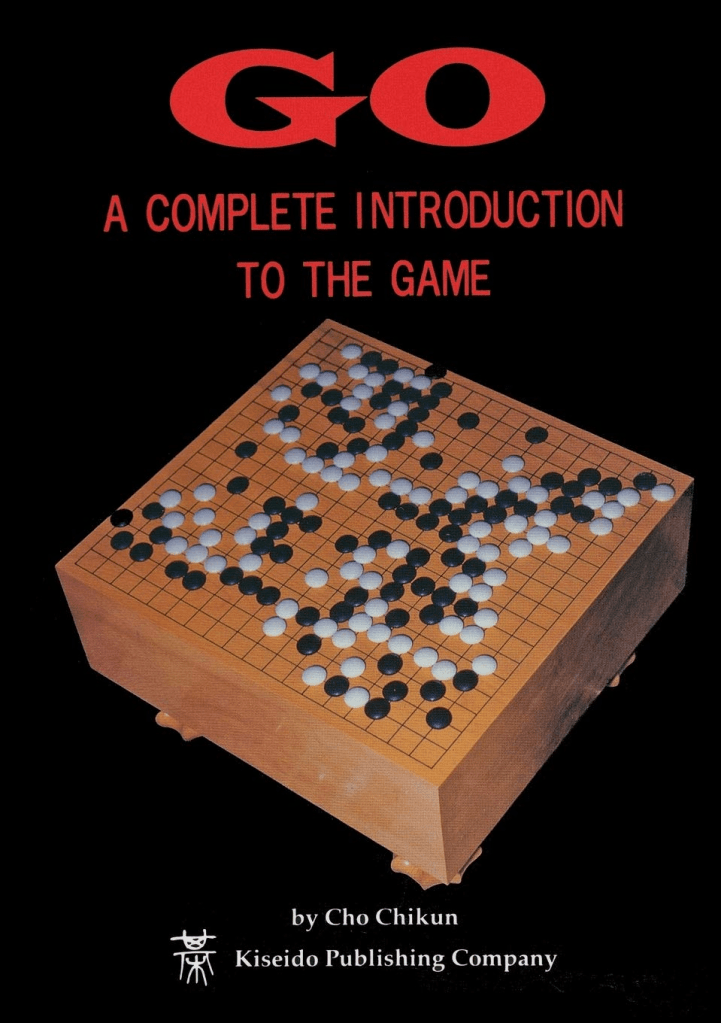
Go: A Complete Introduction to the Game

By Cho Chikun

As I was getting back into Go, I re-read this excellent beginner’s guide in the SmartGo app. Cho Chikun is one of the most famous professional players in modern times, and the Japanese player with the most titles.

This book deftly introduces all the important aspects of Go rules and basic strategy, while alternating chapters about the history and cultural significance of Go. It’s a perfect introduction to the game (or re-introduction, in my case).

Double Digit Kyu Games

By Neil Moffatt

Another book from my SmartGo library.

In amateur Go, players start at a rank of 30 kyu. As they improve, their rank decreases down to 1 kyu, then to 1 dan, and up to 7 dan. As you might expect, players with double digit kyu ranks are beginners and casual players.

While most books about Go are written by pro players for obvious reasons, Moffatt wrote this as a moderately high (1 kyu-ish) amateur. He’s close enough to still remember and understand why the players of these games make the mistakes they do.

Moffatt also goes into more detail than usual in explaining the merits and disadvantages of each move, often exploring various alternatives. They result is a set of thorough game deconstructions that are very useful aids for an amateur player to recognize their own shortcomings.

Lore Olympus, Vol. 1

By Rachel Smythe

I bought this on a whim while on vacation, mostly on the authority of a positive blurb by Kieran Gillian (of Die and other comics), and a brief skimming of the art. Unfortunately, this book was not for me.

I don’t read a lot of romance, but I’m not strictly opposed to the genre. This, however, was just too much irritating teenage angst and not enough mythology for my tastes. When the romance hinges on everybody being afraid to voice how they feel, and the conflict stems from people hating each other for basically no reason, I get bored.

As far as the art goes, the character work is nice, but these characters live in a world composed of colored smears. This lack of any background detail is something that seems to be more and more common in indie comics, and while I understand it, I do miss the crispness that you see more in high budget superhero comics.

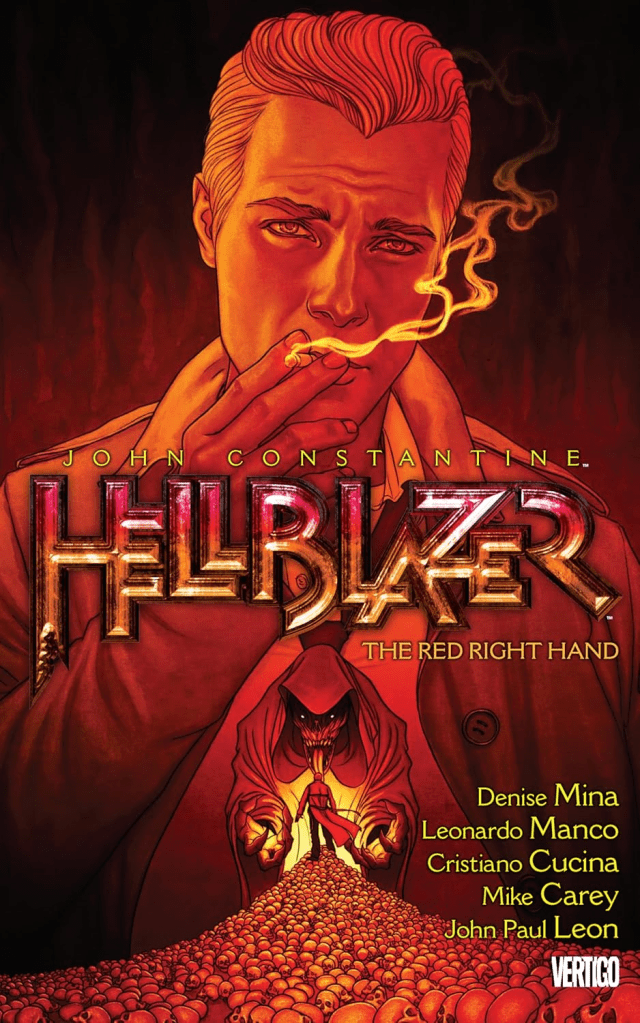
Hellblazer: The Red Right Hand

By Denise Mina and Mike Carey

Illustrated by Leonardo Manco, Cristiano Cucina, John Paul Leon

I do love me some John Constantine, but this collection wasn’t my favorite. There are two story arcs here: one where Constantine enters into a trap, and one where he gets out of it.

The typical Constantine story usually has a mystery twist, and this is no exception. Unfortunately, the twist didn’t shock me, it just made me shrug. Maybe if I were reading the series in sequence I would be better prepped as a reader.

It’s also not uncommon for Constantine to have some plan that only gets revealed when everything seems hopeless. Here, he doesn’t have much of a plan at all.

A collection of Constantine’s friends show up midway through, and it feels like deus ex machina, but even they don’t actually do very much. They muddle through, and the eventual resolution to the situation hardly feels like any of the characters had agency.

The last issue in this volume is a stand-alone one-off story, and it’s a classic, solid Hellblazer story. It made me a little sad that the rest of the book didn’t hold up as well.

Dissecting Influences — Sci-Fi From My Childhood

If you’ve been around here for a while, you might remember that my favorite writing podcast is Writing Excuses. In Episode 17.7, the team discussed dissecting your influences.

We all have stories we love, whether they be books, shows or movies. The idea of this episode was that it can be useful to take apart our favorite things and figure out why we like them, because it guides us toward things that matter to us. The themes and ideas that draw us to these works will often be fertile ground for our own writing. And while it may seem obvious that we all know exactly what we like in media, the truth is that we often leave those stones unturned. It might even be surprising to dig into what really brings us joy in a favorite movie or book.

After listening to this episode, I started compiling a list of my own favorite media. It wasn’t hard to start. In fact, it was hard to stop. The things closest to mind were mostly books I had read recently or old favorites that I’ve been re-reading with my kids. But I soon started to remember books from childhood, poetry, and even influences outside fiction altogether.

With this list in hand, and continuing to add to it, I thought it might be fun to dissect my own writer brain in public. I have to limit myself to a reasonable size for a blog post, so I’m going to pick a somewhat arbitrary classification to pull out a handful of entries.

The Grown-Up Sci-Fi of My Childhood

That’s right, it’s some of my first loves in science fiction, way back when I was still in school. The actual dates of publication vary quite a bit, from 1965 to 1994, and these are all novels aimed at adults. One of the things that drew me into these books was the faintly illicit idea that I, as a child, could read stories intended for grown-ups. It felt like a window into ideas and worlds I wasn’t yet allowed to enter. Going from “Choose Your Own Adventure” and Goosebumps to heady books like Dune is a real shock to the system.

On that note, let’s start with Herbert’s masterpiece.

Dune

Having read this book at least three times—and one of those times quite recently—I have a hard time going back to the headspace I was in when I read it originally. I think I was in high school, and I’m pretty sure the reason I started reading it was because I saw a mention of it where someone said it was as influential in science-fiction as Lord of the Rings was in fantasy.

I think Dune is a pretty great book for young people who are starting to get into science fiction. On the one hand, it reduces the many political and economic complexities of the far future into a feudal culture where the only thing that matters are the machinations of a handful of powerful factions. The protagonist, Paul, is a ducal heir with adult responsibilities, but he’s still not quite an adult. Interestingly, the whole feudal system and it’s quasi-European royalty end up falling apart by the end of the book, with young Paul engineering their downfall at the hands of colonized people.

I remember this book being interesting because it sets up a world where people and decisions hundreds of years previous can have profound and complicated effects on the present. It’s a world of complex, interrelated systems that nobody can completely understand, and even a single person putting a wrench in the gears in just the right way can totally change the universe.

I also genuinely love Paul’s relationship with his own psychic powers. He hates them. He is constantly vacillating between seeing the future and being unable to steer it, or losing that sight and the fear of not knowing. I don’t think I’ve ever read a book that handled that kind of power in quite the same way.

I have to at least mention the other books in the (original) Dune series. I read them all, although not right away. I don’t think any of them quite measure up to the original, but I appreciate how strange they are, and Herbert’s audacity in choosing to set them thousands of years apart in far-flung futures that are less and less similar to our own modern lives.

Ender’s Game

Another book with a child protagonist? Possibly a theme. Ender in this book is much younger than Paul is at the beginning of Dune, but he deals with some comparable drama. This is another book that I re-read recently with my kids.

This book was astounding in a few different ways. Firstly, while it’s not exactly dystopic fiction, it does depict a world where war with aliens has resulted in hardship for average people and a government with dictatorial power. We learn early on that Ender is special because he’s a “third.” In a world where the government limits how many children each couple can have, he is a rarity.

All of the main characters are children: Ender and his siblings, and all of the kids at the battle school. Parents and adults are present, but they have little time “on-screen.” Like the dictatorial government, they show up periodically and force some seemingly arbitrary and often cruel new rules onto the children, but it’s the children and their relationships that matter. This is a book that understands what it feels like to be a child, to feel like adults don’t give you all the information and many decisions are left completely out of your hands.

Ender is bred to be a soldier and a leader. He’s trained for it. He is subjected to insane cruelty, to the point where he ends up having to kill other children to defend himself, all because it’s part of the program. But the ultimate cruelty happens at the end of the book, when he discovers that the supposedly wise adults who forced this horrible life on him didn’t even understand the enemy that they trained him to kill. The entire war is nothing more than an interspecies miscommunication, and he finds out by accident.

And then he leaves. He finds the one person he loves and who loves him: his sister. They get on a spaceship and fly away. He leaves behind all the systems of abuse and control that defined his entire life. Maybe a metaphor for growing up.

The “Ender” series continues on. Speaker for the Dead, Xenocide, and Children of the Mind are all great books, but again I feel like the original is still the best. The series is similar to Dune in the way it jumps large spans of time in a wildly changing galaxy. The Dune series eventually had a bunch of new books written much later, by Herbert’s son. I heard they were terrible and I never read them. The “Ender” series, on the other hand, had more and more books still written by Orson Scott Card, but I got to the point where I just wasn’t that interested by yet another rehash of the same story from a different secondary character’s perspective.

Before we move on, it’s worth mentioning that I’m still disappointed that Orson Scott Card turned out to be a homophobe and the sort of person who politely states their deeply held and hateful beliefs. Card was one of my early writing heroes, and I still hold his books on writing in high esteem, but as a person, he really bums me out. He kind of did the whole “J.K. Rowling” thing before Rowling.

The Uplift Saga

While the above two entries are the first (and I would argue, most important) books in a series, David Brin’s “Uplift” books are inseparable in my mind. There are six of them, in a pair of trilogies:

  • Sundiver
  • Startide Rising
  • The Uplift War

…and…

  • Heaven’s Reach
  • Brightness Reef
  • Infinity’s Shore

I suspect this series might be the most influential set of books in my childhood, but I came at them in a very weird way. I’m honestly not sure if I even remember it correctly. I know I read them out of order, because I bought one of these books at a garage sale, completely unaware that it was part of a series. I can’t be sure, but I think it was The Uplift War, the third book in the first trilogy.

That might sound a little insane to some readers, but it’s something I did multiple times as a kid. I even read through the fifth book in a series once, and didn’t realize it was part of a series until the ending completely failed to resolve the plot. One of the crazy things about being a child is that the world makes no sense. Every time you open a “grown-up” book, it’s like being transported into a completely new universe. Of course it’s confusing. Everything is confusing when you’re a child. It’s the ultimate introduction to the concept of “in media res.”

While Dune imagines a sci-fi future with no aliens whatsoever, and Ender’s Game has only the buggers, who seem to be mindless insectoid killing machines, the Uplift books are absolutely chockablock with all sorts of aliens. They are not your usual little green men. They are crabby things with 360° vision or energy creatures that live in the corona of the sun. They are varied and logical for the environment they came from.

The Uplift books depict a humanity that has just made contact with a galaxy full of aliens. There is a galactic culture. It is full of aliens who are much more advanced and powerful than humans, and we are forced to very abruptly change our own assessment of how awesome we are.

Humanity has started the process of advancing the intelligence of chimpanzees, dogs, gorillas and dolphins through genetic manipulation and technology. It turns out this is a pretty damn important concept to all the aliens, who call it “Uplift.” In fact, it’s the glue that binds all these different cultures together, as the uplifted races are forced into millennia-long servitude to the race that gave them the gift of sentience, and the races providing “Uplift” have a higher social position. Of course, the top dogs of the galaxy aren’t excited to see the newcomers, humanity, get that kind of respect, let alone the servitude of multiple freshly uplifted species.

Again, we have a fictional world that is too big for its characters. Hell, even the entire human race (and super-dogs/chimps/gorillas) is just trying to keep from drowning in a galaxy where almost everything is out of their control. I think, as a child, I was fascinated by the idea that everything we know and have ever known on planet Earth might be utterly inconsequential in the wider universe.

Overtime?

I have to admit, when I started writing this article I thought I might not have that much to say. Now I’m almost 2,000 words into this, everyone has probably stopped reading, and I only made it through half the books I intended.

I’m going to call it here. I found this to be a really fun exercise, but I’m curious if anyone else will be interested. I got more out of it than I thought I would, not the least of which is the desire to go and re-read the entire Uplift series. If anyone enjoys this, I might make it a regular feature. I have a lot of books, shows, and movies on my list.

Learning from Great Hooks

The “hook” is the opening of a story: the handful of sentences where a reader is willing to completely suspend judgement and open themselves up to a new world. It’s called a hook because it’s the author’s opportunity to reel the reader in. To grab hold of them and refuse to let them go until the story is done.

Hooks are among the most daunting things to write. A hook needs to pull the reader in, but it’s also a promise of what’s to come. If the hook captures the reader’s interest, but does it in a way that’s at-odds with the rest of the story, it will feel like a betrayal. A bait-and-switch.

Today, I want to look at hooks from a few books I like and see what I can learn from them. How are they structured? As a reader, how do these introductory sentences pull me in? What do they promise about the story to come?

Travel Light, by Naomi Mitchison

It is said that when the new Queen saw the old Queen’s baby daughter, she told the King that the brat must be got rid of at once. And the King, who by now had almost forgotten the old Queen and had scarcely looked at the baby, agreed and thought no more about it. And that would have been the end of that baby girl, but that her nurse, Matulli, came to hear of it. Now this nurse was from Finmark, and, like many another from thereabouts, was apt to take on the shape of an animal from time to time. So she turned herself into a black bear then and there, and picked up the baby in her mouth, blanket and all, and growled her way out of the Bower at the back of the King’s hall, and padded out through the light spring snow that had melted already hear the hall, and through the birch woods and the pine woods into the deep dark woods where the rest of the bears were waking up from their winter sleep.

This lovely rush of words is only five sentences. Most of them start with conjunctions, making it feel like one long, breathless run. So much is happening.

It’s clear from the first few words that this is going to be a fairy tale, and that’s further confirmed when we see that being able to turn into an animal is treated as no particularly impressive feat. We can also tell that this is no light and fluffy fairy tale. It begins with the almost casual cruelty of the king and queen.

This opening also makes it clear that this girl is the protagonist, and she will not be living a normal life. In this single paragraph, we see her lose her birthright, saved by a bear-woman and brought to live in the woods. It’s hard not to be curious about what will happen next.

The Truth is a Cave in the Black Mountains, by Neil Gaiman

You ask me if I can forgive myself? I can forgive myself for many things. For where I left him. For what I did. But I will not forgive myself for the year that I hated my daughter, when I believed her to have run away, perhaps to the city. During that year I forbade her name to be mentioned, and if her name entered my prayers when I prayed, it was to ask that she would one day learn the meaning of what she had done, of the dishonour that she had brought to my family, of the red that ringed her mother’s eyes.

I hate myself for that, and nothing will ease that, not even what happened that night, on the side of the mountain.

This opening starts in the second person, drawing the reader in by including them in what seems to be conversation in progress. A conversation with us.

We start with a few fragmented sentences, already waist-deep in mysteries. Where did you leave him? Who is he? What did you do? The daughter clearly didn’t run away to the city, so what happened to her?

The viewpoint character is already being defined here. He’s someone with strong emotions – a fierce temper that more or less caused him to disown his daughter, and his shame when he discovers this still unexplained truth of what really happened to her.

Ender’s Game, by Orson Scott Card

“I’ve watched through his eyes, I’ve listened through his ears, and I tell you he’s the one. Or at least as close as we’re going to get.”

“That’s what you said about the brother.”

“The brother tested out impossible. For other reasons. Nothing to do with his ability.”

“Same with the sister. And there are doubts about him. He’s too malleable. Too willing to submerge himself in someone else’s will.”

“Not if the other person is his enemy.”

“So what do we do? Surround him with enemies all the time?”

“If we have to.”

“I thought you said you liked this kid.”

“If the buggers get him, they’ll make me look like his favorite uncle.”

“All right. We’re saving the world, after all. Take him.”

Starting with dialogue puts us in the action immediately. It also tells us that whoever these two disembodied voices are talking about is probably important to the story. Dialogue like this, without tags attributing it to a character, is a dangerous choice because it can be disorienting to the reader. In this case, it works because we don’t have to care about these two speakers, only the information they’re conveying really matters.

The first sentence sounds like standard Messiah fare, but it’s immediately subverted. We understand that the target of this discussion is being observed and tested (in a very invasive way), and his brother and sister were subjected to this treatment as well. These voices are willing to be cruel to him if it’s required to make him into this messianic figure and save the world. The stakes of the story are already being established on the first page.

There is a little mystery here as well. What are the buggers, and why does the world need to be saved?

The Hitchhiker’s Guide to the Galaxy, by Douglas Adams

Far out in the uncharted backwaters of the unfashionable end of the Western Spiral arm of the Galaxy lies a small unregarded yellow sun.

Orbiting this at a distance of roughly ninety-eight million miles is an utterly insignificant little blue-green planet whose ape-descended life forms are so amazingly primitive that they still think digital watches are a pretty neat idea.

This planet has — or rather had — a problem, which was this: most of the people living on it were unhappy for pretty much of the time. Many solutions were suggested for this problem, but most of these were largely concerned with the movements of small green pieces of paper, which is odd because on the whole it wasn’t the small green pieces of paper that were unhappy.

It goes on like this for another page and a half of prologue, which meanders right into the first chapter. I found it hard to pick a cut-off point.

To me, this is the most interesting example we’ll look at today. It doesn’t introduce any of the main characters, or anything about the situation or setting (beyond Earth in general).

It does tell us that it’s science fiction, it’s not going to take itself seriously, and it’s going to be looking at everything from a rather skewed and unexpected viewpoint. In fact, what it’s really introducing is the the author’s incredibly distinctive voice and tone. If you’ve read Douglas Adams, you’ll know that his narrative voice is almost a character in its own right (even if it isn’t from an actual character’s perspective). This series includes plenty of chapter-length digressions and asides, and is undoubtedly better for it.

In short, the story can afford to wait a bit, because it’s so damn entertaining to just listen to what Adams has to say.

Give it a Try!

I’d encourage every writer to do this exercise with some favorite books. One of the wonderful things you’ll discover is the sheer variety of forms that a hook can take. You don’t need to feel forced into a formula — there are a plethora of ways to pull readers into a story. By analyzing the hooks of stories you love, you might discover some great ideas you can apply to your own stories.